Showing posts with label 1890s. Show all posts

Monday, March 18, 2019

107. 16 OLD NAMES OF PAMPANGA TOWNS


The early Kapampangan settlements as found by Spaniards, and the early pueblos that they organized were known by ancient, local names---far different from the names of today’s modern municipalities and cities. Either derived from plants and trees, or from their distinctive natural features and location, many of these names are hardly remembered by young Kapampangans today.
**********

1. CANDAUE (Candaba)
Candaba originally had an older variant name—Candaue, Candawe—which refers to a place where the municipal cemetery is now located. In old maps, the ancient settlement was marked as “Candave”, “Candava”, and eventually localized to “Candaba”. Already a rich settlement in 1571, it also has one of the oldest barrios in the province—Mandasig—founded by Mandic, the wife and first cousin of Malangsic, one of the children of Prince Balagtas, as related in the 1539 will of Pansomun.


2. PÚRAC (Porac)
“Púrac”or “Pórag” was how the name of Porac was pronounced in the 1850s. “Púrac” was a flowering rattan plant (Calamus curag) which must have grown and proliferated in the area, now known as Porac.


3. BACULUD (Bacolor)
The town known for its people of arts, literature and culture was called “Baculud”, from the word “macabaculud”, an upland surrounded by low-lying lands—which refers to Lubao.  Its name has the same etymological origin as the city of Bacolod.  Founded in 1571, “Bacolor” is the Hispanic name of this former capital of Pampanga.


4. BALAYAN NING PAMBUÍT (Arayat)
Before the coming of the Spaniards, the town was called by its ancient name “Balayan ning Pambuit”, then located at barrio Palinlang (or Paglinglang), as the  poblacion was still forested. In vernacular, the place was originally called “dayat”, which means ‘an irrigated riceland or seedbed. Its most visible landmark is Bunduk Alaya (from ‘paralaya”, thus,  eastern mountain).


5. MASICÚ (Mexico)
Before it was christened as Mexico in 1577, the place was called “Masicu”—and pronounced that way-- which may been derived from the “síko fruits” (chicos) that supposedly grew in the area, hence, “ma-sicu”. Another version had it that the town was “elbowing other towns”—hence, “macasicu”. In any case, the name was Romanized to “Mexico”, before the replacement of ‘X” with “J”, after the 19th century.


6. WAWÂ (Guagua)
The ancient prosperous town was originally called in “Wawâ”, which means “the mouth of a river”, based on its location. The spelling was Hispanized into “Guagua”in 1590, in much the same way that the “wa” of Palawan was written in old Spanish maps as “Paragua”.


7. PINPÍN (Santa Ana)
The ancient name of Santa Ana is “Pinpin” (variations: Pimping, Pingping, Pimpin) after an important person who may have lived during the time of Malangsíc. It was then placed under the advocation of Santa Ana when the Spaniards came, a name the town adopted.


8. BABÂ (Lubao)
“Babâ” is Kapampangan for “low”, in contrast to “baculud”. “Lubao” or “tubao”, is an extinct word meaning “to arise, or emerge, or float from water” (its modern form is the dipthong “gatao” or “gato”, to float) . “Babâ Lubao” thus means “to rise from the low depths of the water”. Old residents still refer to themselves as “tau cu Babâ”.


9. SANTA RITA DE LELE (Santa Rita)
As a neighbor of the major town of Bacolor to where residents would go for their daily marketing and commercial transactions, the town was known as “Sta. Rita de Lele”.  It was also called “Sta. Rita Baculud”.


10. SASMOAN (Sexmoan)
Sasmuan was written on maps for over a century as “Sexmoan”, the Spanish transcription of the old town’s name, until 1991, when it reverted back to its vernacular version—Sasmuan. “Sasmoan” means “a place of convergence”, a meeting place where Kapampangans met when they were waging war with the Chinese. The sexual connotation of Sexmoan in English prompted the municipal government to return to the old name.


11. CABAGSÁC (San Luis)
“Cabagsác” was the former name of the town of San Luis, a contraction of “cabág bagsac” , or “bagsácan cabag”, which means “ a drop-off place of  fruit bats”. The name was extended to “San Nicolas Cabagsác”, to honor its Spanish Augustinian priest, Fray Nicolas de Orduño.


12. VIRGEN DEL PILAR (San Simon)
Tradition has it that the former name of an Simon town was “Virgen del Pilar”, its titular patroness whose fiesta is celebrated every October 12. It is also to honor the memory of its founder, Mariano del Pilar.


13. BALIWAG (Santo Tomas)
The traditional name of Santo Tomas is “Baliwag”, a new town in 1773. It is derived from the term “maliwag”,someone prone to habitual tardiness. It was rechristend Santo Tomas in 1792.


14. CULIÁT (Angeles)
The town was inaugurated in 1829, and was given two names by its founder, Don Angel Pantaleon de Miranda: ‘Culiat’, a woody vine (Gnetum indicum Lour.) that grew in abundance in the area cleared by his tenants and future residents of the place. Another name given was “Angeles” in honor of the ‘Los Santos Angeles Custodios” (Holy Guardian Angels), titular patrons of the town, and of the founder himself. Only oldtimers use Culiat nowadays; to modern-day residents, Angeles is preferred, as it has a more cosmopolitan ring for a city.
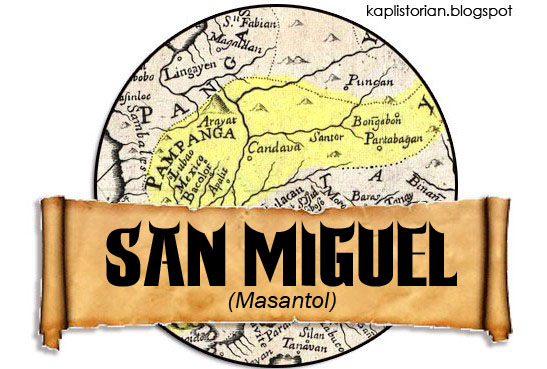

15. SAN MIGUEL (Masantol)
Masantol used to be a barrio of Macabebe, as recorded in the 1853 census. It was known as San Miguel, formed from the Macabebe barrios of Bebe, Bulacus, Caingin and Nigui sometime in 1877 or 1878. It was renamed Masantol, meaning  “a place full of santol (Sandoricum koetjape Merr.) fruit trees” after 1903.


16. CAUMPAUI (Floridablanca)
Before the town was named either after the count of Floridablanca, Jose Moniño (1728-1803) or the white pandacaqui flower, there was a certain place called “Caumpaui” existing in the area in 1847, that was established earlier by Spanish missionaries as a “hacienda” and administered from Lubao. It was transferred to the new town in 1867. Floridablanca is considered as Pampanga’s youngest town,

SOURCE:
Henson, Mariano. The Province of Pampanga and its Towns(A.D.1300-1962)

Tuesday, October 9, 2018

96. 18 NOTABLE KAPAMPANGAN DOCTORS BORN BEFORE 1900, part II


DR. LIBORIO P. GOMEZ, Sto. Tomas
(b. 23 Jul. 1887/ d.1958 )
Born to Magdaleno and Catalina Pineda, the future pathologist, medical educator, and scientist has an impressive background. As a pensionado in 1903, he was sent to the U.S. to study at Pomona College, University of Missouri,  From there, he earned a doctorate degree of Philosophy in  Pathology and Physiology at the University of Chicago, and a medical degree from the Rush Medical College. At the Bureau of Science, he studied Bacteriology for 7 years, and his expertise enabled him to become the Head of the Department of Pathology and Bacteriology of the said bureau. In 1953,  he was coaced from retirement to help establish the Dept. of Pathology and Microbiology of the newly-organized medical school,  FEU-Dr. Nicanor Reyes Medical Foundation.  Dr. Gomez headed this department as its chairman and professor until his death.


DR. JULIAN D. DYCAICO, Angeles
(b. 17 Oct. 1888/ d. 11 Mar. 1965 )
The noted physician-surgeon of Angeles was the son of Jose and Rufina Dayrit. He studied at the Philippine Normal School (1906-09), and at the UP College of Liberal Arts ( 1909-11). He went on to earn his Doctor of Medicine degree at the U.P. College of Medicine and Surgery in 1914. After his internship at the Philippine general Hospital, he went into private practice in 1915. Dr. Dycaico was elected councilor of Angeles, and was  connected with the beginnings of Holy Angel Academy in 1933,as its first school physician and comptroller.


DR. RUFINO ABRIOL, Arayat
(b. 7 Apr. 1890/ d. 19? )
Dr. Abriol holds the distinction of being elected President of the Philippine Islands Medical Association (1935-36) and Chairman of the Board of Examiners, in his time. The U.P.-educated doctor also became a Fellow of the American Medical Society, as well as a member of both Manila and Pampanga Medical Association. Dr. Abriol garnered the highest rating for the Medical Board Examination in 19 13. He went to Johns Hopkins University for further studies in Public Health. Dr. Abriol, married to Rosa Reyes, was also a member of the faculty of Medicine, University of the Philippines.


DR. BASILIO J.VALDES, Floridablanca
(b. 10 July 1892/d. 26 Jan. 1970)
Though he resided mostly in Manila, Basilio José Segundo Pica Valdés was born in the Floridablanca hacienda of his father, Dr. Benito Salvador Valdes, who was married to Filomena Pica. Influenced by his father, he took up Medicine at the University of Santo Tomas and graduated with honors in 1916. Immediately, he plunged headlong into medical service, treating all his patients with respect and fairness, and adapting a personal motto—“Audaces Fortuna Juvat”—Fortune helps the brave. He joined the French Army as a medical volunteer, followed by a stint at the U.S. Army as a surgeon from 1917-1919. When he returned to the Philippines, he became a medical inspector for the Philippine Constabulary for 8 years (1926-1934). Pres. Manuel L. Quezon appointed him as Chief of Staff of the Philippine Constabulary and Philippine Army in 1939, elevating his rank to a general (he would rise to become a Brigadier General). Two years later, Basilio was appointed as Secretary of National Defense. During the Japanese period, he served under Pres. Jose P. Laurel as Secretary of Public Works. In the 1950s, he headed the family’s Hacienda del Carmen in Floridablanca, Pampanga, which is now known as barrio Valdes.


DR. WENCESLAO B. VITUG, Lubao
(b. 28 Sep. 1892/d. 7 Jan. 1986)
The son of Esteban and Juana Beltran, thefutur doctor went to local schools in Lubao and San Fernando, and finished at Pampanga High School. He earned his medical degree from the University of the Philippines in 1918, where he also taught after. He became a visiting physician of the Philippine General Hospital, where his expertise and skill became very much known. This was how the doctor met his future wife, Juanita Arrastia, Miss Pampanga of 1926, who accompanied her mother to PGH for her check-up, and who happened to be Dr. Vitug’s patient. The couple settled in Lubao, had 5 children, and became hacenderos. The Vitugs eventually moved to Manila.


DR. DALMACIO SONGCO, Guagua
(B.24 Sep. 1895/ d.19 ?)
Dr. Songco spent 4 years at the Escuela de Bellas Artes, then moved to the University of Santo Tomas for his medical degree which he finished in 1926. His education was paid for by Bulaqueño philanthropist, Dr. Felix de Leon. The artist-doctor made news when his exhibits at the Pampanga pavilion during the 1920 Manila Carnival were seized by the police. His framed artworks—which showed paintings of Philippine paper currency from one pesos to 500 pesos—were deemed as counterfeit.  Through the intercession of Gov. Honorio Ventura and Don Pablo Angeles David, all charges were dropped against Dr. Songco. During the great Philippine cholera epidemic of 1926, he volunteered to help at the San Lazaro Hospital. He also had a stint at the San Juan de Dios Hospital., eventually serving as president of the Sanitary Divisions of Cebu and Bataan. Dr. Songco married Julia Sanchez of Porac in 1917.


DR. RAFAEL L.  TEOPACO, San Fernando
(b. 24 Oct. 1896/d. ?)
The son of Jose and Albina Limjuco, the distinguished doctor began his early studies at the San Fernando Elementary School, then enrolled at the National University and the University of the Philippines. He took his internship at the Loyola University, training at the St. Mar Hospital, Chicago. From there, he visited the leading clinics of Europe. He placed 3rd at the medical board exams ( 86% ) in 1928, and also placed 3rd in the exams for Senior Surgeons (83%). Dr. Teopaco served at the Bontoc Provincial Hospital (1928), Baguio Hospital (1929), and as Director of the Pampanga Provincial Hospital in 1931. He is married to Demetria Genuino.


DR. CASTOR T. SURLA, Angeles
(b. 26 Mar. 1897/ d. ?)
Betis-born Surla, whose parents were Castor Sr. and Paula Tizon, relocated to Angeles for his schooling and stayed there permanently. He finished medicine at the University of Sto. Tomas in 1918, and took his residency at the San Juan de Dios Hospital. He likewise taught at the Escuela de Enfermeras in 1919 and headed the Ntra. Sra. Del Pilar Hospital in Zamboanga until 1920. In 1921, he became a longtime instructor at his alma mater, UST, teaching abdominal surgery and genito-urinary diseases.


DR. EMIGDIO C. CRUZ, Arayat
(b. 5 Aug. 1898-d. 1978)
Emigdio was born from the union of Jacinto Cruz, a Malabon rice trader and Andrea Castor, a Portuguese-Filipina from Candaba. His father, an ‘herbolario’ in Arayat, encouraged his children to take up science courses.  Indeed, 3 sons (Emigdio, Vicente and Cecilio) would become doctors. Emigdio himself, went to U.P., finishing Medicine only in 1929, at a rather late age of 31. After becoming one of the board topnotchers, he practiced in Arayat where he would meet his wife, Restituta Roque. Dr. Cruz is credited as the founder of Arayat General Hospital which he would serve as its medical director from 1935-38. He joined the Army and became a Captain of the Medical Corps in 1939.  As a result, he became Pres. Quezon's personal physician, whom he joined in exile in the U.S., until the president’s death. In 1946, he returned to the country with the Quezon family. Dr. Cruz is the recipient of the Philippine Congressional Medal of Valor and Distinguished Service Cross for his valiant WWII underground work.


Wednesday, October 3, 2018

95. 18 NOTABLE KAPAMPANGAN DOCTORS BORN BEFORE 1900, part I

The list of Kapampangan doctors of distinction is long, so we cover first those born at the turn of the 19th century. Their legacies of service to humankind through their medical expertise,  skills,  involvement in community and national affairs plus their personal qualities, are still remembered by a grateful province today. Here are the first 9: 

**********

DR. FRANCISCO T. LIONGSON, Bacolor
(b. 3 Dec. 1869/d. 20 Feb. 1919)
The doctor who would go on to become a Pampanga governor and the first Kapampangan senator was born to Emigdio Liongson and Eulalia Tongio. After earning his Bachelor of Arts from Letran, he sailed to Spain in 1889 to study medicine at the Universidad Central de Madrid,. There, he obtained his degree in Medicine and Surgery 1894, and his doctorate the next year. He further trained in different Paris hospitals like the renowned Pasteur Institute. Exposed to Filipino propagandists in Spain, he began to take interest in the country’s current state and future. He returned to the Philippines with his Spanish wife, Ma. Doloroes Alonso in late 1895.  When the Revolution broke, Dr. Liongson  joined the Katipunan as a doctor with the rank of a captain. With the coming of Americans, he continued his fight for the country, becoming one of the founding fathers of the Nacionalista Party. In 1912, he ran for the governorship of Pampanga and won. His term was marked with peace and prosperity. The highlight of his political career was his election as the first Kapampangan senator in 1916.


DR. GREGORIO T.  SIÑGIAN, San Fernando
(b. 9 May 1872/d. 29 Jan. 1937 )
Born to Cristino and Angela Torres, the young Gregorio went to a private school in San Fernando, then finished high school at Colegio de San Juan de Letran. He took up Medicine at the University of Sto. Tomas in March 1896. In 1907, Dr. Singian was appointed as the first Filipino associate professor of surgery in the Philippine Medical School, which later became the U.P. College of Medicine. He gained renown as a surgeon, so much so that he was known as “mago de bisturi” (wizard of the scalpel), earning him the title of “Father of Philippine Surgery”.  He became the Director of the San Juan de Dios Hospital in 1920 and founded the Philippine College of Surgeons in 1936.


DR. VICENTE H. PANLILIO, Mexico
(b. 19 Jul. 1872/d.19 ?)
The Letran graduate, son of Antonio and Luisa Hizon, proceeded to the University of Sto. Tomas to pursue Medicine which he finished in 1895. The next year,  he went to Barcelona, Spain for advanced studies. He finished his doctorate in Medicine in 1901. Returning to the Philippines in 1902, he put up a private practice in Mexico where he became the town’s ‘doctor de sanidad’.  Dr. Panlilio moved to San Fernando permanently in 1906, and became a physician for the Manila Railroad Co. until 1925. He also forayed into business and politics, becoming a director of PASUDECO as well as a  2-term councilor of the capital town. He married the patriot Nicolas Dayrit.


DR. JACOBO P. FAJARDO, Bacolor
(b. 25 July 1876/d. 23 July 1941)
This distinguished physician, surgeon and public health pioneer was born to Justino and Andrea Puno of Bacolor. After the Revolution where he served as aide-de-camp to Gen. Emilio Aguinaldo, he went to the University of Santo Tomas where he finished a degree in medicine in 1905.  While still in school, he married Antonio Jacinto in 1900. He served as president of the Municipal Board of Health of Arayat, Pampanga, then assigned to assigned to Negros Oriental, Pangasinan and Mindanao as district health officer. As deputy in the Philippine Assembly (1909-12),  he authored the Fajardo Bill in 1912, that was the basis for the organization and efficient administration of public health services in the country. Dr. Fajardo was appointed Director of Bureau of Health (now DOH) in 1924. He was the first Filipino doctor to receive a Rockefeller grant that allowed him to travel to the USA and Europe, as part of his public health research.


DR. FELINO D. SIMPAO, Guagua
(b. 1 Jun. 1880/ d. 1954)
Born to Serapio and Epifania del Rosario, Dr. Simpao was schooled in Letran in 1896, and proceeded to the U.P., and then to Asilo de Huerfanos in Malabon in 1898. During the Revolution, he served as 1st lieutenant of Gen. Tomas Mascardo.  After the war, he enrolled at UST for his medical licentiate in 1909. As a doctor, he joined the Bureau of Sanitation, and appointed medico provincial of La Union, Pangasinan, Leyte (where he founded its provincial hospital), Cavite and Sorsogon. He also worked as a volunteer doctor at the San Lazaro Hospital during the cholera epidemic in Manila. The multi-facetted physician, who was also a poet-playwright,  wrote for several papers like “E Mangabiran”, “Ing Balen”, “Ing Catimawan”, “El Ideal” and “El Renacimiento”. From 1910-12, Dr. Simpao served as the Mayor of Guagua. During his term, the school central, the market, and the Pampanga Pavilion for the 1909 Manila Carnival were all built under his supervision. He was one of the founders of Pampanga’s Nacionalista Party. Dr. Simpao  ran for the governorship of Pampanga but was beaten by another doctor--Francisco Liongson.


DR. CLEMENTE N. PUNO, Bacolor
(b. 23 Nov. 1881/ d.19? )
The child of Eugenio and Patricia Nuqui, he went to Colegio de Letran for his high school years (1895-98), and then to the University of Sto. Tomas (1901-05) for his medical course. Dr. Puno had his own private practice in Candaba and Guagua, and became the president of the Sanitary Division of Guagua, Bacolor and Sta. Rita. Married to Beatriz Concepcion, Dr. Puno was a member of the Colegio Medico Farmaceutico de Filipinas and the Pampanga Medical Association.


DR. FERNANDO S, GONZALEZ, Apalit
(b. 6 Nov. 1884/d. 19? )
This medico cirujano from Apalit, born to Joaquin and Florencia Sioco, attended Letran before enrolling at the Colegio de Farmacia y Medicina, of the UST from 1901-07. He taught English, Physiology and Hygiene at the Instituto de Burgos in 1907. He then practiced in Candaba until 1914, before joining the government service beginning in 1914 to 1928.  During this period, he became the district health officer of San Luis, Candaba, Arayat, Apalit and San Simon. He was also assigned in La Union, the  Rizal, Cavite and Bataan. Dr. Gonzalez then returned to serve Pampanga from 1919-1927.  He is also an active member of several associations of scientific history in America and the Philippines.


DR. GERVACIO SANTOS CUYUGAN, San Fernando
(b. 19 June 1886/ d. 1 Jun. 1968)
Dr. Gervacio Santos-Cuyugan, born to Florencio and Juana Cuyugan, became a U.S. government scholar after his studies at Liceo de Manila. As a pensionado, he and hs contemporary, Jose Abad Santos, was sent to the University of Illinois to take up Medicine from 1905-1910. Upon his return, he started as a Junior Health Inspector at the Bureau of health in 1911, and worked his way up to become a Senior Surgeon at the Philippine General Hospital. In 1913, he taught Surgery at the University of the Philippines. In 1918, Dr. Santos-Cuyugan became a Major and Adjutant of the Surgeon General of the National Guard. The next year, he went into private practice after his marriage to Jacinta Belza. He was later appointed Director of the Tayabas General Hospital. His daughter is  the opera singer, Fides Cuyugan.


DR. ABELARDO O. LANSANG, Sta. Rita
(b. 9 Jul. 1887/ d. 19? )
The young Abelardo was sent to the Ateneo de Manila by his parents, Arcadio and Manuela Ocampo, where he earned a Bachelor of Arts degree in 1901.  He finished Medicine at the University of Sto. Tomas in 1914, went into private practice, then became a resident physician at SanJuan de Dios Hospital from 1921-25. Dr. Lansang dabbled in politics and was elected as a town councilor. His wife, Efigenia Lansang, bore him 5 children.

SOURCES:
NINU'T NINU QNG CAPAMPANGAN, 1934, Fajardo & Kabigting
www.viewsfromthpampang.blogspot.com

Thursday, April 26, 2018

79. 10 KAPAMPANGAN PORTRAITS PAINTED BY SIMON FLORES


The wish to be remembered after one is gone is only human. People live on, in the stories we conjure as we view portraits. Through their faces, expressions, finery and pose---we see people as the artists saw them. 

In Pampanga, there was no lack of portrait sitters as the numerous members of the landed gentry sought the services of itinerant artists. The most prominent name is Manila –born Simon Flores de la Rosa (1839), who settled in Bacolor and made the rounds of Kapampangan towns, and a handful of his portraits form part of his legacy.

*************
QUIASON FAMILY (San Fernando)
Two Flores portraits of the Quiason Family of San Fernando, headed by Cirilo Cunanan Quiason are still existence today. Cirilo  and his 2 brothers, Lucio and Pablo, were successful landowners and traders, and each one commissioned Flores to create family portraits. The first painting depicts him, at age 33 and his wife Severina David Henson along with  their two children painted in 1875. The artwork costs 50 pesos per head, in gold coins,  for a total of 200 pesos. The seated baby is named Jose.  The older child holding a prayer book is Aureo. The seated baby, Jose, was originally painted naked. He was teased about this when he grew up, so he burned the part that showed his genitals. The painting has been restored since.

The second painting shows the expanded family, painted after 1875. They would have 9 children in all. Ceferina became a widow after Cirilo was accused by the town friar of engaging in seditious acts. The friar, who had romantic designs on his daughter Rosaruo, was rebuffed by Cirilo, who was then captured and tortured.


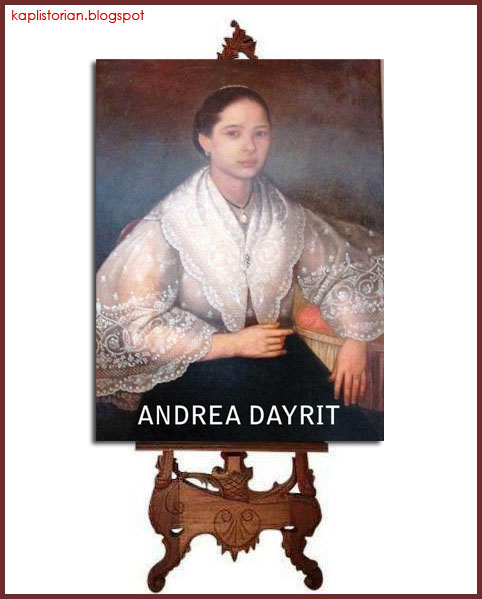
ANDREA DAYRIT (Sta. Ana)
In the town of Sta. Ana, Flores painted the pretty Andrea Dayrit. Her portrait hung in the 1840s Dizon house, famous in its time for its late Neoclassical and English Regency architectural details. Portrait of Andrea Dayrit by Simon Flores, circa 1870s, Oil on canvas, 81 X 58 cm.


MIGUELA HENSON (Mexico)
Mexico has a couple of Flores portraits, and the most well-known is that of long-haired Miguela Henson in front of her Isabelina-style dresser.  It is now in the Bangko Sentral ng Pilipinas collection. Ca. 1880s.


MSGR. IGNACIO TAMBUNGUI (Bacolor)
Flores, who settled in San Vicente in Bacolor, also painted portraits of his wife, Simplicia Tambungui, originally from Guagua, but no work survived.However, in 1890, he painted a portrait of his brother Monsignor Ignacio Pineda Tambungui ,  a canon of the Manila Cathedral and a chaplain at the San Juan de Dios Hospital. In return, Msgr. Tambungui gave his brother-in-law church decorating-commissions in Pampanga towns.


DON JOSE LEON SANTOS (Bacolor)
Bacolor’s most influential couple in the 1850s also sat for Flores.  Don Jose Leon y Santos was one of the sons of gobernadorcillo Francisco Paula de los Santos, Gobernadorcillo and Doña Luisa Gonzaga de Leon. Jose Leon Santos became the gobernadorcillo of Bacolor in 1857. The oil portrait of him was done in August 1887 when he was 59 years old.


DOÑA RAMONA JOVEN (Bacolor)
Don Jose Leon y Santos was first married to Arcadia Joven y Suarez. Upon her death, Leon Santos wed her sister, Ramona Joven. Her portrait was completed in August 1882.  Both paintings now hang at the Museo de La Salle.


OLEGARIO RODRIGUEZ (Bacolor)
One of the earliest known works of  Flores, dates from 1862,--when he was just 23. It is that of Don Olegario Rodriguez (1806/1874), patriarch of the still-flourishing Rodriguez clan of Bacolor, when the subject was “56 anos.”  Rodriguez is shown wearing the European black coat with tails, embroidered “nipis” shirt of “pina”, and trousers of a “principalia,” seated on an armchair. Until Pinatubo of 1991, it used to hang in the sala of his ancestral house but has since been secured by Rodriguez descendants in Manila.


SEVERINA OCAMPO DE ARROYO
In Candaba, Flores painted portraits of two matrons, both from the affluent landowning class. The first portrait is that of  Severina Ocampo de Arroyo, noted for her serious, icy stare. A virina-encased ivory santo is shown beside her. ca. 1885.


QUINTINA CASTOR DE SADIE (Candaba)
Another portrait done of a rich lady of the house is that of hefty Quintina Castor de Sadie, nicknamed “Fat Woman from Candaba.” The two Candaba portraits were formerly owned by banker Manuel Martinez Dizon, which he later sold to the Bangko Sentral ng Pilipinas in the 1980s.  


SOURCES:
Msgr. Ignacio Tambungui: Kasaysayan

Saturday, November 18, 2017

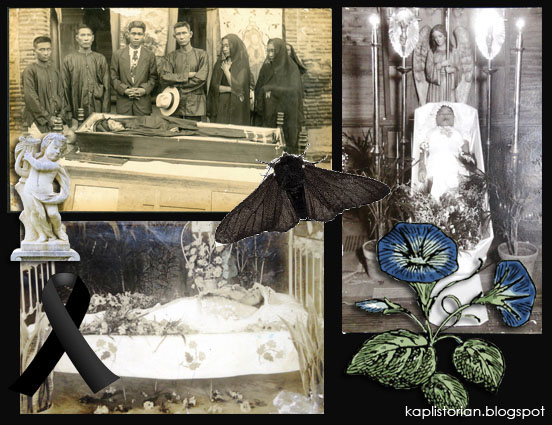
66. 20 FUNERAL TRADITIONS & PRACTICES THAT KAPAMPANGANS OBSERVE

All Saints’ Day (Todos Los Santos on Nov. 1) and All Souls Day (Nov. 2) used to be 2 distinct observances until somehow, they merged as one. When campo santos (cemeteries) began being built outside of the town, folks found it convenient to divide their pious duties: Nov. 1 was devoted to grave visits while Nov. 2 was reserved for church rites. Death came early for Filipinos in the 19th century; life expectancy was just about 35 years. Life, was indeed precious, which was why, death was considered major rite of passage, with traditional ceremonies and post-mortem practices created around the inevitable.

**********
1.There were certain portents of death that old Kapampangan folks believed in: the appearance of a black moth, a dog digging up the ground for no apparent reason, the dreaming of a loss tooth, combing one’s hair at night. To avoid untimely deaths, one should neither position his bed towards the door nor join a picture-taking session if the number of subjects is either 3 or 13. If the toes of the dead curled inwards, beware of another impending death.

2.As soon as someone died in the neighborhood (indicated by loud wailing), neighbors knew exactly what to do next. Members of the grieving family were not allowed to do any work, and so the neighbors took over. There were no funeral services, no embalming, and so everything that needed to be done must be done quickly, before decomposition set in (burial must take place within 24 hours)

3.Early Filipinos believed in the mystical number 7, representing the 7 holes of the head. Our pre-colonial ancestors thus covered their dead’s faces with a death mask cut out with 7 holes. But Kapampangans also believed that an invisible 8th hole exists at the crown of the head of certain special persons, gifting them with the power to liaise between the dead and the living.

4.The deceased was laid on his bed decorated with hangings (black for an adult, white for a child). If the deceased did not own a bed, he was laid out on a mat (dase or banig) on the floor. A black cloth is draped in front of the house to signify a death in the household.

5.The grieving family would have nothing to do but stay beside the dead to weep (they had less than 24 hours to say their final good-byes). If they had to talk to visitors at all, it should be about the life and legacy of the departed.

6.Meanwhile, the teenagers stayed up all night to keep watch and guard against the magcucutud (or manananggal), the airborne supernatural creatures who stole corpses. They entertained themselves by playing card games like entre siete and pierde y gana or playing the traditional Kapampangan games of caragatan (or bugtungan) and talubangan (or bulaclacan), where the boys played butterflies to the girls' flowers.

7.There are certain no-no’s when a death in the family occurred. The family of the deceased were prohibited from bathing, cleaning the house or getting a haircut. The children of the deceased were not supposed to play; if they did, old folks warned, they'd go crazy. A dead should not be perfumed lest he decomposes faster.

8.Children and infants were carried across the coffin to prevent hauntings by the deceased. Taking out the deathbed through the window is another sure way to ward off ghostly encounters.

9.In Macabebe they still do tagulele, an ancient practice that the Bergaño dictionary defined as "the chant of lamentation during a person's wake or burial, relating the bravery of the deceased."

10.Any form of house cleaning is still prohibited during the wake, or another member of the family might also die. When the coffin is already being carried out of the house, however, it should be followed with sweeping of the floor, to drive away illness and bad spirits.

11.Some relatives must also stay behind and peep out of the windows as the coffin is being taken out. The deceased person's bed must be discarded by taking it out of the house through a window, to ensure his happiness in the next life and to prevent another death in the family.

12.The Church dictated the rituals associated with the dead and the dying. Back then, fees were being collected by unscrupulous frailes for walking the dead to his burial ground or for ringing the church bells a certain number of times. During a funeral procession, prayers were intoned at regular intervals called “posas”.

13.During the funeral procession, everyone (not just the family) should be in black and holding lighted candles. The widow and female relatives should wear sucong (long black veils). Rich families spend more to have a punebre (funeral band) and the parish priest accompanying the dead to the cemetery.

14.In those days when there were still no public cemeteries, the dead were buried in private properties, usually the backyard. A child's corpse was always buried neck-deep while a male adult's corpse only knee-deep, in the belief that the soul of older people needed to get out of this world more quickly.

15.When it was time for the dead to be buried, the coffin, as was the custom in old Mabalacat, was placed on a “lankayan”, a stretcher of bamboos, which was then carried on the shoulders of 4 persons. Shortly before burial, relatives younger than the deceased took turns kissing his hand, while the children were held up and passed to waiting arms across the coffin to prevent hauntings. Taking out the deathbed through the window is another sure way to ward off ghostly encounters.

16.Everyone threw in a handful of soil as the casket was lowered, but only the gravediggers were permitted to look at it. There was also the prevalent practice of burying a rosary with the dead, but it had to be cut first lest the dead became restless. (Death is the end of our physical life, but a rosary, in a chain form, is “endless”, so it also needs to be cut).

17.In the first two nights after burial, family and friends gathered around a makeshift altar inside the house to pray for the deceased, have bread, sweets and tea or coffee (nothing more), followed by merriment (more caragatan and talubangan).

18.On the third night, when the soul was believed to come for a brief visit, a seat would be reserved for him at the dining table where ash, instead of food, was put on his plate and covered with cacaricucha leaves. The soul would be pleased to see this and would reward his loved ones with a passing apparition or even clues to some hidden wealth.

19.From fourth to eighth nights, only bread, sweets and tea/coffee would be served again to those who participated in the prayer vigils, but on the ninth night (the uacas of the pasiyam), a big dinner was served. Groups of visitors took turns praying for the deceased before proceeding to the dinner table.

20.The period of mourning ends after a year—lukas paldas—and on this day, the black clothes worn by the bereaved family are finally replaced and kept in the baul. A pa-misa and a grand salu-salo cap this day, with everyone reminiscing about the past year and of the days with their beloved departed. Tears are wiped, laughter returns. Indeed, to everything, there is a season.

SOURCES:
Castro, Alex. Kematen: A Time to Mourn/ Mourning Mortality, www.viewsfromthepampang.blogspot.com