Showing posts with label Mabalacat. Show all posts

Tuesday, January 28, 2025

114. 9 TAMBAY SPOTS IN PAMPANGA

Pampanga has been on the tourist map staple for a long, long time. Known for the majestic cooking of its people and its astonishing mix of country and cityscapes, the province also offers casual hangout spots perfect for the chill days, may it be for tourists or even locals.
                                                                     ********

1. PORAC BAYWALK PARK, Porac
The serene Porac river view plus the fresh breeze of air is the perfect equation of a “tambay” spot. Porac Baywalk Park, also known as Porac Babo Robot, turns into a lively night market by sunset that offers the local flavors of Pampanga. With both tourists and locals enjoying the delicate Porac riverscape, various activities by the local government of Porac are held in this place throughout the year.

Photo from: Porac Government Page

2. MINALIN SUNSET PARK, Minalin
Situated between Minalin’s proud vast fish ponds, Sunset Park is an up and coming destination in the north of Pampanga. If you’re looking to spend the afternoon lazing around, watching the sunset and mingling with people, Sunset Park is a must visit. With expansion plans from the government, Minalin is looking to expand this beautiful stretch into an entertainment hub for the locals and tourists to enjoy in the future.

                                  Photo from: Sunstar 

3. CAPITAL TOWN, City of San Fernando
Capital Town is the best hang out spot if you want to experience both tradition and modernity at once. Situated along Capitol Boulevard in the heart of San Fernando, Pampanga. One of the most famous places to visit in Capital Town is the largest McDonald's branch in the Philippines; more importantly, this branch accommodates parks with traditional carriage, food carts selling low-cost street foods, and more. This hangout spot is undoubtedly among the best options for those on a tight budget. All you need to do is bring your picnic blanket and enjoy the fun experience at Capital Town.

                                 Photo from: Mega World

4. THE ORCHID GARDEN RESORTCity of San Fernando
The Jewel of San Fernando is only a short drive away from Capital Town and is one of the must-visit destinations when the ber-months approach. The Christmas Village Pampanga, which is part of The Orchid Resort, brings holiday fantasies to life with displays including nativity scenes, Santa's workshop, lights illuminating every corner, and special activities that can create cherished memories with your family. During the regular days, The Christmas Village turns into a resort and a recreational park that offers scenic dining experiences with its wide range of restaurants and establishments inside.

                                  Photos from: The Orchids Gardens

5. CLARK PARADE GROUNDS, Mabalacat
A place full of historical upbringing and a symbolic reminder of Philippines-United States friendship over the years, now serves as a park with natural scenery for families to enjoy. Clark Parade Grounds has made significant strides and now provides ideal leisure activities like jogging, biking, strolling, and picnics. The greenery and abundance of open spaces at Clark Parade Grounds made it one of the greatest places to unwind and chill out with your loved ones.

                                 Photo from: Feliix Inc.

6. BAMBOO HUB ECO PARK, Lubao
The Bamboo Hub Eco Park in Lubao, Pampanga serves as a hub for bamboo cultivation with its unique and environmentally-focused design to promote sustainable practices. Visitors can learn about the different species of bamboo, its ecological benefits, and how it can be used for various purposes. The park plays a part in reforestation efforts, encouraging the use of bamboo as a sustainable alternative to deforestation practices. Bamboo's ability to quickly grow and stabilize the soil makes it ideal for preventing erosion and improving biodiversity.

                                 Photo from: Pelago


7. CLARK GLOBAL CITY / WEST AERO PARK, Clark Freeport Zone
This area looks like a normal gasoline station full of car dealerships, but at night, this is where the car enthusiasts or “tambay” near Clark hang out. Clark Global City was a go-to place for Gen z’s, millennials, and even boomers when they wanted to chill out with their Barkadas, flexing their cars while drinking beer on their open trunks and camp chairs.

                                 Photo from: Skyscraper City Forum

8. NORTHWALK CLARK / SF2, Clark Freeport Zone
If you want to witness planes take off and land while drinking beer with your friends this tambay spot is for you. Due to its spacious parking lots, it’s been a go-to chill spot for different generations. The illuminating lights at night give a serene and comforting place for barkadas to sit, drink, and have deep conversations.

                                  Photo from: Foursquare


9. TABNUAN CULTURAL CENTER, Mabalacat, Xevera
Just February of last year, another hangout or chill spot in the outskirts of Pampanga emerged. Tabnuan Cultural Center is not only a heritage spot to visit but also a tambay must-see as it houses a magnificent view of Mabalacat City and offers a breather from the hustle and bustle of the city scene. Tabnuan is quite literally tambay-material with wide space and the fact that the name literally means “meeting place.” Various food stalls, local merchandise and affordable coffee hosted by Cafe Municipio will surely make your tambay more worthwhile. While you’re there, Balacat Tea is a must try!

                                            Photo from: Mabalacat City News Facebook

They introduce a new concept of these places may not be your usual tourist spots but they introduce a new concept of relaxation, not only for the locals but tourists as well.


P.S: This was made by Center for Kapampangan Studies interns who love to tambay.


Sunday, June 24, 2018

85. 8 WATER FALLS IN PAMPANGA YOU SHOULD KNOW

And you thought that, since  Pampanga is one of the Central Plain of Luzon provinces, it would all be flatland. But remember , Pampanga is hemmed with mountains , hills, valleys and cliffs too, where water can run, cascade and fall. Here is a list of Pampanga’s waterfalls—some already popular with tourists, others not so well-known.
**********
DARABULBUL FALLS, Porac
The Darabulbul or simply, Dara Falls can be found in hilly Brgy. Jalung, Porac. It is so named because of the gurgling sound created by the strong water flow that emanates from the mountains. Often likened to Pagsanjan Falls of laguna, Dara Falls is a favorite destination of locals during the summer months. The falls can be reached after a 15 minute trek from the Porac bridge.

HADUAN FALLS, Mabalacat
The Haduan Falls is located in Sitio Haduan, within Mabalacat City, accessible through the Gate 14 of the Clark Freeport Zone, but only after a 2-hour trek through the rocky and cold Haduan River. The river is used freely by Aetas for washing and feeding livestock. The trekking experience with an Aeta guide includes crossing a hanging bridge and climbing a stone wall to reach the falls, which is not really high but is described as serenely beautiful. A waiver is needed prior to the trek as the Gate is part f a leased property. The local government has plans to develop Haduan Falls as a major tourist destination of the city.

MIYAMIT FALLS, Porac
Miyamit Falls is perhaps Pampanga’s most popular natural wonder, as it has been used several times for extreme sports and ultra-marathons. Located at Sapang Uwak in Porac, the hundred-feet Miyamit Falls is known for its strong water surges and rock formations. The water is clean, potable and cool, views are enchantingly relaxing and scenic. Access to Miyamit Falls is via a long trek, and requires a signed waiver from the Porac Municipal Hall.

MT. ARAYAT NATIONAL PARK FALLS, Arayat
Established on 27 June 1933, the national park in San Juan, Baño has natural scenic attractions including  a spring-fed waterfall that cascades into the crystal-clear waters of the swimming pools.

MT. PINATUBO TWIN FALLS, Porac
After a long, arduous trek through the Delta 5 trail going to the volcano, the adventurer will be treated to the wondrous view of the Mt. Pinatubo Twin Falls  that falls through the crevice between  steep walls.  The waters cascade quietly in two levels, hence the name.  The main fall  descend to a lower rocky tier, where the water flows and collects into a pool., set amidst an awe-inspiring scenery. The twin falls could be accessed through Porac, and requires a 4x4 vehicle to reach. Those with more strength and stamina can opt for a 9-hour trek.

PAU FALLS,  Arayat
Located at barangay Baliti in Arayat, Pau Waterfalls can be reached via narrow, steep  trails. However, the waterfall and its environs are not well-kept; trash is often found in the water. It is hope that the local leaders can maintain and clean the area as the Pau Waterfall has the potential to be a major tourism revenue generator.

SAPANG ANGKA FALLS, Porac
The Sapang Angka Falls got its name from the jackfruit (angka) that once abound in the place before Pinatubo wiped them out. Going to Sapang Angka involves crossing many treacherous river trails via the Delta 5 route from sitio Pidpid. On a hassle-free day, it can be reached after an hour and a half of trekking from the Delta 5 trail. The area around the Sapang Angka Falls is small, but the atmosphere is serenely beautiful and relaxing.

3rd FALLS, Sapang Bato
Said to be a refreshing summer spot for Aetas in the past, the 3rd Falls in Barangay Sapang Bato can be accessed by traversing the lahar-filled valley of Sitio Target. It is a mini-waterfall that cascades on craggy rocks, but the chilly water is invigorating, a welcome respite to the summer-weary visitor.

 CREDITS:
Photos:
Haduan Falls: courtesy of Elijah Manlapaz, Mabalacat City News FB group, https://www.facebook.com/MabalacatCityNews/photos/pcb.183276175655222/183272678988905/?type=3&theater
Dara Falls, 3rd Falls,  Miyamit Falls, Mt. Arayat Park Waterfall: www.pampangatalents.com
Sapang Angka falls: 1D Trek to Sapang Angka Falls, Porac Pampanga
By Armela Patalud -  November 8, 2016, aroundthemetro.ph, http://aroundthemetro.ph/sapang-angka-falls-porac-pampanga/

Info:
5 Stunning Waterfalls in Pampanga You Shouldn’t Miss This Summer, Traveller Buddy: https://travellerbuddy.wordpress.com/2017/04/11/5-stunning-waterfalls-in-pampanga-you-shouldnt-miss-this-summer/
Mabalacat City News FB Page: https://www.facebook.com/MabalacatCityNews/

Sunday, May 6, 2018

80. 15 KAPAMPANGAN PLACES, THEIR MONICKERS AND MOTTOS

The use of short descriptive phrases--sobriquets, nicknames, monickers-- to describe places goes a long way back in history. "Pearl of the Orient" (Perla del Oriente) was first used in 1571 for Manila, now used as a sobriquet for the whole country. Central Luzon, which includes Pampanga, was dubbed as the "Rice Granary of the Philippines". Pampanga, of course, lays claim to the title of "Culinary Capital of the Philippines". Not all place nicknames, however, are positive in nature-- some are insulting, some amusing, many hilarious --but this naming tradition lives on today. Recently, town mottos, too, are being appended to rally people to support their municipality's vision/mission. 

**********


ANGELES CITY
Angeles earned its reputation as a center of entertainment with the rise of its barangay, Balibago as a recreation and leisure hub for serving both American and local patrons. The city’s proximity to Clark Air Base jumpstarted the establishments of night clubs, pubs, bars and gambling dens which lined the main avenue of Balibago, as well as the nearby perimeter roads known as Fields and Friendship Avenue. The entertainment strip was lit with neon marquees with Las Vegas inspired names such as Copa Cabana, Nina’s Papagayo, Little brown Jug, and Tropicana. Like Los Angeles, it was dubbed as the “City of Angels”, as it was named for both the founder (Angel Pantaleon de Miranda) and titular patrons  (Los Angeles Custodios).  The Casino Filipino, run by PAGCOR, is also located in Balibago.
“Abe-abe…Saup-saup…Agyu Tamu!” (Together...Helping Each Other...We Can!)


APALIT 
Apalit is the last town of Pampanga as one goes south to Manila, hence its nickname. The town is also famous for its long tradition in blacksmithing, and  the best bolos are said to come from Apalit. Today, th town doe not only produce bladed weapons like machetes and knives, but also domestic steel tools like rakes, hoes, anvils, picks, shovels and garden implements.
“Aplit…Apalit!” (Quicken the Pace...Apalit!)


BACOLOR
Like the ancient capital of Greece—Athens—Bacolor was the undisputed seat of arts and culture of the province, with the highest concentration of poets, artists, zarzuela performers, musicians, singers and writers. Bacolor is the proud home of such literary greats  as Juan Crisostomo Soto, Felix Galura, Luisa Gonzaga de Leon, Jose Gutierrez David, Mariano Proceso Pabalan Byron, Anselmo Fajardo, Zoilo Hilario, among others. Bacolor was also the country’s capital for two years during the Spanish colonial times when Manila was invaded by the British.
“Pluribus Unum, Non Plus Ultra" (Out of Many, No Further and Beyond)”


CAPAS
Capas is one of the richest, most historic towns of Tarlac,  the final site of the infamous Bataan Death March. It is a trekkers’ and mountaineers’ paradise as the challenging Mount Pinatubo treks were first offered by this town, which today continues to  attract thousands of tourists every year, unprecedented in number. This accounts for its latest nicknames as Tarlac’s tourism capital.
"Paspas..Capas!" (Make Haste, Capas!)


DAU
Camp Stotsenburg established its  Post Exchange in Dau, which presaged its rise from a barrio of Mabalacat to  the country's PX capital in the 70s. With the relaxation of Clark rules, PX goods flowed out of the base in abundance, to be resold later in stores  that quickly sprouted like mushrooms along MacArthur Highway of Dau. The completion of the North Expressway that linked Dau to Manila facilitated the great American experience as visitors trooped to Dau to buy Pringles, Oreos, Kellogg’s Corn Flakes, Hershey’s Chocolates, Almond Rocha, Hanes and Fruit of the Loom shirts, imported rubber shoes, branded cosmetics, apples and grapes, among others. The reversal of fortune began with the departure of American servicemen facilitated by the Pinatubo eruption of 1991. Business took a turn for the worse when PX Clubs opened at Clark-which extended PX shopping privileges to Filipinos.  Today, Dau shops continue to flourish, with toilet fixtures, military uniforms, various tools, and used surplus items replacing the once in-demand PX goods.


FLORIDABLANCA
The third largest municipality in the province has so much potential waiting to be untapped that the municipal government came up with a kilometric monicker for the province that reads more like a vision.
“Abe-abe king Panyulung!” (Together in Advancement)


LUBAO
The ancient town of Lubao (old name: Baba) has the sole distinction of producing two presidents: Diosdado Pangan Macapagal (b. Sep. 28, 1910/d. Apr. 21, 1997), who served from 1961-1965 as our ninth President, and daughter Gloria Macapagal Arroyo ( b.Apr. 5, 1947 ), who was our 14th President,  from 2001 until 2010.


MABALACAT
Over 97% of Clark Economic Zone is on Mabalacat land, hence the claim as Clarks economic breadbasket. ‘Makati of the North’ is a monicker coined by the long-running Morales Administration, which came across as too pretentious. The only similarity is, like the Binays of Makati, Morales’ term was a long one, stepping down only 2017, after 22 years in power. The Kamikaze monicker is in reference to the Divine Wind suicide attacks of Japan that was planned in the home of local Mabalacat resident,  Marcos Santos, during the last years of World War II.
“Misanmetung, Mabalacat! (United for once, Mabalacat!)


MACABEBE
In the art of peddling, perhaps no one can compare to the selling skills of the Macabebe cloth vendors. In fact, Macabebe takes pride in being called “Home of the Peddlers”, a reputation built by these native vendors who roamed across the Archipelago, travelling on foot and in groups of two or more, selling the famous ‘Macabebe cloth’—actually, Manila-bought fabrics. These humble, hardworking cloth vendors infused a lot of money into their town and in the 1930s, were largely responsible for pumping up Macabebe’s economy.
"Memalen Macabebe, tapat makiabe!" (Macabebe townfolks are loyal friends)


MAGALANG
Magalang aspires to become the sweet tamarind capital of the Philippines through a locally-propagated tamarind variety known as Aglibut. The late Professor Andres Aglibut, a consultant of Pampanga Agricultural College, successfully developed a  sampaluk type noted for it sour-sweet taste and juicy dark brown flesh. This is in consonance with the town’s “farm tourism” program which aims to revitalize the farm industry of this scenic, agricultural town.
“One Magalang! Metung King Panyulung!” (One Magalang, One in our Stride to Progress)


MINALIN
The town is known as the "Egg Basket of Central Luzon" because of its large scale production of eggs and chickens. According to the municipal government, Minalin earns P30 million per month or P1 million per day from the sales of eggs. There are 22 poultry raisers who own around 280,000 chickens. These chickens produce 479,100 eggs per day. So important is this egg industry that a laying chicken is even included in its town seal.


SAN FERNANDO
The capital city of San Fernando is popularly known as the "Christmas Capital of the Philippines" because of its traditional giant Christmas lantern industry. The establishment of the Paskuhan Village in 1990 served to reinforce its image, but the lantern-shaped complex folded up after the Pinatubo eruption and fell into disarray. Its Giant Lantern Festival held every December remains the city’s biggest attraction, in which the city’s barangays field their biggest and brightest lantern in a friendly competition attended by thousands of local and international tourists.


SAN LUIS
San Luis’ most famous son is the Huk Supremo, Luis Mangalus Taruc, who was born in the barrio of sta. Monica, of peasant parents on June 21, 1913. Following the Japanese invasion, Taruc formed the Hukbalahap (Hukbo ng Bayan Laban sa Hapon), along with Casto Alejandrino and other guerillas, in central Luzon in 1942.  San Luis became one of the hotbeds of Huk activities in the 50s and 60s. in 2017, Taruc was recognizedas a hero by the National Historical Commission of the Philippines (NCHP) for his role the struggle for  agrarian reforms.


SANTA RITA
Sugarcane was the cash crop that made Pampanga so rich, Sta. Rita included. The town is famous for its sweet delicacies-- turrones de casuy (wafer paper-wrapped cashew nougats) and sans rival (rich pastry made with layers of buttercream, meringue, and chopped cashew nuts). Ocampo-Lansang made these treats famous, and which in turn, gave the town’s nickname.
 “Sesen taya ing Santa Rita” (Let's care for Sta. Rita)


SANTO TOMAS
Santo Tomas is the smallest town of Pampanga but it has many unique homegrown industries like red clay pottery and funeral casket-making. The latter products are known for their beauty and fine quality,  made by craftsmen from about 100 registered enterprises, not to mention 200 backyard producers.  Its nickname as the casket capital of the country was given by the Department of Trade and Industry (DTI) in the 1980s, and its reputation shows no sign of waning. It is estimated currently, that 40% of the town depends on the coffin-making industry. It has been the tradition of Sto. Tomas town to donate coffins to affected provinces during times of calamities.

SOURCES:
Dau: Photo by Jun Malig, Inquirer Central Luzon
Floridablanca: www.pampangatalents.com
Photo: by Chris Navarro,

Wednesday, April 11, 2018

78. 12 LONGTIME PAMPANGA BUSINESSES THAT ARE STILL IN EXISTENCE TODAY

Businesses come and go. But not for these Kapampangan enterprises founded by visionaries who poured in blood, sweat and tears to build these commercial establishments that have--with a dash of luck--become icons of economic success in the province's business landscape. Let's see some of these businesses that are still in existence and continue to endure to this very day.
**********
APUNG DIUNG BAKERY (1880)
The oldest-known bakery in Pampanga-- “Apung Diung”-- is still in existence in Plaza Burgos, Guagua, after over 120 years of operation. Founded by Aurelio Diyco , the panaderia still uses oldtime recipes and traditional baking methods to come up with special pastries and treats. Apung Diung is credited with popularizing ‘masa podrida” (Nancy Balls brand), the local  version of shortbread biscuits , perfect with coffee or tea. The circular cookie literally means “rotten dough”, but the taste is anything but that. Rich-tasting with a crisp, crumbly texture, masa podrida cookies are made from butter, flour and sugar. Known today as “Apung Diung Pan Plaza Bakery”, the business is now owned and operated by Diyco descendants, and continues to bring to treats like cheese rolls, sampaguitas, egg pies, pan de salitos and other breads to sweet-toothed Kapampangans.

LA MODERNA BAKERY (late 1800s)
La Moderna had its roots  in the late 1800’s when couple Ignacio and Maria Lansang Narciso opend a sweets shop in Sta. Rita. In 1947, son Pablo Narciso and his wife Narcisa Carlos relocated the candy company to  Guagua, which soon evolved into a bakery, La Moderna.   Its wood-fired ovens or pugon  churned out baked treats that were sold  as far north as Dagupan, and in Divisoria, Manila. All 10 Narciso kids all helped in managing La Moderna, which employed over 150 employees working in shifts daily, to meet the growing demands. The second and third children, Toto Narciso and Butchie N. Lagman took over La Moderna  in the early 80’s, and the bakery came to be known for both its traditional and new product innovations: gorgoryas, mamon tostado, sampaguitas, masa podrida and turrones. Not even the eruption of Pinatubo could bring the business down as La Moderna found a loyal Manila market via the Salcedo weekend market. After over 70 years,  La Moderna Bakery continues to operate in Guagua today, right in Plaza Burgos, proof that once a favorite, always a favorite!

R.T. PARAS HAUTE COUTURE (1902)
R. T. Paras Haute Couture is perhaps the most notable fashion house established by a Kapampangan--Roberta Tablante Paras, a woman of extraordinary talent and character. Roberta was one of the daughters of Modesto Paras, a former juez de paz (justice of the peace) of Angeles. Her dressmaking skills were recognized early. But a liaison with a married doctor caused her to be disowned; she fled to Manila and open a small dressmaking shop in Binondo in 1902 and in Quiapo in 1912. She single-handedly operated her  business, building a client list that would include the First Lady Aurora Aragon Quezon. Roberta’s daughter, Josefina, acquired her mother’s skills and business acumen, and turned R. T. Paras as one of the country’s most popular couture shops in the 40s and 50s. Her son, former design head of Jean Patou,  Froilan “Roy” Gonzales would eventually return home to head R.T.Paras Haute Couture which has become a name synonymous with excellence in the domain of high quality wedding gowns, corporate attire, suits and formal wear.

PAMPANGA HOTEL & PANCITERIA (after 1912)
Along A. Consunji Street, on the side of the San Fernando Cathedral still stands the Pampanga Hotel and Panciteria, now operating under the name Pampanga Lodge and Restaurant. The famed hotel cum restaurant was put up in  the spacious Buison Building, which in 1908, started housing Pampanga High School. The building then came into the possession of the Eusebio family, and became the residence of Andres Eusebio, who married Asuncion Santos, daughter of Don Teodoro Santos, Sr. (Dorong Tola). The school vacated the premises when the new Pampanga High School was erected in 1912. Harvardian Colleges, founded in 1955, also used the building for its classes. Pampanga Hotel and Panciteria took over its use, providing affordable lodgings and meals to San Fernando visitors  through the 50s- 60s. The establishment still operates in the same town plaza location.

ANGELES ELECTRIC CORPORATION, (1923)
Angeles City’s main power provider, the Angeles Electric Corp., began as Angeles Electric Light and Power Plant on July 10, 1923, a project of Don Juan Nepomuceno and wife, Nena Gomez. The couple—who already had an ice plant, and would go on to found other ventures like Holy Angel Academy, a softdrinks factory, a subdivicion and a commercial shopping complex---thought that bringing  power to a community, including light to the church—was a great idea. With a 2,000 pesos down payment on a Php 72,000 power plant machines—the Nepomucenos set forth to establish the electric company that would serve Angeles continuously, except during the dark days of the war. It was incorporated in 1959 as Angeles Electric Corp. and the institution continues to provide power service, efficiently and competently-- not only to the city but also to nearby areas, today.

FUNERARIA PUNZALAN, (1930)
One of Pampanga’s leading funeral services was founded way back in 1930 by Pedro Manalili Punzalan who first started Funeraria Punzalan in Arayat town. In the eary 1950s, he bought an old house in San Fernando along Tiomico St., and converted it into another funeral parlor that soon gained patronage in the capital and in nearby towns. In 1959, Funeraria Punzalan opened its Guagua branch, and soon, Punzalan descendants rode on the popularity of the successful memorial and mortuary business by putting up their own branches bearing the same name.  At its peak, Funeraria Punzalan had branches in Candaba, Calumpit and in Nueva Ecija (Jaen and Cabiao). Another Punzalan relative put up parlors in Bataan (Orani, Hermosa, Dinalupihan, Balanga, Limay, Samal, Abucay) which are still currently in operation, along with the San Fernando, Arayat and Porac branches.

ONG SIN SIU GROCERY (1939)
Ong Sin Siu or simply “Sencio” is the name of the oldest supermarket in Mabalacat. It was founded in 1939 by Chinese couple Ong Sin Siu and wife Apung Achi Ong. The small grocery store was put up along MacArthur Highway, Calumpang, and sold everything from canned goods, softdrinks, cosmetics, toys, school supplies, hardware and other day-to-day essentials. Apung Sencio, who was known for being generous to his patrons (he lent money freely), ran the grocery along with his children.  Through the years, the grocery expanded and continues to enjoy a loyal following from the city, this, despite the rise of hypermarts and similar superstores in the area.

HIZON’S BAKESHOP (1946)
Hizon’s Cakes & Pastries on Bocobo St. in Ermita, Manila was founded by Inocencia Hizon, a widowed single mother working as a department store clerk at Aguinaldo’s, Escolta. The Hizon roots are in Mexico. Family lore has it that the now-famous ensaymada recipe was given to her by an anonymous woman. Inocencia baked dozens of ensaymadas using the recipe, and engaged the help of her sister to peddle the pastries in offices, which, to her surprise, were all sold-out. This encouraged her to put up a bakeshop in 1946 on Raon St, which she named simply as “Hizon’s”. It transferred to its present location in Bocobo in 1963. Today, Hizon’s has branches in Pasay, Greenhills and Makati, run by daughter Milagros Ramos Roasa. The shop, regarded as an institution, (it was the late Dolphy's favorite hang-out place),  is also famous for its taisans, apple pies and ube cakes, but the ensaymada remains a sentimental favorite.

APUNG GARI BAKERY & KIOSK, (1955)
San Fernando’s favorite bakeshop at the Assumpta Building, along the busy Abad Santos St., barrio St. Rosario, was put up by an enterprising couple, Jesusa “Susing” Quiambao and husband Jose “Pitong” Valencia, in 1955. It was named after Susing’s mother, Margarita Quiambao.  As a manager of the post-war “La Satisfacion Bakery, “Apung Gari” earned a reputation as a good cook. Her daughter and son-in-law soon took over the business, renaming it as “Apung Gari Bakery and Kiosk”. For fifty centavos, one can enjoy Pancit Luglug (a best-seller), Arroz Caldo, Chicken Mami, Magnolia Ice Cream and Ice Cream Sundae. Halo-halo, Lumpiang Prito, Magnolia Milk. Assorted cakes and pies could be had for forty centavos. Students from Assumption and other schools, government employees frequented “Apung Gari” for over six decades. Descendants continued the business long after the death of the Valencias, until it was sold to the Santiago family around 2007.  The new owners retained the name owing to its pulling power which evokes simple, but tasty food and good times. Recently, the name was changed to LBS (for Leonila B. Santiago) Bakeshop and Kiosk, and time will tell if the same affinity for the one and only “Apung Gari” will rub off on the newly-rechristened bakeshop.

JOHNNY’S GROCERY STORE, (early 1950s)
The founder of Angeles’ early grocery/supermarket  was Amoy-born Johnny Uy whose family migrated to the Philippines and settled in Pampanga. He married Lilia So, who belongs to the well-known clan of Angeles. After their marriage, they put up a mall shop, Johnny’s Grocery Store along Miranda St, which would become the go-to place of Angeles families for their daily, domestic needs, including liquors. The Uys would put up a multi-storey building in Balibago in the early 1970s, which also proved to be very successful, carrying imported goods from American comic books, cigarettes, premiere liquor brands to the latest music records. The Miranda branch was lost in a blaze, but Johnny’s Supermarket in Balibago and at Sto. Rosario Street—housed in a newly-refurbished building, are still going strong. In 2014, “Papa Johnny”as known  by locals, was recognized by the province for his significant contributions to the community and its economy.

MAKABALI CLINIC (1957)
The modern V.L. Makabali Memorial Hospital, Inc along Mendoza St., in San Fernando, began as a modest 6-bedroom maternity clinic that Dr. Venancia L. Makabali opened in a house, on Aug. 11, 1957. Dra. Makabali was a 1946 graduate of medicine at the University of Santo Tomas, where she specialized in Obstetrics and Gynecology. She later went to the U.S. to undergo advanced OB-GYNE training. Her reputation as a women’s health doctor soon spread and the single doctor’s career took off. Just a few months after the clinic opened, she added 4 more beds, one operating room, one delivery room, ten nursery bassinets, a laboratory, and an X-ray room. For years, Dra. Makabali ran her famed clinic, which continued to operate long after her death in 1972. The clinic was then made into a family corporation with all the surviving brothers and sisters as incorporators. This led to the construction of a modern hospital complex now known as  V.L. Makabali Memorial Hospital, Inc.

RURAL BANK OF MABALACAT (1964)
The little bank that could—that’s the Rural Bank of Mabalacat Inc, which after half a century, still operates in the city, an important partner in community progress. The rural bank, established by founding members Concepcion de Leon, Jaime Gomez, Lourdes Dycaico, Benedicto Tiglao  and Angelo Hizon opened  its doors in the Poblacion office on November 4, 1964 . An extension office was put up in Dau on December 8, 1972. However, lahar threats in 1991-1992 from Mount Pinatubo’s eruption prompted the bank to transfer its main office from Mabalacat to Dau, but this did not hamper the bank from expanding its network, opening branches in Magalang (1993), Sindalan, San Fernando (November 1997),  Bamban,Tarlac (November 2002) and another full service branch in Angeles City in 2009. The Rural Bank of Mabalacat Inc, has withstood many challenges like the Asian Economic Crisis, the political upheavals that affected our econmy and financial system in the 1980s, and enjoys continued grwth and stability today.

SOURCES: 
ANGELES ELECTRIC CORP.:  Center for Kapampangan Studies, Holy Angel University
APUNG DIUNG: Photos, from Mr. Jorge Hizon FB page, https://www.facebook.com/search/top/?q=APUNG%20DIUNG%2C%20HIZON
LA MODERNA BAKERY:  Photos and info from La Modern bakery blog:  http://lamoderna1947.blogspot.com/
PAMPANGA HOTEL: 1960 yearbook, Pampanga High School
FUNERARIA PUZALAN, all photos by Jerry Punzalan Sagmit
ONG SIN SIU: Photo from “Ing Mabalaqueño 2017 Year End issue.
HIZON’S BAKESHOP: Photo of Hizon’s Raon branch, Philippine History & Architecture FB page,
APUNG GARI: Alex Castro Collection
JOHNNY’S GROCERY STORE: Vintage Photo by J. Scott,
Photo of Johnny’s Supermaket-Balibago: https://www.facebook.com/JohnnysSupermarket/
MAKABALI CLINIC: 1959 Pampanga Medical Society Souvenir Program
V. L. Makabali Memorial Hospital FB page
RURAL BANK OF MABT.: http://rbmabalacat.com/about-us/

Monday, October 30, 2017

65. 12 STATELY KAPAMPANGAN RESIDENCES, AS THEY LOOKED IN THE 1930s

The 1930s was a period of relative peace and prosperity for many Kapampangans, especially for those who made their fortunes from the province’s burgeoning sugar and rice industry. Old colonial homes were refurbished and expanded, modern residences were built,  designer mansions and multi-storey homes were commissioned to be lived in, and to be seen. Here are some of them as they appeared in the halcyon days of the 1930s.
 **********
The spacious Don Alfonso de Leon residence was designed by Arch. Fernando H. Ocampo, considEred as the “Father of Modern Architecture”. It was constructed with Rizal Cement and furnished with renowned Puyat Furniture pieces.

The residence of Don Luis Wenceslao Dison and Feliza Hizon Dison is located in brgy. San Jose. It is another creation of Arch. Fernando H. Ocampo, built with Rizal Cement, painted by A.B. Villanueva & Sons, and furnished with Puyat Furniture. The 1930s house, whose main features remain intact,  is now being used as the Archdiocesan Chancery.

Don Benigno Fajardo is one of the founding fathers of Lubao Institute which opened in 1929. The most distinctive part of his multi-level house is the double-roofed upper storey terrace, accessible by a grand central staircase.


A prominent sugar planter of Lubao, Don Ambrosio Gonzales (b.1876/d.1957)  is also a socio-civic leader of the town, having founded the Hormiga de Hierro (Ants of Steel) in 1901. His charming 2-storey house, which is enclosed by a metal grill fence, sits on a lush garden and is typical of the modernized homes in 1930s Pampanga.

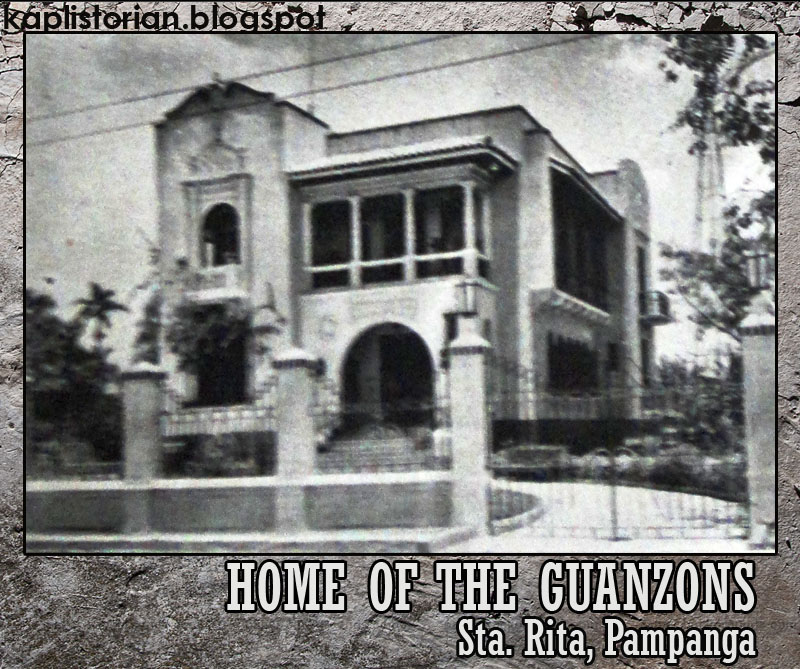
The Guanzon house was built in 1932 by Don Felipe Pineda Guanzon for his wife Dona Epifania Alvendia- Guanzon of Sta. Rita. Known today as Villa Epifania, the concrete house has sleek art deco elements, a style in vogue during the Commonwealth years.

Don Leandro Ibarra, an accomplished lawyer, was named Secretary of Interior of the Philippine Revolutionary Government under Emilio Aguinaldo. His capacious  “bahay na bato” residence was still well-kept and in order in the 1930s,

The Angeles home of Don Jose Lazatin, a  well-known businessman and sugar planter was designed by Menem Tayag. The concrete and wood house is furnished with the latest in Puyat Furniture.

The imposing Lopez Mansion, built in the grand Greek revival style, is reputed to be the first all-concrete house in Pampanga. It is constructed with APO Cement and furnished with Puyat Furniture. Owner Don Alejandro Lopez was a successful planter, owner of the Lopez Rice Mill, Co., and the Vice President of Pampanga Sugar Mills Planters Association. Together with his wife, Jacinta Limson and his family, Lopez resided and also held office here.

The home of Don Jose Luciano in Magalang was a favorite party place of the town’s elite, and the Lucianos would often host dinners and balls for Manila’s high society families like the Madrigals.  The beautiful house with a wide porch. was specially designed by Arch. Fernando H. Ocampo,  built with Rizal Cement and furnished with Puyat Furniture.

The beautiful home of lawyer  Don Pedro Morales (b.1886/d.1945) and Magdalena Hizon, was designed by his wife’s cousin, Arch. Fernando H. Ocampo in Mabalacat. A typical 30s house, it was furnished with Puyat Furniture. When the couple perished in he 1945 liberation of Manila, their lone surviving child inherited the house, and moved it to Magalang. Unfortunately, a fire destroyed the ancestral Morales house.

The house of Don Teodosio Pecson Santos and Josefa Panlilio was another design of the much-in demand architect, Fernando H. Ocampo, and furnished with the usual Puyat Furniture. Located along A. Consunji Street in Barangay San Jose),  it was purchased by the Miranda family, and is now recognized as one of the capital city’s treasured ancestral houses.

Don Emiliano J. Valdes (b. 1876/d.1953), the generous Kapampangan philanthropist who gave his name as well as financial donation to fund Pampanga’s leading TB hospital in Angeles had his grand residence built along Plaridel St. in the mid 30s. The Valdeses had barely enjoyed their new house when his wife died on 20 September 1936.To make matters worse, his house was taken over by the Japanese during the war and turned into a military headquarters. To forget the sad events that transpired in his Angeles home, he sold the house and lot after the war, and the space has since become a commercial area.

SOURCES:
PAMPANGA SOCIAL REGISTER, 1933
Lubao Commemorative Fiesta Program, 1936
www.viewsfromthepampang.blogspot.com, for Emiliano Valdes, Lopez Mansion, Pedro Morales House,