Showing posts with label Magalang. Show all posts

Friday, June 28, 2019

111. 6 ANCESTRAL HOUSES OF MAGALANG: A LIST BY LOUIE ALDRIN L. BARTOLO

KAPLISTORIAN EXCLUSIVE! Magalang is one of Pampanga’s most historic towns, and its old houses—if they could only speak—could tell endless tales of,  not only strifes and struggles, but also of progress and plenty. These 5 ancestral houses, selected by historian and teacher LOUIE ALDRIN LACSON BARTOLO, reflect the spirit of those times, when Magaleños, like all Kapampangans, built their residences as big and as grand as their dreams.
**********
LUCIANO HOUSE (Marbea Subdivision, San Nicolas I)
This Spanish style mansion is located behind the Magalang Municipal Hall. It was
constructed in 1925 by Dr. Andres J. Luciano. This house is marked with woodcarved designs  derived from the Spanish style and motifs. During the American period, the house, with its spacious surroundings, was a favorite venue of lavish parties sponsored by social clubs like Mountain Side Club and El Circulo Magaleño. During the Commonwealth period, President Manuel L. Quezon, a friend of Don Andres, also visited this house during his trips to Magalang. In World War II, this house was occupied and looted by the guerillas. When Don Andres died in 1959, the house was passed on to his daughter, Maria Elvira L. Luciano. In later years, it continued to be a shooting site for such films as Lino Brocka’s masterpiece, Ina, Kapatid, Anak (1979), starring Rio Locsin, Lolita Rodriguez and Charito Solis. In 2004, the horror movie, Pa-siyam, directed by Erik Matti, was also filmed in the Luciano house.

FELICIANO HOUSE (San Pedro I)
A few steps from Magalang Public Market is the beautiful Feliciano house, constructed in 1935 by the couple Don Andres Feliciano and Doña Maria Paras. The house features a  mix of Spanish and American architectural styles. During the liberation of Magalang in 1945, the house was made into a rest house of US Army Officers. When Don Andres passed away in 1947, the house was inherited by  his son, Jose P. Feliciano. This house was later used as a meeting place of elite and youth groups, like  the U-N-I Club,  composed of young Magalang professionals. When Jose passed away in 1962, the house was inherited by his American-educated son, Engr. Rodolfo L. Feliciano. The huse was restored and brought back to its former glory.

ORDOÑEZ-CALMA HOUSE (Luciano St., Sta. Cruz)
This multi-story house was built in 1929 by carpenters and artisans from Betis, commissioned by Hilariona Ordonez Calma. The house was commandeered by the Japanese military  during the war. A post-war bakery was put below and its cooking facilities are still operational to this day.  The house retains its original decorative grills and capiz windows. The historic house in a busy commercial of Magalang is now under the care of Juliet Calma Dizon.
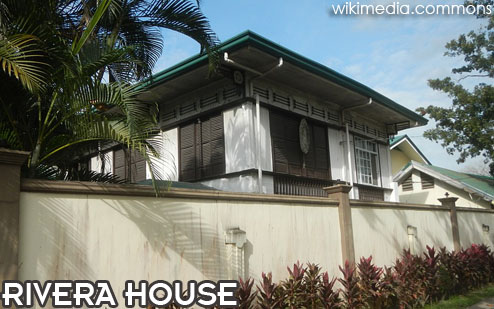
RIVERA HOUSE (Ayuyao St. San Nicolas I)
This house with distinctive Spanish influences was built around 1893, by the couple Don Cayetano Rivera and Doña Julia Rita Dizon. The house has rich woodcarvings that feature a signature star motif, that is revealing of  Don Cayetano’s affiliation with masonry and later, with the  Katipunan. Don Cayetano’s played a key role in the early formation of the First Republic of the Philippines, being one of the signatories of Pact of Biak –na-Bato. After the Revolution, he returned to farming, and acquired vast tracts of land in Concepcion, Tarlac. He also founded one of the first sugar mills in Tarlac—the Azucarera de Rivera. In the Commonwealth years, Don Cayetano’s friend, President Manuel L. Quezon was a regular visitor to this Magalang home. During World War II, the house was made into Japanese Military Headquarters, along with the neighboring Magalang Elementary School, which was converted into a Japanese military garrison and later,  execution grounds. When the Japanese occupied the house, they looted and destroyed much of the valuables. After Don’s death, he passed on the house to his nephew, Eliseo Rivera. At present, the house is under the care of  Eliseo’s daughter-in-law, Nimfa Rivera.

LACSON HOUSE (Lacson St., San Nicolas I)
Behind the majestic San Bartolome Church, stands an ancestral house with an architectural style reminiscent of old Spanish homes. This is the Lacson House, constructed in 1923 by the couple, Don Daniel O. Lacson and Doña Lucia David. The craftsmanship of the house reflects the high level of artistry of Kapampangan artisans who worked on this fine structure. During World War II, this house served as one of the Japanese military garrisons. When Don Daniel passed away in 1948, the house was inherited by his  two daughters, Lucila and Rosario Lacson, both spinsters. When Rosario passed away in 1991, she bequeathed the house to her sister-in-law, Evangelina Hilario Lacson, the  well-known Kapampangan academician and writer. In 1995, National Historical Institute (now National Historical Commission of the Philippines), placed a historical marker in front of the house for its cultural and historical significance. After Evangelina’s death in  2008, his son, Ariel H. Lacson became the new owner, but in 2014, he, too, passed away, leaving the house to nephew, Eduard V. Lacson. The house was acquired by Mayor Maria Lourdes P. Lacson, now the present owner.

AYUYAO HOUSE (San Nicolas I)
This house that is just a next-door neighbor of the  Magalang Municipal Hall, was built in 1915 by the couple, Isidoro Ayuyao, Sr., Municipal Secretary during the American regime  and his wife, Ana David, one of the pioneers of Magalang’s sweets industry. Its  flooring or “lande” was originally made of bamboo slats, and the house topped with a roof of nipa.  In later years, it was reconstructed and made entirely of wood with ornamental carvings, galvanized roofing and concrete foundations. When Ana passed away, her son, Dr. Claro Ayuyao inherited the house, which he later expanded to include his dental clinic. During 1950s, this house was visited by prominent personalities who were invited as guest speakers during the closing exercises of Magalang Institute, founded by Atty. Isidoro Ayuyao. Among these  are future Philippine president Diosdado P. Macapagal, and brother-in-law, movie actor Rogelio de la Rosa. In 1965, the house underwent minor repairs. At present, this house is owned and maintained by the children of Dr. Claro Ayuyao.


**********
ABOUT OUR CONTRIBUTOR: LOUIE ALDRIN LACSON BARTOLO. Teacher, Writer, Historian and a Magaleño, Bartolo is the author of “The Magalang Book: The Historical Life and Culture of a Kapampangan Town 1605-2015”, published in 2015 by Center for Tarlaqueño Studies of Tarlac State University, made possible through an NCCA grant. He also keeps a blog,”Amlat Magaleño”, that aims to promote the local history of Magalang. Bartolo finished his Bachelor of Secondary Education Major in Social Studies at Holy Angel University (HAU)


SOURCES:
INTERVIEWS:
Luciano House; interview with Mrs. Teresita Suba, one of the former caretakers of Luciano house, June 25, 2019.
Rivera House: interview with Mr. Sean Rivera, a descendant of Don Cayetano Rivera, June 26, 2019.
Ayuyao House: interview with Dr. Nunilon G. Ayuyao and Mr. Amante M. Ayuyao; both grandchildren of Isidoro Ayuyao, Sr. and Ana David, June 26, 2019.
Lacson House: interview with the late Mr. Ariel H. Lacson (way back August 4, 2012); grandson of spouses, Don Daniel O. Lacson and Doña Lucia David.
BOOK SOURCES:
Bartolo, Louie Aldrin L. and Dizon, Lino L. (2016), The Magalang Book: The Historical Life and Culture of a Kapampangan Town (1605-2015), National Commission for Culture and the Arts.
PHOTOS: All photos from wikimedia commons, unless otherwise noted. https://commons.wikimedia.org/wiki/Category:Old_houses_in_Magalang,_Pampanga

Sunday, May 6, 2018

80. 15 KAPAMPANGAN PLACES, THEIR MONICKERS AND MOTTOS

The use of short descriptive phrases--sobriquets, nicknames, monickers-- to describe places goes a long way back in history. "Pearl of the Orient" (Perla del Oriente) was first used in 1571 for Manila, now used as a sobriquet for the whole country. Central Luzon, which includes Pampanga, was dubbed as the "Rice Granary of the Philippines". Pampanga, of course, lays claim to the title of "Culinary Capital of the Philippines". Not all place nicknames, however, are positive in nature-- some are insulting, some amusing, many hilarious --but this naming tradition lives on today. Recently, town mottos, too, are being appended to rally people to support their municipality's vision/mission. 

**********


ANGELES CITY
Angeles earned its reputation as a center of entertainment with the rise of its barangay, Balibago as a recreation and leisure hub for serving both American and local patrons. The city’s proximity to Clark Air Base jumpstarted the establishments of night clubs, pubs, bars and gambling dens which lined the main avenue of Balibago, as well as the nearby perimeter roads known as Fields and Friendship Avenue. The entertainment strip was lit with neon marquees with Las Vegas inspired names such as Copa Cabana, Nina’s Papagayo, Little brown Jug, and Tropicana. Like Los Angeles, it was dubbed as the “City of Angels”, as it was named for both the founder (Angel Pantaleon de Miranda) and titular patrons  (Los Angeles Custodios).  The Casino Filipino, run by PAGCOR, is also located in Balibago.
“Abe-abe…Saup-saup…Agyu Tamu!” (Together...Helping Each Other...We Can!)


APALIT 
Apalit is the last town of Pampanga as one goes south to Manila, hence its nickname. The town is also famous for its long tradition in blacksmithing, and  the best bolos are said to come from Apalit. Today, th town doe not only produce bladed weapons like machetes and knives, but also domestic steel tools like rakes, hoes, anvils, picks, shovels and garden implements.
“Aplit…Apalit!” (Quicken the Pace...Apalit!)


BACOLOR
Like the ancient capital of Greece—Athens—Bacolor was the undisputed seat of arts and culture of the province, with the highest concentration of poets, artists, zarzuela performers, musicians, singers and writers. Bacolor is the proud home of such literary greats  as Juan Crisostomo Soto, Felix Galura, Luisa Gonzaga de Leon, Jose Gutierrez David, Mariano Proceso Pabalan Byron, Anselmo Fajardo, Zoilo Hilario, among others. Bacolor was also the country’s capital for two years during the Spanish colonial times when Manila was invaded by the British.
“Pluribus Unum, Non Plus Ultra" (Out of Many, No Further and Beyond)”


CAPAS
Capas is one of the richest, most historic towns of Tarlac,  the final site of the infamous Bataan Death March. It is a trekkers’ and mountaineers’ paradise as the challenging Mount Pinatubo treks were first offered by this town, which today continues to  attract thousands of tourists every year, unprecedented in number. This accounts for its latest nicknames as Tarlac’s tourism capital.
"Paspas..Capas!" (Make Haste, Capas!)


DAU
Camp Stotsenburg established its  Post Exchange in Dau, which presaged its rise from a barrio of Mabalacat to  the country's PX capital in the 70s. With the relaxation of Clark rules, PX goods flowed out of the base in abundance, to be resold later in stores  that quickly sprouted like mushrooms along MacArthur Highway of Dau. The completion of the North Expressway that linked Dau to Manila facilitated the great American experience as visitors trooped to Dau to buy Pringles, Oreos, Kellogg’s Corn Flakes, Hershey’s Chocolates, Almond Rocha, Hanes and Fruit of the Loom shirts, imported rubber shoes, branded cosmetics, apples and grapes, among others. The reversal of fortune began with the departure of American servicemen facilitated by the Pinatubo eruption of 1991. Business took a turn for the worse when PX Clubs opened at Clark-which extended PX shopping privileges to Filipinos.  Today, Dau shops continue to flourish, with toilet fixtures, military uniforms, various tools, and used surplus items replacing the once in-demand PX goods.


FLORIDABLANCA
The third largest municipality in the province has so much potential waiting to be untapped that the municipal government came up with a kilometric monicker for the province that reads more like a vision.
“Abe-abe king Panyulung!” (Together in Advancement)


LUBAO
The ancient town of Lubao (old name: Baba) has the sole distinction of producing two presidents: Diosdado Pangan Macapagal (b. Sep. 28, 1910/d. Apr. 21, 1997), who served from 1961-1965 as our ninth President, and daughter Gloria Macapagal Arroyo ( b.Apr. 5, 1947 ), who was our 14th President,  from 2001 until 2010.


MABALACAT
Over 97% of Clark Economic Zone is on Mabalacat land, hence the claim as Clarks economic breadbasket. ‘Makati of the North’ is a monicker coined by the long-running Morales Administration, which came across as too pretentious. The only similarity is, like the Binays of Makati, Morales’ term was a long one, stepping down only 2017, after 22 years in power. The Kamikaze monicker is in reference to the Divine Wind suicide attacks of Japan that was planned in the home of local Mabalacat resident,  Marcos Santos, during the last years of World War II.
“Misanmetung, Mabalacat! (United for once, Mabalacat!)


MACABEBE
In the art of peddling, perhaps no one can compare to the selling skills of the Macabebe cloth vendors. In fact, Macabebe takes pride in being called “Home of the Peddlers”, a reputation built by these native vendors who roamed across the Archipelago, travelling on foot and in groups of two or more, selling the famous ‘Macabebe cloth’—actually, Manila-bought fabrics. These humble, hardworking cloth vendors infused a lot of money into their town and in the 1930s, were largely responsible for pumping up Macabebe’s economy.
"Memalen Macabebe, tapat makiabe!" (Macabebe townfolks are loyal friends)


MAGALANG
Magalang aspires to become the sweet tamarind capital of the Philippines through a locally-propagated tamarind variety known as Aglibut. The late Professor Andres Aglibut, a consultant of Pampanga Agricultural College, successfully developed a  sampaluk type noted for it sour-sweet taste and juicy dark brown flesh. This is in consonance with the town’s “farm tourism” program which aims to revitalize the farm industry of this scenic, agricultural town.
“One Magalang! Metung King Panyulung!” (One Magalang, One in our Stride to Progress)


MINALIN
The town is known as the "Egg Basket of Central Luzon" because of its large scale production of eggs and chickens. According to the municipal government, Minalin earns P30 million per month or P1 million per day from the sales of eggs. There are 22 poultry raisers who own around 280,000 chickens. These chickens produce 479,100 eggs per day. So important is this egg industry that a laying chicken is even included in its town seal.


SAN FERNANDO
The capital city of San Fernando is popularly known as the "Christmas Capital of the Philippines" because of its traditional giant Christmas lantern industry. The establishment of the Paskuhan Village in 1990 served to reinforce its image, but the lantern-shaped complex folded up after the Pinatubo eruption and fell into disarray. Its Giant Lantern Festival held every December remains the city’s biggest attraction, in which the city’s barangays field their biggest and brightest lantern in a friendly competition attended by thousands of local and international tourists.


SAN LUIS
San Luis’ most famous son is the Huk Supremo, Luis Mangalus Taruc, who was born in the barrio of sta. Monica, of peasant parents on June 21, 1913. Following the Japanese invasion, Taruc formed the Hukbalahap (Hukbo ng Bayan Laban sa Hapon), along with Casto Alejandrino and other guerillas, in central Luzon in 1942.  San Luis became one of the hotbeds of Huk activities in the 50s and 60s. in 2017, Taruc was recognizedas a hero by the National Historical Commission of the Philippines (NCHP) for his role the struggle for  agrarian reforms.


SANTA RITA
Sugarcane was the cash crop that made Pampanga so rich, Sta. Rita included. The town is famous for its sweet delicacies-- turrones de casuy (wafer paper-wrapped cashew nougats) and sans rival (rich pastry made with layers of buttercream, meringue, and chopped cashew nuts). Ocampo-Lansang made these treats famous, and which in turn, gave the town’s nickname.
 “Sesen taya ing Santa Rita” (Let's care for Sta. Rita)


SANTO TOMAS
Santo Tomas is the smallest town of Pampanga but it has many unique homegrown industries like red clay pottery and funeral casket-making. The latter products are known for their beauty and fine quality,  made by craftsmen from about 100 registered enterprises, not to mention 200 backyard producers.  Its nickname as the casket capital of the country was given by the Department of Trade and Industry (DTI) in the 1980s, and its reputation shows no sign of waning. It is estimated currently, that 40% of the town depends on the coffin-making industry. It has been the tradition of Sto. Tomas town to donate coffins to affected provinces during times of calamities.
SOURCES:
Dau: Photo by Jun Malig, Inquirer Central Luzon
Floridablanca: www.pampangatalents.com
Photo: by Chris Navarro,

Tuesday, September 5, 2017

60. 16 IMPORTANT CULTURAL PROPERTIES IN PAMPANGA, AS DECLARED BY THE NATIONAL MUSEUM

Important Cultural Properties or cultural properties having exceptional cultural, artistic, and historical significance to the Philippines are determined by the National Museum, the National Historical Commission of the Philippines (NHCP), the National Library of the Philippines (NLP), and/or the National Archives of the Philippines (NAP). Pampanga is honored to have in its midst, important cultural properties that are now included in the Philippine Registry of Cultural Property (PRECUP),  the repository of all information pertaining to properties in the Philippines deemed significant to our cultural heritage.
**********

SAN AGUSTIN PARISH CHURCH (Lubao)
The San Agustin Parish Church is considered one of the oldest in Pampanga, having been built in 1572, in Barrio Sta. Catalina. It moved to its present site 30 years later, due to floods. Fray Antonio Herrera undertook the construction using local materials, including sand mixed with egg albumen as binder. It was used as a hospital in 1899 by American forces. Destroyed in the last war, it was restored from 1949-1952, under Fr. Melencio Garcia. It celebrated its 440th founding anniversary in 5 May 2012 with the reception of the relics of St. Augustine and St. Monica. The church was declared by the National Historical Commission as Important Cultural Property on 28 August  2013.

THE CHURCH COMPLEX OF SANTO ROSARIO (Angeles City)
The Holy Rosary Church was built by residents of Culiat and was finished in 1896. Exhibiting a European Romanesque style,  its most distinctive feature are its twin bell towers, which served as watch towers for the revolucionarios from 1898-99. The remains of Angeles founder, Angel Pantaleon de Miranda and his wife, Rosalia de Jesus, are interred at the sides of the altar. During the Philippine-American War, the church served as a military hospital from1899-1904, and was also used by the Japanese army in the 1940s as a motor pool. The adjoining building was a convent that Augustinian nuns turned into the Colegio de la Sagrada Familia.  German Benedictine nuns took ver the school in 1922 and who renamed it Holy Family Academy.

ANGEL PANTALEON DE MIRANDA HOUSE (Angeles City)
The house of Angel Pantaleon de Miranda, considered the oldest house in the city, was built in 1824, with much of the wood coming from their original 1811 house in Barrio Cutcut reused in the construction. The stately 19th century bahay-na–bato was bequeathed to daughter, Juana de Miranda, who was married to Dr. Mariano Henson, LL.D.  It then passed on to a series of heirs, including son, Don Mariano Vicente Henson, Jose Pedro Henson, and Vicente N. Henson. Vicente’s daughter, Rosalie, married to Mr. Sergio T. Naguiat, Jr., are the current owners of the old house known today as “bale matua”.

PATRICIA MERCADO-GOMEZ MASNOU HOUSE (Angeles City)
The house of Patricia Mercado was built in 1860, paid for by Fray Guillermo Gomez Masnou, then Angeles parish priest, with whom she had 6 children, Upon his death, Mercado took over the domain until her death in 1900. Daughter Maria Teodora “Mariquita” Gomez , who was married to Don Filomeno Santos, inherited the house and rented out the ground floor to American Thomasites John  W. Osborn and Marion Huff. Mariquita’s eldest—Francisco Santos—took possession of the house upon her death in 1954; in 1986 he sold it to Mr. Jose G. Paras who restored the crumbling home to its old glory.  It currently is being used as a function hall for social and community activities.

JUAN NEPOMUCENO CAMALIG (Angeles City)
The old camalig (shed or storehouse for grains) along Sto. Rosario St. was built in 1840 by Don Ciriaco de Miranda. A descendant, Capitan Juan Nepomuceno, the town’s first post-colonial mayor, improved on the original wooden structure. The 150-year-old wooden camalig was inherited by descendant  Armando L. Nepomuceno through five generations, who owned a small pizzeria established in 1973. In 1980, he transferred his pizzeria to the camalig Now known as the Historic Camalig Restaurant, it is also billed  as ‘The Home of Armando's Pizza: Ang Pambansang Pizza'." The camalig houses many old family photos and artifacts original to the granary. Armando’s son and his family, Marc Nepomuceno, are the current owners of the place, which stands as a fine example of successful adaptive re-use for business.

JOSE PEDRO HENSON’S “DEPOSITO” (Angeles City)
This structure—which was meant to be a used as a storage and parking house for carrozas and processional santos, was built in 1899 by Jose Pedro Henson, great grandson of the founder of Angeles. It served as a jail for errant American soldiers during the Philippine-American War. One such prisoner was Pvt. George A. Raymond who was put on trial,found guilty of murder, robbery and rape, and sentenced to death by a U.S. Military Commission. After the last war, it was rented to the U.S. Army 11th Film Exchange. Once again, it was used as a jail by the U.S. military police and 13th U.S. Air Force at various times, from 1947 to 1965. It was converted into the city’s post office building form 1967-1978 and today it houses a Physical Therapy Clinic.

CIRIACO DE MIRANDA HOUSE (Angeles City)
The Nepomuceno Ancestral House  was built in 1840 by Don Ciriaco de Miranda, the first gobernadorcillo of Angeles town, and the younger of two surviving sons of the founders of Angeles, Angel Pantaleon de Miranda and Rosalia de Jesus. He was married to Carlota de Leon. As they were childless, they raised Agustina Henson, the daughter of Mariano Henson and Juan Ildefonso de Miranda, daughter of the founder of Angeles, Angel Pantaleon de Miranda with Rosalia de Jesus. On 25 July 1868, Carlota willed their house of wood, stone and capiz to their foster daughter Agustina, who married Pio Rafael Nepomuceno of Lucban, Quezon. Upon her death on 27 July 1905, her property was passed on to her heirs, children Ysabelo, Juan, Ramona, Nemesia, Maria, and her Dayrit grandchildren, from late daughter Carmen.

MARIANO LACSON HOUSE (Angeles City)
Mariano Lacson was a rich haciendero who owned most of Sapang Maisac. He had this house built around late 1930’s, it was said to be the first "architected" house in Angeles. It was commissioned to Arch’t Fernando Hizon Ocampo. During WWII, the Japanese took over the house and made it their garrison. It was occupied by the USO, an agency of the American military in the 1950s. Dr. Amelia Guiao & Dr. Luz Ayson made this house the Mother of Perpetual Help Hospital. It was then used as the site of the first OB Montessori Pre-School in Angeles—whose most famous alumni is international Broadway star, Lea Salonga.Today, this house is owned by a Cebu-based company; it is building a tall structure at the back though they promised to keep the house intact.

RAFAEL YUTUC SR. HOUSE (Angeles City) 
Along Sto. Entierro St  stands the old Yutuc House, which once belonged to Rafael Yutuc  Sr., a pharmacist , and his wife Felixberta Dela Cruz. The house, which sits on a spacious 1,647 sq. m. lot, bears traces of its 19th century beginnings. The senior Yutuc died at an early age and a son, Rafael Jr., with wife Carolina Dela Cruz, inherited the house.   Family lore has it that the residence was so beautiful that Juan Luna was moved to make a painting of it. The house has undergone many restorations, including one in 1923. A neighbor put up a funeral parlor business just across the house;  but  as the Yutuc children apparently could not stand having a front view to funeral wakes every day, they sold the house to the Lagunilla family. The new owners solved this problem by putting up a  high wall which unfortunately hides the house—now known as Casa Lagunilla-- from public appreciation.

MUNICIPAL HALL OF GUAGUA
The heritage town hall of Guagua where the mayor and other elected officials hold office, was built in 1937. It has kept most of its original features, which is remarkable for an 80 year old edifice built in the Commonwealth years. It stands on the grounds fronting Brgy. Plaza Burgos. The old statue of the patriotic writer, Aurelio Tolentino has been moved to the front of the municipal hall.

THE CHURCH COMPLEX OF INMACULADA CONCECPION (Guagua)
The first church edifice was constructed in 1587 but was unfortunately razed by fire. The current Church structure was constructed in 1772 under the administration of the Augustinians. The Church was greatly improved in 1862 until 1870. The interiors are simple and the centerpiece attraction is the main altar, a creation of noted local artist Willy Layug. While still simple, the exteriors on the other hand, are marked by massive strength. The Cathedral-type church is located immediately adjacent to the Guagua Municipal Building and houses the Cardinal Santos Catholic Center and the Immaculate Conception Parochial School.

THE CHURCH COMPLEX OF SAN BARTOLOME (Magalang)
The 19th-century baroque church of Magalang, dedicated to San Bartolome, is located at Brgy. San Nicolas I, Magalang. Around 1725,  the Magalang convent was exempted from paying its dues to the Augustinian province, thus allowing it to save up financial resources for the erection of a more permanent church structure.  The church, as we know it, was built by Fray Ramon Sarrionandia in 1866, with the finishing touches undertaken by Fray Fernando Vasquez, who had 2 bells installed.  In 1891,  Fray Toribio Fanjul renovated the church flooring and sacristy.

MUNICIPAL HALL OF MAGALANG
The Magalang Municipal Hall is a town landmark located across the Plaza de la Libertad. Its predecessor was the old Spanish era (ca. 1866) Casa Tribunal building built after the transfer of the town from San Bartolome. Made of light materials like nipa and bamboo, it was refurbished in 1875 during the tenure of gobernadorcillo Tereso Manalo, who had military barracks (cuartel) added. More improvements were initiated by Capitan Paulino Gueco in 1896, before the revolucionarios took over who used the municipio to detain  Fr. Pedro Diez Ubierna (the last Spanish priest of Magalang) and two Spaniards. The new edifice was built in 1922 , during the presidency of Antonio Y. Luciano, and was inaugurated 2 years later. The municipal building, which survived the war and other natural calamities, was declared an Important Cultural property in 2015.

MUNICIPAL HALL OF LUBAO
The Municipal Hall of Lubao, constructed around 1937 is one of the early concrete structures erected during the Commonwealth years. It was originally a 2-storey building with stairs at the sides that was expanded over the years, eventually acquiring a neo-classic look distinctively characterized by its massive frontal columns and clean, elegant lines. Much of its original features are intact—from its wooden flooring, balustrades to its offices. In march 2016, a new municipal hall costing Php14.7 million is envisioned to rise in an eight-hectare property along Jose Abad Santos Avenue in Brgy. Santa Catalina in an area where the town traces its beginnings.

HELIOGRAPH TOWERS OF SAN ISIDRO AND STA. CRUZ (Magalang)
In Magalang, the remnants of two 20 meter high torre heliografico (heliographic towers)—one in Brgy. San Isidro, the other in Sta. Cruz--were declared as Important Cultural Properties in 2017. Of the two, the Sta. Cruz tower is better preserved—part of a series of more than 10 heliograph towers that were strategically located in Magalang, Mabalacat and Concepcio in Tarlac as stations of communications. Messages are transmitted through flashes of light generated in rapid succession by mirrors that are turned on an axis. Transmission of messages via mirror signaling was known and practiced by North American Indians.

MUNICIPIO DEL PUEBLO ANGELES
The town hall was constructed during the American regime, in 1922, under mayor Juan D. Nepomuceno, and was built from the original 1840 Casa Tribunal. A detachment of the Spanish Army occupied the Tribunal in 1897, and the Philippine Revolutionary Government took it after the Spaniards fled in 1898. It was in this building that the Americans installed Florentino Pamintuan as the town alcalde. During WWII, the Japanese used the town hall as a jail for American escapees from the Death March prior to their execution. Beginning 1999, the town hall has been converted into a museum, Museo ning Angeles, by the Kuliat Foundation. In June 2012, the Museo ning Angeles was declared an Important Cultural Property of the Philippines, the first  such structure to be given such a distinction.


SOURCES:
Mercado-Masnou House: The Officoial Website of Angeles City.
Yutuc House/ Mariano Lacson House/ Yutuc House: Information and pictures c/o Joy L. Cruz
Heliograph Towers: Joel Pabustan Mallari / Louie Bartolo Lacson
Ciriaco de Miranda House: Nepomuceno, Marc: The Nepomucenos of Angeles City
Guagua Municipal Hall: Official website of Guagua, Pampanga, https://www.guagua.gov.ph/
Magalang Church: Galende, Pedro G. (1996). Angels in Stone: Architecture of Augustinian Churches in the Philippines (2nd ed.). Manila, Philippines: San Agustin Museum. pp. 143–144
Lubao Municipal Hall: 1939 Lubao Town Fiesta souvenir program
Magalang Municipal Hall: Photo: iorbitnews

Thursday, June 15, 2017

50. 18 PAMPANGA LANDMARKS AND MONUMENTS, 2nd of 2 parts

JOSE ABAD SANTOS MONUMENT
Location: Heritage District, Angeles City
Jose Abad Santos was the fifth Chief Justice of the Supreme Court of the Philippines and served as Acting President of the Philippines during World War II. Born in San Fernando (b. 19 Feb. 1886), he and his son Pepito were captured by the Japanese forces in Cebu, then taken to Malabang, Lanao where the jurist was ordered executed. He comforted his son with this noble thought: “"Do not cry, Pepito, show to these people that you are brave. It is an honor to die for one's country. Not everybody has that chance." The monument of Abad Santos stands in the heritage district of Angeles City, in front of the old municipio, now converted into a museum. It was inaugurated on 31 Oct. 1958, during the last term of Angeles Mayor, Manuel Abad Santos, a nephew of Pampanga’s most well-known hero. The plaque, courtesy the Pampanga Masonic Lodge , is inscribed with a re-stated version of his last words given to his son:  “He gave up life to consecrate an idea—that it is a rare opportunity not given to everyone to die for one’s country”.

BENEDICTO T. DAYRIT STATUE
Location: Town Plaza, Magalang
On 28 Dec. 1963, Mayor Benedicto Tapnio Dayrit (b. 21 Aug. 1932) was assassinated by the alleged men of Huk Cmdr. Sumulong during the Magalang centenary celebration at the town plaza. The well-loved mayor was gunned down as the “Mountain Side” evening ball was going on, the highlight of the 3-day festivities to mark the 100th anniversary of the transfer of Magalang town proper.  It was speculated that the Mayor Dayrit was killed because he refused to tax the public school teachers.  In his honor, the Freedom Park and the emergency hospital were renamed after him. A statue in his likeness was also unveiled at the town square in memory of this devoted public servant—the first re-elected chief executive of Magalang,  and who was, as the plaque on the pedestal states, “a champion of the masses, defender of the poor, a devoted public servant beloved by his people.


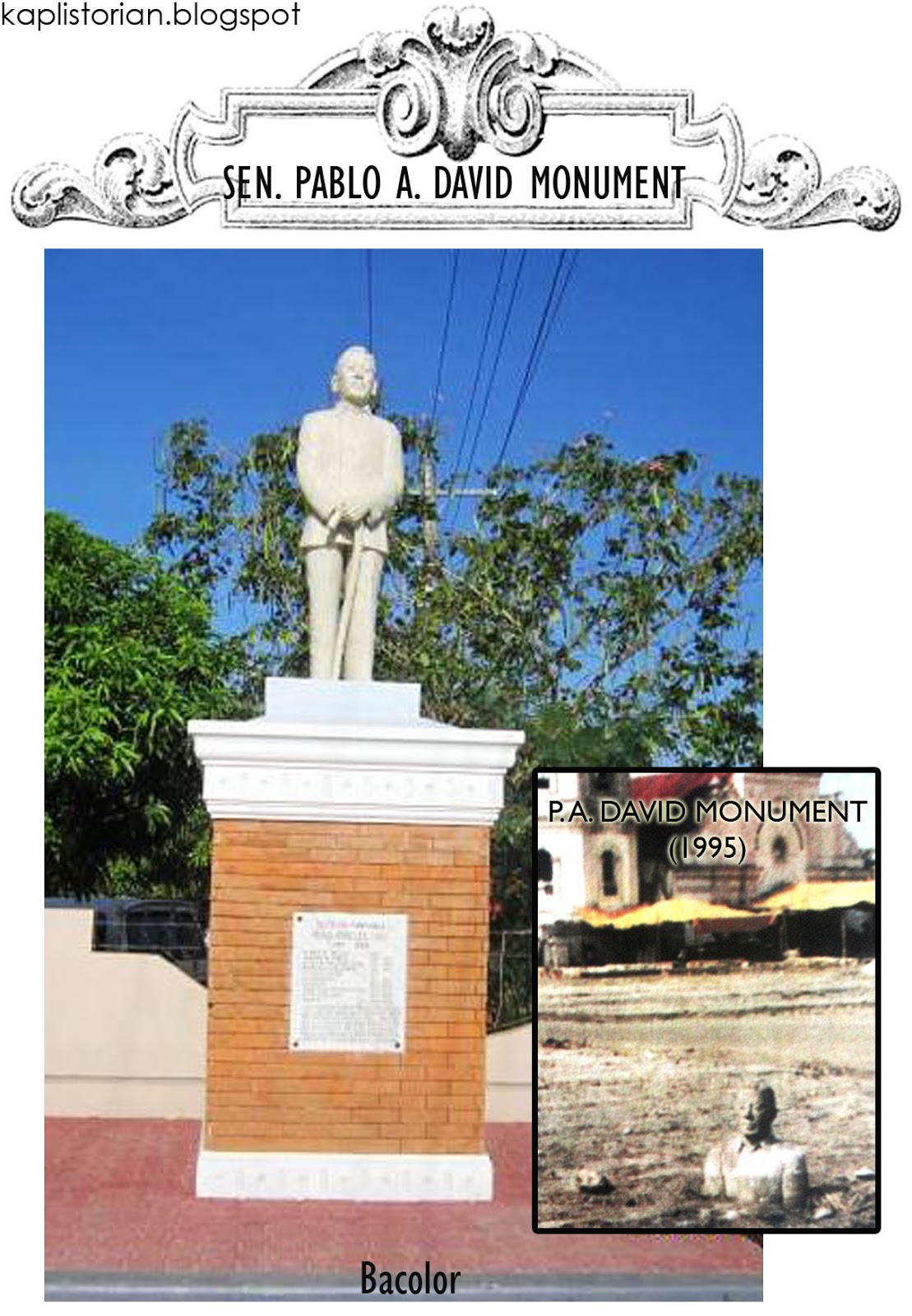
GOV. PABLO ANGELES DAVID MONUMENT
Location: Bacolor, Pampanga
This monument was erected as a token of gratitude to the late Gov. Pablo Angeles David (1889-1965) who served the government in various official capacities. A distinguished son of Bacolor, Pablo Angeles David was born to Carlos de los Angeles  and Ceferina Mesina David on 17 August 1889. He passed the bar in 1910, became a juez de paz for Sta. Rita, Sasmuan and Bacolor  until he became Asst. Provincial Fiscal. Provincial Board Member (1916-1919). He would become the governor of the province from (1931-37), and after his term, served as Judge Court of First Instance (1939-1945). After the war, David was called on to become an acting Governor (1945-1947). He served as Senator of the Philippine Republic from 1948-1953. The monument, as the plaque inscriptions note, is a “symbol of love and affection of the people of Bacolor”, made possible by virtue of Resolution No. 44, Series of 1982 of the Municipal Council of Bacolor.


PRES. MANUEL ROXAS MONUMENT
Location: Clark Air Base
Manuel  Acuña Roxas (b. 1 Jan. 1892) was the fifth President of the Philippines who served from 1946 until his death in 1948. He briefly served as the third and last President of the Commonwealth of the Philippines . On the morning of 15 April 1948, at the Kelly Theater in Clark Air Base,  Roxas delivered a speech before the United States Thirteenth Air Force. He suddenly felt dizzy and was immediately brought to the residence of Major General E.L. Eubank. Shortly after, he suffered a fatal heart attack in the evening. Roxas' presidential term is thus the third shortest, lasting only one year, ten months, and 18 days. A plaque originally marked his place of death in Clark. On the occasion of the 56th death anniversary of the soldier-statesman, the Pres. Manuel A.Roxas Foundation (PMARF) and the National Historic Institute, in cooperation with the Clark Development Corp., inaugurated the Pres. Roxas memorial statue  on 15 April 2004.


KAMIKAZE MONUMENT
Location: Japanese War Memorial, Mabalacat
As World War II drew to a close with imminent American victory, Vice Admiral Takajiro Ohnisi arrived in Mabalacat on 19 Oct. 1944 and, meeting in the house of Marcos Santos,  planned organized suicide attack units composed of "Zero aircraft fighters" against the Americans.  Thus, the Kamikaze suicide mission was launched. In all, over 5,000 Japanese pilots died in these missions. In 1975, a Kamikaze Marker was erected in Barangay Cacutud through the initiative of local historian-writer-artist Daniel H. Dizon. Buried in lahar in 1991, it was replaced with a new peace memorial in October 2001. On October 24, 2004, a life-size fiberglass gold statue of an unnamed Kamikaze pilot was unveiled at the Japanese War Memorial, eliciting cries of outrage and disgust that saw print on national dailies. Local tourism official Guy Hilbero, the proponent of the controversial project, maintains that the statue “is not a memorial glorifying the Kamikaze pilots” but its aim is to promote peace “using the lessons of war”. Concerned individuals think otherwise. Dr. Benito Legarda Jr. of the National Historic Institute, calls it a “monument to servility” as “the purpose of the Kamikaze was precisely to prolong the war”.


MONUMENTO FERNANDINO
Location: Dolores, San Fernando
The grand and imposing thirty-foot bronze monument that welcomes everyone to the capital city is a masterpiece of the National Artist Abdulmari Imao, a Tausug who also was one of the Ten Outstanding Young Men of the Philippines in 1968.  “Monumento Fernandino” shows four allegorical figures  aspects of the city’s history—the penitent girl with a lantern, lady with a torch, lady making an offering and a boatman. When seen from a distance, the tableau seems like a plant growing on a barren landscape. San Fernando’s newest landmark was inaugurated in December 2004. 


CAPT. COLIN P. KELLY MEMORIAL SHRINE
Location: cor. Ninoy Aquino Ave. and Foxhound St., Clark Air Base
One of the historic buildings in Clark Air Base was the Kelly Theater, constructed in 1953, the only cinema house in Clark and the venue of many stage plays and cultural shows. There was an earlier Kelly Theater built earlier—in 1947—that was converted from an old gymnasium. Both theaters were names after B-17 pilot Capt. Colin Purdie Kelly Jr. (b. 11 July 1915/10 Dec. 1941)  who died in action against the Japanese forces in 1941. Kelly’s damaged plane, while returning from a bombing run, blew up near Clark Field after being engaged by enemy forces. Capt. Kelly was declared America’s first hero of WWII by US President Franklin D. Roosevelt.  The  memorial statue of the fallen captain was inaugurated on the theater grounds on 10 Dec. 2007—the 66th year of his passing. It was made possible  though the auspices of the Mabalacat Tourism Office and the Air Force Wing of the Philippine Air Force. Lt. Clay Crawford, Chief of the U.S. Air Force Programs of JUSMAG, graced the significant event.


RUFINO CARDINAL SANTOS STATUE
Location: Guagua, Pampanga
Marking his 100th birth anniversary, the Center for Kapampangan Studies of Holy Angel University donated 6-foot statue of the late Rufino Cardinal Santos y Jiao at the Immaculate Parish in Guagua, Pampanga. The country’s first  Cardinal, born in brgy. Santo Niño in Guagua in 1908,  served as the Archbishop of Manila from 1953, before receiving the red hat from Pope John Paul XXIII on 31 March 1960. Cardinal Santos was known for founding Caritas Manila, the reconstruction of St. Paul Hospital (now the Cardinal Santos Medical Center) and in rebuilding the war-damaged Manila Cathedral in 1958.  He passed away on 3 Sep. 1973. The statue of the Cardinal Santos was made by Kapampangan artist,  Edillardo Paras. It rests  atop a seven-foot concrete pedestal outside the Rufino J. Cardinal Santos convention hall adjacent to the Parish Church. It was unveiled on 26 Aug. 2008 by Pres. Gloria Macapagal-Arroyo.


LUIS TARUC FREEDOM PARK MONUMENT
Location: Brgy. San Sebastian, San Luis
In July 2013, a public park in San Luis was named after the late Huk supremo,  Luis Taruc ((b. 21 Jun. 1913/4 May 2005), a noted leader of the Hukbalahap guerrilla group, a high-ranking official of the Socialist Party of the Philippines, military leader of the United Front, and an agrarian reform champion. The symbol of his advocacy finds full expression in the monument of a peasant family, celebrating their freedom from the bondage of the soil. The mother holds his baby aloft clutching a laurel crown of victory while the farmer-father holds the implement of his sweat and labors.

BONUS:
PHOTO COURTESY: Jason Paul Laxamana, The Prodigal
Mole Cricket blog
RIZAL "WATERWORLD" MONUMENT
Masantol, Pampanga
A solitary figure of the national hero appears to rise from the floodwaters that have covered the grounds of an elementary school where this solitary monument stands.


SOURCES & REFERENCES:
JOSE ABAD SANTOS. Photo: (old photo) Alex R. Castro, (new photo): Wikimedia commons: https://commons.wikimedia.org/wiki/File:0434fjfJose_Abad_Santos_Monument_Pampangafvf_04.jpg
BENEDICTO T. DAYRIT STATUE. Photo: Magalang Heritage FB Group, c/o Doriz Manlapaz.
Special thanks to Louie Bartolo Lacson for additional info.
(old photo): Singsing Magazine, Center for Kapampangan Studies
KAMIKAZE MONUMENT.
Photo: Kamikaze Pilot Statue, www.pampangatalents.com
KELLY SHRINE
CARDINAL SANTOS: