Showing posts with label Pampanga River. Show all posts

Wednesday, August 8, 2018

89. 16 FISH NAMES IN KAPAMPANGAN

Fishing is the lifeblood of many Kapampangans especially those living in towns lining the Gran Rio de la Pampanga. As such, the Kapampangan is acquainted with all kinds of fishes that have become so much a part of his life,  his industry and his culture.
**********
BACOCO (Pacific Sea Bream)
There are quite a few species of fish that are called by the name bacoco here in the Philippines of which the Pacific Sea Bream is one.  This particular species is primarily found in estuaries and even in rivers in brackish water.  They are not a particularly large fish however they are a heavy set fish and make a good food fish.

BALULUNGI (Needlebeak)
A folklorist describes balulungi as “a small fish resembling a swordfish”. It could have been coined by combining “balungus” (mouth/beak) with tungi (sharp stick). According to Kapampangan culinary chef Gene Gonzales, these fish were considered “plebeian fare because of their reputation as surface skimmers that feed on floating waste”. A freshwater variety, the balulungi could be the Rynchorhamphus georgii, a long billed, half beak fish., known as baritos, buging and bugiw in other Philippine languages.

BIA (Goby)
Bia are from the very common fish family Gobiidae (goby fish) , one of the largest in the world.  Most of them are relatively small, typically less than 10 cm (3.9 in) in length. The world’s smallest goby fish, Pandaka Pygmaea, is found in the Philippines. This dwarf goby called “bia” or “tabios” has a size that range only from .9 to 1.5 cm. Bia are commercial edible fishes, found in local Kapampangan fare, cooked by the handful in batter and fried.
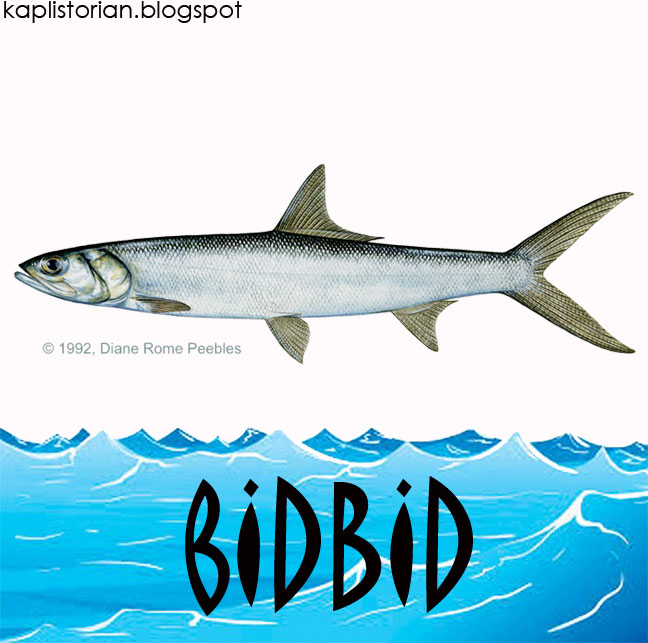
BIDBID (Ladyfish)
These long and slender fish from the Elopidae family are characterized by a small, pointed head, large deeply forked tail, as well as big eyes and mouth, lined with sharp, tiny teeth. Bidid also have small, thin scales  The scales are small and thin. The coastal-dwelling bidbid are foun d throughout the tropical regions where they are known as ladyfish, skip jacks and tenpounders.

BUAN-BUAN (Wolf herring)
This predator fish is quite rare and elusive. It has silvery sides, a long sardine shaped body and large fangs. The riverine barangay of Mabuanbuan in Sasmuan got its name from this fish species, which Bergaño describes as “pescado espinoso”--a spiny fish, with white scales, but delicious. 

BUNDAQUI (Mudfish)
Bundaqui is another old term for “bulig” or mudfish, a big fish that is also known in many Southeast Asian countries. The stages of the bulig’s growth are chronicled by Bergaño—the yellow-striped fingerlings are called “bundalag”,  the grow to their intermediate size called “bundaqui”. The fully grown fish is called “dalag”. French historian Jean Mallat write about this fish during the rainy season: “ It is more or less during this period that they catch in this lake (Candaba Swamp) a great quantity of dalacs, a fish which the Indios are extremely fond of, and which is in fact, delicious. The dalac resembles a very large and very short short eel, and its way of swimming makes it prefer muddy places”.
DULUNGAN (Mullet)
Dulungan or balanak (mullet, banak in Tagalog) is one of the more expensive fishes in the Philippines, common in the Cagayan River, but also in Pampang rivers and estuaries. They are a challenge to catch, and as such, are served during special occasions—as quenelles (creamed fish,  combined with breadcrumbs and egg, then cooked) or served with mayonnaise.

LICAUC (Silver Perch)
This is a small bangus-like fish that teems in ponds after flood or rain, preferred for their small roes (puga). Its Tagalog name is ayungin or silver perch. In the dictionary complied by Fray Bergaño, it is properly termed as lucauc, or pececillos.

LIWALU (Climbing Perch)
This common fish--Liwalu--also gave its name to such places as Maliwalu (in Bacolor and Tarlac City) and Caluluan (Ca-liwalu-wan, in Concepcion). Incidentally, the Historical Data Papers of Concepcion call it archer fish, but American inchthyologist Albert William Herre, who called it “lawalo” classified it as a Climbing Perch, Ananas testudineus (Bloch). This fish is known for prolonged living without water hence the name “liwalu”, meaning “luwal” or outside (the waters).

PACUT (Young river crab)
Pacut is a small-crab like crustacean, which when fully grown, is called talangka, Philippines shore crabs, still smaller than alimasag and ema.

PALAS-SAN (Swordfish)
Bergaño collected a unique Kapampangan term for a swordfish -- “palas-san”. Its Tagalog counterpart, now also rarely used is “tag-gan”. Of course, there is a flat, narrow-bodied fish that we also call “ispada” (beltfish), but this is obviously different from the bigger, predatory swordfish that take its name for its long, flat bill.

PALIMANOC (Ray Fish)
Fray Bergaño was very sparse with his description of “palimanoc”—he just noted that it is “a certain kind of fish, a ray fish”). Rays are a distinctive, cartilaginous marine fishes, noted for their flat, disc-like bodies, broad, wing-like pectoral fins that are fused to the head, and gill slits that are placed on their ventral surfaces. Their tails have venomous spines that can cause injuries.  Their nearest relatives are the sharks.

SAPSAP (Toothpony Fish)
The fish (Gazza mintua, Bloch), also called sapsap in Tagalog, is commonly available in Philippine markets.  It is often used as main ingredient in cooking Filipino favorite fish stews like paksi and pangat.

TABANGOGO (Manila Sea Catfish)
Tabangongo or kanduli (Arius manillensis) is a species of commercial marine catfish endemic to the island of Luzon. First described by the French zoologist Achille Valenciennes in 1840,  the fish inhabits marine, brackish, and freshwater habitats. Compared to the black-skinned “itu”,  the tabangongo has shiny silvery gray skin with a big head, and is delicious as adobo or as sinigang.

TAGAN-BIRHEN (Sole)
The fish with a religious name –tagan birhen (Virgin’s Leftover, solea humilis) is a member of the sole family of fishes (Soleidae). It is sometimes called "tagan ginu" (the Lord's leftover). The flat fish, to imaginative Kapampangans, has the silhouette of the Virgin, with the tail forming the crowned head. It is prized in many restaurants, although some soles are poisonous.

TALANG-TALANG (Goldfish)
There is a talang fish (Queenfish) that is endemic in the Philippines, but this short-headed, skinny, silvery fish does not conform to the description of Bergaño’S Kapampangan talang-talang, which he simply calls a “goldfish”. Its name may have come from “talang”, the round mabolo fruit (velvet apple) which can come in red or golden yellow color. The color, plus the plump shape certainly mimc that of the common aquarium goldfish, which is native to east Asia.

INFO SOURCES:
Dizon, Lino L. , “Fish in the Life of Kapampangan”. Singsing Magazine, Vol. 3, No. 2 issue.
F. Diego Bergano Dictionary, tramslated by Fr. Venancio Samson, CKS, Holy Angel University
Wikimedia

PICTURE SOURCES:
BACOCO (Pacific Sea Bream): https://pam.wikipedia.org/wiki/Bakoko
SAPSAP (Toothpony Fish): https://www.uniprot.org/taxonomy/218819
TAGAN BIRHEN (Sole Fish): https://species.wikimedia.org/wiki/Solea
TABANGOGO (Manila Sea Catfish): http://fishing.ph/fishes/kanduli/

Wednesday, November 29, 2017

67. 12 RIVER MYTHS AND MYSTERIES OF PAMPANGA

1. THE ONCE-MIGHTY PORAC RIVER
Ancient Porac was in the vicinity of a seashore.

Three pre-historic settlements in Porac, one unearthed by anthropologist H. Otley Beyer’s team in 1939 (Hacienda Ramona site), another by archaeologist Robert Fox in 1959 (Balukbuk site), and the third by the National Museum in 1999 (Upper Balukbuk site) raise the question of why the settlers built relatively large communities high up on the foothills of the Zambales Mountain Range. A  theory says that the ancient Porac River, which today is nothing but a shallow brook, was navigable enough for large water vessels from Manila Bay, and that the subsequent eruptions of Mount Pinatubo, years (not centuries) before the Spaniards arrived in 1571, silted the river and either destroyed the communities or forced the inhabitants to abandon them. Old folks in Lubao town, claim that in the 1960s, they saw what looked like large wooden boards floating in the Porac-Gumain river. The boards, between 12 and 16 feet long, were roughly cut and had holes in them, which made the folks speculate that they must have been parts of a large ancient boat washed down from upstream Porac River, which they believe to be navigable in the distant past. (Joel Pabustan Mallari)

2. WERE BETIS AND LUBAO AS BIG AS CEBU?
The conquistadores found thriving Muslim communities here.

The earliest  Spanish chronicles show that the first settlements in Pampanga were situated along the major waterways. Miguel Loarca listed these ancient settlements with their corresponding population figures, thus revealing a comparison between Pampanga settlements and those in other parts of the archipelago. In the list, Betis (Vitis) and Lubao had a population of 3,500 people, the same number as that of Cebu. Calumpit (Calonpite) outnumbered Macabebe by 400 people, but the latter Pampanga town had a bigger population than Vigan (1,600 people), Malolos (800), Negros (700) and Ylocos (500). Most if not all of these Pampanga communities thrived along or close to riverine areas for two basic reasons: abundant resources and accessibility of transportation. This is true for all the great cities and civilizations of the world (J. Mallari)

3. LUBAO’S ANCIENT BURIAL BOATS
Skeletons turn up during a flood.

Old civilizations all over the world—like Vikings, Austronesians, and Ebypt--observed a variety of elaborate burial rituals, one of which involved boats. Researchers of the Center for Kapampangan Studies, together with Dr. Rodrigo Sicat, author of The Kapampangans, recently interviewed old folks in Dr. Sicat’s hometown, Lubao, living near the now-heavily silted Gumain River. According to them, during the great flood of 1972, an eroded section of the protective dike near the property of a Pablo de la Peña in Brgy. Gumi turned up several boat-shaped coffins. They described the finds as canoe-shaped kabaung, inside of which were the skeletal remains of what appeared to be at least six-footers. Beside the skeletons, the interviewees claimed, were indigenous and tradeware ceramics: blue-and-whites and local earthen pots like kuran and banga. Each coffin measured between 12 and 18 feet long, carved out of the trunk of a bulaon tree (Vitex parviflora Juss.).  (J. Mallari)

4. FACTORIA AND THE SHIP THAT SANK IN NUEVA ECIJA
Did Spanish galleons sail as far as the headwaters of the Pampanga River?

Pedro Arcilla wrote that as recently as the early 1900s, large boats could still navigate the Pampanga River from Manila Bay all the way to Cabanatuan City and other Nueva Ecija towns. In fact, a parish document in a Nueva Ecija town mentions a casco (old folks there say it was a Chinese junk, others say it was a Spanish galleon) that sank during a storm in the early 1800s in that upstream section of the Pampanga River that flowed through the town of Factoria. An old resident of San Isidro town (present name of Factoria) allegedly recovered a part of this sunken ship’s rudder which is now displayed in his private museum, awaiting scientific verification. In times past, Factoria once controlled the tobacco industry in the North and was once the capital of Nueva Ecija. Indeed, this once-thriving town, formerly within the boundaries of the Kapampangan Region, owed all of this to its proximity to the Pampanga River. (J. P. Mallari)

5. THE SASMUAN-CABIAO CONNECTION
This upstream town served as haven to Kapampangan refugees.

In the Sasmuan Papers of the Luther Parker Collections (c.1900), there is a claim that Factoria became the capital of Pampanga in 1762, when the British invaded Manila and the country’s capital was moved to Bacolor. The territory of Pampanga extended all the way to Nueva Vizcaya, and Nueva Ecija as a province, was still non-existent. The provincial governor of Pampanga, a Señor Biron, was residing in Factoria, when British soldiers invaded Sasmuan through the town’s Manglares River.  Biron ordered all the residents in eastern Sasmuan  to evacuate to Cabiao (then still part of Pampanga). A group of women, led by Doña Magdalena Pineda protested against the order, citing the inconvenience of moving to Cabiao. After the British left the country in 1765, the Philippine capital was returned to Manila and apparently, Pampanga’s capital was returned to Bacolor and thus ended Factoria’s brief shining moment in history.

6. MEXICO: PAMPANGA’S CAPITAL BEFORE BACOLOR?
Bacolor was the provincial capital only from 1755 to 1903
Bacolor  started functioning as capital of Pampanga in 1746 and officially became capital only in 1755.  The town served as the provincial seat of government until 1903, when the capital was moved to San Fernando. In Conquistas de las Islas Filipinas, Gaspar de San Agustin, OSA wrote that the provincial capital  prior to Bacolor was Mexico town, one of the oldest and most prosperous communities in Pampanga. The province’s oldest surviving church structure is found in San Jose Matulid; the town has a barangay named Parian which indicates the presence of a community of Chinese merchants before; and a tributary to the Pampanga River links Mexico directly to Manila Bay passing through the important towns of San Fernando, Bacolor, Guagua, Sasmuan and Macabebe.

7. SAPANG BALEN AND ITS VIOLENT PAST
Angeles City lies in the path of an old, forgotten river

When the city’s founder Don Angel Pantaleon de Miranda  and wife Doña Rosalia de Jesus, came to Kuliat  to establish a new town, they chose the area around the Sapang Balen creek. The creek may seem harmless but its present tranquility belies a violent past. Historian Mariano Henson notes that on July 20, 1881, “A typhoon and a heavy downpour of rain caused the treacherous Taug salient, which used to originate at the southwesternmost tip of barrio Pampang, to swell up to a murky, clay-ey tone into the Sapang Balen Creek, causing the destruction of the three bridges of 1850 and carrying away three houses from barrio San Jose. It is said that before 1796, the Taug sometimes went a few hundred yards behind the present church during protracted heavy rainfall.” A similar devastation occurred in 1972 when Sapang Balen washed away dozens of houses in San Jose, and again when Mount Pinatubo erupted on June 15, 1991, when the creek overflowed into downtown Angeles. Sapang Balen is actually the ancient path of Taug River; at some point in the distant past.
(C. Manese)

8. THE MYSTERY OF THE SACOBIA RIVER
The mighty river probably did not exist before the 1850s

Sacobia River, which became a byword during the lahar season in the 1990s, is one of four major rivers emanating from the eastern slope of Mount Pinatubo itself.  Strangely, however, Sacobia River does not appear in maps made during the entire colonial period until mid-1800s. Cartographers could not have missed such a major river, considering that even creeks in the vicinity of the Sacobia River are depicted. Is it possible that Sacobia River did not exist before mid-1800s? There is a theory that it may have been formed, probably due to a lake breakout on the slopes of Mount Pinatubo, in the 1850s. Sometime in 1856, the town of San Bartolome in southern Tarlac was completely swamped with floodwaters from Parua, the river’s old name. Parua may have been the downstream name of Bamban River (Sapang Mabanglu). 1856 may have been the year Sacobia River was formed; it elbowed away from Mabalacat (in a spot called Maskup in sitio Bana) to merge with the Bamban River before proceeding to Concepcion and draining into Rio Chico. Another puzzle is the name “Sacobia.” Nobody knows what it means or to whom it refers. It is not a Kapampangan term and there was no Spaniard or Filipino who went by that name. (J.P.Mallari)

9. RUSSIA’S GRAND DUKE CAME BY BOAT
The world’s rich and famous traveled all the way to Apalit

DURING colonial times, elegant mansions of rich Kapampangan families lined the Rio Grande, the most famous of which was that of Don Joaquin Arnedo Cruz and Doña Maria Sioco Arnedo, in Sulipan, Apalit. “(Their) combined fortunes…created a lifestyle of leisure and luxury unmatched elsewhere in the archipelago,” writes Gene Gonzales in his book Cocina Sulipeña. The couple frequently threw lavish parties for their guests who came from Manila via the bay and Pampanga River .Among the guests  Jose Rizal, Gen. Arthur McArthur, Gen. William Howard Taft, and Prince Norodom I of Cambodia, who reportedly fell in love with a local maiden, Pepita Roxas of the next town Calumpit, Bulacan. But the best-cherished visit to Sulipan was that of Alexis Alexandrovich, Grand Duke of Russia and son of the Czar himself. While in Pampanga, the Russian Duke hunted birds in the surrounding marshes, and boar and deer in the mountains. In gratitude, he gifted his gracious hosts with a whole set of monogrammed porcelain dinner set.

10. THE LOST CANNERY OF GUAGUA
Why a small tributary in an interior town is called Dalan Bapor

Guagua has always been a commercial hub, even as early as pre-Hispanic times when it was a thriving community of Moros who traded with Chinese merchants. The Pasak-Guagua River which connected with the Rio Grande, served as the highway of cargo ships doing business in the town; a tributary to this river is known as Dalan Bapor (literally, ship’s way), which today has been reduced to just a shallow canal. Until World War II, however, it bustled with economic activity because it led to the Guagua  Cannery located in what is now a Brgy. Sta. Filomena  subdivision beside the Guagua National College. Old folks living in the area recall that the cannery occupied the entire land area of the subdivision; that “huge ships” transported tons of canned goods like sardines and even local specialties like tabang talangka and burung asan; that it offered retail canning services for affluent families who wanted to send canned products abroad; that it was bombed by Japanese planes in World War II; and that it finally closed in the 1960s following a series of labor disputes. (J. Mallari)

11. THE GREAT FLOOD OF 1972
Pampanga’s worst calamity before Pinatubo

Next to the eruption of Pinatubo, the worst calamity to ever hit the Kapampangan Region in recent memory was the flood of 1972, when the entire Central Plain of Luzon was submerged under water. Heavy monsoon rains lasting 40 days nonstop had been triggered by four tropical cyclones that made a direct hit in the area during that year’s rainy season: Asiang, Konsing, Toyang and Undang.The flood, which claimed 298 lives, was worst in the Central Plain because this area is the natural catch basin of two major waterways, the Pampanga River and the Agno River; moreover, the presence of the Candaba Swamp (pinac), alugin (waterlogged) areas and baná (marshes), as well as the phenomenon of subsidence, further makes the area susceptible to flooding. (C. Manese)

SOURCES:
Singsing Magazine, Center for Kapampangan Studies, "River Myths and Mysteries". by Joel Pabustan-Mallari, Robby Tantingco, C. Manese.