Showing posts with label Philippine Military Academy. Show all posts

Monday, February 4, 2019

105. 11 DISTINGUISHED, TOP-RANKED MILITARY MEN OF PAMPANGA, part II


Col. PATRICIO C. BUYSON
Bacolor’s distinguished colonel,  Patricio Buyson,  was trained at Fort Sill where he finished a 6-month course at  the U.S. Armv Artillery and Missile School.  He had his baptism of fire in the Korean war where the then-major served as a battery commander in the Battalion Combat Team of the Philippine Army, which was attached the Third Infantry Division Artillery, then commanded by Gen. Verdi B. Barnes. He and the good general would meet again when, in August 1959, Maj. Buyson returned to Fort Sill to take up a 9-month course in advanced officer artillery training, which included the study of missiles. This was in preparation for a new artillery school that was then being planned by the Philippine Army, and which he was tapped to join as an instructor. Post-war, Maj. Buyson was assistant superintendent of ROTC units in .Manila.


Lt. Gen. GREGORIO M. CAMILING JR.
Named as the Commanding General of the Philippine Army in 2002, Lt. Col. Gregorio M. Camiling Jr. (b. 15 Nov. 1947)  has parents whose are both Kapampangans: Gregorio Camiling Sr. (Bacolor) and Apolonia M. Miclat (San Fernando). Two of his brothers were officers of the AFP. After graduating as salutatorian of Cubao High School, he gained admission at the Philippine Military Academy from where he graduated in 1969. He rose quickly up the ranks; from a 2nd lieutenant of the Philippine Army assigned Mindanao in 1969, he was made the commanding officer of Alpha Company of the 26th Infantry Battalion from 1971-74 that saw action against Muslim rebels in the deep south. He was promoted to Captain in 1975, and a Major of the AFP in 1977. Because of his military experience, the Philippine Army named him as instructor and department head of the School for Combat Arms (1977-1980). In the 90s, as a personal choice of Pres. Cory Aquino, he served his 4th Mindanao tour as Chief of Staff of the 4th Infantry Division, and stayed on in the region, providing support to the government panel during the MNLF negotiations. In 1999, he was nominated as commanding general of the UN Peace Keeping Forces in East Timor. Later that year, he was promoted to Major General in October 16. From 2000-01, Maj. Gen. Camiling served as chief of the Southern Command of the AFP, which led to the neutralization of the Abu Sayyaf. He was eventually promoted to Vice Chief of Staff of the Armed Forces of the Philippines, the 2nd highest-ranking military officer in the Philippines. He has been awarded 9 Distinguished Service Star Awards Gold Cross Medal, 4 Military Merit Medals with 4th Bronze Spearhead Device (Combat), 19 Military Merit Medals, Silver Wing Medal, and 6 Military Commendation Medals, to name a few. He is now retired.


Gen. RICARDO A. DAVID JR.
Born in San Fernando, Gen. Ricardo David Jr. finished his early education at Dolores Elementary School, as class valedictorian in 1967. He moved to Victoria, Tarlac to continue his high school, graduating  as salutatorian at Victoria High School. He took up Engineering at St. Louis University, Baguio on a scholarship, which he finished at the Philippine Military Academy, in 1973. He was the Commanding Officer of the 50th Infantry Battalion, Philippine Army (1996-98) and the Commanding General of the 402nd Infantry Brigade, Philippine Army ( 2005- 2006). The general then became the Northern Luzon AFP Command Chief. In 30 June 2010, he was named by Pres. Benigno Aquino III as Chief of Staff of the Armed Forces of the Philippines, a post he assumed in July. His decorations included: Philippine Republic Presidential Unit Citation, Anti-dissidence Campaign Medal, Distinguished Aviation Cross, Distinguished Service Star and Combat Commander's (Kagitingan) Badge, among others. In 2011, Gen. David was appointed by Pres. Benigno Aquino III as the chief of Bureau of Immigration


Maj. PEDRO DEANG
The first Kapampángan valedictorian of the Philippine Constabulary Academy hails from Minalin, and eventually moved to Angeles. Pedro Deang (b. 16 January 1906)  finished at the top of his class in 1932, just the fourth batch of cadets to be graduated from the country’s premiere military school. He joined the Philippine Constabulary as a lieutenant and was assigned to Sulu. There he met his future wife, Emiliana Rodriguez. When WWII broke out, Pedro was deployed to Bataan but not after sending his wife and uncles to Guinobatan, Albay, where they waited for his return. As a Major in Bataan, he was the operations officer of the 31st Infantry Division of the Philippine Army, under Brig Gen Clifford Bluemel. He served alongside the future president, Capt. Ramon Magsaysay, who was the motor transport officer of the 32st Infantry. When Bataan fell, Maj. Deang, along with thousands of American and Filipino surrenderees, joined the infamous Death March. Along the way, he was rescued by civilians, but he opted to remain with his men and rejoined the march to Capas, where he died at Camp O’Donnell on 23 April 1943.
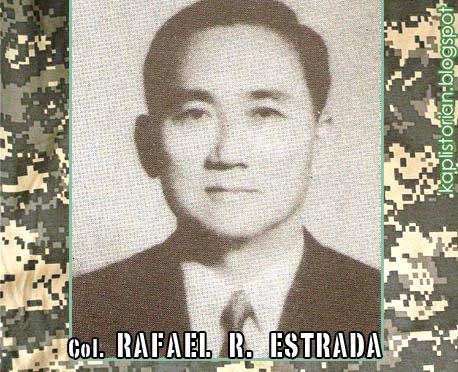


Col. RAFAEL R. ESTRADA
The distinguished Col. Rafael Reynaldo Estrada was born in Concepcion, Tarlac,  (b. October 1918) the son of Dr. Salvador Q. Estrada and Demetria Reynaldo. Highlights of his military service include his membership in the 2nd Regular Division USAFFE, and was also involved in the defense of Luzon and the Battle of Bataan (1941-42). With rations lacking and ammunitions almost gone, their commanding officer, Gen. Edward King surrendered to the Japanese on 9 April 1942. Estrada became a POW (prisoner of war) and joined the notorious 100 km. Death March to Camp O’Donnel in Tarlac. Luckily for him, he survived the march and imprisonment. After the war he was appointed Director of the Philippine Veterans Board by President Magsaysay and became Commissioner of the Veterans Claims Commission. He also became the Founder and National Commander Emeritus of Defenders of Bataan and Corregidor, Inc. (DBC). To show his commitment to help war vets, Col. Estrada developed the Blue Ridge Subdivision in Quezon City exclusively for WWII veterans. Col. Estrada counts poet Nina Estrada-Puyat and  former Sen. Eva Estrada-Kalaw as half-sisters. The respected WWII veteran died at age 98 on Oct. 2016.


 Brig. Gen. RAFAEL D. GOSECO
The late Brig. Gen Rafael D. Goseco (ret.), was a homegrown boy  from Sto. Niño,  Guagua, a graduate of the esteemed Guagua National College, founded in 1918. He would later serve the same school as its President. His wife, Dr. Petronila S. Goseco, was also a dean at the college. In May 1999, the generous general gave a deed of donation to the Court, giving some 5,000 sq. m. of land, that were part of the family’s 20-hectare property in Brgy. San Matias, Guagua,. The land was offered as site for the proposed Hall of Justice and other buildings that the Court may be minded to construct. According to General Goseco, his family will find fulfillment in knowing that it had done something for the government. Gen. Goseco passed away in February 2015. His son Ronald, a graduate of UP and the PMA, assumedthe presidency of Guagua National College.


Cmdre. JOSE G. LANSANGAN JR.
Commodore Jose G.Lansangan, from Sta. Ana, was a multi-facteted military man who was also a businessman, a college head, and author. He finished a degree in Marine Transportation, a Master in Business and Government Administration and in National Security Administration at the Royal Naval Staff College in Greenwich, London. His military career included being serving as Chief of Naval Staff of the Philippine navy (1876-78) and Commander of the Cavite Naval Base (1978-1982). Eventually, he would assume the presidency of the National Defense College of the Philippines (1982 -88). Together with his partners, he put up a government, business and industry consultancy firm (Martillano, Lansangan, Domingo & Associates, Inc.), headed the FRIENDS Foundation, and served as president of the Makati Mabuhay Lions Club as president. In March 2017, Cmdre. Lansangan wrote his memoirs,  “The 21st Century Legacy Letters Volume 1: 17 Legacy Lessons”.


Rear Adm. ARMANDO Q. MADAMBA
From San Juan, San Fernando, Armando Quizon Madamba (b. 3 Nov. 1938) was a product of Pampanga High School, class 1954. From there, he went to the state university (U.P.) to study engineering, but moved to the PMA after qualifying for the exams. At the academy, he gain renown for his brilliance in military planning and strategy. The 1962 graduate joined the Philippine Navy as ensign. He performed so well that his studies were sponsored at the Fletcher School of Law and Diplomacy at Tufts University in Boston, Massachusetts. There, he earned his M.A. in International Affairs (1970) and M.A. in Law and Diplomacy  (1971).  He was assigned to Iran as Attache at the Philippine embassy for 5 years (1975-80). Towards the decade’s end, he attended the Naval Command College course for Senior International Officers at the US Naval War College in Newport, Rhode Island. As Deputy Chief of Staff, he pushed for the complete  modernization of AFP. He retired as a Vice Admiral, but Pres. Fidel V. Ramos named him Ambassador to the Asian Pacific Economic Cooperation  in 1996. He engaged in consultancy work after his diplomatic stint. His impressive career has earned him the Distinguished Conduct Star, the Distinguished Service Star, the Philippine Legion of Honor,  Navy Distinguished Cross, the 1991 Cavalier Award of the Philippine Military Academy and Outstanding Kapampangan Award for Military Service in 1993.


Gen. RAFAEL M. MANIAGO
The future general, Rafael Manarang Maniago (b. 7 Nov. 1936)  comes from Parian, Mexico. He is said to be a descendant of the brave 17th century hero, Francisco Maniago, who led a revolt against Spain. He graduated from the Philippine Military Academy in 1962 and joined the Philippine Army. He served as regional military commander in different military zones and installations in the Philippines. As a colonel, Maniago was named Commanding Officer of the  403rd Infantry Brigade, 4th Infantry Division of the Philippine Army from 1988-89. It is known officially as the Peacemaker Brigade which specializes in anti-guerrilla warfare. From 1990-91, the colonel served as the Commander of the 502nd Infantry (Liberator) Brigade. Gen. Maniago passed away on 1 January 2004.

Col. SAMUEL S. QUIWA
Before his death from pneumonia on 12  February 2011, Col. Samuel Quiwa (b. 3 Feb. 1917) was considered as the last surviving World War II hero of San Fernando, having outlived 16 other comrades. Quiwa , a USAFFE (U.S. Armed Forces in the Far East) soldier, was a participant in the battles of Bataan and Corregidor in 1942.  He was able to escape the 3-day Death March that started in Mariveles, Bataan, but slipped back to war-ravaged Corregidor, only to surrender to the Japanese. For 20 days, he became a POW, along with other American military men, until they were transferred to Manila. After his release, he went underground in Nueva Ecija and Pangasinan as a guerrilla fighter. When the country was liberated, he returned to active service and was assigned to the 103rd Military Police Command, now the Northern Luzon Command of the AFP. He retired in 1969. For his gallantry, he was awarded the Philippine Defense Ribbon, American Defense Ribbon, WWII Victory Medal and Ribbon, Philippine Liberation Medal, among others. Before his death, he managed to receive financial reward from the U.S. government.


1st Lt. RUBEN P. SONGCO

Capt. Ruben Paras Songco (b. 5 Sep. 1921/ d. 5 Dec. 1944), was a native son of Guagua. A graduate of the prestigious U.S. Naval Academy, Annapolis,Maryland, in 1943, he excelled in football, tennis, lacrosse and boxing. He was graduated a year early due to the War. During the War, he was a member of the 1st Reconnaissance Battalion missions that left for Australia in Oct. 1943, with Gen. MacArthur attending their send-off. He was with Maj. Lawrence Phillips, Capt.  Galang, 4 radio operators and 2 reconnaisance men when they landed in Mindoro, only to be tracked and captured by the Japanese with the help of a Filipino informer. 1st Lt. Ruben Songco was one of those killed; only 3 survived. The other sad thing about his shortlived military career  was that, because of his Filipino nationality, he was  denied a commission in the U.S. Navy.

SOURCES:
Patricio Buyson: Pampanga High School, Golden 50th Anniversary Yearbook,
Photo courtesy of the Philippine Army Official Website
Pedro Deang: Picture and information courtesy of First Consul Elmer Cato.
Rafael Goseco: GNC Batch of 2005 FB page
Samuel Quiwa: “ LAST WW II WAR HERO IN SAN FERNANDO DIES”by Charlene Quiwa.


Friday, January 25, 2019

104. 13 DISTINGUISHED, TOP-RANKED MILITARY MEN OF PAMPANGA, part I

Brave warriors, fearless soldiers, and dauntless freedom fighters—all figured prominently in our early provincial history. Here is a more contemporary list of our finest Kapampangans in uniform who have managed to ascend up our country’s military hierarchy—top-ranked and acclaimed for their boldness achievements.

**********


PNP Chief OSCAR D. ALBAYALDE
The current Philippine National Police director who replaced Ronald “Bato” de la Rosa was born in San Fernando (b. 8 Nov. 1963). Oscar David Albayalde went to local city schools : San Fernando Elementary School, Pampanga High School, University of Assumption. He graduated with cum laude honors from the Philippine Military Academy Sinagtala Class of 1986, and also finished his Masters in Public Adminsitration at  MLQ University. He started his service with the Police Constabulary Special Action Force (SAF) from 1986-91. Among his  significant positions in the Police Regional Office-3 were: Acting Provincial Director of Pampanga Police; Chief, Regional Intelligence Division; Chief,Regional Police Coommunity Relations, and Chief, Regional Investigations Division. Albayalde was named Outstanding Kapampangan in Law Enforcement in 2016.


Col. JUAN E. ARROYO
The Philippine National Police - Communications and Electronics Service (PNP-CES) traces its beginnings at the turn of the 20th century, originally known as the “SIGNAL CORPS” which contributed to the development of the communications systems and facilities of the police force. In the critical war years,  beginning in 1941, Col. Juan E. Arroyo  was designated Chief Signal officer of the Philippine Constabulary (PC)  until 1942, when the Japanese took over the islands. In the period leading  to our  liberation, Col. Arroyo resumed his post as PC Signal Officer. After the war, he became the manager of the National Steel Corp., The Arroyos are from Candaba.


Col. EMIGDIO C. CRUZ
Col. Emigdio "Meding" C. Cruz of Arayat went to U.P., finishing a Liberal Arts course in 1923 and Medicine in 1929, at a rather late age of 31. He was Pres. Manuel L. Quezon’s chief physician and trusted aide during the War years. He was the recipient of the Philippine Congressional Medal of Valor and Distinguished Service Cross in 1948, the highest award that the Philippine government can give to its citizens,  for his “daring resourcefulness and long sustained courage” he displayed at the height of the second World War. After Quezon’s death in 1944, Meding lingered in the U.S., doing stints at Walter Reed Hospital, Brunns General Hospital, Ann Arbor University Hospital and the Barnes General Hospital in Missouri. He returned to the Philippines in Feb. 1946. Today, a government hospital stands in Arayat—the Dr. Emigdio C. Cruz Medical Center--named after the decorated physician-patriot who passed away in 1978.


Brig. Gen. RENE R. CRUZ
Arayat son Gen. Rene R. Cruz had an illustrious military career. As a colonel, he was connected with the Philippine National Police Academy. He was also the former RaCom Commander and PC-INP Commander and, like all high-ranking officers, was drawn into the People Power revolution in 1986. After the police general retired, he became a director of the Bataan Shipyard and Engineering Co. Inc. (Baseco). Gen, Cruz also headed the Philippine Olympic Committee (POC) from 1993-96. It was during his term that boxer Manuel Velasco won an Olympic silver in the Atlanta Olympics in 1996. He was honored by his alma mater, University of the East, a Distinguished Alumnus in Military Science award, where he finished in 1957. He passed away of heat attack, 30 Sept. 2015.


Brig. Gen. ROMEO S. DAVID
The unico hijo of a former San Fernando vice mayor and a public school teacher, Romeo Soliman David attended local schools, graduating in 1951 at the Pampanga High School. He pursued an engineering course in Manila but opted for Philippine Military Academy when he passed the admission.  At PMA, he shone in sports and in academics, and graduated among the top of his class in 1956. He became a pilot for the Philippine Air Force and was sent off by the Philippine government for pilot training in the U.S. he also underwent advanced studies at the United States Air War College in Air University, Alabama USA in 1983. David served as military air base commander and commanding general of the Armed Forces of the Philippines Regional Unified Command III. After his retirement, then Pres. Cory Aquino appointed him as president  of Philippine Amusement and Gaming Corporation in 1987-1989. Pres. Fidel Ramos named him as president and CEO of Clark Development Corporation and Clark International Airport in 1995-1998. The retired general heads the Rainbow Rising High Co., Inc., a natural gas producer based in Palawan.


Brig. Gen. VIRGILIO M. DAVID
The general from Bacolor, Virgilio Mañago David, was a PMA graduate, and an alumnus of Pampanga High School,  Class of 1954. He was a former National Police Commissioner, and served as the Anti-Drug Chief of during the term of president Cory Aquino. As head of the Narcotics Command (NARCOM), he had to revamp the agency of over 1,000 men which had been plagued with corruption charges under 2 previous heads.  Upon retirement,  he was appointed administrator of the Philippine Coconut Authority from 1992-98. He then became its director, but his term was marred by an incident when, in late May 2005, during an altercation with a person who parked his car in front of his house, the general fired his gun, injuring a construction worker nearby.


Col. MIGUEL NICDAO
Guagua-born Col. Miguel Nicdao (b. 8 May 1888/d. 1938), was but 15 when he became a pensionado (government scholar)  to the U.S., a batchmate of Jose Abad Santos. With six other Filipinos, Nicdao began his studies at Illinois State Normal University,  became a champion orator, and  graduated with an Education degree—the youngest of the 1907 batch. Once home, he started work as Principal of the San Luis Intermediate School. He was also assigned in Mabalacat, Apalit and in San Fernando where he was with Pampanga High School  for 3 years. The young teacher found it frustrating to advance in his career, so in 1911, Nicdao enrolled in the newly-opened Camp Henry T. Allen (the pre-cursor of the Philippine Military Academy). After undergoing an intensive 3-month boot camp training, he graduated as 3rd Lieutenant.  The 23 year-old embarked on his  new military career, and led campaigns in Lanao and Cotabato, during the Moro War years (1909-1923).  He would eventually become the District Commander for Muslim Mindanao. By 1917, he had attained the rank of a First Lieutenant of the PC, with missions in Cagayan and Misamis.  In the 1930s, he was instrumental in crushing a Sakdalista revolt in Laguna. The bemedalled colonel  passed away at age 50 of peritonitis, during a military exercise in Leyte, and was given full military honors during his burial.


Brig. Gen. RAMSEY L. OCAMPO
Brig. Gen. Ramsey Lapuz Ocampo is a native of Candaba, and a 1963 alumnus of Pampanga High School. As a police superintendent, he was the provincial police director of Pampanga from 1990-1992, and rose to become the Regional Director of police command VII.  Ramsey was responsible for the very good peace and order situation in Cebu City. The general also became Chief of the Central Intelligence Service (CIS) and NARCOM. He later pursued a law course and a doctorate degree and now the multi-facetted general has his own law firm and is the Vice President for Security Services of Clark.


Lt. Col. LEON F. PUNSALAN
The  West Pointer and M.I.T. graduate who saw action with the Philippine Army was born in San Simon, Pampanga on 3 July 1910. Leon Flores Punsalan is a 1928 Pampanga High School alumnus . In 1936, he graduated as a Mechanical Engineer at West Point in the top ten of his class, and he was assigned to serve  in the Philippine Army in 1938. In 1940 he was assigned in an Army base in Boston, Massachusetts and attended nigh class for his his Masters Degree in Mechanical Engineering from MIT. He invented a durable rifle cartridge ejector and obtained a patent for it. After serving for 31 years in the U.S. Army, he retired in Hampton, Virginia, where he taught mathematics and physics at local high school. He was the founder of the Pampanga Language Club of Virginia. Lt. Col. Punsalan was also a writer and a poet. Died 3 October 2001 at the age of 91.


Brig. Gen. MARCOS SOLIMAN
The general best remembered as the anonymous whistleblower who exposed the Marcos plan to place the country under Martial Law to oppositionist Benigno Aquino Jr., was born in Candaba (b. 25 April 1910), the son of the town police chief.  He was a classmate of Pres. Diosdado Macapagal at the Pampanga High School, Class 1929. He graduated in 1933 from the Philippine Constabulary Academy, and then served  the PC company in  Iloilo as a lieutenant for 2 years. Soliman was chosen to study in the Air Corps Flight School at Randolph Field, Texas. After his tour of duty, he was appointed commandant of  various ROTC units like the U.P. FEU and U.S.T. During the War, he refused to surrender to the Japanese, and became a guerilla untilhis captured in January 1944. Though released, he continued doing espionage work. In the post-war years, he served as Superintendent of the Philippine Military Academy and Commanding General of the Philippine Army. Upon leaving the military, he became chief of the National Intelligence Coordinating Agency. Shortly after Martial Law was declared in Sept. 1972, newspaper reported his death due to a heart attack, but his family believed that Marcos was responsible for his death.


Brig. Gen. BASILIO VALDES
Basilio Valdes (b. 10 Jul 1892) with roots in Floridablanca, was a doctor first, but also earned recognition as a military man, and a government executive. He finished medicine at the University of Santo Tomas and graduated with honors in 1916. Driven to serve beyond his country, he joined the French Army as a medical volunteer, then the U.S. Army as a surgeon from 1917-1919. He labored in Europe as part of the American Red Cross mission. Thus began his second career in military service. Returning home, he joined the Philippine Constabulary from 1926-1934 as medical inspector. Pres. Manuel L. Quezon appointed him as Chief of Staff of the Philippine Constabulary and Philippine Army in 1939, elevating his rank to a general (he would rise to become a Brigadier General). Two years later, Basilio was appointed as Secretary of National Defense. To expand his military education, he attended the Command and General Staff School in Fort Leavenworth, Kansas, graduating there in 1943. During the Japanese period, he served under Pres. Jose P. Laurel as Secretary of Public Works. He died in 26 January 1970.


Brig, Gen. LUIS A. VILLA-REAL
The venerable general, Luis “Louie Villa-Real, was a graduate of Culver Military School who joined the Philippine Army and headed its 21st field artillery. He fought in World War II and is acknowledged as one of the valiant Defenders of Bataan and Corregidor, having also walked in the Death March. He was to serve many presidents, including Pres. Cory Aquino who appointed him head of National Intelligence Coordinating Authority (NICA) after the fall of Marcos. Known as a Huk fighter in his time, he also headed the Philippine Anti-Communist League. He was never known to be political; in fact, he was critical of the military hierarchy in Pres. Aquino’s time, proof that he was a true servant of the Filipino people. The Villa-Reals trace their roots in Arayat.


Maj. PORFIRIO ZABLAN
The early years of Philippine aviation count only some 400 military men--all chosen between 1907 to 1935, with Pres. Quezon’s approval.  Among the first 10 Filipinos to undergo actual flight training were 10 Philippine Constabulary (PC) officers, led by topnotcher 1st Lt. Porfirio Zablan; and 23 recruits from the National Guard. Zablan, who rose to the rank of a Major,  became the first fighter pilot of the Philippines, but perished while training in the U.S. in 17 June 1935. In his memory, the Zablan Airfield in Quezon City was named after him.

(OTHER RANKING KAPAMPANGANS IN THE MILITARY: Col. (Ret.) Vicente A. Pascual (Arayat), Commodore Lodovigildo L. Gantioqui, Ph. Navy (Arayat), Col. Sergio Sanchez,  Col. Federico Calma, Col. Auelio Miranda, Col. Gregorio Yambao, Col. David Pelayo, Col. Pacifico Marin, Col. Diosdado Garcia,Col. Migule Pingul, L.t Col. Felix Duenas (Phil Coconut Authority director), Maj. Conrad Flores, Lt. Col. Patricio Buyson, Major Rufino Dizon, Capt. Crescencio Pineda)

SOURCES:
Oscar Albayalde: Most Outstanding Kapampangan Award 2016 souvenir program
Juan Arroyo:
Rene R. Cruz, Luis Villareal: The Pampangos, by Rafaelita Hilario Soriano, 1999, 218 pages
Basilio Valdes, Emigdio Cruz. Miguel Nicdao: www.viewsfromthepampang.blogspot
Marcos Soliman: PHS Golden Jubilee 50th Yearbook, 1962
Romeo David, Virgilio M. David: History of Pampanga Towns, by Andro Camiling, http://www.andropampanga.com/history_phs.htm
Leon Flores Punsalan: The Untold Battle of Leo Punsalan, https://scholar.lib.vt.edu/VA-news/VA-Pilot/issues/1995/vp950910/09070045.htm