Showing posts with label Clark Air Base. Show all posts

Saturday, March 2, 2019

106. 12 SIGNIFICANT EVENTS THAT HAPPENED IN CLARK

Clark Air Base’s history is intertwined with the history of the Philippines since that fateful day when the United States established its presence at the turn of the 20th century—1902 to be exact--that was to last a hundred years. Here are some significant moments that happened in “Pampanga’s piece of America”.
********


THE BOMBING OF CLARK, 8 December 1941
After the attack of Pearl Harbor by the Japanese forces, airstrikes against the U.S. were planned  on its military bases in the Pacific to prevent intervention of the the Far East Force (FEAF). Also, the capture of the Philippines was necessary to control the shipping routes between Japan and Greater East Asia Co-Prosperity Sphere, which consisted of Japan-occupied countries during World War II. At Takao Naval Air Base, 27 Mitsubishi G4M Type 1 land attack bombers  of the Takao Kokutai took off  on 8 December 1945, at 9:30 a.m. with Clark Field as their target. At 12 noon, Clark Field received warning of the approaching airstrike. Thirty five minutes later, 53 Japanese bombers dropped down bombs on Clark Field, followed by the Zero pilots descending to strafe the field thoroughly. While a few American P-40’s were airborne, they could not provide counter attacks as they were poorly positioned.  Twelve of Clark Field’s seventeen   B-17 planes were destroyed, while 34 P-40s were destroyed on the ground and in aerial combat.
Earlier, 11 B-17s had been flown to safety to Mindanao before the attack, while 2 remained unscathed as they were on reconnaissance missions. The American forces regained Clark Filed on 31 January 1945.


THE FATAL CRASH OF PILOT CAPT. COLIN P. KELLY. 10 December 1941
 Capt. Colin Purdie Kelly Jr. (b. 11 July 1915/10 Dec. 1941) was a B-17 pilot who died in action against the Japanese forces in 1941. The Madiosn, Florida native was a West Point 1937 graduate  how as the first Army officer to fly the Boeing Flying Fortress in the Far East. On 10 Dec. 1941, Kelly took off from Clark Field in his B-17 plane with his bombardier, Sgt. Meyer Levin, to engage the Japanese in a bombing run. He managed to damage the Japanese cruiser Natori. Returning to Clark,  the Tainan Air Group A16Ms that were patrolling Vigan followed Kally’s plane and attacked it. Nearig Clark, his damaged aircract caught fire. Kelly ordered his crew to bail out but the plane blew up, killing him. Capt. Kelly was declared America’s first hero of WWII by US President Franklin D. Roosevelt. He was posthumously awarded the Distinguished Service Cross For "extraordinary heroism" and "selfless bravery". The Kelly Theater in Clark, converted from an old gymnasium in 1947 was named after him. A memorial statue of the hero was inaugurated on the Kelly Theater grounds on 10 Dec. 2007—the 66th year of his passing.


PRES. MANUEL A. ROXAS DIES IN CLARK, 15 April 1948
On 15 April 1948, upon the invitation from Maj. Gen. E. L. Eubank, Pres. Manuel A. Roxas, along with Sen. Pres. Jose Avelino, Speaker Eugenio Perez and Gen. Rafael Jalandoni, visited Clark Air Base. His tour was capped by a speech he delivered at the Kelly Theater. He felt faint after his speech, and so he was talen to the residence of Maj. Gen. Eubank to rest. It turned out that his condition was a prelude to a series of heart attacks that led to his death at 9:23 in the evening. The president’s body was brought to Manila the following day on a special train that reeached MalacaƱang at 9:20 a.m.


CLARK AS A LOGISTICS HUB DURING THE VIETNAM WAR, 1964-75
During the second phase of the Cold War, Clark grew into a major American air base, serving as an important logistics hub during the 20 year Vietnam War. Clark joined the war effort in March 1964; its  KC-135 tankers refuelled fighters enroute to Laos. Injured American soldiers were evacuated and flown weekly from the Saigon airport to Clark Air Base, to be treated or operated on at the Clark Air Base Hospital. Touted as “Asia’s Military Medical Center” when it opened in 1964, the hospital was the savior of thousands of American military men and their families, recognized for its exceptional medical services and treatment of soldiers. At the height of the War, 70% of the patients at the Clark hospital were soldiers who sustained varying degrees of injuries in the battlefields. The Clark Air Base mortuary also served as the place for the processing of Vietnam War casualties,  headed by a mortuary officer, who help ensured the dignified transfer of the body to a team of military personnel for conveyance to the port mortuary and finally to his family. In 1975, after the end of the ground combat, Clark Air Base was also used for the massive evacuation of Vietnamese orphan children, dubbed as   Operation Babylift. The operation expanded to include evacuation of adult refugees from Saigon, Phnom Penh, and Vientiane, and the humanitarian effort became known as “Operation New Life”.


BOB HOPE’S USO SHOWS IN CLARK AIR BASE, 1966, 1967, 1972, 1987
From 1964 to 1972, the famous stand-up comic Bob Hope entertained U.S. troops in Southeast Asia, in his annual Christmas USO (United Services Organization) shows. The one-man moral booster machine took his shows to Vietnam, Laos, Guam, Thailand. Diego Garcia, Wake Island, and Clark Air Base in the Philippines, which he described as the “Country Club of the Pacific”. In January 1966, Hope arrived in Clark and was welcomed by the base commander Lt. Gen. James Wilson. His show that year featured Phyllis Diller, Chris Noel, Joey Heaherton and regulars Les Brown and his Band of Renown. By Christmas 1967, the number of American military in Vietnam had reached almost 500,000, resulting in massive crowds  and making Hope’s appearances even more important for boosting morale. He was welcomed by gen. Benjamin O. Davis in Clark where his shows featured Raquel Welch , Barbara McNair, Phil Crosby and Miss World, Madeleine Hartog Bell. His last stop in Clark was for his 1987 USO show which was taped for TV entitled “'Bob Hope`s USO Christmas from the Persian Gulf-Around the World in Eight Days”.   Guests included Barbara Eden, Lee Greenwood and Connie Stevens.


POWs HOMECOMING,  12 February  1973
In 1968, RichardM.Nixon was elected as the new U.S. president and he began move to end the conflict in Vietnam. The number of American forces in Southeast Asia was also substantially reduced. His policy was to give continued support to non-communist SEA  countries, while lessening military presence in the areas. One immediate U.S. demand to North Vietnam was for the full release of American POWs and an accurate accounting of  servicemen missing or killed in action. It was in 1972 that an agreement was reached for the repatriation of prisoners, and Clark Air Base as designated as the point of the POWs return from Hanoi.  “Operation Homecoming” thus began on 12 February 1972 when  a C-141A Starlifter transport jet took off from Hanoi and the first flight of 40 U.S. prisoners of wars began their journey home. Arriving at Clark at around 4:15 P.M., the POWs returned to a hero’s welcome, received by Adm. Noel Gayler, Commander-in-Chief of the Pacific Command; Lt.  Gen. William G. Moore, 13th  Air Force Commander; and Air Force Sr. Master Sgt. Homer E. Henderson, Joint Information Bureau Asst. Non-comm. O-I-C. A second group followed on February 18, until all the 591 POWs were returned home by late March 1973. On 6 April 1975, the Clark Air Base Peace Garden was dedicated to the memory of those who died or were declared "missing in action" in Southeast Asia.


THE PHILIPPINE ADMINISTRATION OF CLARK AIR BASE, 7 January 1979
A pivotal period in Clark Air Base history began in the year 1979, when the government of the Philippines began assuming administration of the Asia’s biggest American military base. When the revised 1947 Military Bases Agreement was ratified on January 7, it was put into effect immediately and on February 16,  the command and security command and security of Clark and other American bases was officially turned over to to the Philippine government. The size of the Clark reservation was also trimmed from 156,204 acres to 131,000 acres, while the base size remained the same at 9155 acres. On March 25, Clark's third major labor strike occurred.


PRES. FERDINAND MARCOS FLEES THE COUNTRY VIA CLARK, 25 February 1986
When the People Power street rallies turned into a nationwide revolution, the desperate Marcos called the office of the U.S. president, and managed to talk to Senator Paul Laxalt. He asked the senator if the State Department’s advice for him to step down was valid, further asking if there was a way for him to share power with Mrs. Cory Aquino, whom he beat by rigging the snap elections. When Sen. Laxalt told him it was time “to cut and cut cleanly”, the embattled Marcos agreed to give up the presidency to avert further violence and possible bloodbath. Marcos was given a safe passage with helicopters from Clark Air Base's 31 ARRS picking him up at his Presidential palace, and flying him to the Clark airport. There, he and his retinue transferred to a C-9A and were flown first to Guam’s Hickam Air Force Base enroute to Hawaii


FILIPINO EMPLOYEES’ STRIKES ROCK CLARK, 1971, 1983,  22 March 1986
The first time that Filipino employees went on strike in Clark was when they stage a walk-out on 3 March 1971. This came a time when ant-American sentiments was at its most high. The strike was ended after 3 days, but only 4 months later, on July 25,  a bigger strike followed that lasted for 25 days. Another strike happened in October 1983, when thousands of Filipino workers went on indefinite strike today over demands for wage increases. Pres. Reign was due to visit that year, but the trip was called off. But the most serious civilian employees strike was stage on 22 March 1986. Thousands of Filipino workers  blockaded the gates of both Clark and Subic on 25 March in a
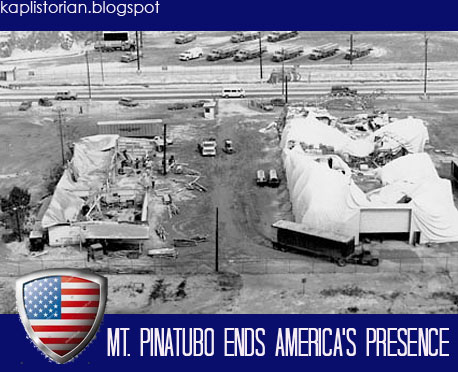

MT. PINATUBO ERUPTION ENDS AMERICA’S PRESENCE IN CLARK
As early as April, pilot in Clark have reported seeing ominous smoke emanating from Mount Pinatubo, a volcano that has not erupted in 500 years. When it was clar that an eruption was imminent, Clark mounted a massive evacuation  of 15,000 U.S. personnel and their dependents on June 10. The major June 12 eruption dumped tons of ash on Clark.  But another eruption in June 15, exacerbated by passing typhoon Yunya, further cause massive damages, and all but buried the military base in a sea of ash, mud, pyroclastic materials and lahar. About 2,500 servicemen and women stayed on to provide security and try to maintain basic services. Meanwhile, the extension of the Military Bases Agreement was rejected by the Philippine Senate, and was due to expire on September 16. Driven by budgetary realities (it would tae $500 million to rehabilitate Pinatubo-damaged Clark)  and nature's explosive whims, the U.S. did not renegotiate anymore and agreed to leave Clark Air Base in 1992 but keep the sprawling Subic Bay Naval Base for 10 more years. The U.S. Air Force formally transferred entire Clark to the Philippines on 26 November 1991, ending its 100 years in the Philippines. On 24 November 1997, the last U.S. forces left the Philippines.


THE CLARK AIRPORT BEGINS COMMERCIAL OPERATIONS, 1995
The airport was rehabilitated from the damaged US Clark Air Base that was  closed in 199. After two years of cleaning up debris and lava, the Clark Special Economic Zone was opened on the site with the airport at the center. In 1995, the Clark International Airport Corporation was established to manage the airfield facilities. In 1996, limited air service from Clark to Hong Kong began, signaling the first international flight. Renamed Disodado Macapagal Airport by Pres. Gloria Macapagal-Arroyo in 2003  to honor her father, it reverted back to Clark International Airport in February 2012. Today, Clark hosts 490 flights per week (332 Domestic flights, 158 International flights), with  19 local and 11 international destinations, as of June 2018.


CLARK HOSTS APEC MEETING 2015
The Philippines hosted the year-long Asia-Pacific Economic Cooperation (APEC) summit in 2015. It was held against the backdrop of Chinese intrusion f islands in the South China Sea, contested by several countries, like Vietnam, Japan, Malaysia, and the Philippines. The First Senior Officials' Meeting and Related Meetings were held at the Fontana Leisure Park, Clark Freeport, Angeles City and Subic Bay, Zambales, from 26 January to 7 February 2015. Kapampangan DFA-Undersecretary Laura Quiambao-del Rosario was chair of the summit.

SOURCES:
CLARK AS LOGISTICS HUB:
THE STARS AND STRIPES ARCHIVES “Vietnam wounded go 1st class on air ambulance (1965), U.S. SOLDIERS IN VIETNAM”: https://www.stripes.com/news/vietnam-wounded-go-1st-class-on-air-ambulance-1.292349
BOB HOPE: Bob Hope, The USO One Man Morale Machine https://www.uso.org/stories/154-bob-hope-the-uso-s-one-man-morale-machine
Bob Hope Special January 19th, 1966: https://www.youtube.com/watch?v=75jUL2E6tEQ&t=4120s
PHILIPPINE ADMIN OF CLARK: : http://www.clarkab.org/history/
CLARK EMPLOYEES’ STRIKE: http://www.clarkab.org/history/
MT. PINATUBO ENDS AMERICA’S PRESENCE: http://www.clarkab.org/history/
CLARK AIRPORT: https://en.wikipedia.org/wiki/Clark_International_Airport
Photo: I Remember Clark Air Base FB page
CLARK HOSTS APEC MEET:
Photo courtesy of Mick Basa/Rappler.

Sunday, March 4, 2018

75. 11 POINTS OF INTEREST IN AND AROUND PINATUBO IN 1925

In January 17, 1925, Capt. H.A. Myers of the 26th Cavalry, by order of Col. Cavanaugh, prepared and circulated a guide to provide persons interested in riding, with information concerning the best trails an roads to take when riding out of the Post proper. The Stotsenburg Reservation and nearby country, in general, offers much that is worth exploring, for there is a lot of beautiful scenery and many interesting landmarks to be found there. A list of these trails and scenic spots, in and around Pinatubo, as well as  Bamban, are contained in the memo. Some of the names and locations of these trails have been lost to memory.
**********

1. FERN CANYON
This canyon probably offers the finest scenery of its kind around Camp Stotsenburg and should be visited at least once by every person of the garrison. Here, one can see beautiful array of typical shrubbery, particularly ferns, the abundance and variety of which gives the canyon its name.

Wild fowl abound, especially the smaller birds many of which are bedecked with the brightest of plumage. After entering the canyon proper, it narrows down into a gorge only a few feet wide with walls of slid rock on either side varying from 75 to more than 150 feet in height. Huge trees jut out from the walls many feet overhead. Only at midday does the sun ever reach the depths of the canyon and the air is always cool and laden with the fragrance of wild flowers.

2. THREE-CRATER TRAIL
This trail, which forms part of the first part of the 24th Field Artillery China Sea Trail, is very much worthwhile. The trail follows along a canyon which opens out frequently into circular clearings similar to and probably are, very old craters. There is a heavy growth of plant life on all sides and birds and animal life abound. Interesting and unusual geological formations are frequently encountered. The stream which flows through this canyon furnishes a portion of Stotsenburg’s water supply and the water line and settling basin are passed shortly after entering the canyon. Here and there are short trails leading up into the surrounding hills. Persons talking this ride should try and follow the trail as far as the Bamban River which is encountered at the end of the canyon about 4 miles from the Post. Due to its being used throughout the year and forming part of the 24th Field Artillery China Sea Trail, this trail is generally in good shape. Take your camera.

3. LOST CANYON
Lying just south of the the larger and more imposing canyon of the Three Crater Trail, Lost Canyon is very frequently overlooked by equestrians but this oversight is the distinct loss of the latter because Lost Canyon, with its misleading off-shoots and dense growth offers a haven for the seeker of the unusual and uncertain. Entering the canyon, one passes through the gardens of several enlisted men, after which the narrow trail follows along a small stream. The canyon is narrow and overgrown with dense tropical shrubbery, vines and trees. Here, one can find everything in its natural state, there being few evidences of changes made by man. Vari-colored birds flit among the trees and shrubbery, unconscious if intruders, Air plants such as epiphytic orchids grace the front porches of most quarters in the Post and many varieties can be seen as they grow in their natural state. Lost Canyon extends for a considerable distance but for the mounted visitor, only about 1 mile. There are numerous off-shoots from the main trail easily mistaken for the latter, but all finally coming to an end in some inaccessible spot. No doubt, some early pioneer, after struggling to find his way through the canyon, found inspiration for giving it its name. This is a fine place to cool off on hot, tropical days.

4. SOUTH BOUNDARY TRAIL
Following along the Southern Boundary of the reservation from Camp Stotsenburg to Dau, this trail—which in reality is a second class road—offers an excellent route for person desiring to take a ride of several miles over level country. The dirt road is soft and makes a good footing for horses, particularly if gaits faster than a walk are desired. The trail, after being taken to the outskirts of Tacondo, leads almost directly east to Dau. From this point, persons can either return over the same route or take the main Stotsenburg-Dau road. The country along the entire route is level and if desired, one can ride cross-country or; make us of the numerous small trails which run in every direction.

5. SPANISH CUT-SECOND AND THIRD RIVER TRAILS
This is one of the most interesting rides that can be taken around Stotsenburg. Leaving the Post proper, the route leads past the Forage Farm, across Pistil Gulch to the Bamban River. In making the descent to the river, the trail leads down to a long steep bank, somewhat thrilling to ride down, but not at all dangerous if taken slowly. Crossing the river—which is never deep nor dangerous except in the rainy season—the trail leads into a deep cut covered overhead with trees and shrubbery. Following up the cut which is quite steep but accessible, the trail emerges at the top and leads on generally North between, over and around hills, across small streams and through thickets. The scenery here is beautiful. Second River is reached about 1 mile North of the Bamban, and the Third River is a large pool of cool, clear, sparkling water. This is an excellent place for swimming and in years gone by, it was quite the thing to arrange swimming parties here, tents being taken out  of pack mules for dressing rooms. There are any number of excellent sites along the route for staging picnics.

6. DRY RIVER BED TRAIL
This trail offers an excellent route for beginners as it runs through the sandy river bed, has an easy footing for horses and is about the best place one can find to fall off. This trail is also an excellent place to work frisky, nervous horses as the deep sand tends to quiet them down. Except during rainy weather, this stream bed can be followed to a point south east of Dolores and in very dry weather, even further. Trees line the stream bed forming natural barriers on either side. Beginners who are reluctant to try a trot or gallop should do their first work at increased gaits in this sandy stretch. In going over the trail, one can either ride down as far as a point south of Dolores and then return over the same ground or take the Banyan Trail leading through the Banana Grove and back to the Post via Air Service, Murrayville, etc.

7.BANYAN TRAIL
This is an excellent route to take for a short ride. One can leave the Post, cover this trail to where it joins the Dolores Road and return in about three quarters of an hour. The trail is taken near the Air Service then runs through the Banana Grove where the famous Banyan Tree is passed. There is a very dense growth in the Banana Grove and as the sun seldom filters through the thick foliage, it is always cool here. Leaving the Banana Grove, one can either return via the Dry River Bed or take the Dolores Road back to the Post.

8. THE ARTILLERY TRAIL TO THE CHINA SEA
The Artillery Trail to the China Sea constructed by the 24th Artillery is open from about the first of November to the first of July for individually-mounted parties and pack animals. A 2 ½ hour ride, without one hill, brings one to Camp 3 located on the Bamban River. An excellent place for a picnic or to camp (plenty of tent poles, benches and firewood always on hand). A good swimming hole about 200 yards from the camp. During this ride, you will pass through th  4 craters and are struck by the scenic beauty and marvelous rock formation, reminders of the Pre-Glacial  Age.

About a half hour’s ride from the fourth crater, the typical forest begins and continues to the base of Mount Pinatubo. The beauty and wonders of this forest cannot be appreciated unless seen. There is practically no animal life but abundant flora; ferns, air plants, orchids, giant fern trees and other tress 250 feet tall and 25 to 30 feet in diameter. Other beautiful flora peculiar to this forest only, and never named.

From Camp 3 to Camp 4 is about a 1 hour ride following the Bamban River over a practically level trail. Camp 4 is a good halfway camp if going to Pinatubo. Animals should be rested and packs removed before going up out of Bamban as at this point, the only difficult climb begins. The trail follows a gorge out of the Canyon of the Bamban and reaches the divide between the Bamban and Dry Pasig valleys. After following the divide for about four miles, you make a slight descent coming out of the forestand by a slight climb into Zambales Pass and Camp 6. The altitude of Camp 6 is about 4,000 feet The cool climate and invigorating atmosphere rivals Baguio. It is an excellent place to camp with plenty of good spring water available.

The view from Zambales Pass is incomparable with anything in the Philippine Islands. Looking back to the east, the plains of Pampanga are visible for scores of miles and to the West, the mountains of the coast and over them,the China Sea and the Capones islands. From Camp 6, you should ride about a mile further to the north and view Pnatubo Crater. It is beyond description with its walls rising from 500 to 2,000 feet. Parties should not attempt to go beyond this pint unless prepared to stay out sometime. Also, parties going beynd Camp 3 should consist of at least 5 persons, and should be armed.

9. TRAIL TO DRY PASIG
This trail requires about 4 hours to cover but is very worthwhile, and should be taken at least once by everyone. It runs from the Post proper to Sapang Bato Ridge, and then southwest through numerous cultivated areas, a hacienda, a large coconut grove, the latter the only one near the Stotsenburg reservation. Several pretty canyons are crossed and the country in general, offers much in scenic beauty. The trail terminates at what is known as Dry Pasig, a stream bed usually having little, if any, water but deriving its name from the fact that the head waters of the Pasig River originate in this area. The trail, of course, continues on further from this point, but persons coming from Camp Stotsenburg will hardly care to ride beyond.

10. GRIFFITH’S PEAK
The ride to the summit of Griffiths Peak is one of the nicest that can be taken in or around Stotsenburg. The climb up the Peak is steep but not difficult, and once at the top, one can get a very excellent vew of the country for miles around. On clear days, the Central Luzon Valley stretches out to the east and is plainly visible as far as the mountain ranges that run North and South along the Pacific coast of Luzon. Angeles, San Fernando, San Pedro Magalang, and in fact, all of the towns and barrios to the east and South can be seen on clear days. If one cares to take the ride, there is a rail running down the northwestern slope of Griffiths Peak that leads to a point on the Bamban River just above the Intake Station, the latter being where Stotsenburg secures its water supply. The trail from the high South bank of Bamban, down to the stream bed where the Station is located is too steep to be attempted by a horse. However, persons can go down dismounted with no difficulty and should do so as the spot where the Station is located is picturesque. At one point near is a long tunnel where the water line runs under a high hill. This tunnel is large enough for a person to walk through and offers an interesting diversion for persons desiring to explore . This trip should best be taken after the grass has been pruned off and only in dry weather.

11. TOP ‘O THE WORLD
This hill is reached by so many trails that any attempt to describe them all is difficult and unnecessary. It is possible to approach the hill from most any direction and encounter a trail or several of them. However, there are a few general routes over and around the hill which offer the best footing and are therefore the most advisable ones to follow. First, there is a trail which runs West along the crest of a ridge that begins back of the T line. This trail goes over the Reservoir Hill and on along the ridge, turns North and then  goes to a point on the South side of Top ‘O the World. From here, one can go up to the uppermost point on the Top ‘O the World or else proceed on West along the south side of the hill, and then northwest along the ridge that runs along the Top ‘O the World to Griffiths Peak. From the highest point of Top ‘O the World, there is a trail that running dwn the crest of the ridge in a northeasterly direction. This is called the “Knife’s Edge” . The trail is very narrow with steep slopes on either side. None but the very experienced rider who has confidence in his horse should ride over this portion of the trail. The view from Top ‘O the World is excellent. Persons desiring to cover a formidable but safe hill trail should take one of the several trails leading up and around Top ‘O the World, as they are all in good condition, well-travelled and offer no onstacle which the average rider on the average horse should not be able to negotiate.

CREDITS, PINATUBO TRAILS:
NOTE: While most of these photos are Stotsenburg photos, some are representational.
Banyan Forest picture (representation only): https://www.flickr.com/photos/nitinmnair/3968634739, posted by Alel, 30 Sep. 2009

Wednesday, December 27, 2017

69. 10 PLACES IN CLARK AND THE NAMES BEHIND THEM

When one goes to Clark today, he passes avenues like C.M. Recto, G. Puyat, M.A. Roxas, K. Laxamana---all names of Filipino statesmen, heroes and personalities. But in the not-so-distant past, when Clark was still a piece of America in Pampanga, its  major thoroughfares and buildings bore ‘stateside’ names like Dyess, O’Leary, Kelly, Levin, Mitchell, Wagner among others. Not many Kapampangans know the faces behind these names today, so here are a few of them.
**********


CAMP STOTSENBURG, named after Col. John Miller Stotsenburg
The future Clark Air Base started as an unnamed camp established six miles northwest of Angeles town by soldiers of the 5th U.S. Cavalry regiment on Dec. 26, 1902.  It was the tradition to name camps after American soldiers killed in the Philippine-American War, and that was how Col. John M. Stotsenburg, killed in action on April 23, 1899 near Quinga, Bulacan, came to be immortalized when the cavalry post was named after him. A graduate of West Point (1881) and  the Infantry and cavalry School at Fort Leavenworth, Kansas (1897), Col. Stotsenburg was assigned to the Philippines to lead the 1st Nebraska Regiment as their battalion commander. In an unplanned engagement on April 23, Col. Stotsenburg ordered an immediate advance to fight the Filipinos. Moments later, he was shot in the chest and killed; he was only 40 years old.


CLARK FIELD, named after Maj. Harold Melville Clark
The first airplane landing field were just long dirt landings scraped from the ground in 1919. Eventually, a more expansive airfield was built, asphalted and expanded before World War II. The airfield would be named after Maj. Harold M. Clark, a Philippine-educated American (Manila High School, 1910, future president Manuel A. Roxas was a classmate), who received his pilot’s wings in March 1917. One of the first aviators in Hawaii, Clark was flying his seaplane in the Panama Canal Zone when it crashed on May 2, 1919. The young pilot was killed but his name would live on, overshadowing the original camp name, and by the 1960s, the camp complex  together with its airfields, would be known Clark Field or Clark Air Base.


BOBBITT THEATER, named after Col. Aubrey Malcolm Bobbitt
The popular movie house of Clark that was favorite of  American servicemen, their families, as well as Wagner High teens, screened the latest blockbuster films from the 60s thru the 90s--from “The Thing” “Saturday Night Fever” ,”Jaws”, to “American Werewolf in London”. Bobbitt stood next to the BX, across from what used to be the main gas station, in the same parking lot of what was once the American Express Bank. It was named after Col. Aubrey M. Bobbitt (b. Jan. 25, 1940/d. Aug. 29, 1971), base commander and the commander of the 6200th Air Base Wing, in September 1972. Col. Bobbitt had an illustrious 29-year career in the U.S. military, serving in Newfoundland, Europe and the Philippines. He died at the USAF Hospital of heart attack. Bobbitt Theater, post-Pinatubo, it became a hotel, a cocktail lounge (“Forbidden City”), and is  now part of the Widus Hotel and Casino complex.


BONG HIGHWAY, named after Maj. Richard Bong  (now Manuel L. Quezon Avenue)
Bong Highway has such a local ring to it, sounding much like a common Pinoy nickname. But this major Clark road which leads to the Mimosa main gate (now a Filinvest  property),was named after a World War II Medal of Honor recipient, Major Richard Ira "Dick" Bong (b.Sep. 24, 1920/d. Aug. 6, 1945). One of t host decorated fighter pilots, Major Bong is known for downing 40 Japanese aircrafts in his lifetime. Tragically, he died in California while testing a jet aircraft before the war ended.


DYESS AVENUE, named after Ofcr. William Edwin Dyess (now, C.M. Recto Highway)
William Edwin "Ed" Dyess (August 9, 1916 – December 22, 1943) was an officer of the United States Army Air Corps during World War II. He was in command of the 21st Pursuit Squadron tasked to defend Clark. He was captured after the Allied loss at the Battle of Bataan and endured the subsequent Bataan Death March. After a year in captivity, he escaped and spent three months on the run before being evacuated from the Philippines by a U.S. submarine. Once back in the U.S., he recounted the story of his capture and imprisonment, providing the first widely published eye-witness account of the brutality of the Death March. He returned to duty in the Army Air Forces but was killed in a training accident months later.


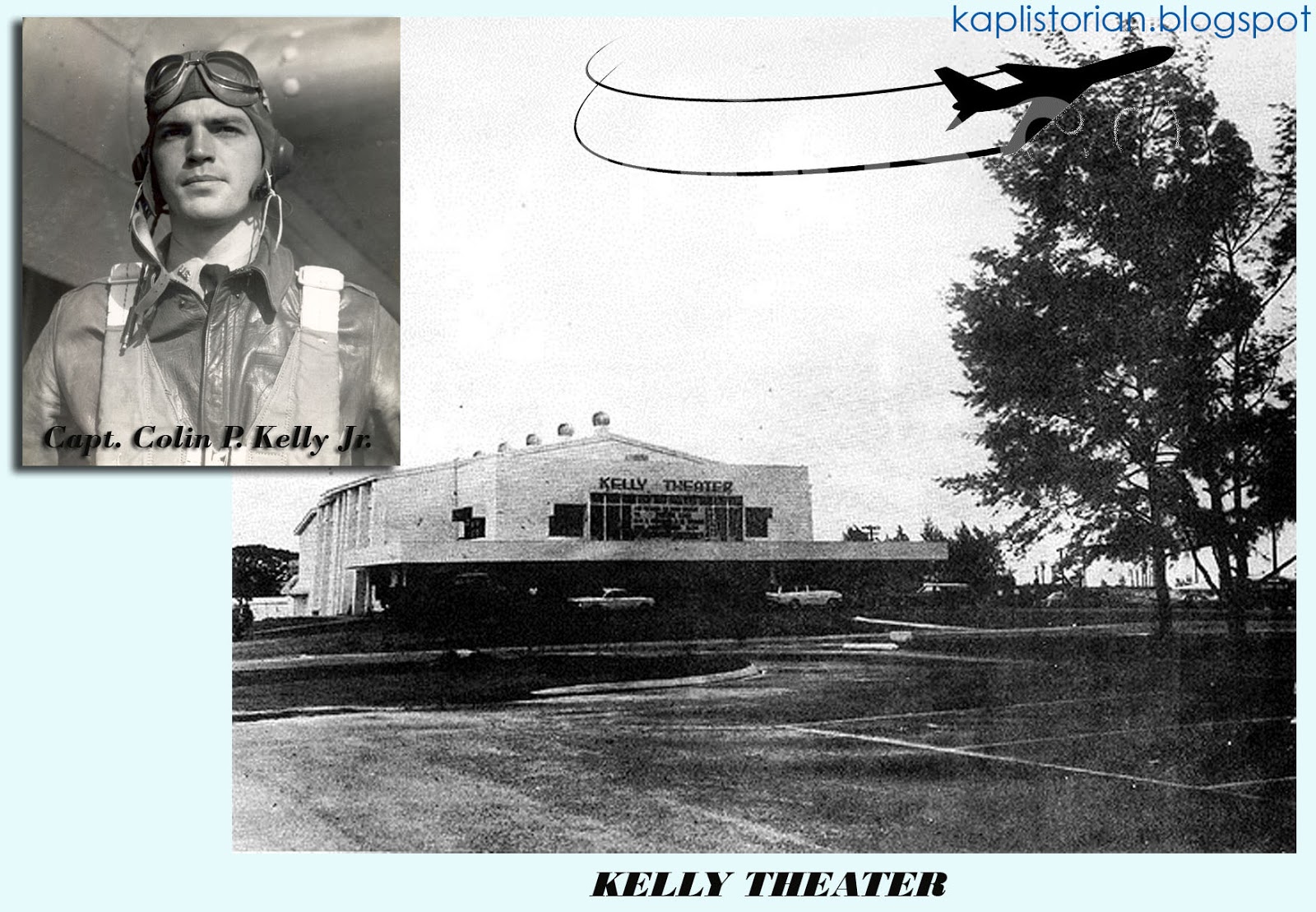
KELLY THEATER, named after Capt. Colin Purdue Kelly Jr.
One of the historic buildings in Clark Air Base was the Kelly Theater, constructed in 1953, the only cinema house in Clark and the venue of many stage plays and cultural shows. There was an earlier Kelly Theater built earlier—in 1947—that was converted from an old gymnasium. Both theatres were names after B-17 pilot Capt. Colin P. Kelly Jr. (b.Jul. 11, 1915/d. Dec. 10, 1941)  who died in action against the Japanese forces in 1941. Kelly’s damaged plane, while returning from a bombing run, blew up near Clark Field after being engaged by enemy forces. Capt. Kelly was declared America’s first hero of WWII by US President Franklin D. Roosevelt.  The memorial statue of the fallen captain was inaugurated on the theater grounds on 10 Dec. 2007—the 66th year of his passing. Kelly Theater, located at the cor. Ninoy Aquino Ave. and Foxhound St., survived Mt. Pinatubo, but eventually everything from the seats to the roof and front walls were stolen.


MEYER LEVIN GYMNASIUM, named after Master Sgt. Meyer Levin
The gymnasium facility on Dau Avenue, east of the Parade Ground was named after Meyer Levin in 1955, a master sergeant of the U.S. Army Air Corps. Raised in Brooklyn, New York, Levin (b.Jun 5, 1916/d.Jan. 7, 1943)—who had wanted to become an aviator—became a bombardier and flew with Capt. Colin Kelly after the Japanese attack of Clark Field. During his last mission on January 7, 1943, Levin volunteered to bomb the Japanese convoy ships that was approaching Australia. The weather worsened, and as the plane used up its fuel, the crew bailed out as the planed ditched the water. Levin remained in the plane to release the rafts that saved his crew. He died in the crash and is listed as one of those missing at Manila National Cemetery. Levin was awarded the  Distinguished Flying Cross (for successfully bombing the Japanese warship “Haruna”) and a Purple Heart for his heroic war feats.


MITCHELL HIGHWAY, named after Brig. Gen. William Lendrum Mitchell,  (now J. Abad Santos Avenue)
One of the most travelled roads in Clark—the Mitchell Highway-- stretches all the way from the Mars Station, then passes close to the Parade Grounds, and leads all the way to the Friendship Gate. It was named Philippine-American war veteran, Gen. William “Billy” Mitchell (b.Dec. 29, 1879/d.Feb. 19, 1936), regarded as the father of the United Sates Air Force. Gen. Mitchell also saw action during World War I in France, and even commanded the American air combat units in that country post-war. In 1924, he returned to Pampanga to revisit  Camp Stotsenburg where he even gave flying lessons to Gen. Emilio Aguinaldo, whom he had helped capture. The North American B-25 Mitchell—an American military aircraft design—was also named in his honor.


WAGNER HIGH SCHOOL, named after 1st Lt. Boyd David Wagner
The beginnings of Wagner High School and Middle School could be traced back in 1957-58 when the Grades 7-12 of Wurtsmith High transferred to individual wooden buildings at the former Chapel Center. That site that will eventually be renamed Wagner High School. The school was named after 1st Lt. Boyd David Wagner, of the U.S. Army Air Corps, who commanded the 17th Pursuit Squadron that was ordered to protect Clark. On Dec. 14, 1941 shot down four Japanese airplanes, and 2 days later, downed another enemy aircraft at Vigan. Thus, he became the first American World War II Ace, and for which he earned him a Distinguished Service Cross. Wagner was nearly blinded in the Lingayen Gulf battle, but survived and evacuated to Australia where he recovered.Later, he was sent back to the U.S. to train new fighter pilots. On  Nov. 29, 1942, Col. Wagner disappeared while on a flight from Florida to Alabama. His plane wreckage was found six weeks later, some 4 miles north of Freeport, Florida. His remains are buried at Grandview Cemetery, Johnstown, Pennsylvania.


WURTSMITH MEMORIAL SCHOOL, named after Maj. Gen. Paul Bernard Wurstmith
 The Clark Dependents’ School opened in 1947 to accommodate school-age children. In 1950, it was moved to another used office building that would be renamed in 1954 as Wurtsmith Memorial  High School. It was name in memory of Maj. Gen. Paul Bernard Wurtsmith (b. Aug. 9,1906/Sept. 13, 1946), who became a flying cadet in 1927. Over the next 13 years, he served in command positions and his fighters’ feats include downing 78 enemy aircraft in the defense of Darwin in Australia, against the Japanese. In 1945, he commanded the 13th Air Force in the Southern Philippines campaign. Wurtsmith was killed when his plane crashed in the mountain area near Asheville, North Carolina. The Clark school that bears his name would have a new air-conditioned building on the former site of the Stotsenburg base picnic grounds in 1961. Construction of an expanded campus complex began in 1989, and the newly-renovated Wurtsmith High opened for schoolyear 1990-1991. The Pinatubo eruption (which occurred just a week before the end of the school year) forced the transfer of the graduation rites to Subic. The school was later demolished and replaced with Fontana Casino.

BONUS!
A hill in Clark bears a peculiar name, because it was not named after a person, or even after a flower, as its name suggests.


LILY HILL
Lilly Hill first appeared on an 1898 map, and is thought to have been derived from the Kapampangan  word “lili”, which means “lost”. The Americanized name was apt because it was easy to get lost on that hill which stood separately from other hills in the area. Used as an observation point by Americans from 1903--42, it was also used by the Japanese for the same purpose. It would become the stronghold of the Kembu Group which defended Clark from late 1944-45. Post-war, a USAF aircraft warning and control unit was put up in the summit until 1962. A Buddhits shrine was built on the hilltop by the Japanese in 1998 on  the 54th commemoration of the Kamikaze. It features a large 5-ton granite statue of Kannon, the "Goddess of Peace ".

SOURCES:
Camp Stotsenburg:
Pix of Camp Stotsenburg: Alex Castro Collection
Pix of Col. John Stotsenburg:
Clark Air Base:
Pix,:Harold Clark: An Annotated Pictorial History of Clark Air Base,  by David Rosmer
Bobbitt Theater:
Pix of Bobbitt Theater: www.margaritastation.com
Bong Avenue:
Pix: Welcome to Clark Air Base, Guardian of Philippine Defense booklet
Dyess Highway:
Pix: Welcome to Clark Air Base, Guardian of Philippine Defense booklet
Kelly Theater:
Pix: An Annotated Pictorial History of Clark Air Base,  by David Rosmer
Pix of Colin P. Kelly: Aces of WW2, http://acesofww2.com/bombers/41/
Meyer Levin Gym:
Pix: An Annotated Pictorial History of Clark Air Base,  by David Rosmer
Mitchell Highway:
Pix: Welcome to Clark Air Base, Guardian of Philippine Defense booklet
Wagner High School:
Pix of Boyd Wagner: Photograph by Carl Mydans for TIME & LIFE Pictures),  (Colourised by Doug)
Pix: Wagner High School, 1971, collection of K. Morgan
Wurtsmith Elem. School:
Pix of Wurtsmith School: http://www.clarkab.org/history/
Lily Hill:
Pix: An Annotated Pictorial History of Clark Air Base,  by David Rosmer
Images: 
Pix; clarksubic.com

Wednesday, October 4, 2017

63. INSIDE CLARK AIR BASE: 13 VINTAGE IMAGES FROM THE 1960s

Clark Air Force Base, straddling parts of Angeles and Mabalacat, is the headquarters of the U.S. Thirteenth Air Force. This modern, fully equipped air base is the nerve center of the Unites States Air Force operations in Southeast Asia. Let's take a look at what's inside Clark, in the 1960s.
 **********
1. OFFICERS’ OPEN MESS
The tastefully furnished, air conditioned CAB Officers’ Club holds events like dances, variety shows, game nights, bridge tournaments, buffet and family dinners. The club is famous for its charcoal broiled foods and excellent services available at the downstairs “Rathskeller”. Adjacent to the main building, one can find a barber shop, beauty salon, an outdoor patio and a swimming pool.

2. THE ‘TOP3’ NCO CLUB
Touted as ‘the finest in the air force’, the NCO club has an indoor patio that can seat 1100 persons. It features a beautifully-decorated bandstand manned by a 16-piece dance band which plays 6 times a week, while Western music holds forth the other night. The plush cocktail lounge—"T-Bar-3 Room"—is a fine place to relax and bask in the Western-style atmosphere complete with cattle horn dĆ©cor and Western rug. The NCO Club also has a Stag Room and an air-conditioned barber shop.


3. AIRMEN’S CLUB
The Airmen’ Open Mess, established in 1954 on Bong Highway,  is a favorite spot of ‘lower four’ airmen. Recently remodeled in the early 1960s, it has a Stag Room, cocktail lounge, TV and game room, an enlarged dining area and a ballroom with a distinctive tropical motif. The club features dancing nightly, Sunday breakfasts, floor shows, game nights, and a weekly “Mr. Big Shot” contest where the winner gets a free all-expense paid weekend in Manila. This facility was later renamed Coconut Grove.


4. SILVER WINGS SERVICE CLUB
The Silver Wing Service Club is a recreation center, constructed in 1949, that provides a host of activities for personnel and their dependents—from games, pool, billiards, ping pong, shuffleboard, badminton, plus card and games of all types.  The Mars-o-Gram, the base telegraph office, is also housed in this club. The spacious main lounge is equipped with a stage and a superb dance floor. Weekly programs include Sunday morning coffee hours, square dancing, USO Shows, Grand Ole Opry entertainment and Manila specialty attractions. One of the most popular is “Stateside Calling”, where base personnel can send messages and requests to their loved ones via their hometown radio, through the facilities of the Clark radio station.


5. ARMED FORCES RADIO AND TELEVISION STATION
Clark TV is available on Channel 8, and offers approximately 8 hours of TV enjoyment every day, with special presentations such as sports events, feature movies, and canned popular U.S. TV series, like “Perry Mason” and “Rawhide”. The best in stateside viewing from the 4 major TV networks can be seen daily. In addition, local talent shows, such as Pantomime Teens and others are also shown.  Round the clock radio—1220 on the dial is provided. UPI (United Press Int’l) and AP (Associated Press)  wires and over 250,000 transcribed musical selections offer the best for everyone’s pleasure.


6. CHAPEL 1
Clark Air Base has 3 base chapels with 8 staff chaplains of different denominations to cater to spiritual needs of Clark servicemen and their families. They are used daily and weekly by members of all religions and for various services (Protestant Sunday service, Sunday School, Episcopal, Christian Science, Jewish Service, etc.). Catholic Mass is said 7 times on Sunday, and twice daily. Baptisms, weddings and other religious ceremonies can also be conducted in the chapels. The Chapel 1, which started as a single standing structure along Dyess Highway (now Recto Ave.), was expanded in the 1960s and installed with air conditioning.  Damaged by the Pinatubo eruption, Chapel 1 underwent a series of rehabilitation and improvements, and is now known as the Chapel of Our Lady of Remedies.


7. CLARK AIR BASE HOSPITAL
Opening its doors in December 1964, the new, $5 million Clark Air Base Hospital was built over a period of 4 years to answer the primary health care of U.S. military personnel and their dependents stationed not only in the Philippines, but all over Southeast Asia. It was equipped with the most modern facilities for almost all kinds of medical care , except heart surgery and neurosurgery. It had a Laboratory, X-ray facilities, a Pharmacy, and an efficient Emergency Room open 24/7. The hospital personnel is mostly American, including its nursing staff. Interestingly, the hospital also offers specialized training services to Filipino medical residents in the fields of veterinary medicine, sanitation, immunization and public health care. Now in ruins, the hospital was featured by the US TV show, “Ghost Hunters” for supposed paranormal activities happening in there.


8. HOBBY SHOP
The base hobby center, along Marrat Highway,  comes complete with equipment and instructors, plus many departments that cater to every type of major hobby: Woodworking, Leathercraft, Photography, Ceramics, Graphic and Fine Arts, Hi-Fi and Electronics, Lapidary, Model Building and even Automotive. Two hobby stores are maintained at the center for arts and crafts supplies. The model center has all the materials and tools needed to build models of just about everything, with a flying circle for model airplanes and a model car track.


9. BX (BASE EXCHANGE) AND COMMISSARY
The Base Exchange facilities in Clark includes a spacious main building and surrounding support buildings that contain every solution to almost every shopping problem. In the main store alone, on O’Leary Avenue, 10,000 items are offered. There are 7 BX branches scattered around the base for shopping convenience, all carrying many imported items as well as standard stateside purchases. The main BX is surrounded with fresh vegetables stores , jewelry and watch repair shop, shoe store, travel agency, radio-TV shops, tailors, barbers and beauty salons. Also in operation is a modern service station that offers standard services as well as motor,  scooter and U.S. spare parts sales. Adjacent to the BX is the local commissary with food stocks, frozen meats, canned goods, fresh produce, egg and poultry. A bakery, milk and ice cream plant are also on the BX grounds to supply bread, cakes and dairy products  of ” stateside quality”. A new Base Commissary along Dyess Highway was opened in April 1984, containing state-of-the-art equipment and marketing concepts, built at a total cost of $6.2 million.  At the time of its construction, it was the largest in the world.


10. PERMANENT AIRMEN’S QUARTERS
Housing in Clark began in 1919 with the creation of dormitories for servicemen. Modern in-base housing in the 60s already included buildings like this 2-storey, permanent airmen’s quarters, designed to make the most of the tropical breeze. These are furnished with the most essential items of furniture. Married officers and eligible civilians can plan on a 9-month delay in getting government quarters. The majority of the people obtain housing off-base until government housing becomes available.


11. BACHELOR OFFICERS QUARTERS
Bachelor-type quarters are available for single officers an those awaiting their families. Generally, these consist of a furnished room complete with refrigerator and bathroom facilities. They are designed for tropical living, with louvres and very little glass to allow unhindered ventilation. The Bachelors Officers Quarters are in the hill area, near the club annex, and are equipped with carport areas beneath them.


12. EDUCATIONAL FACILITIES
Elementary, secondary, vocational and college level courses are conducted in on-duty and off-duty classes at the base. The Wurtsmith Memorial School (1954), a modern school designed for “tropical teaching and learning”, is tuition-free to school-age dependents of military and civilian personnel at Clark. All textbooks, work books and other supplies are furnished to the students free of charge; papers and pencils are issued on regular schedules to meet their needs. Wurtsmith would be renamed Wagner High School in 1962. A decade earlier, in 1953, a branch of the University of the Philippines was established as a base residence program leading to a liberal arts degree.


13. SPORTS FACILITIES
Complete sports facilities include the Meyer Levin Gymnasium (built in 1955), just east of the Parade Ground, with courts for handball, squash, basketball and volleyball. A brand new football stadium called “Bamboo Bowl” and a well-lighted baseball diamond  are also available for use. The  sprawling Clark Golf Club with a challenging 18-hole course, practice green, driving range an club house is a must-stop fpr golf enthusiasts. There are 3 swimming pools in the base, where swimming classes are conducted regularly. A year-round program of sporting events have been developed to appeal to active athletes and spectators alike: from King Football, Little League baseball, Interservice League competitions, Powder Puff softball, basketball, volleyball and golf tournaments to boxing bouts, target shooting, horseback riding, diving exhibitions.

SOURCE:
Welcome to Clark Air Base Philippines booklet, ca. 1965