Showing posts with label Aurelio Tolentino. Show all posts

Saturday, August 25, 2018

91. 24 SIGNIFICANT BOOKS ABOUT PAMPANGA YOU MUST KNOW, part I

Books written about Pampanga, its people and culture, including its language, literature, history. Some of these books were written by foreigners, others by local writers, in Spanish, in English, and in Kapampangan— great reading essentials to know more about our province. Here are the first 12:
**********

1. VIDA DEL GLORIOSO S. NICOLAS, TRADUCIDA EN YDIOMA PAMPANGO, por el P.R Phelipe Tallada, del orden N.P.S. Agustin, el año de 1614. (Life of the Glorious Saint Nicolas, Translated in the Pampango Language by Rev. Fr. Felipe Tallada, of the order of St. Augustine, in the year 1614).
Significance: This is the first ever book published in Kapampangan, in 1614. It is a biography of the life of St. Nicholas, with prayers and reflections.


2. ARTE Y REGLA DE LA LENGUA PAMPANGA, Compuesto por el Padre Predicador  Fray Francisco Coronel y prior misionero del Convento de Macabebe, 1621. (Kapampangan Grammar and Rules, by Fr. Francisco Coronel, prior of Macabebe, ca, 1621)
Significance: The earliest Kapampangan grammar and rule book in existence.  In 2005, it also became the first Kapampangan grammar book from that period to be transcribed, translated  and annotated in English, by Fr. Edilberto V. Santos. The book still contains the original text with a parallel English translation.


3. VOCABULARIO DE PAMPANGO EN ROMANCE Y DICCIONARIO DE ROMANCE EN PAMPANGO, by Fray Diego Bergaño, first published in 1732, reprinted 1860, 1916.
Significance: This Kapampangan dictionary and glossary book of over 5,177 Kapampangan word entries by the Augustinian priest Bergaño represent not just one of the earliest extant studies of our language, but also probably, the most scholarly and comprehensive. A translated English version was published by the Center for Kapampangan Studies in 2007, along with a Bergaño’s companion grammar book, “Arte de la Lengua Pampanga”, first published in 1729.


4. EJERCISIO COTIDIANO, by Dña. Luisa Gonzaga de Leon, ca. 1844.
(Book of Daily Devotions)
Significance:  Ejercisio Cotidiano (Daily Devotions) is a book of prayers, meditations and reflections, written by Bacolor-born Luisa Gonzaga de Leon (b.1805/d.1843),  printed in Spanish in 1844. This makes her the first Filipino woman to publish a book. In 1910, the book was translated into Kapampangan.


5. ING MACUYAD A PAMAGSALITA DIQUIL QÑG BIE NANG DELANAN AT PANĞATIMAUAN NING METUNG A MEBIJAG. By Fernando Garcia OSA. Published 1900. Imprenta del Colegio de Sto. Tomas. (Translated as “An Epistle of a Friar-Prisoner”, by Lino L. Dizon, 2007).
Significance: A rare account of the captivity of an Augustinian priest, P. Fernando Garcia OSA, written by the Spaniard himself in Kapampangan,  during during the Philippine revolution. It includes accounts of his “sorties from town to town and provinces” as prisoner and missionary at the turn of the century. His observations were critical of the treatment religious received from the revolucionarios. He escaped in Bontoc, reached Manila to write about his trials and tribulations as a POW.


6. GONZALO DE CORDOBA, Comedia Heroica de la Conquista de Granada o sea Vida de Don Gonzalo de Cordova, Llamado el Gran Capitan. By Fr. Anselmo Jorge Fajardo, ca. 1830s. published 1912, by Cornelio Pabalán y Byron. (Heroic Comedy of the Conquest of Granada or The Life of Don Gonzalo de Cordova, Called the Great Captain)
Significance: The longest comedia (also called “moro-moro”) in Philippine literature, the play about the exploits of Capt. Cordoba took seven nights to perform, as the lines alone numbered 31,000. When published, the book was 832 pages long. No wonder, it was only published once, over a century ago.

7. NAPUN, NGENI’T BUKAS, by Aurelio Tolentino. “Ing dramang ‘Napun, Ngeni’t Bukas’ kesukul ne ning ginawa at meatulan king apat a kasalanang sedicion, conspiracion, rebellion at insureccion laban king gobierno Americano”. 1914, Limbagang Noli. (The drama Yesterday, Today and Tomorrow caused the writer to be jailed and charged with 4 crimes: sedition, conspiracy, rebellion and insurrection against the American government).
Significance: This is Tolentino’s play first staged to a jampacked crowd in 1903 at Teatro Libertad. A key scene called for one Tagalog performer to bring down the American flag and then trample it, but the actor froze when he saw Americans in the audience. Tolentino ascended the stage and did the act himself. He was found guilty of “scurrilous libel’ for desecrating the Stars and Stripes,  and was imprisoned.


8. A CHILD OF SORROW. A Novel by Zoilo M. Galang. 1921.
Significance: The first novel in English written by a Filipino. The novel-- was made into a movie in 1930. Zoilo Galang of Bacolor, also was an encyclopedist, who put together the 10-vlume “Encyclopedia of the Philippines” published in 1934-36.


9. HISTORIA NING FILIPINAS. By Santiago Mallari. 1933 (History of the Philippines)
Significance: This slim volume is the first comprehensive Philippine history book in the Kapampangan language. It also has an account of the battle exploits and death of Tarik Soliman, the boy warrior of Macabebe. The book also devotes a section on the  Kalantiao code in Kapampangan, which has since been debunked.


10. PAMPANGA DIRECTORY, Agricultural, Commercial, Industrial, and Professional Guidebook of the Province of Pampanga, The Richest Market Outside Manila. Vol.I, by Manuel David, Managing Editor. 1933.
Significance: This limited edition book, published to commemorate the holding of the 1933 Pampanga Carnival and Exposition, gives us a snapshot of the province in the area of agriculture, commerce, and industries, etc.  during the peacetime era.  All 21 municipalities of the province are represented here, including history, key people, geographical info, products,  among others.


11. NINU’T NINU QNG CAPAMPANGAN, Bilungan Dang Bie ding Anac nang Carangalan Ning Lalawigan Capampangan, by Faustino Gutierrez. 1934 , Catimawan Press.(Who's Who in Pampanga.,  A Compendium of the Lives of the Honorable Children of Pampanga Province).
 Significance: The limited edition book contains photos and brief biographical entries of the leading personalities, families, movers and shakers of Pampanga during the Commonwealth years.


12. A BRIEF HISTORY OF THE TOWN OF ANGELES (From its Foundation in 1796 A.D. to the Present), and his other Writings. By Mariano A.Henson. 1948, Katiwala Press.
Significance: For decades, this was the only widely-referenced published book on the history of Angeles town (reprinted 2002), written by Angeles’ venerable historian and genealogist. His major opus— “The History of Pampanga and its Towns” (rev. 1965)–remains in typewritten and mimeographed form—and continues to be consulted by Kapampangan scholars.

SOURCES:
Singsing Magazine, various issues, Center for Kapampangan Studies, HAU.
Dizon, Lino L. The Epistle of a Friar-Prisoner, as written by F. Fernando Garcia OSA, Center for Kapampangan Studies, HAU.
A Child of Sorrow: http://thessalythea.blogspot.com/2015/07/a-child-of-sorrow-biographical-analysis.html
Historia ning Filipinas, Pampanga Directory, Gonzalo de Cordoba, Napun, Ngeni't Bukas: Alex R. Castro Collection

Wednesday, June 28, 2017

52. 9 KAPAMPANGAN ZARZUELAS

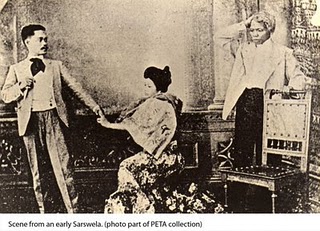
Zarzuelas were Spanish musical play productions that were introduced in the Philippines in 1879. Three years later, the performing troupe of Sr. Alejandro Cubero staged a zarzuela in San Fernando that inspired Kapampangan playwrights, poets, dramatists and musicians to create local zarzuelas.  It is said that zarzuelas spurred the golden age of Pampango literature, that saw the rise to prominence of great writers like Soto, Galura and Pabalan Byron.
******

ING MANAGPE (1900, Mariano Proceso Pabalan Byron)
The very first zarzuela in Kapampangan was written by the Bacolor playwright, Mariano Proceso Pabalan Byron (2 Jul. 1862/d.1 Jan. 1904). Entitled “Ing Managpe” (The Patcher), it premiered at the famed Teatro Sabina in September 1900. The one-act comedy revolved around the marital spats of Don Diego and her jealous wife Dña. Juana, that were always “patched” by their maid Sianang. The other “patcher” refers to Sianang’s boyfriend, Pablo, who pretended to be a spotted dog. Amado Gutierrez David provided the music for this popular zarzuela that struck a chord with the audience for its very Filipino theme of domestic quarrels. “Ing Managpe” also earned for Pampanga the distinction of being the first province to have a zarzuela in the vernacular. In fact, it is much older than Severino Reyes’ “Walang Sugat”.Ing Managpe” was last staged at Holy Angel University, Angeles City in 2006.

ALANG DIOS (1901, Juan Crisostomo Soto)
Juan Crisostomo C. Soto’s (b. 27 Jan. 1867/d. 12 Jul. 1918) “Alang Dios” (There is No God) is a 3-act zarzuela grande that was first staged at the Teatro Sabina in Bacolor on 16 Nov. 1902, a year after it was written by Pampanga’s best known literary great. It is a tragic love story that involves Enrique, an impoverished painter,  and Maria Luz, daughter of a wealthy Don Andres. Enrique, falsely accused of stealing a diamond crucifix belonging to the Don, is jailed. Upon release, he learns of Maria Luz’s impending wedding to Ramon. Meanwhile, Clara, a maid of Maria Luz, confesses to have faked the theft that led to Enrique’s incarceration; this was too late to stop the wedding. To prevent a duel between Enrique and Ramon, Don Monico intervenes and reveals that Enrique and Ramon are really half-brothers, and that Clara and Maria Luz are half-sisters. Finally reconciled, the brothers come home to find Maria Luz dead, leading them to exclaim, “there is no God!”.  The music was composed by Pablo Palma. Soto’s masterpiece was staged at Cultural Center of the Philippines in 1975. On the writer’s 150th birth anniversary, “Alang Dios” was once again staged in Angeles City on February 2017, featuring many Soto descendants as performers.

ING POETA (Aurelio Tolentino)
The prolific and controversial writer from Guagua, Aurelio Tolentino (b. 15 Oct. 1868/d. 3 Jul 1915) wrote proficiently in 3 languages: Spanish, Tagalog and Kapampangan. Of his 69 known literary works, 21 are in Kapampangan—and his zarzuela “Ing Poeta” is one of them, a comedy of errors revolving around the exploits of poet Augusto and how he won the hand of Maria, after successfully staging a merry mix-up of a play in response to Maria’s father’s (Don Pedro) challenge to put up an entertainment, in time for the fiesta. The clever Augusto hatched a plan in which Don Pedro, Don Cumeris, his wife Calara, plus the town people became the actors themselves, of the real-life zarzuela--without their knowledge.

ING MORA (Felix Napao Galura)
Felix Galura Napao (b. 21 Feb.1866/d. 21 Jul. 1919) was a brilliant grammarian, poet, translator, editor, journalist, patriot and town leader of Bacolor. Because he believed that Spanish literary forms with nonsensical, fantastic scenes were the main cause of the backwardness of Filipinos, Galura began translating Spanish works into the vernacular. With Juan Crisostomo Sotto, he wrote the zarzuela “Ing Singsing A Bacal” (The Ring of Steel) which was based on a Spanish play. His only surviving zarzuela today is “Ing Mora” (The Moslem Woman). An undated typescript of the one-act zarzuela in verse is kept at the University of the Philippines library.

EMU CU TATAGQUILAN ( ca. 1915-18, Juan Elias de Guzman)
Juan Elias de Guzman, a Mabalacat resident, is the first known writer in Spanish and Pampango. He took Jose Rizal's Noli Me Tangere and transformed it into a Kapampangan zarzuela entitled “Emu Cu Tatagquilan” (Don’t Touch Me). The lead performers were Gerardo Castro as Crisostomo Ibarra, Amalia Malig as Maria Clara and Mariano de la Cruz as Pilosofo Tacio. Francisco Siopongco (Alcalde), Emilio Dominguez (Padre Salvi), A. de la Cruz (Elias).There were no theaters to speak of; instead, plays were staged on platforms constructed near the San Felipe Bridge.  The play was directed by J. L. Mendoza. When de Guzman died, it was said that Rizal's portrait fell from the wall at the precise moment of his death 1. He was the first to be interred in the Municipal Cemetery of Mabalacat, constructed in 1907.

LA INDEPENDENCIA (Jose Gutierrez David)
 The acclaimed Supreme Court justice from Bacolor, Jose Gutierrez David (b.19 Jan. 1891/d. 27 Mar. 1977) was, on the side, an accomplished Kapampangan writer, poet, dramaturgist, playwright and zarzuela actor. In conjunction with his friend, Zoilo Hilario, he wrote several dramas like “Amanda”, “Migdusang E Micasala” and “La Independencia”. The latter was converted into a Kapampangan zarzuela by inserting some songs in between scenes and dialogues.  The zarzuela repertory Compania Sabina, performed  this zarzuela with a patriotic theme similar to the plays of Aurelio Tolentino, that bordered on the seditious, all over Pampanga, Tarlac and Manila. It is unfortunate that the original scripts written in long-hand by Gutierrez-David were all lost when his Manila home was burned during the Liberation.  

KING BINGID NING BARIKULKUL (1925-29, Jacinto Tolentino)
Aurelio’s older brother, Jacinto Tolentino (b.1865/d.1932) also wrote literary pieces whose style and content was more artistic rather than nationalistic. A prolific writer of zarzuelas, he produced “Ing Mangaimbugan” (The Lustful One, 1901) stated at Teatro Trining in Guagua, “Tusu Ya Man ing Matsin”, a one-act comedy, and “King Bingid ning Barikulkul” (At the Edge of a Pit), expressedly written for daughter Tereza, in the lead role. The musical play is effectively supported by separate male and female choruses, and the inclusion of a play within a play. A commentary about “the unfaithful wife”, the zarzuela tells of jealous Librada, who entertains the advances of Ramon, to spite husband Manuel. But before Librada consummates the affair, she and husband Manuel are invited to watch Ramon’s zarzuela whose plot uncannily resembled their real-life situation. Ridden with guilt, Librada admits to Manuel her unfaithfulness, and all is forgiven.

BAYUNG JERUSALEM (1932, Urbano Macagapal)
Urbano Macapagal (b. ca,1883/d. 30 Jan. 1946) is better known as the father of Pres. Diosdado P. Macapagal, but this former  farmer gained local fame as a playwright, man of letters and founder of Compania Lubeña of Lubao. Together with his son, Diosdado, Macapagal wrote “Bayung Jerusalem” (The New Jerusalem) which was first shown at a barrio fiesta in San Nicolas Primero, Lubao on 5 May 1932. It is said that the zarzuela is ranked equal in popularity with Soto’s “ Alang Dios!”.  Its appeal lies in the romantic episodes and comedic moments involving  the characters of Sebio and Sebia. Macapagal also saw fit to inject gentle satire in the characterization of minor characters, such as the policeman and the gambler, as well as Sebio and Sebia. This zarzuelang Kapampangan was directed by Severo Vitug in its premier staging, with music composed by Victor Lumanug.

CRUCIFIJONG PILAK (1956, Jose Gallardo)
A revival in the interest for zarzuela was sparked in the 1950s by Jose M. Gallardo (b. 20 Jan. 1918/ d.1986 ), a Candaba prodigy who, at 14, could memorize poems read from magazines, wrote for "Bulaklak” at 16, and finished his first verse narrative at 17, "Apat a Banua,". In all, Gallardo wrote 200 poems, 26 plays and zarzuelas, 30 crissotans, 6 novels and countless short stories. His best known work is "Crucifijong Pilak," (Silver Crucifix) staged more than 100 times between 1956 and 1972. The plot is about the broken vow of Fidel and Laura, former sweethearts who once swore their love for each other upon the silver crucifix worn by the latter. Fidel’s infidelity results in the imposition of a curse by Laura, which opens a floodgate of catastrophic events that  befell the lives of all the characters. The story concludes with every one finding repentance, forgiveness and redemption. Most, if not all, the stagings of “Crucifijong Pilak” were directed by Gallardo himself, considered as the most prolific and influential Kapampangan writer of his generation.

PHOTOS
Ing Managpe:  Singsing Magazine, Holy Angel University
Alang Dios: Sapni nang Crissot Literary & Cultural Foundation, https://www.facebook.com/lsapni/?hc_ref=SEARCH\
Emu Cu Tatagquilan: Alex R. Castro Collection
Ing Poeta , Ing Mora, La Independencia, Bayun Jerusalem: representational photos from Alex R. Castro Collection