Showing posts with label American Occupation of the Philippines. Show all posts

Sunday, December 2, 2018

101. 12 AMERICAN THOMASITES IN PAMPANGA & TARLAC


The American contribution to Philippine education began with the arrival of Thomasites – a band of American teachers who came to our shores in 1901, lured by a sense of adventure, prospects of employment in the exotic Far East. and a genuine will to serve and build a new nation. Here is a select group of these pioneering teachers who served in Pampanga and Tarlac.
**********
1. GEORGE N, ANDERSON, Arayat, Candaba
George N. Anderson’s commitment to advance education in the islands was so total, that when the school in Candaba was razed to the ground , the supervising teacher shelled out Php 500 from his own pockets as his contribution towards the rebuilding of the school. As a pioneer teacher in Arayat, Anderson put up an intermediate school to teach Grades 4, 5 and 6 students (a primary school was already up, that took in Grades 1-4 pupils). Established in 1909, the intermediate school would be named in his honor: Anderson Intermediate School, which operated under that name from 1909 to 1974. It then became Anderson Elementary School, offering complete Grades 1-6 classes. A fellow teacher by the name of Carrie E. Anderson taught in Arayat at the same time as George did; she may have been his wife.

2. ALFRED ARNOLD, Apalit, Arayat
Thomasite Alfred Arnold  was assigned as a primary school teacher to handle Grades 1 to 4 classes, in Arayat. He is well known for taking the extra step to win over Filipino officials who were indifferent to the idea of public education propagated by the U.S. The assiduous teacher organized and staged special programs of entertainment at his schools to interest the native town heads and gain their support and cooperation.

3. WILLIAM M. CARRUTH, Betis, Sta. Rita, San Simon
A young graduate of Cleveland, Ohio, William Carruth arrived in Betis in 1901 and was immediately besieged with problems---all the books in the school where he was supposed to teach were in Spanish. He wrote to the Dept. of Public Instruction for help, and soon, the right supplies arrived and school operations began to run smoothly—until he fell ill. But  Carruth carried on, even making himself available to teach geometry, algebra and physics at a teacher’s program in San Fernando. The Betis school was abandoned due to poor facilities and financial constraints.  Carruth, thus, moved to Sta. Rita, where he began anew to organize the primary school, plus 2 barrio schools. Faced with incompetent teachers and apathetic town officials, he finished his term in 1903, and then moved to San Simon. Carruth was an efficient, professional administrator, but the of support from his superiors and the community, perhaps wore him down to frustration. Carruth did not renew his 3-year contract and returned to the U.S.

4. W. HUSE CHAPMAN, Angeles, Zambales
W. Huse Chapman, of Connecticut, was a civil servant of the U.S. Bureau of Education and worked as a Thomasite teacher among the Negritos in the Philippines, in the Zambales region. He was deployed to Angeles, Pampanga as Supervising Teacher. While there, Chapman took an interest in photography and took ethnographic portraits, of  Negritos, their customs; activities; dwellings, structures and other material culture; and natural surroundings. Specific subjects include basket weaving, a burial, scarification, and a group of hooded self-flagellants. These 163 photos compiled in 1909, are in the Bancroft Library of the University of California Berkely.

5. ADAM C. DERKUM, Mexico, Tarlac, Zambales
Born in 1874, Adam C. Derkum studied and graduated from the University of Southern California. He was appointed to the civil service on 30 December 1903. On 1 March  1906,  Dr. Adam Derkum, together wife Agnes, were assigned to Mexico, Pampanga. He became a supervising teacher then rose in position to become  a Division Superintendent of schools in Zambales and Tarlac. He had a new building erected at a new location in 1915 after the Tarlac Provincial High School had incurred much damage wrought by usage and time. He also organized  training programs for students,  through teacher camps and educational missions. As part of the American effort to promote physical education and national fitness, Dr. Derkum help found the Philippine Amateur Athletic Federation, along with Manuel L. Quezon, Camilo Osias, Regino R. Ylanan and Jorge R. Vargas. He was chosen as President  and Chairman of the 1926 Pampanga Fair and Provincial Garden Day, This was to be one of  his last major activities as the Derkums and their four Philippine-born children, returned to America where they would spend rest of their lives in California.

6. LULU LONG HIGLEY, Bacolor
Born on 1 Oct. 1874 in Lagrange County, Indiana, Lulu Long-Higley and her husband Levi Campbell Higley (b. 1871/d.1959) taught together at Bacolor and at the Pampanga Industrial School. Lulu herself, taught industrial arts. Husband Levi was the assigned to an industrial school in Lipa, Batangas, and assumed the position of principal of the secondary school. Lulu Higley remained in Bacolor, where eldest son Phillips Isidors was born. When Higley returned to her husband’s home state, she gave birth to two more sons: Ralph and Erwin Isaac. She passed away in Genesee county on 21 Mar. 1951 at age 76, and she is interred with her husband at the county’s Springvale Cemetery.

 7. WILLIAM S. IREY, Magalang, Bataan
Pennsylvanian William Segner Irey was born in 1872, in West Chester county, an education graduate of West Chester State Normal College.  After a 13-year teaching stint in his home state, he would joined the contingent of teachers sent to the Philippines in 1901. He was stationed in Magalang, where he is credited with establishing the elementary school in the poblacion. Irey would be moved around Pampanga, living in Mexico and San Fernando, and also serving in Bataan as a 3rd grade supervisor. Irey was also an inventor of some sorts; obtaining patents for such ingenious creations as a cigarette-producing machine, a cooking apparatus, change-speed gearing and  improvements to kerosene lamps.

8. KILMER O. MOE, Magalang
Upon arrival in the Philippines, Thomasite Kilmer O. Moe, from Hoople, North Dakota, was assigned to teach in Magalang. His interest in agriculture was piqued when the “Granja Modelo”, a pilot agricultural school founded in 1885 by Spaniards, and later renamed “Estacion Pecuaria” became idle. Together with Assemblyman Andres Luciano, Moe—now a district supervisor-- initiated its reconstruction in 1917. The Bureau of Education threw its support behind its reopening and Gov. Honorio Ventura donated more funds to aid the project. Thus, the Magalang Farm School was born. Moe was also involved in the restoration of the Central Luzon Agricultural School which opened in Muñoz, Nueva Ecija on 10 Jun. 1909. After suffering typhoon damage in November, Moe initiated changes such as the use of strong materials for the school buildings.  Additions included student dorms, a superintendent office, a house for American teachers, a machine shop and a sawmill. Kilmer O. Moe wrote many treatises about various aspects of Philippine farming, including rice and sugar planting.

9. JOHN W. OSBORN, Angeles, Magalang, San Fernando
John W. Osborn is known for being the first principal of Pampanga High School in 1908, the most revered institution for secondary education in the province. PHS would produce  a president,  eminent scholars, writers, politicians, military leaders, lawyers, and builders of  our nation. Osborn was from Bringhamton, New York,  a 1901 graduate of Western Reserve University, Ohio . Before his assignment in the capital town, he was minding the affairs of the elementary schools in Magalang (1904) and Angeles (he rented the ground floor of the Gomez/Masnou House with Marion Huff, another Thomasite). PHS originally was located at the Eusebio Residence located near the town plaza, with classes opening in 1908. Enrollment was so low that it was unable to form a senior class until 1911-1912. As student population grew, the school was transferred to a new building near the Provincial Capitol. It was Osborn who chose future Justice Jose Gutierrez David to deliver a speech before  Secretary of War, William Howard Taft and presidential daughter Alice Roosevelt, during their visit to San Fernando in 1904. In his unpublished memoirs, Justice Gutierrez recalled that “Mr. Osborn  was quite satisfied and elated judging from the manner he congratulated me. For me, that was enough”.

 10. LUTHER PARKER, Masantol, Arayat, Bacolor
The most high-profile Thomasite Pampanga, Luther Parker was born in Missouri to James R. and Mary C. Parker, in 1872. A graduate of the State Normal School in Chico, California, he arrived in the Philippines  in 1901, and served in the Bureau of Education for twenty-five years, the last 7 years as division superintendent of schools. His first assignment was Masantol, then in Arayat as Supervising Teacher, and the town postmaster. He was also a regular contributor of articles for Manila Times. Parker’s accomplishments included writing a “Diccionariong Ingles, Kapampangan at Kastila," in 1905, studying Philippine linguistics, and initiating the writing of town histories. Parker became the Principal of the Bacolor Trade School in March 1907, as well as General Inspector of school shops in the country. He was assigned from 1914-1916 in San Francisco to oversee the  Philippine exhibit of school industrial work. For his achievements, Kapampangan officials proposed to adopt Parker as a son of Pampanga province. Parker also served in Pangasinan  ( 1918, promoted food production campaigns and gardening), Ilocos Norte,  (1921, organized Bands of Mercy , mainly a children’s group that championed kindness to animals) and Nueva Ecija (1922-26). He retired and lingered in the country until 1931, when the Parker family left the country for good. The Parkers took up residence in Santa Cruz, California. He passed away in 1948. His collection of pictures, memorabilia, albums of clippings are kept in the University of the Philippines.

11. CARROLL A. PEABODY, Mabalacat, Tarlac
Thomasite Carroll Peabody, a fresh graduate of Western Reserve University in Ohio, was first assigned to Mabalacat in 1902 where he became a “maestro Americano” , teaching his Kapampangan pupils in nipa and bamboo classrooms.  He later  became a supervisor, then a Division Superintendent in Tarlac. His wife, Emma, was also a teacher. Also assigned there was Joseph L. Flaherty, a Supervising Teacher as of 1906. Peabody documented the hardships of setting up schools and keeping them running despite inadequate supplies (billiard cue chalk were sometimes used as blackboard chalk), in his unpublished memoirs, “Personal Reminiscences of Early Days, 1898-1902”.

12. FRANK RUSSELL WHITE, Tarlac
Thomasite Frank Russell White  was born in Millburn, Illinois on 8 June 1875. He has the singular distinction of opening the first provincial high school in the Philippines—Tarlac High School on 1 Sep. 1902—and was its first principal. The high school had an initial enrolment of 35 students which grew to 93 before the end of that year. White served for 2 months, and then appointed Division Superintendent for Tarlac province. The high school he founded would have a permanent 2-storey building of  Oregon pine, a 76 feet long and 42 feet wide. It was built though the initiative of his successor, Mr. S.C. Campbell,  at a cost of Php 48,000. It opened in 1904. White rose to become the 4th Director of Education of the Philippine islands, but died an early death due to an illness on 17 Aug. 1913.  Unfortunately, the heritage building was razed by fire on 28 Oct. 2015. For years, tales of a “white ghost” haunting the high school were often heard—but this must have been simply a reference to the teacher who made history in Tarlac—Mr. Frank Russell White.

A COMPREHENSIVE LIST OF THOMASITES ASSIGNED TO PAMPANGA & TARLAC
Albright, Henrietta M., Tarlac, Tarlac
Anderson, Carrie E. Arayat, Pampanga Intermediate
Ansbro, Lucinda, Tarlac, Tarlac
Bass, James H. Apalit, Pampanga Supervising Teacher
Briggs, George N. Surigao, Surigao, Cagayan and Misamis; San Fernando, Pampanga and Bataan Division Superintendent
Campbell, S.A. Tarlac, Tarlac; Cavite Division Superintendent
Carleton, Charles W. Bacolor, Pampanga Industrial School
Derkum, Agnes M. Mexico, Pampanga Intermediate School
Flaherty, Joseph L. Mabalacat, Pampanga Supervising Teacher
Franke, Walter E. Florida-Blanca, Pampanga Supervising Teacher
Gambill, J.M. San Fernando, Pampanga Supervising Teacher
Gammill, J.A. Iloilo, Iloilo andAntique; San Fernando, Pampanga and Bataan Superintendent
Gascon, Osmond Guagua, Pampanga In Charge Barrio School
Higley, Levi C. Bacolor, Pampanga; Lipa, Batangas Industrial School; Principal
(Secondary school)
Howard, Joseph G. Apalit, Pampanga Industrial School
Huff, Marion Bacolor, Pampanga Industrial School
Manns, Alys E. San Fernando, Pampanga Provincial High School
Manns, Thomas F. Balanga, Bataan; San Fernando, Pampanga Principal, High School (in charge)
Mayo, William L. Tarlac, Tarlac Provincial High School
McGee, Fannie, Tarlac, Tarlac
Preuitt, William E. San Fernando, Pampanga and Bataan Superintendent
Reimold, O.S., Tarlac, Tarlac
Rudy, Abraham Macabebe, Pampanga Supervising Teacher
Russell, Florence E. Tarlac, Tarlac Provincial High School
Russell, H.C. Laoag, Ilocos Norte; Tarlac, Tarlac Principal, High School
Shearer, Lucy B. San Fernando, Pampanga Provincial High School
Vaughan, William T. Candaba, Pampanga Supervising Teacher
Williamson, Katherine P. San Fernando,Pampanga Provincial High School
Young, Katherine M. San Fernando, Pampanga Provincial High School

SOURCES:
Alan Derkum, Carroll Peabody, John W.Osborn : www.viewsfromthepampang.blogspot.com
Photo of Kilmer O. Moe's calling Card: Doris Manlapaz, Magalang Historical Society
Photo of Luther Parker in Arayat: John Tewell, flickr.com
Dizon, Lino L., Mr. White, A Thomasite History of Tarlac Province 1901-1913, in Honor of Frank Russell White. Published by the Center for Tarlaqueño Stduies and the Center for Kapampangan Studies, 2002.
Larkin, John A. The Pampangans,: Colonial Society in a Philippine Province © 1972 The Regents of the University of California, 19913 Edition by new ay Publishing. Pp.143-157.
Gutierrez-David, Jose. The Story of my Life, unpublished memoirs

Sunday, March 4, 2018

75. 11 POINTS OF INTEREST IN AND AROUND PINATUBO IN 1925

In January 17, 1925, Capt. H.A. Myers of the 26th Cavalry, by order of Col. Cavanaugh, prepared and circulated a guide to provide persons interested in riding, with information concerning the best trails an roads to take when riding out of the Post proper. The Stotsenburg Reservation and nearby country, in general, offers much that is worth exploring, for there is a lot of beautiful scenery and many interesting landmarks to be found there. A list of these trails and scenic spots, in and around Pinatubo, as well as  Bamban, are contained in the memo. Some of the names and locations of these trails have been lost to memory.
**********

1. FERN CANYON
This canyon probably offers the finest scenery of its kind around Camp Stotsenburg and should be visited at least once by every person of the garrison. Here, one can see beautiful array of typical shrubbery, particularly ferns, the abundance and variety of which gives the canyon its name.

Wild fowl abound, especially the smaller birds many of which are bedecked with the brightest of plumage. After entering the canyon proper, it narrows down into a gorge only a few feet wide with walls of slid rock on either side varying from 75 to more than 150 feet in height. Huge trees jut out from the walls many feet overhead. Only at midday does the sun ever reach the depths of the canyon and the air is always cool and laden with the fragrance of wild flowers.

2. THREE-CRATER TRAIL
This trail, which forms part of the first part of the 24th Field Artillery China Sea Trail, is very much worthwhile. The trail follows along a canyon which opens out frequently into circular clearings similar to and probably are, very old craters. There is a heavy growth of plant life on all sides and birds and animal life abound. Interesting and unusual geological formations are frequently encountered. The stream which flows through this canyon furnishes a portion of Stotsenburg’s water supply and the water line and settling basin are passed shortly after entering the canyon. Here and there are short trails leading up into the surrounding hills. Persons talking this ride should try and follow the trail as far as the Bamban River which is encountered at the end of the canyon about 4 miles from the Post. Due to its being used throughout the year and forming part of the 24th Field Artillery China Sea Trail, this trail is generally in good shape. Take your camera.

3. LOST CANYON
Lying just south of the the larger and more imposing canyon of the Three Crater Trail, Lost Canyon is very frequently overlooked by equestrians but this oversight is the distinct loss of the latter because Lost Canyon, with its misleading off-shoots and dense growth offers a haven for the seeker of the unusual and uncertain. Entering the canyon, one passes through the gardens of several enlisted men, after which the narrow trail follows along a small stream. The canyon is narrow and overgrown with dense tropical shrubbery, vines and trees. Here, one can find everything in its natural state, there being few evidences of changes made by man. Vari-colored birds flit among the trees and shrubbery, unconscious if intruders, Air plants such as epiphytic orchids grace the front porches of most quarters in the Post and many varieties can be seen as they grow in their natural state. Lost Canyon extends for a considerable distance but for the mounted visitor, only about 1 mile. There are numerous off-shoots from the main trail easily mistaken for the latter, but all finally coming to an end in some inaccessible spot. No doubt, some early pioneer, after struggling to find his way through the canyon, found inspiration for giving it its name. This is a fine place to cool off on hot, tropical days.

4. SOUTH BOUNDARY TRAIL
Following along the Southern Boundary of the reservation from Camp Stotsenburg to Dau, this trail—which in reality is a second class road—offers an excellent route for person desiring to take a ride of several miles over level country. The dirt road is soft and makes a good footing for horses, particularly if gaits faster than a walk are desired. The trail, after being taken to the outskirts of Tacondo, leads almost directly east to Dau. From this point, persons can either return over the same route or take the main Stotsenburg-Dau road. The country along the entire route is level and if desired, one can ride cross-country or; make us of the numerous small trails which run in every direction.

5. SPANISH CUT-SECOND AND THIRD RIVER TRAILS
This is one of the most interesting rides that can be taken around Stotsenburg. Leaving the Post proper, the route leads past the Forage Farm, across Pistil Gulch to the Bamban River. In making the descent to the river, the trail leads down to a long steep bank, somewhat thrilling to ride down, but not at all dangerous if taken slowly. Crossing the river—which is never deep nor dangerous except in the rainy season—the trail leads into a deep cut covered overhead with trees and shrubbery. Following up the cut which is quite steep but accessible, the trail emerges at the top and leads on generally North between, over and around hills, across small streams and through thickets. The scenery here is beautiful. Second River is reached about 1 mile North of the Bamban, and the Third River is a large pool of cool, clear, sparkling water. This is an excellent place for swimming and in years gone by, it was quite the thing to arrange swimming parties here, tents being taken out  of pack mules for dressing rooms. There are any number of excellent sites along the route for staging picnics.

6. DRY RIVER BED TRAIL
This trail offers an excellent route for beginners as it runs through the sandy river bed, has an easy footing for horses and is about the best place one can find to fall off. This trail is also an excellent place to work frisky, nervous horses as the deep sand tends to quiet them down. Except during rainy weather, this stream bed can be followed to a point south east of Dolores and in very dry weather, even further. Trees line the stream bed forming natural barriers on either side. Beginners who are reluctant to try a trot or gallop should do their first work at increased gaits in this sandy stretch. In going over the trail, one can either ride down as far as a point south of Dolores and then return over the same ground or take the Banyan Trail leading through the Banana Grove and back to the Post via Air Service, Murrayville, etc.

7.BANYAN TRAIL
This is an excellent route to take for a short ride. One can leave the Post, cover this trail to where it joins the Dolores Road and return in about three quarters of an hour. The trail is taken near the Air Service then runs through the Banana Grove where the famous Banyan Tree is passed. There is a very dense growth in the Banana Grove and as the sun seldom filters through the thick foliage, it is always cool here. Leaving the Banana Grove, one can either return via the Dry River Bed or take the Dolores Road back to the Post.

8. THE ARTILLERY TRAIL TO THE CHINA SEA
The Artillery Trail to the China Sea constructed by the 24th Artillery is open from about the first of November to the first of July for individually-mounted parties and pack animals. A 2 ½ hour ride, without one hill, brings one to Camp 3 located on the Bamban River. An excellent place for a picnic or to camp (plenty of tent poles, benches and firewood always on hand). A good swimming hole about 200 yards from the camp. During this ride, you will pass through th  4 craters and are struck by the scenic beauty and marvelous rock formation, reminders of the Pre-Glacial  Age.

About a half hour’s ride from the fourth crater, the typical forest begins and continues to the base of Mount Pinatubo. The beauty and wonders of this forest cannot be appreciated unless seen. There is practically no animal life but abundant flora; ferns, air plants, orchids, giant fern trees and other tress 250 feet tall and 25 to 30 feet in diameter. Other beautiful flora peculiar to this forest only, and never named.

From Camp 3 to Camp 4 is about a 1 hour ride following the Bamban River over a practically level trail. Camp 4 is a good halfway camp if going to Pinatubo. Animals should be rested and packs removed before going up out of Bamban as at this point, the only difficult climb begins. The trail follows a gorge out of the Canyon of the Bamban and reaches the divide between the Bamban and Dry Pasig valleys. After following the divide for about four miles, you make a slight descent coming out of the forestand by a slight climb into Zambales Pass and Camp 6. The altitude of Camp 6 is about 4,000 feet The cool climate and invigorating atmosphere rivals Baguio. It is an excellent place to camp with plenty of good spring water available.

The view from Zambales Pass is incomparable with anything in the Philippine Islands. Looking back to the east, the plains of Pampanga are visible for scores of miles and to the West, the mountains of the coast and over them,the China Sea and the Capones islands. From Camp 6, you should ride about a mile further to the north and view Pnatubo Crater. It is beyond description with its walls rising from 500 to 2,000 feet. Parties should not attempt to go beyond this pint unless prepared to stay out sometime. Also, parties going beynd Camp 3 should consist of at least 5 persons, and should be armed.

9. TRAIL TO DRY PASIG
This trail requires about 4 hours to cover but is very worthwhile, and should be taken at least once by everyone. It runs from the Post proper to Sapang Bato Ridge, and then southwest through numerous cultivated areas, a hacienda, a large coconut grove, the latter the only one near the Stotsenburg reservation. Several pretty canyons are crossed and the country in general, offers much in scenic beauty. The trail terminates at what is known as Dry Pasig, a stream bed usually having little, if any, water but deriving its name from the fact that the head waters of the Pasig River originate in this area. The trail, of course, continues on further from this point, but persons coming from Camp Stotsenburg will hardly care to ride beyond.

10. GRIFFITH’S PEAK
The ride to the summit of Griffiths Peak is one of the nicest that can be taken in or around Stotsenburg. The climb up the Peak is steep but not difficult, and once at the top, one can get a very excellent vew of the country for miles around. On clear days, the Central Luzon Valley stretches out to the east and is plainly visible as far as the mountain ranges that run North and South along the Pacific coast of Luzon. Angeles, San Fernando, San Pedro Magalang, and in fact, all of the towns and barrios to the east and South can be seen on clear days. If one cares to take the ride, there is a rail running down the northwestern slope of Griffiths Peak that leads to a point on the Bamban River just above the Intake Station, the latter being where Stotsenburg secures its water supply. The trail from the high South bank of Bamban, down to the stream bed where the Station is located is too steep to be attempted by a horse. However, persons can go down dismounted with no difficulty and should do so as the spot where the Station is located is picturesque. At one point near is a long tunnel where the water line runs under a high hill. This tunnel is large enough for a person to walk through and offers an interesting diversion for persons desiring to explore . This trip should best be taken after the grass has been pruned off and only in dry weather.

11. TOP ‘O THE WORLD
This hill is reached by so many trails that any attempt to describe them all is difficult and unnecessary. It is possible to approach the hill from most any direction and encounter a trail or several of them. However, there are a few general routes over and around the hill which offer the best footing and are therefore the most advisable ones to follow. First, there is a trail which runs West along the crest of a ridge that begins back of the T line. This trail goes over the Reservoir Hill and on along the ridge, turns North and then  goes to a point on the South side of Top ‘O the World. From here, one can go up to the uppermost point on the Top ‘O the World or else proceed on West along the south side of the hill, and then northwest along the ridge that runs along the Top ‘O the World to Griffiths Peak. From the highest point of Top ‘O the World, there is a trail that running dwn the crest of the ridge in a northeasterly direction. This is called the “Knife’s Edge” . The trail is very narrow with steep slopes on either side. None but the very experienced rider who has confidence in his horse should ride over this portion of the trail. The view from Top ‘O the World is excellent. Persons desiring to cover a formidable but safe hill trail should take one of the several trails leading up and around Top ‘O the World, as they are all in good condition, well-travelled and offer no onstacle which the average rider on the average horse should not be able to negotiate.

CREDITS, PINATUBO TRAILS:
NOTE: While most of these photos are Stotsenburg photos, some are representational.
Banyan Forest picture (representation only): https://www.flickr.com/photos/nitinmnair/3968634739, posted by Alel, 30 Sep. 2009

Wednesday, December 27, 2017

69. 10 PLACES IN CLARK AND THE NAMES BEHIND THEM

When one goes to Clark today, he passes avenues like C.M. Recto, G. Puyat, M.A. Roxas, K. Laxamana---all names of Filipino statesmen, heroes and personalities. But in the not-so-distant past, when Clark was still a piece of America in Pampanga, its  major thoroughfares and buildings bore ‘stateside’ names like Dyess, O’Leary, Kelly, Levin, Mitchell, Wagner among others. Not many Kapampangans know the faces behind these names today, so here are a few of them.
**********


CAMP STOTSENBURG, named after Col. John Miller Stotsenburg
The future Clark Air Base started as an unnamed camp established six miles northwest of Angeles town by soldiers of the 5th U.S. Cavalry regiment on Dec. 26, 1902.  It was the tradition to name camps after American soldiers killed in the Philippine-American War, and that was how Col. John M. Stotsenburg, killed in action on April 23, 1899 near Quinga, Bulacan, came to be immortalized when the cavalry post was named after him. A graduate of West Point (1881) and  the Infantry and cavalry School at Fort Leavenworth, Kansas (1897), Col. Stotsenburg was assigned to the Philippines to lead the 1st Nebraska Regiment as their battalion commander. In an unplanned engagement on April 23, Col. Stotsenburg ordered an immediate advance to fight the Filipinos. Moments later, he was shot in the chest and killed; he was only 40 years old.


CLARK FIELD, named after Maj. Harold Melville Clark
The first airplane landing field were just long dirt landings scraped from the ground in 1919. Eventually, a more expansive airfield was built, asphalted and expanded before World War II. The airfield would be named after Maj. Harold M. Clark, a Philippine-educated American (Manila High School, 1910, future president Manuel A. Roxas was a classmate), who received his pilot’s wings in March 1917. One of the first aviators in Hawaii, Clark was flying his seaplane in the Panama Canal Zone when it crashed on May 2, 1919. The young pilot was killed but his name would live on, overshadowing the original camp name, and by the 1960s, the camp complex  together with its airfields, would be known Clark Field or Clark Air Base.


BOBBITT THEATER, named after Col. Aubrey Malcolm Bobbitt
The popular movie house of Clark that was favorite of  American servicemen, their families, as well as Wagner High teens, screened the latest blockbuster films from the 60s thru the 90s--from “The Thing” “Saturday Night Fever” ,”Jaws”, to “American Werewolf in London”. Bobbitt stood next to the BX, across from what used to be the main gas station, in the same parking lot of what was once the American Express Bank. It was named after Col. Aubrey M. Bobbitt (b. Jan. 25, 1940/d. Aug. 29, 1971), base commander and the commander of the 6200th Air Base Wing, in September 1972. Col. Bobbitt had an illustrious 29-year career in the U.S. military, serving in Newfoundland, Europe and the Philippines. He died at the USAF Hospital of heart attack. Bobbitt Theater, post-Pinatubo, it became a hotel, a cocktail lounge (“Forbidden City”), and is  now part of the Widus Hotel and Casino complex.


BONG HIGHWAY, named after Maj. Richard Bong  (now Manuel L. Quezon Avenue)
Bong Highway has such a local ring to it, sounding much like a common Pinoy nickname. But this major Clark road which leads to the Mimosa main gate (now a Filinvest  property),was named after a World War II Medal of Honor recipient, Major Richard Ira "Dick" Bong (b.Sep. 24, 1920/d. Aug. 6, 1945). One of t host decorated fighter pilots, Major Bong is known for downing 40 Japanese aircrafts in his lifetime. Tragically, he died in California while testing a jet aircraft before the war ended.


DYESS AVENUE, named after Ofcr. William Edwin Dyess (now, C.M. Recto Highway)
William Edwin "Ed" Dyess (August 9, 1916 – December 22, 1943) was an officer of the United States Army Air Corps during World War II. He was in command of the 21st Pursuit Squadron tasked to defend Clark. He was captured after the Allied loss at the Battle of Bataan and endured the subsequent Bataan Death March. After a year in captivity, he escaped and spent three months on the run before being evacuated from the Philippines by a U.S. submarine. Once back in the U.S., he recounted the story of his capture and imprisonment, providing the first widely published eye-witness account of the brutality of the Death March. He returned to duty in the Army Air Forces but was killed in a training accident months later.


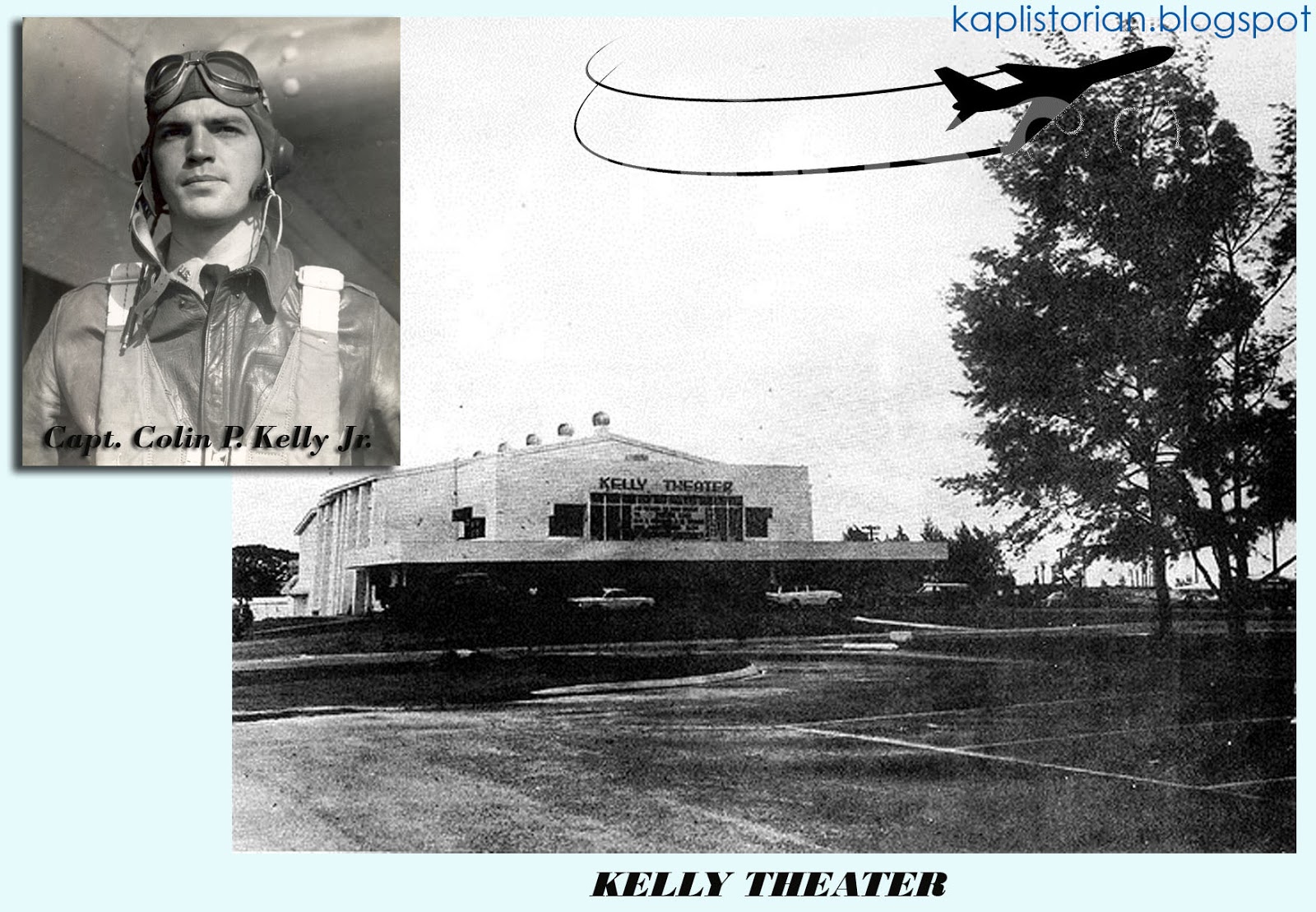
KELLY THEATER, named after Capt. Colin Purdue Kelly Jr.
One of the historic buildings in Clark Air Base was the Kelly Theater, constructed in 1953, the only cinema house in Clark and the venue of many stage plays and cultural shows. There was an earlier Kelly Theater built earlier—in 1947—that was converted from an old gymnasium. Both theatres were names after B-17 pilot Capt. Colin P. Kelly Jr. (b.Jul. 11, 1915/d. Dec. 10, 1941)  who died in action against the Japanese forces in 1941. Kelly’s damaged plane, while returning from a bombing run, blew up near Clark Field after being engaged by enemy forces. Capt. Kelly was declared America’s first hero of WWII by US President Franklin D. Roosevelt.  The memorial statue of the fallen captain was inaugurated on the theater grounds on 10 Dec. 2007—the 66th year of his passing. Kelly Theater, located at the cor. Ninoy Aquino Ave. and Foxhound St., survived Mt. Pinatubo, but eventually everything from the seats to the roof and front walls were stolen.


MEYER LEVIN GYMNASIUM, named after Master Sgt. Meyer Levin
The gymnasium facility on Dau Avenue, east of the Parade Ground was named after Meyer Levin in 1955, a master sergeant of the U.S. Army Air Corps. Raised in Brooklyn, New York, Levin (b.Jun 5, 1916/d.Jan. 7, 1943)—who had wanted to become an aviator—became a bombardier and flew with Capt. Colin Kelly after the Japanese attack of Clark Field. During his last mission on January 7, 1943, Levin volunteered to bomb the Japanese convoy ships that was approaching Australia. The weather worsened, and as the plane used up its fuel, the crew bailed out as the planed ditched the water. Levin remained in the plane to release the rafts that saved his crew. He died in the crash and is listed as one of those missing at Manila National Cemetery. Levin was awarded the  Distinguished Flying Cross (for successfully bombing the Japanese warship “Haruna”) and a Purple Heart for his heroic war feats.


MITCHELL HIGHWAY, named after Brig. Gen. William Lendrum Mitchell,  (now J. Abad Santos Avenue)
One of the most travelled roads in Clark—the Mitchell Highway-- stretches all the way from the Mars Station, then passes close to the Parade Grounds, and leads all the way to the Friendship Gate. It was named Philippine-American war veteran, Gen. William “Billy” Mitchell (b.Dec. 29, 1879/d.Feb. 19, 1936), regarded as the father of the United Sates Air Force. Gen. Mitchell also saw action during World War I in France, and even commanded the American air combat units in that country post-war. In 1924, he returned to Pampanga to revisit  Camp Stotsenburg where he even gave flying lessons to Gen. Emilio Aguinaldo, whom he had helped capture. The North American B-25 Mitchell—an American military aircraft design—was also named in his honor.


WAGNER HIGH SCHOOL, named after 1st Lt. Boyd David Wagner
The beginnings of Wagner High School and Middle School could be traced back in 1957-58 when the Grades 7-12 of Wurtsmith High transferred to individual wooden buildings at the former Chapel Center. That site that will eventually be renamed Wagner High School. The school was named after 1st Lt. Boyd David Wagner, of the U.S. Army Air Corps, who commanded the 17th Pursuit Squadron that was ordered to protect Clark. On Dec. 14, 1941 shot down four Japanese airplanes, and 2 days later, downed another enemy aircraft at Vigan. Thus, he became the first American World War II Ace, and for which he earned him a Distinguished Service Cross. Wagner was nearly blinded in the Lingayen Gulf battle, but survived and evacuated to Australia where he recovered.Later, he was sent back to the U.S. to train new fighter pilots. On  Nov. 29, 1942, Col. Wagner disappeared while on a flight from Florida to Alabama. His plane wreckage was found six weeks later, some 4 miles north of Freeport, Florida. His remains are buried at Grandview Cemetery, Johnstown, Pennsylvania.


WURTSMITH MEMORIAL SCHOOL, named after Maj. Gen. Paul Bernard Wurstmith
 The Clark Dependents’ School opened in 1947 to accommodate school-age children. In 1950, it was moved to another used office building that would be renamed in 1954 as Wurtsmith Memorial  High School. It was name in memory of Maj. Gen. Paul Bernard Wurtsmith (b. Aug. 9,1906/Sept. 13, 1946), who became a flying cadet in 1927. Over the next 13 years, he served in command positions and his fighters’ feats include downing 78 enemy aircraft in the defense of Darwin in Australia, against the Japanese. In 1945, he commanded the 13th Air Force in the Southern Philippines campaign. Wurtsmith was killed when his plane crashed in the mountain area near Asheville, North Carolina. The Clark school that bears his name would have a new air-conditioned building on the former site of the Stotsenburg base picnic grounds in 1961. Construction of an expanded campus complex began in 1989, and the newly-renovated Wurtsmith High opened for schoolyear 1990-1991. The Pinatubo eruption (which occurred just a week before the end of the school year) forced the transfer of the graduation rites to Subic. The school was later demolished and replaced with Fontana Casino.

BONUS!
A hill in Clark bears a peculiar name, because it was not named after a person, or even after a flower, as its name suggests.


LILY HILL
Lilly Hill first appeared on an 1898 map, and is thought to have been derived from the Kapampangan  word “lili”, which means “lost”. The Americanized name was apt because it was easy to get lost on that hill which stood separately from other hills in the area. Used as an observation point by Americans from 1903--42, it was also used by the Japanese for the same purpose. It would become the stronghold of the Kembu Group which defended Clark from late 1944-45. Post-war, a USAF aircraft warning and control unit was put up in the summit until 1962. A Buddhits shrine was built on the hilltop by the Japanese in 1998 on  the 54th commemoration of the Kamikaze. It features a large 5-ton granite statue of Kannon, the "Goddess of Peace ".

SOURCES:
Camp Stotsenburg:
Pix of Camp Stotsenburg: Alex Castro Collection
Pix of Col. John Stotsenburg:
Clark Air Base:
Pix,:Harold Clark: An Annotated Pictorial History of Clark Air Base,  by David Rosmer
Bobbitt Theater:
Pix of Bobbitt Theater: www.margaritastation.com
Bong Avenue:
Pix: Welcome to Clark Air Base, Guardian of Philippine Defense booklet
Dyess Highway:
Pix: Welcome to Clark Air Base, Guardian of Philippine Defense booklet
Kelly Theater:
Pix: An Annotated Pictorial History of Clark Air Base,  by David Rosmer
Pix of Colin P. Kelly: Aces of WW2, http://acesofww2.com/bombers/41/
Meyer Levin Gym:
Pix: An Annotated Pictorial History of Clark Air Base,  by David Rosmer
Mitchell Highway:
Pix: Welcome to Clark Air Base, Guardian of Philippine Defense booklet
Wagner High School:
Pix of Boyd Wagner: Photograph by Carl Mydans for TIME & LIFE Pictures),  (Colourised by Doug)
Pix: Wagner High School, 1971, collection of K. Morgan
Wurtsmith Elem. School:
Pix of Wurtsmith School: http://www.clarkab.org/history/
Lily Hill:
Pix: An Annotated Pictorial History of Clark Air Base,  by David Rosmer
Images: 
Pix; clarksubic.com