

JOSE ABAD SANTOS
MONUMENT
Location: Heritage
District, Angeles City
Jose Abad Santos was the fifth Chief Justice of the
Supreme Court of the Philippines and served as Acting President of the
Philippines during World War II. Born in San Fernando (b. 19 Feb. 1886), he and
his son Pepito were captured by the Japanese forces in Cebu, then taken to
Malabang, Lanao where the jurist was ordered executed. He comforted his son
with this noble thought: “"Do not cry, Pepito, show to these people that
you are brave. It is an honor to die for one's country. Not everybody has that
chance." The monument of Abad Santos stands in the heritage district of
Angeles City, in front of the old municipio, now converted into a museum. It
was inaugurated on 31 Oct. 1958, during the last term of Angeles Mayor, Manuel
Abad Santos, a nephew of Pampanga’s most well-known hero. The plaque, courtesy
the Pampanga Masonic Lodge , is inscribed with a re-stated version of his last
words given to his son: “He gave up life
to consecrate an idea—that it is a rare opportunity not given to everyone to
die for one’s country”.

BENEDICTO T. DAYRIT
STATUE
Location: Town
Plaza, Magalang
On 28 Dec. 1963, Mayor Benedicto Tapnio Dayrit (b. 21
Aug. 1932) was assassinated by the alleged men of Huk Cmdr. Sumulong during the
Magalang centenary celebration at the town plaza. The well-loved mayor was
gunned down as the “Mountain Side” evening ball was going on, the highlight of
the 3-day festivities to mark the 100th anniversary of the transfer of
Magalang town proper. It was speculated
that the Mayor Dayrit was killed because he refused to tax the public school teachers.
In his honor, the Freedom Park and the
emergency hospital were renamed after him. A statue in his likeness was also
unveiled at the town square in memory of this devoted public servant—the first
re-elected chief executive of Magalang,
and who was, as the plaque on the pedestal states, “a champion of the
masses, defender of the poor, a devoted public servant beloved by his people.
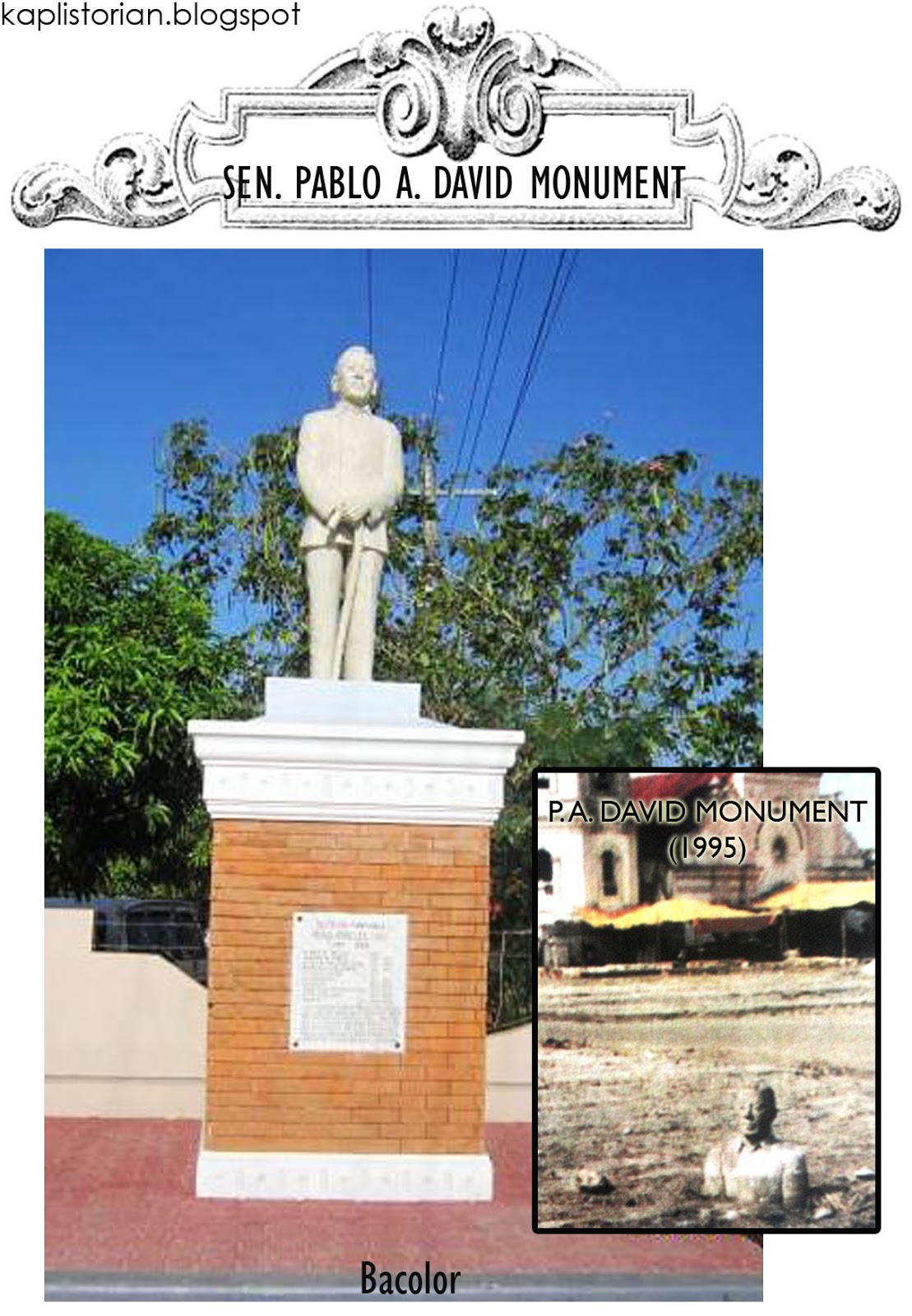
GOV. PABLO ANGELES
DAVID MONUMENT
Location: Bacolor,
Pampanga
This monument was erected as a token of gratitude to the late Gov. Pablo Angeles David (1889-1965) who served the government in various official
capacities. A distinguished son of Bacolor, Pablo
Angeles David was born to Carlos de los Angeles and Ceferina Mesina David on 17 August 1889.
He passed the bar in 1910, became a juez de paz for Sta. Rita, Sasmuan and
Bacolor until he became Asst. Provincial
Fiscal. Provincial Board Member (1916-1919). He would become the governor of
the province from (1931-37), and after his term, served as Judge Court of First
Instance (1939-1945). After the war, David was called on to become an acting
Governor (1945-1947). He served as Senator of the Philippine Republic from
1948-1953. The monument, as the plaque inscriptions note, is a “symbol of love
and affection of the people of Bacolor”, made possible by virtue of Resolution
No. 44, Series of 1982 of the Municipal Council of Bacolor.

PRES. MANUEL ROXAS
MONUMENT
Location: Clark
Air Base
Manuel Acuña Roxas
(b. 1 Jan. 1892) was the fifth President of the Philippines who served from
1946 until his death in 1948. He briefly served as the third and last President
of the Commonwealth of the Philippines . On the morning of 15 April 1948, at
the Kelly Theater in Clark Air Base, Roxas delivered a speech before the United
States Thirteenth Air Force. He suddenly felt dizzy and was immediately brought
to the residence of Major General E.L. Eubank. Shortly after, he suffered a
fatal heart attack in the evening. Roxas' presidential term is thus the third
shortest, lasting only one year, ten months, and 18 days. A plaque originally
marked his place of death in Clark. On the occasion of the 56th death anniversary
of the soldier-statesman, the Pres. Manuel A.Roxas Foundation (PMARF) and the
National Historic Institute, in cooperation with the Clark Development Corp.,
inaugurated the Pres. Roxas memorial statue
on 15 April 2004.

KAMIKAZE MONUMENT
Location: Japanese
War Memorial, Mabalacat
As World War II drew to a close with imminent American
victory, Vice Admiral Takajiro Ohnisi arrived in Mabalacat on 19 Oct. 1944 and,
meeting in the house of Marcos Santos, planned organized suicide attack units
composed of "Zero aircraft fighters" against the Americans. Thus, the Kamikaze suicide mission was
launched. In all, over 5,000 Japanese pilots died in these missions. In 1975, a
Kamikaze Marker was erected in Barangay Cacutud through the initiative of local
historian-writer-artist Daniel H. Dizon. Buried in lahar in 1991, it was
replaced with a new peace memorial in October 2001. On October 24, 2004, a
life-size fiberglass gold statue of an unnamed Kamikaze pilot was unveiled at
the Japanese War Memorial, eliciting cries of outrage and disgust that saw
print on national dailies. Local tourism official Guy Hilbero, the proponent of
the controversial project, maintains that the statue “is not a memorial
glorifying the Kamikaze pilots” but its aim is to promote peace “using the
lessons of war”. Concerned individuals think otherwise. Dr. Benito Legarda Jr.
of the National Historic Institute, calls it a “monument to servility” as “the
purpose of the Kamikaze was precisely to prolong the war”.

MONUMENTO
FERNANDINO
Location: Dolores,
San Fernando
The grand and imposing thirty-foot bronze monument that
welcomes everyone to the capital city is a masterpiece of the National Artist
Abdulmari Imao, a Tausug who also was one of the Ten Outstanding Young Men of
the Philippines in 1968. “Monumento
Fernandino” shows four allegorical figures
aspects of the city’s history—the penitent girl with a lantern, lady
with a torch, lady making an offering and a boatman. When seen from a distance,
the tableau seems like a plant growing on a barren landscape. San Fernando’s
newest landmark was inaugurated in December 2004.

CAPT. COLIN P. KELLY
MEMORIAL SHRINE
Location: cor.
Ninoy Aquino Ave. and Foxhound St., Clark Air Base
One of the historic buildings in Clark Air Base was the
Kelly Theater, constructed in 1953, the only cinema house in Clark and the
venue of many stage plays and cultural shows. There was an earlier Kelly
Theater built earlier—in 1947—that was converted from an old gymnasium. Both
theaters were names after B-17 pilot Capt. Colin Purdie Kelly Jr. (b. 11 July
1915/10 Dec. 1941) who died in action
against the Japanese forces in 1941. Kelly’s damaged plane, while returning
from a bombing run, blew up near Clark Field after being engaged by enemy
forces. Capt. Kelly was declared America’s first hero of WWII by US President
Franklin D. Roosevelt. The memorial statue of the fallen captain was
inaugurated on the theater grounds on 10 Dec. 2007—the 66th year of
his passing. It was made possible though
the auspices of the Mabalacat Tourism Office and the Air Force Wing of the
Philippine Air Force. Lt. Clay Crawford, Chief of the U.S. Air Force Programs
of JUSMAG, graced the significant event.

RUFINO CARDINAL
SANTOS STATUE
Location: Guagua,
Pampanga
Marking his 100th birth anniversary, the Center for
Kapampangan Studies of Holy Angel University donated 6-foot statue of the late
Rufino Cardinal Santos y Jiao at the Immaculate Parish in Guagua, Pampanga. The
country’s first Cardinal, born in brgy.
Santo Niño in Guagua in 1908, served as
the Archbishop of Manila from 1953, before receiving the red hat from Pope John
Paul XXIII on 31 March 1960. Cardinal Santos was known for founding Caritas
Manila, the reconstruction of St. Paul Hospital (now the Cardinal Santos
Medical Center) and in rebuilding the war-damaged Manila Cathedral in
1958. He passed away on 3 Sep. 1973. The
statue of the Cardinal Santos was made by Kapampangan artist, Edillardo Paras. It rests atop a seven-foot concrete pedestal outside
the Rufino J. Cardinal Santos convention hall adjacent to the Parish Church. It
was unveiled on 26 Aug. 2008 by Pres. Gloria Macapagal-Arroyo.

LUIS TARUC FREEDOM
PARK MONUMENT
Location: Brgy.
San Sebastian, San Luis
In July 2013, a public park in San Luis was named after the
late Huk supremo, Luis Taruc ((b. 21
Jun. 1913/4 May 2005), a noted leader of the Hukbalahap guerrilla group, a
high-ranking official of the Socialist Party of the Philippines, military leader
of the United Front, and an agrarian reform champion. The symbol of his
advocacy finds full expression in the monument of a peasant family, celebrating
their freedom from the bondage of the soil. The mother holds his baby aloft
clutching a laurel crown of victory while the farmer-father holds the implement
of his sweat and labors.
BONUS:
 |
| PHOTO COURTESY: Jason Paul Laxamana, The Prodigal Mole Cricket blog |
RIZAL "WATERWORLD" MONUMENT
Masantol, Pampanga
A solitary figure of the national hero appears to rise from the floodwaters that have covered the grounds of an elementary school where this solitary monument stands.
SOURCES & REFERENCES:
JOSE ABAD
SANTOS. Photo: (old photo) Alex R. Castro, (new photo): Wikimedia commons: https://commons.wikimedia.org/wiki/File:0434fjfJose_Abad_Santos_Monument_Pampangafvf_04.jpg
BENEDICTO T.
DAYRIT STATUE. Photo: Magalang Heritage FB Group, c/o Doriz Manlapaz.
Special thanks to Louie Bartolo Lacson for additional
info.
PABLO ANGELES
DAVID. Photo: wikimapia: http://wikimapia.org/27899704/Senator-Pablo-Angeles-David-Monument
(old photo): Singsing Magazine, Center for Kapampangan
Studies
MANUEL ROXAS
MEMORIAL. Photo: http://www.clarksubicmarketing.com/clark_air_base_history.htm
KAMIKAZE
MONUMENT.
Photo: Kamikaze
Pilot Statue, www.pampangatalents.com
MONUMENTO FERNANDINO.
Photo: https://commons.wikimedia.org/wiki/Category:Monumento_Fernandino#/media/File:9998Monumento_Fernandino_Pampangafvf_14.JPG
KELLY SHRINE
Photo: Clark
Air Base History: http://www.clarksubicmarketing.com/clark_air_base_history.htm
CARDINAL
SANTOS:
Photo: http://www.pampangatalents.com/04_Gallery/Pampanga/Villages/Guagua/slides/Guagua_Town_25.html
Source: Cardinal Santos Historical Marker Unveiled, http://www.gmanetwork.com/news/news/regions/118778/cardinal-s-historical-marker-unveiled/story/
LUIS TARUC
FREEDOM PARK MONUMENT. Photo: https://commons.wikimedia.org/wiki/Category:Luis_M._Taruc_Freedom_Park_(San_Luis,_Pampanga)#/media/File:FvfSanLuisPampanga8891_20.JPG
Source:
inquirer.net, http://newsinfo.inquirer.net/444233/guerrilla-leader-land-reform-champion-gets-place-of-honor


#/media/File:FvfSanLuisPampanga8891_20.JPG)

