Showing posts with label Kapampangan places. Show all posts

Friday, July 6, 2018

86. 10 KAPAMPANGAN PLACE NAMES AND THEIR ORIGINS, part III


1.      BUCANAN, Magalang
A barangay in Magalang owes its  foreign-sounding name from a modern sugarcane crusher made in England with a “Buchanan” brand, owned by a local haciendero. These imported steel crushers made sugar processing easier, helping modernize the industry.


2.      BUNTUK BABI, Concepcion
The contemporary name of this barangay is Sta. Monica, but its old name, Buntuk Babi (Hog’s Head), is still fondly remembered. The name, as the story goes, was a tribute to a Negrito chief who hanged pigs’ heads as trophies of his achievements. Another version had it that the name came from the locals’ tradition of hanging a “buntuk babi” in their veranda during their fiestas. The barangay was once visited by Felipe “Apo Ipe” Salvador, a religious cult leader of Sta. Iglesia.


3.      CALANTIPE, Apalit
Barangay Calantipe in Apalit was named after a local wetland bulrush or grassweed,  that grew in profusion in the place. Belonging to the genus Scirpus, the calantipe plant has grass-like leaves, and clusters of small spikelets.


4.      CASTULI, Macabebe
The flowering plant (hibiscus abelmoschus) that looked like a gumamela gave its name to an Apalit barrio still known today as Castuli. The perennial herbaceous plants, which can grow up to two meters tall, bears 5-petalled white or yellow flowers, with a red or purple spot at each petal’s base. Castuli has medicinal and culinary uses, Abelmoschus is now recognized as a separate genus from hibiscus plants.


5.      CONSUELO, Macabebe
“Maniup” was the old name of brgy. Consuelo, owing to a story of a ghost that haunted the area that blew (“tiup”) wisps of cool air at people who passed by. But when a wealthy entrepreneur moved in to set up a liquor business there, many locals found gainful employment at his gin factory. As business flourished, the population of the barrio grew as migrant workers streamed in. The barrio prospered even more, and the residents enjoyed lasting “consuelo” (kuswelo, in the vernacular)—contentment and happiness—at last.


6.      MABUANBUAN, Sasmuan
The riverine barangay of Sasmuan—Mabuanbuan---got its name from a specie of fish that thrived in their waters called “buanbuan”, which Bergaño describes as “a delicious fish, spiny and with white scales”.  Thus, “Mabuanbuan” means a place flourishing with buanbuan fish. Surprisingly, Tagalogs call it “bulanbulan”. Buanbuan is a kind of tarpon fish, found  in brackish or freshwater, can measure more than a feet long,  and can be fished all year long.


7.      MALATUMBAGA, Magalang
A sitio of San Vicente, Magalang used to be called “Malatumbaga”,  a hardwood lumber tree similar to molave. The durable malatumbaga is used in house constructions, for making posts, window sills, floors, sculptures, frames, railroad ties and ship-building. In turn, the malatumbaga tree gets its name from a hard, reddish bronze metal called “tumbaga”, used for jewelry.


8.      MAMATITANG, Mabalacat
Mamatitang used to be a vast sugarland with prime sugar haciendas owned by rich Mabalacat people. Mascup River ran through one of its sitios, a popular resort destination.  Mamatitang was named after an early female Baluga settler named “Titang”. “Mama” was an appellation used to address old people and the two words became one.


9.      PAGUIRUAN, Floridablanca
The name “Paguiruan”, sometimes spelled as Pagyuruan, came about due to a local industry that began in the small Apalit barrio. Years ago, people used to go to the place to harvest fruits from buri plants which grew thickly in the area.  They were able to manufacture a certain type of sweet-tasting delicacy  called “yuruan”. It soon grew to a lucrative business for the people, who, in trun, renamed their barrio into “Pagyuruan”, a place where “yuruan” is made.


10.  SUCAD, Apalit
Formerly called Sta Lucia, barrio Sucad derived its name from “sucad”, meaning “to measure, so as to indicate a boundary”. Town lore has it that menfolk from Sucad distrusted male visitors from nearby San Simon who came to their barrio to serenade the local maidens. To prevent possible trouble, the San Simon men were called to inform them that they cannot overstep their bounds. A demarcation line was agreed on to define their barrio’s boundaries, which cannot be trespassed by both sides—“angga mu queni ing ‘sucad’ yu”.


SOURCES:
Historical data papers: Floridablanca, Candaba, Floridablanca, Macabebe, Magalang
Bartolo, Lou Aldrin L., The Magalang Book, NCCA, Center for Tarlaqueño Studies, 2015.
Dizon, Lino L. Amlat, Kapampangan Local History Contours in Tarlac and Pampanga,
Center for Tarlaqueño Studies, Tarlaca State University, 2000.
Sibug, Edgardo C., Porac, A Rancheria at Batiauan 1594-2004, published by the Municipal Government of Porac.
Vocabulario de Pampango en Romance y Diccionario de Romance en Pampango. The English Translation of the Kapampangan Spanish Dictionaryy written by Fray Dego Bergano of the Order of St. Augustine, first published in 1732. Holy Angel University Press.
PHOTOS:
All maps: googlemaps, unless otherwise noted.
Bucanan:  pinterest
Buntuk Babi:
Calantipe:
Consuelo:
HDP, Macabebe
Mabuanbuan,
Malatumbaga:
Mamatitang:
Castro, Alex R. Scenes from a Borderton and other Views, 2006, privately printed.
Paguiruan/ Pagyuruan:
HDP Floridablanca
Sucad: HDP Apalit

Tuesday, December 13, 2016

28. 10 MORE KAPAMPANGAN PLACENAMES AND THEIR ORIGIN STORIES, part 2

BALITUCAN (Magalang)
San Ildefonso is the official name of this eastern barrio of Magalang, founded in 1868. Locals though, prefer calling it by its more popular, delicious-sounding name---Balitucan--derived from “balitug”,  roasted corn kernels sprinkled with sugar, that are a favorite snack items of Kapampangans. Corn and sugar are the principal produce of this place. But there exists another version why it is so named.  There are those who believe that the name came from”balituk”, or gold in Ilocano, which supports another tale that the settlers of the place where Ilocanos from Nueva Ecija. Balitucan, which straddles Tarlac, Pampanga and Nueva Ecija, is the biggest barangay of Magalang.

KALEDIAN (Arayat)
Kaledian is the old name of the Camba, a barangay in Arayat. Pres. Manuel L. Quezon established a farmstead here, and named it Hacienda Caledian, after one of the major barangays of Baler, his birthplace. The name “Caledian” is believed to have been derived from “Calle diyan!” (the street over there) referring to a road that had no specific geographical boundary at that time. It is interesting to note that next to Caledian, Arayat is the barrio Suklayin”, also named by Quezon after a Baler place. Caledian was re-named Camba in later years, but Suklayin has retained its name.

DARABULBUL (Concepcion)
Another place in Tarlac with a name that often elicited embarrassed snickers in the past is Darabulbul, in existence as a barrio since 1853. People love to tell stories that the vulgar-sounding name was derived from somebody’s aunt’s public hair (“Dara” or aunt + “bulbul” or pubic hair). “Darabulbul” is an old Kapampangan term that means “the spurting or gushing of liquid like water—often with sporadic, gurgling sound. It is the name also ascribed to a river where the barrio is located, which, locals refer to as “Ilug Burat” (Prick River).  Today, Darabulbul has been renamed Corazon de Jesus.

MALATUNDUNBAKA (Porac)
Hacienda Ramona, in Dolores, Porac, is the site of important archaeological excavations conducted in the 1950s that date back to pre-colonial Pampanga. It is also where one can find a rock formation that resembled the ridge on a cattle’s back, hence it is known as “Malatundunbaka” (“like the nape of a cattle”). In ancient times, Malatundunbaka was where corpses were dried to prepare them for secondary burial. A burial jar with a skeleton and bracelets were found in the area, as noted by noted archaeologist Robert Fox.

MANIBAUG (Porac)
“Sibaung”—an insect from the beetle family that infested palms and coconut trees, gave its name to this barangay which once had swarms of them. People from nearby Bacolor would come to this place to go”manibaung” – or go hunting for such black beetles that were considered culinary delicacies, espceically when cooked adobo-style. “Manibaung” was later corrupted to “Manibaug”.  Today, the culinary practice of preparing ‘sibaung’ still is practiced in Porac.

MARGOT (Angeles)
Margot was a new settlement founded on the southern boundary of Camp Stotsenburg in the mid 1920s. The barrio with a distinct American name was envisioned to be a healthful, sanitary place where the American soldiers could seek wholesome leisure under military supervision—in contrast to “sinful” Sapang Bato. ‘Margot’ (formerly sitios Talimundoc & Tacondo), was derived from the name of the only daughter of the Commanding Officer of Camp Stotsenburg.

MINING (Angeles)
Even local historian Mariano Henson has no clues as to the origin of the name “Mining”. At first glance, the seemingly English name of this small eastern barrio of Angeles is suggestive of the presence of “mina” (mine ores), but no such documentation  exist. A more plausible story comes from recollections of longtime residents Marciano Catanghal and Agustin Pineda (aged 81 and 68 respectively, at the time of the 2000 interview), the place had no name since the Japanese Occupation. Due to the proliferation of  sweet-smelling kamuning trees lining their main road, the residents used these natural landmarks to name their barrio “Mining”, a diminutive of “kamuning”.

SEPUNG BULAON (Porac)
Sepung Bulaon was once a sitio of barrio Pias, and was separated as a barrio in 1882. In Kapampangan, “Sepung Bulaon” means “the tip of a molave tree”. The hardwood molave used to grow in profusion in the area, but one tall ancient bulaon tree stood out for its imposing height. It was only after the old tree fell that people realized its extraordinary dimension—its tip extended all the way to the location of the visita. To remember their natural landmark, the barrio was named Sepung Bulaon.

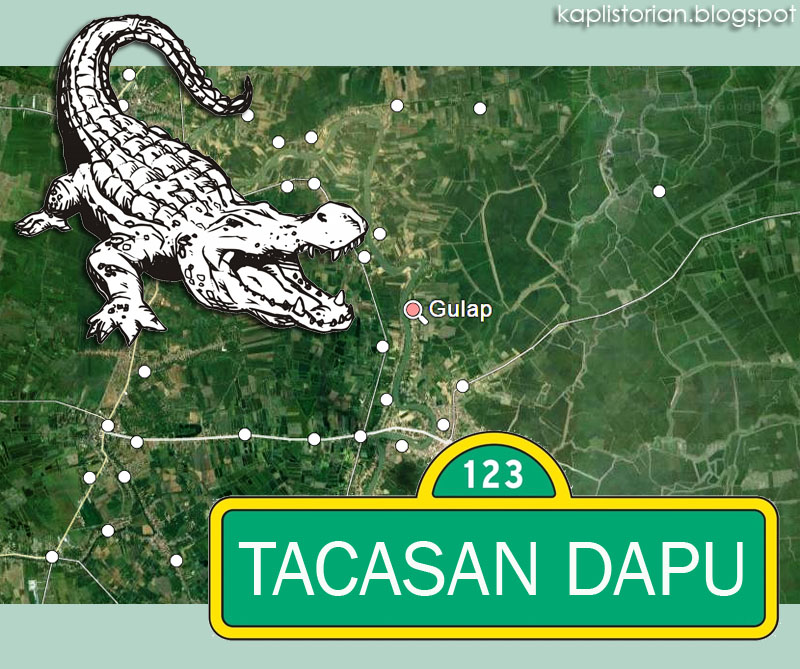
TACASAN DAPU (Candaba)
Barangay Gulap of Candaba used to have an old sitio by the name of Tacasan Dapu Legend has it that in the old days, a fishpond called Lucong always overflowed due to a river that always spilled its water into the pond—along with its resident man-eating crocodile. The crocodile always used this spillway to come and go, hence the name, “Tacasan Dapu”. This became an annual occurrence so the residents , fearful of the crocodile’s presence, moved to a new location, depopulating the sitio.

TINANG (Concepcion)
The barrio’s name was actually the nickname of a certain Maria Cristina, the kind wife of a German settler who cleared the area and began a farmhouse there in the 1900s—hence the early name, ‘Caingin Aleman’. After some time,  the place was called simply “Tinang” after the gracious “Indang Tinang”. However, as early as 1853, there was already a barrio by that name in Magalang-Concepcion town, thus dispelling this romantic origin story. This barrio was consolidated with 5 others to form barangay San Miguel during the American occupation.

Sources:
Cojuangco, Tingting. TARLAC
Dizon, Lino L. , AMLAT, Kapampangan Local History Contours in Tarlac and Pampanga, Center for Tarlaqueño Studies, Tarlac State University, 2000.
Dizon, Lino L. East of Pinatubo: Former recollect Missions in Tarlac and Pampanga (1712-1898), Museo Archivo Recoletos,  Center for Tarlaqueño Studies, Tarlac State University, 1998.
Kasaysayang Local: Angeles City, by Zaide Foundation and Dept. of Education, Culture and Sports, All-Nations Publishing, Quezon City, 2000.
Mallari, Joel P. Etymology of Place Names in San Fernando. http://tarebalakdiscovery.blogspot.com/2008/01/baltangan-da-ring-memalen-ning-san.html
Sibug, Edgardo C. Porac, A Rancheria at Batiauan 1594-2004, Municipal Government of Porac, 2006.
Batang Baler:http://www.batangbaler.net/2010/03/28/caledian-and-suklayin/
Historical Data Papers of Apalit, Candaba, Macabebe,

Photo Sources
Balitucan: cornicks: sweetcherriepie.com
Sepung Bulaon: Molave tree, www.flickr.com
Tinang: www.oxpal.com (costumes)
Map of Margot and Mining: Kasaysayang Local: Angeles City
Map of Concepcion: Tarlac
All other maps: google maps