Showing posts with label Kapampangan literature. Show all posts

Wednesday, October 24, 2018

98. 10 TOMBS AND MEMORIALS OF REMARKABLE KAPAMPANGAN PERSONALITIES

DON ANGEL PANTALEON DE MIRANDA
(ca. 1765/ d. 21 Jun. 1835)
Place of Memorial: Sto. Rosario Church
Founder of Angeles. Together with wife, Doña Rosalía de Jesús and some followers, the group headed north to clear a forested area there for rice and sugar farming in 1796. The settled area became known as Culiat, named after the vines that proliferated in the place. Culiat would become the future city of Angeles, named after him and his patron, the Guardian Angel.

FELINO GIL
(b.1803/d.1884)
Place of Interment: Pio Chapel, Porac, Pampanga
Spanish civic leader. For helping secure lands in Porac for the friar missions, he was awarded tracts of land that he successfully turned into sugar plantations. Recognized as one of the founders—along with Juan P.  Zita-- of the “Escuela de Artes y Oficios de Bacolor”, which aimed to train artisans, on 14 Nov. 1861. Later renamed to Bacolor Trade School in 1915, which offerd courses in Woodworking Domestic Science, Ironworking and Building Construction.

 HONORIO T. VENTURA
(b. 30 Jul. 1887/ d. 3 Sep. 1940)
Place of Interment: Cementerio del Norte (Manila North Cemetery)
Son of Balbino Ventura and Juana Tizon of Bacolor. Graduated with a law degree from Universty of Santo Tomas , and went to Spain for advance studies in Jurisprudence. Appointed as acting governor of Pampanga in 1916. Served as Chief of the Executive Bureau of the Department of Interior and later as Secretary of the Interior in place of Atty. Felipe Agoncillo. The former Pampanga School of Arts and Trades in Bacolor, Pampanga which he supported as a philantrophist, was re-named as Don Honorio T. Ventura College of Arts and Trades in his honor. One of his scholars was the future president, Diosdado P. Macapagal.
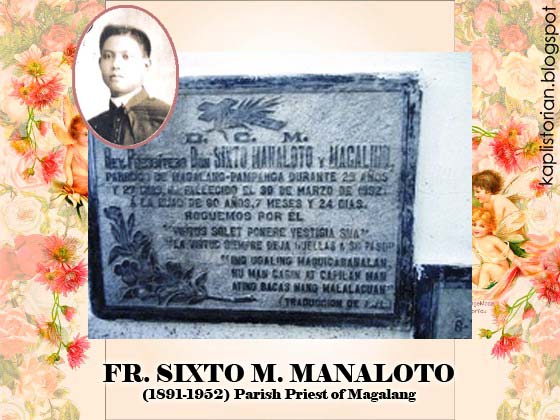
FR. SIXTO M. MANALOTO
(b. 6 Jul. 1891/d. 30 Mar. 1952)
Place of Interment: Magalang Memorial Park
Though Tarlac-born, Fr. Manaloto would make a lasting impression on Magaleños, serving their parish for an unprecedented period of nearly 30 years. On 8 December 1915, feast of the Immaculate Conception, Fr. Manaloto, a product of San Carlos Seminary, was ordained into priesthood by Archbishop Harty in 1915. Assigned in Magalng in 1923, he is known for his major restoration works of San Bartolome Church., for opening a parochial school in the town and for sending poor, but deserving students to Manila, many of whom eventually returned as professionals and became leaders of the community.

 JOSE CORAZON DE JESUS
(b. 22 Nov. 1896/ 26 May 1932)
Place of Interment: Cementerio del Norte (Manila North Cemetery)
Son of Vicente de Jesús  of Sta. Maria, Bulacan and Susana Pangilinan of Pampanga. As Huseng Batute,  he wrote nationalistic articles for Ang Democracia, Liwayway, Taliba, under the pseudonym Huseng Batute. He supported Philippine independence and wrote critical articles about Philippine society under the Americans. Known as the King of Balagtasan, for his mastery of Tagalog poetry.Wrote the lyrics  of the popular Filipino song “Bayan Ko”,which has become an alternative anthem.

KUDIARO LAXAMANA
(b.1906/d.1970)
Place of Interment: Clark Cemetery, Angeles City, Pampanga
Born in the Mt. Pinatubo area. Aeta World War II Guerrilla Hero. Head of the 55-155th Squadron of the Northwest Pampanga Mountain District. Reputedly killed 50 Japanese soldiers, chopping off at least 17 enemy heads with  his bolo. Given a post-humous recognition in Mabalacat in 1995 for his wartime bravery. Killed in 1970 for his advocacies. Given a 21-gun salute at his burial at the Clark Cemetery. A major road in Clark—Kudiaro Laxamana Ave.—is named after him.

RUFINO J. CARDINAL SANTOS
(26 Aug. 1908-d. 3 Sep. 1973)
Place of Interment: Manila Metropolitan Cathedral crypt
The 1st Filipino Prince of the Church. Born in Sto. Niño, Guagua to Gaudencio Santos and Rosalia Jiao. Accepted as seminarian at San Carlos Seminary in 1921.  At 19, became a scholar of the Pontifical Gregorian University in Rome in 1927. Ordained on 25 Oct. 1931 in Rome. Assigned to Imus, Cavite and Marilao, Bulacan as assistant priest; then to Manila. After his war imprisonment, was named by Arch.  Michael O’Doherty as Vicar General of Manila, then elected as the Titular Bishop of Barca and Auxiliary Bishop to the archbishop. Succeeded Arch. Gabriel M. Reyes as the new archbishop of Manila in 1953, following his appointment by Pope Pius XII. Elevated to the rank of the cardinal at the Basilica of St. Peter in Rome at 9:30 a.m. on 31 Mar. 1960.

CLEOFE J. BALINGIT
(b. 9 Apr. 1910/ d. 5 Jun. 1981)
Place of Interment: Apalit Municipal Cemetery
Daughter of  Macabebe Scout Felix Balingit and Juliana Jaime of Macabebe. Chosen to represent Pampanga in the search for the 1936 Queen of the Manila Carnival, touted as “the biggest annual event of the Orient”. Her candidacy was supported by the newspaper “Ing Catimauan”. Placed 4th after the winner, Mercedes Montilla, of Negros Occidental,  crowned Miss Mindanao 1936. Married to Dr. Mariano Bayani of Apalit.  Spent the rest of her life involved in socio-civic causes,  especially the Pampanga Chapter of the Girl Scouts and the local Red Cross.

DIOSDADO P. MACAPAGAL
(b. 28 Sep. 1910/ d. 21 Apr. 1997)
Place of Interment: Libingan ng mga Bayani
Born in Lubao to Urbano and Romana Pangan. “The poor boy from Lubao” became the 9th President of the Philippines, serving from 1961 to 1965, and the sixth Vice-President, serving from 1957 to 1961. Was a member of the House of Representatives, and headed the Constitutional Convention of 1970. Father of Gloria Macapagal Arroyo, the 14th President of the Philippines from 2001 to 2010. Succeeded by Ferdinand Marcos.

THE AQUINOS OF TARLAC
Place of Interment: Manila Memorial Park, Parañaque, Manila
Corazon Cojuangco Aquino ((b. 25 Jan. 1933/d. 1 Aug. 2009)
The first woman president and the 11th chief executive of the Philippines.  The most prominent figure of the 1986 People Power Revolution that ended the 21 years of dictatorial rule by Pres. Marcos. People rallied around her after her husband’s assassination and swept the plain housewife to power. Hailed as the “Mother of Asian Democracy”.
Benigno Aquino Jr. (b. 27 Nov. 1932 /d. 21 Aug.1983)
A leading oppositionist of the Pres. Ferdinand Marcos and his dictatorial regime. Arrested and jailed for 7 years during the Martial Law of 1972.Founder of the lakas ng Bayan (Laban) party. Allowed to travel by Marcos in 1980 for medical reasons, byt was assassinated upon his return to Manila in 1983. His death was the catalyst for te People Power Revolution that ended the arcos regime and started his wife Corazon’s ascent to power.

FERNANDO POE JR
(b. 20 Aug. 1939/d. 14 Dec. 2004)
Place of Interment: Cementerio del Norte (Manila North Cemetery)
Actor, director, film producer and presidential of the Philippines. Considered King of Philippine Movies. Began showbiz career in the 1953 with the movie “Anak ni Palaris”. Has over 200 films to his credit. Most portrayals show him as a champion of the poor. 5-time winner of FAMAS Award. Married to showbiz royalty, Susan Roces; daughter Grace Poe is a senator. Ran for the 2004 presidential race, but lost by the slimmest of margin against Gloria Macapagal-Arroyo.

ALEXIS TIOSECO
(b. 11 Feb. 1981/d. 1 Sep. 2009)
Place of Interment: Family mausoleum, Angeles City Cemetery
The young film critic is the great-grandchild of Leonardo Lilles, a successful agricultural engineer, businessman and town leader of Macabebe.  Noted film critic and film professor at the University of Asia and the Pacific. Known advocate of Southeast Asian cinema. Named  in 2005 as “one of the most important young people in the Philippines today”, by Philippine Star, for championing Philippine cinema. On 1 Sep. 2009, Tioseco and Slovenian girlfriend Nika Bohinc, were murdered in their Quezon City apartment by 3 burglars. Their househelp was convicted in May 2018 for her participation in the crime,

BONUS!
COLIN P. KELLY JR.
(b. 11 July 1915/10 Dec. 1941) 
Place of Memorial: Madison, Florida
B-17 pilot Capt. Colin Purdie Kelly Jr. died in action against the Japanese forces in 1941. Kelly’s damaged plane, while returning from a bombing run, blew up near Clark Field after being engaged by enemy forces. Declared as America’s first hero of WWII by US President Franklin D. Roosevelt.  The Kelly Theater of Clark as named after him. There is a  memorial statue of the fallen captain in front of the theater ruins inaugurated on 10 Dec. 2007—the 66th year of his passing.

CONRADO Y, GUINTO, KING OF POETS
(b. 21 Jan. 1946/d. 5 May 2015)
Place of Interment: Porac, Pampanga
Conrado Guinto is the fictional character in the award-winning advocacy film,”ARI: My Life with a King”, produced by Holy Angel University. The aging Kapampangan poet royalty befriends a Pampanga-born high school lad, JP, who can’t speak the language. Their contentious relationship ends with the death of Conrado, but only after passing the poet’s torch, and the laurel crown to the young boy. Portrayed by real-life poeta laureado,  Francisco "Frank" Guinto, who won Best Actor honors in the Metro-Manila Film Festival 2016, New Wave edition. The FAMAS-award winning sory was penned by Robby Tantingco and directed by Carlo Catu.

SOURCES:
(tomb)
FELINO GIL: Jerry Punzalan Sagmit (tomb); Luther Parker Collection (photo)
SIXTO MANALOTO,:Old Cemetery: https://magalang-heritage.weebly.com/old-cemetery.html
JOSE CORAZON DE JESUS: http://malacanang.gov.ph/undas-2012-a-cemeteries-tour/(tomb); flickr.com, posted by NCCA Official (photo)
CLEOFE BALINGIT: Alex R. Castro Collection
COLIN KELLY: www.findagrave.com
CARDINAL SANTOS: findagrave.com (tomb); Alex R. Castro (photo)
KUDIARO LAXAMANA: www.finadagrave.com (tomb);
 www.art.com (photo)
DISODADO MACAPAGAL: Twitter photo, by Maria Cepeda (tomb); wikipedia.com  (photo)
CORY AQUINO, NINOY AQUINO: wikimedia commons
FERNANDO POE JR: Wikimedia commons (grave); Alex R. Castro (photo)
ALEXIS TIOSECO: Robby Tantingco (tomb), Association for Southeast Asian Cinemas Conference - WordPress.com (photo)

Friday, February 2, 2018

72. 12 KAPAMPANGAN FOLK SONGS

Song genres like the basultu, kuraldal, harana, kundiman,  juvenile songs and many others written and composed by anonymous, often unlettered folks all bear witness to the immense richness of Kapampangn culture. Here is a comprehensive list of popular, as well as less-known folk tunes from the Kapampangan region:
**********

1. ATIN KU PUNG SINGSING
This may very well be the national hymn of Pampanga, as this plaintive folk song—about  the promise of a girl to give her heart to the man who finds her lost ring—is known all over the country. It is an example of a ‘basultu’, a people’s song that often has an allegorical theme. “Atin Ku Pung Singsing” has been recorded by many artists including Nora Aunor and Freddie Aguilar, and a Tagalog version exists.
LISTEN TO "ATIN KU PUNG SINGSING" HERE:
by Mabuhay Singers

 **********

2. ARO, KATIMYAS NA NITANG DALAGA
It has been a tradition in old Pampanga for a swain to sing a serenade song to the object of his affection during the period of courtship. This dramatic kundiman, is sung from the point of view of a young man as he espies his true love from a distance—Isyang, daughter of Apung, charmed by her beauty and graceful movements as she carries a basket-full of rice cakes on her head.

LISTEN TO "ARO KATIMYAS NA" HERE:
sung by Earl Policarpio

********** 

3. ATSING ROSING
Another harana song, in which the singer exalts ‘Atsing Rosing’ by offering her a fantastic assortment of gifts:  a necklace of stars,  a half-moon crown, a hammock made of clouds held by a blue rainbow rope. The singer summons heroes Rizal and Bonifacio to guard the lovely Rosing.
LISTEN TO 'ATSING ROSING' HERE:
sung by Andy Alviz

 **********

4. DALUMDUM NING BENGI
This harana song is different in that the singer does not refer to his heart’s desire, but instead, describes in poetic terms the intense moment of their evening encounter—the falling of rain, cloudy, star-less skies—the only light being the brief flash of lightning.
LISTEN TO 'DALUMDUM NING BENGI' HERE:
sung by Totoy Bato

**********

5. EKA MAMAKO
There are many songs in Spanish called “No Te Vayas” (Don’t Go), and these were eventually introduced to Filipino. The most well-known is  the popular “No Te Vayas de Zamboanga” by Juan Cuadrado, Sr., which even merited an English version (“Don’t you go, don’t you go to far Zamboanga!”). This Pampango version was provided by Imang Fely Tinio.
LISTEN TO "EKA MAMAKO" HERE:
sung by Mr. Ernie Turla

**********

6. INYANG MALATI KU
This very popular ‘basultu’ has so many versions, lyrics-wise—from romantic to the comic (“Inyang malati ku, linub kung kutseru, sira ya'ing kalesa, pile ya'ing kabayu”) . Even the beat is sung in varied ways—from slow and wistful, to bouncy and upbeat. This version has a more nostalgic feel to it.
LISTEN TO "INYANG MALATI KU" HERE
sung by Jonas David & April de los Santos

**********

7. O KAKA, O KAKA
Another “basultu” which is perfect for dancing. Many grandmothers also sang this as a lullabye to put their ‘apos’  to sleep. The singer calls a friend’s (“kaka”)  attention and then proceeds to sing his observations of him and of things around him, in a light, playful and teasing manner.
LISTEN TO "O KAKA, O KAKA" HERE:
sung by Juan Miguel Louise B. Soto

**********

8. O YAN NA ING PAPEL
The lilting “Oyan na ing Papel” has  a repetitive tune and short lyrics that give a directive for Maring to catch a piece of paper being blown by the wind. The windblown paper that contains Pepings’s wedding details, including riding an unrepaired cart to the ceremony
LISTEN TO "OYAN NA ING PAPEL"HERE:
Sung by ArtiSta.Rita

**********

9. O PATAG A BUNDUK
A playful song of many contradictions that talk about a flat mountain, a tree that grows like a vine, a banana tree that grows in a flower pot, monggo that needs a trellis, a santol-bearing mango tree, a hen that’s also a chick, and a rooster that lays eggs. Indeed, this is something for Ripley’s!
LISTEN TO "O PATAG A BUNDUK" HERE:
sung by Je Manansala

**********

10. ONE DAY, MISAN A ALDO
Our love affair with things American began immediately—language was not a barrier. This narrative song begins in fractured English, which is immediately translated literally in Kapampangan—to hilarious effects. This popular song is known to tagalogs as “One Day, Isang Araw”.
LISTEN TO "ONE DAY, ISANG ARAW'
Tagalog Version

**********

11. PIESTA DA RENG ASAN
This old non-sensical song bout n imaginary election among river fishes surprisingly provides a glimpse into folk lifestles, beliefs and attitudes. This ‘basultu’ was contributed by Magdalena Dayrit of San Fernando which Dr. Alejandro Perez included in his 1968 book ‘Pampanga Folklore’.

**********

12. SISINGLE, SISINGLE
This is a play song that is sung in consonance with a game of the same title,  variationof ‘talanan dutung’. It starts with a line of  children holding hands, with the lead child holding fast to a wooden wall, gate, tree trunk, or nay wooden object. With held hands swaying, as they sing. At the last note of the song, the players break the line and scamper to look for a wooden object to touch. A player who fails to do so becomes the next “taya” or ‘it’.

**********
SOURCES:
 SERENATA, A Tresury of Kapampangan Songs, musical notations by Edwin Lumanug, Holy Angel University Press, 2009.
Atin Ku Pung Singsing:https://www.youtube.com/watch?v=v-_pLp1LbE8, uploaded by alpc 2008, Jan. 26, 2012.
Aro, Katimyas Na:https://www.youtube.com/watch?v=sP2r66Q28Cs, uploaded by Earl Policarpio, Jan. 12, 2014
Atsing Rosing:https://www.youtube.com/watch?v=WOHelCZj08Q, uploded by Kapampangan Mekeni, Mar. 9, 2015
Dalumdum ning Bengi:https://www.youtube.com/watch?v=xDViVI-KcSc, uploaded by Kapampangan Mekeni, Mar. 9, 2015
Eka Mamako:https://www.youtube.com/watch?v=ptW62miPZS8, posted by Ernie Turla, May 1, 2007
Inyang Malati Ku:https://www.youtube.com/watch?v=wjpB4-PnewY, uploaded by Benny Guinto, Nov. 23, 2011
O Kaka, o Kaka:https://www.youtube.com/watch?v=an1DEiaE7C0, uploaded by Juan Miguel Louise B. Soto, Aug. 30, 2017
Oyan na ing Papel:https://www.youtube.com/watch?v=zA4DYBkyw88, uploaded by sisigman,  Oct. 9, 2007
O Patag a Bunduk:https://www.youtube.com/watch?v=UE4urAc8Kcc, uploaded by Je Manansala, Nov. 12, 2012
One Day, Misan a Aldo:https://www.youtube.com/watch?v=qBFpGOedBz4, uploaded by robie317, Feb. 10, 2017
Piesta da reng Asan:
Sisingle, Sisingle:

Wednesday, July 26, 2017

55. 10 THINGS YOU SHOULD KNOW ABOUT THE LEGENDARY SINUKUAN


The legend of Sinukuan or Suku has pre-historic origins—and his story has been told and retold by Kapampangans across the centuries,  such that many versions—embellished and romanticized-- exist about his identity and nature. Was he a god?  An enchantress? A demigod?  Or, as scholars contend, a real historical figure from the past? One thing for sure, Sinukuan was endowed with supernatural, mystical powers, making him more than a mere mortal and elevating him to the pantheon of Kapampangan mythical icons.

1. ORIGINS: SINUKUAN was said to be the first-born of couple, Calupit and Cargon Cargon (also known as Matungcu). The pair were descendants of Adam and Eve who came to Asia and settled in the mystical Alaya mountain of Pampanga. Cargon Cargon took care of the mountain and after his death in the hands of a Zambal god, SINUKUAN took over and inherited the mountain.

2. GENDER AND IDENTITY: In early accounts, SINUKUAN was a male human being, albeit with extraordinary qualities—“a very fine fellow with arms and sinews as iron..a quick thinker..unexcelled by anybody in the island of Luzon. In some, he was “a god who can create earthquakes” and a “king who lived inside the mountain of Arayat”. Another early 20th c. account described the denizen as a sorcerer of the mountain. While Macario Naval identified SINUKUAN as the wife of Minga in his 1916 account, the earlier 1899 story of Don Isabelo delos Reyes from his opus, “Folklore Filipino”, had it the other way around---SINUKUAN was the husband of Minga, thus making him a male.

3. APPEARANCE: SINUKUAN was said to resemble Cupid (Eros) because of his handsome visage. One account however, narrates that he “was formerly a handsome youth who, upon marrying a mortal, was transformed into his present ugly, hideous form”.

4. FAMILY: SINUKUAN was said to have a wife named ‘Marianusep de Sinucuan’, with whom he had 2 daughters named Calibangut and Calikangutabak, who had opposing personalities. The older Calibangut was tall, dark and deceitful, while the younger one was serene and very beautiful. It is also said that one of the daughters died, leaving the other daughter so lonely that a local town girl was specially handpicked to be her companion. “El Folklore Filipino” had SINUKUAN fathering 3 girls—Rosalina, Rosa-Minda and Maria.

5. RESIDENCE: Inside Bundok Alaya is a deep, expansive cave---and it is here in the mountain's belly that the grand palace of SINUKUAN was built when his daughters came of age, with the help of witches. The seven bronze gates  of the palace were guarded by a lion, a tiger, a viper, a serpent, an Aeta with bow and arrows and a fierce bird with a curved beak known as “Sagasa”. The palace was decorated with gems and jewels, and SINUKUAN himself reclined on a bench  adorned with gold and precious stones.


6. HOUSEHOLD STAFF: Five fantastic servants ably served the great SINUKUAN, namely: Kargon Kargon, a strong man who could carry the world on his shoulders a la Atlas; Supla Supling, who could generate typhoons; Miran Miron, with a vision so acute, he could see great distances; Punta Punting, the world’s most accurate archer; and Kuran Kurin, the world’s fleetest runner. SINUKUAN was also attended by a retinue of Negritos whom he sent outside his realm to deal with townsfolk.

7. MENAGERIE: SINUKUAN had a special affinity with animals--he kept swines in their mountain dwelling. In fact, his daughters made regular trips to the town to barter their gold for “darak”--animal feed for their pigs. But he also had magical animals like a pair of goats that passed out gold droppings. In a similar way, he owned large cows that excreted pieces of rich sinamay fabrics.

8. SUPER POWERS. SINUKUAN was a shape-shifter, who once morphed into a mosquito so he could spy on people. It was in this manner that he learned that his daughter was consorting with a man, whom he then transformed into a pig. SINUKUAN also had power over nature—he could control winds and raise deadly storms. Most of all, SINUKUAN had immense strengths, available to lift mountains and hurl objects at great distances.

9. INCREDIBLE FEATS: SINUKUAN is credited with performing incredible feats of strength that included moving a forested mountain from Candaba to its present site, transferring Mount Arayat from its original location in Tapang, Nueva Ecija to San Miguel, Bulacan, then moving it yet again to Arayat town, then a swampy place. The displacement of water during the move resulted in the flooding of Candaba. SINUKUAN also built a rock bridge between Candaba and his mountain, through which he regularly supplied the townspeople with gold and silver. However, he left the bridge unfinished as a punishment for the dishonesty and ingratitude of the people.

10. ARCH ENEMIES AND HOW HE VANQUISHED THEM: There were at least two nemeses of SINUKUAN—the first was a supernatural being from Zambales, then the greatest mountain the archipelago,  and Makiling, king of a southern mountain. SINUKUAN was actually a friend of the Zambal deity but he became his foe when Namalyari asked for his daughter’s hand in marriage. They engaged in a 2-day battle hurling stones at each other until Mt. Zambales was shattered into fragments, becoming a range of smaller mountains. In the other, SINUKUAN’s earned the wrath of Makiling when his 3 sons kidnapped his daughters.  He killed all three of them. Makiling retaliated by hurling a pestle at SINUKUAN, lopping off the top of Arayat.  SINUKUAN then took a heavy mortar and threw it with all his might towards Makiling, reducing the great mountain into a hill, and forcing the king to commit suicide.


BONUS:
SINUKUAN IN POP CULTURE. Through the years, SINUKUAN has lent its name to a variety of products, services and institutions, becoming a pop culture icon along the way. At least 3 drinks were named after him---SINUKUAN Water (bottled in Manila by Francisco Santos ca. 1930s), SINUKUAN Flavored Soda Water (made by Sinukuan Aerated Water Factory. in Tondo, ca. 1930s, reformulated as  SINUKUAN Beverages when the company moved to Grace Park in the 1950s). There was also a Binondo-based newspaper called “SINUKUAN”, and a masonic lodge named after him. Books, comics and at least one 1955 movie, bore the name of Mariang SINUKUAN. Today, there is an annual SINUKWAN Festival organized  by the Save Pampanga Movement, and held in San Fernando, a weeklong celebration that memorializes Aring Sinukwan, god of the ancient Kapampangans.

PHOTOS:
Sinukuan bottles: courtesy of Carlos Felix
Sinukuan cigarette wrapper: courtesy of The Pinoy Kollektor
THANKS to Jonel Sicat Diaz, for the artwork

 REFERENCES:
David, Dominador. Pampanga Folklore Stories, 1917.
Franco, Teodulo D., The Story of Sinukan in Pampanga, 1916.
Naval, Macario G. A Collection of Legends from Pampanga, 1916.
Arrastia, Justo. The Legend of Mt. Arayat, 1915.
Carreon, Manuel L. Pampanga Legends, 1917
Gonzales, Leon Ma., Sinukuan, A Folklore Story, 1915, translated by Alfredo Nicdao in 1918.
De los Reyes, Isabelo. El Folklore Filipino, “El Fabuloso Suku” by Pedro Serrao, 1889
Beyer, H. Otley, The Ethnography of the Negrito-Aeta Peoples: A Collection of Original Sources, 1915
Singsing Magazines, Folk Art Issue, The Kapampangans faithful, Folksy and True

Tuesday, March 14, 2017

39. 12 ANCIENT KAPAMPANGAN RIDDLES

Kapampangans, like all Filipinos, love exchanging bugtung or riddles at social events, funeral wakes and weddings. A favorite past time during the war, playing ‘bugtungan’ was widely practiced in rural areas to while away time during long walks home. See if you can answer these ancient riddles that our folks enjoyed in the good old days.
******
1.
2.
3.
4.
5.
6.
7.
8.
9.
10.
11.
12.

ANSWERS:
1. Sulput or amorseco; 2. Sungka; 3, Piña (pineapple); 4. Campana (bell) 5. Mangga (mango); 6. Yamuc (mosquito); 7. Camiseta (shirt); 8. Pluma (fountain pen); 9. Balubad (cashew); 10. Buac (hair); 11. Sampagang saguin (banana blossoms); 12. Angca (jackfruit).

PHOTO SOURCES: online free clip art
SOURCES: 
Historical Data Papers of Candaba, Magalang, Mabalacat.
Icban-Castro, Rosalinda, Literature of the Pampangos, University of the East Press, Manila, Philippines,1981.

Tuesday, September 20, 2016

17. 10 KAPAMPANGANS THE NATION FORGOT

How sad indeed that aside from Jose Abad Santos, most Filipinos cannot name another Kapampangan who deserves to be in the nation’s pantheon of heroes and patriots.The reason for this ignorance is Manila’s control over national history—the same control it has on national language and, unfortunately, pretty much everything else. Nothing in this country ever gets national attention or national recognition unless Manila says so.

Because Manila is a Tagalog city dictating its Tagalog identity on the rest of the nation, we are made, for example, to read all 377 stanzas of 'Florante at Laura' and not even one stanza from the equally great 'Gonzalo de Cordoba,' the country’s longest literary work written by a Kapampangan.
We are also required to know the name of practically every Caviteño, Bulakenyo and Batangueño who ever fought in the Revolution, while all the equally heroic Kapampangans, Ilocanos, Cebuanos, etc. are completely ignored.

If there’s any justice in this country, these 10 Kapampangans must have their statues erected in parks all over the country and their names written in history books:

1. PEDRO ABAD SANTOS, the Socialist Party founder who inspired an entire generation of peasants and laborers to claim the land they tilled and the just wages they earned. He influenced his younger brother Jose to become a more pro-poor Justice Secretary and Chief Justice, and pressured his brother’s boss, President Manuel Quezon, to initiate land reform. Because Jose later died a glorious martyr’s death and Pedro only died from a bleeding ulcer, we have streets, schools and hospitals across the country named after Jose, while all that Pedro got is a small statue in his hometown.

2. BAMBALITO (a.k.a. Tarik Soliman), the Macabebe chieftain who rallied thousands of Macabebe warriors to Tondo to resist Miguel Lopez de Legazpi in 1571. Abandoned by Tagalog leaders Lacandula, Rajah Matanda and Rajah Soliman, he faced the Spanish conquistadores alone at the critical Battle of Bangkusay. His death sealed the fate of the country, and yet who remembers him except us Kapampangans? Worse, Manila credits the Tagalog Rajah Soliman as the hero of Bangkusay (he wasn’t even there). It was only in June 2016 that the National Historic Commission (NHCP) officially corrected the longtime claim that Rajah Soliman was the first native to die for freedom--but this this young warrior--now honored with a commemorative marker in Macabebe.

3. MARTIN SANCHO, the 10-year-old Kapampangan prodigy who was shipped to Spain in 1587 to recite the entire Catholic Catechism (in Latin!) before King Philip II. His performance convinced the King that the natives he imagined to be savages were actually as erudite as Europeans, and that the colony he was ready to quit was after all worth keeping. After creating a sensation in Madrid, Martin next went to Rome where he studied and eventually became the first Filipino Jesuit. Yet he only merited a tiny footnote in Jesuit annals and no mention at all in history books.

4. REMEDIOS GOMEZ, the Huk soldier known as Kumander Liwayway who polished her nails and wore makeup before going to battle. Her feminine ways amused and sometimes irritated her comrades, but she proved that a woman didn’t have to act like a man to fight like a man. Her courage made Huk Supremo Luis Taruc declare that “the role of women was one of the proudest features of the Hukbalahap.” When President Manuel Roxas scolded her after her capture, she told him “You are wrong, Mr. President” to his face. Filipinos romanticize to death the stories of Nelia Sancho, Maita Gomez and other beauty queens-turned-dissidents, yet don’t even know or care that Kumander Liwayway is still alive and living in Metro-Manila.*

5. FELIPE SONSONG, the Macabebe soldier-turned-missionary whose reputation for holiness eclipsed that of mission leader Fr. Diego Sanvitores, SJ and mission companion Pedro Calungsod, and prompted a contemporary, Fr. Lorenzo Bustillo, SJ, to write a detailed account of Sonsong’s life—so detailed that historian Fr. John Schumacher, SJ called Sonsong the most documented Filipino before the time of Jose Rizal. When he died (in 1685), the top civilian and military officials of the Ladrones islands (Guam) carried his casket to the cemetery. Sanvitores has since been beatified and Calungsod canonized, but Sonsong’s own cause for beatification is still neither here nor there.

6. ZOILO GALANG, who holds not one, not two, but three Philippine records: he wrote the country’s first English novel (in 1921), the country’s first book of English poems (in 1925) and the country’s first encyclopedia (in 1934). Galang wrote the novel 'A Child of Sorrow' three years before Paz Marquez Benitez wrote the short story 'Dead Stars,' and yet all textbooks in Philippine Literature in English begin with Benitez and 'Dead Stars.'

7. LUISA GONZAGA DE LEON, the first Filipino woman to author a book (in 1844). This country has honored every woman who pioneered something, including first Filipina admitted to Harvard, first Filipina Ph.D., first Filipina scientist, etc. Gonzaga de Leon wrote a book at a time when most women didn’t even read books, so it’s puzzling why the nation shows no appreciation for this Kapampangan woman’s extraordinary accomplishment.

8. THE MALAYA LOLAS of Mapaniqui, Candaba, all 100 of them, raped all night by Japanese soldiers when they were still young girls and forced to witness the massacre of their husbands and fathers—a story more horrific than anything to ever come out of World War II. And yet the nation has paid more attention to other comfort women with far less compelling stories to tell.

9. PEDRO DANGANAN, the miracle worker from Sapangbato who became such a national celebrity in the 1930s that pilgrims from as far as Ilocos and Bicol flocked to his house by the thousands, sometimes hiding under the 'batalan' to catch his bath water which they believed to be miraculous. Estampitas bearing his image were sold outside churches, while newspapers carried news stories proclaiming that he was “gumagamot nang walang gamot at walang bayad.” It’s amazing how a country obsessed with faith healers and visionaries, from Felipe Salvador to Jun Labo to Judiel Nieva, would have absolutely no memory of this enigmatic Kapampangan.

10. VOLUNTARIOS DE MACABEBE, not the better-known Macabebe Scouts of the American Period, but their earlier version in the Spanish Period, who helped the Spaniards stretch their colonial rule to 300 years, for better or for worse. Even Gen. William Draper of the invading British Navy in 1762 was in awe of their ferocity and military skills. Their do-or-die defense of the fleeing Spaniards so angered Gen. Aguinaldo that he had the whole town burned to the ground. By the time the Americans took over, the Voluntarios were ready to morph into the Scouts to avenge their fate. Today the Scouts are the stuff of debates and movies, while the Voluntarios, whom the Spaniards fondly described as “the loyal companions of our disgraces and glories,” only had a street named after them—and it’s not even here in the Philippines.

*Remedios Gomez died after the article was first published, in May 2014, at age 95.

SOURCE:
ROBBY TANTINGCO, originally published 2014, posted on his FB Notes, 11 November 2015