
********

THE BOMBING OF
CLARK, 8 December 1941
After the attack of Pearl Harbor by the Japanese forces,
airstrikes against the U.S. were planned
on its military bases in the Pacific to prevent intervention of the the
Far East Force (FEAF). Also, the capture of the Philippines was necessary to
control the shipping routes between Japan and Greater East Asia Co-Prosperity
Sphere, which consisted of Japan-occupied countries during World War II. At
Takao Naval Air Base, 27 Mitsubishi G4M Type 1 land attack bombers of the Takao Kokutai took off on 8 December 1945, at 9:30 a.m. with Clark
Field as their target. At 12 noon, Clark Field received warning of the approaching
airstrike. Thirty five minutes later, 53 Japanese bombers dropped down bombs on
Clark Field, followed by the Zero pilots descending to strafe the field
thoroughly. While a few American P-40’s were airborne, they could not provide
counter attacks as they were poorly positioned. Twelve of Clark Field’s seventeen B-17 planes were destroyed, while 34 P-40s
were destroyed on the ground and in aerial combat.
Earlier, 11 B-17s had been flown to safety to Mindanao
before the attack, while 2 remained unscathed as they were on reconnaissance
missions. The American forces regained Clark Filed on 31 January 1945.

THE FATAL CRASH OF
PILOT CAPT. COLIN P. KELLY. 10 December 1941
Capt. Colin Purdie
Kelly Jr. (b. 11 July 1915/10 Dec. 1941) was a B-17 pilot who died in action
against the Japanese forces in 1941. The Madiosn, Florida native was a West
Point 1937 graduate how as the first
Army officer to fly the Boeing Flying Fortress in the Far East. On 10 Dec.
1941, Kelly took off from Clark Field in his B-17 plane with his bombardier,
Sgt. Meyer Levin, to engage the Japanese in a bombing run. He managed to damage
the Japanese cruiser Natori. Returning to Clark, the Tainan Air Group A16Ms that were
patrolling Vigan followed Kally’s plane and attacked it. Nearig Clark, his
damaged aircract caught fire. Kelly ordered his crew to bail out but the plane
blew up, killing him. Capt. Kelly was declared America’s first hero of WWII by
US President Franklin D. Roosevelt. He was posthumously awarded the
Distinguished Service Cross For "extraordinary heroism" and
"selfless bravery". The Kelly Theater in Clark, converted from an old
gymnasium in 1947 was named after him. A memorial statue of the hero was
inaugurated on the Kelly Theater grounds on 10 Dec. 2007—the 66th year of his
passing.

PRES. MANUEL A. ROXAS
DIES IN CLARK, 15 April 1948
On 15 April 1948, upon the invitation from Maj. Gen. E.
L. Eubank, Pres. Manuel A. Roxas, along with Sen. Pres. Jose Avelino, Speaker
Eugenio Perez and Gen. Rafael Jalandoni, visited Clark Air Base. His tour was
capped by a speech he delivered at the Kelly Theater. He felt faint after his
speech, and so he was talen to the residence of Maj. Gen. Eubank to rest. It
turned out that his condition was a prelude to a series of heart attacks that
led to his death at 9:23 in the evening. The president’s body was brought to
Manila the following day on a special train that reeached Malacañang at 9:20 a.m.

CLARK AS A LOGISTICS HUB DURING THE VIETNAM WAR, 1964-75
During the second phase of the Cold War, Clark grew into
a major American air base, serving as an important logistics hub during the 20
year Vietnam War. Clark joined the war effort in March 1964; its KC-135 tankers refuelled fighters enroute to
Laos. Injured American soldiers were evacuated and flown weekly from the Saigon
airport to Clark Air Base, to be treated or operated on at the Clark Air Base
Hospital. Touted as “Asia’s Military Medical Center” when it opened in 1964,
the hospital was the savior of thousands of American military men and their
families, recognized for its exceptional medical services and treatment of
soldiers. At the height of the War, 70% of the patients at the Clark hospital were
soldiers who sustained varying degrees of injuries in the battlefields. The Clark
Air Base mortuary also served as the place for the processing of Vietnam War
casualties, headed by a mortuary
officer, who help ensured the dignified transfer of the body to a team of
military personnel for conveyance to the port mortuary and finally to his
family. In 1975, after the end of the ground combat, Clark Air Base was also
used for the massive evacuation of Vietnamese orphan children, dubbed as Operation Babylift. The operation expanded to
include evacuation of adult refugees from Saigon, Phnom Penh, and Vientiane,
and the humanitarian effort became known as “Operation New Life”.

BOB HOPE’S USO
SHOWS IN CLARK AIR BASE, 1966, 1967, 1972, 1987
From 1964 to 1972, the famous stand-up comic Bob Hope entertained
U.S. troops in Southeast Asia, in his annual Christmas USO (United Services
Organization) shows. The one-man moral booster machine took his shows to
Vietnam, Laos, Guam, Thailand. Diego Garcia, Wake Island, and Clark Air Base in
the Philippines, which he described as the “Country Club of the Pacific”. In
January 1966, Hope arrived in Clark and was welcomed by the base commander Lt.
Gen. James Wilson. His show that year featured Phyllis Diller, Chris Noel, Joey
Heaherton and regulars Les Brown and his Band of Renown. By Christmas 1967, the
number of American military in Vietnam had reached almost 500,000, resulting in
massive crowds and making Hope’s
appearances even more important for boosting morale. He was welcomed by gen.
Benjamin O. Davis in Clark where his shows featured Raquel Welch , Barbara
McNair, Phil Crosby and Miss World, Madeleine Hartog Bell. His last stop in
Clark was for his 1987 USO show which was taped for TV entitled “'Bob Hope`s
USO Christmas from the Persian Gulf-Around the World in Eight Days”. Guests
included Barbara Eden, Lee Greenwood and Connie Stevens.

POWs HOMECOMING, 12 February 1973
In 1968, RichardM.Nixon was elected as the new U.S.
president and he began move to end the conflict in Vietnam. The number of
American forces in Southeast Asia was also substantially reduced. His policy
was to give continued support to non-communist SEA countries, while lessening military presence
in the areas. One immediate U.S. demand to North Vietnam was for the full
release of American POWs and an accurate accounting of servicemen missing or killed in action. It
was in 1972 that an agreement was reached for the repatriation of prisoners,
and Clark Air Base as designated as the point of the POWs return from
Hanoi. “Operation Homecoming” thus began
on 12 February 1972 when a C-141A
Starlifter transport jet took off from Hanoi and the first flight of 40 U.S.
prisoners of wars began their journey home. Arriving at Clark at around 4:15
P.M., the POWs returned to a hero’s welcome, received by Adm. Noel Gayler,
Commander-in-Chief of the Pacific Command; Lt.
Gen. William G. Moore, 13th Air
Force Commander; and Air Force Sr. Master Sgt. Homer E. Henderson, Joint
Information Bureau Asst. Non-comm. O-I-C. A second group followed on February
18, until all the 591 POWs were returned home by late March 1973. On 6 April
1975, the Clark Air Base Peace Garden was dedicated to the memory of those who
died or were declared "missing in action" in Southeast Asia.

THE PHILIPPINE
ADMINISTRATION OF CLARK AIR BASE, 7 January 1979
A pivotal period in Clark Air Base history began in the
year 1979, when the government of the Philippines began assuming administration
of the Asia’s biggest American military base. When the revised 1947 Military
Bases Agreement was ratified on January 7, it was put into effect immediately
and on February 16, the command and
security command and security of Clark and other American bases was officially
turned over to to the Philippine government. The size of the Clark reservation
was also trimmed from 156,204 acres to 131,000 acres, while the base size
remained the same at 9155 acres. On March 25, Clark's third major labor strike
occurred.

PRES. FERDINAND
MARCOS FLEES THE COUNTRY VIA CLARK, 25 February 1986
When the People Power street rallies turned into a
nationwide revolution, the desperate Marcos called the office of the U.S.
president, and managed to talk to Senator Paul Laxalt. He asked the senator if
the State Department’s advice for him to step down was valid, further asking if
there was a way for him to share power with Mrs. Cory Aquino, whom he beat by
rigging the snap elections. When Sen. Laxalt told him it was time “to cut and
cut cleanly”, the embattled Marcos agreed to give up the presidency to avert
further violence and possible bloodbath. Marcos was given a safe passage with helicopters
from Clark Air Base's 31 ARRS picking him up at his Presidential palace, and
flying him to the Clark airport. There, he and his retinue transferred to a
C-9A and were flown first to Guam’s Hickam Air Force Base enroute to Hawaii

FILIPINO EMPLOYEES’
STRIKES ROCK CLARK, 1971, 1983, 22 March
1986
The first time that Filipino employees went on strike in
Clark was when they stage a walk-out on 3 March 1971. This came a time when
ant-American sentiments was at its most high. The strike was ended after 3
days, but only 4 months later, on July 25,
a bigger strike followed that lasted for 25 days. Another strike
happened in October 1983, when thousands of Filipino workers went on indefinite
strike today over demands for wage increases. Pres. Reign was due to visit that
year, but the trip was called off. But the most serious civilian employees
strike was stage on 22 March 1986. Thousands of Filipino workers blockaded the gates of both Clark and Subic
on 25 March in a
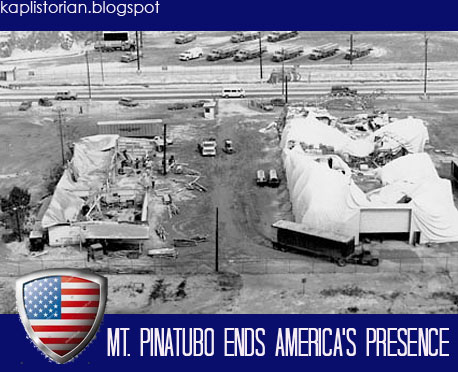
MT. PINATUBO
ERUPTION ENDS AMERICA’S PRESENCE IN CLARK
As early as April, pilot in Clark have reported seeing
ominous smoke emanating from Mount Pinatubo, a volcano that has not erupted in
500 years. When it was clar that an eruption was imminent, Clark mounted a
massive evacuation of 15,000 U.S.
personnel and their dependents on June 10. The major June 12 eruption dumped
tons of ash on Clark. But another eruption
in June 15, exacerbated by passing typhoon Yunya, further cause massive
damages, and all but buried the military base in a sea of ash, mud, pyroclastic
materials and lahar. About 2,500 servicemen and women stayed on to provide
security and try to maintain basic services. Meanwhile, the extension of the
Military Bases Agreement was rejected by the Philippine Senate, and was due to
expire on September 16. Driven by budgetary realities (it would tae $500
million to rehabilitate Pinatubo-damaged Clark)
and nature's explosive whims, the U.S. did not renegotiate anymore and
agreed to leave Clark Air Base in 1992 but keep the sprawling Subic Bay Naval
Base for 10 more years. The U.S. Air Force formally transferred entire Clark to
the Philippines on 26 November 1991, ending its 100 years in the Philippines. On
24 November 1997, the last U.S. forces left the Philippines.

THE CLARK AIRPORT
BEGINS COMMERCIAL OPERATIONS, 1995
The airport was rehabilitated from the damaged US Clark
Air Base that was closed in 199. After
two years of cleaning up debris and lava, the Clark Special Economic Zone was
opened on the site with the airport at the center. In 1995, the Clark
International Airport Corporation was established to manage the airfield
facilities. In 1996, limited air service from Clark to Hong Kong began,
signaling the first international flight. Renamed Disodado Macapagal Airport by
Pres. Gloria Macapagal-Arroyo in 2003 to
honor her father, it reverted back to Clark International Airport in February
2012. Today, Clark hosts 490 flights per week (332 Domestic flights, 158
International flights), with 19 local
and 11 international destinations, as of June 2018.

CLARK HOSTS APEC
MEETING 2015
The Philippines hosted the year-long Asia-Pacific
Economic Cooperation (APEC) summit in 2015. It was held against the backdrop of
Chinese intrusion f islands in the South China Sea, contested by several
countries, like Vietnam, Japan, Malaysia, and the Philippines. The First Senior
Officials' Meeting and Related Meetings were held at the Fontana Leisure Park, Clark
Freeport, Angeles City and Subic Bay, Zambales, from 26 January to 7 February
2015. Kapampangan DFA-Undersecretary Laura Quiambao-del Rosario was chair of
the summit.
SOURCES:
CRASH OF CAPT. KELLY: https://en.wikipedia.org/wiki/Colin_Kelly
CLARK AS LOGISTICS HUB:
THE STARS AND STRIPES
ARCHIVES “Vietnam wounded go 1st class on air ambulance (1965), U.S. SOLDIERS
IN VIETNAM”: https://www.stripes.com/news/vietnam-wounded-go-1st-class-on-air-ambulance-1.292349
Operation baby Lift
Affects Wagner: http://wagner7580.blogspot.com/2016/02/operation-babylift-affects-wagner.html
BOB HOPE: Bob
Hope, The USO One Man Morale Machine https://www.uso.org/stories/154-bob-hope-the-uso-s-one-man-morale-machine
Bob Hope Youtube Video: https://www.youtube.com/watch?v=WLLP0D3gLfk
Bob Hope Special January
19th, 1966: https://www.youtube.com/watch?v=75jUL2E6tEQ&t=4120s
AMERICAN POWS:
https://www.af.mil/News/Article-Display/Article/109716/operation-homecoming-for-vietnam-pows-marks-40-years/
PHILIPPINE ADMIN OF CLARK: : http://www.clarkab.org/history/
MARCOS FLEES PHILIPPINES: https://www.apnews.com/25ef78113ad707b046226114a25c037d
CLARK EMPLOYEES’ STRIKE: http://www.clarkab.org/history/
The Washington Post,
“Filipinos Strike at U.S. Base” https://www.washingtonpost.com/archive/politics/1983/10/04/filipinos-strike-at-us-base/6a003fd0-acc3-423d-84d2-9a0d680b7e9e/?utm_term=.11cff6a0866d
MT. PINATUBO ENDS AMERICA’S PRESENCE: http://www.clarkab.org/history/
CLARK AIRPORT:
https://en.wikipedia.org/wiki/Clark_International_Airport
Photo: I Remember Clark Air Base FB page
Photo: I Remember Clark Air Base FB page
CLARK HOSTS APEC MEET:
Photo courtesy of Mick Basa/Rappler.


