Monday, February 4, 2019

105. 11 DISTINGUISHED, TOP-RANKED MILITARY MEN OF PAMPANGA, part II


Col. PATRICIO C. BUYSON
Bacolor’s distinguished colonel,  Patricio Buyson,  was trained at Fort Sill where he finished a 6-month course at  the U.S. Armv Artillery and Missile School.  He had his baptism of fire in the Korean war where the then-major served as a battery commander in the Battalion Combat Team of the Philippine Army, which was attached the Third Infantry Division Artillery, then commanded by Gen. Verdi B. Barnes. He and the good general would meet again when, in August 1959, Maj. Buyson returned to Fort Sill to take up a 9-month course in advanced officer artillery training, which included the study of missiles. This was in preparation for a new artillery school that was then being planned by the Philippine Army, and which he was tapped to join as an instructor. Post-war, Maj. Buyson was assistant superintendent of ROTC units in .Manila.


Lt. Gen. GREGORIO M. CAMILING JR.
Named as the Commanding General of the Philippine Army in 2002, Lt. Col. Gregorio M. Camiling Jr. (b. 15 Nov. 1947)  has parents whose are both Kapampangans: Gregorio Camiling Sr. (Bacolor) and Apolonia M. Miclat (San Fernando). Two of his brothers were officers of the AFP. After graduating as salutatorian of Cubao High School, he gained admission at the Philippine Military Academy from where he graduated in 1969. He rose quickly up the ranks; from a 2nd lieutenant of the Philippine Army assigned Mindanao in 1969, he was made the commanding officer of Alpha Company of the 26th Infantry Battalion from 1971-74 that saw action against Muslim rebels in the deep south. He was promoted to Captain in 1975, and a Major of the AFP in 1977. Because of his military experience, the Philippine Army named him as instructor and department head of the School for Combat Arms (1977-1980). In the 90s, as a personal choice of Pres. Cory Aquino, he served his 4th Mindanao tour as Chief of Staff of the 4th Infantry Division, and stayed on in the region, providing support to the government panel during the MNLF negotiations. In 1999, he was nominated as commanding general of the UN Peace Keeping Forces in East Timor. Later that year, he was promoted to Major General in October 16. From 2000-01, Maj. Gen. Camiling served as chief of the Southern Command of the AFP, which led to the neutralization of the Abu Sayyaf. He was eventually promoted to Vice Chief of Staff of the Armed Forces of the Philippines, the 2nd highest-ranking military officer in the Philippines. He has been awarded 9 Distinguished Service Star Awards Gold Cross Medal, 4 Military Merit Medals with 4th Bronze Spearhead Device (Combat), 19 Military Merit Medals, Silver Wing Medal, and 6 Military Commendation Medals, to name a few. He is now retired.


Gen. RICARDO A. DAVID JR.
Born in San Fernando, Gen. Ricardo David Jr. finished his early education at Dolores Elementary School, as class valedictorian in 1967. He moved to Victoria, Tarlac to continue his high school, graduating  as salutatorian at Victoria High School. He took up Engineering at St. Louis University, Baguio on a scholarship, which he finished at the Philippine Military Academy, in 1973. He was the Commanding Officer of the 50th Infantry Battalion, Philippine Army (1996-98) and the Commanding General of the 402nd Infantry Brigade, Philippine Army ( 2005- 2006). The general then became the Northern Luzon AFP Command Chief. In 30 June 2010, he was named by Pres. Benigno Aquino III as Chief of Staff of the Armed Forces of the Philippines, a post he assumed in July. His decorations included: Philippine Republic Presidential Unit Citation, Anti-dissidence Campaign Medal, Distinguished Aviation Cross, Distinguished Service Star and Combat Commander's (Kagitingan) Badge, among others. In 2011, Gen. David was appointed by Pres. Benigno Aquino III as the chief of Bureau of Immigration


Maj. PEDRO DEANG
The first Kapampángan valedictorian of the Philippine Constabulary Academy hails from Minalin, and eventually moved to Angeles. Pedro Deang (b. 16 January 1906)  finished at the top of his class in 1932, just the fourth batch of cadets to be graduated from the country’s premiere military school. He joined the Philippine Constabulary as a lieutenant and was assigned to Sulu. There he met his future wife, Emiliana Rodriguez. When WWII broke out, Pedro was deployed to Bataan but not after sending his wife and uncles to Guinobatan, Albay, where they waited for his return. As a Major in Bataan, he was the operations officer of the 31st Infantry Division of the Philippine Army, under Brig Gen Clifford Bluemel. He served alongside the future president, Capt. Ramon Magsaysay, who was the motor transport officer of the 32st Infantry. When Bataan fell, Maj. Deang, along with thousands of American and Filipino surrenderees, joined the infamous Death March. Along the way, he was rescued by civilians, but he opted to remain with his men and rejoined the march to Capas, where he died at Camp O’Donnell on 23 April 1943.
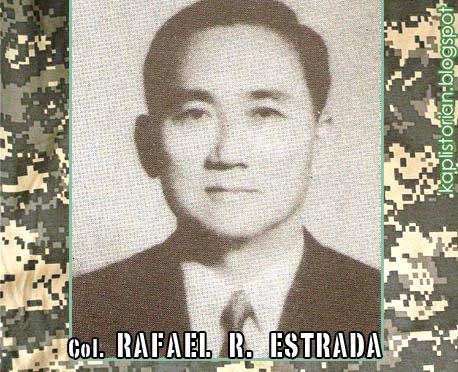


Col. RAFAEL R. ESTRADA
The distinguished Col. Rafael Reynaldo Estrada was born in Concepcion, Tarlac,  (b. October 1918) the son of Dr. Salvador Q. Estrada and Demetria Reynaldo. Highlights of his military service include his membership in the 2nd Regular Division USAFFE, and was also involved in the defense of Luzon and the Battle of Bataan (1941-42). With rations lacking and ammunitions almost gone, their commanding officer, Gen. Edward King surrendered to the Japanese on 9 April 1942. Estrada became a POW (prisoner of war) and joined the notorious 100 km. Death March to Camp O’Donnel in Tarlac. Luckily for him, he survived the march and imprisonment. After the war he was appointed Director of the Philippine Veterans Board by President Magsaysay and became Commissioner of the Veterans Claims Commission. He also became the Founder and National Commander Emeritus of Defenders of Bataan and Corregidor, Inc. (DBC). To show his commitment to help war vets, Col. Estrada developed the Blue Ridge Subdivision in Quezon City exclusively for WWII veterans. Col. Estrada counts poet Nina Estrada-Puyat and  former Sen. Eva Estrada-Kalaw as half-sisters. The respected WWII veteran died at age 98 on Oct. 2016.


 Brig. Gen. RAFAEL D. GOSECO
The late Brig. Gen Rafael D. Goseco (ret.), was a homegrown boy  from Sto. Niño,  Guagua, a graduate of the esteemed Guagua National College, founded in 1918. He would later serve the same school as its President. His wife, Dr. Petronila S. Goseco, was also a dean at the college. In May 1999, the generous general gave a deed of donation to the Court, giving some 5,000 sq. m. of land, that were part of the family’s 20-hectare property in Brgy. San Matias, Guagua,. The land was offered as site for the proposed Hall of Justice and other buildings that the Court may be minded to construct. According to General Goseco, his family will find fulfillment in knowing that it had done something for the government. Gen. Goseco passed away in February 2015. His son Ronald, a graduate of UP and the PMA, assumedthe presidency of Guagua National College.


Cmdre. JOSE G. LANSANGAN JR.
Commodore Jose G.Lansangan, from Sta. Ana, was a multi-facteted military man who was also a businessman, a college head, and author. He finished a degree in Marine Transportation, a Master in Business and Government Administration and in National Security Administration at the Royal Naval Staff College in Greenwich, London. His military career included being serving as Chief of Naval Staff of the Philippine navy (1876-78) and Commander of the Cavite Naval Base (1978-1982). Eventually, he would assume the presidency of the National Defense College of the Philippines (1982 -88). Together with his partners, he put up a government, business and industry consultancy firm (Martillano, Lansangan, Domingo & Associates, Inc.), headed the FRIENDS Foundation, and served as president of the Makati Mabuhay Lions Club as president. In March 2017, Cmdre. Lansangan wrote his memoirs,  “The 21st Century Legacy Letters Volume 1: 17 Legacy Lessons”.


Rear Adm. ARMANDO Q. MADAMBA
From San Juan, San Fernando, Armando Quizon Madamba (b. 3 Nov. 1938) was a product of Pampanga High School, class 1954. From there, he went to the state university (U.P.) to study engineering, but moved to the PMA after qualifying for the exams. At the academy, he gain renown for his brilliance in military planning and strategy. The 1962 graduate joined the Philippine Navy as ensign. He performed so well that his studies were sponsored at the Fletcher School of Law and Diplomacy at Tufts University in Boston, Massachusetts. There, he earned his M.A. in International Affairs (1970) and M.A. in Law and Diplomacy  (1971).  He was assigned to Iran as Attache at the Philippine embassy for 5 years (1975-80). Towards the decade’s end, he attended the Naval Command College course for Senior International Officers at the US Naval War College in Newport, Rhode Island. As Deputy Chief of Staff, he pushed for the complete  modernization of AFP. He retired as a Vice Admiral, but Pres. Fidel V. Ramos named him Ambassador to the Asian Pacific Economic Cooperation  in 1996. He engaged in consultancy work after his diplomatic stint. His impressive career has earned him the Distinguished Conduct Star, the Distinguished Service Star, the Philippine Legion of Honor,  Navy Distinguished Cross, the 1991 Cavalier Award of the Philippine Military Academy and Outstanding Kapampangan Award for Military Service in 1993.


Gen. RAFAEL M. MANIAGO
The future general, Rafael Manarang Maniago (b. 7 Nov. 1936)  comes from Parian, Mexico. He is said to be a descendant of the brave 17th century hero, Francisco Maniago, who led a revolt against Spain. He graduated from the Philippine Military Academy in 1962 and joined the Philippine Army. He served as regional military commander in different military zones and installations in the Philippines. As a colonel, Maniago was named Commanding Officer of the  403rd Infantry Brigade, 4th Infantry Division of the Philippine Army from 1988-89. It is known officially as the Peacemaker Brigade which specializes in anti-guerrilla warfare. From 1990-91, the colonel served as the Commander of the 502nd Infantry (Liberator) Brigade. Gen. Maniago passed away on 1 January 2004.

Col. SAMUEL S. QUIWA
Before his death from pneumonia on 12  February 2011, Col. Samuel Quiwa (b. 3 Feb. 1917) was considered as the last surviving World War II hero of San Fernando, having outlived 16 other comrades. Quiwa , a USAFFE (U.S. Armed Forces in the Far East) soldier, was a participant in the battles of Bataan and Corregidor in 1942.  He was able to escape the 3-day Death March that started in Mariveles, Bataan, but slipped back to war-ravaged Corregidor, only to surrender to the Japanese. For 20 days, he became a POW, along with other American military men, until they were transferred to Manila. After his release, he went underground in Nueva Ecija and Pangasinan as a guerrilla fighter. When the country was liberated, he returned to active service and was assigned to the 103rd Military Police Command, now the Northern Luzon Command of the AFP. He retired in 1969. For his gallantry, he was awarded the Philippine Defense Ribbon, American Defense Ribbon, WWII Victory Medal and Ribbon, Philippine Liberation Medal, among others. Before his death, he managed to receive financial reward from the U.S. government.


1st Lt. RUBEN P. SONGCO

Capt. Ruben Paras Songco (b. 5 Sep. 1921/ d. 5 Dec. 1944), was a native son of Guagua. A graduate of the prestigious U.S. Naval Academy, Annapolis,Maryland, in 1943, he excelled in football, tennis, lacrosse and boxing. He was graduated a year early due to the War. During the War, he was a member of the 1st Reconnaissance Battalion missions that left for Australia in Oct. 1943, with Gen. MacArthur attending their send-off. He was with Maj. Lawrence Phillips, Capt.  Galang, 4 radio operators and 2 reconnaisance men when they landed in Mindoro, only to be tracked and captured by the Japanese with the help of a Filipino informer. 1st Lt. Ruben Songco was one of those killed; only 3 survived. The other sad thing about his shortlived military career  was that, because of his Filipino nationality, he was  denied a commission in the U.S. Navy.

SOURCES:
Patricio Buyson: Pampanga High School, Golden 50th Anniversary Yearbook,
Photo courtesy of the Philippine Army Official Website
Pedro Deang: Picture and information courtesy of First Consul Elmer Cato.
Rafael Goseco: GNC Batch of 2005 FB page
Samuel Quiwa: “ LAST WW II WAR HERO IN SAN FERNANDO DIES”by Charlene Quiwa.


Friday, January 25, 2019

104. 13 DISTINGUISHED, TOP-RANKED MILITARY MEN OF PAMPANGA, part I

Brave warriors, fearless soldiers, and dauntless freedom fighters—all figured prominently in our early provincial history. Here is a more contemporary list of our finest Kapampangans in uniform who have managed to ascend up our country’s military hierarchy—top-ranked and acclaimed for their boldness achievements.

**********


PNP Chief OSCAR D. ALBAYALDE
The current Philippine National Police director who replaced Ronald “Bato” de la Rosa was born in San Fernando (b. 8 Nov. 1963). Oscar David Albayalde went to local city schools : San Fernando Elementary School, Pampanga High School, University of Assumption. He graduated with cum laude honors from the Philippine Military Academy Sinagtala Class of 1986, and also finished his Masters in Public Adminsitration at  MLQ University. He started his service with the Police Constabulary Special Action Force (SAF) from 1986-91. Among his  significant positions in the Police Regional Office-3 were: Acting Provincial Director of Pampanga Police; Chief, Regional Intelligence Division; Chief,Regional Police Coommunity Relations, and Chief, Regional Investigations Division. Albayalde was named Outstanding Kapampangan in Law Enforcement in 2016.


Col. JUAN E. ARROYO
The Philippine National Police - Communications and Electronics Service (PNP-CES) traces its beginnings at the turn of the 20th century, originally known as the “SIGNAL CORPS” which contributed to the development of the communications systems and facilities of the police force. In the critical war years,  beginning in 1941, Col. Juan E. Arroyo  was designated Chief Signal officer of the Philippine Constabulary (PC)  until 1942, when the Japanese took over the islands. In the period leading  to our  liberation, Col. Arroyo resumed his post as PC Signal Officer. After the war, he became the manager of the National Steel Corp., The Arroyos are from Candaba.


Col. EMIGDIO C. CRUZ
Col. Emigdio "Meding" C. Cruz of Arayat went to U.P., finishing a Liberal Arts course in 1923 and Medicine in 1929, at a rather late age of 31. He was Pres. Manuel L. Quezon’s chief physician and trusted aide during the War years. He was the recipient of the Philippine Congressional Medal of Valor and Distinguished Service Cross in 1948, the highest award that the Philippine government can give to its citizens,  for his “daring resourcefulness and long sustained courage” he displayed at the height of the second World War. After Quezon’s death in 1944, Meding lingered in the U.S., doing stints at Walter Reed Hospital, Brunns General Hospital, Ann Arbor University Hospital and the Barnes General Hospital in Missouri. He returned to the Philippines in Feb. 1946. Today, a government hospital stands in Arayat—the Dr. Emigdio C. Cruz Medical Center--named after the decorated physician-patriot who passed away in 1978.


Brig. Gen. RENE R. CRUZ
Arayat son Gen. Rene R. Cruz had an illustrious military career. As a colonel, he was connected with the Philippine National Police Academy. He was also the former RaCom Commander and PC-INP Commander and, like all high-ranking officers, was drawn into the People Power revolution in 1986. After the police general retired, he became a director of the Bataan Shipyard and Engineering Co. Inc. (Baseco). Gen, Cruz also headed the Philippine Olympic Committee (POC) from 1993-96. It was during his term that boxer Manuel Velasco won an Olympic silver in the Atlanta Olympics in 1996. He was honored by his alma mater, University of the East, a Distinguished Alumnus in Military Science award, where he finished in 1957. He passed away of heat attack, 30 Sept. 2015.


Brig. Gen. ROMEO S. DAVID
The unico hijo of a former San Fernando vice mayor and a public school teacher, Romeo Soliman David attended local schools, graduating in 1951 at the Pampanga High School. He pursued an engineering course in Manila but opted for Philippine Military Academy when he passed the admission.  At PMA, he shone in sports and in academics, and graduated among the top of his class in 1956. He became a pilot for the Philippine Air Force and was sent off by the Philippine government for pilot training in the U.S. he also underwent advanced studies at the United States Air War College in Air University, Alabama USA in 1983. David served as military air base commander and commanding general of the Armed Forces of the Philippines Regional Unified Command III. After his retirement, then Pres. Cory Aquino appointed him as president  of Philippine Amusement and Gaming Corporation in 1987-1989. Pres. Fidel Ramos named him as president and CEO of Clark Development Corporation and Clark International Airport in 1995-1998. The retired general heads the Rainbow Rising High Co., Inc., a natural gas producer based in Palawan.


Brig. Gen. VIRGILIO M. DAVID
The general from Bacolor, Virgilio Mañago David, was a PMA graduate, and an alumnus of Pampanga High School,  Class of 1954. He was a former National Police Commissioner, and served as the Anti-Drug Chief of during the term of president Cory Aquino. As head of the Narcotics Command (NARCOM), he had to revamp the agency of over 1,000 men which had been plagued with corruption charges under 2 previous heads.  Upon retirement,  he was appointed administrator of the Philippine Coconut Authority from 1992-98. He then became its director, but his term was marred by an incident when, in late May 2005, during an altercation with a person who parked his car in front of his house, the general fired his gun, injuring a construction worker nearby.


Col. MIGUEL NICDAO
Guagua-born Col. Miguel Nicdao (b. 8 May 1888/d. 1938), was but 15 when he became a pensionado (government scholar)  to the U.S., a batchmate of Jose Abad Santos. With six other Filipinos, Nicdao began his studies at Illinois State Normal University,  became a champion orator, and  graduated with an Education degree—the youngest of the 1907 batch. Once home, he started work as Principal of the San Luis Intermediate School. He was also assigned in Mabalacat, Apalit and in San Fernando where he was with Pampanga High School  for 3 years. The young teacher found it frustrating to advance in his career, so in 1911, Nicdao enrolled in the newly-opened Camp Henry T. Allen (the pre-cursor of the Philippine Military Academy). After undergoing an intensive 3-month boot camp training, he graduated as 3rd Lieutenant.  The 23 year-old embarked on his  new military career, and led campaigns in Lanao and Cotabato, during the Moro War years (1909-1923).  He would eventually become the District Commander for Muslim Mindanao. By 1917, he had attained the rank of a First Lieutenant of the PC, with missions in Cagayan and Misamis.  In the 1930s, he was instrumental in crushing a Sakdalista revolt in Laguna. The bemedalled colonel  passed away at age 50 of peritonitis, during a military exercise in Leyte, and was given full military honors during his burial.


Brig. Gen. RAMSEY L. OCAMPO
Brig. Gen. Ramsey Lapuz Ocampo is a native of Candaba, and a 1963 alumnus of Pampanga High School. As a police superintendent, he was the provincial police director of Pampanga from 1990-1992, and rose to become the Regional Director of police command VII.  Ramsey was responsible for the very good peace and order situation in Cebu City. The general also became Chief of the Central Intelligence Service (CIS) and NARCOM. He later pursued a law course and a doctorate degree and now the multi-facetted general has his own law firm and is the Vice President for Security Services of Clark.


Lt. Col. LEON F. PUNSALAN
The  West Pointer and M.I.T. graduate who saw action with the Philippine Army was born in San Simon, Pampanga on 3 July 1910. Leon Flores Punsalan is a 1928 Pampanga High School alumnus . In 1936, he graduated as a Mechanical Engineer at West Point in the top ten of his class, and he was assigned to serve  in the Philippine Army in 1938. In 1940 he was assigned in an Army base in Boston, Massachusetts and attended nigh class for his his Masters Degree in Mechanical Engineering from MIT. He invented a durable rifle cartridge ejector and obtained a patent for it. After serving for 31 years in the U.S. Army, he retired in Hampton, Virginia, where he taught mathematics and physics at local high school. He was the founder of the Pampanga Language Club of Virginia. Lt. Col. Punsalan was also a writer and a poet. Died 3 October 2001 at the age of 91.


Brig. Gen. MARCOS SOLIMAN
The general best remembered as the anonymous whistleblower who exposed the Marcos plan to place the country under Martial Law to oppositionist Benigno Aquino Jr., was born in Candaba (b. 25 April 1910), the son of the town police chief.  He was a classmate of Pres. Diosdado Macapagal at the Pampanga High School, Class 1929. He graduated in 1933 from the Philippine Constabulary Academy, and then served  the PC company in  Iloilo as a lieutenant for 2 years. Soliman was chosen to study in the Air Corps Flight School at Randolph Field, Texas. After his tour of duty, he was appointed commandant of  various ROTC units like the U.P. FEU and U.S.T. During the War, he refused to surrender to the Japanese, and became a guerilla untilhis captured in January 1944. Though released, he continued doing espionage work. In the post-war years, he served as Superintendent of the Philippine Military Academy and Commanding General of the Philippine Army. Upon leaving the military, he became chief of the National Intelligence Coordinating Agency. Shortly after Martial Law was declared in Sept. 1972, newspaper reported his death due to a heart attack, but his family believed that Marcos was responsible for his death.


Brig. Gen. BASILIO VALDES
Basilio Valdes (b. 10 Jul 1892) with roots in Floridablanca, was a doctor first, but also earned recognition as a military man, and a government executive. He finished medicine at the University of Santo Tomas and graduated with honors in 1916. Driven to serve beyond his country, he joined the French Army as a medical volunteer, then the U.S. Army as a surgeon from 1917-1919. He labored in Europe as part of the American Red Cross mission. Thus began his second career in military service. Returning home, he joined the Philippine Constabulary from 1926-1934 as medical inspector. Pres. Manuel L. Quezon appointed him as Chief of Staff of the Philippine Constabulary and Philippine Army in 1939, elevating his rank to a general (he would rise to become a Brigadier General). Two years later, Basilio was appointed as Secretary of National Defense. To expand his military education, he attended the Command and General Staff School in Fort Leavenworth, Kansas, graduating there in 1943. During the Japanese period, he served under Pres. Jose P. Laurel as Secretary of Public Works. He died in 26 January 1970.


Brig, Gen. LUIS A. VILLA-REAL
The venerable general, Luis “Louie Villa-Real, was a graduate of Culver Military School who joined the Philippine Army and headed its 21st field artillery. He fought in World War II and is acknowledged as one of the valiant Defenders of Bataan and Corregidor, having also walked in the Death March. He was to serve many presidents, including Pres. Cory Aquino who appointed him head of National Intelligence Coordinating Authority (NICA) after the fall of Marcos. Known as a Huk fighter in his time, he also headed the Philippine Anti-Communist League. He was never known to be political; in fact, he was critical of the military hierarchy in Pres. Aquino’s time, proof that he was a true servant of the Filipino people. The Villa-Reals trace their roots in Arayat.


Maj. PORFIRIO ZABLAN
The early years of Philippine aviation count only some 400 military men--all chosen between 1907 to 1935, with Pres. Quezon’s approval.  Among the first 10 Filipinos to undergo actual flight training were 10 Philippine Constabulary (PC) officers, led by topnotcher 1st Lt. Porfirio Zablan; and 23 recruits from the National Guard. Zablan, who rose to the rank of a Major,  became the first fighter pilot of the Philippines, but perished while training in the U.S. in 17 June 1935. In his memory, the Zablan Airfield in Quezon City was named after him.

(OTHER RANKING KAPAMPANGANS IN THE MILITARY: Col. (Ret.) Vicente A. Pascual (Arayat), Commodore Lodovigildo L. Gantioqui, Ph. Navy (Arayat), Col. Sergio Sanchez,  Col. Federico Calma, Col. Auelio Miranda, Col. Gregorio Yambao, Col. David Pelayo, Col. Pacifico Marin, Col. Diosdado Garcia,Col. Migule Pingul, L.t Col. Felix Duenas (Phil Coconut Authority director), Maj. Conrad Flores, Lt. Col. Patricio Buyson, Major Rufino Dizon, Capt. Crescencio Pineda)

SOURCES:
Oscar Albayalde: Most Outstanding Kapampangan Award 2016 souvenir program
Juan Arroyo:
Rene R. Cruz, Luis Villareal: The Pampangos, by Rafaelita Hilario Soriano, 1999, 218 pages
Basilio Valdes, Emigdio Cruz. Miguel Nicdao: www.viewsfromthepampang.blogspot
Marcos Soliman: PHS Golden Jubilee 50th Yearbook, 1962
Romeo David, Virgilio M. David: History of Pampanga Towns, by Andro Camiling, http://www.andropampanga.com/history_phs.htm
Leon Flores Punsalan: The Untold Battle of Leo Punsalan, https://scholar.lib.vt.edu/VA-news/VA-Pilot/issues/1995/vp950910/09070045.htm

Tuesday, December 18, 2018

103. 10 ARTS AND CRAFTS OF PAMPANGA

In the late 19th and early 20th century, a design trend swept Europe and America called “Arts and Crafts”, a movement that promoted handcraftsmanship over industrial mass production. But long before that, Kapampangans have been creating all kinds of objects with their hands, with utilitarian and decorative functions, for their homes, work, leisure and religion.
**********

1. KURAN AT PASU (Sto. Tomas)
Utilitarian and decorative clay vessels and containers were among the earliest crafted objects made by man. All sorts of earthenware—including the ubiquitous  ‘kuran’ (round-bottom cooking pot)—have been produced in parts of Pampanga, as recorded by American Thomasite Luther Parker in the 1900s.  Sto. Tomas is the acknowledge pottery center of the province, with many major potters clustered along Quirino street. According to oldtimers, one pioneer potter was Apung Sindung Mercado who made “pilones”, clay jars used in the manufacture of molasses. From making traditional oya, tapayan, kuran, gusi, balanga and pilun , the potters also added ornamental pasu or masetas for growing garden plants and flowers,


2. PUKPUK (Betis, Apalit)
The fine art of metalsmithing was known to pre-Hispanic people in our archipelago, blossoming in the the late 16th to the 19th century, when the Spanish missionaries arrived to introduce the idea of sacred art in which the Chinese excelled. To decorate the altar, Mexican silver coin were melted and fashioned into tabernacles, altar frontals and vessels, ramilletes (silver floral standees), carrozas, and more. Betis artisans mastered the art, locally termed as ‘pukpuk’ (to hammer) as designs were created by chasing and using the repoussé method,  in which designs are raised on a metal sheet by pounding a pattern from the back using a sinsil (blunt chisel). This is achieved by working on the metal against a wooden block, on which designs have been incised. Artisans spread the art to Apalit which once had the largest number of ‘pukpuk’ shops. Names like the Ramirez Family, Edgardo Yutuc and Jeric Canlas continue this tradition to this day.   


3. DUKIT (Betis)
Betis is the town synonymous with quality carved woodcrafts (“dukit” -to carve) —from church and home furniture, decorative architectural pieces,  to religious statuaries and  relief sculptures.  One of its ancient barrios—Sta. Ursula—was known as the premiere source of such carved masterpieces.  A famous resident is Maestro Apung Juan Flores, who started as  a santo carver an expanded into “muebles” and carved wooden furnishings. He made the decorative wooden carvings of Malacanang Palace during the term of Marcos. Angeles, with its many Clark residents, was a major market of woodcarved products during the 50s thru the 80s. Modern-day mandudukit include the descendants of the Flores family, Willy Layug, Peter Garcia, Salvador Gatus, and the artisans of Betis Crafts of Myrna Bituin, who exports their prized furniture worldwide.


4. PARUL (San Fernando)
The lantern industry owes its popularity to San Fernando lantern maker pioneers who evolved the parul from the simple wooden and paper star lanterns for the “lubenas” (procession)  to the giant kaleidoscopic lanterns that the world marvels at, every December’s Giant Lantern Festival. The advent of electricity gave rise to the invention of the rotor by Rodolfo David; which is used to give the lanterns their amazing play of colors. Well-known parol makers include the Quiwas (led by Ernesto David Quiwa), Rolando Quiambao, Arnel Flores, and Jesus Maglalang. The Christmas capital of the Philippines  has parul stores all over the city still selling traditional lanterns. The Dau Expressway exit is line with lantern stores, hawking paruls of all sorts—capiz, LED-lit,  wire and plastic, and even “rope” lanterns.


5. BURARUL (Angeles)
Kite-making,  though not exactly an industry,  requires a certain degree of artistic and technical skill. Believe to have originated in China, these paper and wood air craft are flown mainly for leisure and play—but they were said to be used also for measuring distances and for military communications. In Pampanga, they are called “burarul”, from the Spanish “volador”,  one that flies. The basic “karang-karang” is nothing more than a folded paper with thread. But the more elaborate kites come in box (“tukong”) or diamond shapes (“sapin-sapin”). There are high-flyers (“gurion”) and competition fighter kites (“panyaklit”). The most complicated ones are figural kites mastered by the professional kite-maker Eulogio Catalan of Angeles City. A former sepulturero, Mang Eloy won renown for his imaginative, award-winning kite creations. He made kites in the forms of birds, fishes, angels, saints and figures  of our  national heroes—all using wooden framework,  paper and paint. His most elaborate was a ferris wheel kite with seated human figures, that actually turned when flown on a string. He also introduced the concept of folding kites. The art of kite making died with him, and today, just a handful in Pampanga know how to fashion homemade kites from “tingting” and papel de hapon.


6. DASE (Candaba, San Luis, San Simon)
As early as the 18th century, dictioanarist Fray Diego Bergaño made mentioned of towns lining the Candaba Swamp that were known for weaving house mats or “dase”. Made from “ebus” (buri palm leaves) . These included weaving families from San Luis and San Simon who are skilled in the art of “pamaglala”, or weaving, usually done communally, after the day’s work. Mat weavers or”magdadase” wove fine mats of large, medium and small sizes—made for sleeping or for covering the bamboo floor. For variety, the leaves are dyed in different colors to produce mats with appealing patterns.


7. KUPIA (Apalit)
An allied product from the province’s weaving tradition are hats or “kupia”, an essential accessory for our tropical climate, where  wearing a head protection from the  scorching sun or sudden rains is mandatory.Before commercial hat shops were established in Pampanga, everday functional hats—"kupia"-- were made all over the province. Apalit was once a hat center, and in Barrio Sucad, ‘kupyang ebus’ by the thousands were woven and commercially sold in town markets from as far as Tarlac, Baguio, Bataan, Zambales and Manila. But due to the scarcity of ‘ebus’ materials, production  gradually slowed down in the 1920s. Pampanga shops that operated in the 1930s sold hats of all shapes, sizes and materials. In San Fernando, one could go to La Fernandina, Zapateria Moderna or to the Japanese bazaar of T. Tsuchibashi along Mercado St. and the Indian Bazaar of Battan Singh. "Sombreros del pais y del extranjero" (local and imported hats) could be bought in Macabebe at the Bazar L. Magat, while "El 96" in Angeles offered a few headwear selections.


8. SANTOS (Betis, Macabebe, Bacolor, Apalit)
Although Betis is the center of woodcarving  in Pampanga, it is Macabebe town which is known as the home of santeros. A santero is a craftsman who uses wood, ivory, cement or fiber glass to produce an ecclesiastical art piece known as santo, in the image of Christ, Mary or a Saint. Before the war, fishing and farming were the only means of livelihood of the people of Macabebe. Santo making was then merely an expression of their ingenuity, and the products were mostly for personal use. Pablo “Ambo” Bautista, a local businessman, is credited with promoting santo-making in the town by gathering local artists and putting them to work in a talyer he opened just for them. Sons Antonio (a painter) and Gener (a carver) further grew the business and improved the craft of santo making. This inspired other carvers to put up shops that soon proliferated along the whole stretch of the town’s main road. Others found their way in the other towns of Pampanga. U.P. Fine Arts graduate Maximiano Jingco also set up a pre-war religious statuary shop in Guagua. Second and third generation carvers continued the santo tradition like Rolando and Boyet Flores (from the Flores family of Sta.Ursula), while a new breed of highly trained carvers came to fore—Nick Lugue (Apalit).Wilfredo Layug  (Betis),  Joseph Magcalas (Apalit) ,  Joed Miclat (San Luis) and the Viray brothers (Bacolor).


9. GITARA (Guagua)
Cebu may have a reputation as the Philippines’ guitar industry leader, but the more well-known guitar brands are made in Guagua, Pampanga. The “gitara” has its origins in Spain, and there’s a mention of  a guitar-prototype in Byron Pabalan’s zarzuela “Ing Managpe”—a stringed instrument called “kalaskas”. Another is the pre-Hispanic “kudyapi”, which, like the guitar, has a box and a fretboard. The pioneer guitar maker in Pampanga is a Matuang Bacani who managed to copy an old Spanish guitar. He passed on his techniques to his son-in-law, Angel Lumanog who mastered the craft of guitar-making, opened a shop and started supplying Macabebe, Bacolor, and San Fernando stores. Son, his guitars were being sought after in Manila. Today, the Lumanog brand is a name synonymous to fine guitars. Apart from the Lumanogs, families like the Garcias, Dizons, Mallaris, Jucos and Manansalas engaged in the production guitars.


10. GAWANG PANDE (Apalit)
The first cannon maker of the country was a Kapampangan named Pande Pira, a smith who put up a foundery in Manila to make “lantakas” or cannons, and other artillery to protect the Intramuros and for use in Spanish galleons. Apalit takes pride in continuing this smithing tradition, and is the leading source of world-class steel crafts in the province,  such as bolo, machete, all types of knives and daggers, plus home and garden implements like rakes, hoes, spades, and other tools. The steel products are made the old fashioned way by hammering sheets of metal ,  made malleable by superheating them, then shaped into blades for bolos, palang, knives, scythes, spears or any bladed implement. The industry gave Apalit town its nickname, “The Blacksmith Capital of Pampanga”. In Floridablanca, smiths produced aluminum crafts, using “aluminyu” that are heated and pounded into shape, using molds.

SOURCE:
SINGSING MAGAZINE, "Pampanga's Folk Arts & Crafts: Going, Going, Gone?", Vol. 5, No. 1.Published by the Center for Kapampangan Studies,Holy Angel University. Excerpted and edited from the articles of JoelPabustan Mallari (Dase, Gitara, Kuran, Burarul, Kupia), Arwin Lingat (Santo), Alex R. Castro (Pukpuk), 
www.viewsfromthepamang.blogspot.com (Hold on to that Hat, Hamming on an Old Guitar, The Art of  the Kuran)
PHOTOS:
Alex R.Castro (Pande, Kupia, Gitara, Santos, Parul, Pande, Pukpok, )
Best, Jonathan. A Philippine Album: American Era Photographs 1900-1930, The Bookmark Inc.(Dase)
Miss Millenial Pampanga 2017 FB Page: (Betis Carving-Dukit)
Singsing Magazine: (Burarul)

Friday, December 7, 2018

102. 9 SAINTLY KAPAMPANGANS WHO COULD BE FUTURE SAINTS

Before the Spaniards came in 1571, Kapampangans were pagans and Muslims. The fact that they quickly embraced Catholicism (and later the other Christian denominations) is a testament of not just the diligence of missionaries but also the inherent religiosity and spirituality of the Kapampangans themselves. Here are a few known for the depth of their holiness, that could qualify them as future saints.

*******

1. MARTIN SANCHO, The 1st Filipino Jesuit (1593)
The distinction of becoming the first Filipino Jesuit goes to a young boy savant who went to Spain to be presented to King Philip II by his guardian, P. Alonzo Sanchez. Not yet 10 years old, Martin Sancho impressed the court not just for his knowledge of Catechism but also for his pious ways. In 1593, Sancho became a Jesuit novice, but died upon his return to the Philippines in 1601, a victim of the white plague which he contracted in Europe.


2. Sor MARTHA de SAN BERNARDO, The 1st Filipino Nun  (1633)
Upon the death of Sor Martha de San Bernardo in 1630, at least 15 Kapampangans initiated the inquiry for her possible beatification. The saintly Kapampangan was the first Filipino nun, having broken barriers by being accepted at the Santa Clara Monastery in Manila, which had previously banned “indias” into their fold. When the Franciscan Provincial initially rejected the application, the Spanish nuns pleaded that she be taken in. A Franciscan chronicler observed that “she was so influential a woman, so noble and virtuous”. Thus, she was accepted, but sent instead to a new monastery set to open in Macao. In 1633, she was invested with her holy habit while on sea, to circumvent Spanish laws, and professed her vows in the Macao—the first brown nun of the congregation.  Sor Martha  spent the rest of her life in holiness and prayer, living up to the highest standards of the Spanish order.


3. Sor MADALENA DE LA CONCEPCION, The 2nd Filipino Nun (1637)
This Kapampangan noblewoman--Madalena de la Concepcion-- was admitted directly to the Sta. Clara of Manila, after the fine example shown by Sor Martha de San Bernardo. She was clothe in the habit by her namesake,  Abbess Madalena de Christo, and professed her vows in 1637. According to her biographer, “she persevered in her monastic life for 49 years in such an exemplary way…; in all those years, no deficiency was noted in her compliance with the policies of the convent, ever excelling with diligence in the most humble and difficult tasks…and always abhorring positions of honor.” The virtuous nun died on 5 April 1685.


4. JUAN DE GUERRA, The 2nd Filipino Martyr after Lorenzo Ruiz (1640)
Juan de Guerra was part of the contingent of 4 diplomats and 70 crewmen sent by the Portuguese city of Macao in 1640  to patch things up with the Japanese anti-Christian officials. It must be remembered that Lorenzo Ruiz was executed for his faith in Nagasaki—the first Filipino martyr. Little did everyone know that the 30-year old seaman from Betis-- Juan de Guerra—would suffer the same fate. At age 6, he had been living at Colegio de San Juan de Letran as a student “interno”. Upon landing in Japan, all people on board were captured and jailed for conspiracy to spread Christianity. They were taken to Nagasaki, at the same place where Ruiz was martyred. Thirteen members of the crew were spared, however, so they could return to Macao as bearers of the Japanese’s warning. Juan de Guerra and a fellow Filipino, Juan Enriquez Carreon, were among the 61 who were beheaded for their Christian faith. It was said that when Manila received the news of their martyrdom, the city celebrated their noble deaths.


5. NICOLAS DE FIGUEROA, The Valiant Martyr of Bacolor (1672)
The Jesuits began their evangelization work in the Oceania with the Marianas Islands, led by Diego Luis de San Vitores and 5 other Jesuits, with a band of soldiers, majority of which were Filipinos, to protect the priests and pacify the native Chamorros. The group landed in Guam on 15 June 1668 and set up the mission there. In the group was a boy catechist from Bacolor, Nicolas de Figueroa, who assisted the priests in their ministries. On 1 April 1672, a band of 20 Chamorros lay in wait to ambush Figueroa and 3 others, that led to the killing of their Spanish companion, Manuel Rangel. Undaunted, the brave Figueroa turned against their leader, killing him with a cutlass, beheading him and chopping up his body, thus successfully scaring the Chamorros away. Fleeing the scene, de Figueroa sought refuge in the village of Ipao, where natives tricked him—dragging him and pushing him from a cliff. His body was repeatedly speared to ensure his death. A day after his martyrdom, San Vitores and his teen aide, Pedro Calungsod, were also killed. In 1673, a Jesuit tribunal began proceedings in Guam to look into possible sainthood for Figueroa.


6. JUAN DE LOS REYES, The Gentle Martyr (1676)
As a member of the missionary group in Micronesia, Juan de los Reyes was known for his extraordinary zeal in his ministerial work, matched with a gentle temperament and conduct. As such, his superiors promoted him to the rank of an “alferez”, holding him up as “an example to others, charitable and thoughtful to the other soldiers”. On 6 September 1676, as de los Reyes and his group (including Fray Sebastian de Monroy, a Spaniard and 5 soldiers) were preparing to set sail from Sumay village to Agana, Guam, they were suddenly attacked with lances, clubs and deadly native weapons, leaving  them all dead.


7. PHELIPPE SONGSONG, The Venerable Martyr of Macabebe (1685)
The life story of Phelippe Songsong (also, Felipe Songsong) is perhaps the best documented of Filipinos in our Spanish colonial history. A Jesuit chronicler from the period described his “life of heroic sanctity” in the missions that led to his death. The Macabebe martyr was born in 1611, after losing his wife, he left his material wealth to his son to volunteer for the religious mission in the Marianas led by the future saint,  Diego de San Vitores. The group of 17 also included Pedro Calungsod. In Agana, Songsong served the Jesuits faithfuly as a domestic, carpenter, tailor, cook, and all-around help. Although referred to as a “frater”, he, as a native, was never admitted to the order. But his holiness was renown.His solid virtues were an example to his countrymen and who, being a noble to his own people,  is now, we believe, from his blameless life, a noble citizen of the realm of heaven”. At the advance age of 73, Songsong was attacked by native heathens who wounded his head and neck seriously. He lingered for 6 months and died while kneeling in prayer on 11 Jan. 1685. Hailed as a saint, his coffin was carried by the governor of Guam to his grave site to honor his sanctity. Meanwhile, San Vitores and Calungsod have been declared saints, but the cause of Songsong has just begun.


8-9. THE SISTERS TALANGPAZ, Servants of God
MADRE DIONICIA DE STA. MARIA TALANGPAZ (b.1691/d.1732)/ and MADRE CECILIA ROSA DE JESUS (b.1693/d.1731)
These nuns were half-Kapampangans. Both their paternal grandmother (Juana Mallari) and maternal grandfather (Agustin Sonsong de Pamintuan) were from Macabebe, Pampanga. Born in Calumpit, they founded the Beaterio de San Sebastian de Calumpang in 1719, thus making them only the second Filipino foundresses of a religious congregation.  Their beaterio was just the 4th in the city, and the only one that was founded by native “indias’. The sisters suffered innumerable times while running the congregation, and at one point, polarizing the women into factions. There were aspirants who used the influence of powerful people to gain admittance into the order, while others were unable to give the required dowry. This led to the sisters’ being ousted from their rented place. But they overcame all these and today, their religious community is the oldest non-contemplative congregation in the Recoleto order.  Devotees of the Talangpaz sisters, Mother Dionisia and Cecilia Rosa, applied for their beatification and the cause was accepted in 1999, thus entitling the sisters as  "Servants of God."

BONUS! A Future Saint Who Walked Among Kapampangans:
FR. CARLOS BRAGA SDB
The life and heroic virtues of Fr. Carlos Braga“the little Don Bosco of China”---are now under study in  Vatican for his future sainthood.  Born in Tirano, Sondrio, Italy, the motherless child was entrusted to the Salesians of Don Bosco and became a priest of that order. In the 1st World War, he was sent to the Far East and served in southern China as a director of the Don Bosco Middle School in Shiu Chow. Don Braga is credited with the erection of many orphanages and schools  in Macao and Hong Kong, and the expansion of  Salesian ministry to Beijing. 

Don Braga reached the Philippines in 1953 and was designated as the first Provincial Superior in 1955. Under his helm,  the Salesian mission in the Philippines flourished, schools were founded all over the country, including the first ever Don Bosco school in Tarlac,  and Don Bosco Pampanga which credits him as a co-founder in 1956. He died in 1971 in Bacolor, Pampanga where he was staying, both as a Confessor and Salesian Director. Four decades years after his death, the Philippine Salesians filed a petition for his beatification, and the Diocesan inquiry began in 2014 in San Fernando, Pampanga.

SOURCES:
Santiago, Dr. Luciano P.R., Laying the Foundations: Kapampangan Pioneers in the Philippine Church 1592-2001, Center for Kapampangan Studies, Holy Angel University 2002.
Tantingco, Robby P. : Felipe Sonsong: From Macabebe Soldier to Saintly Missionary, Center for Kapampangan Studies, 2018
Carlo Braga: 
“Inquiry on Canonization of Salesian Opens Today”, https://www.sunstar.com.ph/article/327296
“China – The cause of the Servant of God Fr Carlo Braga SDB is moving slowly ahead”, http://www.infoans.org/en/sections/news/item/1200-china-the-cause-of-the-servant-of-god-fr-carlo-braga-sdb-is-moving-slowly-ahead

Sunday, December 2, 2018

101. 12 AMERICAN THOMASITES IN PAMPANGA & TARLAC


The American contribution to Philippine education began with the arrival of Thomasites – a band of American teachers who came to our shores in 1901, lured by a sense of adventure, prospects of employment in the exotic Far East. and a genuine will to serve and build a new nation. Here is a select group of these pioneering teachers who served in Pampanga and Tarlac.
**********
1. GEORGE N, ANDERSON, Arayat, Candaba
George N. Anderson’s commitment to advance education in the islands was so total, that when the school in Candaba was razed to the ground , the supervising teacher shelled out Php 500 from his own pockets as his contribution towards the rebuilding of the school. As a pioneer teacher in Arayat, Anderson put up an intermediate school to teach Grades 4, 5 and 6 students (a primary school was already up, that took in Grades 1-4 pupils). Established in 1909, the intermediate school would be named in his honor: Anderson Intermediate School, which operated under that name from 1909 to 1974. It then became Anderson Elementary School, offering complete Grades 1-6 classes. A fellow teacher by the name of Carrie E. Anderson taught in Arayat at the same time as George did; she may have been his wife.

2. ALFRED ARNOLD, Apalit, Arayat
Thomasite Alfred Arnold  was assigned as a primary school teacher to handle Grades 1 to 4 classes, in Arayat. He is well known for taking the extra step to win over Filipino officials who were indifferent to the idea of public education propagated by the U.S. The assiduous teacher organized and staged special programs of entertainment at his schools to interest the native town heads and gain their support and cooperation.

3. WILLIAM M. CARRUTH, Betis, Sta. Rita, San Simon
A young graduate of Cleveland, Ohio, William Carruth arrived in Betis in 1901 and was immediately besieged with problems---all the books in the school where he was supposed to teach were in Spanish. He wrote to the Dept. of Public Instruction for help, and soon, the right supplies arrived and school operations began to run smoothly—until he fell ill. But  Carruth carried on, even making himself available to teach geometry, algebra and physics at a teacher’s program in San Fernando. The Betis school was abandoned due to poor facilities and financial constraints.  Carruth, thus, moved to Sta. Rita, where he began anew to organize the primary school, plus 2 barrio schools. Faced with incompetent teachers and apathetic town officials, he finished his term in 1903, and then moved to San Simon. Carruth was an efficient, professional administrator, but the of support from his superiors and the community, perhaps wore him down to frustration. Carruth did not renew his 3-year contract and returned to the U.S.

4. W. HUSE CHAPMAN, Angeles, Zambales
W. Huse Chapman, of Connecticut, was a civil servant of the U.S. Bureau of Education and worked as a Thomasite teacher among the Negritos in the Philippines, in the Zambales region. He was deployed to Angeles, Pampanga as Supervising Teacher. While there, Chapman took an interest in photography and took ethnographic portraits, of  Negritos, their customs; activities; dwellings, structures and other material culture; and natural surroundings. Specific subjects include basket weaving, a burial, scarification, and a group of hooded self-flagellants. These 163 photos compiled in 1909, are in the Bancroft Library of the University of California Berkely.

5. ADAM C. DERKUM, Mexico, Tarlac, Zambales
Born in 1874, Adam C. Derkum studied and graduated from the University of Southern California. He was appointed to the civil service on 30 December 1903. On 1 March  1906,  Dr. Adam Derkum, together wife Agnes, were assigned to Mexico, Pampanga. He became a supervising teacher then rose in position to become  a Division Superintendent of schools in Zambales and Tarlac. He had a new building erected at a new location in 1915 after the Tarlac Provincial High School had incurred much damage wrought by usage and time. He also organized  training programs for students,  through teacher camps and educational missions. As part of the American effort to promote physical education and national fitness, Dr. Derkum help found the Philippine Amateur Athletic Federation, along with Manuel L. Quezon, Camilo Osias, Regino R. Ylanan and Jorge R. Vargas. He was chosen as President  and Chairman of the 1926 Pampanga Fair and Provincial Garden Day, This was to be one of  his last major activities as the Derkums and their four Philippine-born children, returned to America where they would spend rest of their lives in California.

6. LULU LONG HIGLEY, Bacolor
Born on 1 Oct. 1874 in Lagrange County, Indiana, Lulu Long-Higley and her husband Levi Campbell Higley (b. 1871/d.1959) taught together at Bacolor and at the Pampanga Industrial School. Lulu herself, taught industrial arts. Husband Levi was the assigned to an industrial school in Lipa, Batangas, and assumed the position of principal of the secondary school. Lulu Higley remained in Bacolor, where eldest son Phillips Isidors was born. When Higley returned to her husband’s home state, she gave birth to two more sons: Ralph and Erwin Isaac. She passed away in Genesee county on 21 Mar. 1951 at age 76, and she is interred with her husband at the county’s Springvale Cemetery.

 7. WILLIAM S. IREY, Magalang, Bataan
Pennsylvanian William Segner Irey was born in 1872, in West Chester county, an education graduate of West Chester State Normal College.  After a 13-year teaching stint in his home state, he would joined the contingent of teachers sent to the Philippines in 1901. He was stationed in Magalang, where he is credited with establishing the elementary school in the poblacion. Irey would be moved around Pampanga, living in Mexico and San Fernando, and also serving in Bataan as a 3rd grade supervisor. Irey was also an inventor of some sorts; obtaining patents for such ingenious creations as a cigarette-producing machine, a cooking apparatus, change-speed gearing and  improvements to kerosene lamps.

8. KILMER O. MOE, Magalang
Upon arrival in the Philippines, Thomasite Kilmer O. Moe, from Hoople, North Dakota, was assigned to teach in Magalang. His interest in agriculture was piqued when the “Granja Modelo”, a pilot agricultural school founded in 1885 by Spaniards, and later renamed “Estacion Pecuaria” became idle. Together with Assemblyman Andres Luciano, Moe—now a district supervisor-- initiated its reconstruction in 1917. The Bureau of Education threw its support behind its reopening and Gov. Honorio Ventura donated more funds to aid the project. Thus, the Magalang Farm School was born. Moe was also involved in the restoration of the Central Luzon Agricultural School which opened in Muñoz, Nueva Ecija on 10 Jun. 1909. After suffering typhoon damage in November, Moe initiated changes such as the use of strong materials for the school buildings.  Additions included student dorms, a superintendent office, a house for American teachers, a machine shop and a sawmill. Kilmer O. Moe wrote many treatises about various aspects of Philippine farming, including rice and sugar planting.

9. JOHN W. OSBORN, Angeles, Magalang, San Fernando
John W. Osborn is known for being the first principal of Pampanga High School in 1908, the most revered institution for secondary education in the province. PHS would produce  a president,  eminent scholars, writers, politicians, military leaders, lawyers, and builders of  our nation. Osborn was from Bringhamton, New York,  a 1901 graduate of Western Reserve University, Ohio . Before his assignment in the capital town, he was minding the affairs of the elementary schools in Magalang (1904) and Angeles (he rented the ground floor of the Gomez/Masnou House with Marion Huff, another Thomasite). PHS originally was located at the Eusebio Residence located near the town plaza, with classes opening in 1908. Enrollment was so low that it was unable to form a senior class until 1911-1912. As student population grew, the school was transferred to a new building near the Provincial Capitol. It was Osborn who chose future Justice Jose Gutierrez David to deliver a speech before  Secretary of War, William Howard Taft and presidential daughter Alice Roosevelt, during their visit to San Fernando in 1904. In his unpublished memoirs, Justice Gutierrez recalled that “Mr. Osborn  was quite satisfied and elated judging from the manner he congratulated me. For me, that was enough”.

 10. LUTHER PARKER, Masantol, Arayat, Bacolor
The most high-profile Thomasite Pampanga, Luther Parker was born in Missouri to James R. and Mary C. Parker, in 1872. A graduate of the State Normal School in Chico, California, he arrived in the Philippines  in 1901, and served in the Bureau of Education for twenty-five years, the last 7 years as division superintendent of schools. His first assignment was Masantol, then in Arayat as Supervising Teacher, and the town postmaster. He was also a regular contributor of articles for Manila Times. Parker’s accomplishments included writing a “Diccionariong Ingles, Kapampangan at Kastila," in 1905, studying Philippine linguistics, and initiating the writing of town histories. Parker became the Principal of the Bacolor Trade School in March 1907, as well as General Inspector of school shops in the country. He was assigned from 1914-1916 in San Francisco to oversee the  Philippine exhibit of school industrial work. For his achievements, Kapampangan officials proposed to adopt Parker as a son of Pampanga province. Parker also served in Pangasinan  ( 1918, promoted food production campaigns and gardening), Ilocos Norte,  (1921, organized Bands of Mercy , mainly a children’s group that championed kindness to animals) and Nueva Ecija (1922-26). He retired and lingered in the country until 1931, when the Parker family left the country for good. The Parkers took up residence in Santa Cruz, California. He passed away in 1948. His collection of pictures, memorabilia, albums of clippings are kept in the University of the Philippines.

11. CARROLL A. PEABODY, Mabalacat, Tarlac
Thomasite Carroll Peabody, a fresh graduate of Western Reserve University in Ohio, was first assigned to Mabalacat in 1902 where he became a “maestro Americano” , teaching his Kapampangan pupils in nipa and bamboo classrooms.  He later  became a supervisor, then a Division Superintendent in Tarlac. His wife, Emma, was also a teacher. Also assigned there was Joseph L. Flaherty, a Supervising Teacher as of 1906. Peabody documented the hardships of setting up schools and keeping them running despite inadequate supplies (billiard cue chalk were sometimes used as blackboard chalk), in his unpublished memoirs, “Personal Reminiscences of Early Days, 1898-1902”.

12. FRANK RUSSELL WHITE, Tarlac
Thomasite Frank Russell White  was born in Millburn, Illinois on 8 June 1875. He has the singular distinction of opening the first provincial high school in the Philippines—Tarlac High School on 1 Sep. 1902—and was its first principal. The high school had an initial enrolment of 35 students which grew to 93 before the end of that year. White served for 2 months, and then appointed Division Superintendent for Tarlac province. The high school he founded would have a permanent 2-storey building of  Oregon pine, a 76 feet long and 42 feet wide. It was built though the initiative of his successor, Mr. S.C. Campbell,  at a cost of Php 48,000. It opened in 1904. White rose to become the 4th Director of Education of the Philippine islands, but died an early death due to an illness on 17 Aug. 1913.  Unfortunately, the heritage building was razed by fire on 28 Oct. 2015. For years, tales of a “white ghost” haunting the high school were often heard—but this must have been simply a reference to the teacher who made history in Tarlac—Mr. Frank Russell White.

A COMPREHENSIVE LIST OF THOMASITES ASSIGNED TO PAMPANGA & TARLAC
Albright, Henrietta M., Tarlac, Tarlac
Anderson, Carrie E. Arayat, Pampanga Intermediate
Ansbro, Lucinda, Tarlac, Tarlac
Bass, James H. Apalit, Pampanga Supervising Teacher
Briggs, George N. Surigao, Surigao, Cagayan and Misamis; San Fernando, Pampanga and Bataan Division Superintendent
Campbell, S.A. Tarlac, Tarlac; Cavite Division Superintendent
Carleton, Charles W. Bacolor, Pampanga Industrial School
Derkum, Agnes M. Mexico, Pampanga Intermediate School
Flaherty, Joseph L. Mabalacat, Pampanga Supervising Teacher
Franke, Walter E. Florida-Blanca, Pampanga Supervising Teacher
Gambill, J.M. San Fernando, Pampanga Supervising Teacher
Gammill, J.A. Iloilo, Iloilo andAntique; San Fernando, Pampanga and Bataan Superintendent
Gascon, Osmond Guagua, Pampanga In Charge Barrio School
Higley, Levi C. Bacolor, Pampanga; Lipa, Batangas Industrial School; Principal
(Secondary school)
Howard, Joseph G. Apalit, Pampanga Industrial School
Huff, Marion Bacolor, Pampanga Industrial School
Manns, Alys E. San Fernando, Pampanga Provincial High School
Manns, Thomas F. Balanga, Bataan; San Fernando, Pampanga Principal, High School (in charge)
Mayo, William L. Tarlac, Tarlac Provincial High School
McGee, Fannie, Tarlac, Tarlac
Preuitt, William E. San Fernando, Pampanga and Bataan Superintendent
Reimold, O.S., Tarlac, Tarlac
Rudy, Abraham Macabebe, Pampanga Supervising Teacher
Russell, Florence E. Tarlac, Tarlac Provincial High School
Russell, H.C. Laoag, Ilocos Norte; Tarlac, Tarlac Principal, High School
Shearer, Lucy B. San Fernando, Pampanga Provincial High School
Vaughan, William T. Candaba, Pampanga Supervising Teacher
Williamson, Katherine P. San Fernando,Pampanga Provincial High School
Young, Katherine M. San Fernando, Pampanga Provincial High School

SOURCES:
Alan Derkum, Carroll Peabody, John W.Osborn : www.viewsfromthepampang.blogspot.com
Photo of Kilmer O. Moe's calling Card: Doris Manlapaz, Magalang Historical Society
Photo of Luther Parker in Arayat: John Tewell, flickr.com
Dizon, Lino L., Mr. White, A Thomasite History of Tarlac Province 1901-1913, in Honor of Frank Russell White. Published by the Center for Tarlaqueño Stduies and the Center for Kapampangan Studies, 2002.
Larkin, John A. The Pampangans,: Colonial Society in a Philippine Province © 1972 The Regents of the University of California, 19913 Edition by new ay Publishing. Pp.143-157.
Gutierrez-David, Jose. The Story of my Life, unpublished memoirs