Showing posts sorted by relevance for query literature. Sort by date Show all posts

Monday, September 3, 2018

92. 24 SIGNIFICANT BOOKS ABOUT PAMPANGA YOU MUST KNOW, part II

Part II of the list of 24  Kapampangan books (no.s 13-24), essential reads for every Kapampangan who wants to know about aspects of our history, language, literatature geography, literature, and the lives of Pampanga's leading movers and shakers.
**********

13. BORN OF THE PEOPLE, by Luis Taruc. 1953. Published by International Publishers. Reprinted 1973.
Sugnificance: A must-read autobiography of the supremo of the Hukbalahap or Hukbong Bayan Laban sa Hapon group between 1942 and 1954. Luis Taruc became involved in the agrarian reform problems in the 1930s. He led his Huk guerrilla operations against the Japanese during World War II. of the Philippines. After the war, the Huks continued to clamor for agrarian reform, but which were unmet by th Roxas government. Though he and some colleagues were elected as congressmen, they were not allowed to take their seats. The  went back to the  hills to resume their armed struggle.


14. JUAN CRISOSTOMO SOTO AND THE PAMPANGAN DRAMA, by Juan S. Aguas. 1963. University of the Philippines, Q.C., reprinted, 2016.
Significance: This is a study on the life and works of the greatest Kapampangan writer Soto (1867-1918), with special reference to his masterpiece, “Alang Dios”. Adapted from the author's thesis from 1955. Soto’s literary output is unparalleled in volume and quantity: 50 plays, over 100 poems, scores of short stories, essays and novels. The verbal joust “Crissotan”, the counterpart of the Tagalog’s Balagtasan was named in his honor.


15. THE PAMPANGANS: Colonial Society in a Philippine Province. By John A. Larkin. 1972, University of California Press-Berkely.
Significance: The first book on Kapampangan colonial and social history that does not only treat the usual fare of historians, but also discusses the socio-economic aspects of Pampanga’s existence, including its problems—cash-crop economy driven by sugar, peasants’ unrest, politics, Chinese migration and inter-marriage with indigenous people. More surprising is that this well-researched book was written by an American, John Larkin from the State University of New York at Buffalo, who made his first trip to Pampanga in 1964. He was made an Honorary Kapampangan in 2017.


16. KAPAMPANGAN LITERATURE: A Historical Survey and Anthology, by Edna Zapanta-Manlapaz. 1981, Ateneo de Manila.
Significance: This is a pioneering study of the secular written literature of one of the country’s major language groups—Kapampangan. This volume, and  Rosalina Icban-Castro’s “Literature of the Pampangos” were the major references for kapmapngan literary works—in drama, poetry, and prose.


17. KAPAMPANGAN WRITING: A Selected Compendium and Critique, by Evangelina Hilario-Lacson. 1984, National Historic Commission.
Significance: A useful collection of selected Kapampangan writings, with much information on Pampanga writers and samplings of their works.


18. RECOLLECTIONS AND DIGRESSIONS, Renato Tayag. 1985. Philnabank Club, Manila.
Significance: A personal memoir and a local history book, rolled into one, written by the esteemed lawyer-journalist-writer  Katoks Tayag, an Angeleño. It includes a section on Pampanga and one article-- “The Vanishing Pampanga Nation” is a classic read. Of this book, Jose Luna Castro notes—“this is a meaty book the reader can bite with relish,,and to go with it is a sparkling wine of humor and wit”.


19. AN ANNOTATED PICTORIAL HISTORY OF CLARK AIR BASE, 1899-1986. David Rosmer. 1984. 13th Air Force Office of History, reprinted 1986. Fort Stotsenburg Historical Foundation.
Significance: A definitive reference book about the history of Clark Air Base—from its early beginnings as Camp Stotsenburg, to its modern-day version. The updated 1986 version encompases the ‘cataclysmic events of 1986” (Marcos’ ouster by the People Power Revolution). The book includes many rare photos of the base facilities from the extensive 13th Air Force history photograph collection, which were left and destroyed during the 1991 Pinatubo eruption.


20. THE NEPOMUCENOS OF ANGELES CITY AND THEIR RELATIVES, by Marco D. Nepomuceno. 1987. Published by the author.
Significance: A major work about Pampanga family history and genealogy, gathered from all recorded data and traditional sources, including the work of Mariano A. Henson—The Descendants of the Founders of Angeles (1966) which the author began updating in 1972. Vintage photos accompany the presentation of the Nepomuceno genealogy, organized in simple, easy-to-follow tables.


21. A SHAFT OF LIFE, by Rafaelita Hilario-Soriano. Printon Press. Q.C. 1996.
Significance: This is one of the few books that deal with the contributions of two Central Luzon revolutionary figures—Nueva Ecija’s Gen. Mariano Llanera and Pampanga’s Tiburcio Hilario, during the first and second phases of the Philippine Revolution, retold by the author who is a Hilario descendant.


22. COMFORT WOMAN, Slave of Destiny. By Maria Rosa Henson. 1996. Philippine Center for Investigative Journalism.
Significance: The first book about the ordeals of a comfort woman, personally written and illustrated by Maria Rosa Luna Henson, a Kapampangan . She burst into the national consciousness in 1992, when she broke half-a-century's silence to talk about her experience as ‘comfort woman’ in a World War II rape camp. Her story The book encouraged other women to come out with their own stories, belying earlier claims that the Japanese did not set up ‘comfort stations’ in the Philippines as they did in Korea, Taiwan and Indonesia.


23. PINATUBO: A VOLCANO IN OUR BACKYARD, by Robert P. Tantingco. 2011. Center for Kapampangan Studies, Holy Angel University.
Significance: The 20th anniversary of the Pinatubo eruption spurred the writing of this book which won a National Book Award from the Manila Critics Circle. The book  traces the terrible eruption in 1991, to aid us in appreciating not just any volcano, but this particular volcano, our Pinatubo. It equips us with the scientific basis for all that happened in 1991, but also rewards us with the unique experience of Kapampangans and the monster mountain in our midst.


24. AN INTRODUCTION TO KULITAN, The Indigenous Kapampangan Script. By Michael Raymon M. Pangilinan. 2012,  Center for Kapampangan Studies, Angeles City.
Significance: Kulitan or Súlat Kapampángan, the indigenous Kapampangan script, has found new followers among young people. This book is the perfect reference to understand the indigenous writing system and learn how to write it. It is a product of a life-long research of the writer, a known Kapampangan language expert. 

SOURCES:
Pinatubo, Kulitan: CKS Publications
Comfort Woman, R. Henson: www.mekeniland.blogspot.com
All other Book Covers: from the CKS Library

Saturday, August 25, 2018

91. 24 SIGNIFICANT BOOKS ABOUT PAMPANGA YOU MUST KNOW, part I

Books written about Pampanga, its people and culture, including its language, literature, history. Some of these books were written by foreigners, others by local writers, in Spanish, in English, and in Kapampangan— great reading essentials to know more about our province. Here are the first 12:
**********

1. VIDA DEL GLORIOSO S. NICOLAS, TRADUCIDA EN YDIOMA PAMPANGO, por el P.R Phelipe Tallada, del orden N.P.S. Agustin, el año de 1614. (Life of the Glorious Saint Nicolas, Translated in the Pampango Language by Rev. Fr. Felipe Tallada, of the order of St. Augustine, in the year 1614).
Significance: This is the first ever book published in Kapampangan, in 1614. It is a biography of the life of St. Nicholas, with prayers and reflections.


2. ARTE Y REGLA DE LA LENGUA PAMPANGA, Compuesto por el Padre Predicador  Fray Francisco Coronel y prior misionero del Convento de Macabebe, 1621. (Kapampangan Grammar and Rules, by Fr. Francisco Coronel, prior of Macabebe, ca, 1621)
Significance: The earliest Kapampangan grammar and rule book in existence.  In 2005, it also became the first Kapampangan grammar book from that period to be transcribed, translated  and annotated in English, by Fr. Edilberto V. Santos. The book still contains the original text with a parallel English translation.


3. VOCABULARIO DE PAMPANGO EN ROMANCE Y DICCIONARIO DE ROMANCE EN PAMPANGO, by Fray Diego Bergaño, first published in 1732, reprinted 1860, 1916.
Significance: This Kapampangan dictionary and glossary book of over 5,177 Kapampangan word entries by the Augustinian priest Bergaño represent not just one of the earliest extant studies of our language, but also probably, the most scholarly and comprehensive. A translated English version was published by the Center for Kapampangan Studies in 2007, along with a Bergaño’s companion grammar book, “Arte de la Lengua Pampanga”, first published in 1729.


4. EJERCISIO COTIDIANO, by Dña. Luisa Gonzaga de Leon, ca. 1844.
(Book of Daily Devotions)
Significance:  Ejercisio Cotidiano (Daily Devotions) is a book of prayers, meditations and reflections, written by Bacolor-born Luisa Gonzaga de Leon (b.1805/d.1843),  printed in Spanish in 1844. This makes her the first Filipino woman to publish a book. In 1910, the book was translated into Kapampangan.


5. ING MACUYAD A PAMAGSALITA DIQUIL QÑG BIE NANG DELANAN AT PANĞATIMAUAN NING METUNG A MEBIJAG. By Fernando Garcia OSA. Published 1900. Imprenta del Colegio de Sto. Tomas. (Translated as “An Epistle of a Friar-Prisoner”, by Lino L. Dizon, 2007).
Significance: A rare account of the captivity of an Augustinian priest, P. Fernando Garcia OSA, written by the Spaniard himself in Kapampangan,  during during the Philippine revolution. It includes accounts of his “sorties from town to town and provinces” as prisoner and missionary at the turn of the century. His observations were critical of the treatment religious received from the revolucionarios. He escaped in Bontoc, reached Manila to write about his trials and tribulations as a POW.


6. GONZALO DE CORDOBA, Comedia Heroica de la Conquista de Granada o sea Vida de Don Gonzalo de Cordova, Llamado el Gran Capitan. By Fr. Anselmo Jorge Fajardo, ca. 1830s. published 1912, by Cornelio Pabalán y Byron. (Heroic Comedy of the Conquest of Granada or The Life of Don Gonzalo de Cordova, Called the Great Captain)
Significance: The longest comedia (also called “moro-moro”) in Philippine literature, the play about the exploits of Capt. Cordoba took seven nights to perform, as the lines alone numbered 31,000. When published, the book was 832 pages long. No wonder, it was only published once, over a century ago.

7. NAPUN, NGENI’T BUKAS, by Aurelio Tolentino. “Ing dramang ‘Napun, Ngeni’t Bukas’ kesukul ne ning ginawa at meatulan king apat a kasalanang sedicion, conspiracion, rebellion at insureccion laban king gobierno Americano”. 1914, Limbagang Noli. (The drama Yesterday, Today and Tomorrow caused the writer to be jailed and charged with 4 crimes: sedition, conspiracy, rebellion and insurrection against the American government).
Significance: This is Tolentino’s play first staged to a jampacked crowd in 1903 at Teatro Libertad. A key scene called for one Tagalog performer to bring down the American flag and then trample it, but the actor froze when he saw Americans in the audience. Tolentino ascended the stage and did the act himself. He was found guilty of “scurrilous libel’ for desecrating the Stars and Stripes,  and was imprisoned.


8. A CHILD OF SORROW. A Novel by Zoilo M. Galang. 1921.
Significance: The first novel in English written by a Filipino. The novel-- was made into a movie in 1930. Zoilo Galang of Bacolor, also was an encyclopedist, who put together the 10-vlume “Encyclopedia of the Philippines” published in 1934-36.


9. HISTORIA NING FILIPINAS. By Santiago Mallari. 1933 (History of the Philippines)
Significance: This slim volume is the first comprehensive Philippine history book in the Kapampangan language. It also has an account of the battle exploits and death of Tarik Soliman, the boy warrior of Macabebe. The book also devotes a section on the  Kalantiao code in Kapampangan, which has since been debunked.


10. PAMPANGA DIRECTORY, Agricultural, Commercial, Industrial, and Professional Guidebook of the Province of Pampanga, The Richest Market Outside Manila. Vol.I, by Manuel David, Managing Editor. 1933.
Significance: This limited edition book, published to commemorate the holding of the 1933 Pampanga Carnival and Exposition, gives us a snapshot of the province in the area of agriculture, commerce, and industries, etc.  during the peacetime era.  All 21 municipalities of the province are represented here, including history, key people, geographical info, products,  among others.


11. NINU’T NINU QNG CAPAMPANGAN, Bilungan Dang Bie ding Anac nang Carangalan Ning Lalawigan Capampangan, by Faustino Gutierrez. 1934 , Catimawan Press.(Who's Who in Pampanga.,  A Compendium of the Lives of the Honorable Children of Pampanga Province).
 Significance: The limited edition book contains photos and brief biographical entries of the leading personalities, families, movers and shakers of Pampanga during the Commonwealth years.


12. A BRIEF HISTORY OF THE TOWN OF ANGELES (From its Foundation in 1796 A.D. to the Present), and his other Writings. By Mariano A.Henson. 1948, Katiwala Press.
Significance: For decades, this was the only widely-referenced published book on the history of Angeles town (reprinted 2002), written by Angeles’ venerable historian and genealogist. His major opus— “The History of Pampanga and its Towns” (rev. 1965)–remains in typewritten and mimeographed form—and continues to be consulted by Kapampangan scholars.

SOURCES:
Singsing Magazine, various issues, Center for Kapampangan Studies, HAU.
Dizon, Lino L. The Epistle of a Friar-Prisoner, as written by F. Fernando Garcia OSA, Center for Kapampangan Studies, HAU.
A Child of Sorrow: http://thessalythea.blogspot.com/2015/07/a-child-of-sorrow-biographical-analysis.html
Historia ning Filipinas, Pampanga Directory, Gonzalo de Cordoba, Napun, Ngeni't Bukas: Alex R. Castro Collection

Tuesday, March 14, 2017

39. 12 ANCIENT KAPAMPANGAN RIDDLES

Kapampangans, like all Filipinos, love exchanging bugtung or riddles at social events, funeral wakes and weddings. A favorite past time during the war, playing ‘bugtungan’ was widely practiced in rural areas to while away time during long walks home. See if you can answer these ancient riddles that our folks enjoyed in the good old days.
******
1.
2.
3.
4.
5.
6.
7.
8.
9.
10.
11.
12.

ANSWERS:
1. Sulput or amorseco; 2. Sungka; 3, Piña (pineapple); 4. Campana (bell) 5. Mangga (mango); 6. Yamuc (mosquito); 7. Camiseta (shirt); 8. Pluma (fountain pen); 9. Balubad (cashew); 10. Buac (hair); 11. Sampagang saguin (banana blossoms); 12. Angca (jackfruit).

PHOTO SOURCES: online free clip art
SOURCES: 
Historical Data Papers of Candaba, Magalang, Mabalacat.
Icban-Castro, Rosalinda, Literature of the Pampangos, University of the East Press, Manila, Philippines,1981.

Monday, March 18, 2019

107. 16 OLD NAMES OF PAMPANGA TOWNS


The early Kapampangan settlements as found by Spaniards, and the early pueblos that they organized were known by ancient, local names---far different from the names of today’s modern municipalities and cities. Either derived from plants and trees, or from their distinctive natural features and location, many of these names are hardly remembered by young Kapampangans today.
**********

1. CANDAUE (Candaba)
Candaba originally had an older variant name—Candaue, Candawe—which refers to a place where the municipal cemetery is now located. In old maps, the ancient settlement was marked as “Candave”, “Candava”, and eventually localized to “Candaba”. Already a rich settlement in 1571, it also has one of the oldest barrios in the province—Mandasig—founded by Mandic, the wife and first cousin of Malangsic, one of the children of Prince Balagtas, as related in the 1539 will of Pansomun.


2. PÚRAC (Porac)
“Púrac”or “Pórag” was how the name of Porac was pronounced in the 1850s. “Púrac” was a flowering rattan plant (Calamus curag) which must have grown and proliferated in the area, now known as Porac.


3. BACULUD (Bacolor)
The town known for its people of arts, literature and culture was called “Baculud”, from the word “macabaculud”, an upland surrounded by low-lying lands—which refers to Lubao.  Its name has the same etymological origin as the city of Bacolod.  Founded in 1571, “Bacolor” is the Hispanic name of this former capital of Pampanga.


4. BALAYAN NING PAMBUÍT (Arayat)
Before the coming of the Spaniards, the town was called by its ancient name “Balayan ning Pambuit”, then located at barrio Palinlang (or Paglinglang), as the  poblacion was still forested. In vernacular, the place was originally called “dayat”, which means ‘an irrigated riceland or seedbed. Its most visible landmark is Bunduk Alaya (from ‘paralaya”, thus,  eastern mountain).


5. MASICÚ (Mexico)
Before it was christened as Mexico in 1577, the place was called “Masicu”—and pronounced that way-- which may been derived from the “síko fruits” (chicos) that supposedly grew in the area, hence, “ma-sicu”. Another version had it that the town was “elbowing other towns”—hence, “macasicu”. In any case, the name was Romanized to “Mexico”, before the replacement of ‘X” with “J”, after the 19th century.


6. WAWÂ (Guagua)
The ancient prosperous town was originally called in “Wawâ”, which means “the mouth of a river”, based on its location. The spelling was Hispanized into “Guagua”in 1590, in much the same way that the “wa” of Palawan was written in old Spanish maps as “Paragua”.


7. PINPÍN (Santa Ana)
The ancient name of Santa Ana is “Pinpin” (variations: Pimping, Pingping, Pimpin) after an important person who may have lived during the time of Malangsíc. It was then placed under the advocation of Santa Ana when the Spaniards came, a name the town adopted.


8. BABÂ (Lubao)
“Babâ” is Kapampangan for “low”, in contrast to “baculud”. “Lubao” or “tubao”, is an extinct word meaning “to arise, or emerge, or float from water” (its modern form is the dipthong “gatao” or “gato”, to float) . “Babâ Lubao” thus means “to rise from the low depths of the water”. Old residents still refer to themselves as “tau cu Babâ”.


9. SANTA RITA DE LELE (Santa Rita)
As a neighbor of the major town of Bacolor to where residents would go for their daily marketing and commercial transactions, the town was known as “Sta. Rita de Lele”.  It was also called “Sta. Rita Baculud”.


10. SASMOAN (Sexmoan)
Sasmuan was written on maps for over a century as “Sexmoan”, the Spanish transcription of the old town’s name, until 1991, when it reverted back to its vernacular version—Sasmuan. “Sasmoan” means “a place of convergence”, a meeting place where Kapampangans met when they were waging war with the Chinese. The sexual connotation of Sexmoan in English prompted the municipal government to return to the old name.


11. CABAGSÁC (San Luis)
“Cabagsác” was the former name of the town of San Luis, a contraction of “cabág bagsac” , or “bagsácan cabag”, which means “ a drop-off place of  fruit bats”. The name was extended to “San Nicolas Cabagsác”, to honor its Spanish Augustinian priest, Fray Nicolas de Orduño.


12. VIRGEN DEL PILAR (San Simon)
Tradition has it that the former name of an Simon town was “Virgen del Pilar”, its titular patroness whose fiesta is celebrated every October 12. It is also to honor the memory of its founder, Mariano del Pilar.


13. BALIWAG (Santo Tomas)
The traditional name of Santo Tomas is “Baliwag”, a new town in 1773. It is derived from the term “maliwag”,someone prone to habitual tardiness. It was rechristend Santo Tomas in 1792.


14. CULIÁT (Angeles)
The town was inaugurated in 1829, and was given two names by its founder, Don Angel Pantaleon de Miranda: ‘Culiat’, a woody vine (Gnetum indicum Lour.) that grew in abundance in the area cleared by his tenants and future residents of the place. Another name given was “Angeles” in honor of the ‘Los Santos Angeles Custodios” (Holy Guardian Angels), titular patrons of the town, and of the founder himself. Only oldtimers use Culiat nowadays; to modern-day residents, Angeles is preferred, as it has a more cosmopolitan ring for a city.


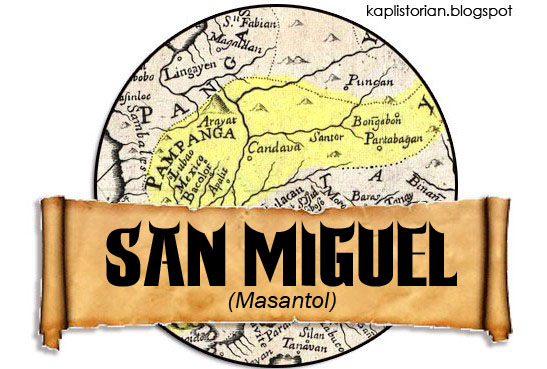
15. SAN MIGUEL (Masantol)
Masantol used to be a barrio of Macabebe, as recorded in the 1853 census. It was known as San Miguel, formed from the Macabebe barrios of Bebe, Bulacus, Caingin and Nigui sometime in 1877 or 1878. It was renamed Masantol, meaning  “a place full of santol (Sandoricum koetjape Merr.) fruit trees” after 1903.


16. CAUMPAUI (Floridablanca)
Before the town was named either after the count of Floridablanca, Jose Moniño (1728-1803) or the white pandacaqui flower, there was a certain place called “Caumpaui” existing in the area in 1847, that was established earlier by Spanish missionaries as a “hacienda” and administered from Lubao. It was transferred to the new town in 1867. Floridablanca is considered as Pampanga’s youngest town,

SOURCE:
Henson, Mariano. The Province of Pampanga and its Towns(A.D.1300-1962)