Showing posts with label 1920s. Show all posts

Monday, July 15, 2019

113. 7 ANCESTRAL HOUSES OF GUAGUA: A LIST BY JERRY PUNZALAN SAGMIT

Guagua—or uaua--meaning “mouth of a river”, has been called as such since 1590 owing to its location along the river which played a role in turning it early into one of Pampangan’s most prosperous towns. The affluence of the twon led to the erection of some of the most stunning ancestral residences in the province.
 ********

1. ARRASTIA-GONZALES HOUSE 1929, San Roque, Guagua


2. DE MESA HOUSE 1935, San Isidro, Guagua


3. DR. GALICANO CORONEL HOUSE 1925, San Nicolas II, Betis
Former vice mayor of Guagua in 1928. The symmetrical looking Victorian house or "gingerbread", is notable for its lace-like fretwork carvings, and its graceful steps that lead to a gated open porch. The house sits on a well-kept, manicured garden.

4. GONZALES-ARAULLO HOUSE 1928, Sto. Nino


 5. OCAMPO HOUSE 1928
Former residence of Mayor Isidro Ocampo.

6. SANTOS-OCAMPO HOUSE 1920
Now occupied by the Jiao Family

7. LOPEZ MANSION 1929, San Nicolas 1st
One of Guagua’s most spectacular landmarks is the Lopez Mansion, an imposing concrete residence built by the sugar magnate, Don Alejandro Lopez (b. 16 May 1883). Done in the  Greek revival style, the façade is dominated by Grecian columns accented with reliefs of foliate swags. Sandwiched in between are glass-paneled openings that lead to individual room balconies. During the war, Japanese Col. Gempachi Sato, commander of the 61st infantry took over the house in 1942. The Alejandros reclaimed the house in 1945. Severely damaged by the Pinatubo eruption in 1991, it was restored in 2016 by an heir, Jose Ronrico “Rico” Vitug Gueco. The house is open for social events and for various functions.

ABOUT OUR CONTRIBUTOR.  JERRY PUNZALAN SAGMIT originally hails from Guagua, but now resides in Porac. He operates Funeraria Punzalan, a memorial service company founded by his ancestor Pedro Manalili Punzalan in Arayat in 1930. He is also interested in heritage and local culture and history.

Sunday, December 2, 2018

101. 12 AMERICAN THOMASITES IN PAMPANGA & TARLAC


The American contribution to Philippine education began with the arrival of Thomasites – a band of American teachers who came to our shores in 1901, lured by a sense of adventure, prospects of employment in the exotic Far East. and a genuine will to serve and build a new nation. Here is a select group of these pioneering teachers who served in Pampanga and Tarlac.
**********
1. GEORGE N, ANDERSON, Arayat, Candaba
George N. Anderson’s commitment to advance education in the islands was so total, that when the school in Candaba was razed to the ground , the supervising teacher shelled out Php 500 from his own pockets as his contribution towards the rebuilding of the school. As a pioneer teacher in Arayat, Anderson put up an intermediate school to teach Grades 4, 5 and 6 students (a primary school was already up, that took in Grades 1-4 pupils). Established in 1909, the intermediate school would be named in his honor: Anderson Intermediate School, which operated under that name from 1909 to 1974. It then became Anderson Elementary School, offering complete Grades 1-6 classes. A fellow teacher by the name of Carrie E. Anderson taught in Arayat at the same time as George did; she may have been his wife.

2. ALFRED ARNOLD, Apalit, Arayat
Thomasite Alfred Arnold  was assigned as a primary school teacher to handle Grades 1 to 4 classes, in Arayat. He is well known for taking the extra step to win over Filipino officials who were indifferent to the idea of public education propagated by the U.S. The assiduous teacher organized and staged special programs of entertainment at his schools to interest the native town heads and gain their support and cooperation.

3. WILLIAM M. CARRUTH, Betis, Sta. Rita, San Simon
A young graduate of Cleveland, Ohio, William Carruth arrived in Betis in 1901 and was immediately besieged with problems---all the books in the school where he was supposed to teach were in Spanish. He wrote to the Dept. of Public Instruction for help, and soon, the right supplies arrived and school operations began to run smoothly—until he fell ill. But  Carruth carried on, even making himself available to teach geometry, algebra and physics at a teacher’s program in San Fernando. The Betis school was abandoned due to poor facilities and financial constraints.  Carruth, thus, moved to Sta. Rita, where he began anew to organize the primary school, plus 2 barrio schools. Faced with incompetent teachers and apathetic town officials, he finished his term in 1903, and then moved to San Simon. Carruth was an efficient, professional administrator, but the of support from his superiors and the community, perhaps wore him down to frustration. Carruth did not renew his 3-year contract and returned to the U.S.

4. W. HUSE CHAPMAN, Angeles, Zambales
W. Huse Chapman, of Connecticut, was a civil servant of the U.S. Bureau of Education and worked as a Thomasite teacher among the Negritos in the Philippines, in the Zambales region. He was deployed to Angeles, Pampanga as Supervising Teacher. While there, Chapman took an interest in photography and took ethnographic portraits, of  Negritos, their customs; activities; dwellings, structures and other material culture; and natural surroundings. Specific subjects include basket weaving, a burial, scarification, and a group of hooded self-flagellants. These 163 photos compiled in 1909, are in the Bancroft Library of the University of California Berkely.

5. ADAM C. DERKUM, Mexico, Tarlac, Zambales
Born in 1874, Adam C. Derkum studied and graduated from the University of Southern California. He was appointed to the civil service on 30 December 1903. On 1 March  1906,  Dr. Adam Derkum, together wife Agnes, were assigned to Mexico, Pampanga. He became a supervising teacher then rose in position to become  a Division Superintendent of schools in Zambales and Tarlac. He had a new building erected at a new location in 1915 after the Tarlac Provincial High School had incurred much damage wrought by usage and time. He also organized  training programs for students,  through teacher camps and educational missions. As part of the American effort to promote physical education and national fitness, Dr. Derkum help found the Philippine Amateur Athletic Federation, along with Manuel L. Quezon, Camilo Osias, Regino R. Ylanan and Jorge R. Vargas. He was chosen as President  and Chairman of the 1926 Pampanga Fair and Provincial Garden Day, This was to be one of  his last major activities as the Derkums and their four Philippine-born children, returned to America where they would spend rest of their lives in California.

6. LULU LONG HIGLEY, Bacolor
Born on 1 Oct. 1874 in Lagrange County, Indiana, Lulu Long-Higley and her husband Levi Campbell Higley (b. 1871/d.1959) taught together at Bacolor and at the Pampanga Industrial School. Lulu herself, taught industrial arts. Husband Levi was the assigned to an industrial school in Lipa, Batangas, and assumed the position of principal of the secondary school. Lulu Higley remained in Bacolor, where eldest son Phillips Isidors was born. When Higley returned to her husband’s home state, she gave birth to two more sons: Ralph and Erwin Isaac. She passed away in Genesee county on 21 Mar. 1951 at age 76, and she is interred with her husband at the county’s Springvale Cemetery.

 7. WILLIAM S. IREY, Magalang, Bataan
Pennsylvanian William Segner Irey was born in 1872, in West Chester county, an education graduate of West Chester State Normal College.  After a 13-year teaching stint in his home state, he would joined the contingent of teachers sent to the Philippines in 1901. He was stationed in Magalang, where he is credited with establishing the elementary school in the poblacion. Irey would be moved around Pampanga, living in Mexico and San Fernando, and also serving in Bataan as a 3rd grade supervisor. Irey was also an inventor of some sorts; obtaining patents for such ingenious creations as a cigarette-producing machine, a cooking apparatus, change-speed gearing and  improvements to kerosene lamps.

8. KILMER O. MOE, Magalang
Upon arrival in the Philippines, Thomasite Kilmer O. Moe, from Hoople, North Dakota, was assigned to teach in Magalang. His interest in agriculture was piqued when the “Granja Modelo”, a pilot agricultural school founded in 1885 by Spaniards, and later renamed “Estacion Pecuaria” became idle. Together with Assemblyman Andres Luciano, Moe—now a district supervisor-- initiated its reconstruction in 1917. The Bureau of Education threw its support behind its reopening and Gov. Honorio Ventura donated more funds to aid the project. Thus, the Magalang Farm School was born. Moe was also involved in the restoration of the Central Luzon Agricultural School which opened in Muñoz, Nueva Ecija on 10 Jun. 1909. After suffering typhoon damage in November, Moe initiated changes such as the use of strong materials for the school buildings.  Additions included student dorms, a superintendent office, a house for American teachers, a machine shop and a sawmill. Kilmer O. Moe wrote many treatises about various aspects of Philippine farming, including rice and sugar planting.

9. JOHN W. OSBORN, Angeles, Magalang, San Fernando
John W. Osborn is known for being the first principal of Pampanga High School in 1908, the most revered institution for secondary education in the province. PHS would produce  a president,  eminent scholars, writers, politicians, military leaders, lawyers, and builders of  our nation. Osborn was from Bringhamton, New York,  a 1901 graduate of Western Reserve University, Ohio . Before his assignment in the capital town, he was minding the affairs of the elementary schools in Magalang (1904) and Angeles (he rented the ground floor of the Gomez/Masnou House with Marion Huff, another Thomasite). PHS originally was located at the Eusebio Residence located near the town plaza, with classes opening in 1908. Enrollment was so low that it was unable to form a senior class until 1911-1912. As student population grew, the school was transferred to a new building near the Provincial Capitol. It was Osborn who chose future Justice Jose Gutierrez David to deliver a speech before  Secretary of War, William Howard Taft and presidential daughter Alice Roosevelt, during their visit to San Fernando in 1904. In his unpublished memoirs, Justice Gutierrez recalled that “Mr. Osborn  was quite satisfied and elated judging from the manner he congratulated me. For me, that was enough”.

 10. LUTHER PARKER, Masantol, Arayat, Bacolor
The most high-profile Thomasite Pampanga, Luther Parker was born in Missouri to James R. and Mary C. Parker, in 1872. A graduate of the State Normal School in Chico, California, he arrived in the Philippines  in 1901, and served in the Bureau of Education for twenty-five years, the last 7 years as division superintendent of schools. His first assignment was Masantol, then in Arayat as Supervising Teacher, and the town postmaster. He was also a regular contributor of articles for Manila Times. Parker’s accomplishments included writing a “Diccionariong Ingles, Kapampangan at Kastila," in 1905, studying Philippine linguistics, and initiating the writing of town histories. Parker became the Principal of the Bacolor Trade School in March 1907, as well as General Inspector of school shops in the country. He was assigned from 1914-1916 in San Francisco to oversee the  Philippine exhibit of school industrial work. For his achievements, Kapampangan officials proposed to adopt Parker as a son of Pampanga province. Parker also served in Pangasinan  ( 1918, promoted food production campaigns and gardening), Ilocos Norte,  (1921, organized Bands of Mercy , mainly a children’s group that championed kindness to animals) and Nueva Ecija (1922-26). He retired and lingered in the country until 1931, when the Parker family left the country for good. The Parkers took up residence in Santa Cruz, California. He passed away in 1948. His collection of pictures, memorabilia, albums of clippings are kept in the University of the Philippines.

11. CARROLL A. PEABODY, Mabalacat, Tarlac
Thomasite Carroll Peabody, a fresh graduate of Western Reserve University in Ohio, was first assigned to Mabalacat in 1902 where he became a “maestro Americano” , teaching his Kapampangan pupils in nipa and bamboo classrooms.  He later  became a supervisor, then a Division Superintendent in Tarlac. His wife, Emma, was also a teacher. Also assigned there was Joseph L. Flaherty, a Supervising Teacher as of 1906. Peabody documented the hardships of setting up schools and keeping them running despite inadequate supplies (billiard cue chalk were sometimes used as blackboard chalk), in his unpublished memoirs, “Personal Reminiscences of Early Days, 1898-1902”.

12. FRANK RUSSELL WHITE, Tarlac
Thomasite Frank Russell White  was born in Millburn, Illinois on 8 June 1875. He has the singular distinction of opening the first provincial high school in the Philippines—Tarlac High School on 1 Sep. 1902—and was its first principal. The high school had an initial enrolment of 35 students which grew to 93 before the end of that year. White served for 2 months, and then appointed Division Superintendent for Tarlac province. The high school he founded would have a permanent 2-storey building of  Oregon pine, a 76 feet long and 42 feet wide. It was built though the initiative of his successor, Mr. S.C. Campbell,  at a cost of Php 48,000. It opened in 1904. White rose to become the 4th Director of Education of the Philippine islands, but died an early death due to an illness on 17 Aug. 1913.  Unfortunately, the heritage building was razed by fire on 28 Oct. 2015. For years, tales of a “white ghost” haunting the high school were often heard—but this must have been simply a reference to the teacher who made history in Tarlac—Mr. Frank Russell White.

A COMPREHENSIVE LIST OF THOMASITES ASSIGNED TO PAMPANGA & TARLAC
Albright, Henrietta M., Tarlac, Tarlac
Anderson, Carrie E. Arayat, Pampanga Intermediate
Ansbro, Lucinda, Tarlac, Tarlac
Bass, James H. Apalit, Pampanga Supervising Teacher
Briggs, George N. Surigao, Surigao, Cagayan and Misamis; San Fernando, Pampanga and Bataan Division Superintendent
Campbell, S.A. Tarlac, Tarlac; Cavite Division Superintendent
Carleton, Charles W. Bacolor, Pampanga Industrial School
Derkum, Agnes M. Mexico, Pampanga Intermediate School
Flaherty, Joseph L. Mabalacat, Pampanga Supervising Teacher
Franke, Walter E. Florida-Blanca, Pampanga Supervising Teacher
Gambill, J.M. San Fernando, Pampanga Supervising Teacher
Gammill, J.A. Iloilo, Iloilo andAntique; San Fernando, Pampanga and Bataan Superintendent
Gascon, Osmond Guagua, Pampanga In Charge Barrio School
Higley, Levi C. Bacolor, Pampanga; Lipa, Batangas Industrial School; Principal
(Secondary school)
Howard, Joseph G. Apalit, Pampanga Industrial School
Huff, Marion Bacolor, Pampanga Industrial School
Manns, Alys E. San Fernando, Pampanga Provincial High School
Manns, Thomas F. Balanga, Bataan; San Fernando, Pampanga Principal, High School (in charge)
Mayo, William L. Tarlac, Tarlac Provincial High School
McGee, Fannie, Tarlac, Tarlac
Preuitt, William E. San Fernando, Pampanga and Bataan Superintendent
Reimold, O.S., Tarlac, Tarlac
Rudy, Abraham Macabebe, Pampanga Supervising Teacher
Russell, Florence E. Tarlac, Tarlac Provincial High School
Russell, H.C. Laoag, Ilocos Norte; Tarlac, Tarlac Principal, High School
Shearer, Lucy B. San Fernando, Pampanga Provincial High School
Vaughan, William T. Candaba, Pampanga Supervising Teacher
Williamson, Katherine P. San Fernando,Pampanga Provincial High School
Young, Katherine M. San Fernando, Pampanga Provincial High School

SOURCES:
Alan Derkum, Carroll Peabody, John W.Osborn : www.viewsfromthepampang.blogspot.com
Photo of Kilmer O. Moe's calling Card: Doris Manlapaz, Magalang Historical Society
Photo of Luther Parker in Arayat: John Tewell, flickr.com
Dizon, Lino L., Mr. White, A Thomasite History of Tarlac Province 1901-1913, in Honor of Frank Russell White. Published by the Center for Tarlaqueño Stduies and the Center for Kapampangan Studies, 2002.
Larkin, John A. The Pampangans,: Colonial Society in a Philippine Province © 1972 The Regents of the University of California, 19913 Edition by new ay Publishing. Pp.143-157.
Gutierrez-David, Jose. The Story of my Life, unpublished memoirs

Thursday, March 29, 2018

77. 10 RARE AND EARLY PHOTOS OF FLAGELLANTS IN PAMPANGA


The ways of  flagellants have always inspired awe and curiosity amongst the faithful during the days of Lent. Pampanga flagellants, however, have a different intent. Bloodied, scourged and caked with dust, magdarames live and act out the passion of the Lord—and the term “dámé”, to sympathize and share one’s grief, to take part in someone else’s suffering-- captures this spirit of oneness, in pain and sorrow. Here are, early images of the “magdarame” in Pampanga,  preserved by the camera from the turn of the 20th century to the 1950s.
************

1. MAMALASPAS
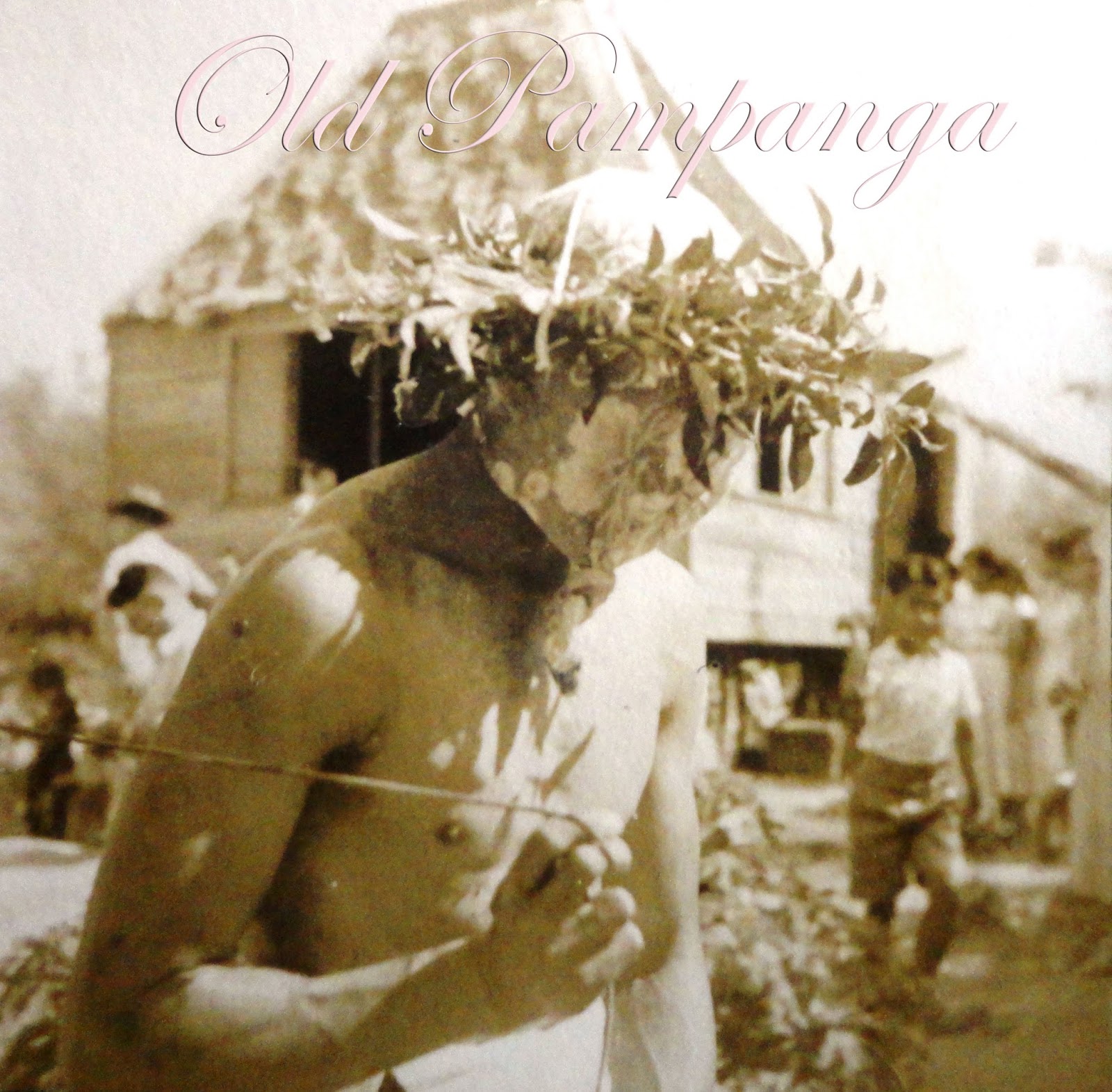
Barefooted flagellants from the early 20th century have their backs incised with wounds, drawing blood by whipping their backs with burilyos--bamboo strips tied to a cloth. These magdarame types are called mamalaspas, A distinctive sound is heard when the bamboo strips strike the flesh.

2. MAGDARAMES IN A VISITA
Makeshift chapels of wood, nipa and light materials serve as pitstops for  retinue of magdarames. Here, at these gaily decorated visitas, they pause to say their prayers, before moving on.

 3. MAGDARAME ANONYMOUS.
A magdarame remains anonymous by covering his face with a black hood or a white cloth, called "capariza", held in place by a crown of vines or twisted branches. These days, the face cover is an option as some modern-day flagellants expose their faces to the world. Instead, a piece of cloth is used to covers their heads, Arab-style.

4. BLOOD AND GORE
The back of a magdarame  is incised with a panabad, a paddle with shards of broken glass or directly with a razor or the sharp tip of a knife, such as the one shown in the photo.

5. EYES ON THE MAGDARAME
A group of American ladies from nearby Fort Stotsenburg gawk at a cross-bearing magdarame, followed by his aide, who intones prayers. Then, as now, magdarames were strange sights to see for foreigners. Today, the display of unusual practices such as flagellation and crucifixion are part of a 'religious tourism program' propagated by such places led by the City of San Fernando.

 6. THE CROSS-BEARERS
A popular type of magdarame is the cross-bearer or mamusan kurus. He either carries a cross or is tied to one. This flagellant carries a cross of bamboo, and he carries its full weight as the cross does not touch the ground. Today's crosses are fashioned from commercial lumber from hardware stores, or fashioned from old electric posts. They are also unusually long, so that the end of the cross touches the ground, thus providing support,

 7. THE WAY OF THE CROSS
Flagellants often walked country trails and roads, in small packs of 8 to 12. Others go on solitary walks, the better to reflect on his personal mission to be united in suffering with Christ. An American in a white suit follows this group in their walk of faith.

8. WHIP IT GOOD!
Another kind of magdarame is the sasalibatbat, who fling their bodies to the ground, rolling over sharp rocks and stones in the process. They are followed by a flogger, who whips them when they are on the ground. Their torsos, legs and arms are tied with abaca rope to impair circulation, hence making the experience more torturous.

9. EVERYTHING'S ALRIGHT?
An ayudante checks on the condition of a magdarame, sprawled on the field under the hot, mid-day sun.  The walk around town begins in the morning, ends by early afternoon and is followed by a dash to the nearest river for a quick, recuperative bath.


10. CRUCIFY HIM!
A magdarame is symbolically crucified, by having his arms tied on the crossbar.  The first re-enactment of Christ's crucifixion happened in the 1955 "Via Crucis" in San Fernando, but it was only in 1962 that an actual crucifixion was done, with the nailing of Artemio Anoza to the cross in barrio San Pedro Cutud. Anoza believed he could realize his dream to be a faith healer with his crucifixion.

PHOTO SOURCES:
Photos, courtesy of "Old Pampanga" FB Group.
Others: Alex R.castro, ebay.com 

Sunday, March 4, 2018

75. 11 POINTS OF INTEREST IN AND AROUND PINATUBO IN 1925

In January 17, 1925, Capt. H.A. Myers of the 26th Cavalry, by order of Col. Cavanaugh, prepared and circulated a guide to provide persons interested in riding, with information concerning the best trails an roads to take when riding out of the Post proper. The Stotsenburg Reservation and nearby country, in general, offers much that is worth exploring, for there is a lot of beautiful scenery and many interesting landmarks to be found there. A list of these trails and scenic spots, in and around Pinatubo, as well as  Bamban, are contained in the memo. Some of the names and locations of these trails have been lost to memory.
**********

1. FERN CANYON
This canyon probably offers the finest scenery of its kind around Camp Stotsenburg and should be visited at least once by every person of the garrison. Here, one can see beautiful array of typical shrubbery, particularly ferns, the abundance and variety of which gives the canyon its name.

Wild fowl abound, especially the smaller birds many of which are bedecked with the brightest of plumage. After entering the canyon proper, it narrows down into a gorge only a few feet wide with walls of slid rock on either side varying from 75 to more than 150 feet in height. Huge trees jut out from the walls many feet overhead. Only at midday does the sun ever reach the depths of the canyon and the air is always cool and laden with the fragrance of wild flowers.

2. THREE-CRATER TRAIL
This trail, which forms part of the first part of the 24th Field Artillery China Sea Trail, is very much worthwhile. The trail follows along a canyon which opens out frequently into circular clearings similar to and probably are, very old craters. There is a heavy growth of plant life on all sides and birds and animal life abound. Interesting and unusual geological formations are frequently encountered. The stream which flows through this canyon furnishes a portion of Stotsenburg’s water supply and the water line and settling basin are passed shortly after entering the canyon. Here and there are short trails leading up into the surrounding hills. Persons talking this ride should try and follow the trail as far as the Bamban River which is encountered at the end of the canyon about 4 miles from the Post. Due to its being used throughout the year and forming part of the 24th Field Artillery China Sea Trail, this trail is generally in good shape. Take your camera.

3. LOST CANYON
Lying just south of the the larger and more imposing canyon of the Three Crater Trail, Lost Canyon is very frequently overlooked by equestrians but this oversight is the distinct loss of the latter because Lost Canyon, with its misleading off-shoots and dense growth offers a haven for the seeker of the unusual and uncertain. Entering the canyon, one passes through the gardens of several enlisted men, after which the narrow trail follows along a small stream. The canyon is narrow and overgrown with dense tropical shrubbery, vines and trees. Here, one can find everything in its natural state, there being few evidences of changes made by man. Vari-colored birds flit among the trees and shrubbery, unconscious if intruders, Air plants such as epiphytic orchids grace the front porches of most quarters in the Post and many varieties can be seen as they grow in their natural state. Lost Canyon extends for a considerable distance but for the mounted visitor, only about 1 mile. There are numerous off-shoots from the main trail easily mistaken for the latter, but all finally coming to an end in some inaccessible spot. No doubt, some early pioneer, after struggling to find his way through the canyon, found inspiration for giving it its name. This is a fine place to cool off on hot, tropical days.

4. SOUTH BOUNDARY TRAIL
Following along the Southern Boundary of the reservation from Camp Stotsenburg to Dau, this trail—which in reality is a second class road—offers an excellent route for person desiring to take a ride of several miles over level country. The dirt road is soft and makes a good footing for horses, particularly if gaits faster than a walk are desired. The trail, after being taken to the outskirts of Tacondo, leads almost directly east to Dau. From this point, persons can either return over the same route or take the main Stotsenburg-Dau road. The country along the entire route is level and if desired, one can ride cross-country or; make us of the numerous small trails which run in every direction.

5. SPANISH CUT-SECOND AND THIRD RIVER TRAILS
This is one of the most interesting rides that can be taken around Stotsenburg. Leaving the Post proper, the route leads past the Forage Farm, across Pistil Gulch to the Bamban River. In making the descent to the river, the trail leads down to a long steep bank, somewhat thrilling to ride down, but not at all dangerous if taken slowly. Crossing the river—which is never deep nor dangerous except in the rainy season—the trail leads into a deep cut covered overhead with trees and shrubbery. Following up the cut which is quite steep but accessible, the trail emerges at the top and leads on generally North between, over and around hills, across small streams and through thickets. The scenery here is beautiful. Second River is reached about 1 mile North of the Bamban, and the Third River is a large pool of cool, clear, sparkling water. This is an excellent place for swimming and in years gone by, it was quite the thing to arrange swimming parties here, tents being taken out  of pack mules for dressing rooms. There are any number of excellent sites along the route for staging picnics.

6. DRY RIVER BED TRAIL
This trail offers an excellent route for beginners as it runs through the sandy river bed, has an easy footing for horses and is about the best place one can find to fall off. This trail is also an excellent place to work frisky, nervous horses as the deep sand tends to quiet them down. Except during rainy weather, this stream bed can be followed to a point south east of Dolores and in very dry weather, even further. Trees line the stream bed forming natural barriers on either side. Beginners who are reluctant to try a trot or gallop should do their first work at increased gaits in this sandy stretch. In going over the trail, one can either ride down as far as a point south of Dolores and then return over the same ground or take the Banyan Trail leading through the Banana Grove and back to the Post via Air Service, Murrayville, etc.

7.BANYAN TRAIL
This is an excellent route to take for a short ride. One can leave the Post, cover this trail to where it joins the Dolores Road and return in about three quarters of an hour. The trail is taken near the Air Service then runs through the Banana Grove where the famous Banyan Tree is passed. There is a very dense growth in the Banana Grove and as the sun seldom filters through the thick foliage, it is always cool here. Leaving the Banana Grove, one can either return via the Dry River Bed or take the Dolores Road back to the Post.

8. THE ARTILLERY TRAIL TO THE CHINA SEA
The Artillery Trail to the China Sea constructed by the 24th Artillery is open from about the first of November to the first of July for individually-mounted parties and pack animals. A 2 ½ hour ride, without one hill, brings one to Camp 3 located on the Bamban River. An excellent place for a picnic or to camp (plenty of tent poles, benches and firewood always on hand). A good swimming hole about 200 yards from the camp. During this ride, you will pass through th  4 craters and are struck by the scenic beauty and marvelous rock formation, reminders of the Pre-Glacial  Age.

About a half hour’s ride from the fourth crater, the typical forest begins and continues to the base of Mount Pinatubo. The beauty and wonders of this forest cannot be appreciated unless seen. There is practically no animal life but abundant flora; ferns, air plants, orchids, giant fern trees and other tress 250 feet tall and 25 to 30 feet in diameter. Other beautiful flora peculiar to this forest only, and never named.

From Camp 3 to Camp 4 is about a 1 hour ride following the Bamban River over a practically level trail. Camp 4 is a good halfway camp if going to Pinatubo. Animals should be rested and packs removed before going up out of Bamban as at this point, the only difficult climb begins. The trail follows a gorge out of the Canyon of the Bamban and reaches the divide between the Bamban and Dry Pasig valleys. After following the divide for about four miles, you make a slight descent coming out of the forestand by a slight climb into Zambales Pass and Camp 6. The altitude of Camp 6 is about 4,000 feet The cool climate and invigorating atmosphere rivals Baguio. It is an excellent place to camp with plenty of good spring water available.

The view from Zambales Pass is incomparable with anything in the Philippine Islands. Looking back to the east, the plains of Pampanga are visible for scores of miles and to the West, the mountains of the coast and over them,the China Sea and the Capones islands. From Camp 6, you should ride about a mile further to the north and view Pnatubo Crater. It is beyond description with its walls rising from 500 to 2,000 feet. Parties should not attempt to go beyond this pint unless prepared to stay out sometime. Also, parties going beynd Camp 3 should consist of at least 5 persons, and should be armed.

9. TRAIL TO DRY PASIG
This trail requires about 4 hours to cover but is very worthwhile, and should be taken at least once by everyone. It runs from the Post proper to Sapang Bato Ridge, and then southwest through numerous cultivated areas, a hacienda, a large coconut grove, the latter the only one near the Stotsenburg reservation. Several pretty canyons are crossed and the country in general, offers much in scenic beauty. The trail terminates at what is known as Dry Pasig, a stream bed usually having little, if any, water but deriving its name from the fact that the head waters of the Pasig River originate in this area. The trail, of course, continues on further from this point, but persons coming from Camp Stotsenburg will hardly care to ride beyond.

10. GRIFFITH’S PEAK
The ride to the summit of Griffiths Peak is one of the nicest that can be taken in or around Stotsenburg. The climb up the Peak is steep but not difficult, and once at the top, one can get a very excellent vew of the country for miles around. On clear days, the Central Luzon Valley stretches out to the east and is plainly visible as far as the mountain ranges that run North and South along the Pacific coast of Luzon. Angeles, San Fernando, San Pedro Magalang, and in fact, all of the towns and barrios to the east and South can be seen on clear days. If one cares to take the ride, there is a rail running down the northwestern slope of Griffiths Peak that leads to a point on the Bamban River just above the Intake Station, the latter being where Stotsenburg secures its water supply. The trail from the high South bank of Bamban, down to the stream bed where the Station is located is too steep to be attempted by a horse. However, persons can go down dismounted with no difficulty and should do so as the spot where the Station is located is picturesque. At one point near is a long tunnel where the water line runs under a high hill. This tunnel is large enough for a person to walk through and offers an interesting diversion for persons desiring to explore . This trip should best be taken after the grass has been pruned off and only in dry weather.

11. TOP ‘O THE WORLD
This hill is reached by so many trails that any attempt to describe them all is difficult and unnecessary. It is possible to approach the hill from most any direction and encounter a trail or several of them. However, there are a few general routes over and around the hill which offer the best footing and are therefore the most advisable ones to follow. First, there is a trail which runs West along the crest of a ridge that begins back of the T line. This trail goes over the Reservoir Hill and on along the ridge, turns North and then  goes to a point on the South side of Top ‘O the World. From here, one can go up to the uppermost point on the Top ‘O the World or else proceed on West along the south side of the hill, and then northwest along the ridge that runs along the Top ‘O the World to Griffiths Peak. From the highest point of Top ‘O the World, there is a trail that running dwn the crest of the ridge in a northeasterly direction. This is called the “Knife’s Edge” . The trail is very narrow with steep slopes on either side. None but the very experienced rider who has confidence in his horse should ride over this portion of the trail. The view from Top ‘O the World is excellent. Persons desiring to cover a formidable but safe hill trail should take one of the several trails leading up and around Top ‘O the World, as they are all in good condition, well-travelled and offer no onstacle which the average rider on the average horse should not be able to negotiate.

CREDITS, PINATUBO TRAILS:
NOTE: While most of these photos are Stotsenburg photos, some are representational.
Banyan Forest picture (representation only): https://www.flickr.com/photos/nitinmnair/3968634739, posted by Alel, 30 Sep. 2009

Saturday, November 18, 2017

66. 20 FUNERAL TRADITIONS & PRACTICES THAT KAPAMPANGANS OBSERVE

All Saints’ Day (Todos Los Santos on Nov. 1) and All Souls Day (Nov. 2) used to be 2 distinct observances until somehow, they merged as one. When campo santos (cemeteries) began being built outside of the town, folks found it convenient to divide their pious duties: Nov. 1 was devoted to grave visits while Nov. 2 was reserved for church rites. Death came early for Filipinos in the 19th century; life expectancy was just about 35 years. Life, was indeed precious, which was why, death was considered major rite of passage, with traditional ceremonies and post-mortem practices created around the inevitable.

**********
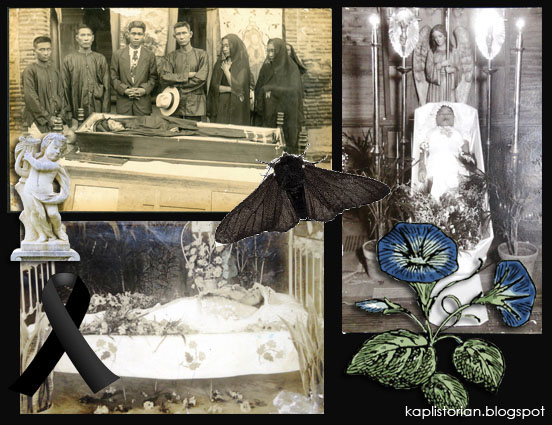
1.There were certain portents of death that old Kapampangan folks believed in: the appearance of a black moth, a dog digging up the ground for no apparent reason, the dreaming of a loss tooth, combing one’s hair at night. To avoid untimely deaths, one should neither position his bed towards the door nor join a picture-taking session if the number of subjects is either 3 or 13. If the toes of the dead curled inwards, beware of another impending death.

2.As soon as someone died in the neighborhood (indicated by loud wailing), neighbors knew exactly what to do next. Members of the grieving family were not allowed to do any work, and so the neighbors took over. There were no funeral services, no embalming, and so everything that needed to be done must be done quickly, before decomposition set in (burial must take place within 24 hours)

3.Early Filipinos believed in the mystical number 7, representing the 7 holes of the head. Our pre-colonial ancestors thus covered their dead’s faces with a death mask cut out with 7 holes. But Kapampangans also believed that an invisible 8th hole exists at the crown of the head of certain special persons, gifting them with the power to liaise between the dead and the living.

4.The deceased was laid on his bed decorated with hangings (black for an adult, white for a child). If the deceased did not own a bed, he was laid out on a mat (dase or banig) on the floor. A black cloth is draped in front of the house to signify a death in the household.

5.The grieving family would have nothing to do but stay beside the dead to weep (they had less than 24 hours to say their final good-byes). If they had to talk to visitors at all, it should be about the life and legacy of the departed.

6.Meanwhile, the teenagers stayed up all night to keep watch and guard against the magcucutud (or manananggal), the airborne supernatural creatures who stole corpses. They entertained themselves by playing card games like entre siete and pierde y gana or playing the traditional Kapampangan games of caragatan (or bugtungan) and talubangan (or bulaclacan), where the boys played butterflies to the girls' flowers.

7.There are certain no-no’s when a death in the family occurred. The family of the deceased were prohibited from bathing, cleaning the house or getting a haircut. The children of the deceased were not supposed to play; if they did, old folks warned, they'd go crazy. A dead should not be perfumed lest he decomposes faster.

8.Children and infants were carried across the coffin to prevent hauntings by the deceased. Taking out the deathbed through the window is another sure way to ward off ghostly encounters.

9.In Macabebe they still do tagulele, an ancient practice that the Bergaño dictionary defined as "the chant of lamentation during a person's wake or burial, relating the bravery of the deceased."

10.Any form of house cleaning is still prohibited during the wake, or another member of the family might also die. When the coffin is already being carried out of the house, however, it should be followed with sweeping of the floor, to drive away illness and bad spirits.

11.Some relatives must also stay behind and peep out of the windows as the coffin is being taken out. The deceased person's bed must be discarded by taking it out of the house through a window, to ensure his happiness in the next life and to prevent another death in the family.

12.The Church dictated the rituals associated with the dead and the dying. Back then, fees were being collected by unscrupulous frailes for walking the dead to his burial ground or for ringing the church bells a certain number of times. During a funeral procession, prayers were intoned at regular intervals called “posas”.

13.During the funeral procession, everyone (not just the family) should be in black and holding lighted candles. The widow and female relatives should wear sucong (long black veils). Rich families spend more to have a punebre (funeral band) and the parish priest accompanying the dead to the cemetery.

14.In those days when there were still no public cemeteries, the dead were buried in private properties, usually the backyard. A child's corpse was always buried neck-deep while a male adult's corpse only knee-deep, in the belief that the soul of older people needed to get out of this world more quickly.

15.When it was time for the dead to be buried, the coffin, as was the custom in old Mabalacat, was placed on a “lankayan”, a stretcher of bamboos, which was then carried on the shoulders of 4 persons. Shortly before burial, relatives younger than the deceased took turns kissing his hand, while the children were held up and passed to waiting arms across the coffin to prevent hauntings. Taking out the deathbed through the window is another sure way to ward off ghostly encounters.

16.Everyone threw in a handful of soil as the casket was lowered, but only the gravediggers were permitted to look at it. There was also the prevalent practice of burying a rosary with the dead, but it had to be cut first lest the dead became restless. (Death is the end of our physical life, but a rosary, in a chain form, is “endless”, so it also needs to be cut).

17.In the first two nights after burial, family and friends gathered around a makeshift altar inside the house to pray for the deceased, have bread, sweets and tea or coffee (nothing more), followed by merriment (more caragatan and talubangan).

18.On the third night, when the soul was believed to come for a brief visit, a seat would be reserved for him at the dining table where ash, instead of food, was put on his plate and covered with cacaricucha leaves. The soul would be pleased to see this and would reward his loved ones with a passing apparition or even clues to some hidden wealth.

19.From fourth to eighth nights, only bread, sweets and tea/coffee would be served again to those who participated in the prayer vigils, but on the ninth night (the uacas of the pasiyam), a big dinner was served. Groups of visitors took turns praying for the deceased before proceeding to the dinner table.

20.The period of mourning ends after a year—lukas paldas—and on this day, the black clothes worn by the bereaved family are finally replaced and kept in the baul. A pa-misa and a grand salu-salo cap this day, with everyone reminiscing about the past year and of the days with their beloved departed. Tears are wiped, laughter returns. Indeed, to everything, there is a season.

SOURCES:
Castro, Alex. Kematen: A Time to Mourn/ Mourning Mortality, www.viewsfromthepampang.blogspot.com

Friday, August 4, 2017

56. 15 OLD-TIME CIGARETTE WRAPPERS FROM PAMPANGA

LA PAMPANGUENA. CALIXTO SURLA y COMPANIA. Angeles, Pampanga

Cigar and cigarette manufacturing in our islands officially began in 1782, under the tobacco monopoly introduced by Gov. Jose Basco y Vargas. Under the system, the government had complete control of tobacco cultivation  and only only select provinces like Bulacan, Nueva Ecija and Pampanga and Ilocos provinces were authorized to grow the plant. Turn-of-the-century cigarrillos were often packaged in batches of 24s-30s, in wrappers with detailed graphics such as these examples from Pampanga. Local backyard entrepreneurs bought processed cigar leaves from growers in the North and engaged  workers to roll and wrap cigarettes in attractive packages in color, carrying assorted visual themes, often irrelevant to the product, ranging from the patriotic to the mythical and romantic.

 LA ASAMBLEA FILIPINA. (The Philippine Assembly), Betis, Pampanga

 LA FUERZA (The Force), Sto. Nino, Guagua, Pampanga

 DOS AMIGOS, FABRICA DE CIGARILLOS FELICIANO DAVID. Betis, Pampanga

 LA REINA FILIPINA, (Philippine Queen, Purita Villanueva), Betis, Pampanga

 BANDA NANG ANGELES/BETIS. The band from Angeles won first place in the
1909 Manila Carnival Band Contest. Angeles, Pampanga

 DING MUNAG NING ASLAGAN. JOAQUINA, INES, Y ROSARIO BASA.
Angeles, Pampanga

 PLAZA DE BETIS. FABRICA DE TABACOS Y CIGARILLOS, P. CAREON

 EL COSECHERO DE SINUCUAN. (The Harvester of Sinukuan)
PASCUALA FLORES. Arayat, Pampanga

 LA NEGRITA, EUSEBIA BASCO, Angeles, Pampanga

 ATES, FABRICA DE TABACOS, NEMECIO LEONARDO. Betis, Pampanga

 LAS DOS HERMANAS. Bacolor, Pampanga

 VIVA SAN MIGUEL. Sto. Cristo, Guagua, Pampanga

SOCIEDAD BETISENA, SIMON ROQUE. Betis, Pampanga

SINUKUAN. Plaza Sto. Tomas, Pampanga

 KALAYAAN. Plaza Sto. Tomas, Pampanga

PUSA. FABRICA DE CIGARILLOS DE MARIA MARIANO. Betis, Pampanga


SOURCES:
ALL CIGARETTE WRAPPERS, Alex R. Castro Collection
"patriotism in a Puff", www.viewsfromthepampang.blogspot.com