Showing posts with label Kapampangan society. Show all posts

Friday, June 28, 2019

111. 6 ANCESTRAL HOUSES OF MAGALANG: A LIST BY LOUIE ALDRIN L. BARTOLO

KAPLISTORIAN EXCLUSIVE! Magalang is one of Pampanga’s most historic towns, and its old houses—if they could only speak—could tell endless tales of,  not only strifes and struggles, but also of progress and plenty. These 5 ancestral houses, selected by historian and teacher LOUIE ALDRIN LACSON BARTOLO, reflect the spirit of those times, when Magaleños, like all Kapampangans, built their residences as big and as grand as their dreams.
**********
LUCIANO HOUSE (Marbea Subdivision, San Nicolas I)
This Spanish style mansion is located behind the Magalang Municipal Hall. It was
constructed in 1925 by Dr. Andres J. Luciano. This house is marked with woodcarved designs  derived from the Spanish style and motifs. During the American period, the house, with its spacious surroundings, was a favorite venue of lavish parties sponsored by social clubs like Mountain Side Club and El Circulo Magaleño. During the Commonwealth period, President Manuel L. Quezon, a friend of Don Andres, also visited this house during his trips to Magalang. In World War II, this house was occupied and looted by the guerillas. When Don Andres died in 1959, the house was passed on to his daughter, Maria Elvira L. Luciano. In later years, it continued to be a shooting site for such films as Lino Brocka’s masterpiece, Ina, Kapatid, Anak (1979), starring Rio Locsin, Lolita Rodriguez and Charito Solis. In 2004, the horror movie, Pa-siyam, directed by Erik Matti, was also filmed in the Luciano house.

FELICIANO HOUSE (San Pedro I)
A few steps from Magalang Public Market is the beautiful Feliciano house, constructed in 1935 by the couple Don Andres Feliciano and Doña Maria Paras. The house features a  mix of Spanish and American architectural styles. During the liberation of Magalang in 1945, the house was made into a rest house of US Army Officers. When Don Andres passed away in 1947, the house was inherited by  his son, Jose P. Feliciano. This house was later used as a meeting place of elite and youth groups, like  the U-N-I Club,  composed of young Magalang professionals. When Jose passed away in 1962, the house was inherited by his American-educated son, Engr. Rodolfo L. Feliciano. The huse was restored and brought back to its former glory.

ORDOÑEZ-CALMA HOUSE (Luciano St., Sta. Cruz)
This multi-story house was built in 1929 by carpenters and artisans from Betis, commissioned by Hilariona Ordonez Calma. The house was commandeered by the Japanese military  during the war. A post-war bakery was put below and its cooking facilities are still operational to this day.  The house retains its original decorative grills and capiz windows. The historic house in a busy commercial of Magalang is now under the care of Juliet Calma Dizon.

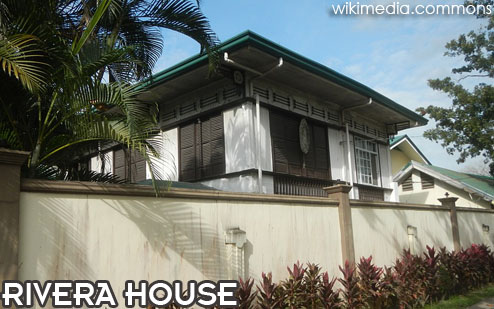
RIVERA HOUSE (Ayuyao St. San Nicolas I)
This house with distinctive Spanish influences was built around 1893, by the couple Don Cayetano Rivera and Doña Julia Rita Dizon. The house has rich woodcarvings that feature a signature star motif, that is revealing of  Don Cayetano’s affiliation with masonry and later, with the  Katipunan. Don Cayetano’s played a key role in the early formation of the First Republic of the Philippines, being one of the signatories of Pact of Biak –na-Bato. After the Revolution, he returned to farming, and acquired vast tracts of land in Concepcion, Tarlac. He also founded one of the first sugar mills in Tarlac—the Azucarera de Rivera. In the Commonwealth years, Don Cayetano’s friend, President Manuel L. Quezon was a regular visitor to this Magalang home. During World War II, the house was made into Japanese Military Headquarters, along with the neighboring Magalang Elementary School, which was converted into a Japanese military garrison and later,  execution grounds. When the Japanese occupied the house, they looted and destroyed much of the valuables. After Don’s death, he passed on the house to his nephew, Eliseo Rivera. At present, the house is under the care of  Eliseo’s daughter-in-law, Nimfa Rivera.

LACSON HOUSE (Lacson St., San Nicolas I)
Behind the majestic San Bartolome Church, stands an ancestral house with an architectural style reminiscent of old Spanish homes. This is the Lacson House, constructed in 1923 by the couple, Don Daniel O. Lacson and Doña Lucia David. The craftsmanship of the house reflects the high level of artistry of Kapampangan artisans who worked on this fine structure. During World War II, this house served as one of the Japanese military garrisons. When Don Daniel passed away in 1948, the house was inherited by his  two daughters, Lucila and Rosario Lacson, both spinsters. When Rosario passed away in 1991, she bequeathed the house to her sister-in-law, Evangelina Hilario Lacson, the  well-known Kapampangan academician and writer. In 1995, National Historical Institute (now National Historical Commission of the Philippines), placed a historical marker in front of the house for its cultural and historical significance. After Evangelina’s death in  2008, his son, Ariel H. Lacson became the new owner, but in 2014, he, too, passed away, leaving the house to nephew, Eduard V. Lacson. The house was acquired by Mayor Maria Lourdes P. Lacson, now the present owner.

AYUYAO HOUSE (San Nicolas I)
This house that is just a next-door neighbor of the  Magalang Municipal Hall, was built in 1915 by the couple, Isidoro Ayuyao, Sr., Municipal Secretary during the American regime  and his wife, Ana David, one of the pioneers of Magalang’s sweets industry. Its  flooring or “lande” was originally made of bamboo slats, and the house topped with a roof of nipa.  In later years, it was reconstructed and made entirely of wood with ornamental carvings, galvanized roofing and concrete foundations. When Ana passed away, her son, Dr. Claro Ayuyao inherited the house, which he later expanded to include his dental clinic. During 1950s, this house was visited by prominent personalities who were invited as guest speakers during the closing exercises of Magalang Institute, founded by Atty. Isidoro Ayuyao. Among these  are future Philippine president Diosdado P. Macapagal, and brother-in-law, movie actor Rogelio de la Rosa. In 1965, the house underwent minor repairs. At present, this house is owned and maintained by the children of Dr. Claro Ayuyao.


**********
ABOUT OUR CONTRIBUTOR: LOUIE ALDRIN LACSON BARTOLO. Teacher, Writer, Historian and a Magaleño, Bartolo is the author of “The Magalang Book: The Historical Life and Culture of a Kapampangan Town 1605-2015”, published in 2015 by Center for Tarlaqueño Studies of Tarlac State University, made possible through an NCCA grant. He also keeps a blog,”Amlat Magaleño”, that aims to promote the local history of Magalang. Bartolo finished his Bachelor of Secondary Education Major in Social Studies at Holy Angel University (HAU)


SOURCES:
INTERVIEWS:
Luciano House; interview with Mrs. Teresita Suba, one of the former caretakers of Luciano house, June 25, 2019.
Rivera House: interview with Mr. Sean Rivera, a descendant of Don Cayetano Rivera, June 26, 2019.
Ayuyao House: interview with Dr. Nunilon G. Ayuyao and Mr. Amante M. Ayuyao; both grandchildren of Isidoro Ayuyao, Sr. and Ana David, June 26, 2019.
Lacson House: interview with the late Mr. Ariel H. Lacson (way back August 4, 2012); grandson of spouses, Don Daniel O. Lacson and Doña Lucia David.
BOOK SOURCES:
Bartolo, Louie Aldrin L. and Dizon, Lino L. (2016), The Magalang Book: The Historical Life and Culture of a Kapampangan Town (1605-2015), National Commission for Culture and the Arts.
PHOTOS: All photos from wikimedia commons, unless otherwise noted. https://commons.wikimedia.org/wiki/Category:Old_houses_in_Magalang,_Pampanga

Wednesday, January 17, 2018

71. 12 EN GRANDE PAMPANGA WEDDINGS HELD IN 1936

One of the most significant milestones in one’s life is the Wedding, in which two people are united in marriage. “Kasal”, is our term for marriage, “kasalan”, the wedding ceremony. The customs and traditions of present-day unions were primarily influenced by a blend of Filipino, Spanish, American and Chinese models. One thing is certain though—when Kapampangans get married, they leave no stone unturned to make sure that theirs is a wedding to remember—the flashier, the better! Here are 12 notable Pampanga weddings in 1936, half of which were held in the “marry” month of June!
**********


LOURDES ALBA & RAFAEL C. HIZON
Married: 30 September 1936, Paco Church, Manila
Sponsors: Dña. Victoria H. vda. De Rodriguez, Don Jaime Hernandez
Notes:
The groom was a successful insurance agent of the National Life Insurance Co. insurance agent at the time of his marriage.

CARMEN DEL ROSARIO & VIRGILIO RODRIGUEZ
Married: 25 January 1936, Sto. Domingo Church, Manila
Sponsors: Dña. Victoria H. vda. De Rodriguez, Dña. Rosa del Rosario Valdezco, Dr. Teofilo Villongco, Hon. Cayetano Rivera
Notes:
Carmeling, a 19-year old Centro Escolar de Señoritas beauty,  and her beau Virgilio Rodriguez ( eldest son of sugar planter  Dña Victoria Hizon Rodriguez and the late Godofredo Rodriguez of San Fernando), had already planned on getting married after college, when the 1935 Manila Carnival intervened. A friend of Carmeling’s father badgered him into allowing her  daughter to run for Miss Philippines.  Thinking that her chances of winning were slim, Carmeling’s father persuaded his reluctant daughter to run. To their utter surprise, Carmeling won the Miss Mindanao title. Her name had already been announced in national newspapers when Carmeling resigned her title to marry the man she loved.

**********


JOSEFINA BUYSON & DR. JESUS EUSEBIO
Married: 12 April 1936, San Guillermo Church, Bacolor
Sponsors: Dña. Bartola S. de Dizon, Hon. Mariano Buyson Lampa
Notes:
Dr. Jesus Eusebio was the eldest son of Don Andres Eusebio,  a prominent sugar planter and businessman, with Asuncion Santos. Jesus was already a practicing ophthalmologist when he proposed to his fiancee, Josefina Buyson. Pitang, as she was called,  was one of the children of Mariano Buyson and Dña. Maria de la Paz Miranda Angeles.  Their well-documented wedding at San Guillermo Church was officiated by Fr. Andres Bituin. The church was decorated with flowers especially brought in a day before by Manila’s foremost florist, Mr. Francisco Hilario. The bride was resplendent in a gown made by Pacita Longos, the most famous couturier of the era. Reception followed at the Buyson residence. Entertainment was provided by Serafin Payawal and Tirso Cruz, Manila’s best big bands.

ESPERANZA PAHATI & ATTY. CARMELINO ALVENDIA
Married: 4 April 1936, Lourdes Church, Manila
Sponsors: Dña. Francisca Pascual de Pahati, Hon. Eusebio Orense
Notes:
Atty. Carmelino Alvendia was the valedictorian of his University of the Philippines law class in 1930. He was the winner of the Callaghan Prize given by the U.P. College of Law. He taught Mercantile Law at  Far Eastern University, and worked with Orense and Belmonte law firm. He hails from Floridablanca, Pampanga.

**********


LUZ HIZON & RAFAEL P. HIZON
Married: 25 April 1936, San Fernando Church, Pampanga
Sponsors: Justice Jose Abad Santos, Dña. Miguela Hizon Teopaco
Notes:
The groom is one of the 8 children of Primo Hizon and Maria Perez of Mexico. Primo was a U.S.T chemistry graduate who carried out researches and scientific studies of diseases and their cures. He would go on to found Hizon Laboratories Inc., the very first pharmaceutical manufacturing company in the Philippines. The pharmaceutical firm still operates today, run and managed by Hizon descendants.

EMILIA P. RORIGUEZ & AMADO R. LUCIANO
Married: 3 June 1936, San Beda Church, Manila
Sponsors: Dña. Josefa Rodriguez, Dr. Andres Luciano
Notes:
Amado is the son of Antonio Luciano, former mayor of Magalang who served for 2 terms, with Nicolas Quiason.
**********


AMPARO Z. DIAZ & DEMETRIO S. SANTOS
Married: 7 June 1936, San Ignacio Church, Manila
Sponsors: Don Mariano J. Santos, Dña. Nieves S. Santos, Justice Anacleto Diaz, Dña. Sotera Z. Diaz
Notes:
Demetrio is the son of Mariano and Nieves Songco Santos. Her bride, Amparo, was two years older. He was 24 when they got married, and he would precede her in death, passing away at just age 43 in California, where they settled with their 6 children. Amparo died in 1985.

MANUELA DE LEON & AUGUSTO HIZON
Married: 20 June 1936, Mexico Church, Pampanga
Sponsors: Dña. Maria Hizon, Don Rafael de Leon
Notes:
Augusto Hizon comes from a very large family—parents Ramon and Maria Hizon had seven daughters and five sons. Coming from a landed class, the Hizons owned haciendas in the province. They also figured in politics, known for being staunch Liberal Party members.”  Augustor’s brother, Rodolfo Hizon, became a post-war mayor of San Fernando mayor. A sister, Corazon, reigned as Miss Pampanga 1933. Meanwhile, Manuela, who hails from Mexico, was the daughter of Don Rafael de Leon, a PASUDECO stockholder,  with Rosario Basa (daughter of patriot Jose Maria Basa).

**********


CORAZON MALIG & BENITO GOLDING
Married: 24 June 1936, San Ignacio Church, Manila
Sponsors: Dña. Remedios Soto de Malig, Don Emilio A. Santos
Notes:
Benito (“Beniting”, “Ben”) Goldman is of Polish-American-Filipino descent. His grandfather, Poland-born Herman Golding, emigrated to the U.S. from Bremen, Germany in January 1856. His father,  Benito “Bennie” Golding Sr. (Herman’s son), married Rosenda Francisco Abriol Santos of Sta. Ana. His bride, Bacolor-born Corazon Malig, was the daughter of Lazaro Malig and Remedios Soto. The couple settled in the U.S. with their children. Benito would pass away first; leaving Corozaon a wido, She died at home in Waldorf, Maryland on 19 April 2003, age 88.

ESTER DE LEON & NORBERTO RODRIGUEZ
Married: 27 June 1936, Sto. Rosario Church, Angeles, Pampanga
Sponsors: Don Jose de Leon y Joven, Dña. Josefa Rodriguez
Notes:
The bride, Ester, was the daughter of Alonzo de Leon and Vicenta Paras of San Fernando. Besides being a sugar planter, Alonzo was a respected leader in finance and agriculture.

**********


CONSUELO CONSING & ARTURO LUMANLAN
Married: 8 August 1936, U.S.T. Chapel
Sponsors: Don Rafael Consing, Dña. Potenciana Cuyugan Lumanlan
Notes:
Arturo Lumanlan is the son of Porac sugar planter Bonifacio Lumanlan, with Potenciana Cuyugan. Consuelo was the eldest child of Rafael Consing with Porfiria Quintana. She would outlive her husband by many years. Arturo’s sister, Juanita Lumanlan-Nepomuceno became Pampanga’a governor and congresswoman.

ANTONIETA PANLILIO & DR. ALFREDO ORTIZ
Married: 27 June 1936, Knox memorial Church, Manila
Sponsors: Dr. Mariano Lamson, Dña. Camila Panlilio

SOURCES:
All photos, Pampanga Social Register, 1936, by Kabigting.
www.viewsfromthepampanga.blogspot.com, various articles
Ninu't Ninu Qng Capampangan, by Kabigting

Monday, October 30, 2017

65. 12 STATELY KAPAMPANGAN RESIDENCES, AS THEY LOOKED IN THE 1930s

The 1930s was a period of relative peace and prosperity for many Kapampangans, especially for those who made their fortunes from the province’s burgeoning sugar and rice industry. Old colonial homes were refurbished and expanded, modern residences were built,  designer mansions and multi-storey homes were commissioned to be lived in, and to be seen. Here are some of them as they appeared in the halcyon days of the 1930s.
 **********
The spacious Don Alfonso de Leon residence was designed by Arch. Fernando H. Ocampo, considEred as the “Father of Modern Architecture”. It was constructed with Rizal Cement and furnished with renowned Puyat Furniture pieces.

The residence of Don Luis Wenceslao Dison and Feliza Hizon Dison is located in brgy. San Jose. It is another creation of Arch. Fernando H. Ocampo, built with Rizal Cement, painted by A.B. Villanueva & Sons, and furnished with Puyat Furniture. The 1930s house, whose main features remain intact,  is now being used as the Archdiocesan Chancery.

Don Benigno Fajardo is one of the founding fathers of Lubao Institute which opened in 1929. The most distinctive part of his multi-level house is the double-roofed upper storey terrace, accessible by a grand central staircase.


A prominent sugar planter of Lubao, Don Ambrosio Gonzales (b.1876/d.1957)  is also a socio-civic leader of the town, having founded the Hormiga de Hierro (Ants of Steel) in 1901. His charming 2-storey house, which is enclosed by a metal grill fence, sits on a lush garden and is typical of the modernized homes in 1930s Pampanga.

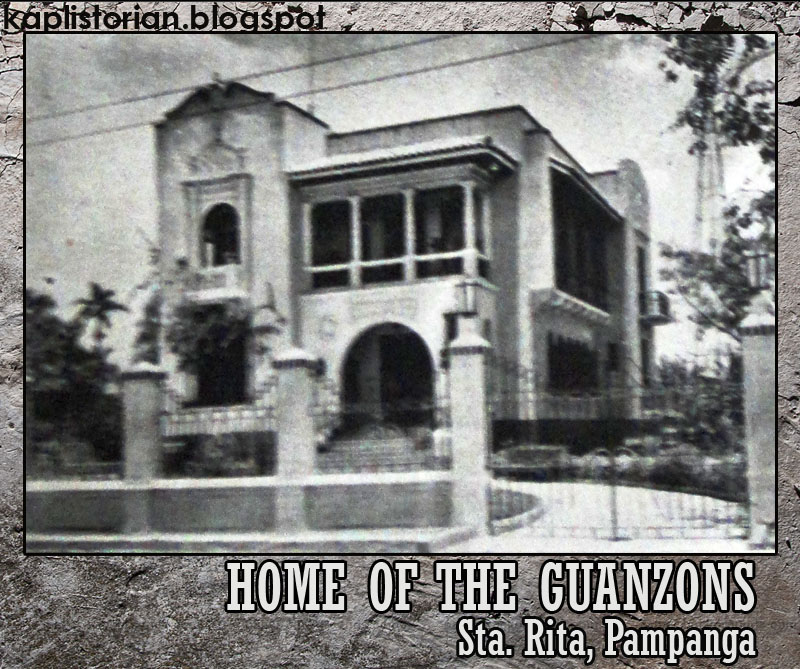
The Guanzon house was built in 1932 by Don Felipe Pineda Guanzon for his wife Dona Epifania Alvendia- Guanzon of Sta. Rita. Known today as Villa Epifania, the concrete house has sleek art deco elements, a style in vogue during the Commonwealth years.

Don Leandro Ibarra, an accomplished lawyer, was named Secretary of Interior of the Philippine Revolutionary Government under Emilio Aguinaldo. His capacious  “bahay na bato” residence was still well-kept and in order in the 1930s,

The Angeles home of Don Jose Lazatin, a  well-known businessman and sugar planter was designed by Menem Tayag. The concrete and wood house is furnished with the latest in Puyat Furniture.

The imposing Lopez Mansion, built in the grand Greek revival style, is reputed to be the first all-concrete house in Pampanga. It is constructed with APO Cement and furnished with Puyat Furniture. Owner Don Alejandro Lopez was a successful planter, owner of the Lopez Rice Mill, Co., and the Vice President of Pampanga Sugar Mills Planters Association. Together with his wife, Jacinta Limson and his family, Lopez resided and also held office here.

The home of Don Jose Luciano in Magalang was a favorite party place of the town’s elite, and the Lucianos would often host dinners and balls for Manila’s high society families like the Madrigals.  The beautiful house with a wide porch. was specially designed by Arch. Fernando H. Ocampo,  built with Rizal Cement and furnished with Puyat Furniture.

The beautiful home of lawyer  Don Pedro Morales (b.1886/d.1945) and Magdalena Hizon, was designed by his wife’s cousin, Arch. Fernando H. Ocampo in Mabalacat. A typical 30s house, it was furnished with Puyat Furniture. When the couple perished in he 1945 liberation of Manila, their lone surviving child inherited the house, and moved it to Magalang. Unfortunately, a fire destroyed the ancestral Morales house.

The house of Don Teodosio Pecson Santos and Josefa Panlilio was another design of the much-in demand architect, Fernando H. Ocampo, and furnished with the usual Puyat Furniture. Located along A. Consunji Street in Barangay San Jose),  it was purchased by the Miranda family, and is now recognized as one of the capital city’s treasured ancestral houses.

Don Emiliano J. Valdes (b. 1876/d.1953), the generous Kapampangan philanthropist who gave his name as well as financial donation to fund Pampanga’s leading TB hospital in Angeles had his grand residence built along Plaridel St. in the mid 30s. The Valdeses had barely enjoyed their new house when his wife died on 20 September 1936.To make matters worse, his house was taken over by the Japanese during the war and turned into a military headquarters. To forget the sad events that transpired in his Angeles home, he sold the house and lot after the war, and the space has since become a commercial area.

SOURCES:
PAMPANGA SOCIAL REGISTER, 1933
Lubao Commemorative Fiesta Program, 1936
www.viewsfromthepampang.blogspot.com, for Emiliano Valdes, Lopez Mansion, Pedro Morales House, 

Thursday, July 6, 2017

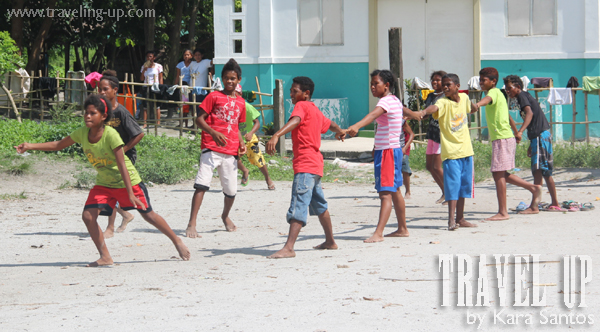
53. 20 FOLK GAMES THAT KAPAMPANGAN KIDS DON’T PLAY ANYMORE

Before the age of computer technology that brought us Tetris, Counterstrike, Super Mario, Dota, Angry Birds and Final Fantasy, it took very little for children to have great fun during their leisure hours. There were a lot of folk games to choose from, that did not require batteries, and complex gadgetry —sometimes it would just take a hole on the ground, two bamboo sticks, or even stones and shells to amuse one’s self. In the 1950s, Kapampangan writer E. Aguilar Cruz noted, “In my time, we children were still familiar with the rhymes learned from our elders and used them at play. But already, I must admit, the old games were being played less and less. Tubigan and sala-salaginto seemed too rustic for young moderns  even for their names alone.” Here’s a look-back at some of the old time games Kapampangan kids in the neighborhood played.
**********

BENDING. Children carry a slipper in all sorts of manner—balanced on top of the head, or on an outstretched arm, tucked under a bent arm or leg—across a distance without falling it to the ground.

BUKINGKINGAN. The local name of “pitik-bulag”. Player A covers his eyes with one hand.  Player B, his opponent, flicks the covering hand of Player A, while he holds up his other hand with a number of fingers. Player A releases his hand cover and quickly holds the other hand up. The number of fingers  he holds up must match that of Player B.

GILING-GILING ISTATWA. Participants intone “Giling-giling istatwa…Ing galo ya ing taya” (Go round and round the statue. He who moves is “it”!). After which, everybody stand immobile; the first to move becomes the “taya”.

HOLEN. Games involving marbles include rolling them in sequence into holes dug on the ground; or putting a number of marbles inside a drawn circle—the objective of which is to dislodge the opponent’s marble from the circle, by hitting it with another marble at an angle (“boljak”)--, which oftentimes cause pockmarks on the marble.

JAKENPOY. The hand game of “rock-paper-scissors” is played between two people using hand shapes to symbolize  a  "rock" (closed fist), "paper" ( flat hand), and "scissors" (fingers in V-shape). In this best-of-3 duel, rock beats scissors, paper beats rock, and scissors beat paper.  Our version is derived from the Japanese “Janken Pon” game, which means “starting with a stone”, which basically has the same mechanics. It is often called today in Pilipino, as “Bato-Bato-Pick”.

LABAN BABAGWA. Also known as “saputan babagwa”, this is a spider game fight conducted on a “tingting” stick. Positioned on the opposite sides of the stick, the spiders approach each other and attempt to enwrap each other with their web. Game ends when one spider gets fully enveloped with the web (“saput”). Spiders are often kept in empty posporo boxes, fed with chili pepper (“lara”) leaves to make them aggressive.

LABULAN GOMA. The simples game involving rubber bands is “labulan goma”. Two rubber bands are placed some distance apart on a table. Players alternately blow their rubber bands to get them closer to each other. A player wins when he blows his rubber band on top of his opponent’s “goma”, which he then collects. Other rubber band games: Sungkitan goma—rubber bands are buried in a sand mound. Players alternately fish for rubber bands by sticking a “tingting” into the sand; Tirisan-goma—a knotted rubber band is laid on the floor and players alternately step or crush the rubber band to get it unknotted.

LUKSUNG BABI. Literally means “jumping over a pig”, or piggyback jumping. Participants try to jump over the bent back of a player (the back of the “pig”) . If everyone succeeds, the “pig” increases the height of his back, by raising himself up. The jumper who fails to clear he distance becomes the next “pig’s back”. Tagalogs call their version “luksong baka”.

MARO. This is the Kapampangan name of the game popularly called “agawan base” (stealing bases) by Tagalogs. Two groups  try to protect their bases, and each base has an assigned guard. Members try to penetrate each other’s  base so it can be stolen by tagging it, but when the members themselves are “tagged” by their opponents, they become prisoners, who are lined up front as bait. A prisoner can only be “saved” and released  by a fellow group member by tagging him, allowing him to return to his base.

PIKU. The local “hopscotch”. A playing court is first drawn on the ground, consisting of squares and a home base—a pit stop where one can rest both feet. The game involves transporting a “batu” gamepiece--which may be a flat stone or pebble , a pottery shard—from one square to another, until the course is finished. This must be done by hopping, skipping or tripping the “batu”, forcing it to move to the next square without touching the drawn lines. Variations: pikung baru, sampaga, bale.

SALIKUTAN. Hide and seek game. Players conceal themselves in the neighborhood, to be found by one or more seekers. Th player designated as :it” or “taya” closes his eyes, and tart counting up to 10, while players hide. He then begins to look for the hidden players, shouting “Pung!” as he finds them. The game can end in many ways, but the most common is when the “taya” locates all players. The first to be found becomes the next “taya”.  Another salikutan variation has the seeker guarding his "home base"; the hiders can come out of hiding to race to home base; once they touch it, they are considered "saved”.

SINTAK. Sintak means “to throw with some force”. It is also the name of an old game played by Kapampangan girls as early as the eighteenth century. It is similar to jackstones—minus the bouncing rubber ball. The game of skill is played with five stones, in which one stone is propelled upwards, and while still in mid-air, another stone is picked up and the falling stone is caught at the same time. A variation is the Tagalog ‘siklot’, where the back of the palm is used to catch the stones.

SISINGLE. This is a singing variation of “talanan dutung”. It starts with a line of  children holding hands, with the lead child holding fast to a wooden wall, gate, tree trunk, or nay wooden object. With held hands swaying, they sing—“Sisingle, sisingle, dakal lang anak single, salibatu, salibatu, buntuk ng Kapitan Besyu. Boom-boom! Mamakbung!”. The last kid on the line now marches under the arm of the lead child touching wooden wall; this causes the arms of the first child to be crossed. The march continues, until all the children in the line have their arms crossed, and only then is the singing finished. At the last note of the song, the players break the line and scamper to look for a wooden object to touch. A player who fails to do so becomes the next “taya”, who calls for the next change of position.

SUNGKA. Sungká is ancient strategy board game that has versions all over the world—from Africa, North America to Asia—where it is known by names like mancala, chongka, congkak, bao, and oware. The board is played on a sungkahan, a carved length of wood with seven pits and two larger pits at both ends designated as “bale” (house). The game involves distributing the shells or pebbles around the pits, by dropping them  into the holes one by one, including putting one in his “bale”.  The objective is to empty all seven pits on one side and the player with the most number of shells in his “bale” wins. Old sungkahans, often carved with designs, are seen more in antique shops than in homes today.

SYATUNG. The tools of the syatung are two bamboo sticks, one at least a foot long, and the other, shorter by a third. The players take turn at hitting the shorter stick with the long stick, placed in a crevice on the ground. This causes it to somersault, which then is hit again in mid-air by the long stick. The object of the game is to land the shorter stick at a farther distance, which is measured by the same stick. The losing player has to run this distance while shouting “syatuuuuuuuung”, until he reaches the game’s starting point—the crevice on the ground. Variations of the name: syatu, shoktung.

TAMBUBUNG. Known as “patintero” in the Tagalog  region, it is the most widely played native game in the country. A playing field is drawn on the ground—3 sections, divided by a line in the middle. There are 5 players in each of the 2 competing teams. The object of tambubung is to get past the lines, which are guarded by players of the opposite team; one guard can traverse the middle line. Team loses when all its player gets tagged by a guard, and are eliminated.  The team then exchange places. “Tambobong” means a barn, or a granary. It is also the old name of Malabon.

TEKS. Teks are small playing cards with  illustrations of superheroes, comics, movie and TV series characters. These are used for trading, as well as for toss-up games, and were avidly collected in the 1960s-70s. Players bet on which side the teks card will come up, and the outcome is decided by flicking the teks in the air. Players often have favorite cards that they use for flipping;  all others are basically used as betting currency.

TILTIL-BAGUK.  This hand game with a fanciful name (“Dip in baguk” or salty shrimp relish)”is played by two children. One player holds his palm up in front of his opponent, and the other player “dips” his pointing finger in the middle of the open palm. The player then chants “tiltil…..baguk!”, after which he closes his palm in an attempt to entrap the opponent’s finger.

TOMPYANG. Children form a circle, put their hands on top of each other, count “metung, adua, atlu”, raise them up in the air, and bring them down again, some palms up and others palm down, eliminating whichever is the majority, until one hand is left. The object of this process is to choose either the “mano”(leader)or the “taya” (“it”, the dunce or pursuer) of the succeeding game.

TUKUPAN-SILIMAN. Kapampangan version of “Blindman’s bluff”. Tukupan-siliman means " to darken by covering eyes with cupped hands"The player designated as “taya” ( “it”) is blindfolded and tries to find his co-players gathered around him. The co-players move about, bluffing the blindfolded “taya” by calling out their locations and issuing misleading directions.


SOURCES:
Adapted from Dr. Lino L. Dizon’s article, ‘games Children Don’t Play Anymore”, Singsing Magazine, vol. 2, no. 1
Castro, Alex R., “Toy Stories”, Views from the Pampang, www.viewsfromthepampang.blogspot
PICTURE SOURCES:
Laban-babagwa: Fililipino Heritage, vol, VI. Felta Publishing.
Tukupan-Siliman: https://www.pinterest.com/pin/128211920616319627/
Bending, Salikutan, Sungka, Teks, Tompyang: Alex R. Castro photos

Wednesday, May 3, 2017

45. 9 REAL-LIFE LOVE STORIES OF KAPAMPANGAN COUPLES

"Oh Jo, caluguran daca...caluguran sobra-sobra", so goes a Kapampangan hit song just a few years back. But oh, the things Kapampangans will do for love. He will go to great lengths to win the love of his life, including getting parental approval, overcoming differences like race, age and social status, hurdling legal impediments and other adversities. The love stories of these Kapampangan couples--some fascinating, others amusing, all real-life-- illustrate how love can indeed, move mountains.
*****

1. FRAY GUILLERMO MASNOU & PATRICIA MERCADO: A Dangerous Liaison
The accomplished Fray Guillermo Masnou (b.6 Dec. 1827)/d.16 May 1895) , the son of Pedro Masnou and Isabel Gomez, was a  graduate of the Real Colegio Seminario de Villadolid. Three years after professing his vows, he sailed to the the Philippines  in 1852, along with 34 other Augustinians. His first assignment was in Sto. Tomas, Pampanga , followed by Angeles  where he served the longest (1855-1877). There, he worked to renovate the church, build the convent, several bridges, the town cemetery and a school building. While on his first year in Pampanga, Fr. Masnou  met Patricia Mercado of Sto. Tomas (b. ca. 1828/d.4 Apr. 1900), a single mother of 3 children. The two started an affair, which resulted in at least 6 children.

In an effort to spare Patricia and his family from possible disgrace, Fr. Masnou devised a way to make it appear that their children were legitimate. He had their names recorded in the Angeles parish books, identifying Patricia Mercado as the mother and a certain Nicolas Gomez as the father. Gomez was supposedly a Spaniard who went to the Philippines to marry the Pampanga native. Records also show he died in 1861—6 years before his youngest daughter was born and more than 38 years before  his “widow” died. All these entries in the canonical books were signed by Fr. Masnou.

 It has now come to light that this Nicolas Gomez was a fictitious character that Fr. Masnou created, to give legitimacy and respectability to his children and his mistress. It was a final act of love that he did,  before he returned to Spain in 1877. His stay would be brief, as a year later, he was back in Pampanga. Could it be that he couldn’t stand being away from his true love?

As a footnote to this 'dangerous liaison', the couple’s firstborn, Esteban Gomez married Josefa Pamintuan. Daughter Teresa would grow up to be the wife of Juan De Dios Nepomuceno, and the two would start a clan that would shape the progress of Angeles.

2. ROMAN R. SANTOS & JULIANA P. ANDRES: The Comeback Story of a Penniless Orphan and His Headstrong Bride.
The riches-to-rags-to-riches story of Roman Rodriguez Santos (b. 9 Aug. 1880/d.19 Jul. 1959) began in Apalit, as the son of a well-to-do family whose fortunes from their sugarlands were all wiped out by a series of calamities—typhoons, earthquakes and sicknesses. To make things worse, his father Hilarion died of beri-beri, leaving a young wife to fend for their 4 children. The final blow to Roman, the only boy in the family, was the death of his mother when he was but 11.

The orphan came to live with a well-off  cousin, Florencia Rodriguez Sioco, married to Spanish mestizo, Joaquin Gonzalez. They took care of Roman, sent him to Letran, and the boy, in turn, ran errands for the family. Roman went home to Apalit once a month. In one of his visits home, Roman stopped to consult a manghuhula (fortune teller)—who prophesied that he would become wealthy beyond his wildest dreams.

On weekends, Roman would explore Manila, walking as far away as Navotas. Here, he would meet Juliana  Andres (b. 1877/d.2 Mar.1946), who turned out to be a second cousin—both their paternal grandmothers, Maria and Leogarda Ochoa, were sisters. Unlike the deprived Roman, Juliana was the daughter of town principalia, known for their vast tracts of lands and fishponds.  Determined to pursue her, Roman left the Gonzalez household to seek a new life in Navotas. At the onset, Juliana’s father disapproved of Roman because of his lowly station in life. He had earlier disowned his own son because he rejected his choice of wife. But the headstrong Juliana prevailed when she eloped with Roman in 1899.

On the day he ran away with Juliana, Roman had 70 pesos in his pocket, a calesa and a horse. In due time, he acquired a boat, and engaged in trading molasses from Pampanga. Through long years of hard work, the once penniless orphan expanded his business, acquired haciendas from the Zobels, established his own fishing corporations, invested in a coconut business,  founded the Rizal Surety and Insurance Co., Empire Insurance Co., and at age 72, the Prudential Bank and Trust Co. By the time he died in 1959, he was a pillar of Philippine economy, with an estate conservatively valued at close to 4 million pesos. The prediction of the Apalit fortune teller Roman met many years before had come true.

3. JOSE GUTIERREZ DAVID & CONCEPCION ROQUE: All Is Fair In Young Love
The future Supreme Court justice, Jose Gutierrez David of Bacolor (b. 29 Jan. 1891/d. 24 Mar. 1977) first met the love of his life, Concepcion Roque (b. 8 Dec. 1891/13 Jul. 1971) of San Fernando,  in 1905, when the 15 year old was chosen to deliver a speech in front of visiting Secretary of War, William Howard Taft and Miss Alice Roosevelt.  Concepcion or “Chong” was also with a group of girls that welcomed the distinguished visitors.  Only after the chinita beauty was promoted to intermediate level that the two met formally. The young Jose lost no time in writing love letters to Chong that were discreetly inserted in her books by Jose’s cousin. In February 1906, Chong accepted Jose’s offer of love, over rich suitors from Guagua, Tarlac and a businessman from San Fernando.

In one of their dates, he overheard Chong talking to her chaperone friend, Maria Guiao, about a lady’s handbag that she liked for sale at a local shop. Jose was determined to save enough money so he could buy the desired bag for Chong by Christmas. Every so often, he would go to the Bombay Bazaar to check if the bag was still there. In four months, he managed to save 15 pesos, the exact amount that he needed to buy the bag. Jose presented the gift on her birthday, which thrilled Chong and further endeared him to her. But the most precious gift was a poem dedicated to her entitled “Tuqui Ca Baculud” (Come to Bacolor), which saw print in the March 1908 of the daily, “Ing Bandila”.

The first time Chong was displeased with Jose was when he quit school in 1907 after a misunderstanding with his teacher. It was she who convinced him to return to high school, which he finished, after an absence of 2 years. The second time was when the two went out to see a movie. While Chong’s chaperone was walking ahead of them, Jose stole a kiss, in fact, two kisses—which alarmed the young Chong.

Influenced by the prevailing notion that a girl was no longer pure once she had been kissed, Chong conceived the idea that they should marry secretly, but would not live together. On 6 Jan. 1912, the couple were secretly married in Minalin by Jose’s judge-uncle, Macario Julao. In no time, the news leaked out, and Chong would have been punished by her outraged father had her mother not intervened. The couple only lived together after Jose graduated from high school in March 1912.

 Jose topped his law class at the Escuela de Derecho  in 1915, became a trial lawyer and then joined the judicial court system  as Auxiliary Justice of the Peace from 1918-20. He would rise to become an Associate Justice of the Supreme Court in 1959, under Pres. Carlos P. Garcia. Retired in 1961 in San Juan,  he outlived his wife for 4 years. It is but fitting that his last poem, “Misan Pa” (Once More) was dedicated to his beloved Chong.

4. JUAN D. NEPOMUCENO & TERESA GOMEZ: Joined By the Gods of Fortune.
The story of Angeles and its progress is inextricably linked to the remarkable partnership of a Juan de Dios Nepomuceno ((b. 8 March 1892/d.22 Apr. 1973 )  and Clara Teresa Teodora Gomez (b. 12 Aug. 1893/d. 17 Apr. 1970)   whose larger-than-life businesses shaped the course of the town’s economy while serving God and their beloved community. The 2 had contrasting backgrounds--Juan was an academic achiever, a summa cum laude law graduate of UST. Unlike her Jesuit-educated husband, Teresa or Nena never went beyond grade school, but developed uncanny business savvy, while dabbling in healing and folk naturopathy.

Family lore has it that Juan actually acted as a go-between for a friend who wanted to woo Teresa. He would pay regular visits to Nena but was too timid to declare his intentions, preferring instead to “court through the eyes” (maglolo ya qng mata). It took Nena’s grandmother, Severina Pamintuan to help the reserved Juan to open up, by asking him blatantly what his feelings for Nena were. In the end, due to this prodding, Juan and Teresa went ahead with their wedding on 19 March 1919 after months of suffering from tuberculosis. In fact, so emaciated were they that they opted to have their wedding picture taken 6 months after the wedding, after they have recovered sufficiently.

The couple set up house in their Bale Maragul, along Santo Rosario, just across the church. Initially, Juan practiced law but the business minded Teresa sought other means of livelihood. Together, they single-handedly opened the 1st electric plant (1921) and the crystal ice plant of the region. They ventured into softdrinks production, and established the country’s 1st Catholic school run by laypersons—now known as Holy Angel University. In the 60s, they developed the city’s premiere subdivision that reconfigured the layout and social strata of Angeles. Around this, a new commercial business district was laid out by the couple and their children, whose very name today—“Nepo”—bears their enduring influence and legacy which continues to reverberate in the city today.

Juan and Teresa raised 10 children in all, each one raised in good old Kapampangan family values, and each one an achiever in their own right. It is no wonder that in 1969, the Nepomucenos were awarded the Rizal Pro-Patria Award for Family Solidarity by then Pres. Ferdinand Marcos at rites in Malacanang.

Throughout their lives, Juan and Nena shared their triumphs not only with their family, but also with the community through their philanthropic works, socio-civic-political-activities and religious advocacies. The couple lived their life simply, quietly and kindly till the end of their days, remaining steadfast in service and prayer.

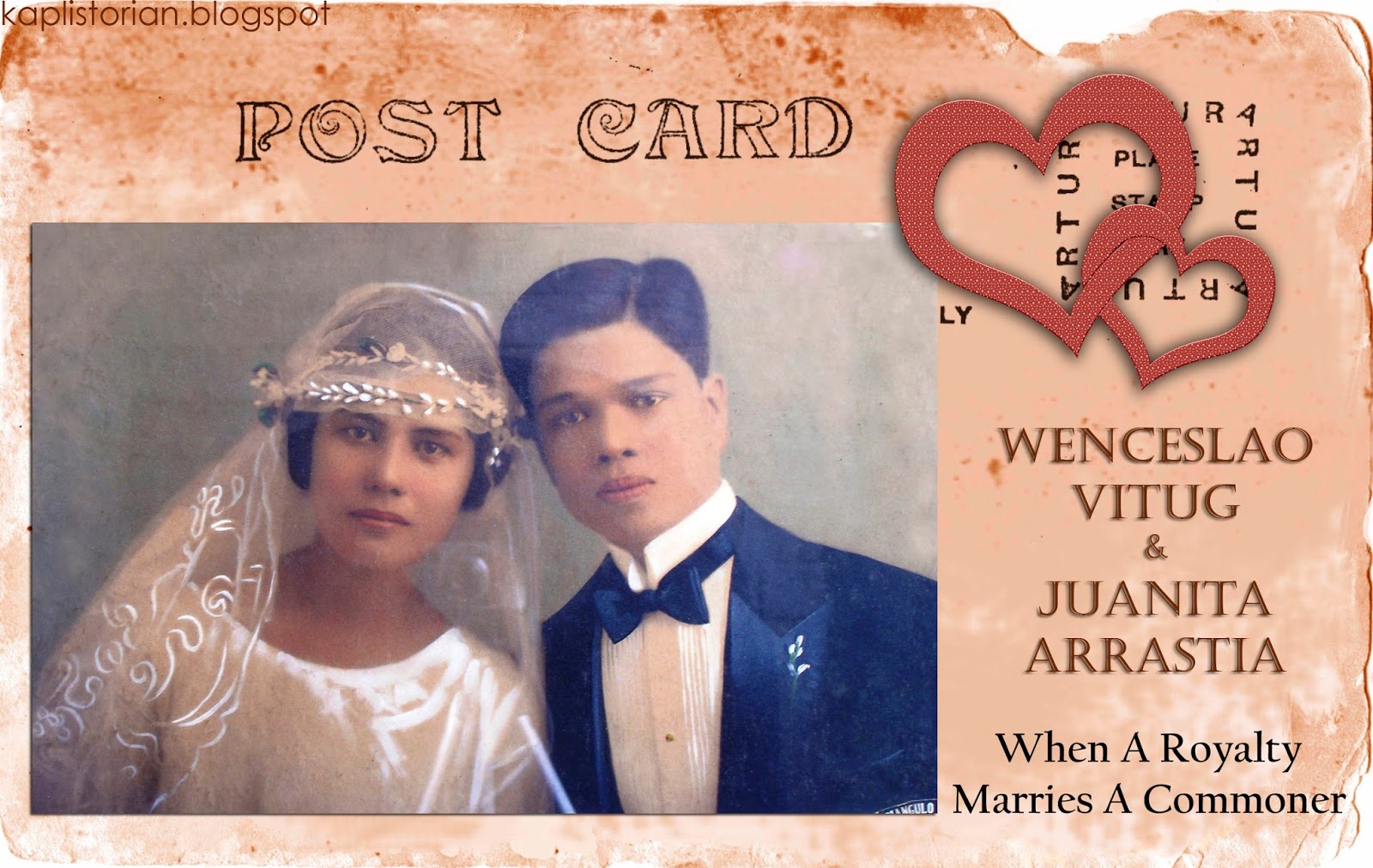
5. DR. WENCESLAO VITUG & JUANITA ARRASTIA: When A Royalty Marries A Commoner.
In 1926, few were surprised at the election of Juanita Salgado Arrastia (b. 8 Mar. 1902/d. 8 September 1994.) as Queen of the Pampanga Carnival. Daughter of the richest hacendero of Lubao, the Spanish-Kapampangan comes from a family noted for the legendary beauty of their women, a group that that would come to include actress Letty Alonso, international socialite Isabel Arrastia Preysler and Steve McQueen’s wife, Neile Adams. But the Colegio de Sta. Rosa student had a more practical reason for her triumph- "I won because my father had the biggest hacienda in Lubao”, she said, “ It wasn't about beauty."

It was no wonder that, a few months after being named Miss Pampanga, Juanita did the unthinkable—she married Dr. Wenceslao Beltran Vitug (b. 28 Sep 1892/7 January 1986), considered a “commoner” having come from Concepcion, a barrio of Arrastia sharecroppers. Moreover, “Beses” was dark and plain, not to mention 10 years her senior. But he overcame his lowly beginnings by topping his class at the Pampanga High School, earned a medical degree from the University of the Philippines, practiced at the Philippine General Hospital and taught Medicine at the University of Santo Tomas. His whirlwind romance with Juanita served to accelerate further his rise to social prominence.

Their love affair began when she and her sister, Carmen, accompanied their diabetic mother to the PGH for consultation with the accomplished doctor- internist. His diagnosis impressed Juanita’s mother,  Doña Francisca, who did her best to push her daughter to become friends with "Beses".  She did not need much prodding, as Juanita had also fallen in love with the brilliant doctor.

The marriage of Juanita to a ‘commoner’ who made good was big news in Lubao. The Vitugs quickly settled in the town and became hacenderos themselves. Eventually, they would run two households—one in Manila, the other in Lubao, balancing work with raising 5 children.  The hacienda that was left to their management prospered and grew, and in turn, their tenants rewarded them with their loyalty. In the truest sense of the perfect royalty, Juanita Arrastia wore her crown on her heart, not on her head.

6. DIOSDADO P. MACAPAGAL & PURITA DELA ROSA: Devotion Until Death
The poor boy from Lubao and the future president, Diosdado P. Macapagal ( b. 28 Sep. 1910/d. 21 Apr. 1997 and Purita dela Rosa (b. 1916/d.1943) were neighbors in San Nicolas, a sleepy barrio of Lubao, Pampanga. Purita had an admirer, who happened to be a friend of Dadong. Dadong used to accompany this friend in his regular visits to the dela Rosa home, so Purita and Dadong became acquaintances as well. Also, both were hometown zarzuela stars who, on several occasions, had performed alongside each other. Little did Dadong know that it was him that Purita was attracted to, finding him gentle, good-looking and promising.

It took 10 years before their courtship culminated in their wedding on 4 July 1938. On that special day, Dadong recalls his "sublime feeling of oneness with my wife as God meant it to be and as we celebrated our wedding together, there was another celebration in the city—American Independence Day."

In a rented house in Sta. Ana, the newlyweds made their home. Dadong worked as an assistant attorney while Purita played her role as a doting wife, often cooking sinigang for her new husband. Their union was blessed with two children, Cielo and Arturo.

Purita, however, had always been plagued by poor health all her life. After her second child was born, she fell ill, and her sickness was aggravated due to the lack of medical attention in wartime Philippines. Dadong tended to Purita, staying by her bedside, as a dutiful caregiver. She lingered for 3 years, and died in Dadong’s arms, a tragic scene straight from a movie. Purita was only 27, a president’s wife who never became a First Lady, but who definitely was first in Diosdado’s heart, in the short years they were together,

7. VIRGILIO RODRIGUEZ & CARMELING DEL ROSARIO: Giving Up the Crown for the Man She Loves
One of the most striking beauties ever to emerge from the legendary Manila Carnivals of the peacetime years was Carmen del Rosario (b.2 Jul. 1916/d. 17 Apr. 2012), Miss Mindanao 1935. Though not Pampanga-born,  her marriage to the scion of San Fernando’s most prominent family and her long-time residence in the capital certainly qualifies her to be claimed as one of Pampanga’s own. She was one of 9 children to Jose del Rosario and Carmelita de Leon of Manila . Her grandfather, Anacleto Sales del Rosario was the country’s leading chemist during the Spanish times and was an acquaintance of Jose P. Rizal

As a standout campus beauty of Centro Escolar de Señoritas,  Carmeling was wooed and pursued by a number of swains. One of them was the dashing Virgilio H. Rodriguez, the eldest son of the affluent sugar planter and businesswoman Doña Victoria Hizon Rodriguez, widow of the late Godofredo Rodriguez of San Fernando.

The couple had planned to get married after college, but the 1935 Manila Carnival intervened. A La Vanguardia  editor and a friend of Carmeling’s father, had been badgering the latter to allow her 19 year old daughter to run for Miss Philippines under his paper’s sponsorship.  Thinking that her chances of winning were slim, Carmeling’s father persuaded his reluctant daughter to run. They agreed however, that should she win, she would immediately relinquish her title and go back to her studies.

As luck would have it, Carmeling garnered enough votes to place 4th—and win the Miss Mindanao title behind winner Conchita Sunico. But for her family, there was no real cause for rejoicing for it meant putting on hold all her plans for one full year. Her victory had already been reported in newspapers along with Catalina Zabala (Miss Luzon) and Julieta Abad (Miss Visayas)  when she announced that she was giving up her title.  Her decision ruffled quite a few of the feathers of carnival officials and participants who now believed her to be a nuisance candidate. Celia Araullo, who placed fifth, replaced her.

Carmeling not only went back to school, but the very next year, on 26 June 1935, she married her beau Virgilio,  in spectacular rites at the Sto. Domingo Church. The couple settled in San Fernando, where Carmeling quickly learned to speak in Kapampangan. They had 5 children: Victoria, Godofredo, Gorgonia, Ana Marie and Jo Anne. She settled in San Lorenzo Village, Makati with a daughter until her death at age 96.

8. BENIGNO AQUINO JR. & CORAZON COJUANGCO: A Car Accident Made Them Do It.
The future hero, Benigno Aquino Jr, (b.27 Nov. 1932/d. 21 Aug.1983)  and first female president of the Philippines, Corazon Cojuangco (b.25 Jan. 1933/d.1 Aug. 2009)  first met when they both were 9 years old.  The two families were actually related to each other—Ninoy’s half-brother, Servillano Jr., was married to Cory’s cousin, Trinidad Cojuangco. Cory’s father, Jose Sr., was godfather of Lupita, Ninoy’s sister.

As Ninoy came of age, he was linked to several ladies—including Imelda Romualdez—who was introduced to him by Danieling Romualdez (Imelda’s cousin)  whose wife was Ninoy’s aunt, Paz Gueco of Magalang. Ninoy was often asked by her matchmaker aunt to escort Imelda home, after her work. Imelda once claimed that Ninoy courted her, and Ninoy’s sisters (except Lupita) favored her. But their relationship came to a sudden halt when Ninoy met Cory during one of her vacations from the U.S. where she was studying. Their romance became more definite when she returned for good to the Philippines..

In one of their early dates, Ninoy, Cory and sister Josephine, a chaperone, met an accident when their Buick was hit by a jeep. While the 2 sisters were confined at a hospital,  Ninoy told Cory that the accident was meant for them to get married. To this, Cory gave feeble resistance, after insisting that the accident was planned by Ninoy on purpose. Even Cory’s parents approved of the match and on 11 October 1954 , Ninoy and Cory, both 21, got married and this consolidate the Aquino-Cojuangco family wealth and power, leaving behind legacy of bloodless people power revolution of EDSA.

9. SILVESTRE  LANSANGAN & ERLINDA BAUTISTA: Romeo and Juliet of Mabalacat.
The story of star-crossed lovers Erlinda Castro Bautista (b. 14 June 1936/d. 16 Sep. 2010) and Silvestre Malit Lansangan (b.12 Nov.1932)  is the stuff TV telenovelas are made of. In fact, their story was featured as an episode in the “Miss D” drama series on Channel 7, aired on 12 August 1998. Linda and Beting first met in May 1949, during a town santacruzan where Linda was the Reyna Elena. He was quickly smitten by the young queen and she too, succumbed to her feelings. So, on 3 Sep 1950, 14 year-old Linda went to hear mass and never came back home, having eloped with 18 year-old Beting.

Linda’s mother, Apung Coring, was against Bet, because her daughter was too young to get married. But lovestruck  Erlinda would not come home. The disappointed parents took a drastic measure--they decided to send her to jail for disobedience. There, the police chief, an uncle, took her under his custody but gave her special treatment. Undeterred, Beting secretly saw his beloved Linda by climbing the back wall and peering through the cell’s small window--every day for 21 days—the length of time Linda was incarcerated. Their love story made them popular in Mabalacat, so much so that the people made this line for Linda: "Tadtaran daku man mapinu, ing mitalamsik a daya kang Bet ya pa murin." (Even I were finely chopped, my blood that spatters will still be for Bet).

Eventually, Linda’s parents sent her off to Marikina where her paternal relatives resided. There, she enrolled at the Cubao Elementary School. Beting sought her out and found her in Cubao after a month’s relentless search. For the second time, the two decided to elope again.  But, they were caught in time by Linda’s grandfather—and ex-Katipunero-- who saw her stuffing her bag with clothes. The couple were already in a bus when the old man came running with a bolo, demanding that they alight from the vehicle. Their thwarted plan was reported to her parents. But this time, realizing the depth and sincerity of their love, Linda’s parents gave their blessings to the couple. Linda and Beting were married in San Juan Church and were blessed with 4 children: Joel, Rod, Elvis and Lily, all married with children, all residing in the United States.

BONUS! A Different Love..
THE LOVE OF LOLO PULONG/PULONIA
Never has the voice of the LGBT community been heard much louder than now---what with current issues in the news lately—from same-sex marriage to the victories of Filipino gays and transgenders in unexpected fields like sports and politics. Ours have always been an accepting society—since the ancient time of gender-bending babaylans who were empowered to heal and speak with divinities. The story of Crispulo “Pulong” Luna (b. 10 Jun 1903/d.May 1970) is another proof that indeed, love knows no gender.

His case was first written about by the award-winning writer, J. Neil Garcia in his book, “Performing the Self: Occasional Prose”.  In fact, “Pulong” made it to the cover of his acclaimed book. Born to parents Pedro Luna and Candelaria Trinidad of Sasmuan, Pampanga,  he grew up in Orani, Bataan where his father made a living in fishing, then moved to Paco, Manila.

There, the young Pulong discovered Victoria Studios where he delighted in posing for the cameras---all made up with rouge and lipstick, and dressed in female outfits—from an exquisite baro’t saya to exotic Japanese geisha robes. His permissive family didn’t mind his feminine behavior and his cross-dressing fetish, and when asked why he didn’t get married, he replied, “Por Dios, babae ako!”.

Pulong then fell in love with Juan, a young carpenter and many years his junior, and the two would live together as partners. Pulong’s immediate family and sisters did not object to this arrangement, and their relationship could have gone on had it not been for a tragic accident. Juan died from his injuries he sustained from a fall while doing construction work. Pulong, alone once more, moved in with his sisters after his partner’s death, and found work as a store help and a laundry worker.

In his golden years, Lolo Pulong kept company with gay beauticians in his neighborhood, “Lolo Pulonia” as they called him, passed away in May 1970.

PICTURES & SOURCES:
FRAY GUILLERMO MASNOU & PATRICIA MERCADO: Nepomuceno, Carmelo M.D. The Gomez family of Angeles Pampanga and the Mercado relatives, privately printed, 2002.
DON ROMAN R. SANTOS & DÑA. JULIANA P. ANDRES: Santos, Vicente Roman,, Alejandro, Reynaldo G., TAHANAN, A House Reborn, Duende Publishing. © 2003. pp. 24-49.
JOSE GUTIERREZ DAVID & CONCEPCION ROQUE: My Story, unpublished manuscript of Jose Gutierrez David., picture courtesy of Del Rosario Family
DON JUAN D. NEPOMUCENO & DNA.TERESA GOMEZ Mendoza, Erlita. A Cofradia of Two: Oral History on the Family Life and Lay Religiosity of Juan D. Nepomuceno and Teresa G. Nepomuceno of Angeles, Pampanga. Center for Kapampangan Studies, Holy Angel University, Angeles City. 2004.
DR. WENCESLAO VITUG & JUANITA ARRASTIA. Castro, Alex R. Aro, Katimyas Da!: A Memory Album of Titled Kapampangan Beauties 1908-2010, Center for Kapampangan Studies, Holy Angel University, Angeles City, 2013.Picture courtesy of Cathy Hengstrom
DIOSDADO MACAPAGAL & PURITA DELA ROSA: "A Love Story Thru War, Poverty and Illness", by Ria Salgado-Llanes, PDI. Northern Luzon, 14 February 2007.
VIRGILIO RODRIGUEZ & CARMELING DEL ROSARIO: www.manilacarnivals.blogspot/com, Picture from Pampanga Social Register 1933
NINOY AQUINO & CORY AQUINO, Tantingco, Robby P. Singsing Magazine, Picture from Bob Rzaon, A Life Devoted to Salon Photography
LINDA & BET LANSANGAN: Wedding anniversary program of Erlinda Castro and Silvestre Lansangan.
LOLO PULONG: Garcia, J. Neil C. Performing the Self: Occasional Prose. University of the Philippines, 2003. (also P