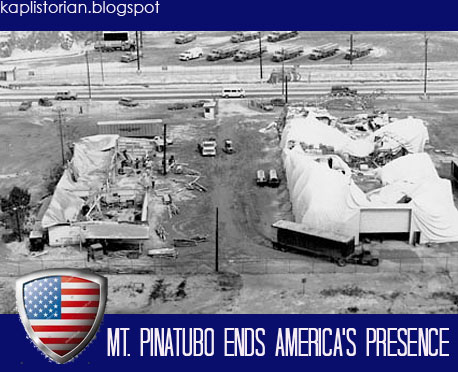
When one goes to
Clark today, he passes avenues like C.M. Recto, G. Puyat, M.A. Roxas, K.
Laxamana---all names of Filipino statesmen, heroes and personalities. But in
the not-so-distant past, when Clark was still a piece of America in Pampanga,
its major thoroughfares and buildings
bore ‘stateside’ names like Dyess, O’Leary, Kelly, Levin, Mitchell, Wagner
among others. Not many Kapampangans know the faces behind these names today, so
here are a few of them.
**********
CAMP STOTSENBURG,
named after Col. John Miller Stotsenburg
The future Clark Air Base started as an unnamed camp
established six miles northwest of Angeles town by soldiers of the 5th
U.S. Cavalry regiment on Dec. 26, 1902.
It was the tradition to name camps after American soldiers killed in the
Philippine-American War, and that was how Col. John M. Stotsenburg, killed
in action on April 23, 1899 near Quinga, Bulacan, came to be immortalized when
the cavalry post was named after him. A graduate of West Point (1881) and the Infantry and cavalry School at Fort
Leavenworth, Kansas (1897), Col. Stotsenburg was assigned to the Philippines to
lead the 1st Nebraska Regiment as their battalion commander. In an
unplanned engagement on April 23, Col. Stotsenburg ordered an immediate advance
to fight the Filipinos. Moments later, he was shot in the chest and killed; he
was only 40 years old.
CLARK FIELD, named
after Maj. Harold Melville Clark
The first airplane landing field were just long dirt
landings scraped from the ground in 1919. Eventually, a more expansive airfield
was built, asphalted and expanded before World War II. The airfield would be
named after Maj. Harold M. Clark, a Philippine-educated American (Manila High
School, 1910, future president Manuel A. Roxas was a classmate), who received
his pilot’s wings in March 1917. One of the first aviators in Hawaii, Clark was
flying his seaplane in the Panama Canal Zone when it crashed on May 2, 1919.
The young pilot was killed but his name would live on, overshadowing the
original camp name, and by the 1960s, the camp complex together with its airfields, would be known
Clark Field or Clark Air Base.
BOBBITT THEATER,
named after Col. Aubrey Malcolm Bobbitt
The popular movie house of Clark that was favorite
of American servicemen, their families,
as well as Wagner High teens, screened the latest blockbuster films from the
60s thru the 90s--from “The Thing” “Saturday Night Fever” ,”Jaws”, to “American
Werewolf in London”. Bobbitt stood next to the BX, across from what used to be
the main gas station, in the same parking lot of what was once the American
Express Bank. It was named after Col. Aubrey M. Bobbitt (b. Jan. 25, 1940/d.
Aug. 29, 1971), base commander and the commander of the 6200th Air
Base Wing, in September 1972. Col. Bobbitt had an illustrious 29-year career in
the U.S. military, serving in Newfoundland, Europe and the Philippines. He died
at the USAF Hospital of heart attack. Bobbitt Theater, post-Pinatubo, it became
a hotel, a cocktail lounge (“Forbidden City”), and is now part of the Widus Hotel and Casino
complex.
BONG HIGHWAY, named after Maj. Richard Bong (now Manuel L. Quezon Avenue)
Bong Highway has such a local ring to it, sounding much like
a common Pinoy nickname. But this major Clark road which leads to the Mimosa
main gate (now a Filinvest property),was
named after a World War II Medal of Honor recipient, Major Richard Ira
"Dick" Bong (b.Sep. 24, 1920/d. Aug. 6, 1945). One of t host decorated
fighter pilots, Major Bong is known for downing 40 Japanese aircrafts in his
lifetime. Tragically, he died in California while testing a jet aircraft before
the war ended.
DYESS AVENUE,
named after Ofcr. William Edwin Dyess (now, C.M. Recto Highway)
William Edwin "Ed" Dyess (August 9, 1916 –
December 22, 1943) was an officer of the United States Army Air Corps during
World War II. He was in command of the 21st Pursuit Squadron tasked
to defend Clark. He was captured after the Allied loss at the Battle of Bataan
and endured the subsequent Bataan Death March. After a year in captivity, he
escaped and spent three months on the run before being evacuated from the
Philippines by a U.S. submarine. Once back in the U.S., he recounted the story
of his capture and imprisonment, providing the first widely published
eye-witness account of the brutality of the Death March. He returned to duty in
the Army Air Forces but was killed in a training accident months later.
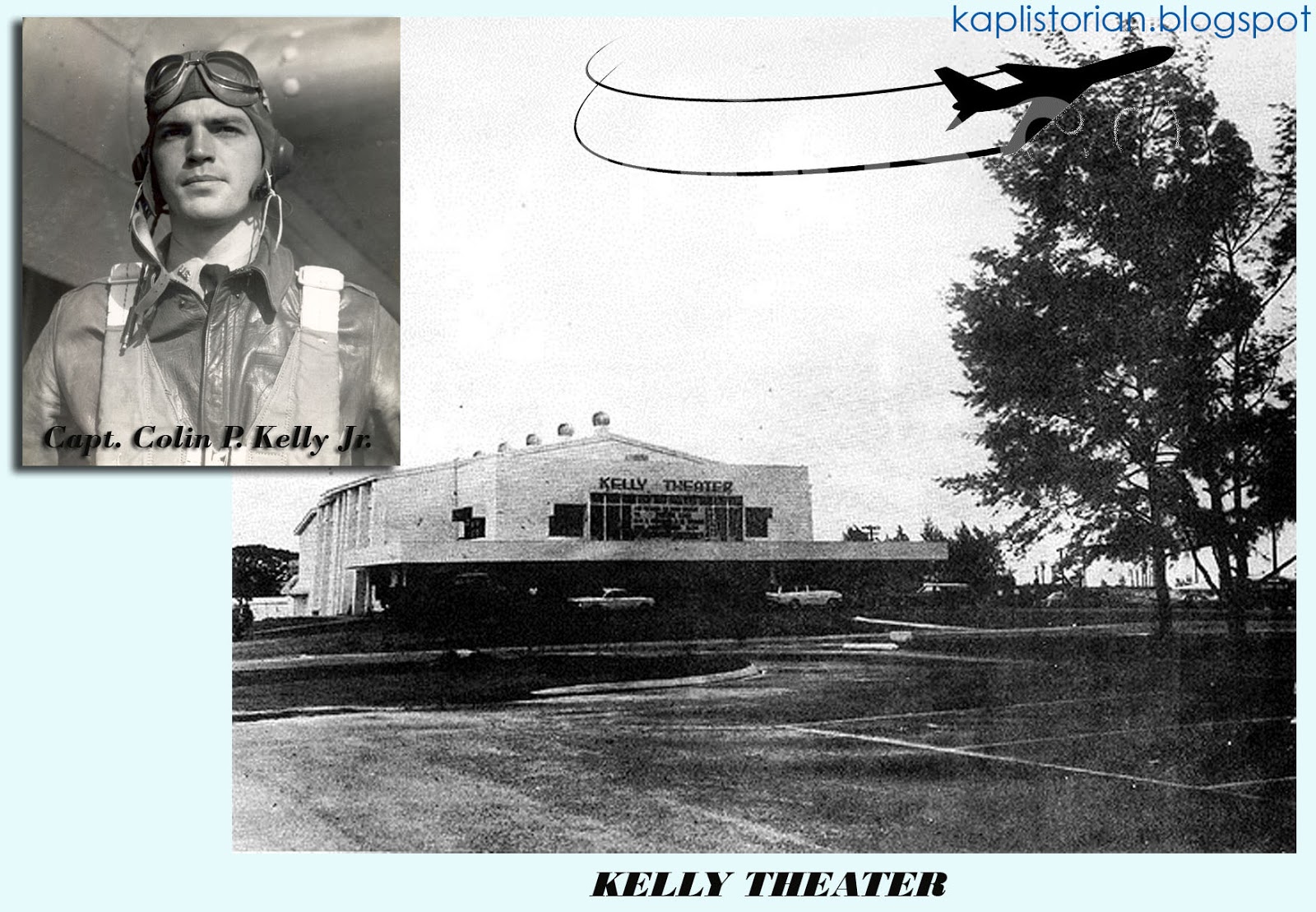
KELLY THEATER,
named after Capt. Colin Purdue Kelly Jr.
One of the historic buildings in Clark Air Base was the
Kelly Theater, constructed in 1953, the only cinema house in Clark and the
venue of many stage plays and cultural shows. There was an earlier Kelly
Theater built earlier—in 1947—that was converted from an old gymnasium. Both
theatres were names after B-17 pilot
Capt. Colin P. Kelly Jr. (b.Jul. 11,
1915/d. Dec. 10, 1941) who died in
action against the Japanese forces in 1941. Kelly’s damaged plane, while
returning from a bombing run, blew up near Clark Field after being engaged by
enemy forces. Capt. Kelly was declared America’s first hero of WWII by US
President Franklin D. Roosevelt. The memorial
statue of the fallen captain was inaugurated on the theater grounds on 10 Dec.
2007—the 66th year of his passing. Kelly Theater, located at the cor. Ninoy
Aquino Ave. and Foxhound St., survived Mt. Pinatubo, but eventually everything
from the seats to the roof and front walls were stolen.
MEYER LEVIN
GYMNASIUM, named after Master Sgt. Meyer Levin
The gymnasium facility on Dau Avenue, east of the Parade
Ground was named after Meyer Levin in 1955, a master sergeant of the U.S. Army
Air Corps. Raised in Brooklyn, New York, Levin (b.Jun 5, 1916/d.Jan. 7, 1943)—who
had wanted to become an aviator—became a bombardier and flew with Capt. Colin
Kelly after the Japanese attack of Clark Field. During his last mission on
January 7, 1943, Levin volunteered to bomb the Japanese convoy ships that was
approaching Australia. The weather worsened, and as the plane used up its fuel,
the crew bailed out as the planed ditched the water. Levin remained in the
plane to release the rafts that saved his crew. He died in the crash and is
listed as one of those missing at Manila National Cemetery. Levin was awarded
the Distinguished Flying Cross (for
successfully bombing the Japanese warship “Haruna”) and a Purple Heart for his
heroic war feats.
MITCHELL HIGHWAY,
named after Brig. Gen. William Lendrum Mitchell, (now J. Abad Santos Avenue)
One of the most travelled roads in Clark—the Mitchell
Highway-- stretches all the way from the Mars Station, then passes close to the
Parade Grounds, and leads all the way to the Friendship Gate. It was named
Philippine-American war veteran, Gen. William “Billy” Mitchell (b.Dec. 29,
1879/d.Feb. 19, 1936), regarded as the father of the United Sates Air Force. Gen.
Mitchell also saw action during World War I in France, and even commanded the American
air combat units in that country post-war. In 1924, he returned to Pampanga to revisit Camp Stotsenburg where he even gave flying
lessons to Gen. Emilio Aguinaldo, whom he had helped capture. The North American
B-25 Mitchell—an American military aircraft design—was also named in his honor.
WAGNER HIGH SCHOOL,
named after 1st Lt. Boyd David Wagner
The beginnings of Wagner High School and Middle School
could be traced back in 1957-58 when the Grades 7-12 of Wurtsmith High transferred
to individual wooden buildings at the former Chapel Center. That site that will
eventually be renamed Wagner High School. The school was named after 1st Lt. Boyd
David Wagner, of the U.S. Army Air Corps, who commanded the 17th
Pursuit Squadron that was ordered to protect Clark. On Dec. 14, 1941 shot down
four Japanese airplanes, and 2 days later, downed another enemy aircraft at
Vigan. Thus, he became the first American World War II Ace, and for which he
earned him a Distinguished Service Cross. Wagner was nearly blinded in the
Lingayen Gulf battle, but survived and evacuated to Australia where he
recovered.Later, he was sent back to the U.S. to train new fighter pilots.
On Nov. 29, 1942, Col. Wagner
disappeared while on a flight from Florida to Alabama. His plane wreckage was
found six weeks later, some 4 miles north of Freeport, Florida. His remains are
buried at Grandview Cemetery, Johnstown, Pennsylvania.

WURTSMITH MEMORIAL SCHOOL, named after Maj. Gen. Paul Bernard Wurstmith
The Clark Dependents’ School opened in 1947 to
accommodate school-age children. In 1950, it was moved to another used office
building that would be renamed in 1954 as Wurtsmith Memorial High School. It was name in memory of Maj.
Gen. Paul Bernard Wurtsmith (b. Aug. 9,1906/Sept. 13, 1946), who became a
flying cadet in 1927. Over the next 13 years, he served in command positions
and his fighters’ feats include downing 78 enemy aircraft in the defense of
Darwin in Australia, against the Japanese. In 1945, he commanded the 13th
Air Force in the Southern Philippines campaign. Wurtsmith was killed when his
plane crashed in the mountain area near Asheville, North Carolina. The Clark
school that bears his name would have a new air-conditioned building on the
former site of the Stotsenburg base picnic grounds in 1961. Construction of an expanded campus complex began in 1989, and the
newly-renovated Wurtsmith High opened for schoolyear 1990-1991. The Pinatubo
eruption (which occurred just a week before the end of the school year) forced
the transfer of the graduation rites to Subic. The school was later demolished
and replaced with Fontana Casino.
BONUS!
A hill in Clark
bears a peculiar name, because it was not named after a person, or even after a
flower, as its name suggests.
LILY HILL
Lilly Hill first appeared on an 1898 map, and is thought
to have been derived from the Kapampangan
word “lili”, which means “lost”. The Americanized name was apt because it
was easy to get lost on that hill which stood separately from other hills in
the area. Used as an observation point by Americans from 1903--42, it was also
used by the Japanese for the same purpose. It would become the stronghold of
the Kembu Group which defended Clark from late 1944-45. Post-war, a USAF
aircraft warning and control unit was put up in the summit until 1962. A Buddhits
shrine was built on the hilltop by the Japanese in 1998 on the 54th commemoration of the Kamikaze. It features
a large 5-ton granite statue of Kannon, the "Goddess of Peace ".
SOURCES:
Camp Stotsenburg:
Pix of Camp Stotsenburg: Alex Castro Collection
Pix of Col. John Stotsenburg:
Clark Air Base:
Pix,:Harold Clark: An Annotated Pictorial History of Clark Air
Base, by David Rosmer
Bobbitt Theater:
Bong Avenue:
Pix: Welcome to Clark Air Base, Guardian of Philippine Defense booklet
Dyess Highway:
Pix: Welcome to Clark Air Base, Guardian of Philippine Defense booklet
Kelly Theater:
Pix: An Annotated Pictorial History of Clark Air Base, by David Rosmer
Meyer Levin Gym:
Pix: An Annotated Pictorial History of Clark Air Base, by David Rosmer
Mitchell Highway:
Pix: Welcome to Clark Air Base, Guardian of Philippine Defense booklet
Wagner High School:
Pix of Boyd Wagner: Photograph by Carl Mydans for TIME & LIFE
Pictures), (Colourised by Doug)
Pix: Wagner High School, 1971, collection of K. Morgan
Wurtsmith Elem. School:
Lily Hill:
Pix: An Annotated Pictorial History of Clark Air Base, by David Rosmer
Images:
Pix; clarksubic.com

.jpg)