Showing posts with label Kapampangan hero. Show all posts

Wednesday, October 24, 2018

98. 10 TOMBS AND MEMORIALS OF REMARKABLE KAPAMPANGAN PERSONALITIES

DON ANGEL PANTALEON DE MIRANDA
(ca. 1765/ d. 21 Jun. 1835)
Place of Memorial: Sto. Rosario Church
Founder of Angeles. Together with wife, Doña Rosalía de Jesús and some followers, the group headed north to clear a forested area there for rice and sugar farming in 1796. The settled area became known as Culiat, named after the vines that proliferated in the place. Culiat would become the future city of Angeles, named after him and his patron, the Guardian Angel.

FELINO GIL
(b.1803/d.1884)
Place of Interment: Pio Chapel, Porac, Pampanga
Spanish civic leader. For helping secure lands in Porac for the friar missions, he was awarded tracts of land that he successfully turned into sugar plantations. Recognized as one of the founders—along with Juan P.  Zita-- of the “Escuela de Artes y Oficios de Bacolor”, which aimed to train artisans, on 14 Nov. 1861. Later renamed to Bacolor Trade School in 1915, which offerd courses in Woodworking Domestic Science, Ironworking and Building Construction.

 HONORIO T. VENTURA
(b. 30 Jul. 1887/ d. 3 Sep. 1940)
Place of Interment: Cementerio del Norte (Manila North Cemetery)
Son of Balbino Ventura and Juana Tizon of Bacolor. Graduated with a law degree from Universty of Santo Tomas , and went to Spain for advance studies in Jurisprudence. Appointed as acting governor of Pampanga in 1916. Served as Chief of the Executive Bureau of the Department of Interior and later as Secretary of the Interior in place of Atty. Felipe Agoncillo. The former Pampanga School of Arts and Trades in Bacolor, Pampanga which he supported as a philantrophist, was re-named as Don Honorio T. Ventura College of Arts and Trades in his honor. One of his scholars was the future president, Diosdado P. Macapagal.
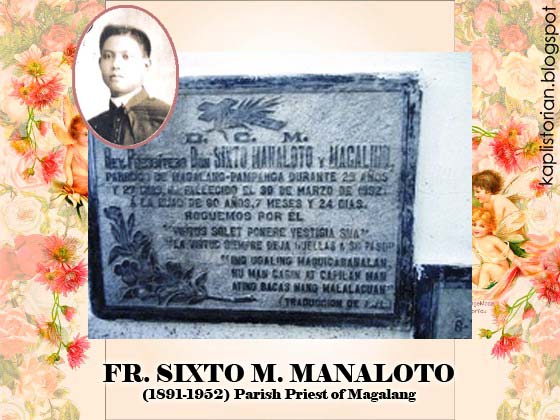
FR. SIXTO M. MANALOTO
(b. 6 Jul. 1891/d. 30 Mar. 1952)
Place of Interment: Magalang Memorial Park
Though Tarlac-born, Fr. Manaloto would make a lasting impression on Magaleños, serving their parish for an unprecedented period of nearly 30 years. On 8 December 1915, feast of the Immaculate Conception, Fr. Manaloto, a product of San Carlos Seminary, was ordained into priesthood by Archbishop Harty in 1915. Assigned in Magalng in 1923, he is known for his major restoration works of San Bartolome Church., for opening a parochial school in the town and for sending poor, but deserving students to Manila, many of whom eventually returned as professionals and became leaders of the community.

 JOSE CORAZON DE JESUS
(b. 22 Nov. 1896/ 26 May 1932)
Place of Interment: Cementerio del Norte (Manila North Cemetery)
Son of Vicente de Jesús  of Sta. Maria, Bulacan and Susana Pangilinan of Pampanga. As Huseng Batute,  he wrote nationalistic articles for Ang Democracia, Liwayway, Taliba, under the pseudonym Huseng Batute. He supported Philippine independence and wrote critical articles about Philippine society under the Americans. Known as the King of Balagtasan, for his mastery of Tagalog poetry.Wrote the lyrics  of the popular Filipino song “Bayan Ko”,which has become an alternative anthem.

KUDIARO LAXAMANA
(b.1906/d.1970)
Place of Interment: Clark Cemetery, Angeles City, Pampanga
Born in the Mt. Pinatubo area. Aeta World War II Guerrilla Hero. Head of the 55-155th Squadron of the Northwest Pampanga Mountain District. Reputedly killed 50 Japanese soldiers, chopping off at least 17 enemy heads with  his bolo. Given a post-humous recognition in Mabalacat in 1995 for his wartime bravery. Killed in 1970 for his advocacies. Given a 21-gun salute at his burial at the Clark Cemetery. A major road in Clark—Kudiaro Laxamana Ave.—is named after him.

RUFINO J. CARDINAL SANTOS
(26 Aug. 1908-d. 3 Sep. 1973)
Place of Interment: Manila Metropolitan Cathedral crypt
The 1st Filipino Prince of the Church. Born in Sto. Niño, Guagua to Gaudencio Santos and Rosalia Jiao. Accepted as seminarian at San Carlos Seminary in 1921.  At 19, became a scholar of the Pontifical Gregorian University in Rome in 1927. Ordained on 25 Oct. 1931 in Rome. Assigned to Imus, Cavite and Marilao, Bulacan as assistant priest; then to Manila. After his war imprisonment, was named by Arch.  Michael O’Doherty as Vicar General of Manila, then elected as the Titular Bishop of Barca and Auxiliary Bishop to the archbishop. Succeeded Arch. Gabriel M. Reyes as the new archbishop of Manila in 1953, following his appointment by Pope Pius XII. Elevated to the rank of the cardinal at the Basilica of St. Peter in Rome at 9:30 a.m. on 31 Mar. 1960.

CLEOFE J. BALINGIT
(b. 9 Apr. 1910/ d. 5 Jun. 1981)
Place of Interment: Apalit Municipal Cemetery
Daughter of  Macabebe Scout Felix Balingit and Juliana Jaime of Macabebe. Chosen to represent Pampanga in the search for the 1936 Queen of the Manila Carnival, touted as “the biggest annual event of the Orient”. Her candidacy was supported by the newspaper “Ing Catimauan”. Placed 4th after the winner, Mercedes Montilla, of Negros Occidental,  crowned Miss Mindanao 1936. Married to Dr. Mariano Bayani of Apalit.  Spent the rest of her life involved in socio-civic causes,  especially the Pampanga Chapter of the Girl Scouts and the local Red Cross.

DIOSDADO P. MACAPAGAL
(b. 28 Sep. 1910/ d. 21 Apr. 1997)
Place of Interment: Libingan ng mga Bayani
Born in Lubao to Urbano and Romana Pangan. “The poor boy from Lubao” became the 9th President of the Philippines, serving from 1961 to 1965, and the sixth Vice-President, serving from 1957 to 1961. Was a member of the House of Representatives, and headed the Constitutional Convention of 1970. Father of Gloria Macapagal Arroyo, the 14th President of the Philippines from 2001 to 2010. Succeeded by Ferdinand Marcos.

THE AQUINOS OF TARLAC
Place of Interment: Manila Memorial Park, Parañaque, Manila
Corazon Cojuangco Aquino ((b. 25 Jan. 1933/d. 1 Aug. 2009)
The first woman president and the 11th chief executive of the Philippines.  The most prominent figure of the 1986 People Power Revolution that ended the 21 years of dictatorial rule by Pres. Marcos. People rallied around her after her husband’s assassination and swept the plain housewife to power. Hailed as the “Mother of Asian Democracy”.
Benigno Aquino Jr. (b. 27 Nov. 1932 /d. 21 Aug.1983)
A leading oppositionist of the Pres. Ferdinand Marcos and his dictatorial regime. Arrested and jailed for 7 years during the Martial Law of 1972.Founder of the lakas ng Bayan (Laban) party. Allowed to travel by Marcos in 1980 for medical reasons, byt was assassinated upon his return to Manila in 1983. His death was the catalyst for te People Power Revolution that ended the arcos regime and started his wife Corazon’s ascent to power.

FERNANDO POE JR
(b. 20 Aug. 1939/d. 14 Dec. 2004)
Place of Interment: Cementerio del Norte (Manila North Cemetery)
Actor, director, film producer and presidential of the Philippines. Considered King of Philippine Movies. Began showbiz career in the 1953 with the movie “Anak ni Palaris”. Has over 200 films to his credit. Most portrayals show him as a champion of the poor. 5-time winner of FAMAS Award. Married to showbiz royalty, Susan Roces; daughter Grace Poe is a senator. Ran for the 2004 presidential race, but lost by the slimmest of margin against Gloria Macapagal-Arroyo.

ALEXIS TIOSECO
(b. 11 Feb. 1981/d. 1 Sep. 2009)
Place of Interment: Family mausoleum, Angeles City Cemetery
The young film critic is the great-grandchild of Leonardo Lilles, a successful agricultural engineer, businessman and town leader of Macabebe.  Noted film critic and film professor at the University of Asia and the Pacific. Known advocate of Southeast Asian cinema. Named  in 2005 as “one of the most important young people in the Philippines today”, by Philippine Star, for championing Philippine cinema. On 1 Sep. 2009, Tioseco and Slovenian girlfriend Nika Bohinc, were murdered in their Quezon City apartment by 3 burglars. Their househelp was convicted in May 2018 for her participation in the crime,

BONUS!
COLIN P. KELLY JR.
(b. 11 July 1915/10 Dec. 1941) 
Place of Memorial: Madison, Florida
B-17 pilot Capt. Colin Purdie Kelly Jr. died in action against the Japanese forces in 1941. Kelly’s damaged plane, while returning from a bombing run, blew up near Clark Field after being engaged by enemy forces. Declared as America’s first hero of WWII by US President Franklin D. Roosevelt.  The Kelly Theater of Clark as named after him. There is a  memorial statue of the fallen captain in front of the theater ruins inaugurated on 10 Dec. 2007—the 66th year of his passing.

CONRADO Y, GUINTO, KING OF POETS
(b. 21 Jan. 1946/d. 5 May 2015)
Place of Interment: Porac, Pampanga
Conrado Guinto is the fictional character in the award-winning advocacy film,”ARI: My Life with a King”, produced by Holy Angel University. The aging Kapampangan poet royalty befriends a Pampanga-born high school lad, JP, who can’t speak the language. Their contentious relationship ends with the death of Conrado, but only after passing the poet’s torch, and the laurel crown to the young boy. Portrayed by real-life poeta laureado,  Francisco "Frank" Guinto, who won Best Actor honors in the Metro-Manila Film Festival 2016, New Wave edition. The FAMAS-award winning sory was penned by Robby Tantingco and directed by Carlo Catu.

SOURCES:
(tomb)
FELINO GIL: Jerry Punzalan Sagmit (tomb); Luther Parker Collection (photo)
SIXTO MANALOTO,:Old Cemetery: https://magalang-heritage.weebly.com/old-cemetery.html
JOSE CORAZON DE JESUS: http://malacanang.gov.ph/undas-2012-a-cemeteries-tour/(tomb); flickr.com, posted by NCCA Official (photo)
CLEOFE BALINGIT: Alex R. Castro Collection
COLIN KELLY: www.findagrave.com
CARDINAL SANTOS: findagrave.com (tomb); Alex R. Castro (photo)
KUDIARO LAXAMANA: www.finadagrave.com (tomb);
 www.art.com (photo)
DISODADO MACAPAGAL: Twitter photo, by Maria Cepeda (tomb); wikipedia.com  (photo)
CORY AQUINO, NINOY AQUINO: wikimedia commons
FERNANDO POE JR: Wikimedia commons (grave); Alex R. Castro (photo)
ALEXIS TIOSECO: Robby Tantingco (tomb), Association for Southeast Asian Cinemas Conference - WordPress.com (photo)

Tuesday, September 20, 2016

17. 10 KAPAMPANGANS THE NATION FORGOT

How sad indeed that aside from Jose Abad Santos, most Filipinos cannot name another Kapampangan who deserves to be in the nation’s pantheon of heroes and patriots.The reason for this ignorance is Manila’s control over national history—the same control it has on national language and, unfortunately, pretty much everything else. Nothing in this country ever gets national attention or national recognition unless Manila says so.

Because Manila is a Tagalog city dictating its Tagalog identity on the rest of the nation, we are made, for example, to read all 377 stanzas of 'Florante at Laura' and not even one stanza from the equally great 'Gonzalo de Cordoba,' the country’s longest literary work written by a Kapampangan.
We are also required to know the name of practically every Caviteño, Bulakenyo and Batangueño who ever fought in the Revolution, while all the equally heroic Kapampangans, Ilocanos, Cebuanos, etc. are completely ignored.

If there’s any justice in this country, these 10 Kapampangans must have their statues erected in parks all over the country and their names written in history books:

1. PEDRO ABAD SANTOS, the Socialist Party founder who inspired an entire generation of peasants and laborers to claim the land they tilled and the just wages they earned. He influenced his younger brother Jose to become a more pro-poor Justice Secretary and Chief Justice, and pressured his brother’s boss, President Manuel Quezon, to initiate land reform. Because Jose later died a glorious martyr’s death and Pedro only died from a bleeding ulcer, we have streets, schools and hospitals across the country named after Jose, while all that Pedro got is a small statue in his hometown.

2. BAMBALITO (a.k.a. Tarik Soliman), the Macabebe chieftain who rallied thousands of Macabebe warriors to Tondo to resist Miguel Lopez de Legazpi in 1571. Abandoned by Tagalog leaders Lacandula, Rajah Matanda and Rajah Soliman, he faced the Spanish conquistadores alone at the critical Battle of Bangkusay. His death sealed the fate of the country, and yet who remembers him except us Kapampangans? Worse, Manila credits the Tagalog Rajah Soliman as the hero of Bangkusay (he wasn’t even there). It was only in June 2016 that the National Historic Commission (NHCP) officially corrected the longtime claim that Rajah Soliman was the first native to die for freedom--but this this young warrior--now honored with a commemorative marker in Macabebe.

3. MARTIN SANCHO, the 10-year-old Kapampangan prodigy who was shipped to Spain in 1587 to recite the entire Catholic Catechism (in Latin!) before King Philip II. His performance convinced the King that the natives he imagined to be savages were actually as erudite as Europeans, and that the colony he was ready to quit was after all worth keeping. After creating a sensation in Madrid, Martin next went to Rome where he studied and eventually became the first Filipino Jesuit. Yet he only merited a tiny footnote in Jesuit annals and no mention at all in history books.

4. REMEDIOS GOMEZ, the Huk soldier known as Kumander Liwayway who polished her nails and wore makeup before going to battle. Her feminine ways amused and sometimes irritated her comrades, but she proved that a woman didn’t have to act like a man to fight like a man. Her courage made Huk Supremo Luis Taruc declare that “the role of women was one of the proudest features of the Hukbalahap.” When President Manuel Roxas scolded her after her capture, she told him “You are wrong, Mr. President” to his face. Filipinos romanticize to death the stories of Nelia Sancho, Maita Gomez and other beauty queens-turned-dissidents, yet don’t even know or care that Kumander Liwayway is still alive and living in Metro-Manila.*

5. FELIPE SONSONG, the Macabebe soldier-turned-missionary whose reputation for holiness eclipsed that of mission leader Fr. Diego Sanvitores, SJ and mission companion Pedro Calungsod, and prompted a contemporary, Fr. Lorenzo Bustillo, SJ, to write a detailed account of Sonsong’s life—so detailed that historian Fr. John Schumacher, SJ called Sonsong the most documented Filipino before the time of Jose Rizal. When he died (in 1685), the top civilian and military officials of the Ladrones islands (Guam) carried his casket to the cemetery. Sanvitores has since been beatified and Calungsod canonized, but Sonsong’s own cause for beatification is still neither here nor there.

6. ZOILO GALANG, who holds not one, not two, but three Philippine records: he wrote the country’s first English novel (in 1921), the country’s first book of English poems (in 1925) and the country’s first encyclopedia (in 1934). Galang wrote the novel 'A Child of Sorrow' three years before Paz Marquez Benitez wrote the short story 'Dead Stars,' and yet all textbooks in Philippine Literature in English begin with Benitez and 'Dead Stars.'

7. LUISA GONZAGA DE LEON, the first Filipino woman to author a book (in 1844). This country has honored every woman who pioneered something, including first Filipina admitted to Harvard, first Filipina Ph.D., first Filipina scientist, etc. Gonzaga de Leon wrote a book at a time when most women didn’t even read books, so it’s puzzling why the nation shows no appreciation for this Kapampangan woman’s extraordinary accomplishment.

8. THE MALAYA LOLAS of Mapaniqui, Candaba, all 100 of them, raped all night by Japanese soldiers when they were still young girls and forced to witness the massacre of their husbands and fathers—a story more horrific than anything to ever come out of World War II. And yet the nation has paid more attention to other comfort women with far less compelling stories to tell.

9. PEDRO DANGANAN, the miracle worker from Sapangbato who became such a national celebrity in the 1930s that pilgrims from as far as Ilocos and Bicol flocked to his house by the thousands, sometimes hiding under the 'batalan' to catch his bath water which they believed to be miraculous. Estampitas bearing his image were sold outside churches, while newspapers carried news stories proclaiming that he was “gumagamot nang walang gamot at walang bayad.” It’s amazing how a country obsessed with faith healers and visionaries, from Felipe Salvador to Jun Labo to Judiel Nieva, would have absolutely no memory of this enigmatic Kapampangan.

10. VOLUNTARIOS DE MACABEBE, not the better-known Macabebe Scouts of the American Period, but their earlier version in the Spanish Period, who helped the Spaniards stretch their colonial rule to 300 years, for better or for worse. Even Gen. William Draper of the invading British Navy in 1762 was in awe of their ferocity and military skills. Their do-or-die defense of the fleeing Spaniards so angered Gen. Aguinaldo that he had the whole town burned to the ground. By the time the Americans took over, the Voluntarios were ready to morph into the Scouts to avenge their fate. Today the Scouts are the stuff of debates and movies, while the Voluntarios, whom the Spaniards fondly described as “the loyal companions of our disgraces and glories,” only had a street named after them—and it’s not even here in the Philippines.

*Remedios Gomez died after the article was first published, in May 2014, at age 95.

SOURCE:
ROBBY TANTINGCO, originally published 2014, posted on his FB Notes, 11 November 2015

Wednesday, August 17, 2016

12.Part II: LITTLE-KNOWN THINGS ABOUT JOSE ABAD SANTOS, CHIEF JUSTICE AND HERO

L-R: Jose Abad Santos, elder brother Pedro, 1st Lady Aurora Aragon-Quezon

11. BROTHERS JOSE AND PEDRO ABAD SANTOS HAD CONFLICTING POLITICAL BELIEFS THAT PUT THEM IN DIFFICULT SITUATIONS.
The two brothers were poles apart when it came to their political convictions. The elder Pedro was founder of the Socialist Party of the Philippines that supported a revolution of the masses, while Jose was a Secretary of Justice tasked with enforcing the law—which included opposing his brother. In one event in Pampanga where a reform program was launched before farmers, Jose pleaded with Pedro not to embarrass Quezon . Pedro complied, introducing Quezon as a 'friend of the masses and the poor'. But before Quezon spoke, Pedro panned the legal system that, he said, landlords used against the poor. He challenged Jose, then seated next to Quezon, and sarcastically remarked that the 'secretary cannot help us if he just sits in his office.' Though often at odds, both were champions of the welfare of the common people.

 12. ABAD SANTOS INTRODUCED THE IDEA OF PUBLISHING THE NAMES OF BAR EXAMINERS.
Abad Santos believed that to ensure clean examinations, the names of the bar examiners should be published. This innovation was adopted by the Supreme Court in 1934. Beginning with Vol. 56 of the Philippine Reports, the names of the members of the Bar Exams Committee have appeared on print. However, the Supreme Court in recent years, found it unwise to reveal the names of the examiners bfore the actual exams, as this has resulted in leakages.

 13. ABAD SANTOS SHARES A BIRTHDAY WITH THE FIRST LADY, AURORA ARAGON-QUEZON.
Jose Abad Santos was born on 19 February 1886. He shares his birthday with the Philippine First Lady, Aurora Aragon-Quezon (born 19 February 1888), whose husband, Pres. Quezon, he had dutifully served. It was also on 19 February 1942 that the evacuation of civilians from Corregidor—where Quezon and his wartime cabinet were holed up--began.

 14. ABAD SANTOS BRIEFLY SERVED AS THE ACTING PRESIDENT OF THE PHILIPPINE COMMONWEALTH. 
On 17 March 1942, Pres. Manuel L. Quezon designated Abad Santos as the Acting President with full authority to act in the name of, and on behalf of the President of the Philippine Commonwealth in areas unoccupied by the Japanese. This appointment was made through a letter written by Quezon in Negros Occidental, en route to his escape to the U.S. via Australia.

L-R: Last photo of Abad Santos with Japanese capt., son Pepito,Pampanga Capitol monument

 15. ABAD SANTOS' LAST LETTER TO HIS FAMILY WAS WRITTEN IN KAPAMPANGAN.
 The last letter of Abad Santos to his family was dated 16 April 1942, written in Cebu, just a little over 2 weeks before he was executed. It was delivered to the family in Manila by a kind Japanese Christian, Capt. Watanabe. The short letter, in Kapampangan, reads: Caluguran cung Mandang, Ing magdala caniti yapin ing Captain Watanabe a aquilala ming Pepito queni Cebu.Mayap ya tratus a papaquit quecami. Masalese que bili queni at eyu que pigaganacan. Panayan cu ing agad tang miquit queni. Yanamu, at masalese congan sanang dasnan mi.  Ing maligud queca, Jose A.

 16. PEPITO, ABAD SANTOS' SON, WAS ORIGINALLY PLANNED TO BE EXECUTED WITH HIS FATHER.
Keiji Fukui was an interpreter of Maj. Gen. Kiyotake Kawaguchi that led the Japanese forces in the conquest of Cebu. He testified during the war crimes trial that Gen. Masaharu Homma’s execution order originally included Pepito. However, Gen. Kawaguchi, “on his own discretion” decided to spare his son. Pepito was told to change his name to avoid detection (he chose, “Jose Francisco”, from his Christian name and the surname of his friend Rudy Francisco, aka actor Fred Montilla).

 17. GEN. HOMMA'S WAR CRIMES DID NOT ORIGINALLY INCLUDE THE CASE OF ABAD SANTOS.
 When Col. Manuel Lim was named as Chief of the Philippine War Crimes Commission, he was surprised to know that, of the 42 crimes against Gen. Masaharu Homma, no reference was made about the Abad Santos case. Lim brought the matter to the attention of Gen. Douglas MacArthur, who gave him full authority to conduct a thorough investigation. Four days before Homma was arraigned, Macarthur authorized the inclusion of Abad Santos’ execution in the charges against him. Homma was found guilty and executed on 3 April 1946.

 18. THE WHEREABOUTS OF ABAD SANTOS' GRAVE REMAINS UNKNOWN.
Abad Santos, his son Pepito and Col. Benito Valeriano were captured by the Japanese on 11 April 1942 in Barili, Cebu. Refusing to cooperate with the Japanese, Abad Santos was ordered executed by Gen. Homma, imputing the destruction of the bridges and other public works in Cebu to him. They were taken first to Parang, Cotabato then brought to Malabang, Lanao on 30 April, where Abad Santos was informed of his execution. Abad Santos was executed on 2 May 1942 under a tall coconut tree near a river bank. In the afternoon, Pepito was taken to his father's grave that the son thought was too small to hold his body. The grave was marked by a rock. After the war, an intensive search for Jose’s burial ground was launched but by then, the terrain had been cultivated and planted with crops, and the reference points—like the hut and the trees—were all gone.

L-R: Marina Benipayo, Manuel Abad Santos, Jamby Madrigal, Roxanne Abad
Santos, bust at Luneta, JASMS-QC, commemorative stamp.

 19. ABAD SANTOS AND HIS FAMOUS RELATIONS: 
 • Manuel Dizon Abad Santos Sr., Mayor of Angeles ( nephew of Jose Abad Santos, his father Irineo Basco Abad Santos, was Jose’s elder brother)
 • Consuelo “Jamby” Madrigal, Senator (granddaughter of Jose Abad Santos, daughter of Amanda Jr. with Vicente Madrigal)
 • Rosanna Pangilinan Abad Santos, Actress (screen name: Roxanne Abad Santos, great grandniece of Jose Abad Santos. Daughter of Irineo Atienza Abad Santos, whose father was Manuel Dizon Abad Santos Sr.)
 • Marina Abad Santos-Benipayo, Beauty Queen, Model, TV Personality (grandniece of Jose Abad Santos. Her mother, Nieves Abad Santos-Benipayo, is the daughter of Nieves Dayrit with Quirino Basco Abad Santos, Jose’s younger brother)

 20. TRIBUTES AND HONORS TO ABAD SANTOS.
• Jose Abad Santos is honored with monuments at the Pampanga Provincial Capitol in San Fernando,Pampanga, at the heritage district of Angeles, in Tayabas City, and a bust at Rizal Park.
• Jose Abad Santos Memorial School. The primary and secondary education school of Philippine Women’s University was named after Abad Santos in 1949. JASMS QC was established in 1956.
•The municipality of Trinidad in Davao del Sur, created in 1948, was renamed as Jose Abad Santos in his honor in 1954.
• The Bureau of Posts issued an Abad Santos commemorative stamp in 1960.
• Abad Santos Avenue is the name of the main avenue in San Fernando, Pampanga, (formerly Olongapo-Gapan Rd.). There is also 3-km Abad Santos in Tondo, Manila, and at Clark Freeport Zone.
• Abad Santos is commemorated on the ₱1000-peso bill along with Gen. Vicente Lim and Josefa Llanes Escoda, who were all killed by the Japanese during the World War II.

 Source: 
Aquino, Ramon C., A CHANCE TO DIE, A Biography of Jose Abad Santos, the Late Chief justice of the Philippines, Alemar-Phoenix Publishing House and Jose Abad Santos Memorial Society of the Philippines. 1967 Graphic Magazine

Thursday, August 11, 2016

11. Part I, 20 LITTLE-KNOWN THINGS ABOUT JOSE ABAD SANTOS, CHIEF JUSTICE AND HERO

(19 Feb. 1886-d.2 May 1942)

Chief Justice Jose Abad Santos y Basco (b.1886/d/1942), jurist and martyr-hero of the last World War, is perhaps, one of the more nationally-known patriots ever to come from Pampanga. Who can forget his last, parting words to his son?: "Do not cry, Pepito, show to these people that you are brave. It is an honor to die for one's country. Not everybody has that chance”. Here are a few lesser-known aspects of his short, but heroic life

 1. THE DOUBLE SURNAME 'ABAD SANTOS' CAME TO BE, IN COMPLIANCE WITH A LEGAL REQUIREMENT.
“Abad” was added by Vicente (Jose’s father) to his existing Santos surname to differentiate his family from other Santoses, a common patronymic in the country. On the other hand, Esteban, Vicente’s brother, appended “Ferre”, making his surname “Ferre Santos”.

 2. THE YOUNG ABAD SANTOS WAS NICKNAMED ' SENGSENG'.
 Abad Santos was one of 10 children of Vicente Abad Santos and Toribia Basco. His father was already 56 when he was born. Nicknamed “Sengseng”, Jose, together with Quirino and Salvador who followed him, were affectionately called “Los Tres Reyes” by their mother, who was especially fond of the three. When he became a parent, his children addressed him as “Tatang” and their mother, “Ima”, as he preferred.

L-R. Amanda Teopaco, wife of Abad Santos, as a pensionado in the U.S.

3. ABAD SANTOS WAS A 'PENSIONADO' WHOSE BATCH INCLUDED 3 WELL-KNOWN KAPAMPANGANS. 
 Abad Santos was one of 2nd batch of 18 government scholars sent to study in the U.S. in 1904. Included in this group were his own kabalens—Sotero Baluyot, the future Pampanga governor who studied civil engineering in Iowa; Fabian de la Paz of Macabebe, who was enrolled at the Western Illinois State Teachers’ College; and medical student Gervacio Santos Cuyugan, who would become one of Pres. Quezon’s personal physicians. Cuyugan and Abad Santos, both from San Fernando, would become fast friends and roommates while both enrolled at University of Illinois. On his 2nd year, Abad Santos moved to Northwestern University.

 4. ABAD SANTOS FLUNKED THE 1910 BAR EXAMS.
Abad Santos returned to the Philippines in 1909 to become a member of the bar. He took the 1910 Bar Exams—but failed. That was because the test covered Spanish codes while his training abroad emphasized American laws. The next year in September, he again, took the bar exams, and this time, passed it. He was admitted to the bar on 12 October 1911.

 5.AMANDA TEOPACO, THE WIFE OF ABAD SANTOS WAS A NATIONAL BEAUTY QUEEN.
Amanda Teopaco (b.1901) was the daughter of the revolutionist Pedro Teopaco and Miguela Hizon, sister of patriot Gen. Maximino Hizon. While an “interna” at the Centro Escolar de Señoritas in Manila, her pictures would often appear in newspapers like El Renacimiento and La Vanguardia, often with poems dedicated to her. One picture of hers found its way to the Philippine Free Press which was then conducting a beauty search. The winners were selected by the Free Press readers at the end of 1909. Amanda finished in 6th place among the Top 13 Beauties.

 6. THOUGH A KAPAMPANGAN, ABAD SANTOS HAD A TASTE FOR SIMPLE, NATIVE FOOD. 
At home, Abad Santos favored simple native food. For dessert, he preferred “panocha” (peanut candy) over leche flan. he was fond of “pindang” and “halo-halo”. His breakfast consisted of fried rice, tuyo, coffee and fruit—a regular morning fare that he never got tired of eating.

L-R. Daughters Luz and Amanda, national swimmers;

 7. THE DAUGHTERS OF ABAD SANTOS WERE MEMBERS OF THE PHILIPPINE NATIONAL SWIMMING TEAM. 
Amanda Jr. was a member of the 1934 Far Eastern Games swimming team representing the Philippines in the 50-meter free style and 100-meter backstroke with sister Luz Abad Santos. Both were champion swimmers of Philippine Women’s College. This skill was learned from their father, who learned to swim in the San Fernando river. When Abad Santos had their house built in San Juan, he also had a swimming pool added, where he trained his daughters to swim.

 8. JOSE'S BROTHER, ANTONIO, MARRIED AMANDA' SISTER, RAMONA, MAKING HIM HIS BROTHER'S OWN BROTHER-IN-LAW.
 Amanda Teopaco was actually a distant cousin of Abad Santos. The sponsors at their wedding on 21 September 1918 were Pedro Abad Santos and Mrs. Aurea Ocampo- Escaler. When Jose’s elder brother Antonio married Ramona Teopaco, he became his brother’s own brother-in-law and Ramona, became his sister-in-law twice. By coincidence, two Abad Santos daughters married two brothers.

 9. TWO ABAD SANTOS DAUGHTERS MARRIED TO TWO MADRIGAL BROTHERS.
Amanda Jr. married industrialist Antonio Paterno Madrigal ( he founded Consolidated Bank and Trust Company, East-Asia Capital Corporation, Susana Realty Incorporated, Rizal Cement Company and Corinthian Gardens). Victoria, married Jose Paterno Madrigal who was at the helm of Madrigal Properties. Both brothers were sons of business tycoon and Senator Vicente Madrigal and Susana Paterno.

 10. ABAD SANTOS HELD THE POSITION OF SECRETARY OF JUSTICE THREE TIMES.
Under Gov. Gen. Leonard Wood (1922-1923, resigned due to a conflict with Wood), Under Gov. Generals Henly L. Stimson, Dwight F. Davis and Theodore Roosevelt Jr. (1928-1932), and finally under Pres. Manuel L. Quezon (1938-1941). In between, Abad Santos engaged in private practice, first with brother Pedro, then partnered with Dean Conrado Benitez. He later joined the law firm of Camus, Delgado & Recto.

Sources:
Aquino, Ramon C., A CHANCE TO DIE, A Biography of Jose Abad Santos, the Late Chief justice of the Philippines, Alemar-Phoenix Publishing House and Jose Abad Santos Memorial Society of the Philippines. 1967

Graphic Magazine