Showing posts with label World War 2. Show all posts

Saturday, March 2, 2019

106. 12 SIGNIFICANT EVENTS THAT HAPPENED IN CLARK

Clark Air Base’s history is intertwined with the history of the Philippines since that fateful day when the United States established its presence at the turn of the 20th century—1902 to be exact--that was to last a hundred years. Here are some significant moments that happened in “Pampanga’s piece of America”.
********


THE BOMBING OF CLARK, 8 December 1941
After the attack of Pearl Harbor by the Japanese forces, airstrikes against the U.S. were planned  on its military bases in the Pacific to prevent intervention of the the Far East Force (FEAF). Also, the capture of the Philippines was necessary to control the shipping routes between Japan and Greater East Asia Co-Prosperity Sphere, which consisted of Japan-occupied countries during World War II. At Takao Naval Air Base, 27 Mitsubishi G4M Type 1 land attack bombers  of the Takao Kokutai took off  on 8 December 1945, at 9:30 a.m. with Clark Field as their target. At 12 noon, Clark Field received warning of the approaching airstrike. Thirty five minutes later, 53 Japanese bombers dropped down bombs on Clark Field, followed by the Zero pilots descending to strafe the field thoroughly. While a few American P-40’s were airborne, they could not provide counter attacks as they were poorly positioned.  Twelve of Clark Field’s seventeen   B-17 planes were destroyed, while 34 P-40s were destroyed on the ground and in aerial combat.
Earlier, 11 B-17s had been flown to safety to Mindanao before the attack, while 2 remained unscathed as they were on reconnaissance missions. The American forces regained Clark Filed on 31 January 1945.


THE FATAL CRASH OF PILOT CAPT. COLIN P. KELLY. 10 December 1941
 Capt. Colin Purdie Kelly Jr. (b. 11 July 1915/10 Dec. 1941) was a B-17 pilot who died in action against the Japanese forces in 1941. The Madiosn, Florida native was a West Point 1937 graduate  how as the first Army officer to fly the Boeing Flying Fortress in the Far East. On 10 Dec. 1941, Kelly took off from Clark Field in his B-17 plane with his bombardier, Sgt. Meyer Levin, to engage the Japanese in a bombing run. He managed to damage the Japanese cruiser Natori. Returning to Clark,  the Tainan Air Group A16Ms that were patrolling Vigan followed Kally’s plane and attacked it. Nearig Clark, his damaged aircract caught fire. Kelly ordered his crew to bail out but the plane blew up, killing him. Capt. Kelly was declared America’s first hero of WWII by US President Franklin D. Roosevelt. He was posthumously awarded the Distinguished Service Cross For "extraordinary heroism" and "selfless bravery". The Kelly Theater in Clark, converted from an old gymnasium in 1947 was named after him. A memorial statue of the hero was inaugurated on the Kelly Theater grounds on 10 Dec. 2007—the 66th year of his passing.


PRES. MANUEL A. ROXAS DIES IN CLARK, 15 April 1948
On 15 April 1948, upon the invitation from Maj. Gen. E. L. Eubank, Pres. Manuel A. Roxas, along with Sen. Pres. Jose Avelino, Speaker Eugenio Perez and Gen. Rafael Jalandoni, visited Clark Air Base. His tour was capped by a speech he delivered at the Kelly Theater. He felt faint after his speech, and so he was talen to the residence of Maj. Gen. Eubank to rest. It turned out that his condition was a prelude to a series of heart attacks that led to his death at 9:23 in the evening. The president’s body was brought to Manila the following day on a special train that reeached Malacañang at 9:20 a.m.


CLARK AS A LOGISTICS HUB DURING THE VIETNAM WAR, 1964-75
During the second phase of the Cold War, Clark grew into a major American air base, serving as an important logistics hub during the 20 year Vietnam War. Clark joined the war effort in March 1964; its  KC-135 tankers refuelled fighters enroute to Laos. Injured American soldiers were evacuated and flown weekly from the Saigon airport to Clark Air Base, to be treated or operated on at the Clark Air Base Hospital. Touted as “Asia’s Military Medical Center” when it opened in 1964, the hospital was the savior of thousands of American military men and their families, recognized for its exceptional medical services and treatment of soldiers. At the height of the War, 70% of the patients at the Clark hospital were soldiers who sustained varying degrees of injuries in the battlefields. The Clark Air Base mortuary also served as the place for the processing of Vietnam War casualties,  headed by a mortuary officer, who help ensured the dignified transfer of the body to a team of military personnel for conveyance to the port mortuary and finally to his family. In 1975, after the end of the ground combat, Clark Air Base was also used for the massive evacuation of Vietnamese orphan children, dubbed as   Operation Babylift. The operation expanded to include evacuation of adult refugees from Saigon, Phnom Penh, and Vientiane, and the humanitarian effort became known as “Operation New Life”.


BOB HOPE’S USO SHOWS IN CLARK AIR BASE, 1966, 1967, 1972, 1987
From 1964 to 1972, the famous stand-up comic Bob Hope entertained U.S. troops in Southeast Asia, in his annual Christmas USO (United Services Organization) shows. The one-man moral booster machine took his shows to Vietnam, Laos, Guam, Thailand. Diego Garcia, Wake Island, and Clark Air Base in the Philippines, which he described as the “Country Club of the Pacific”. In January 1966, Hope arrived in Clark and was welcomed by the base commander Lt. Gen. James Wilson. His show that year featured Phyllis Diller, Chris Noel, Joey Heaherton and regulars Les Brown and his Band of Renown. By Christmas 1967, the number of American military in Vietnam had reached almost 500,000, resulting in massive crowds  and making Hope’s appearances even more important for boosting morale. He was welcomed by gen. Benjamin O. Davis in Clark where his shows featured Raquel Welch , Barbara McNair, Phil Crosby and Miss World, Madeleine Hartog Bell. His last stop in Clark was for his 1987 USO show which was taped for TV entitled “'Bob Hope`s USO Christmas from the Persian Gulf-Around the World in Eight Days”.   Guests included Barbara Eden, Lee Greenwood and Connie Stevens.


POWs HOMECOMING,  12 February  1973
In 1968, RichardM.Nixon was elected as the new U.S. president and he began move to end the conflict in Vietnam. The number of American forces in Southeast Asia was also substantially reduced. His policy was to give continued support to non-communist SEA  countries, while lessening military presence in the areas. One immediate U.S. demand to North Vietnam was for the full release of American POWs and an accurate accounting of  servicemen missing or killed in action. It was in 1972 that an agreement was reached for the repatriation of prisoners, and Clark Air Base as designated as the point of the POWs return from Hanoi.  “Operation Homecoming” thus began on 12 February 1972 when  a C-141A Starlifter transport jet took off from Hanoi and the first flight of 40 U.S. prisoners of wars began their journey home. Arriving at Clark at around 4:15 P.M., the POWs returned to a hero’s welcome, received by Adm. Noel Gayler, Commander-in-Chief of the Pacific Command; Lt.  Gen. William G. Moore, 13th  Air Force Commander; and Air Force Sr. Master Sgt. Homer E. Henderson, Joint Information Bureau Asst. Non-comm. O-I-C. A second group followed on February 18, until all the 591 POWs were returned home by late March 1973. On 6 April 1975, the Clark Air Base Peace Garden was dedicated to the memory of those who died or were declared "missing in action" in Southeast Asia.


THE PHILIPPINE ADMINISTRATION OF CLARK AIR BASE, 7 January 1979
A pivotal period in Clark Air Base history began in the year 1979, when the government of the Philippines began assuming administration of the Asia’s biggest American military base. When the revised 1947 Military Bases Agreement was ratified on January 7, it was put into effect immediately and on February 16,  the command and security command and security of Clark and other American bases was officially turned over to to the Philippine government. The size of the Clark reservation was also trimmed from 156,204 acres to 131,000 acres, while the base size remained the same at 9155 acres. On March 25, Clark's third major labor strike occurred.


PRES. FERDINAND MARCOS FLEES THE COUNTRY VIA CLARK, 25 February 1986
When the People Power street rallies turned into a nationwide revolution, the desperate Marcos called the office of the U.S. president, and managed to talk to Senator Paul Laxalt. He asked the senator if the State Department’s advice for him to step down was valid, further asking if there was a way for him to share power with Mrs. Cory Aquino, whom he beat by rigging the snap elections. When Sen. Laxalt told him it was time “to cut and cut cleanly”, the embattled Marcos agreed to give up the presidency to avert further violence and possible bloodbath. Marcos was given a safe passage with helicopters from Clark Air Base's 31 ARRS picking him up at his Presidential palace, and flying him to the Clark airport. There, he and his retinue transferred to a C-9A and were flown first to Guam’s Hickam Air Force Base enroute to Hawaii


FILIPINO EMPLOYEES’ STRIKES ROCK CLARK, 1971, 1983,  22 March 1986
The first time that Filipino employees went on strike in Clark was when they stage a walk-out on 3 March 1971. This came a time when ant-American sentiments was at its most high. The strike was ended after 3 days, but only 4 months later, on July 25,  a bigger strike followed that lasted for 25 days. Another strike happened in October 1983, when thousands of Filipino workers went on indefinite strike today over demands for wage increases. Pres. Reign was due to visit that year, but the trip was called off. But the most serious civilian employees strike was stage on 22 March 1986. Thousands of Filipino workers  blockaded the gates of both Clark and Subic on 25 March in a
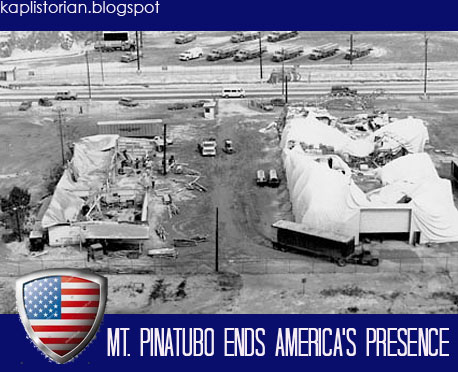

MT. PINATUBO ERUPTION ENDS AMERICA’S PRESENCE IN CLARK
As early as April, pilot in Clark have reported seeing ominous smoke emanating from Mount Pinatubo, a volcano that has not erupted in 500 years. When it was clar that an eruption was imminent, Clark mounted a massive evacuation  of 15,000 U.S. personnel and their dependents on June 10. The major June 12 eruption dumped tons of ash on Clark.  But another eruption in June 15, exacerbated by passing typhoon Yunya, further cause massive damages, and all but buried the military base in a sea of ash, mud, pyroclastic materials and lahar. About 2,500 servicemen and women stayed on to provide security and try to maintain basic services. Meanwhile, the extension of the Military Bases Agreement was rejected by the Philippine Senate, and was due to expire on September 16. Driven by budgetary realities (it would tae $500 million to rehabilitate Pinatubo-damaged Clark)  and nature's explosive whims, the U.S. did not renegotiate anymore and agreed to leave Clark Air Base in 1992 but keep the sprawling Subic Bay Naval Base for 10 more years. The U.S. Air Force formally transferred entire Clark to the Philippines on 26 November 1991, ending its 100 years in the Philippines. On 24 November 1997, the last U.S. forces left the Philippines.


THE CLARK AIRPORT BEGINS COMMERCIAL OPERATIONS, 1995
The airport was rehabilitated from the damaged US Clark Air Base that was  closed in 199. After two years of cleaning up debris and lava, the Clark Special Economic Zone was opened on the site with the airport at the center. In 1995, the Clark International Airport Corporation was established to manage the airfield facilities. In 1996, limited air service from Clark to Hong Kong began, signaling the first international flight. Renamed Disodado Macapagal Airport by Pres. Gloria Macapagal-Arroyo in 2003  to honor her father, it reverted back to Clark International Airport in February 2012. Today, Clark hosts 490 flights per week (332 Domestic flights, 158 International flights), with  19 local and 11 international destinations, as of June 2018.


CLARK HOSTS APEC MEETING 2015
The Philippines hosted the year-long Asia-Pacific Economic Cooperation (APEC) summit in 2015. It was held against the backdrop of Chinese intrusion f islands in the South China Sea, contested by several countries, like Vietnam, Japan, Malaysia, and the Philippines. The First Senior Officials' Meeting and Related Meetings were held at the Fontana Leisure Park, Clark Freeport, Angeles City and Subic Bay, Zambales, from 26 January to 7 February 2015. Kapampangan DFA-Undersecretary Laura Quiambao-del Rosario was chair of the summit.

SOURCES:
CLARK AS LOGISTICS HUB:
THE STARS AND STRIPES ARCHIVES “Vietnam wounded go 1st class on air ambulance (1965), U.S. SOLDIERS IN VIETNAM”: https://www.stripes.com/news/vietnam-wounded-go-1st-class-on-air-ambulance-1.292349
BOB HOPE: Bob Hope, The USO One Man Morale Machine https://www.uso.org/stories/154-bob-hope-the-uso-s-one-man-morale-machine
Bob Hope Special January 19th, 1966: https://www.youtube.com/watch?v=75jUL2E6tEQ&t=4120s
PHILIPPINE ADMIN OF CLARK: : http://www.clarkab.org/history/
CLARK EMPLOYEES’ STRIKE: http://www.clarkab.org/history/
MT. PINATUBO ENDS AMERICA’S PRESENCE: http://www.clarkab.org/history/
CLARK AIRPORT: https://en.wikipedia.org/wiki/Clark_International_Airport
Photo: I Remember Clark Air Base FB page
CLARK HOSTS APEC MEET:
Photo courtesy of Mick Basa/Rappler.

Tuesday, September 20, 2016

17. 10 KAPAMPANGANS THE NATION FORGOT

How sad indeed that aside from Jose Abad Santos, most Filipinos cannot name another Kapampangan who deserves to be in the nation’s pantheon of heroes and patriots.The reason for this ignorance is Manila’s control over national history—the same control it has on national language and, unfortunately, pretty much everything else. Nothing in this country ever gets national attention or national recognition unless Manila says so.

Because Manila is a Tagalog city dictating its Tagalog identity on the rest of the nation, we are made, for example, to read all 377 stanzas of 'Florante at Laura' and not even one stanza from the equally great 'Gonzalo de Cordoba,' the country’s longest literary work written by a Kapampangan.
We are also required to know the name of practically every Caviteño, Bulakenyo and Batangueño who ever fought in the Revolution, while all the equally heroic Kapampangans, Ilocanos, Cebuanos, etc. are completely ignored.

If there’s any justice in this country, these 10 Kapampangans must have their statues erected in parks all over the country and their names written in history books:

1. PEDRO ABAD SANTOS, the Socialist Party founder who inspired an entire generation of peasants and laborers to claim the land they tilled and the just wages they earned. He influenced his younger brother Jose to become a more pro-poor Justice Secretary and Chief Justice, and pressured his brother’s boss, President Manuel Quezon, to initiate land reform. Because Jose later died a glorious martyr’s death and Pedro only died from a bleeding ulcer, we have streets, schools and hospitals across the country named after Jose, while all that Pedro got is a small statue in his hometown.

2. BAMBALITO (a.k.a. Tarik Soliman), the Macabebe chieftain who rallied thousands of Macabebe warriors to Tondo to resist Miguel Lopez de Legazpi in 1571. Abandoned by Tagalog leaders Lacandula, Rajah Matanda and Rajah Soliman, he faced the Spanish conquistadores alone at the critical Battle of Bangkusay. His death sealed the fate of the country, and yet who remembers him except us Kapampangans? Worse, Manila credits the Tagalog Rajah Soliman as the hero of Bangkusay (he wasn’t even there). It was only in June 2016 that the National Historic Commission (NHCP) officially corrected the longtime claim that Rajah Soliman was the first native to die for freedom--but this this young warrior--now honored with a commemorative marker in Macabebe.

3. MARTIN SANCHO, the 10-year-old Kapampangan prodigy who was shipped to Spain in 1587 to recite the entire Catholic Catechism (in Latin!) before King Philip II. His performance convinced the King that the natives he imagined to be savages were actually as erudite as Europeans, and that the colony he was ready to quit was after all worth keeping. After creating a sensation in Madrid, Martin next went to Rome where he studied and eventually became the first Filipino Jesuit. Yet he only merited a tiny footnote in Jesuit annals and no mention at all in history books.

4. REMEDIOS GOMEZ, the Huk soldier known as Kumander Liwayway who polished her nails and wore makeup before going to battle. Her feminine ways amused and sometimes irritated her comrades, but she proved that a woman didn’t have to act like a man to fight like a man. Her courage made Huk Supremo Luis Taruc declare that “the role of women was one of the proudest features of the Hukbalahap.” When President Manuel Roxas scolded her after her capture, she told him “You are wrong, Mr. President” to his face. Filipinos romanticize to death the stories of Nelia Sancho, Maita Gomez and other beauty queens-turned-dissidents, yet don’t even know or care that Kumander Liwayway is still alive and living in Metro-Manila.*

5. FELIPE SONSONG, the Macabebe soldier-turned-missionary whose reputation for holiness eclipsed that of mission leader Fr. Diego Sanvitores, SJ and mission companion Pedro Calungsod, and prompted a contemporary, Fr. Lorenzo Bustillo, SJ, to write a detailed account of Sonsong’s life—so detailed that historian Fr. John Schumacher, SJ called Sonsong the most documented Filipino before the time of Jose Rizal. When he died (in 1685), the top civilian and military officials of the Ladrones islands (Guam) carried his casket to the cemetery. Sanvitores has since been beatified and Calungsod canonized, but Sonsong’s own cause for beatification is still neither here nor there.

6. ZOILO GALANG, who holds not one, not two, but three Philippine records: he wrote the country’s first English novel (in 1921), the country’s first book of English poems (in 1925) and the country’s first encyclopedia (in 1934). Galang wrote the novel 'A Child of Sorrow' three years before Paz Marquez Benitez wrote the short story 'Dead Stars,' and yet all textbooks in Philippine Literature in English begin with Benitez and 'Dead Stars.'

7. LUISA GONZAGA DE LEON, the first Filipino woman to author a book (in 1844). This country has honored every woman who pioneered something, including first Filipina admitted to Harvard, first Filipina Ph.D., first Filipina scientist, etc. Gonzaga de Leon wrote a book at a time when most women didn’t even read books, so it’s puzzling why the nation shows no appreciation for this Kapampangan woman’s extraordinary accomplishment.

8. THE MALAYA LOLAS of Mapaniqui, Candaba, all 100 of them, raped all night by Japanese soldiers when they were still young girls and forced to witness the massacre of their husbands and fathers—a story more horrific than anything to ever come out of World War II. And yet the nation has paid more attention to other comfort women with far less compelling stories to tell.

9. PEDRO DANGANAN, the miracle worker from Sapangbato who became such a national celebrity in the 1930s that pilgrims from as far as Ilocos and Bicol flocked to his house by the thousands, sometimes hiding under the 'batalan' to catch his bath water which they believed to be miraculous. Estampitas bearing his image were sold outside churches, while newspapers carried news stories proclaiming that he was “gumagamot nang walang gamot at walang bayad.” It’s amazing how a country obsessed with faith healers and visionaries, from Felipe Salvador to Jun Labo to Judiel Nieva, would have absolutely no memory of this enigmatic Kapampangan.

10. VOLUNTARIOS DE MACABEBE, not the better-known Macabebe Scouts of the American Period, but their earlier version in the Spanish Period, who helped the Spaniards stretch their colonial rule to 300 years, for better or for worse. Even Gen. William Draper of the invading British Navy in 1762 was in awe of their ferocity and military skills. Their do-or-die defense of the fleeing Spaniards so angered Gen. Aguinaldo that he had the whole town burned to the ground. By the time the Americans took over, the Voluntarios were ready to morph into the Scouts to avenge their fate. Today the Scouts are the stuff of debates and movies, while the Voluntarios, whom the Spaniards fondly described as “the loyal companions of our disgraces and glories,” only had a street named after them—and it’s not even here in the Philippines.

*Remedios Gomez died after the article was first published, in May 2014, at age 95.

SOURCE:
ROBBY TANTINGCO, originally published 2014, posted on his FB Notes, 11 November 2015

Wednesday, August 17, 2016

12.Part II: LITTLE-KNOWN THINGS ABOUT JOSE ABAD SANTOS, CHIEF JUSTICE AND HERO

L-R: Jose Abad Santos, elder brother Pedro, 1st Lady Aurora Aragon-Quezon

11. BROTHERS JOSE AND PEDRO ABAD SANTOS HAD CONFLICTING POLITICAL BELIEFS THAT PUT THEM IN DIFFICULT SITUATIONS.
The two brothers were poles apart when it came to their political convictions. The elder Pedro was founder of the Socialist Party of the Philippines that supported a revolution of the masses, while Jose was a Secretary of Justice tasked with enforcing the law—which included opposing his brother. In one event in Pampanga where a reform program was launched before farmers, Jose pleaded with Pedro not to embarrass Quezon . Pedro complied, introducing Quezon as a 'friend of the masses and the poor'. But before Quezon spoke, Pedro panned the legal system that, he said, landlords used against the poor. He challenged Jose, then seated next to Quezon, and sarcastically remarked that the 'secretary cannot help us if he just sits in his office.' Though often at odds, both were champions of the welfare of the common people.

 12. ABAD SANTOS INTRODUCED THE IDEA OF PUBLISHING THE NAMES OF BAR EXAMINERS.
Abad Santos believed that to ensure clean examinations, the names of the bar examiners should be published. This innovation was adopted by the Supreme Court in 1934. Beginning with Vol. 56 of the Philippine Reports, the names of the members of the Bar Exams Committee have appeared on print. However, the Supreme Court in recent years, found it unwise to reveal the names of the examiners bfore the actual exams, as this has resulted in leakages.

 13. ABAD SANTOS SHARES A BIRTHDAY WITH THE FIRST LADY, AURORA ARAGON-QUEZON.
Jose Abad Santos was born on 19 February 1886. He shares his birthday with the Philippine First Lady, Aurora Aragon-Quezon (born 19 February 1888), whose husband, Pres. Quezon, he had dutifully served. It was also on 19 February 1942 that the evacuation of civilians from Corregidor—where Quezon and his wartime cabinet were holed up--began.

 14. ABAD SANTOS BRIEFLY SERVED AS THE ACTING PRESIDENT OF THE PHILIPPINE COMMONWEALTH. 
On 17 March 1942, Pres. Manuel L. Quezon designated Abad Santos as the Acting President with full authority to act in the name of, and on behalf of the President of the Philippine Commonwealth in areas unoccupied by the Japanese. This appointment was made through a letter written by Quezon in Negros Occidental, en route to his escape to the U.S. via Australia.

L-R: Last photo of Abad Santos with Japanese capt., son Pepito,Pampanga Capitol monument

 15. ABAD SANTOS' LAST LETTER TO HIS FAMILY WAS WRITTEN IN KAPAMPANGAN.
 The last letter of Abad Santos to his family was dated 16 April 1942, written in Cebu, just a little over 2 weeks before he was executed. It was delivered to the family in Manila by a kind Japanese Christian, Capt. Watanabe. The short letter, in Kapampangan, reads: Caluguran cung Mandang, Ing magdala caniti yapin ing Captain Watanabe a aquilala ming Pepito queni Cebu.Mayap ya tratus a papaquit quecami. Masalese que bili queni at eyu que pigaganacan. Panayan cu ing agad tang miquit queni. Yanamu, at masalese congan sanang dasnan mi.  Ing maligud queca, Jose A.

 16. PEPITO, ABAD SANTOS' SON, WAS ORIGINALLY PLANNED TO BE EXECUTED WITH HIS FATHER.
Keiji Fukui was an interpreter of Maj. Gen. Kiyotake Kawaguchi that led the Japanese forces in the conquest of Cebu. He testified during the war crimes trial that Gen. Masaharu Homma’s execution order originally included Pepito. However, Gen. Kawaguchi, “on his own discretion” decided to spare his son. Pepito was told to change his name to avoid detection (he chose, “Jose Francisco”, from his Christian name and the surname of his friend Rudy Francisco, aka actor Fred Montilla).

 17. GEN. HOMMA'S WAR CRIMES DID NOT ORIGINALLY INCLUDE THE CASE OF ABAD SANTOS.
 When Col. Manuel Lim was named as Chief of the Philippine War Crimes Commission, he was surprised to know that, of the 42 crimes against Gen. Masaharu Homma, no reference was made about the Abad Santos case. Lim brought the matter to the attention of Gen. Douglas MacArthur, who gave him full authority to conduct a thorough investigation. Four days before Homma was arraigned, Macarthur authorized the inclusion of Abad Santos’ execution in the charges against him. Homma was found guilty and executed on 3 April 1946.

 18. THE WHEREABOUTS OF ABAD SANTOS' GRAVE REMAINS UNKNOWN.
Abad Santos, his son Pepito and Col. Benito Valeriano were captured by the Japanese on 11 April 1942 in Barili, Cebu. Refusing to cooperate with the Japanese, Abad Santos was ordered executed by Gen. Homma, imputing the destruction of the bridges and other public works in Cebu to him. They were taken first to Parang, Cotabato then brought to Malabang, Lanao on 30 April, where Abad Santos was informed of his execution. Abad Santos was executed on 2 May 1942 under a tall coconut tree near a river bank. In the afternoon, Pepito was taken to his father's grave that the son thought was too small to hold his body. The grave was marked by a rock. After the war, an intensive search for Jose’s burial ground was launched but by then, the terrain had been cultivated and planted with crops, and the reference points—like the hut and the trees—were all gone.

L-R: Marina Benipayo, Manuel Abad Santos, Jamby Madrigal, Roxanne Abad
Santos, bust at Luneta, JASMS-QC, commemorative stamp.

 19. ABAD SANTOS AND HIS FAMOUS RELATIONS: 
 • Manuel Dizon Abad Santos Sr., Mayor of Angeles ( nephew of Jose Abad Santos, his father Irineo Basco Abad Santos, was Jose’s elder brother)
 • Consuelo “Jamby” Madrigal, Senator (granddaughter of Jose Abad Santos, daughter of Amanda Jr. with Vicente Madrigal)
 • Rosanna Pangilinan Abad Santos, Actress (screen name: Roxanne Abad Santos, great grandniece of Jose Abad Santos. Daughter of Irineo Atienza Abad Santos, whose father was Manuel Dizon Abad Santos Sr.)
 • Marina Abad Santos-Benipayo, Beauty Queen, Model, TV Personality (grandniece of Jose Abad Santos. Her mother, Nieves Abad Santos-Benipayo, is the daughter of Nieves Dayrit with Quirino Basco Abad Santos, Jose’s younger brother)

 20. TRIBUTES AND HONORS TO ABAD SANTOS.
• Jose Abad Santos is honored with monuments at the Pampanga Provincial Capitol in San Fernando,Pampanga, at the heritage district of Angeles, in Tayabas City, and a bust at Rizal Park.
• Jose Abad Santos Memorial School. The primary and secondary education school of Philippine Women’s University was named after Abad Santos in 1949. JASMS QC was established in 1956.
•The municipality of Trinidad in Davao del Sur, created in 1948, was renamed as Jose Abad Santos in his honor in 1954.
• The Bureau of Posts issued an Abad Santos commemorative stamp in 1960.
• Abad Santos Avenue is the name of the main avenue in San Fernando, Pampanga, (formerly Olongapo-Gapan Rd.). There is also 3-km Abad Santos in Tondo, Manila, and at Clark Freeport Zone.
• Abad Santos is commemorated on the ₱1000-peso bill along with Gen. Vicente Lim and Josefa Llanes Escoda, who were all killed by the Japanese during the World War II.

 Source: 
Aquino, Ramon C., A CHANCE TO DIE, A Biography of Jose Abad Santos, the Late Chief justice of the Philippines, Alemar-Phoenix Publishing House and Jose Abad Santos Memorial Society of the Philippines. 1967 Graphic Magazine

Thursday, August 11, 2016

11. Part I, 20 LITTLE-KNOWN THINGS ABOUT JOSE ABAD SANTOS, CHIEF JUSTICE AND HERO

(19 Feb. 1886-d.2 May 1942)

Chief Justice Jose Abad Santos y Basco (b.1886/d/1942), jurist and martyr-hero of the last World War, is perhaps, one of the more nationally-known patriots ever to come from Pampanga. Who can forget his last, parting words to his son?: "Do not cry, Pepito, show to these people that you are brave. It is an honor to die for one's country. Not everybody has that chance”. Here are a few lesser-known aspects of his short, but heroic life

 1. THE DOUBLE SURNAME 'ABAD SANTOS' CAME TO BE, IN COMPLIANCE WITH A LEGAL REQUIREMENT.
“Abad” was added by Vicente (Jose’s father) to his existing Santos surname to differentiate his family from other Santoses, a common patronymic in the country. On the other hand, Esteban, Vicente’s brother, appended “Ferre”, making his surname “Ferre Santos”.

 2. THE YOUNG ABAD SANTOS WAS NICKNAMED ' SENGSENG'.
 Abad Santos was one of 10 children of Vicente Abad Santos and Toribia Basco. His father was already 56 when he was born. Nicknamed “Sengseng”, Jose, together with Quirino and Salvador who followed him, were affectionately called “Los Tres Reyes” by their mother, who was especially fond of the three. When he became a parent, his children addressed him as “Tatang” and their mother, “Ima”, as he preferred.

L-R. Amanda Teopaco, wife of Abad Santos, as a pensionado in the U.S.

3. ABAD SANTOS WAS A 'PENSIONADO' WHOSE BATCH INCLUDED 3 WELL-KNOWN KAPAMPANGANS. 
 Abad Santos was one of 2nd batch of 18 government scholars sent to study in the U.S. in 1904. Included in this group were his own kabalens—Sotero Baluyot, the future Pampanga governor who studied civil engineering in Iowa; Fabian de la Paz of Macabebe, who was enrolled at the Western Illinois State Teachers’ College; and medical student Gervacio Santos Cuyugan, who would become one of Pres. Quezon’s personal physicians. Cuyugan and Abad Santos, both from San Fernando, would become fast friends and roommates while both enrolled at University of Illinois. On his 2nd year, Abad Santos moved to Northwestern University.

 4. ABAD SANTOS FLUNKED THE 1910 BAR EXAMS.
Abad Santos returned to the Philippines in 1909 to become a member of the bar. He took the 1910 Bar Exams—but failed. That was because the test covered Spanish codes while his training abroad emphasized American laws. The next year in September, he again, took the bar exams, and this time, passed it. He was admitted to the bar on 12 October 1911.

 5.AMANDA TEOPACO, THE WIFE OF ABAD SANTOS WAS A NATIONAL BEAUTY QUEEN.
Amanda Teopaco (b.1901) was the daughter of the revolutionist Pedro Teopaco and Miguela Hizon, sister of patriot Gen. Maximino Hizon. While an “interna” at the Centro Escolar de Señoritas in Manila, her pictures would often appear in newspapers like El Renacimiento and La Vanguardia, often with poems dedicated to her. One picture of hers found its way to the Philippine Free Press which was then conducting a beauty search. The winners were selected by the Free Press readers at the end of 1909. Amanda finished in 6th place among the Top 13 Beauties.

 6. THOUGH A KAPAMPANGAN, ABAD SANTOS HAD A TASTE FOR SIMPLE, NATIVE FOOD. 
At home, Abad Santos favored simple native food. For dessert, he preferred “panocha” (peanut candy) over leche flan. he was fond of “pindang” and “halo-halo”. His breakfast consisted of fried rice, tuyo, coffee and fruit—a regular morning fare that he never got tired of eating.

L-R. Daughters Luz and Amanda, national swimmers;

 7. THE DAUGHTERS OF ABAD SANTOS WERE MEMBERS OF THE PHILIPPINE NATIONAL SWIMMING TEAM. 
Amanda Jr. was a member of the 1934 Far Eastern Games swimming team representing the Philippines in the 50-meter free style and 100-meter backstroke with sister Luz Abad Santos. Both were champion swimmers of Philippine Women’s College. This skill was learned from their father, who learned to swim in the San Fernando river. When Abad Santos had their house built in San Juan, he also had a swimming pool added, where he trained his daughters to swim.

 8. JOSE'S BROTHER, ANTONIO, MARRIED AMANDA' SISTER, RAMONA, MAKING HIM HIS BROTHER'S OWN BROTHER-IN-LAW.
 Amanda Teopaco was actually a distant cousin of Abad Santos. The sponsors at their wedding on 21 September 1918 were Pedro Abad Santos and Mrs. Aurea Ocampo- Escaler. When Jose’s elder brother Antonio married Ramona Teopaco, he became his brother’s own brother-in-law and Ramona, became his sister-in-law twice. By coincidence, two Abad Santos daughters married two brothers.

 9. TWO ABAD SANTOS DAUGHTERS MARRIED TO TWO MADRIGAL BROTHERS.
Amanda Jr. married industrialist Antonio Paterno Madrigal ( he founded Consolidated Bank and Trust Company, East-Asia Capital Corporation, Susana Realty Incorporated, Rizal Cement Company and Corinthian Gardens). Victoria, married Jose Paterno Madrigal who was at the helm of Madrigal Properties. Both brothers were sons of business tycoon and Senator Vicente Madrigal and Susana Paterno.

 10. ABAD SANTOS HELD THE POSITION OF SECRETARY OF JUSTICE THREE TIMES.
Under Gov. Gen. Leonard Wood (1922-1923, resigned due to a conflict with Wood), Under Gov. Generals Henly L. Stimson, Dwight F. Davis and Theodore Roosevelt Jr. (1928-1932), and finally under Pres. Manuel L. Quezon (1938-1941). In between, Abad Santos engaged in private practice, first with brother Pedro, then partnered with Dean Conrado Benitez. He later joined the law firm of Camus, Delgado & Recto.

Sources:
Aquino, Ramon C., A CHANCE TO DIE, A Biography of Jose Abad Santos, the Late Chief justice of the Philippines, Alemar-Phoenix Publishing House and Jose Abad Santos Memorial Society of the Philippines. 1967

Graphic Magazine