Showing posts with label Angeles City. Show all posts

Saturday, March 2, 2019

106. 12 SIGNIFICANT EVENTS THAT HAPPENED IN CLARK

Clark Air Base’s history is intertwined with the history of the Philippines since that fateful day when the United States established its presence at the turn of the 20th century—1902 to be exact--that was to last a hundred years. Here are some significant moments that happened in “Pampanga’s piece of America”.
********


THE BOMBING OF CLARK, 8 December 1941
After the attack of Pearl Harbor by the Japanese forces, airstrikes against the U.S. were planned  on its military bases in the Pacific to prevent intervention of the the Far East Force (FEAF). Also, the capture of the Philippines was necessary to control the shipping routes between Japan and Greater East Asia Co-Prosperity Sphere, which consisted of Japan-occupied countries during World War II. At Takao Naval Air Base, 27 Mitsubishi G4M Type 1 land attack bombers  of the Takao Kokutai took off  on 8 December 1945, at 9:30 a.m. with Clark Field as their target. At 12 noon, Clark Field received warning of the approaching airstrike. Thirty five minutes later, 53 Japanese bombers dropped down bombs on Clark Field, followed by the Zero pilots descending to strafe the field thoroughly. While a few American P-40’s were airborne, they could not provide counter attacks as they were poorly positioned.  Twelve of Clark Field’s seventeen   B-17 planes were destroyed, while 34 P-40s were destroyed on the ground and in aerial combat.
Earlier, 11 B-17s had been flown to safety to Mindanao before the attack, while 2 remained unscathed as they were on reconnaissance missions. The American forces regained Clark Filed on 31 January 1945.


THE FATAL CRASH OF PILOT CAPT. COLIN P. KELLY. 10 December 1941
 Capt. Colin Purdie Kelly Jr. (b. 11 July 1915/10 Dec. 1941) was a B-17 pilot who died in action against the Japanese forces in 1941. The Madiosn, Florida native was a West Point 1937 graduate  how as the first Army officer to fly the Boeing Flying Fortress in the Far East. On 10 Dec. 1941, Kelly took off from Clark Field in his B-17 plane with his bombardier, Sgt. Meyer Levin, to engage the Japanese in a bombing run. He managed to damage the Japanese cruiser Natori. Returning to Clark,  the Tainan Air Group A16Ms that were patrolling Vigan followed Kally’s plane and attacked it. Nearig Clark, his damaged aircract caught fire. Kelly ordered his crew to bail out but the plane blew up, killing him. Capt. Kelly was declared America’s first hero of WWII by US President Franklin D. Roosevelt. He was posthumously awarded the Distinguished Service Cross For "extraordinary heroism" and "selfless bravery". The Kelly Theater in Clark, converted from an old gymnasium in 1947 was named after him. A memorial statue of the hero was inaugurated on the Kelly Theater grounds on 10 Dec. 2007—the 66th year of his passing.


PRES. MANUEL A. ROXAS DIES IN CLARK, 15 April 1948
On 15 April 1948, upon the invitation from Maj. Gen. E. L. Eubank, Pres. Manuel A. Roxas, along with Sen. Pres. Jose Avelino, Speaker Eugenio Perez and Gen. Rafael Jalandoni, visited Clark Air Base. His tour was capped by a speech he delivered at the Kelly Theater. He felt faint after his speech, and so he was talen to the residence of Maj. Gen. Eubank to rest. It turned out that his condition was a prelude to a series of heart attacks that led to his death at 9:23 in the evening. The president’s body was brought to Manila the following day on a special train that reeached Malacañang at 9:20 a.m.


CLARK AS A LOGISTICS HUB DURING THE VIETNAM WAR, 1964-75
During the second phase of the Cold War, Clark grew into a major American air base, serving as an important logistics hub during the 20 year Vietnam War. Clark joined the war effort in March 1964; its  KC-135 tankers refuelled fighters enroute to Laos. Injured American soldiers were evacuated and flown weekly from the Saigon airport to Clark Air Base, to be treated or operated on at the Clark Air Base Hospital. Touted as “Asia’s Military Medical Center” when it opened in 1964, the hospital was the savior of thousands of American military men and their families, recognized for its exceptional medical services and treatment of soldiers. At the height of the War, 70% of the patients at the Clark hospital were soldiers who sustained varying degrees of injuries in the battlefields. The Clark Air Base mortuary also served as the place for the processing of Vietnam War casualties,  headed by a mortuary officer, who help ensured the dignified transfer of the body to a team of military personnel for conveyance to the port mortuary and finally to his family. In 1975, after the end of the ground combat, Clark Air Base was also used for the massive evacuation of Vietnamese orphan children, dubbed as   Operation Babylift. The operation expanded to include evacuation of adult refugees from Saigon, Phnom Penh, and Vientiane, and the humanitarian effort became known as “Operation New Life”.


BOB HOPE’S USO SHOWS IN CLARK AIR BASE, 1966, 1967, 1972, 1987
From 1964 to 1972, the famous stand-up comic Bob Hope entertained U.S. troops in Southeast Asia, in his annual Christmas USO (United Services Organization) shows. The one-man moral booster machine took his shows to Vietnam, Laos, Guam, Thailand. Diego Garcia, Wake Island, and Clark Air Base in the Philippines, which he described as the “Country Club of the Pacific”. In January 1966, Hope arrived in Clark and was welcomed by the base commander Lt. Gen. James Wilson. His show that year featured Phyllis Diller, Chris Noel, Joey Heaherton and regulars Les Brown and his Band of Renown. By Christmas 1967, the number of American military in Vietnam had reached almost 500,000, resulting in massive crowds  and making Hope’s appearances even more important for boosting morale. He was welcomed by gen. Benjamin O. Davis in Clark where his shows featured Raquel Welch , Barbara McNair, Phil Crosby and Miss World, Madeleine Hartog Bell. His last stop in Clark was for his 1987 USO show which was taped for TV entitled “'Bob Hope`s USO Christmas from the Persian Gulf-Around the World in Eight Days”.   Guests included Barbara Eden, Lee Greenwood and Connie Stevens.


POWs HOMECOMING,  12 February  1973
In 1968, RichardM.Nixon was elected as the new U.S. president and he began move to end the conflict in Vietnam. The number of American forces in Southeast Asia was also substantially reduced. His policy was to give continued support to non-communist SEA  countries, while lessening military presence in the areas. One immediate U.S. demand to North Vietnam was for the full release of American POWs and an accurate accounting of  servicemen missing or killed in action. It was in 1972 that an agreement was reached for the repatriation of prisoners, and Clark Air Base as designated as the point of the POWs return from Hanoi.  “Operation Homecoming” thus began on 12 February 1972 when  a C-141A Starlifter transport jet took off from Hanoi and the first flight of 40 U.S. prisoners of wars began their journey home. Arriving at Clark at around 4:15 P.M., the POWs returned to a hero’s welcome, received by Adm. Noel Gayler, Commander-in-Chief of the Pacific Command; Lt.  Gen. William G. Moore, 13th  Air Force Commander; and Air Force Sr. Master Sgt. Homer E. Henderson, Joint Information Bureau Asst. Non-comm. O-I-C. A second group followed on February 18, until all the 591 POWs were returned home by late March 1973. On 6 April 1975, the Clark Air Base Peace Garden was dedicated to the memory of those who died or were declared "missing in action" in Southeast Asia.


THE PHILIPPINE ADMINISTRATION OF CLARK AIR BASE, 7 January 1979
A pivotal period in Clark Air Base history began in the year 1979, when the government of the Philippines began assuming administration of the Asia’s biggest American military base. When the revised 1947 Military Bases Agreement was ratified on January 7, it was put into effect immediately and on February 16,  the command and security command and security of Clark and other American bases was officially turned over to to the Philippine government. The size of the Clark reservation was also trimmed from 156,204 acres to 131,000 acres, while the base size remained the same at 9155 acres. On March 25, Clark's third major labor strike occurred.


PRES. FERDINAND MARCOS FLEES THE COUNTRY VIA CLARK, 25 February 1986
When the People Power street rallies turned into a nationwide revolution, the desperate Marcos called the office of the U.S. president, and managed to talk to Senator Paul Laxalt. He asked the senator if the State Department’s advice for him to step down was valid, further asking if there was a way for him to share power with Mrs. Cory Aquino, whom he beat by rigging the snap elections. When Sen. Laxalt told him it was time “to cut and cut cleanly”, the embattled Marcos agreed to give up the presidency to avert further violence and possible bloodbath. Marcos was given a safe passage with helicopters from Clark Air Base's 31 ARRS picking him up at his Presidential palace, and flying him to the Clark airport. There, he and his retinue transferred to a C-9A and were flown first to Guam’s Hickam Air Force Base enroute to Hawaii


FILIPINO EMPLOYEES’ STRIKES ROCK CLARK, 1971, 1983,  22 March 1986
The first time that Filipino employees went on strike in Clark was when they stage a walk-out on 3 March 1971. This came a time when ant-American sentiments was at its most high. The strike was ended after 3 days, but only 4 months later, on July 25,  a bigger strike followed that lasted for 25 days. Another strike happened in October 1983, when thousands of Filipino workers went on indefinite strike today over demands for wage increases. Pres. Reign was due to visit that year, but the trip was called off. But the most serious civilian employees strike was stage on 22 March 1986. Thousands of Filipino workers  blockaded the gates of both Clark and Subic on 25 March in a
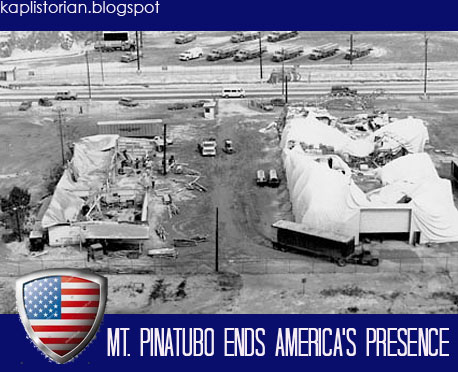

MT. PINATUBO ERUPTION ENDS AMERICA’S PRESENCE IN CLARK
As early as April, pilot in Clark have reported seeing ominous smoke emanating from Mount Pinatubo, a volcano that has not erupted in 500 years. When it was clar that an eruption was imminent, Clark mounted a massive evacuation  of 15,000 U.S. personnel and their dependents on June 10. The major June 12 eruption dumped tons of ash on Clark.  But another eruption in June 15, exacerbated by passing typhoon Yunya, further cause massive damages, and all but buried the military base in a sea of ash, mud, pyroclastic materials and lahar. About 2,500 servicemen and women stayed on to provide security and try to maintain basic services. Meanwhile, the extension of the Military Bases Agreement was rejected by the Philippine Senate, and was due to expire on September 16. Driven by budgetary realities (it would tae $500 million to rehabilitate Pinatubo-damaged Clark)  and nature's explosive whims, the U.S. did not renegotiate anymore and agreed to leave Clark Air Base in 1992 but keep the sprawling Subic Bay Naval Base for 10 more years. The U.S. Air Force formally transferred entire Clark to the Philippines on 26 November 1991, ending its 100 years in the Philippines. On 24 November 1997, the last U.S. forces left the Philippines.


THE CLARK AIRPORT BEGINS COMMERCIAL OPERATIONS, 1995
The airport was rehabilitated from the damaged US Clark Air Base that was  closed in 199. After two years of cleaning up debris and lava, the Clark Special Economic Zone was opened on the site with the airport at the center. In 1995, the Clark International Airport Corporation was established to manage the airfield facilities. In 1996, limited air service from Clark to Hong Kong began, signaling the first international flight. Renamed Disodado Macapagal Airport by Pres. Gloria Macapagal-Arroyo in 2003  to honor her father, it reverted back to Clark International Airport in February 2012. Today, Clark hosts 490 flights per week (332 Domestic flights, 158 International flights), with  19 local and 11 international destinations, as of June 2018.


CLARK HOSTS APEC MEETING 2015
The Philippines hosted the year-long Asia-Pacific Economic Cooperation (APEC) summit in 2015. It was held against the backdrop of Chinese intrusion f islands in the South China Sea, contested by several countries, like Vietnam, Japan, Malaysia, and the Philippines. The First Senior Officials' Meeting and Related Meetings were held at the Fontana Leisure Park, Clark Freeport, Angeles City and Subic Bay, Zambales, from 26 January to 7 February 2015. Kapampangan DFA-Undersecretary Laura Quiambao-del Rosario was chair of the summit.

SOURCES:
CLARK AS LOGISTICS HUB:
THE STARS AND STRIPES ARCHIVES “Vietnam wounded go 1st class on air ambulance (1965), U.S. SOLDIERS IN VIETNAM”: https://www.stripes.com/news/vietnam-wounded-go-1st-class-on-air-ambulance-1.292349
BOB HOPE: Bob Hope, The USO One Man Morale Machine https://www.uso.org/stories/154-bob-hope-the-uso-s-one-man-morale-machine
Bob Hope Special January 19th, 1966: https://www.youtube.com/watch?v=75jUL2E6tEQ&t=4120s
PHILIPPINE ADMIN OF CLARK: : http://www.clarkab.org/history/
CLARK EMPLOYEES’ STRIKE: http://www.clarkab.org/history/
MT. PINATUBO ENDS AMERICA’S PRESENCE: http://www.clarkab.org/history/
CLARK AIRPORT: https://en.wikipedia.org/wiki/Clark_International_Airport
Photo: I Remember Clark Air Base FB page
CLARK HOSTS APEC MEET:
Photo courtesy of Mick Basa/Rappler.

Tuesday, December 18, 2018

103. 10 ARTS AND CRAFTS OF PAMPANGA

In the late 19th and early 20th century, a design trend swept Europe and America called “Arts and Crafts”, a movement that promoted handcraftsmanship over industrial mass production. But long before that, Kapampangans have been creating all kinds of objects with their hands, with utilitarian and decorative functions, for their homes, work, leisure and religion.
**********

1. KURAN AT PASU (Sto. Tomas)
Utilitarian and decorative clay vessels and containers were among the earliest crafted objects made by man. All sorts of earthenware—including the ubiquitous  ‘kuran’ (round-bottom cooking pot)—have been produced in parts of Pampanga, as recorded by American Thomasite Luther Parker in the 1900s.  Sto. Tomas is the acknowledge pottery center of the province, with many major potters clustered along Quirino street. According to oldtimers, one pioneer potter was Apung Sindung Mercado who made “pilones”, clay jars used in the manufacture of molasses. From making traditional oya, tapayan, kuran, gusi, balanga and pilun , the potters also added ornamental pasu or masetas for growing garden plants and flowers,


2. PUKPUK (Betis, Apalit)
The fine art of metalsmithing was known to pre-Hispanic people in our archipelago, blossoming in the the late 16th to the 19th century, when the Spanish missionaries arrived to introduce the idea of sacred art in which the Chinese excelled. To decorate the altar, Mexican silver coin were melted and fashioned into tabernacles, altar frontals and vessels, ramilletes (silver floral standees), carrozas, and more. Betis artisans mastered the art, locally termed as ‘pukpuk’ (to hammer) as designs were created by chasing and using the repoussé method,  in which designs are raised on a metal sheet by pounding a pattern from the back using a sinsil (blunt chisel). This is achieved by working on the metal against a wooden block, on which designs have been incised. Artisans spread the art to Apalit which once had the largest number of ‘pukpuk’ shops. Names like the Ramirez Family, Edgardo Yutuc and Jeric Canlas continue this tradition to this day.   


3. DUKIT (Betis)
Betis is the town synonymous with quality carved woodcrafts (“dukit” -to carve) —from church and home furniture, decorative architectural pieces,  to religious statuaries and  relief sculptures.  One of its ancient barrios—Sta. Ursula—was known as the premiere source of such carved masterpieces.  A famous resident is Maestro Apung Juan Flores, who started as  a santo carver an expanded into “muebles” and carved wooden furnishings. He made the decorative wooden carvings of Malacanang Palace during the term of Marcos. Angeles, with its many Clark residents, was a major market of woodcarved products during the 50s thru the 80s. Modern-day mandudukit include the descendants of the Flores family, Willy Layug, Peter Garcia, Salvador Gatus, and the artisans of Betis Crafts of Myrna Bituin, who exports their prized furniture worldwide.


4. PARUL (San Fernando)
The lantern industry owes its popularity to San Fernando lantern maker pioneers who evolved the parul from the simple wooden and paper star lanterns for the “lubenas” (procession)  to the giant kaleidoscopic lanterns that the world marvels at, every December’s Giant Lantern Festival. The advent of electricity gave rise to the invention of the rotor by Rodolfo David; which is used to give the lanterns their amazing play of colors. Well-known parol makers include the Quiwas (led by Ernesto David Quiwa), Rolando Quiambao, Arnel Flores, and Jesus Maglalang. The Christmas capital of the Philippines  has parul stores all over the city still selling traditional lanterns. The Dau Expressway exit is line with lantern stores, hawking paruls of all sorts—capiz, LED-lit,  wire and plastic, and even “rope” lanterns.


5. BURARUL (Angeles)
Kite-making,  though not exactly an industry,  requires a certain degree of artistic and technical skill. Believe to have originated in China, these paper and wood air craft are flown mainly for leisure and play—but they were said to be used also for measuring distances and for military communications. In Pampanga, they are called “burarul”, from the Spanish “volador”,  one that flies. The basic “karang-karang” is nothing more than a folded paper with thread. But the more elaborate kites come in box (“tukong”) or diamond shapes (“sapin-sapin”). There are high-flyers (“gurion”) and competition fighter kites (“panyaklit”). The most complicated ones are figural kites mastered by the professional kite-maker Eulogio Catalan of Angeles City. A former sepulturero, Mang Eloy won renown for his imaginative, award-winning kite creations. He made kites in the forms of birds, fishes, angels, saints and figures  of our  national heroes—all using wooden framework,  paper and paint. His most elaborate was a ferris wheel kite with seated human figures, that actually turned when flown on a string. He also introduced the concept of folding kites. The art of kite making died with him, and today, just a handful in Pampanga know how to fashion homemade kites from “tingting” and papel de hapon.


6. DASE (Candaba, San Luis, San Simon)
As early as the 18th century, dictioanarist Fray Diego Bergaño made mentioned of towns lining the Candaba Swamp that were known for weaving house mats or “dase”. Made from “ebus” (buri palm leaves) . These included weaving families from San Luis and San Simon who are skilled in the art of “pamaglala”, or weaving, usually done communally, after the day’s work. Mat weavers or”magdadase” wove fine mats of large, medium and small sizes—made for sleeping or for covering the bamboo floor. For variety, the leaves are dyed in different colors to produce mats with appealing patterns.


7. KUPIA (Apalit)
An allied product from the province’s weaving tradition are hats or “kupia”, an essential accessory for our tropical climate, where  wearing a head protection from the  scorching sun or sudden rains is mandatory.Before commercial hat shops were established in Pampanga, everday functional hats—"kupia"-- were made all over the province. Apalit was once a hat center, and in Barrio Sucad, ‘kupyang ebus’ by the thousands were woven and commercially sold in town markets from as far as Tarlac, Baguio, Bataan, Zambales and Manila. But due to the scarcity of ‘ebus’ materials, production  gradually slowed down in the 1920s. Pampanga shops that operated in the 1930s sold hats of all shapes, sizes and materials. In San Fernando, one could go to La Fernandina, Zapateria Moderna or to the Japanese bazaar of T. Tsuchibashi along Mercado St. and the Indian Bazaar of Battan Singh. "Sombreros del pais y del extranjero" (local and imported hats) could be bought in Macabebe at the Bazar L. Magat, while "El 96" in Angeles offered a few headwear selections.


8. SANTOS (Betis, Macabebe, Bacolor, Apalit)
Although Betis is the center of woodcarving  in Pampanga, it is Macabebe town which is known as the home of santeros. A santero is a craftsman who uses wood, ivory, cement or fiber glass to produce an ecclesiastical art piece known as santo, in the image of Christ, Mary or a Saint. Before the war, fishing and farming were the only means of livelihood of the people of Macabebe. Santo making was then merely an expression of their ingenuity, and the products were mostly for personal use. Pablo “Ambo” Bautista, a local businessman, is credited with promoting santo-making in the town by gathering local artists and putting them to work in a talyer he opened just for them. Sons Antonio (a painter) and Gener (a carver) further grew the business and improved the craft of santo making. This inspired other carvers to put up shops that soon proliferated along the whole stretch of the town’s main road. Others found their way in the other towns of Pampanga. U.P. Fine Arts graduate Maximiano Jingco also set up a pre-war religious statuary shop in Guagua. Second and third generation carvers continued the santo tradition like Rolando and Boyet Flores (from the Flores family of Sta.Ursula), while a new breed of highly trained carvers came to fore—Nick Lugue (Apalit).Wilfredo Layug  (Betis),  Joseph Magcalas (Apalit) ,  Joed Miclat (San Luis) and the Viray brothers (Bacolor).


9. GITARA (Guagua)
Cebu may have a reputation as the Philippines’ guitar industry leader, but the more well-known guitar brands are made in Guagua, Pampanga. The “gitara” has its origins in Spain, and there’s a mention of  a guitar-prototype in Byron Pabalan’s zarzuela “Ing Managpe”—a stringed instrument called “kalaskas”. Another is the pre-Hispanic “kudyapi”, which, like the guitar, has a box and a fretboard. The pioneer guitar maker in Pampanga is a Matuang Bacani who managed to copy an old Spanish guitar. He passed on his techniques to his son-in-law, Angel Lumanog who mastered the craft of guitar-making, opened a shop and started supplying Macabebe, Bacolor, and San Fernando stores. Son, his guitars were being sought after in Manila. Today, the Lumanog brand is a name synonymous to fine guitars. Apart from the Lumanogs, families like the Garcias, Dizons, Mallaris, Jucos and Manansalas engaged in the production guitars.


10. GAWANG PANDE (Apalit)
The first cannon maker of the country was a Kapampangan named Pande Pira, a smith who put up a foundery in Manila to make “lantakas” or cannons, and other artillery to protect the Intramuros and for use in Spanish galleons. Apalit takes pride in continuing this smithing tradition, and is the leading source of world-class steel crafts in the province,  such as bolo, machete, all types of knives and daggers, plus home and garden implements like rakes, hoes, spades, and other tools. The steel products are made the old fashioned way by hammering sheets of metal ,  made malleable by superheating them, then shaped into blades for bolos, palang, knives, scythes, spears or any bladed implement. The industry gave Apalit town its nickname, “The Blacksmith Capital of Pampanga”. In Floridablanca, smiths produced aluminum crafts, using “aluminyu” that are heated and pounded into shape, using molds.

SOURCE:
SINGSING MAGAZINE, "Pampanga's Folk Arts & Crafts: Going, Going, Gone?", Vol. 5, No. 1.Published by the Center for Kapampangan Studies,Holy Angel University. Excerpted and edited from the articles of JoelPabustan Mallari (Dase, Gitara, Kuran, Burarul, Kupia), Arwin Lingat (Santo), Alex R. Castro (Pukpuk), 
www.viewsfromthepamang.blogspot.com (Hold on to that Hat, Hamming on an Old Guitar, The Art of  the Kuran)
PHOTOS:
Alex R.Castro (Pande, Kupia, Gitara, Santos, Parul, Pande, Pukpok, )
Best, Jonathan. A Philippine Album: American Era Photographs 1900-1930, The Bookmark Inc.(Dase)
Miss Millenial Pampanga 2017 FB Page: (Betis Carving-Dukit)
Singsing Magazine: (Burarul)

Sunday, May 6, 2018

80. 15 KAPAMPANGAN PLACES, THEIR MONICKERS AND MOTTOS

The use of short descriptive phrases--sobriquets, nicknames, monickers-- to describe places goes a long way back in history. "Pearl of the Orient" (Perla del Oriente) was first used in 1571 for Manila, now used as a sobriquet for the whole country. Central Luzon, which includes Pampanga, was dubbed as the "Rice Granary of the Philippines". Pampanga, of course, lays claim to the title of "Culinary Capital of the Philippines". Not all place nicknames, however, are positive in nature-- some are insulting, some amusing, many hilarious --but this naming tradition lives on today. Recently, town mottos, too, are being appended to rally people to support their municipality's vision/mission. 

**********


ANGELES CITY
Angeles earned its reputation as a center of entertainment with the rise of its barangay, Balibago as a recreation and leisure hub for serving both American and local patrons. The city’s proximity to Clark Air Base jumpstarted the establishments of night clubs, pubs, bars and gambling dens which lined the main avenue of Balibago, as well as the nearby perimeter roads known as Fields and Friendship Avenue. The entertainment strip was lit with neon marquees with Las Vegas inspired names such as Copa Cabana, Nina’s Papagayo, Little brown Jug, and Tropicana. Like Los Angeles, it was dubbed as the “City of Angels”, as it was named for both the founder (Angel Pantaleon de Miranda) and titular patrons  (Los Angeles Custodios).  The Casino Filipino, run by PAGCOR, is also located in Balibago.
“Abe-abe…Saup-saup…Agyu Tamu!” (Together...Helping Each Other...We Can!)


APALIT 
Apalit is the last town of Pampanga as one goes south to Manila, hence its nickname. The town is also famous for its long tradition in blacksmithing, and  the best bolos are said to come from Apalit. Today, th town doe not only produce bladed weapons like machetes and knives, but also domestic steel tools like rakes, hoes, anvils, picks, shovels and garden implements.
“Aplit…Apalit!” (Quicken the Pace...Apalit!)


BACOLOR
Like the ancient capital of Greece—Athens—Bacolor was the undisputed seat of arts and culture of the province, with the highest concentration of poets, artists, zarzuela performers, musicians, singers and writers. Bacolor is the proud home of such literary greats  as Juan Crisostomo Soto, Felix Galura, Luisa Gonzaga de Leon, Jose Gutierrez David, Mariano Proceso Pabalan Byron, Anselmo Fajardo, Zoilo Hilario, among others. Bacolor was also the country’s capital for two years during the Spanish colonial times when Manila was invaded by the British.
“Pluribus Unum, Non Plus Ultra" (Out of Many, No Further and Beyond)”


CAPAS
Capas is one of the richest, most historic towns of Tarlac,  the final site of the infamous Bataan Death March. It is a trekkers’ and mountaineers’ paradise as the challenging Mount Pinatubo treks were first offered by this town, which today continues to  attract thousands of tourists every year, unprecedented in number. This accounts for its latest nicknames as Tarlac’s tourism capital.
"Paspas..Capas!" (Make Haste, Capas!)


DAU
Camp Stotsenburg established its  Post Exchange in Dau, which presaged its rise from a barrio of Mabalacat to  the country's PX capital in the 70s. With the relaxation of Clark rules, PX goods flowed out of the base in abundance, to be resold later in stores  that quickly sprouted like mushrooms along MacArthur Highway of Dau. The completion of the North Expressway that linked Dau to Manila facilitated the great American experience as visitors trooped to Dau to buy Pringles, Oreos, Kellogg’s Corn Flakes, Hershey’s Chocolates, Almond Rocha, Hanes and Fruit of the Loom shirts, imported rubber shoes, branded cosmetics, apples and grapes, among others. The reversal of fortune began with the departure of American servicemen facilitated by the Pinatubo eruption of 1991. Business took a turn for the worse when PX Clubs opened at Clark-which extended PX shopping privileges to Filipinos.  Today, Dau shops continue to flourish, with toilet fixtures, military uniforms, various tools, and used surplus items replacing the once in-demand PX goods.


FLORIDABLANCA
The third largest municipality in the province has so much potential waiting to be untapped that the municipal government came up with a kilometric monicker for the province that reads more like a vision.
“Abe-abe king Panyulung!” (Together in Advancement)


LUBAO
The ancient town of Lubao (old name: Baba) has the sole distinction of producing two presidents: Diosdado Pangan Macapagal (b. Sep. 28, 1910/d. Apr. 21, 1997), who served from 1961-1965 as our ninth President, and daughter Gloria Macapagal Arroyo ( b.Apr. 5, 1947 ), who was our 14th President,  from 2001 until 2010.


MABALACAT
Over 97% of Clark Economic Zone is on Mabalacat land, hence the claim as Clarks economic breadbasket. ‘Makati of the North’ is a monicker coined by the long-running Morales Administration, which came across as too pretentious. The only similarity is, like the Binays of Makati, Morales’ term was a long one, stepping down only 2017, after 22 years in power. The Kamikaze monicker is in reference to the Divine Wind suicide attacks of Japan that was planned in the home of local Mabalacat resident,  Marcos Santos, during the last years of World War II.
“Misanmetung, Mabalacat! (United for once, Mabalacat!)


MACABEBE
In the art of peddling, perhaps no one can compare to the selling skills of the Macabebe cloth vendors. In fact, Macabebe takes pride in being called “Home of the Peddlers”, a reputation built by these native vendors who roamed across the Archipelago, travelling on foot and in groups of two or more, selling the famous ‘Macabebe cloth’—actually, Manila-bought fabrics. These humble, hardworking cloth vendors infused a lot of money into their town and in the 1930s, were largely responsible for pumping up Macabebe’s economy.
"Memalen Macabebe, tapat makiabe!" (Macabebe townfolks are loyal friends)


MAGALANG
Magalang aspires to become the sweet tamarind capital of the Philippines through a locally-propagated tamarind variety known as Aglibut. The late Professor Andres Aglibut, a consultant of Pampanga Agricultural College, successfully developed a  sampaluk type noted for it sour-sweet taste and juicy dark brown flesh. This is in consonance with the town’s “farm tourism” program which aims to revitalize the farm industry of this scenic, agricultural town.
“One Magalang! Metung King Panyulung!” (One Magalang, One in our Stride to Progress)


MINALIN
The town is known as the "Egg Basket of Central Luzon" because of its large scale production of eggs and chickens. According to the municipal government, Minalin earns P30 million per month or P1 million per day from the sales of eggs. There are 22 poultry raisers who own around 280,000 chickens. These chickens produce 479,100 eggs per day. So important is this egg industry that a laying chicken is even included in its town seal.


SAN FERNANDO
The capital city of San Fernando is popularly known as the "Christmas Capital of the Philippines" because of its traditional giant Christmas lantern industry. The establishment of the Paskuhan Village in 1990 served to reinforce its image, but the lantern-shaped complex folded up after the Pinatubo eruption and fell into disarray. Its Giant Lantern Festival held every December remains the city’s biggest attraction, in which the city’s barangays field their biggest and brightest lantern in a friendly competition attended by thousands of local and international tourists.


SAN LUIS
San Luis’ most famous son is the Huk Supremo, Luis Mangalus Taruc, who was born in the barrio of sta. Monica, of peasant parents on June 21, 1913. Following the Japanese invasion, Taruc formed the Hukbalahap (Hukbo ng Bayan Laban sa Hapon), along with Casto Alejandrino and other guerillas, in central Luzon in 1942.  San Luis became one of the hotbeds of Huk activities in the 50s and 60s. in 2017, Taruc was recognizedas a hero by the National Historical Commission of the Philippines (NCHP) for his role the struggle for  agrarian reforms.


SANTA RITA
Sugarcane was the cash crop that made Pampanga so rich, Sta. Rita included. The town is famous for its sweet delicacies-- turrones de casuy (wafer paper-wrapped cashew nougats) and sans rival (rich pastry made with layers of buttercream, meringue, and chopped cashew nuts). Ocampo-Lansang made these treats famous, and which in turn, gave the town’s nickname.
 “Sesen taya ing Santa Rita” (Let's care for Sta. Rita)


SANTO TOMAS
Santo Tomas is the smallest town of Pampanga but it has many unique homegrown industries like red clay pottery and funeral casket-making. The latter products are known for their beauty and fine quality,  made by craftsmen from about 100 registered enterprises, not to mention 200 backyard producers.  Its nickname as the casket capital of the country was given by the Department of Trade and Industry (DTI) in the 1980s, and its reputation shows no sign of waning. It is estimated currently, that 40% of the town depends on the coffin-making industry. It has been the tradition of Sto. Tomas town to donate coffins to affected provinces during times of calamities.

SOURCES:
Dau: Photo by Jun Malig, Inquirer Central Luzon
Floridablanca: www.pampangatalents.com
Photo: by Chris Navarro,

Wednesday, April 11, 2018

78. 12 LONGTIME PAMPANGA BUSINESSES THAT ARE STILL IN EXISTENCE TODAY

Businesses come and go. But not for these Kapampangan enterprises founded by visionaries who poured in blood, sweat and tears to build these commercial establishments that have--with a dash of luck--become icons of economic success in the province's business landscape. Let's see some of these businesses that are still in existence and continue to endure to this very day.
**********
APUNG DIUNG BAKERY (1880)
The oldest-known bakery in Pampanga-- “Apung Diung”-- is still in existence in Plaza Burgos, Guagua, after over 120 years of operation. Founded by Aurelio Diyco , the panaderia still uses oldtime recipes and traditional baking methods to come up with special pastries and treats. Apung Diung is credited with popularizing ‘masa podrida” (Nancy Balls brand), the local  version of shortbread biscuits , perfect with coffee or tea. The circular cookie literally means “rotten dough”, but the taste is anything but that. Rich-tasting with a crisp, crumbly texture, masa podrida cookies are made from butter, flour and sugar. Known today as “Apung Diung Pan Plaza Bakery”, the business is now owned and operated by Diyco descendants, and continues to bring to treats like cheese rolls, sampaguitas, egg pies, pan de salitos and other breads to sweet-toothed Kapampangans.

LA MODERNA BAKERY (late 1800s)
La Moderna had its roots  in the late 1800’s when couple Ignacio and Maria Lansang Narciso opend a sweets shop in Sta. Rita. In 1947, son Pablo Narciso and his wife Narcisa Carlos relocated the candy company to  Guagua, which soon evolved into a bakery, La Moderna.   Its wood-fired ovens or pugon  churned out baked treats that were sold  as far north as Dagupan, and in Divisoria, Manila. All 10 Narciso kids all helped in managing La Moderna, which employed over 150 employees working in shifts daily, to meet the growing demands. The second and third children, Toto Narciso and Butchie N. Lagman took over La Moderna  in the early 80’s, and the bakery came to be known for both its traditional and new product innovations: gorgoryas, mamon tostado, sampaguitas, masa podrida and turrones. Not even the eruption of Pinatubo could bring the business down as La Moderna found a loyal Manila market via the Salcedo weekend market. After over 70 years,  La Moderna Bakery continues to operate in Guagua today, right in Plaza Burgos, proof that once a favorite, always a favorite!

R.T. PARAS HAUTE COUTURE (1902)
R. T. Paras Haute Couture is perhaps the most notable fashion house established by a Kapampangan--Roberta Tablante Paras, a woman of extraordinary talent and character. Roberta was one of the daughters of Modesto Paras, a former juez de paz (justice of the peace) of Angeles. Her dressmaking skills were recognized early. But a liaison with a married doctor caused her to be disowned; she fled to Manila and open a small dressmaking shop in Binondo in 1902 and in Quiapo in 1912. She single-handedly operated her  business, building a client list that would include the First Lady Aurora Aragon Quezon. Roberta’s daughter, Josefina, acquired her mother’s skills and business acumen, and turned R. T. Paras as one of the country’s most popular couture shops in the 40s and 50s. Her son, former design head of Jean Patou,  Froilan “Roy” Gonzales would eventually return home to head R.T.Paras Haute Couture which has become a name synonymous with excellence in the domain of high quality wedding gowns, corporate attire, suits and formal wear.

PAMPANGA HOTEL & PANCITERIA (after 1912)
Along A. Consunji Street, on the side of the San Fernando Cathedral still stands the Pampanga Hotel and Panciteria, now operating under the name Pampanga Lodge and Restaurant. The famed hotel cum restaurant was put up in  the spacious Buison Building, which in 1908, started housing Pampanga High School. The building then came into the possession of the Eusebio family, and became the residence of Andres Eusebio, who married Asuncion Santos, daughter of Don Teodoro Santos, Sr. (Dorong Tola). The school vacated the premises when the new Pampanga High School was erected in 1912. Harvardian Colleges, founded in 1955, also used the building for its classes. Pampanga Hotel and Panciteria took over its use, providing affordable lodgings and meals to San Fernando visitors  through the 50s- 60s. The establishment still operates in the same town plaza location.

ANGELES ELECTRIC CORPORATION, (1923)
Angeles City’s main power provider, the Angeles Electric Corp., began as Angeles Electric Light and Power Plant on July 10, 1923, a project of Don Juan Nepomuceno and wife, Nena Gomez. The couple—who already had an ice plant, and would go on to found other ventures like Holy Angel Academy, a softdrinks factory, a subdivicion and a commercial shopping complex---thought that bringing  power to a community, including light to the church—was a great idea. With a 2,000 pesos down payment on a Php 72,000 power plant machines—the Nepomucenos set forth to establish the electric company that would serve Angeles continuously, except during the dark days of the war. It was incorporated in 1959 as Angeles Electric Corp. and the institution continues to provide power service, efficiently and competently-- not only to the city but also to nearby areas, today.

FUNERARIA PUNZALAN, (1930)
One of Pampanga’s leading funeral services was founded way back in 1930 by Pedro Manalili Punzalan who first started Funeraria Punzalan in Arayat town. In the eary 1950s, he bought an old house in San Fernando along Tiomico St., and converted it into another funeral parlor that soon gained patronage in the capital and in nearby towns. In 1959, Funeraria Punzalan opened its Guagua branch, and soon, Punzalan descendants rode on the popularity of the successful memorial and mortuary business by putting up their own branches bearing the same name.  At its peak, Funeraria Punzalan had branches in Candaba, Calumpit and in Nueva Ecija (Jaen and Cabiao). Another Punzalan relative put up parlors in Bataan (Orani, Hermosa, Dinalupihan, Balanga, Limay, Samal, Abucay) which are still currently in operation, along with the San Fernando, Arayat and Porac branches.

ONG SIN SIU GROCERY (1939)
Ong Sin Siu or simply “Sencio” is the name of the oldest supermarket in Mabalacat. It was founded in 1939 by Chinese couple Ong Sin Siu and wife Apung Achi Ong. The small grocery store was put up along MacArthur Highway, Calumpang, and sold everything from canned goods, softdrinks, cosmetics, toys, school supplies, hardware and other day-to-day essentials. Apung Sencio, who was known for being generous to his patrons (he lent money freely), ran the grocery along with his children.  Through the years, the grocery expanded and continues to enjoy a loyal following from the city, this, despite the rise of hypermarts and similar superstores in the area.

HIZON’S BAKESHOP (1946)
Hizon’s Cakes & Pastries on Bocobo St. in Ermita, Manila was founded by Inocencia Hizon, a widowed single mother working as a department store clerk at Aguinaldo’s, Escolta. The Hizon roots are in Mexico. Family lore has it that the now-famous ensaymada recipe was given to her by an anonymous woman. Inocencia baked dozens of ensaymadas using the recipe, and engaged the help of her sister to peddle the pastries in offices, which, to her surprise, were all sold-out. This encouraged her to put up a bakeshop in 1946 on Raon St, which she named simply as “Hizon’s”. It transferred to its present location in Bocobo in 1963. Today, Hizon’s has branches in Pasay, Greenhills and Makati, run by daughter Milagros Ramos Roasa. The shop, regarded as an institution, (it was the late Dolphy's favorite hang-out place),  is also famous for its taisans, apple pies and ube cakes, but the ensaymada remains a sentimental favorite.

APUNG GARI BAKERY & KIOSK, (1955)
San Fernando’s favorite bakeshop at the Assumpta Building, along the busy Abad Santos St., barrio St. Rosario, was put up by an enterprising couple, Jesusa “Susing” Quiambao and husband Jose “Pitong” Valencia, in 1955. It was named after Susing’s mother, Margarita Quiambao.  As a manager of the post-war “La Satisfacion Bakery, “Apung Gari” earned a reputation as a good cook. Her daughter and son-in-law soon took over the business, renaming it as “Apung Gari Bakery and Kiosk”. For fifty centavos, one can enjoy Pancit Luglug (a best-seller), Arroz Caldo, Chicken Mami, Magnolia Ice Cream and Ice Cream Sundae. Halo-halo, Lumpiang Prito, Magnolia Milk. Assorted cakes and pies could be had for forty centavos. Students from Assumption and other schools, government employees frequented “Apung Gari” for over six decades. Descendants continued the business long after the death of the Valencias, until it was sold to the Santiago family around 2007.  The new owners retained the name owing to its pulling power which evokes simple, but tasty food and good times. Recently, the name was changed to LBS (for Leonila B. Santiago) Bakeshop and Kiosk, and time will tell if the same affinity for the one and only “Apung Gari” will rub off on the newly-rechristened bakeshop.

JOHNNY’S GROCERY STORE, (early 1950s)
The founder of Angeles’ early grocery/supermarket  was Amoy-born Johnny Uy whose family migrated to the Philippines and settled in Pampanga. He married Lilia So, who belongs to the well-known clan of Angeles. After their marriage, they put up a mall shop, Johnny’s Grocery Store along Miranda St, which would become the go-to place of Angeles families for their daily, domestic needs, including liquors. The Uys would put up a multi-storey building in Balibago in the early 1970s, which also proved to be very successful, carrying imported goods from American comic books, cigarettes, premiere liquor brands to the latest music records. The Miranda branch was lost in a blaze, but Johnny’s Supermarket in Balibago and at Sto. Rosario Street—housed in a newly-refurbished building, are still going strong. In 2014, “Papa Johnny”as known  by locals, was recognized by the province for his significant contributions to the community and its economy.

MAKABALI CLINIC (1957)
The modern V.L. Makabali Memorial Hospital, Inc along Mendoza St., in San Fernando, began as a modest 6-bedroom maternity clinic that Dr. Venancia L. Makabali opened in a house, on Aug. 11, 1957. Dra. Makabali was a 1946 graduate of medicine at the University of Santo Tomas, where she specialized in Obstetrics and Gynecology. She later went to the U.S. to undergo advanced OB-GYNE training. Her reputation as a women’s health doctor soon spread and the single doctor’s career took off. Just a few months after the clinic opened, she added 4 more beds, one operating room, one delivery room, ten nursery bassinets, a laboratory, and an X-ray room. For years, Dra. Makabali ran her famed clinic, which continued to operate long after her death in 1972. The clinic was then made into a family corporation with all the surviving brothers and sisters as incorporators. This led to the construction of a modern hospital complex now known as  V.L. Makabali Memorial Hospital, Inc.

RURAL BANK OF MABALACAT (1964)
The little bank that could—that’s the Rural Bank of Mabalacat Inc, which after half a century, still operates in the city, an important partner in community progress. The rural bank, established by founding members Concepcion de Leon, Jaime Gomez, Lourdes Dycaico, Benedicto Tiglao  and Angelo Hizon opened  its doors in the Poblacion office on November 4, 1964 . An extension office was put up in Dau on December 8, 1972. However, lahar threats in 1991-1992 from Mount Pinatubo’s eruption prompted the bank to transfer its main office from Mabalacat to Dau, but this did not hamper the bank from expanding its network, opening branches in Magalang (1993), Sindalan, San Fernando (November 1997),  Bamban,Tarlac (November 2002) and another full service branch in Angeles City in 2009. The Rural Bank of Mabalacat Inc, has withstood many challenges like the Asian Economic Crisis, the political upheavals that affected our econmy and financial system in the 1980s, and enjoys continued grwth and stability today.

SOURCES: 
ANGELES ELECTRIC CORP.:  Center for Kapampangan Studies, Holy Angel University
APUNG DIUNG: Photos, from Mr. Jorge Hizon FB page, https://www.facebook.com/search/top/?q=APUNG%20DIUNG%2C%20HIZON
LA MODERNA BAKERY:  Photos and info from La Modern bakery blog:  http://lamoderna1947.blogspot.com/
PAMPANGA HOTEL: 1960 yearbook, Pampanga High School
FUNERARIA PUZALAN, all photos by Jerry Punzalan Sagmit
ONG SIN SIU: Photo from “Ing Mabalaqueño 2017 Year End issue.
HIZON’S BAKESHOP: Photo of Hizon’s Raon branch, Philippine History & Architecture FB page,
APUNG GARI: Alex Castro Collection
JOHNNY’S GROCERY STORE: Vintage Photo by J. Scott,
Photo of Johnny’s Supermaket-Balibago: https://www.facebook.com/JohnnysSupermarket/
MAKABALI CLINIC: 1959 Pampanga Medical Society Souvenir Program
V. L. Makabali Memorial Hospital FB page
RURAL BANK OF MABT.: http://rbmabalacat.com/about-us/