Showing posts with label Kapampangan leisure. Show all posts

Wednesday, November 21, 2018

100. 10 KAPAMPANGAN MATINEE IDOLS OF THE 1950s-1960s

These midcentury Kapampangan screen stars were the Daniel Padilla, Dingdong Dantes, and Alden Richards of their days--captivating female fans, melting hearts and causing screams and swoons, with their good looks and great acting talents.
**********


1. GREGORIO FERNANDEZ, Lubao
(b. 25 May 1904/ d. 11 March 1973)
Actor-director Gregorio “Yoyong” Fernandez was the son of  Eugenio Aranita Fernandez and Maria Montemayor, and grew up in an artistic milieu. To help finance his dentistry studies, he  became an actor at  Mayon Photoplay Corp.  where he did  “Anak sa Ligaw”. This film started his long career in Philippine moviedom, first as an actor ( “Yesterday, Today and Tomorrow” ,  “Ang Lumang Simbahan”, and the 1921 hit, “Ligaw ni Bulaklak” ). His first directorial debut was  “Asahar at Kabaong” (1937). He would have a directing career at LVN Studios, even winning a FAMAS in 1955 for “Higit sa Lahat”. His children with Pilar Padilla became actors too: Merle Fernandez, and Rudy “Daboy” Fernandez. Fernandez  was active until the early 70s; his last film was “Daing”, shown in 1971. 

2. MANUEL CONDE, San Fernando
(b. 9 Oct.1915/d. 11 Aug.1985)
Manuel Pabustan Urbano Sr., better known as Director Manuel Conde, is recognized as one of the greatest Filipino directors of our time. Born in Daet to Dionisio Urbano and Lucia Pabustan of San Fernando, Manuel enrolled in Geology at Adamson University, hoping to be a mining engineer. But he was lured by the movies, starting as an ‘extra’ in “Mahiwagang Biolin”. It was in LVN that he became a director. When he started his production outfit, he starred in his on pictures starting with the popular “Juan Tamad” series, and costume epics like Prinsipe Paris (1949), Krus Na Kawayan (1956), Siete Infantes de Lara (1950) and its re-make in 1973. But it was for “Genghis Khan” (1950) that introduced Philippine cinema to the world. From among 780 film entries, it was chosen as one of 20 films to vie for awards at the Venice Film Festival. Though it did not win, the film emerged as one of the most acclaimed movies of the prestigious festival. United Artists bought the film for international distribution, where it would later be dubbed in 16 languages and became a bestseller.


3. ROGELIO DELA ROSA, Lubao
(b. 12 Nov. 1916/ 26 Nov. 1986)
Lubao’s native son, born Regidor dela Rosa,  rose to become the brightest male star in the Golden Age of the Philippine Cinema (1940s-50s). Born to Feliciano de la Rosa and Rosario Lim, he was discovered by Gregorio Fernandez. He debuted in “Ligaw na Bulaklak”, with Rosa del Rosario in 1932. Soon, he was being paired with Emma Alegre, and Paraluman, but his team-up with Carmen Rosales was the longest and most successful . By 1948, he was the highest paid movie actor in the Philippines. . His 1955 role in “Higit sa Lahat” earned him a FAMAS 'Best Actor' trophy as well as the Best Actor Award at the 1956 Southeast Asian Film Festival in Hong Kong. After retirement, he entered politics, got elected as a Senator (1957-63), ran for Presidency (retracted upon the pleading of Macapagal, his brother-in-law, who was also running for the same position) and became an ambassador to Sri Lanka, Cambodia and The Hague, Netherlands.

4. JAIME DELA ROSA, Lubao
(b. 18 Sep.1921/d. 2 Dec. 1992)
Rogelio’s younger brother, Tommy, assumed the screen name Jaime de la Rosa, and he too, would earn his place in Philippine showbiz. He was studying Law when he was first featured in the Eastern Pictures movie, “Anak ng Lansangan” in 1939.Making his strong presence felt, he was cast successively in 3 movies: “Cadena de Amor”, “Bawal na Pag-ibig” and “Kahapon Lamang” . Before the war began, he was seen in a musical, “Ibong Sawi”. Two post-war roles would etch Jaime’s image in the hearts and minds of movie fans forever. One, was in the 1st ever “Darna” movie, starring Rosa del Rosario, as the lead’s love interest. And, in 1953, he was Fredo, the human lover of the fabled mermaid , “Dyesebel”, played by Edna Luna. Jaime was married to Betty Santos, also a Kapampangan.


5. EDDIE DEL MAR, Candaba
(b. 13 Oct. 1923/d. 8 Nov. 1986)
Born Eduardo Magat in Candaba, the son of Albino Magat and Benigna Sangalang, he was a medical student at UST when war intervened. After the War,  Sampaguita Pictures gave him a screen test which he passed. As “Eduardo del Mar” he became a featured player in "Kapilya sa May Daang Bakal" starring Oscar Moreno and Tita Duran, and directed by Tor Villano. It was at Premiere Productions where he made his most memorable film "Sisa". As Crisostomo Ibarra, he generated much buzz and an acting nomination. The film itself won the top "Maria Clara Award" in 1951. Thus began his association with "Rizaliana movies". His 1956 film, “Ang Buhay at Pag-ibig ni Dr. Jose Rizal” would changed the course of his showbiz career. The film, which dramatized Rizal’s romances,  won for del Mar the 1956 Best Actor Award trophy. Five years later, he would star in the movie adaptation of “Noli Me Tangere”  that was produced to commemorate Rizal’s birth centenary in 1961. Many actors have essayed the role of Rizal since— Joel Torre, Albert Martinez Cesar Montano, to name a few—but nobody was more famously identified with that role than Eddie del Mar.

6. LUIS GONZALES, San Luis
(b. 8 Aug. 1928/d. 15 Mar. 2012)
Luis Mercado, also known as Luis Gonzales, did over 100 films during his career, mostly by Sampaguita Pictures. He is best remembered for essaying the role of Pres. Ferdinand Marcos in two 1965 biopics: “Iginuhit ng Tadhana”, a Marcos’ propaganda film; and  “Pinagbuklod ng Langit”. He co-starred with Gloria Romero, who had appeared with him in the 1955 romantic comedy, “Despatsador” and which led to other blockbusters like “Artista” , “Hootsy Kootsy” (1955), Pagdating ng Takip Silim, Teresa, Vacationista (1956), Colegiala, (1957), Alaalang Banal, Palaboy, (1958), Sinisinta Kita (1963) and Show of Shows (1964). Together, they did about 30 movies. Luis would continue to be active in the next decades and some of his memorable movies include “Tubog sa Ginto” and “Haydee” in 1970, where he helped launch the career of another Kapampangan, Hilda Koronel. He was married to socialite Vina Concepcion, with whom he had 3 children.


7. EDDIE GARCIA, Macabebe
(b. 2 May 1929)
The bemoustached kontrabida you love to hate—Eduardo “Eddie” García started in showbiz as a swashbuckling hero in Manuel Conde’s 1950 classic, “Siete Infantes de Lara” . It also comes as a pleasant surprise that his grandmother was from Macabebe, married to a Spaniard, which makes him a quarter Kapampangan. Born in Sorsongon to Antonio Garcia and Vicenta Verchez, he joined the Philippine Scouts after the war. Fresh from his assignment in Okinawa, he answered a casting call for a costume film—and the tall, Hispanic-looking scout made it to the Conde film. Soon, he was being called to play villains, owing to his sleek, well-kept moustache, roles he played with such credibility. One of his movies was aptly titled, “Contravida”, which he did in 1955. Another memorable role is that fo a closeted gay husband in the 1970 film “Tubog sa Ginto”, by Lino Brocka. The durable actor is the only artist inducted in three categories in the FAMAS Hall of Fame: Best Actor, Best Supporting Actor and Best Director. The prolific Garcia continues to act in TV shows and movies today, with over 400 appearances to his credit.

8. JESS LAPID SR., Guagua
(b. 5 Oct. 1933/d.13 Jul. 1968)
At the height of his career, ranked among the bigtime action stars of the 60s, led by Fernando Poe Jr. and Joseph Estrada. Born as Jesus Songco Lapid, he had started as an “extra”, then became a stuntman, where he had the good fortune of doubling for Fernando Poe, Jr. They became fast friends, and Poe would eventually give Lapid his break in the  1963 FPJ Productions’ “Sierra Madre”, where he gave a noteworthy performance. His next move, “Kardong Kidlat” (1964) would catapult him to stardom. Lapid had just wrapped up the movie “Simaron Brothers”with Jun Aristorenas, when, on the night of 13 July 1968, he was shot to death at the Lanai Nightclub after a row between two groups of movie personalities, which also involved his reputed girlfriend,  Nancy Roman, an actress. Lapid was just 35. As a belated tribute, nephew Lito Lapid appeared as Jess in the biopic “The Jess Lapid Story”, released in 1978.


9. RAMIL RODRIGUEZ, San Fernando
(b. 22 Aug. 1944/d. 29 Apr. 2014)
Ramil Rodriguez,  (Rene Rodriguez Jr., in real life) the elder son of Rene Hizon Rodriguez and Ma. Rosa Moreno. The Rodriguezes are from a prominent family with roots in Bacolor. They were friends of the Vera-Perezes, who owned Sampaguita Pictures. Ramil, unlike the younger Pepito, was the more reticent one when they were offered to make movies. In the end, family friendship prevailed and began his showbiz career via the 1960 movie, "Palanca". He was officially introduced in 1964's "Leron-Leron Sinta", a musical comedy starring Susan Roces and Eddie Gutierrez. As part of Stars '66, Ramil was  paired with Loretta Marquez, and Liberty Ilagan. He took on everything from comedies,  musicals, action and drama flicks in the '60s and evolved into a fine dramatic actor in the 80s. He starred in classics like "Blusang Itim", "Magdusa Ka", (1986), "Asawa Ko, Huwag Mong Agawin", "Ibulong Mo sa Diyos" (1988). Ramil found a new set of fans with his appearances in telenovelas like 1997's "Mula Sa Puso", "Love to Love" (2004) , "Magpakailanman" (2005) and the highly rated "Bakekang" (2006-07). He died of lung cancer.

10. PEPITO RODRIGUEZ, San Fernando
(b.1944)
Pepito Rodriguez was born Jose Rodriguez in 1944, younger brother of Ramil. The Rodriguezes were from a prominent family with roots in Bacolor. In 1963, Pepito joined the movie bandwagon as the boy-next-door type, in the film “Haliging Bato”. He was noticed in light musical romances like “Dance o’ Rama”, “Jukebox Jamboree” and of course, in the popular “Mga Bata..” series. He dabbled in drama like “Alaala ng Lumipas” (1965) , “Hinango Ka Sa Lusak” (1967), but fans seemed to like him better in lightweight romance films. When actor Ricky Belmonte entered the picture as Rosemarie’s other love interest, an alternative love team was formed. After appearing in “Life Everlasting” in 1971, Pepito  dropped out of circulation, only to come back almost a decade later in the made-for-TV movie, “The Children of An Lac” as the Vietnamese Capt. Nam. He was lured to return in the 1985 drama, “Palimos na Pag-ibig”, and in the 1990 action film “Alias Baby Face”. He would permanently retire from showbiz after that, and settle in the U.S. as a successful businessman.

SOURCES:
Wikipedia.com
http://www.andropampanga.com/history_sanluis.htm
Salumbides, V.icente. Motion Pictures in the Philippines, 1952
Tiongson, Nicanor, The Cinema of Manuel Conde, UST Publishing House, 2008
All others: Alex Castro Collection

Thursday, July 6, 2017

53. 20 FOLK GAMES THAT KAPAMPANGAN KIDS DON’T PLAY ANYMORE

Before the age of computer technology that brought us Tetris, Counterstrike, Super Mario, Dota, Angry Birds and Final Fantasy, it took very little for children to have great fun during their leisure hours. There were a lot of folk games to choose from, that did not require batteries, and complex gadgetry —sometimes it would just take a hole on the ground, two bamboo sticks, or even stones and shells to amuse one’s self. In the 1950s, Kapampangan writer E. Aguilar Cruz noted, “In my time, we children were still familiar with the rhymes learned from our elders and used them at play. But already, I must admit, the old games were being played less and less. Tubigan and sala-salaginto seemed too rustic for young moderns  even for their names alone.” Here’s a look-back at some of the old time games Kapampangan kids in the neighborhood played.
**********

BENDING. Children carry a slipper in all sorts of manner—balanced on top of the head, or on an outstretched arm, tucked under a bent arm or leg—across a distance without falling it to the ground.

BUKINGKINGAN. The local name of “pitik-bulag”. Player A covers his eyes with one hand.  Player B, his opponent, flicks the covering hand of Player A, while he holds up his other hand with a number of fingers. Player A releases his hand cover and quickly holds the other hand up. The number of fingers  he holds up must match that of Player B.

GILING-GILING ISTATWA. Participants intone “Giling-giling istatwa…Ing galo ya ing taya” (Go round and round the statue. He who moves is “it”!). After which, everybody stand immobile; the first to move becomes the “taya”.

HOLEN. Games involving marbles include rolling them in sequence into holes dug on the ground; or putting a number of marbles inside a drawn circle—the objective of which is to dislodge the opponent’s marble from the circle, by hitting it with another marble at an angle (“boljak”)--, which oftentimes cause pockmarks on the marble.

JAKENPOY. The hand game of “rock-paper-scissors” is played between two people using hand shapes to symbolize  a  "rock" (closed fist), "paper" ( flat hand), and "scissors" (fingers in V-shape). In this best-of-3 duel, rock beats scissors, paper beats rock, and scissors beat paper.  Our version is derived from the Japanese “Janken Pon” game, which means “starting with a stone”, which basically has the same mechanics. It is often called today in Pilipino, as “Bato-Bato-Pick”.

LABAN BABAGWA. Also known as “saputan babagwa”, this is a spider game fight conducted on a “tingting” stick. Positioned on the opposite sides of the stick, the spiders approach each other and attempt to enwrap each other with their web. Game ends when one spider gets fully enveloped with the web (“saput”). Spiders are often kept in empty posporo boxes, fed with chili pepper (“lara”) leaves to make them aggressive.

LABULAN GOMA. The simples game involving rubber bands is “labulan goma”. Two rubber bands are placed some distance apart on a table. Players alternately blow their rubber bands to get them closer to each other. A player wins when he blows his rubber band on top of his opponent’s “goma”, which he then collects. Other rubber band games: Sungkitan goma—rubber bands are buried in a sand mound. Players alternately fish for rubber bands by sticking a “tingting” into the sand; Tirisan-goma—a knotted rubber band is laid on the floor and players alternately step or crush the rubber band to get it unknotted.

LUKSUNG BABI. Literally means “jumping over a pig”, or piggyback jumping. Participants try to jump over the bent back of a player (the back of the “pig”) . If everyone succeeds, the “pig” increases the height of his back, by raising himself up. The jumper who fails to clear he distance becomes the next “pig’s back”. Tagalogs call their version “luksong baka”.

MARO. This is the Kapampangan name of the game popularly called “agawan base” (stealing bases) by Tagalogs. Two groups  try to protect their bases, and each base has an assigned guard. Members try to penetrate each other’s  base so it can be stolen by tagging it, but when the members themselves are “tagged” by their opponents, they become prisoners, who are lined up front as bait. A prisoner can only be “saved” and released  by a fellow group member by tagging him, allowing him to return to his base.

PIKU. The local “hopscotch”. A playing court is first drawn on the ground, consisting of squares and a home base—a pit stop where one can rest both feet. The game involves transporting a “batu” gamepiece--which may be a flat stone or pebble , a pottery shard—from one square to another, until the course is finished. This must be done by hopping, skipping or tripping the “batu”, forcing it to move to the next square without touching the drawn lines. Variations: pikung baru, sampaga, bale.

SALIKUTAN. Hide and seek game. Players conceal themselves in the neighborhood, to be found by one or more seekers. Th player designated as :it” or “taya” closes his eyes, and tart counting up to 10, while players hide. He then begins to look for the hidden players, shouting “Pung!” as he finds them. The game can end in many ways, but the most common is when the “taya” locates all players. The first to be found becomes the next “taya”.  Another salikutan variation has the seeker guarding his "home base"; the hiders can come out of hiding to race to home base; once they touch it, they are considered "saved”.

SINTAK. Sintak means “to throw with some force”. It is also the name of an old game played by Kapampangan girls as early as the eighteenth century. It is similar to jackstones—minus the bouncing rubber ball. The game of skill is played with five stones, in which one stone is propelled upwards, and while still in mid-air, another stone is picked up and the falling stone is caught at the same time. A variation is the Tagalog ‘siklot’, where the back of the palm is used to catch the stones.
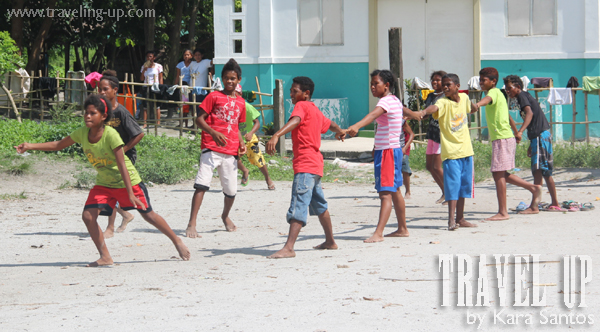
SISINGLE. This is a singing variation of “talanan dutung”. It starts with a line of  children holding hands, with the lead child holding fast to a wooden wall, gate, tree trunk, or nay wooden object. With held hands swaying, they sing—“Sisingle, sisingle, dakal lang anak single, salibatu, salibatu, buntuk ng Kapitan Besyu. Boom-boom! Mamakbung!”. The last kid on the line now marches under the arm of the lead child touching wooden wall; this causes the arms of the first child to be crossed. The march continues, until all the children in the line have their arms crossed, and only then is the singing finished. At the last note of the song, the players break the line and scamper to look for a wooden object to touch. A player who fails to do so becomes the next “taya”, who calls for the next change of position.

SUNGKA. Sungká is ancient strategy board game that has versions all over the world—from Africa, North America to Asia—where it is known by names like mancala, chongka, congkak, bao, and oware. The board is played on a sungkahan, a carved length of wood with seven pits and two larger pits at both ends designated as “bale” (house). The game involves distributing the shells or pebbles around the pits, by dropping them  into the holes one by one, including putting one in his “bale”.  The objective is to empty all seven pits on one side and the player with the most number of shells in his “bale” wins. Old sungkahans, often carved with designs, are seen more in antique shops than in homes today.

SYATUNG. The tools of the syatung are two bamboo sticks, one at least a foot long, and the other, shorter by a third. The players take turn at hitting the shorter stick with the long stick, placed in a crevice on the ground. This causes it to somersault, which then is hit again in mid-air by the long stick. The object of the game is to land the shorter stick at a farther distance, which is measured by the same stick. The losing player has to run this distance while shouting “syatuuuuuuuung”, until he reaches the game’s starting point—the crevice on the ground. Variations of the name: syatu, shoktung.

TAMBUBUNG. Known as “patintero” in the Tagalog  region, it is the most widely played native game in the country. A playing field is drawn on the ground—3 sections, divided by a line in the middle. There are 5 players in each of the 2 competing teams. The object of tambubung is to get past the lines, which are guarded by players of the opposite team; one guard can traverse the middle line. Team loses when all its player gets tagged by a guard, and are eliminated.  The team then exchange places. “Tambobong” means a barn, or a granary. It is also the old name of Malabon.

TEKS. Teks are small playing cards with  illustrations of superheroes, comics, movie and TV series characters. These are used for trading, as well as for toss-up games, and were avidly collected in the 1960s-70s. Players bet on which side the teks card will come up, and the outcome is decided by flicking the teks in the air. Players often have favorite cards that they use for flipping;  all others are basically used as betting currency.

TILTIL-BAGUK.  This hand game with a fanciful name (“Dip in baguk” or salty shrimp relish)”is played by two children. One player holds his palm up in front of his opponent, and the other player “dips” his pointing finger in the middle of the open palm. The player then chants “tiltil…..baguk!”, after which he closes his palm in an attempt to entrap the opponent’s finger.

TOMPYANG. Children form a circle, put their hands on top of each other, count “metung, adua, atlu”, raise them up in the air, and bring them down again, some palms up and others palm down, eliminating whichever is the majority, until one hand is left. The object of this process is to choose either the “mano”(leader)or the “taya” (“it”, the dunce or pursuer) of the succeeding game.

TUKUPAN-SILIMAN. Kapampangan version of “Blindman’s bluff”. Tukupan-siliman means " to darken by covering eyes with cupped hands"The player designated as “taya” ( “it”) is blindfolded and tries to find his co-players gathered around him. The co-players move about, bluffing the blindfolded “taya” by calling out their locations and issuing misleading directions.


SOURCES:
Adapted from Dr. Lino L. Dizon’s article, ‘games Children Don’t Play Anymore”, Singsing Magazine, vol. 2, no. 1
Castro, Alex R., “Toy Stories”, Views from the Pampang, www.viewsfromthepampang.blogspot
PICTURE SOURCES:
Laban-babagwa: Fililipino Heritage, vol, VI. Felta Publishing.
Tukupan-Siliman: https://www.pinterest.com/pin/128211920616319627/
Bending, Salikutan, Sungka, Teks, Tompyang: Alex R. Castro photos

Tuesday, March 14, 2017

39. 12 ANCIENT KAPAMPANGAN RIDDLES

Kapampangans, like all Filipinos, love exchanging bugtung or riddles at social events, funeral wakes and weddings. A favorite past time during the war, playing ‘bugtungan’ was widely practiced in rural areas to while away time during long walks home. See if you can answer these ancient riddles that our folks enjoyed in the good old days.
******
1.
2.
3.
4.
5.
6.
7.
8.
9.
10.
11.
12.

ANSWERS:
1. Sulput or amorseco; 2. Sungka; 3, Piña (pineapple); 4. Campana (bell) 5. Mangga (mango); 6. Yamuc (mosquito); 7. Camiseta (shirt); 8. Pluma (fountain pen); 9. Balubad (cashew); 10. Buac (hair); 11. Sampagang saguin (banana blossoms); 12. Angca (jackfruit).

PHOTO SOURCES: online free clip art
SOURCES: 
Historical Data Papers of Candaba, Magalang, Mabalacat.
Icban-Castro, Rosalinda, Literature of the Pampangos, University of the East Press, Manila, Philippines,1981.