DON ANGEL
PANTALEON DE MIRANDA
(ca. 1765/ d. 21
Jun. 1835)
Place of Memorial: Sto. Rosario Church
Founder of Angeles. Together with wife, Doña Rosalía de
Jesús and some followers, the group headed north to clear a forested area there
for rice and sugar farming in 1796. The settled area became known as Culiat,
named after the vines that proliferated in the place. Culiat would become the
future city of Angeles, named after him and his patron, the Guardian Angel.

FELINO GIL
(b.1803/d.1884)
Place of
Interment: Pio Chapel, Porac, Pampanga
Spanish civic leader. For helping secure lands in Porac
for the friar missions, he was awarded tracts of land that he successfully
turned into sugar plantations. Recognized as one of the founders—along with Juan
P. Zita-- of the “Escuela de Artes y
Oficios de Bacolor”, which aimed to train artisans, on 14 Nov. 1861. Later
renamed to Bacolor Trade School in 1915, which offerd courses in Woodworking
Domestic Science, Ironworking and Building Construction.

(b. 30 Jul. 1887/
d. 3 Sep. 1940)
Place of
Interment: Cementerio del Norte (Manila
North Cemetery)
Son of Balbino Ventura and Juana Tizon of Bacolor.
Graduated with a law degree from Universty of Santo Tomas , and went to Spain
for advance studies in Jurisprudence. Appointed as acting governor of Pampanga
in 1916. Served as Chief of the Executive Bureau of the Department of Interior
and later as Secretary of the Interior in place of Atty. Felipe Agoncillo. The
former Pampanga School of Arts and Trades in Bacolor, Pampanga which he
supported as a philantrophist, was re-named as Don Honorio T. Ventura College
of Arts and Trades in his honor. One of his scholars was the future president,
Diosdado P. Macapagal.
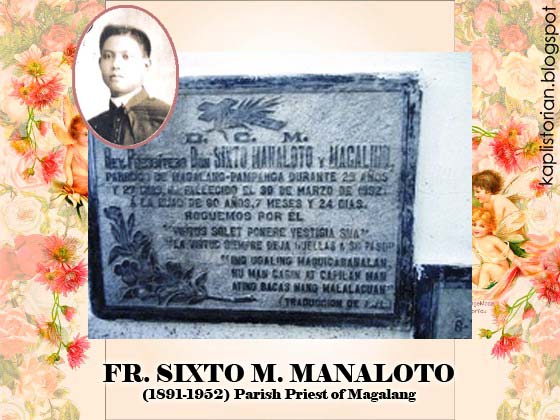
FR. SIXTO M.
MANALOTO
(b. 6 Jul. 1891/d.
30 Mar. 1952)
Place of
Interment: Magalang Memorial Park
Though Tarlac-born, Fr. Manaloto would make a lasting
impression on Magaleños, serving their parish for an unprecedented period of
nearly 30 years. On 8 December 1915, feast of the Immaculate Conception, Fr. Manaloto,
a product of San Carlos Seminary, was ordained into priesthood by Archbishop
Harty in 1915. Assigned in Magalng in 1923, he is known for his major
restoration works of San Bartolome Church., for opening a parochial school in
the town and for sending poor, but deserving students to Manila, many of whom
eventually returned as professionals and became leaders of the community.

JOSE CORAZON DE
JESUS
(b. 22 Nov. 1896/
26 May 1932)
Place of
Interment: Cementerio del Norte (Manila North Cemetery)
Son of Vicente de Jesús
of Sta. Maria, Bulacan and Susana Pangilinan of Pampanga. As Huseng
Batute, he wrote nationalistic articles for Ang Democracia, Liwayway, Taliba,
under the pseudonym Huseng Batute. He supported Philippine independence and
wrote critical articles about Philippine society under the Americans. Known as
the King of Balagtasan, for his mastery of Tagalog poetry.Wrote the lyrics of the popular Filipino song “Bayan Ko”,which
has become an alternative anthem.

KUDIARO LAXAMANA
(b.1906/d.1970)
Place of Interment: Clark Cemetery, Angeles City, Pampanga
Born in the Mt. Pinatubo area. Aeta World War II Guerrilla Hero. Head of the 55-155th Squadron of the Northwest Pampanga Mountain District. Reputedly killed 50 Japanese soldiers, chopping off at least 17 enemy heads with his bolo. Given a post-humous recognition in Mabalacat in 1995 for his wartime bravery. Killed in 1970 for his advocacies. Given a 21-gun salute at his burial at the Clark Cemetery. A major road in Clark—Kudiaro Laxamana Ave.—is named after him.

RUFINO J. CARDINAL SANTOS
(26 Aug. 1908-d. 3 Sep. 1973)
Place of Interment: Manila Metropolitan Cathedral crypt
The 1st Filipino Prince of the Church. Born in Sto. Niño, Guagua to Gaudencio Santos and Rosalia Jiao. Accepted as seminarian at San Carlos Seminary in 1921. At 19, became a scholar of the Pontifical Gregorian University in Rome in 1927. Ordained on 25 Oct. 1931 in Rome. Assigned to Imus, Cavite and Marilao, Bulacan as assistant priest; then to Manila. After his war imprisonment, was named by Arch. Michael O’Doherty as Vicar General of Manila, then elected as the Titular Bishop of Barca and Auxiliary Bishop to the archbishop. Succeeded Arch. Gabriel M. Reyes as the new archbishop of Manila in 1953, following his appointment by Pope Pius XII. Elevated to the rank of the cardinal at the Basilica of St. Peter in Rome at 9:30 a.m. on 31 Mar. 1960.

CLEOFE J. BALINGIT
(b. 9 Apr. 1910/ d. 5 Jun. 1981)
Place of Interment: Apalit Municipal Cemetery
Daughter of Macabebe Scout Felix Balingit and Juliana Jaime of Macabebe. Chosen to represent Pampanga in the search for the 1936 Queen of the Manila Carnival, touted as “the biggest annual event of the Orient”. Her candidacy was supported by the newspaper “Ing Catimauan”. Placed 4th after the winner, Mercedes Montilla, of Negros Occidental, crowned Miss Mindanao 1936. Married to Dr. Mariano Bayani of Apalit. Spent the rest of her life involved in socio-civic causes, especially the Pampanga Chapter of the Girl Scouts and the local Red Cross.

DIOSDADO P. MACAPAGAL
(b. 28 Sep. 1910/ d. 21 Apr. 1997)
Place of Interment: Libingan ng mga Bayani
Born in Lubao to Urbano and Romana Pangan. “The poor boy from Lubao” became the 9th President of the Philippines, serving from 1961 to 1965, and the sixth Vice-President, serving from 1957 to 1961. Was a member of the House of Representatives, and headed the Constitutional Convention of 1970. Father of Gloria Macapagal Arroyo, the 14th President of the Philippines from 2001 to 2010. Succeeded by Ferdinand Marcos.

THE AQUINOS OF
TARLAC
Place of
Interment: Manila Memorial Park, Parañaque, Manila
Corazon Cojuangco
Aquino ((b. 25 Jan. 1933/d. 1 Aug. 2009)
The first woman president and the 11th chief
executive of the Philippines. The most
prominent figure of the 1986 People Power Revolution that ended the 21 years of
dictatorial rule by Pres. Marcos. People rallied around her after her husband’s
assassination and swept the plain housewife to power. Hailed as the “Mother of
Asian Democracy”.
Benigno Aquino Jr.
(b. 27 Nov. 1932 /d. 21 Aug.1983)
A leading oppositionist of the Pres. Ferdinand Marcos and
his dictatorial regime. Arrested and jailed for 7 years during the Martial Law
of 1972.Founder of the lakas ng Bayan (Laban) party. Allowed to travel by
Marcos in 1980 for medical reasons, byt was assassinated upon his return to
Manila in 1983. His death was the catalyst for te People Power Revolution that
ended the arcos regime and started his wife Corazon’s ascent to power.

FERNANDO POE JR
(b. 20 Aug.
1939/d. 14 Dec. 2004)
Place of
Interment: Cementerio del Norte (Manila North Cemetery)
Actor, director, film producer and presidential of the
Philippines. Considered King of Philippine Movies. Began showbiz career in the
1953 with the movie “Anak ni Palaris”. Has over 200 films to his credit. Most
portrayals show him as a champion of the poor. 5-time winner of FAMAS Award.
Married to showbiz royalty, Susan Roces; daughter Grace Poe is a senator. Ran
for the 2004 presidential race, but lost by the slimmest of margin against
Gloria Macapagal-Arroyo.

ALEXIS TIOSECO
(b. 11 Feb.
1981/d. 1 Sep. 2009)
Place of Interment: Family mausoleum, Angeles City Cemetery
The young film critic is the great-grandchild of Leonardo
Lilles, a successful agricultural engineer, businessman and town leader of
Macabebe. Noted film critic and film
professor at the University of Asia and the Pacific. Known advocate of
Southeast Asian cinema. Named in 2005 as
“one of the most important young people in the Philippines today”, by
Philippine Star, for championing Philippine cinema. On 1 Sep. 2009, Tioseco and
Slovenian girlfriend Nika Bohinc, were murdered in their Quezon City apartment
by 3 burglars. Their househelp was convicted in May 2018 for her participation
in the crime,
BONUS!


COLIN P. KELLY JR.
(b. 11 July
1915/10 Dec. 1941)
Place of Memorial:
Madison, Florida
B-17 pilot Capt. Colin Purdie Kelly Jr. died in action
against the Japanese forces in 1941. Kelly’s damaged plane, while returning
from a bombing run, blew up near Clark Field after being engaged by enemy
forces. Declared as America’s first hero of WWII by US President Franklin D. Roosevelt. The Kelly Theater of Clark as named after
him. There is a memorial statue of the
fallen captain in front of the theater ruins inaugurated on 10 Dec. 2007—the
66th year of his passing.

CONRADO Y, GUINTO, KING
OF POETS
(b. 21 Jan.
1946/d. 5 May 2015)
Place of
Interment: Porac, Pampanga
Conrado Guinto is the fictional character in the
award-winning advocacy film,”ARI: My Life with a King”, produced by Holy Angel
University. The aging Kapampangan poet royalty befriends a Pampanga-born high
school lad, JP, who can’t speak the language. Their contentious relationship
ends with the death of Conrado, but only after passing the poet’s torch, and
the laurel crown to the young boy. Portrayed by real-life poeta laureado, Francisco "Frank" Guinto, who won Best Actor honors in
the Metro-Manila Film Festival 2016, New Wave edition. The FAMAS-award winning
sory was penned by Robby Tantingco and directed by Carlo Catu.
SOURCES:
HONORIO VENTURA: https://www.flickr.com/photos/govph/
(tomb)
FELINO GIL: Jerry Punzalan Sagmit (tomb); Luther Parker
Collection (photo)
SIXTO MANALOTO,:Old Cemetery: https://magalang-heritage.weebly.com/old-cemetery.html
SIXTO MANALOTO,:Old Cemetery: https://magalang-heritage.weebly.com/old-cemetery.html
JOSE CORAZON DE JESUS: http://malacanang.gov.ph/undas-2012-a-cemeteries-tour/(tomb);
flickr.com, posted by NCCA Official (photo)
CLEOFE BALINGIT: Alex R. Castro Collection
COLIN KELLY: www.findagrave.com
(tomb); https://fcit.usf.edu/wwii/overseas.php.(photo)
CARDINAL SANTOS: findagrave.com (tomb); Alex R. Castro
(photo)
KUDIARO LAXAMANA: www.finadagrave.com
(tomb);
www.art.com (photo)
DISODADO MACAPAGAL: Twitter photo, by Maria Cepeda
(tomb); wikipedia.com (photo)
CORY AQUINO, NINOY AQUINO: wikimedia commons
FERNANDO POE JR: Wikimedia commons (grave); Alex R.
Castro (photo)
ALEXIS TIOSECO: Robby Tantingco (tomb), Association for
Southeast Asian Cinemas Conference - WordPress.com (photo)