Showing posts with label Kapampangan children. Show all posts

Thursday, July 6, 2017

53. 20 FOLK GAMES THAT KAPAMPANGAN KIDS DON’T PLAY ANYMORE

Before the age of computer technology that brought us Tetris, Counterstrike, Super Mario, Dota, Angry Birds and Final Fantasy, it took very little for children to have great fun during their leisure hours. There were a lot of folk games to choose from, that did not require batteries, and complex gadgetry —sometimes it would just take a hole on the ground, two bamboo sticks, or even stones and shells to amuse one’s self. In the 1950s, Kapampangan writer E. Aguilar Cruz noted, “In my time, we children were still familiar with the rhymes learned from our elders and used them at play. But already, I must admit, the old games were being played less and less. Tubigan and sala-salaginto seemed too rustic for young moderns  even for their names alone.” Here’s a look-back at some of the old time games Kapampangan kids in the neighborhood played.
**********

BENDING. Children carry a slipper in all sorts of manner—balanced on top of the head, or on an outstretched arm, tucked under a bent arm or leg—across a distance without falling it to the ground.

BUKINGKINGAN. The local name of “pitik-bulag”. Player A covers his eyes with one hand.  Player B, his opponent, flicks the covering hand of Player A, while he holds up his other hand with a number of fingers. Player A releases his hand cover and quickly holds the other hand up. The number of fingers  he holds up must match that of Player B.

GILING-GILING ISTATWA. Participants intone “Giling-giling istatwa…Ing galo ya ing taya” (Go round and round the statue. He who moves is “it”!). After which, everybody stand immobile; the first to move becomes the “taya”.

HOLEN. Games involving marbles include rolling them in sequence into holes dug on the ground; or putting a number of marbles inside a drawn circle—the objective of which is to dislodge the opponent’s marble from the circle, by hitting it with another marble at an angle (“boljak”)--, which oftentimes cause pockmarks on the marble.

JAKENPOY. The hand game of “rock-paper-scissors” is played between two people using hand shapes to symbolize  a  "rock" (closed fist), "paper" ( flat hand), and "scissors" (fingers in V-shape). In this best-of-3 duel, rock beats scissors, paper beats rock, and scissors beat paper.  Our version is derived from the Japanese “Janken Pon” game, which means “starting with a stone”, which basically has the same mechanics. It is often called today in Pilipino, as “Bato-Bato-Pick”.

LABAN BABAGWA. Also known as “saputan babagwa”, this is a spider game fight conducted on a “tingting” stick. Positioned on the opposite sides of the stick, the spiders approach each other and attempt to enwrap each other with their web. Game ends when one spider gets fully enveloped with the web (“saput”). Spiders are often kept in empty posporo boxes, fed with chili pepper (“lara”) leaves to make them aggressive.

LABULAN GOMA. The simples game involving rubber bands is “labulan goma”. Two rubber bands are placed some distance apart on a table. Players alternately blow their rubber bands to get them closer to each other. A player wins when he blows his rubber band on top of his opponent’s “goma”, which he then collects. Other rubber band games: Sungkitan goma—rubber bands are buried in a sand mound. Players alternately fish for rubber bands by sticking a “tingting” into the sand; Tirisan-goma—a knotted rubber band is laid on the floor and players alternately step or crush the rubber band to get it unknotted.

LUKSUNG BABI. Literally means “jumping over a pig”, or piggyback jumping. Participants try to jump over the bent back of a player (the back of the “pig”) . If everyone succeeds, the “pig” increases the height of his back, by raising himself up. The jumper who fails to clear he distance becomes the next “pig’s back”. Tagalogs call their version “luksong baka”.

MARO. This is the Kapampangan name of the game popularly called “agawan base” (stealing bases) by Tagalogs. Two groups  try to protect their bases, and each base has an assigned guard. Members try to penetrate each other’s  base so it can be stolen by tagging it, but when the members themselves are “tagged” by their opponents, they become prisoners, who are lined up front as bait. A prisoner can only be “saved” and released  by a fellow group member by tagging him, allowing him to return to his base.

PIKU. The local “hopscotch”. A playing court is first drawn on the ground, consisting of squares and a home base—a pit stop where one can rest both feet. The game involves transporting a “batu” gamepiece--which may be a flat stone or pebble , a pottery shard—from one square to another, until the course is finished. This must be done by hopping, skipping or tripping the “batu”, forcing it to move to the next square without touching the drawn lines. Variations: pikung baru, sampaga, bale.

SALIKUTAN. Hide and seek game. Players conceal themselves in the neighborhood, to be found by one or more seekers. Th player designated as :it” or “taya” closes his eyes, and tart counting up to 10, while players hide. He then begins to look for the hidden players, shouting “Pung!” as he finds them. The game can end in many ways, but the most common is when the “taya” locates all players. The first to be found becomes the next “taya”.  Another salikutan variation has the seeker guarding his "home base"; the hiders can come out of hiding to race to home base; once they touch it, they are considered "saved”.

SINTAK. Sintak means “to throw with some force”. It is also the name of an old game played by Kapampangan girls as early as the eighteenth century. It is similar to jackstones—minus the bouncing rubber ball. The game of skill is played with five stones, in which one stone is propelled upwards, and while still in mid-air, another stone is picked up and the falling stone is caught at the same time. A variation is the Tagalog ‘siklot’, where the back of the palm is used to catch the stones.

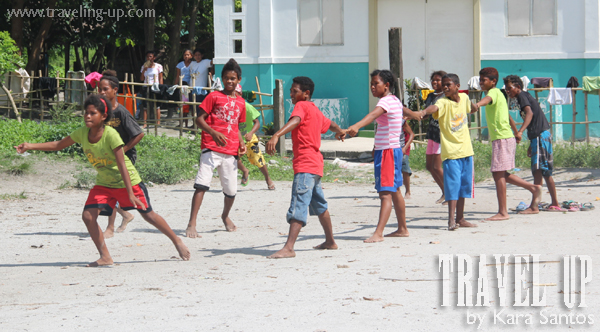
SISINGLE. This is a singing variation of “talanan dutung”. It starts with a line of  children holding hands, with the lead child holding fast to a wooden wall, gate, tree trunk, or nay wooden object. With held hands swaying, they sing—“Sisingle, sisingle, dakal lang anak single, salibatu, salibatu, buntuk ng Kapitan Besyu. Boom-boom! Mamakbung!”. The last kid on the line now marches under the arm of the lead child touching wooden wall; this causes the arms of the first child to be crossed. The march continues, until all the children in the line have their arms crossed, and only then is the singing finished. At the last note of the song, the players break the line and scamper to look for a wooden object to touch. A player who fails to do so becomes the next “taya”, who calls for the next change of position.

SUNGKA. Sungká is ancient strategy board game that has versions all over the world—from Africa, North America to Asia—where it is known by names like mancala, chongka, congkak, bao, and oware. The board is played on a sungkahan, a carved length of wood with seven pits and two larger pits at both ends designated as “bale” (house). The game involves distributing the shells or pebbles around the pits, by dropping them  into the holes one by one, including putting one in his “bale”.  The objective is to empty all seven pits on one side and the player with the most number of shells in his “bale” wins. Old sungkahans, often carved with designs, are seen more in antique shops than in homes today.

SYATUNG. The tools of the syatung are two bamboo sticks, one at least a foot long, and the other, shorter by a third. The players take turn at hitting the shorter stick with the long stick, placed in a crevice on the ground. This causes it to somersault, which then is hit again in mid-air by the long stick. The object of the game is to land the shorter stick at a farther distance, which is measured by the same stick. The losing player has to run this distance while shouting “syatuuuuuuuung”, until he reaches the game’s starting point—the crevice on the ground. Variations of the name: syatu, shoktung.

TAMBUBUNG. Known as “patintero” in the Tagalog  region, it is the most widely played native game in the country. A playing field is drawn on the ground—3 sections, divided by a line in the middle. There are 5 players in each of the 2 competing teams. The object of tambubung is to get past the lines, which are guarded by players of the opposite team; one guard can traverse the middle line. Team loses when all its player gets tagged by a guard, and are eliminated.  The team then exchange places. “Tambobong” means a barn, or a granary. It is also the old name of Malabon.

TEKS. Teks are small playing cards with  illustrations of superheroes, comics, movie and TV series characters. These are used for trading, as well as for toss-up games, and were avidly collected in the 1960s-70s. Players bet on which side the teks card will come up, and the outcome is decided by flicking the teks in the air. Players often have favorite cards that they use for flipping;  all others are basically used as betting currency.

TILTIL-BAGUK.  This hand game with a fanciful name (“Dip in baguk” or salty shrimp relish)”is played by two children. One player holds his palm up in front of his opponent, and the other player “dips” his pointing finger in the middle of the open palm. The player then chants “tiltil…..baguk!”, after which he closes his palm in an attempt to entrap the opponent’s finger.

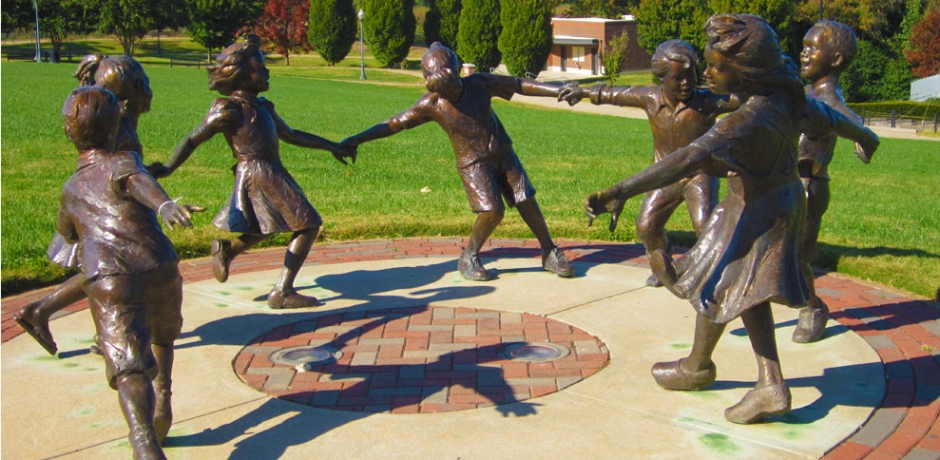
TOMPYANG. Children form a circle, put their hands on top of each other, count “metung, adua, atlu”, raise them up in the air, and bring them down again, some palms up and others palm down, eliminating whichever is the majority, until one hand is left. The object of this process is to choose either the “mano”(leader)or the “taya” (“it”, the dunce or pursuer) of the succeeding game.

TUKUPAN-SILIMAN. Kapampangan version of “Blindman’s bluff”. Tukupan-siliman means " to darken by covering eyes with cupped hands"The player designated as “taya” ( “it”) is blindfolded and tries to find his co-players gathered around him. The co-players move about, bluffing the blindfolded “taya” by calling out their locations and issuing misleading directions.


SOURCES:
Adapted from Dr. Lino L. Dizon’s article, ‘games Children Don’t Play Anymore”, Singsing Magazine, vol. 2, no. 1
Castro, Alex R., “Toy Stories”, Views from the Pampang, www.viewsfromthepampang.blogspot
PICTURE SOURCES:
Laban-babagwa: Fililipino Heritage, vol, VI. Felta Publishing.
Tukupan-Siliman: https://www.pinterest.com/pin/128211920616319627/
Bending, Salikutan, Sungka, Teks, Tompyang: Alex R. Castro photos

Tuesday, March 14, 2017

39. 12 ANCIENT KAPAMPANGAN RIDDLES

Kapampangans, like all Filipinos, love exchanging bugtung or riddles at social events, funeral wakes and weddings. A favorite past time during the war, playing ‘bugtungan’ was widely practiced in rural areas to while away time during long walks home. See if you can answer these ancient riddles that our folks enjoyed in the good old days.
******
1.
2.
3.
4.
5.
6.
7.
8.
9.
10.
11.
12.

ANSWERS:
1. Sulput or amorseco; 2. Sungka; 3, Piña (pineapple); 4. Campana (bell) 5. Mangga (mango); 6. Yamuc (mosquito); 7. Camiseta (shirt); 8. Pluma (fountain pen); 9. Balubad (cashew); 10. Buac (hair); 11. Sampagang saguin (banana blossoms); 12. Angca (jackfruit).

PHOTO SOURCES: online free clip art
SOURCES: 
Historical Data Papers of Candaba, Magalang, Mabalacat.
Icban-Castro, Rosalinda, Literature of the Pampangos, University of the East Press, Manila, Philippines,1981.

Saturday, March 4, 2017

38. 10 KAPAMPANGAN WUNDERKIDS

Once in a great while, gifted kids are born to astound the world with barrier-breaking feats and achievements. Mozart was a composer at age 5, Shakuntala Devi was an Indian mental calculator prodigy and 11 year old Mikaela Fudolig entered the University of the Philippines, and graduated in Physics, summa cum laude in 2007. Pampanga, too,  has its own share of amazing wonder kids who made news for their talents, genius and good looks.

MARTIN SANCHO was a frail 10 year-old boy, who, in 1587, was sent all the way to Spain to have an audience with Philip II, then the world’s most powerful monarch. He had earlier created a sensation among Spaniards in Manila for his fluency in Spanish and knowledge in Catholic education.  It was the intent of Spanish officials to present him to the royal court as proof that the new colony—which the king wanted to quit-- were worth keeping and that the natives could be educated like Europeans. Martin Sancho did not disappoint. He, not only conversed with the King in Spanish, but breathlessly recited prayers, articles of faith, and  the entire Catholic catechism in Latin! His performance was met with thundering applause. After his successful  appearance, the boy stayed on in Spain as a ward of his companion priest, Fr. Alonso Sanchez. When he reached  17, he was taken to Rome to join the Jesuit novitiate. He went back to Spain, lived in Toledo, and finished college in Murcia. In 1601, Sancho, his body racked with tuberculosis, finally returned to the Philippines to reunite with his Kapampangan parents whom he had left when he was only 10. Martin Sancho tragically died one month later at age 25.

Nestlé dairy products were known to Filipinos as early as 1895, imported by Sprungli and Co. Milkmaid Sweetened Condensed Milk was an early brand from the company that was heavily promoted.  In 1929.  Milkmaid conducted its search for the country’s most “Beautiful Babies”. Readers were encouraged to send pictures of cute babies and the chosen few appeared on the pages of The Philippine Free Press, the leading newspaper of the day. One winner was a bouncing Kapampangan baby boy, CARLOS SALVADOR GOMEZ JR, of Mabalacat, Pampanga. Born on 7 February 1929, Baby “Bolet” is the firstborn of Carlos Ramiro Gomez Sr. and Ma. Paz Dionisia Dizon. The senior Carlos was descended from the Spanish Masnous of Valladolilid. In his adult years, Bolet  married Zenaida Novak Feliciano of Magalang on 14 March 1950, with whom he had 10 children. He died of brain aneurysm at age 68 on 31 October 1997.

By the 1950s, Sampaguita Pictures was already an established Philippine movie company—producing blockbuster films like Paru-Parong Bukid, Takipsilim, Apoy sa Langit , Anghel ng Pagibig, and many more. Its contract stars included Rogelio de la Rosa, Carmen Rosales, Pancho Magalona and Tita Duran. But in 1951, a disastrous fire razed the studios to the ground, leaving the founders—the Vera-Perezes—on the brink of bankruptcy. Enter TESSIE AGANA (b. 16 May 1942), daughter of actress Linda Estrella and Adriano Agana of Tarlac—and recently cast in the tearjerker budget film, “Roberta”, written by Mars Ravelo. During the shooting, Tessie was bribed with Max’s Fried Chicken to put her in an acting mood. It worked; she memorized all her lines, cried at the drop of a hat, and stole every scene she was in. When “Roberta” was shown at the Life Theater, it became a monster hit—and the one week run was overextended, until it broke all existing box-office records. Her convincing performance as a poor, pitiful child endeared her to an audience who took her into their hearts, and catapulted her to instant stardom—the first child superstar of Philippine movies. Sampaguita Pictures managed to get back on its feet and would eventually come out even bigger and better than it was before. In gratitude for helping save the studio, Tessie was cast in picture after picture, and was hailed as the Philippines’ Shirley Temple. After her stint with showbiz, Tessie Agana married Dr. Rodolfo L. Jao in the U.S. in 1962, and would raise a big family of 9 children. She is settled currently in Valparaiso, Indiana.

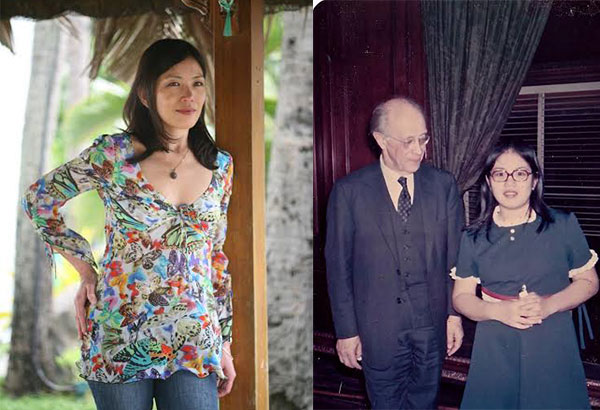
CECILE LICAD (b. 11 May 1961), daughter of Rosario Buencamino and Dr Jesus Vitug Licad from Lubao, began her piano studies at age 3. At 7, she made her debut as soloist with the Philharmonic Orchestra of the Philippines. At  11 years old, the prodigy won the Manila Young Artists’ competition with her incredible rendering of Chopin’s F Minor concerto, a piece that one judge assumed was not for her age. At 12, she was accepted at the Curtis Institute of Music under the mentorship of Rudolf Serkin, Seymour Lipkin and Mieczyslaw Horszowski. At 19, she won the prestigious Leventritt Gold Medal, one of the youngest winners ever and attained international acclaim.  Signed up by CBS records, her Rachmaninov Piano Concerto No. 2 and the Saint-Saëns’ Piano Concerto No. 2 made it to the Billboard classical charts. Licad, a favorite of First Lady Imelda Marcos, has played with the world’s most notable orchestras like the New York Philharmonic, Boston Symphony, London Philharmonic and Tokyo’s NHK Symphony,  among others. She has also appeared in top music festivals such as Tanglewood, Santa Fe and Marlboro Music Festival. In March 2007, she performed with her then 19-year-old son Ottavio L. Meneses, also a pianist, at the Cultural Center of the Philippines. Licad, called “a pianist’s pianist” by The New Yorker, held her historic homecoming Pampanga recital at Holy Angel University in March 1912.

The Filipina musical theater star who took West End and Broadway by storm was born as Maria Lea Carmen Salonga (born 22 February 1971) to Ligaya Imutan and Feliciano Salonga, a Kapampangan naval admiral. LEA SALONGA spent the first six years of her life in Angeles City where she attended the local O.B.Montessori school.  At age 7, she made her theatre debut in the musical, King and I. She also starred in Annie, Paper Moon, The Fantasticks, The Sound of Music, among others. At 10, she recorded  “Small Voice” which turned her into a certified child star. She had her own TV show ”Love, Lea”, earned a FAMAS nomination, and made popular movies in the 1980s. But it was her casting as Kim after a worldwide search  for “Miss Saigon” that made her  an international star in 1989. The Cameron Macintosh-produced musical gave her a coveted Laurence Olivier Award. She reprised that role for Broadway, and won a Tony, Drama Desk, Outer Critics Circle and Theatre World Awards. In 1992 Lea lent her voice to the Oscar-winning song from the Disney film, Aladdin—“A Whole New World”. She was in the “Les Miserables” anniversary concerts (1993,1996), headlined ”Flower Drum Song” (2002), starred in “Cinderella” and returned to Broadway with “Allegiance”. In her 37-year career, Lea has performed for six Philippine presidents , three American Presidents, for Diana, Princess of Wales and Her Majesty Queen Elizabeth II.

KIMBERLY JANE CUNANAN (b.1991) made waves at the Batang Pinoy Games held in Bacolod City in December 2001 when she won in the Under 10 Age Group category.  The young princess of the gameboard, daughter of Herome Cunanan of Apalit and Annabel de Guzman of Dau, proved that her victory was no fluke as she collected 4 more national titles. Cunanan would have played in international chess championships in Kuala Lumpur and Spain had it not been for lack of funds. In 2004, she was named as a member of the Philippine Team to the World Youth Chess Championship in Crete, Greece (bannered by then 11-year old Wesley So), but could not compete due to financial constraints. In 2006, she was named as Most Outstanding Kapampangan Awardee in the field of Sports. In June 2007, Cunanan, then 15, clinched the gold medal in the Under-16 division at the Eight Asean Age Group Chess Championships in Thailand  and led two other Filipinos to the team bronze.

At the 2003 Most Outstanding Kapampangan Awards, ANGELI MARK DAVID BARRO  (b. 1 October 1992) became the youngest winner to be recognized for his achievement in sports—earning the coveted recognition at age 11 years, 2 months. Born in Lakandula, Dau to parents Angelito Barro and Leni David, this taekwondo champion blackbelter is the recipient of over 21 awards and citations in sports. He has also won Gold, Silver and Bronze medals at various editions of Batang Pinoy, a national age-group sportsfest. As the youngest among 50 delegations to the 12th U.S. Open Taekwondo Championship in Las Vegas, Nevada, Barro came away with a Bronze Medal. In his older years, he was named as one of the Ten Outstanding Youths of Angeles City for 2010. Barro graduated in 2013 from the Angeles University Foundation College of Criminal Justice Education , and was named Most Outstanding Senior of the Year Award and Student of the Year .

ANNIKA CHANEL PINEDA-CAYABYAB (b. 2001) comes from a family of sports enthusiasts: her mother, Mylin Pineda is an avid golfer, while her father, Archen Cayabayab was a former basketball player from National University and the Philippine Basketball League (PBL).  Coached by Jack Nicklaus-trained Norman Sto. Domingo, Annyka began her career at the Mimosa golf course in Clark and started competing age 7, and bagged her first title a year later.  She has not stopped there since and continued collecting titles—from the Future Champions of Golf International junior championships in San Diego, California to the Veritas World Junior international golf tournament, a crown which she has won thrice beginning in 2012. In 2014, the young OB Montessori grade schooler was recognized with a Most Outstanding Kapampangan Awards in the field of sports. Her grandmother, Lilia Pineda, is the incumbent governor of Pampanga and hails from Lubao.

The showbiz career of ETHAN DIZON (b. 2002, West Hills, California) began very early at age 2, when he bagged his first commercial roles for the national ads of Target, the American Egg Board, Taco Bell, and Mercedes Benz. His father , actor Eric Dizon is the son of Chris Dizon who is from Mabalacat, Pampanga.  Ethan’s mother, Corinne Chooey is of Chinese ancestry, a relative of Hong Kong actress Kwun Ling Chow. Ethan made his acting debut in the CBS hit series, “How I Met Your Mother” and had guest roles in  “Grey's Anatomy”, and “'Til Death”. He can be seen most recently on Awkward and Sullivan & Son. His film credits include: “Get A Job”, “Bad Words” ( with Jason Bateman), and the “The Inevitable Defeat of Mister and Pete”, where he is best-known for playing Pete.  In 2017, he will be seen in “Spiderman: Homecoming”. Ethan is a member of Screen Actors Guild since 2006.  A gifted artist, he was nominated for Best Actor at the NBCU Short Film Festival 2014 in "Paulie", where he played the title role.

“Little Miss Philippines” is a special segment conducted by “Eat Bulaga” , the longest-running noontime show on Channel 7. It is a nationwide pageant search for little girls and is credited with launching the careers of former winners and candidates as Aiza Seguerra (1987), Gladys Reyes, Donna Cruz, Dessa, Lady Lee, Jessa Zaragoza, Pauleen Luna (1995) and Julie Anne San Jose. In 2012, 6 year old RYZZA MAE DIZON (b. 12 June 2005) of Brgy. Pampang, Angeles entered the contest. She was short, chubby, dark and toothless---but she was bubbling with charm and precocity. Even so, the audition jury  ought to eliminate her—but show hosts Ruby Rodriguez recognized her specialness and pleaded that they give her a chance. The smart dark-horse not only advanced to the finals but  won the coveted 2012 Little Miss Philippines crown, over finalists Maria Francesca Rojas, Jenna Marie Niedens , Jhie Ann Marie Crisostomo and Precious Angel Aceah Delda. Ryzza also was awarded Miss Talent and “Cutest Little Miss” for getting the most “likes” on Facebook. She went on to become a co-host of Eat Bulaga , starred in a talk show (The Ryzza Mae Show), had her own teleserye, and appeared in blockbuster movies like My Little Bossing and  Si Agimat, si Enteng Kabisote at si Ako.


 PHOTO SOURCES
CECILE LICAD:
 ETHAN DIZON:
 ANGELI MARK BARRO: Leni Barro FB page
ANNIKA PINEDA CAYABYAB
 RYZZA MAE DIZON
 LEA SALONGA
ALL OTHERS: Alex R. Castro Collection