There’s no Christmas like a Pampanga Christmas! It’s the the time of the year when Kapampangans put on their best shows—through their unique religious festivals, quaint customs, unusual traditions—some vanishing, some flourishing—all sublime expressions of a people’s devotion to their faith, and for visitors--all sure to please and awe. Here are reasons why Christmas in Pampanga is unique.
1. THE SERENATA OF BETIS. On the eve of the barrio fiesta on December 30, three of the best brass bands in Pampanga, including Sasmuan’s Banda 31 and Betis’ own Banda 48, come together in front of the famous Betis Church and perform all the musical pieces they have in their respective repertoires to the delight of the crowd, often lasting until the wee hours. The objective is to outplay, outclass and outlast each other. The band that can play the most number of pieces without repeating is declared winner. Their repertoires consist of arias, fantasies, classical opera pieces from Verdi, Gounod, Rossini, Auber, and Bellini, local folk songs, Christmas songs, Broadway songs, and standards from John Sousa and US military bands, apparently brought here by the Thomasites. Other towns hold their own serenatas, including Angeles City during its
fiesta and Sta. Rita during Holy Week
('pasyon serenata'), but it is only in Betis that it is held during the holiday season, making Christmas in Pampanga truly unique.
2. THE KURALDAL OF SASMUAN. Kapampangans dance the kuraldal in Betis, in Apalit, in Macabebe, in Masantol, in Lubao and almost everywhere else, but the biggest, longest and most fervent kuraldal happens in this small fishing town, starting on the feast day of its patron saint, St. Lucy, on Dec. 13, and reaching its climax on Jan. 6 (traditional feast day of the Three Kings) and Jan. 10, when the Christmas season officially ends in Sasmuan.
"Kuraldal" is a generic term for devotional dances performed during feast days of saints but the mad dancing and gyrating done by devotees in Sasmuan would make Obando and Sinulog seem like innocent grade-school folk dances. Dancers shout
"Viva Apu Lucia! Puera sakit (Away with illness)!" Barren mothers are often said to conceive after dancing the kuraldal. Apparently the tradition dates back to pre-Hispanic times, probably around a prehistoric pagan god now lost and replaced by a Catholic saint, because Spanish chronicler Gaspar de Sa Agustin wrote that the image of St. Lucy had been venerated in Sasmuan “since long ago”--and he wrote that in 1698!
3. THE PASTORELA OF MABALACAT. During the nine-day simbang bengi, the parish choir of this town performs the
Kyrie, Gloria, Credo, Agnus Dei and other parts of the Mass like no other choir does—with operatic flourish and high drama complete with violins. The songs are collectively called
‘pastorela’ (from
Misa de Pastorela, Mass of the Shepherds) supposedly brought from Spain during colonial times but adopted by local musicians who made them more spectacular and melodramatic, I suspect to keep drowsy Mass-goers entertained. The Spanish friars collaborated with our ancestors to come up with all sorts of gimmicks to make church services worthy alternatives to their folk practices. Thus, they created
lubenas, sabat santacruzan, salubong, tanggal, kuraldal, libad, and of course,
pastorela. The Misa de Pastorela is still done in Spain, Portugal and Mexico, where it is sometimes called
Misa de los Pastores (Mass of the Shepherds) and Misa de Gallo (Rooster's Mass), but here in the Philippines, there's only one parish left where they still sing the
pastorela: the Our Lady of Grace Parish in Mabalacat City. Catch the
pastorela before they vanish!
4. MAJIGANGGAS OF STA. ANA. The more well-known Higante Festival in Angono has a counterpart in Sta. Ana town of Pampanga known as Majigangga. Giant human puppets representing dark, evil-looking people take to the streets and revel with the residents in the church patio, from Dec. 16 to Christmas Day, when they are supposedly banished by Christ’s birth. The unique tradition was derived from Mexico, which had a form of street pageant called
“mojigangga” , which, in turn was adapted from medieval Spain. Kapampangans however, used the puppets as symbols of evil, unlike in Mexico where they represented saints and royal figures. The tradition has been kept alive mostly by the family and friends of the late Jacinto Quiambao, as well as by the town's cultural advocates who see the majiganggas as a valuable tradition that expresses the townspeople's folk religiosity. The giants trail the lubenas (lantern procession) and perform in the church patio, drawing children and adults alike closer to the church where the
simbang bengi is held.
5. THE GIANT LANTERNS OF SAN FERNANDO. The term deserves to be in capital letters because these humongous wheels of rotating lights, like UFO mother ships descending from the night sky, are truly world-class. Their sheer size (average 20 feet) , design, and the precision with which the kaleidoscope of colors dances (lit by 5,000 bulbs)-- you'd think they were assembled by a well-financed army of engineers, electricians, artists, computer technicians and programmers, but in reality, the lanterns are only put together in a backyard in some barrio in San Fernando, by a ragtag team of local craftsmen and artisans, using hairpins, masking tape, and a spaghetti tangle of wires connected to tin drums mounted on a six-by-six truck. Someone rotates these drums with a wheel to the tune of Christmas carols. Every December, these Giant Lanterns turn San Fernando into a dazzling city of lights, as they vie for several titles at the Giant Lantern festival. The
“ligligan parul’ was said to have started in San Fernando in 1904 or 1908, following the transfer of the provincial capital from Bacolor to the town, and grew to spectacular proportions with the introduction of electricity in 1931.
6. MAYTINIS. Traditional 9-day processions in Pampanga are called
“lubenas” (corrupted from
“novena”) , held from Dec. 16 to Dec. 24. “
Lubenas” happens in Angeles, San Fernando, Mexico and Magalang, but the Christmas Eve event held in Mabalacat is most elaborate. Called “Maytinis”, (derived from “matins”, early evening prayers), it is marked with the spectacular procession of holy images—patrons of every barangay, accompanied by colorfully lit lanterns or
parul of the most amazing variety. Village choirs singing
“Dios te Salve” accompany the faithful as they wend their way through the main streets of the town and back to the courtyard of the church. Barangays try to outdo each other in decorating the
carrozas and in designing the electrified lanterns that are borne on bamboo poles. After the midnight mass, citations are given to the barangay with the most representation, best lantern, best choir, and most prayerful.
7. THE ANIMATED FISH LANTERNS OF ANGELES. Everyone is familiar with the star-shaped lantern that symbolized the bright star that guided the Magis and shepherds to the stable where Jesus was born. But there existed other lanterns shapes that were processioned in Angeles during Christmas time. Local historian Mariano Angeles recorded such event in 1830 when a procession featured “quaint, illuminated lanterns made of the same material (bamboo and paper), depicting aquatic animals, in skillful and artistic imitation of the real ones. The big paper fishes and lobsters, by means of ingenious contrivances, are made to move their dorsal andcaudal fins, their mouths, and their eyes”. The Fish, is of course, a symbol of Christ, and the lanternsserved as added attractions to the religious processions. Only a few barangays in Angeles still have the fish lantern in prusisyons, as the last maker of such lanterns, Eulogio Catahan (
Apung Eloy) have since passed away in late 2012.
8. THE HANDMADE CHRISTMAS TOYS OF GUAGUA. In old Guagua, children received Christmas toys not from fancy shops but handcrafted for the occasion by loving fathers, uncles and brothers. This folk art was still thriving in the early 1950s. A 1953 magazine account describes the toys thus:
“These are the animal pull toys that were fashioned from bamboo and wire. The skeleton frame was then covered with thin, white “papel de japon”. They were mounted on 4-wheeled wooden platforms, and were so constructed that at every turn of the wheels, parts of their bodies moved and simulated an action peculiar to the animal they represented”.
The animals chosen were often culled from the figures present at the birth of Jesus—lambs, cows, doves—as well as domesticated ones like dogs, cats, carabaos. Ingeniously made, the chickens flapped their wings, the cats played with their balls of thread, and dogs crouched and leaped as they were pulled on the town streets at night, lit with candles. The children with their glowing toys head for the church with their parents for the traditional mass. “It seemed”, waxed one Guagua resident recalling the scene,
“as if all mankind and all the creatures of the earth were going again to the manger to worship at the feet of the Prince of Peace”.
9. PANUNULUYAN. Biblical
dramatizations were often enacted to teach catechism and
caton during the
Spanish times. Thus, the
Panunuluyan, adapted from
“las posadas” of Mexico, a
novenario
performed on the 9 days before Christmas. It is known in the Tagalog region,
but Pampanga has its versions too. The
Panunuluyan dramatizes the search for lodging
of the Holy Couple, Jose and the very pregnant Maria. Originally, the images of
the two, atop decorated
carrozas, are processioned on Christmas eve and taken
from house to house, in re-enactment of that event in Bethlehem. Eventually, real people, instead of santos,
were cast to assume the roles of Jose and Maria, almost always respectable
citizens of the town. The cast expanded to include the 3 Magis, Melchor, Gaspar
and Baltazar and even a Narrator and a
Koro, a Chorus of singers who sang and
delivered verses for the Holy Couple. Only a few towns like Sta. Rita and
Arayat now stage this playlet every year, but sometimes done in the church grounds—no longer on the streets.

10. PAMANGAN PASKU!
From the 'duman' whose harvest in early November coincides with the countdown to Christmas, to the 'tsokolati king batirul' and the 'panara' which mass goers coming home from the 'simbang bengi' take for breakfast. It is during Christmas when the dining table is most heavily laden with a cornucopia of the best that the Kapampangan culinary tradition can offer--galantina, bringhe, asado, escabeche, estofado, afritada, mechado, menudo, azucena, pochero, relleno, morcon, lengua, etc.--and the delicacies that only Kapampangans can make—turrones, sans rival, pastillas de leche, tibuk tibuk, pepalto, yemas, sanikulas, empanada, ensaimada, bobotu, pulburun, leche flan, silvana, espasol, araru, putu seco, ale ubi, bibingkang nasi, calame ubi, calame biko, sampelut, inangit, galang galang, putu lazon, kutsinta, suman tili, suman bulagta, suman ebus, patupat, alualu (Kabigting style, Corazon style, Razon style, you name it), pionono, tocino del cielo, samani, bangka bangka, batya batya, bucarillo, putung babi, taisan, plantadilla, rosquetes, mayumung kamias, mayumung kamatis, brazo de la reina, etc.
There's even a street food called 'patcu' which is a corruption of 'pascu' and 'lagang pasku' which your mother cooks only this time of year when the Chinese ham is available.
BONUS:
AGUMAN SANDUK OF MINALIN
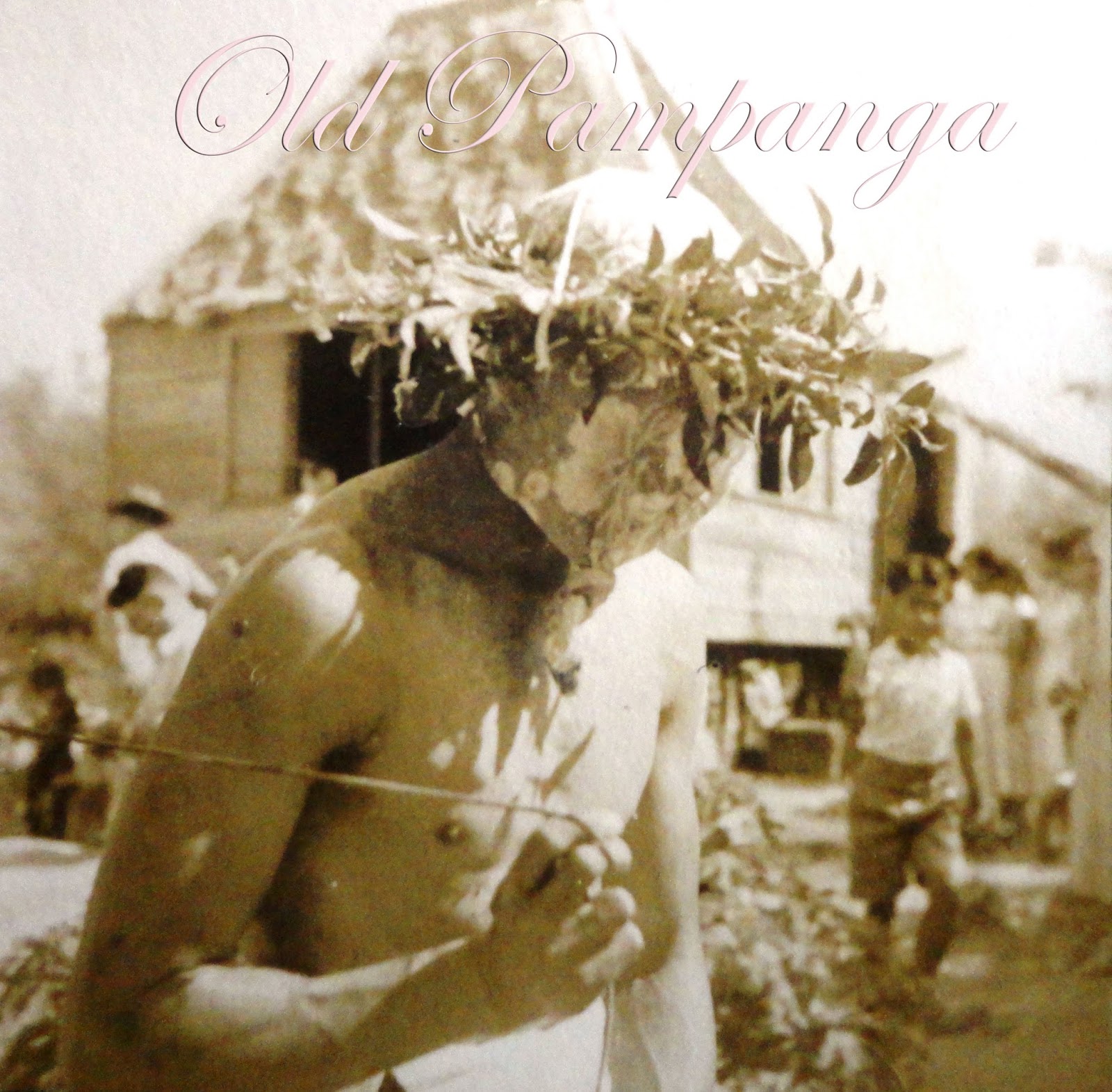
Technically, the Aguman Sanduk is not part of the Christmas festivities. But its celebration takes place within the holiday period-- on January 1 afternoon, while the country takes a rest after welcoming the New Year. Since its conception in 1934, the menfolk of Minalin have participated in the most flamboyantly freakish parade ever seen—the Aguman Sanduk (Fellowship of the Ladle) . On this day, they dab rouge and lipstick on their faces, put on their wives’ or sisters’ dresses and join others dressed similarly in a riotous street parade. The tradition started as a dare among men 80 years ago while on a drinking binge—to prove their machismo and as a liberation from repression. The only difference is that the particpants are all straight males and boys. The culmination of Pampanga’s zaniest festival is the selection and coronation of the ugliest cross-dresser, the Reyna ning Aguman Sanduk, where, she is given a ladle as a scepter.
SOURCES:
Adapted from“Why Christmas in Pampanga is Unique?” by Robby P. Tantingco, originally posted on his facebook page. 6 Dec. 2013.
With additional notes by Alex Castro
“Folk Festivals”, Singsing Magazine, Vol. 1, No. 4, p. 5
Singsing Magazine, “Pampanga’s Folk Arts” Vol. 5. Nol. 1. Center for Kapampangan Studies, Holy Angel University.
Henson, Mariano A., “A Brief History of the Town of Angeles”, ©1948, revised edition, 2003.
Photo Sources:
Serenata: Punto Central Luzon/ Kuraldal, Aguman Sanduk: Headline Gitnang Luzon/
Pastorela/Christmas Toys: Alex Castro/ Majinganggas, Pamangan Pasku: RPT /
Giant Lanterns: Ivan Henares/ Maytinis: Jude Belnas photo
Fish Lanterns: Singsing Magazine/ Panunuluyan: Sta. Rita de Cascia Parish FB page.