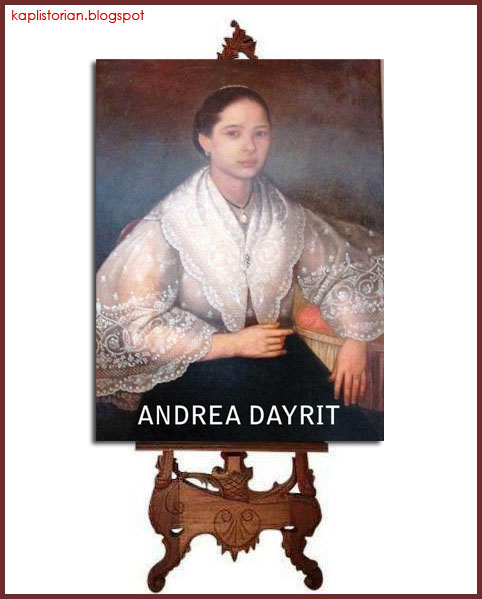
The Philippine art
scene is made livelier by the contributions of these gifted Kapampangan artists
whose unparalleled skills in painting, has earned not only personal glory, but
accolades for the country. Meet 14 of these painters, abstractionists, watercolorists,
muralists, printmakers and sculptors who rank them among the country’s finest
visual artists.
**********
1. IRINEO MIRANDA
The Dean of Philippine Illustrators, Irineo Miranda (b.
1896/d.1964), was an early graduate of the University of the
Philippines’College of Fine Arts, finishing in 1916. He honed his craft under
Fernando Amorsolo, and soon, he was earning illustration commissions from
Pacific Commercial Company, doing product labels and advertisements. So good
was he, that in 1918, he was appointed to the faculty of U.P. where he taught
his forte—cartooning--along with decorative painting and commercial design. He
would stay on for over 40 years in the academe. He continued to get project,
illustrating covers for Graphic, Liwayway and El Debate magazines. In his time,
he was also a top-notch water-colorist and a political caricaturist.
2. JUAN C. FLORES
Pampanga’s legendary sculptor and carver, Juan C. Flores
(b. 24 Jun. 1900/d. 14 Sep. 1992) of Sta. Ursula, Betis, grew up in a fishing
community. Not wanting to be a fisherman, he went to Manila to seek his fortune
and found work in the santo shops of Quiapo. He became an apprentice of Maximo
Vicente, worked with the Tampingcos, and
honed his carving skills to perfection. But just as he was making a name in the
city, he returned to Betis in 1922 to start his own ‘taller’. He made religious statuaries, furniture, decorative
wooden items, church fixtures famed for their details and high quality. On the
side, he mentored young artists like painters Vicente Manansala, Antonio Dumlao
and Allan Cosio. First Lady Imelda
Marcos gave him commissions to do the decorative woodworks in Malacañang. He was
rewarded in 1971 with a Washington D.C. trip
as the country’s representative in an art competition which he topped. Flores’
winning piece was a bust of the U.S. Pres. Richard Nixon. At the ripe age of 77, he
was given the Panday Pira Award. His most cherished award was being awarded as
one of the “Most Distinguished Sons of Pampanga” in 1982. His work is continued
today by his son Daniel Flores.

3. ELIAS LAXA
Guagua’s master painter of Philippine vignettes
(b.1904/d.1990), was born in Banka, a
fishing village. At 16, he left for Manila, but it was only at the
advance age of 25 that he enrolled at the U.P. College of Fine Arts, graduating
in 1933. Laxa took on odd jobs, including sign painting in Escolta. He went
into serious painting only after the War, supporting himself by giving art
lessons. His signature works are his
color-splashed seascapes, inspired by his humble background. But he could also
paint other subjects—calesas on narrow alleys, market women, old colonial
churches, --done in colorful, swift-strokes. In 1952, Laxa held his first one
man show at the Miguel Galvez gallery. It was through his art that he managed
to support his 9 children, who earned degrees in engineering, architecture and
education. In 1964, he flew to Hawaii where he found artistic success. Laxa’s
family would join him there, in the island state that embraced him and his art.
He passed away in 1990.

4. JOSE BUMANLAG
DAVID
In the field of
portraiture—where technical accuracy, mastery of light, tone and mood are
required of the artist, one Kapampangan painter stands out—Jose Bumanlag David
(b. 26 Jul. 1909/d.199?) of Mexico. Though he painted a variety of subjects
throughout his long, prolific career, it is in portraiture that he found
recognition, thanks largely to his American clientele. A product of Pampanga High School and the U.P.
Fine Arts (1934), his paintings often appeared on the national magazine,
Philippine Free Press. His works could be found in pre-war classrooms as he
painted many historical scenes. David took a break to finish a management
course in 1964 at the Air Force Institute at Gunter Air Base University,
Alabama. From 1971 till 1982, he gave private art classes to bored American
wives of U.S. military personnel and their other family members in Clark Field.
One of his last one-man show was held in
1990 at Galerie Andrea in 1990. Many of his portraits of American military
officers used to hang in various Clark Air Base buildings and those of Filipino
heroes at the Scottish Rite Temple.
5. VICENTE S.
MANANSALA
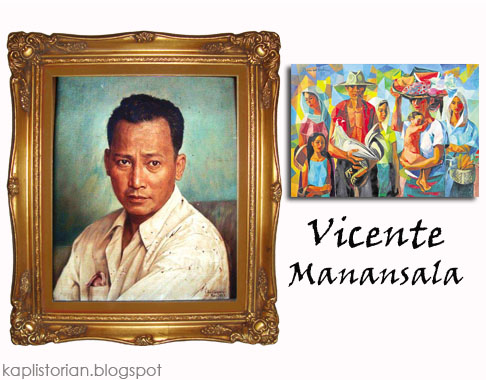
National Artist Vicente “ Enteng” Manansala (b. 22 Jan.
1910/d. 22 Aug. 1981) was born in
Macabebe, and already had artistic inclinations as a boy growing up in
Intramuros where his family relocated. At age 15, he painted his first oil—a
head of a cow coped fom a milk can. He entered U.P. Fine Arts in 1926, and left
home after graduation. He worked as a billboard painter, art director and
finally won his first national award in 1941, for his work “Pounding Rice”. He
would be included as a member of the “13 Moderns” and the “Neo-Realist Group”.
Manansala earned scholarships in Canada (Ecole de Beaux Arts in Banff) and France (Ecole de Beaux Arts of the
University of Paris). He devised his own technique called “transparent cubism”.
His prized paintings are in various private and corporate collections here and
abroad. Holy Angel University has a section of its museum called The Vicente
Manansala Collection, holding most of the sketches, studies and drawings from
the artist’s estate. Mananala was named
National Artist for painting in 1981.

6. PATRICIO SALVADOR
(b. 17 Mar. 1911/d.?). A 1931 graduate of Pampanga High, he pursued an art
course at the U.P. School of Fine Arts, taking only a year to learn and master
painting basics. Soon, this Fernandino was dividing his time between commercial
art and landscape painting. He was still painting in the mid 1990s at his
humble home on Teopaco St. His small work, “Ricefields”, painted in oil in 1943
now hangs at the Jorge B. Vargas Filipiniana Museum at the U.P.
7. GALO B. OCAMPO,
Sta. Rita
Galo B. Ocampo, (b. 16 Oct. 1913/d. 12 Sep. 1985 ), who
hails from Sta. Rita, studied at the Univeristy of the Philippines. He is the
only Flipino to study heraldry abroad and to hold membership in the
International Institute of Genealogy and Heraldry in Madrid. He later became a
Director of the National Museum in 1961. The multi-talented artist was
also painter, sculptor, scenographer,
writer, teacher, and a cultural-activist.
On 22 July 2015, the order of Lakandula was conferred posthumously
to Galo B. Ocampo with the order of
Maringal na Pinuno (grand officer) from the National Museum director, Jeremy
Barnes.
8. LIBORIO T. GATBONTON
Liborio “Gat” Gatbonton (b. 23 Jun. 1914/.5 May 1976) was
a Filipino cartoonist and caricaturist during the 1940s and 1950s who created
the popular series "Jappy Days," a comic book that satirized the
Japanese rule in the Philippines. He was also the chief cartoonist of the
comics section of the now-defunct Evening Chronicle. The Candaba native went to
Pampanga High School and took a correspondence course in cartooning. He took
formal art lessons at the University of the Philippines, and, in 1935, joined
T.V.T. Publications as a staff artist. He became a cartoonist for the Manila
Chronicle and was the first Filipino artist to have his work published on The
New York Times.
9. SALVADOR CABRERA
Salvador Cabrera (b.1930/d.1986) was BenCab’s big brother,
older by some 12 years. He was often referred to as a ’quick-draw’ artist who
could finish as many as 10 paintings in a day. His trademark works showed
youngsters with large, gazing, soulful
eyes, inspired by artist Margaret Keane. Salvador, who maintained an Ermita studio, had a successful career as an editorial
cartoonist of Daily Mirror, where his comic strip featuring a character named
Bindoy, ran for 10 years. In his heyday, he built a large clientele, who paid
Php500 for his portraits, a hefty sum at that time—and he could finish 5 a day.
He managed to provide a luxurious life for his family, but in the troubled
‘80s, when patrons ceased coming, he had to rely on BenCab’s help as his health
began to fail. Salvador Cabrera was also
a skilled watercolorist, illustrator and a lay-out artist, and his works were
once carried by Angeles galleries, He died of heart attack in 1986.
10. ALLAN COSIO
The versatile artist, Allan Cosio (b. 1941) traces his
roots in Bacolor. This painter (op art and abstract) , printmaker, sculptor and
tapestry maker has represented the
Philippines at the Valparaiso Biennale in Chile. The Indian Triennale, and the
International Sculptue Event in Victoria, Australia. He has also exhibited in
Geneva (Switzerland), California, Munic, Beijing, Marsala (Italy) and Hong
Kong. For 5 consecutuve years, he was a prize winner at the annual Art
Association of the Philippines (AAP) competitions. He won a Britsih grant as
his award for winning the grand prize in the 1980 AAP awards. Cosio is married
to the Ivi Avellana, daughter of director Lamberto Avellana and theater
actress, Daisy Avellana.
11. BENEDICTO CABRERA
(BenCab)
Benedicto Cabrera (BenCab, b. 10 Apr. 1942) is a
full-blooded Kapampangan whose parents are from Sasmuan. He studied at the
University of the Philippines, graduating in 1963, and had his first one-man
show at the Gallery Indio in 1966. After BenCab married British Caroline
Kennedy in London in 1969, the couple decided to stay there, where he slowly,
but surely established his name in the international art scene, holding exhibits
(London, New York ,Macau) and winning
several art awards. Returing to the Philippines in 1972, he was hailed as a
Filipino pioneer of the arts, but the restrictive Martial Law years forced him
back to London. This episode marked the beginning of his involvement with
social commentary and the topics of freedom from repression. Later in the
1990s, BenCab founded the Tamawan Village, an artists’ sanctuary-cum-gallery
that has become a popular cultural destination in Baguio. He was named a
National Artist for Visual Arts in 2006, and in 2009, U.P., his alma mater, conferred
upon him an honorary Doctor of Humanities degree.

12. JOSE W. HERNANDEZ
Manila-born Jose W. Hernandez (b. 22 Sept. 1944/ d.19? )
practically grew up in San Fernando, when his father was assigned as a law
teacher at Harvardian College. Jose spent his grade school years at the
Assumption Academy. His artistic inclinations showed early; he would fill his
notebooks with drawings rather than schoolwork. In his senior year at Pampanga
High, he was offered a scholarship by Pres. Diosdado P. Macapagal. However, he
abandoned his schooling to learn from established artists like Fernando C.
Amorsolo, Botong Francisco, Vicente Manansala, Simon Saulog and Ben Alano.
Painting in the realist tradition, he had his first group exhibit with Mabini
masters in 1965. From 1974-77, Hernandez operated his own gallery in Angeles
City. His works have been exhibited in the U.S., and reproduced on Unicef
greeting cards.
13. MARCELINO C. GALANG
“Mars” Galang (b. 1 Jan. 1945/d.2001).was born in
Cabusao, Camarines Sur. His father, Zoilo M. Galang of Bacolor, was
pioneering encyclopedist who
singlehandedly produced the 10-volume “Philippine Encylopedia” published in
1934. This makes Mars, a
half-Kapampangan. He went to public schools in the Sta. Cruz district of
Manila, then took up Fine Arts at the University of the Philippines on a
scholarship. He became not only a painter, but also a printmaker, colorist and
draftsman. Mars dabbled in minimalism, where he excelled. He represented the
Philippines at the 1st India Triennial in New Delhi (1968) and the 7th Paris
Biennial. His last one-man show ws in 1985, an thereafter remained inactive.
14. CESAR VICTOR “CID”
P. REYES
The prodigious artist, advertising executive, book
author, art scholar and art critic Cid Reyes (b. 28 Jul. 1946) is a Kapamangan
Pangilinan, courtesy of his mother Humilde, from Apalit. After his Lasalle
studies, he became an Italian government scholar at the Academia de belle Arti
in Rome, and tool courses in Art History at the City Lit Institute in London. Twice
named Art Critic of the Year, Reyes is also a mutli-awarded advertising
creative. In 1989, he authored “Conversations in Philippine Art”, which
featured his interviews with 8 National Artists. His published books have won 2 national Book
Awards. As a painter, Reyes has exhibited his works in major art galleries
featuring his robust abstract works using automotive paint. Reyes travels
around the country lecturing on various aspects of art and art history. He was
named Most Outstanding Kapampangan in Arts in 2015.
15. CLAUDE S. TAYAG
The renaissance man from Angeles City, Claudio “Claude”
Moises Tayag (b. 1956) is the son of writer-lawyer Renato ‘Katoks’ Tayag.
Although an AB Economics U.P. graduate, he forayed into art by observing
artists E. Aguilar Cruz (his menor), Romula Galicano and Sofornio Y. Mendoza. He won praises for his
paintings of folk festival imageries and
folk santo watercolors. He also ventured into creating functional and
decorative sculptural wooden pieces. Also known as an award-winning chef, Tayag
and wife Mary Ann Quioc, offer unique dining experiences at his residence known
as Bale Dutung (Wooden House), and at his 1856 Downtown Café, pop culture
restaurant.
16. NORMAN TIOTUICO
The foremost exponent of Kapampangan contemporary indigenous
art, Norman Tiotiuico (b.1966) of Angeles City is a Fine Arts graduate of the
University of the Philippines. In 2004, he was named a Rockefeller and Ford
Foundation grantee at the 4th International Sculpture Symposium in Vietnam His
works are mostly sculptures, inspired by spiritual and environmental issues.
Tiotuico, subscribes to the belief that he, as an artist, is just a medium used
by the Creator as an executor of His ideas. His work is represented at Saatchi Art,
the world’s leading online art gallery. This Most Outstanding Kapampangan
Awardee for the Arts in 2008 exhibits regularly; his latest, ”Kalalangan Kapampángan Experiment” (Feb. 2018), features his latest
native art installation works.
SOURCES;
Salvador Cabrera: lex Castro Collection
BenCab: photo: wikipedia
Allan Cosio: http://www.philstar.com/arts-and-culture/2014/11/24/1394631/allan-cosio-cid-reyes-ricco-renzo
Juan Flores:Singsig,Magazine
Mars Galang: Portrait by BenCab, Art Manila Newspaper,
Vol. 2 Series 7, 2001
Liboro Gatbonton: Mobilways
Elias Laxa: Sunday Times Magazine 1963.
Vicente Manansala: Vicente Manansala Collection, Holy
Angel University
Irineo Miranda: Leon Gallery
Galo Ocampo: Positively Filipino
Cid Reyes: Cuadro Filipino, photo by Joey Ibay.
Claude Tayag: Scred Heart
Seminary Annual
Norman Tiotuico: Saatchi-Art, iorbitnews
All others: Kayumanggi, Biographes of Philippine Visual Artists, Peso Book Foundation 2000.