Showing posts with label Porac. Show all posts

Tuesday, January 28, 2025

114. 9 TAMBAY SPOTS IN PAMPANGA

Pampanga has been on the tourist map staple for a long, long time. Known for the majestic cooking of its people and its astonishing mix of country and cityscapes, the province also offers casual hangout spots perfect for the chill days, may it be for tourists or even locals.
                                                                     ********

1. PORAC BAYWALK PARK, Porac
The serene Porac river view plus the fresh breeze of air is the perfect equation of a “tambay” spot. Porac Baywalk Park, also known as Porac Babo Robot, turns into a lively night market by sunset that offers the local flavors of Pampanga. With both tourists and locals enjoying the delicate Porac riverscape, various activities by the local government of Porac are held in this place throughout the year.

Photo from: Porac Government Page

2. MINALIN SUNSET PARK, Minalin
Situated between Minalin’s proud vast fish ponds, Sunset Park is an up and coming destination in the north of Pampanga. If you’re looking to spend the afternoon lazing around, watching the sunset and mingling with people, Sunset Park is a must visit. With expansion plans from the government, Minalin is looking to expand this beautiful stretch into an entertainment hub for the locals and tourists to enjoy in the future.

                                  Photo from: Sunstar 

3. CAPITAL TOWN, City of San Fernando
Capital Town is the best hang out spot if you want to experience both tradition and modernity at once. Situated along Capitol Boulevard in the heart of San Fernando, Pampanga. One of the most famous places to visit in Capital Town is the largest McDonald's branch in the Philippines; more importantly, this branch accommodates parks with traditional carriage, food carts selling low-cost street foods, and more. This hangout spot is undoubtedly among the best options for those on a tight budget. All you need to do is bring your picnic blanket and enjoy the fun experience at Capital Town.

                                 Photo from: Mega World

4. THE ORCHID GARDEN RESORT, City of San Fernando
The Jewel of San Fernando is only a short drive away from Capital Town and is one of the must-visit destinations when the ber-months approach. The Christmas Village Pampanga, which is part of The Orchid Resort, brings holiday fantasies to life with displays including nativity scenes, Santa's workshop, lights illuminating every corner, and special activities that can create cherished memories with your family. During the regular days, The Christmas Village turns into a resort and a recreational park that offers scenic dining experiences with its wide range of restaurants and establishments inside.

                                  Photos from: The Orchids Gardens

5. CLARK PARADE GROUNDS, Mabalacat
A place full of historical upbringing and a symbolic reminder of Philippines-United States friendship over the years, now serves as a park with natural scenery for families to enjoy. Clark Parade Grounds has made significant strides and now provides ideal leisure activities like jogging, biking, strolling, and picnics. The greenery and abundance of open spaces at Clark Parade Grounds made it one of the greatest places to unwind and chill out with your loved ones.

                                 Photo from: Feliix Inc.

6. BAMBOO HUB ECO PARK, Lubao
The Bamboo Hub Eco Park in Lubao, Pampanga serves as a hub for bamboo cultivation with its unique and environmentally-focused design to promote sustainable practices. Visitors can learn about the different species of bamboo, its ecological benefits, and how it can be used for various purposes. The park plays a part in reforestation efforts, encouraging the use of bamboo as a sustainable alternative to deforestation practices. Bamboo's ability to quickly grow and stabilize the soil makes it ideal for preventing erosion and improving biodiversity.

                                 Photo from: Pelago


7. CLARK GLOBAL CITY / WEST AERO PARK, Clark Freeport Zone
This area looks like a normal gasoline station full of car dealerships, but at night, this is where the car enthusiasts or “tambay” near Clark hang out. Clark Global City was a go-to place for Gen z’s, millennials, and even boomers when they wanted to chill out with their Barkadas, flexing their cars while drinking beer on their open trunks and camp chairs.

                                 Photo from: Skyscraper City Forum

8. NORTHWALK CLARK / SF2, Clark Freeport Zone
If you want to witness planes take off and land while drinking beer with your friends this tambay spot is for you. Due to its spacious parking lots, it’s been a go-to chill spot for different generations. The illuminating lights at night give a serene and comforting place for barkadas to sit, drink, and have deep conversations.

                                  Photo from: Foursquare


9. TABNUAN CULTURAL CENTER, Mabalacat, Xevera
Just February of last year, another hangout or chill spot in the outskirts of Pampanga emerged. Tabnuan Cultural Center is not only a heritage spot to visit but also a tambay must-see as it houses a magnificent view of Mabalacat City and offers a breather from the hustle and bustle of the city scene. Tabnuan is quite literally tambay-material with wide space and the fact that the name literally means “meeting place.” Various food stalls, local merchandise and affordable coffee hosted by Cafe Municipio will surely make your tambay more worthwhile. While you’re there, Balacat Tea is a must try!

                                            Photo from: Mabalacat City News Facebook

They introduce a new concept of these places may not be your usual tourist spots but they introduce a new concept of relaxation, not only for the locals but tourists as well.


P.S: This was made by Center for Kapampangan Studies interns who love to tambay.


Sunday, June 24, 2018

85. 8 WATER FALLS IN PAMPANGA YOU SHOULD KNOW

And you thought that, since  Pampanga is one of the Central Plain of Luzon provinces, it would all be flatland. But remember , Pampanga is hemmed with mountains , hills, valleys and cliffs too, where water can run, cascade and fall. Here is a list of Pampanga’s waterfalls—some already popular with tourists, others not so well-known.
**********
DARABULBUL FALLS, Porac
The Darabulbul or simply, Dara Falls can be found in hilly Brgy. Jalung, Porac. It is so named because of the gurgling sound created by the strong water flow that emanates from the mountains. Often likened to Pagsanjan Falls of laguna, Dara Falls is a favorite destination of locals during the summer months. The falls can be reached after a 15 minute trek from the Porac bridge.

HADUAN FALLS, Mabalacat
The Haduan Falls is located in Sitio Haduan, within Mabalacat City, accessible through the Gate 14 of the Clark Freeport Zone, but only after a 2-hour trek through the rocky and cold Haduan River. The river is used freely by Aetas for washing and feeding livestock. The trekking experience with an Aeta guide includes crossing a hanging bridge and climbing a stone wall to reach the falls, which is not really high but is described as serenely beautiful. A waiver is needed prior to the trek as the Gate is part f a leased property. The local government has plans to develop Haduan Falls as a major tourist destination of the city.

MIYAMIT FALLS, Porac
Miyamit Falls is perhaps Pampanga’s most popular natural wonder, as it has been used several times for extreme sports and ultra-marathons. Located at Sapang Uwak in Porac, the hundred-feet Miyamit Falls is known for its strong water surges and rock formations. The water is clean, potable and cool, views are enchantingly relaxing and scenic. Access to Miyamit Falls is via a long trek, and requires a signed waiver from the Porac Municipal Hall.

MT. ARAYAT NATIONAL PARK FALLS, Arayat
Established on 27 June 1933, the national park in San Juan, Baño has natural scenic attractions including  a spring-fed waterfall that cascades into the crystal-clear waters of the swimming pools.

MT. PINATUBO TWIN FALLS, Porac
After a long, arduous trek through the Delta 5 trail going to the volcano, the adventurer will be treated to the wondrous view of the Mt. Pinatubo Twin Falls  that falls through the crevice between  steep walls.  The waters cascade quietly in two levels, hence the name.  The main fall  descend to a lower rocky tier, where the water flows and collects into a pool., set amidst an awe-inspiring scenery. The twin falls could be accessed through Porac, and requires a 4x4 vehicle to reach. Those with more strength and stamina can opt for a 9-hour trek.

PAU FALLS,  Arayat
Located at barangay Baliti in Arayat, Pau Waterfalls can be reached via narrow, steep  trails. However, the waterfall and its environs are not well-kept; trash is often found in the water. It is hope that the local leaders can maintain and clean the area as the Pau Waterfall has the potential to be a major tourism revenue generator.

SAPANG ANGKA FALLS, Porac
The Sapang Angka Falls got its name from the jackfruit (angka) that once abound in the place before Pinatubo wiped them out. Going to Sapang Angka involves crossing many treacherous river trails via the Delta 5 route from sitio Pidpid. On a hassle-free day, it can be reached after an hour and a half of trekking from the Delta 5 trail. The area around the Sapang Angka Falls is small, but the atmosphere is serenely beautiful and relaxing.

3rd FALLS, Sapang Bato
Said to be a refreshing summer spot for Aetas in the past, the 3rd Falls in Barangay Sapang Bato can be accessed by traversing the lahar-filled valley of Sitio Target. It is a mini-waterfall that cascades on craggy rocks, but the chilly water is invigorating, a welcome respite to the summer-weary visitor.

 CREDITS:
Photos:
Haduan Falls: courtesy of Elijah Manlapaz, Mabalacat City News FB group, https://www.facebook.com/MabalacatCityNews/photos/pcb.183276175655222/183272678988905/?type=3&theater
Dara Falls, 3rd Falls,  Miyamit Falls, Mt. Arayat Park Waterfall: www.pampangatalents.com
Sapang Angka falls: 1D Trek to Sapang Angka Falls, Porac Pampanga
By Armela Patalud -  November 8, 2016, aroundthemetro.ph, http://aroundthemetro.ph/sapang-angka-falls-porac-pampanga/

Info:
5 Stunning Waterfalls in Pampanga You Shouldn’t Miss This Summer, Traveller Buddy: https://travellerbuddy.wordpress.com/2017/04/11/5-stunning-waterfalls-in-pampanga-you-shouldnt-miss-this-summer/
Mabalacat City News FB Page: https://www.facebook.com/MabalacatCityNews/

Wednesday, November 29, 2017

67. 12 RIVER MYTHS AND MYSTERIES OF PAMPANGA

1. THE ONCE-MIGHTY PORAC RIVER
Ancient Porac was in the vicinity of a seashore.

Three pre-historic settlements in Porac, one unearthed by anthropologist H. Otley Beyer’s team in 1939 (Hacienda Ramona site), another by archaeologist Robert Fox in 1959 (Balukbuk site), and the third by the National Museum in 1999 (Upper Balukbuk site) raise the question of why the settlers built relatively large communities high up on the foothills of the Zambales Mountain Range. A  theory says that the ancient Porac River, which today is nothing but a shallow brook, was navigable enough for large water vessels from Manila Bay, and that the subsequent eruptions of Mount Pinatubo, years (not centuries) before the Spaniards arrived in 1571, silted the river and either destroyed the communities or forced the inhabitants to abandon them. Old folks in Lubao town, claim that in the 1960s, they saw what looked like large wooden boards floating in the Porac-Gumain river. The boards, between 12 and 16 feet long, were roughly cut and had holes in them, which made the folks speculate that they must have been parts of a large ancient boat washed down from upstream Porac River, which they believe to be navigable in the distant past. (Joel Pabustan Mallari)

2. WERE BETIS AND LUBAO AS BIG AS CEBU?
The conquistadores found thriving Muslim communities here.

The earliest  Spanish chronicles show that the first settlements in Pampanga were situated along the major waterways. Miguel Loarca listed these ancient settlements with their corresponding population figures, thus revealing a comparison between Pampanga settlements and those in other parts of the archipelago. In the list, Betis (Vitis) and Lubao had a population of 3,500 people, the same number as that of Cebu. Calumpit (Calonpite) outnumbered Macabebe by 400 people, but the latter Pampanga town had a bigger population than Vigan (1,600 people), Malolos (800), Negros (700) and Ylocos (500). Most if not all of these Pampanga communities thrived along or close to riverine areas for two basic reasons: abundant resources and accessibility of transportation. This is true for all the great cities and civilizations of the world (J. Mallari)

3. LUBAO’S ANCIENT BURIAL BOATS
Skeletons turn up during a flood.

Old civilizations all over the world—like Vikings, Austronesians, and Ebypt--observed a variety of elaborate burial rituals, one of which involved boats. Researchers of the Center for Kapampangan Studies, together with Dr. Rodrigo Sicat, author of The Kapampangans, recently interviewed old folks in Dr. Sicat’s hometown, Lubao, living near the now-heavily silted Gumain River. According to them, during the great flood of 1972, an eroded section of the protective dike near the property of a Pablo de la Peña in Brgy. Gumi turned up several boat-shaped coffins. They described the finds as canoe-shaped kabaung, inside of which were the skeletal remains of what appeared to be at least six-footers. Beside the skeletons, the interviewees claimed, were indigenous and tradeware ceramics: blue-and-whites and local earthen pots like kuran and banga. Each coffin measured between 12 and 18 feet long, carved out of the trunk of a bulaon tree (Vitex parviflora Juss.).  (J. Mallari)

4. FACTORIA AND THE SHIP THAT SANK IN NUEVA ECIJA
Did Spanish galleons sail as far as the headwaters of the Pampanga River?

Pedro Arcilla wrote that as recently as the early 1900s, large boats could still navigate the Pampanga River from Manila Bay all the way to Cabanatuan City and other Nueva Ecija towns. In fact, a parish document in a Nueva Ecija town mentions a casco (old folks there say it was a Chinese junk, others say it was a Spanish galleon) that sank during a storm in the early 1800s in that upstream section of the Pampanga River that flowed through the town of Factoria. An old resident of San Isidro town (present name of Factoria) allegedly recovered a part of this sunken ship’s rudder which is now displayed in his private museum, awaiting scientific verification. In times past, Factoria once controlled the tobacco industry in the North and was once the capital of Nueva Ecija. Indeed, this once-thriving town, formerly within the boundaries of the Kapampangan Region, owed all of this to its proximity to the Pampanga River. (J. P. Mallari)

5. THE SASMUAN-CABIAO CONNECTION
This upstream town served as haven to Kapampangan refugees.

In the Sasmuan Papers of the Luther Parker Collections (c.1900), there is a claim that Factoria became the capital of Pampanga in 1762, when the British invaded Manila and the country’s capital was moved to Bacolor. The territory of Pampanga extended all the way to Nueva Vizcaya, and Nueva Ecija as a province, was still non-existent. The provincial governor of Pampanga, a Señor Biron, was residing in Factoria, when British soldiers invaded Sasmuan through the town’s Manglares River.  Biron ordered all the residents in eastern Sasmuan  to evacuate to Cabiao (then still part of Pampanga). A group of women, led by Doña Magdalena Pineda protested against the order, citing the inconvenience of moving to Cabiao. After the British left the country in 1765, the Philippine capital was returned to Manila and apparently, Pampanga’s capital was returned to Bacolor and thus ended Factoria’s brief shining moment in history.

6. MEXICO: PAMPANGA’S CAPITAL BEFORE BACOLOR?
Bacolor was the provincial capital only from 1755 to 1903
Bacolor  started functioning as capital of Pampanga in 1746 and officially became capital only in 1755.  The town served as the provincial seat of government until 1903, when the capital was moved to San Fernando. In Conquistas de las Islas Filipinas, Gaspar de San Agustin, OSA wrote that the provincial capital  prior to Bacolor was Mexico town, one of the oldest and most prosperous communities in Pampanga. The province’s oldest surviving church structure is found in San Jose Matulid; the town has a barangay named Parian which indicates the presence of a community of Chinese merchants before; and a tributary to the Pampanga River links Mexico directly to Manila Bay passing through the important towns of San Fernando, Bacolor, Guagua, Sasmuan and Macabebe.

7. SAPANG BALEN AND ITS VIOLENT PAST
Angeles City lies in the path of an old, forgotten river

When the city’s founder Don Angel Pantaleon de Miranda  and wife Doña Rosalia de Jesus, came to Kuliat  to establish a new town, they chose the area around the Sapang Balen creek. The creek may seem harmless but its present tranquility belies a violent past. Historian Mariano Henson notes that on July 20, 1881, “A typhoon and a heavy downpour of rain caused the treacherous Taug salient, which used to originate at the southwesternmost tip of barrio Pampang, to swell up to a murky, clay-ey tone into the Sapang Balen Creek, causing the destruction of the three bridges of 1850 and carrying away three houses from barrio San Jose. It is said that before 1796, the Taug sometimes went a few hundred yards behind the present church during protracted heavy rainfall.” A similar devastation occurred in 1972 when Sapang Balen washed away dozens of houses in San Jose, and again when Mount Pinatubo erupted on June 15, 1991, when the creek overflowed into downtown Angeles. Sapang Balen is actually the ancient path of Taug River; at some point in the distant past.
(C. Manese)

8. THE MYSTERY OF THE SACOBIA RIVER
The mighty river probably did not exist before the 1850s

Sacobia River, which became a byword during the lahar season in the 1990s, is one of four major rivers emanating from the eastern slope of Mount Pinatubo itself.  Strangely, however, Sacobia River does not appear in maps made during the entire colonial period until mid-1800s. Cartographers could not have missed such a major river, considering that even creeks in the vicinity of the Sacobia River are depicted. Is it possible that Sacobia River did not exist before mid-1800s? There is a theory that it may have been formed, probably due to a lake breakout on the slopes of Mount Pinatubo, in the 1850s. Sometime in 1856, the town of San Bartolome in southern Tarlac was completely swamped with floodwaters from Parua, the river’s old name. Parua may have been the downstream name of Bamban River (Sapang Mabanglu). 1856 may have been the year Sacobia River was formed; it elbowed away from Mabalacat (in a spot called Maskup in sitio Bana) to merge with the Bamban River before proceeding to Concepcion and draining into Rio Chico. Another puzzle is the name “Sacobia.” Nobody knows what it means or to whom it refers. It is not a Kapampangan term and there was no Spaniard or Filipino who went by that name. (J.P.Mallari)

9. RUSSIA’S GRAND DUKE CAME BY BOAT
The world’s rich and famous traveled all the way to Apalit

DURING colonial times, elegant mansions of rich Kapampangan families lined the Rio Grande, the most famous of which was that of Don Joaquin Arnedo Cruz and Doña Maria Sioco Arnedo, in Sulipan, Apalit. “(Their) combined fortunes…created a lifestyle of leisure and luxury unmatched elsewhere in the archipelago,” writes Gene Gonzales in his book Cocina Sulipeña. The couple frequently threw lavish parties for their guests who came from Manila via the bay and Pampanga River .Among the guests  Jose Rizal, Gen. Arthur McArthur, Gen. William Howard Taft, and Prince Norodom I of Cambodia, who reportedly fell in love with a local maiden, Pepita Roxas of the next town Calumpit, Bulacan. But the best-cherished visit to Sulipan was that of Alexis Alexandrovich, Grand Duke of Russia and son of the Czar himself. While in Pampanga, the Russian Duke hunted birds in the surrounding marshes, and boar and deer in the mountains. In gratitude, he gifted his gracious hosts with a whole set of monogrammed porcelain dinner set.

10. THE LOST CANNERY OF GUAGUA
Why a small tributary in an interior town is called Dalan Bapor

Guagua has always been a commercial hub, even as early as pre-Hispanic times when it was a thriving community of Moros who traded with Chinese merchants. The Pasak-Guagua River which connected with the Rio Grande, served as the highway of cargo ships doing business in the town; a tributary to this river is known as Dalan Bapor (literally, ship’s way), which today has been reduced to just a shallow canal. Until World War II, however, it bustled with economic activity because it led to the Guagua  Cannery located in what is now a Brgy. Sta. Filomena  subdivision beside the Guagua National College. Old folks living in the area recall that the cannery occupied the entire land area of the subdivision; that “huge ships” transported tons of canned goods like sardines and even local specialties like tabang talangka and burung asan; that it offered retail canning services for affluent families who wanted to send canned products abroad; that it was bombed by Japanese planes in World War II; and that it finally closed in the 1960s following a series of labor disputes. (J. Mallari)

11. THE GREAT FLOOD OF 1972
Pampanga’s worst calamity before Pinatubo

Next to the eruption of Pinatubo, the worst calamity to ever hit the Kapampangan Region in recent memory was the flood of 1972, when the entire Central Plain of Luzon was submerged under water. Heavy monsoon rains lasting 40 days nonstop had been triggered by four tropical cyclones that made a direct hit in the area during that year’s rainy season: Asiang, Konsing, Toyang and Undang.The flood, which claimed 298 lives, was worst in the Central Plain because this area is the natural catch basin of two major waterways, the Pampanga River and the Agno River; moreover, the presence of the Candaba Swamp (pinac), alugin (waterlogged) areas and baná (marshes), as well as the phenomenon of subsidence, further makes the area susceptible to flooding. (C. Manese)

SOURCES:
Singsing Magazine, Center for Kapampangan Studies, "River Myths and Mysteries". by Joel Pabustan-Mallari, Robby Tantingco, C. Manese.

Wednesday, February 15, 2017

36. 7 SPANISH FRIARS FROM KAPAMPANGAN TOWNS WHO MET VIOLENT DEATHS

There are documents to prove that Spanish friars were treated better in Pampanga than in other regions in the Philippines. Eighteenth-century chronicler Fray Gaspar de San Agustin wrote that Kapampangans were "very good Christians, most respectful of their ministers." But still some frailes met unspeakable deaths—occupational hazards of their mission work. Also, because “ya ing pari, ya ing ari ("he is priest as well as king"), some curas parroco tended to abuse their authority and exploit the parishioners' subservience—leading to their doom. Still others became collateral casualties of the bloody Revolution, victims of strong anti-Spanish sentiments in those tempestuous times.
* * * * * * * * *

BLESSED  FRAY PEDRO DE ZUÑIGA OSA
Assignments: Sasmuan, Porac
Manner of Death: Tortured and burned.

The future saint was born and educated in Sevilla, Spain, where he completed his priestly studies. The newy professed Agustino was shipped off to the Philippines in 1609 and became the first prior of Sasmuan. His arrival resulted in the separation of Sasmuan from the parish of Lubao, reverting back in 1642 due to the scarcity of priests. He ministered in Sasmuan from 1615 to 1618, until he was transferred to Porac. In 1620, Fray de Zuñiga sailed for  Japan with a stop in Taiwan in June. He, along with other missionaries of different orders, were tasked with propagating the Catholic faith among the natives. The ship captain was Catholic  Japanese, Joaquin Hirayama Diaz, and the crew all were members of the Confraternity of the Holy Rosary. En route, the ship was intercepted by Dutch pirates who surrendered the passengers and crew to pagan Japanese officials in the port of Hirando. They were kept in prison for two years, until Fray de Zuñiga,  his Dominican companion, Fray Luis Flores and the captain,  were tortured and burned to death in Nagsaki on 19 August 1622. Fray De Zuñiga and his companions were elevated as “beatos” (Blessed) on 7 May 1867 by Pope Pius IX, just one step away from sainthood. His ashes were brought back by Augustinian fathers to the Philippines where they are interred at the San Agustin Church.

FRAY BALDOMERO ABADIA, OAR
Assignment: O’Donnell, Capas
Manner of Death: Killed in an attack by Revolucionarios

The saintly Fray Baldomero Abadia was another tragic victim of circumstance, who died a valiant, albeit, violent death. From Jarque del Moncayo, Baldomero entered the Recoletos community of Monteagudo, Navarre province, where, on 4 October 1887,  he professed his vows.  During his stay at the rectory, he became acquainted with two future holy men—St. Ezekiel Moreno, who had just returned from the Philippines,  and Blessed Vicente Pinilla, one of the martyrs of Motril, who became his fast friend. In fact, the two would make a trip to Philippines together, arriving in Manila on 18 September 1892. Sometime in January 1896, Fr. Abadia was made parish priest of a newly created O’Donnell town in Tarlac (named after the Spanish Gen. Leopoldo O’Donnell, who coincidentally had given his name to the priest’s brother, Leopoldo Abadia). Fr. Abadia  fulfilled the functions of his sacred ministry with great apostolic zeal.  But at the end of August 1896, the Philippine revolution had exploded, spreading  quickly from Manila to the border provinces. Several Recoletos were murdered, and Fray Baldomero found himself in the danger zone. In his last letter to his family dated Oct. 27, he calmly reassured them that, for his safety, he was sleeping in the soldiers' barracks. But he was not safe at all—he could not trust even his own parishioners. On October 31, Filipino insurgent troops entered O'Donnell and, as historiologist Francisco Sadaba put it-- "inhumanly sacrificed him in hatred of Religion and Spain." Fray Baldomero Abadia was not even 27 years old.

FRAY  GREGORIO BUENO DE LA VIRGEN DEL ROSARIO, OAR
Assignment: Mabalacat
Manner of Death: Executed by firing squad,  Boloed to death

The Spanish fraile  known for putting a curse on Mabalacat, saying that the town will never prosper, was Fray Gregorio Bueno de la Virgen del Rosario. Born in Taragona in Aragon, Spain, he was first assigned to Iba and Masinloc in Zambales, then moved to the Recoletos convent in Manila. On 30 November 1885, the Padre Garigu was named cura of Mabalacat. He was the last Recollect priest to serve and his was also the longest term, staying on for 23 years until his untimely death. The popular belief was that he incurred the wrath of town head Don Marcelo Tiglao, for harassing a female member of his family. The truth was, by 1897, the fervor of the Philippine revolution had reached Pampanga and Tarlac, which resulted in the closing of some Recollect missions. When Filipino revolutionaries succeeded in taking Tarlac from the Spaniards, word reached Mabalacat about Spain’s surrender at the Makabulos headquarters in San Miguel. A horde of angry, impassioned locals, incited by the Tiglao, stormed the parish and dragged Fr. Bueno outside.  The 66 year old priest was paraded on the streets in a bullcart, publicly humiliated and charged with espionage. On 10 July 1898, he was shot dead by a firing squad, although one other version had him boloed to death while in a pit that was to be his grave. Before Padre Bueno died, however, it was said that he managed to utter his famous legendary curse  on Mabalacat: the town will only be freed from the spell if it can produced fourteen native priests—a number that has since been exceeded.

FRAY JUAN HERRERO, OAR
Assignment:  Mabalacat
Manner of Death: Cornered and shot to death

The Recoletos were already firmly established in Pampanga and Tarlac when Fray Juan Herrero OAR, assigned in Dagami, Leyte,  was called on to help the thriving mission center in Mabalacat from where Recoletos fanned out to neighboring places to evangelize. In 1885, he was named as a compañero or assistant priest to long-serving Fr. Gregorio Bueno de la Virgen del Rosario.. Fr. Herrero stayed for just 5 months—from July 11 to December 10, but long enough to be facile with the Kapampangan language, a talent which earned him an amount of respect among the natives. On 30 April 1891, a new assignment took him to Imus where he was named as the Prior-Administrator of the order’s hacienda. But the looming revolution would change the course of the padre’s fate. By 1896, violent attacks against Spaniards were waged in many towns, Imus included. In the last days of September 1896, the Recoletos’ hacienda became the scene of a bloody siege. Advancing revolucionarios managed to corner Spanish soldiers and Recoleto priests--led by Fr. Juan Herrero--who bravely rallied around their country’s flag. Holed up in the hacienda without any hope of escape, Fr. Juan Herrero and 9 other Recoletos were killed in the crossfire by impassioned Filipinos. In an eerie twist of fate, a similar drama would unfold two years later in the same Pampanga town that he once served and involving the parish priest that he once assisted-- Fr. Gregorio Bueno.

FRAY JUAN TARRERO, OSA
Assignments: Arayat
Manner of Death: Executed by Gen. Maximino Hizon

Fray Juan Tarrero was assigned as a cura of Arayat, succeeding Fr. Jose Torres in 1858. Fr. Torres had started rebuilding the church, a project which Fr. Tarrero continued from 1858 to 1892. The work remained unfinished for two reasons—the stirrings of the Revolution had begun, and the poor padre found himself in trouble with the Alejandrino family of Arayat. The Spanish friar had ordered the patriarch, Mariano Alejandrino, exiled to Kiangan in the distant Ifugao province for allegedly being a Freemason. The last straw was when he supposedly abused a girl belonging to the Alejandrino family. By the time of the Revolution, the sons of Mariano—Jose, Joaquin, Manuel, Anselmo and Pastor-- had ascended into power as military leaders. Fearing for his dear life, the priest fled to the neighboring town of Mexico, only to be intercepted and apprehended by the troops of the gallant Kapampangan Gen. Maximino Hizon. He was dragged in front of the church where he was promptly executed. Curiously, Fr, Tarrero’s sorry tale has striking parallels with that of Fr. Bueno in Mabalacat, which is why old folks in Mabalacat and Mexico still believe that their towns have been cursed by executed friars.

FRAY ANTONIO REDONDO
Assignments: Bacolor, Sasmuan, Sta. Ana, Apalit, Minalin, San Fernando, Tarlac
Manner of Death: Illness while in captivity

Born in 1835 in Ceceda (Oviedo), Fr. Redondo took his solemn profession in Valladolid in 1854 and sailed to the Philippines in May 26, 1858. Initially assigned as presbitero in Manila, he was later appointed as cura interino of  Bacolor. He served in parishes in Tarlac (1861) and Pampanga:  Sexmoan (1862), Sta. Ana (1866), Minalin (1871), Apalit (1873) and San Fernando (1886-1898). He served in various capacities: prior vocal (1871 and 1889), Definidor de Provincia (1881) Vicario Provincial and Examinador de Idioma (1893 and 1897). The convents of Sta. Ana and San Fernando (including the church’s painted ceilings and dome) , and Apalit church are some of his accomplishments. During the Revolution, he escaped via Macabebe together with 13 Augustinians and one Recollect through the help of Gen. Ricardo Monet. He was captured by the revolutionaries in Hagonoy on 30 June 1898, as he was en route to Manila to board a ship for Spain. He was held captive in San Fernando where he contracted a disease; and was transferred to Mt. Arayat in 1899.  He was moved back to San Fernando, then to Angeles and finally forced to walk to Magalang. Fr. Redondo was supposed to have been brought to Magalang church, but his conditioned worsened and died on 30 March 1899, after receiving his viaticum from his fellow Franciscan captive, Fr. Francisco Sta. Olalla. 
   
FRAY VICTOR BALTANAS, OAR
Assignment: Mabalacat
Manner of Death: Hacked to death on the head

There has been so much focus on the gruesome murder of Fr. Gregorio Bueno, that it all but overshadowed the cases of his two other Mabalacat compañeros,  who died in the same terrible and controversial manner. The first, was the aforementioned F. Juan Herrero who was killed in Imus, and the second, the good padre, Fray Victor Baltanas de laVirgen del Rosario. Born on on 17 November 1869 in Berceo, La Rioja,  Spain, he became a Recoleto on 24 October 1886. Five years after, he was given a Philippine assignment, and just a few days after his arrival on 21 October 1891, the young deacon was sent to Mabalacat to assist Fr. Bueno and to learn, strangely enough, Tagalog basics. His stay was temporary, for  he was shuffled  from  Mabalacat to Manila, then Palawan (1894-1895) to Intramuros (1899-1902), and then finally to Valencia, Negros Oriental where he served as coadjutor. In October 1907, he became the cura of the Catholic Church of Escalante town. It was here that he was hacked to death in the head by an Aglipayan assassin, Mauricio Gamao, on the night of 15 May 1909, succumbing to his wounds the next day. The murder, motivated by the schism between Aglipayans and the Roman Catholic Church involving church property, was planned in connivance with the town head, Gil Gamao—Mauricio’s relative, who was subsequently convicted and sentenced to life imprisonment. The martyr of Escalante was interred in San Carlos, but his bones were exhumed in 1995 due to acts of vandalism and robbery in the cemetery. These were then kept at the Colegio de Santo Tomas-Recoletos

BONUS: The Prisoner of War Who Survived.
FRAY FERNANDO GARCIA, OSA
Assignment: Macabebe, Betis

One Spanish priest who went through a harrowing experience and lived to tell his tale was the Augustinian Fray Fernando Garcia. He came to the Philippines in 1875, and was assigned in Ilocos, until 1889, until he was recalled to Spain to serve at the Augustinian College at La Vid at  El Escorial. In 1896, he returned to the Philippines, and was assigned in Macabebe, only to be overtaken by the events of the Philippine Revolution. As  Gen. Antonio Luna  and his forces advanced towards Pampanga, he took Spanish officials and friars prisoners—including the poor Fr. Garcia. He and other friars were hauled off from town to town across Central Luzon, forced to walk barefoot, tortured, beaten, starved and publicly displayed like animals as war booty. When Aguinaldo's troops fled to Cordillera mountains to elude pursuing Americans, they took with them the hapless friars hoping to use them later as bargaining chips. A gunfight that killed Gen. Gregorio del Pilar gave the friars a chance to escape via a boat in Ilocos to Manila, where they got safe passage back to Spain. Fr. Garcia recovered to write an account of his 18-month ordeal, Ing Pangatimaua ning Metung a Mebijag, published in 1901. In it, he wrote: “The townspeople secretly gave us coffee to drink as well as bread, cigarettes and clothes. And others sent us money and all forms of sustenance. There were the more daring ones and truly kind who washed our miserable clothes for free." In 1913, he was named prior of the Augustinian Monastery in Manila in 1913. After two years, he returned to Pampanga as párroco of Betis. He died in 1924 and is buried in the side chapel of San Nicolas in San Agustin.


CREDITS:
Singsing Magazine, AUGUSTINIANS IN PAMPANGA


Entry of Fr. Antonio Redondo, by: Louie Aldrin L. Bartolo
Perez, Elviro Jorde, Catalogo Bio-Bibliografico de los Religiosos Agustinos Provincia del Santissimo Nombre de Jesus de las Islas Filipinas (1901), Establecimento tipográfico del Colegio de Sto. Tomas pages 509-510.
Alcubierre, Casimiro España el Filipinas Los Ultimos Años Su de Dominacion en el Archipelago (1910) Establecimiento tipográfico de El Imparcial, 25 de Mayo 1910 pages 54-57

Orejas Tonette. "Showing the Human Side of Heroes", Fr.Juan Tarrero
Tantingco, Robby P.,  "The Friars' Fate in Pampanga"

Photo Credits: 
Photos of Frs. Bueno, Herrero: Order of the Augustinian Recollects Archives, c/o Fr. Rommel Rubia OAR
Singsing Magazine
http://catholicsaints.info/blessed-pedro-de-zuniga/Bl. Pedro de Zuniga

Tuesday, December 13, 2016

28. 10 MORE KAPAMPANGAN PLACENAMES AND THEIR ORIGIN STORIES, part 2

BALITUCAN (Magalang)
San Ildefonso is the official name of this eastern barrio of Magalang, founded in 1868. Locals though, prefer calling it by its more popular, delicious-sounding name---Balitucan--derived from “balitug”,  roasted corn kernels sprinkled with sugar, that are a favorite snack items of Kapampangans. Corn and sugar are the principal produce of this place. But there exists another version why it is so named.  There are those who believe that the name came from”balituk”, or gold in Ilocano, which supports another tale that the settlers of the place where Ilocanos from Nueva Ecija. Balitucan, which straddles Tarlac, Pampanga and Nueva Ecija, is the biggest barangay of Magalang.

KALEDIAN (Arayat)
Kaledian is the old name of the Camba, a barangay in Arayat. Pres. Manuel L. Quezon established a farmstead here, and named it Hacienda Caledian, after one of the major barangays of Baler, his birthplace. The name “Caledian” is believed to have been derived from “Calle diyan!” (the street over there) referring to a road that had no specific geographical boundary at that time. It is interesting to note that next to Caledian, Arayat is the barrio Suklayin”, also named by Quezon after a Baler place. Caledian was re-named Camba in later years, but Suklayin has retained its name.

DARABULBUL (Concepcion)
Another place in Tarlac with a name that often elicited embarrassed snickers in the past is Darabulbul, in existence as a barrio since 1853. People love to tell stories that the vulgar-sounding name was derived from somebody’s aunt’s public hair (“Dara” or aunt + “bulbul” or pubic hair). “Darabulbul” is an old Kapampangan term that means “the spurting or gushing of liquid like water—often with sporadic, gurgling sound. It is the name also ascribed to a river where the barrio is located, which, locals refer to as “Ilug Burat” (Prick River).  Today, Darabulbul has been renamed Corazon de Jesus.

MALATUNDUNBAKA (Porac)
Hacienda Ramona, in Dolores, Porac, is the site of important archaeological excavations conducted in the 1950s that date back to pre-colonial Pampanga. It is also where one can find a rock formation that resembled the ridge on a cattle’s back, hence it is known as “Malatundunbaka” (“like the nape of a cattle”). In ancient times, Malatundunbaka was where corpses were dried to prepare them for secondary burial. A burial jar with a skeleton and bracelets were found in the area, as noted by noted archaeologist Robert Fox.

MANIBAUG (Porac)
“Sibaung”—an insect from the beetle family that infested palms and coconut trees, gave its name to this barangay which once had swarms of them. People from nearby Bacolor would come to this place to go”manibaung” – or go hunting for such black beetles that were considered culinary delicacies, espceically when cooked adobo-style. “Manibaung” was later corrupted to “Manibaug”.  Today, the culinary practice of preparing ‘sibaung’ still is practiced in Porac.

MARGOT (Angeles)
Margot was a new settlement founded on the southern boundary of Camp Stotsenburg in the mid 1920s. The barrio with a distinct American name was envisioned to be a healthful, sanitary place where the American soldiers could seek wholesome leisure under military supervision—in contrast to “sinful” Sapang Bato. ‘Margot’ (formerly sitios Talimundoc & Tacondo), was derived from the name of the only daughter of the Commanding Officer of Camp Stotsenburg.

MINING (Angeles)
Even local historian Mariano Henson has no clues as to the origin of the name “Mining”. At first glance, the seemingly English name of this small eastern barrio of Angeles is suggestive of the presence of “mina” (mine ores), but no such documentation  exist. A more plausible story comes from recollections of longtime residents Marciano Catanghal and Agustin Pineda (aged 81 and 68 respectively, at the time of the 2000 interview), the place had no name since the Japanese Occupation. Due to the proliferation of  sweet-smelling kamuning trees lining their main road, the residents used these natural landmarks to name their barrio “Mining”, a diminutive of “kamuning”.

SEPUNG BULAON (Porac)
Sepung Bulaon was once a sitio of barrio Pias, and was separated as a barrio in 1882. In Kapampangan, “Sepung Bulaon” means “the tip of a molave tree”. The hardwood molave used to grow in profusion in the area, but one tall ancient bulaon tree stood out for its imposing height. It was only after the old tree fell that people realized its extraordinary dimension—its tip extended all the way to the location of the visita. To remember their natural landmark, the barrio was named Sepung Bulaon.

TACASAN DAPU (Candaba)
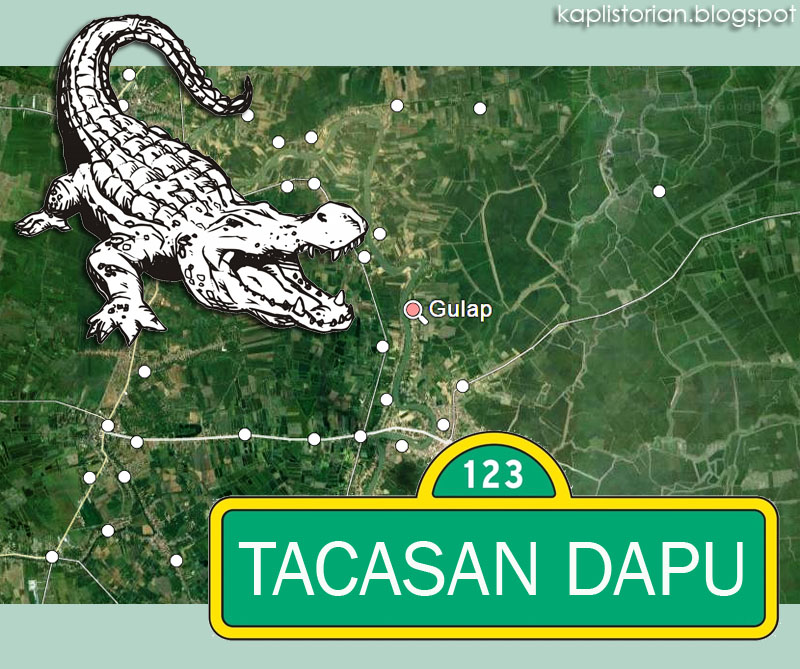
Barangay Gulap of Candaba used to have an old sitio by the name of Tacasan Dapu Legend has it that in the old days, a fishpond called Lucong always overflowed due to a river that always spilled its water into the pond—along with its resident man-eating crocodile. The crocodile always used this spillway to come and go, hence the name, “Tacasan Dapu”. This became an annual occurrence so the residents , fearful of the crocodile’s presence, moved to a new location, depopulating the sitio.

TINANG (Concepcion)
The barrio’s name was actually the nickname of a certain Maria Cristina, the kind wife of a German settler who cleared the area and began a farmhouse there in the 1900s—hence the early name, ‘Caingin Aleman’. After some time,  the place was called simply “Tinang” after the gracious “Indang Tinang”. However, as early as 1853, there was already a barrio by that name in Magalang-Concepcion town, thus dispelling this romantic origin story. This barrio was consolidated with 5 others to form barangay San Miguel during the American occupation.

Sources:
Cojuangco, Tingting. TARLAC
Dizon, Lino L. , AMLAT, Kapampangan Local History Contours in Tarlac and Pampanga, Center for Tarlaqueño Studies, Tarlac State University, 2000.
Dizon, Lino L. East of Pinatubo: Former recollect Missions in Tarlac and Pampanga (1712-1898), Museo Archivo Recoletos,  Center for Tarlaqueño Studies, Tarlac State University, 1998.
Kasaysayang Local: Angeles City, by Zaide Foundation and Dept. of Education, Culture and Sports, All-Nations Publishing, Quezon City, 2000.
Mallari, Joel P. Etymology of Place Names in San Fernando. http://tarebalakdiscovery.blogspot.com/2008/01/baltangan-da-ring-memalen-ning-san.html
Sibug, Edgardo C. Porac, A Rancheria at Batiauan 1594-2004, Municipal Government of Porac, 2006.
Batang Baler:http://www.batangbaler.net/2010/03/28/caledian-and-suklayin/
Historical Data Papers of Apalit, Candaba, Macabebe,

Photo Sources
Balitucan: cornicks: sweetcherriepie.com
Sepung Bulaon: Molave tree, www.flickr.com
Tinang: www.oxpal.com (costumes)
Map of Margot and Mining: Kasaysayang Local: Angeles City
Map of Concepcion: Tarlac
All other maps: google maps