Showing posts with label 1930s. Show all posts

Monday, July 15, 2019

113. 7 ANCESTRAL HOUSES OF GUAGUA: A LIST BY JERRY PUNZALAN SAGMIT

Guagua—or uaua--meaning “mouth of a river”, has been called as such since 1590 owing to its location along the river which played a role in turning it early into one of Pampangan’s most prosperous towns. The affluence of the twon led to the erection of some of the most stunning ancestral residences in the province.
 ********

1. ARRASTIA-GONZALES HOUSE 1929, San Roque, Guagua


2. DE MESA HOUSE 1935, San Isidro, Guagua


3. DR. GALICANO CORONEL HOUSE 1925, San Nicolas II, Betis
Former vice mayor of Guagua in 1928. The symmetrical looking Victorian house or "gingerbread", is notable for its lace-like fretwork carvings, and its graceful steps that lead to a gated open porch. The house sits on a well-kept, manicured garden.

4. GONZALES-ARAULLO HOUSE 1928, Sto. Nino


 5. OCAMPO HOUSE 1928
Former residence of Mayor Isidro Ocampo.

6. SANTOS-OCAMPO HOUSE 1920
Now occupied by the Jiao Family

7. LOPEZ MANSION 1929, San Nicolas 1st
One of Guagua’s most spectacular landmarks is the Lopez Mansion, an imposing concrete residence built by the sugar magnate, Don Alejandro Lopez (b. 16 May 1883). Done in the  Greek revival style, the façade is dominated by Grecian columns accented with reliefs of foliate swags. Sandwiched in between are glass-paneled openings that lead to individual room balconies. During the war, Japanese Col. Gempachi Sato, commander of the 61st infantry took over the house in 1942. The Alejandros reclaimed the house in 1945. Severely damaged by the Pinatubo eruption in 1991, it was restored in 2016 by an heir, Jose Ronrico “Rico” Vitug Gueco. The house is open for social events and for various functions.

ABOUT OUR CONTRIBUTOR.  JERRY PUNZALAN SAGMIT originally hails from Guagua, but now resides in Porac. He operates Funeraria Punzalan, a memorial service company founded by his ancestor Pedro Manalili Punzalan in Arayat in 1930. He is also interested in heritage and local culture and history.

Thursday, March 29, 2018

77. 10 RARE AND EARLY PHOTOS OF FLAGELLANTS IN PAMPANGA


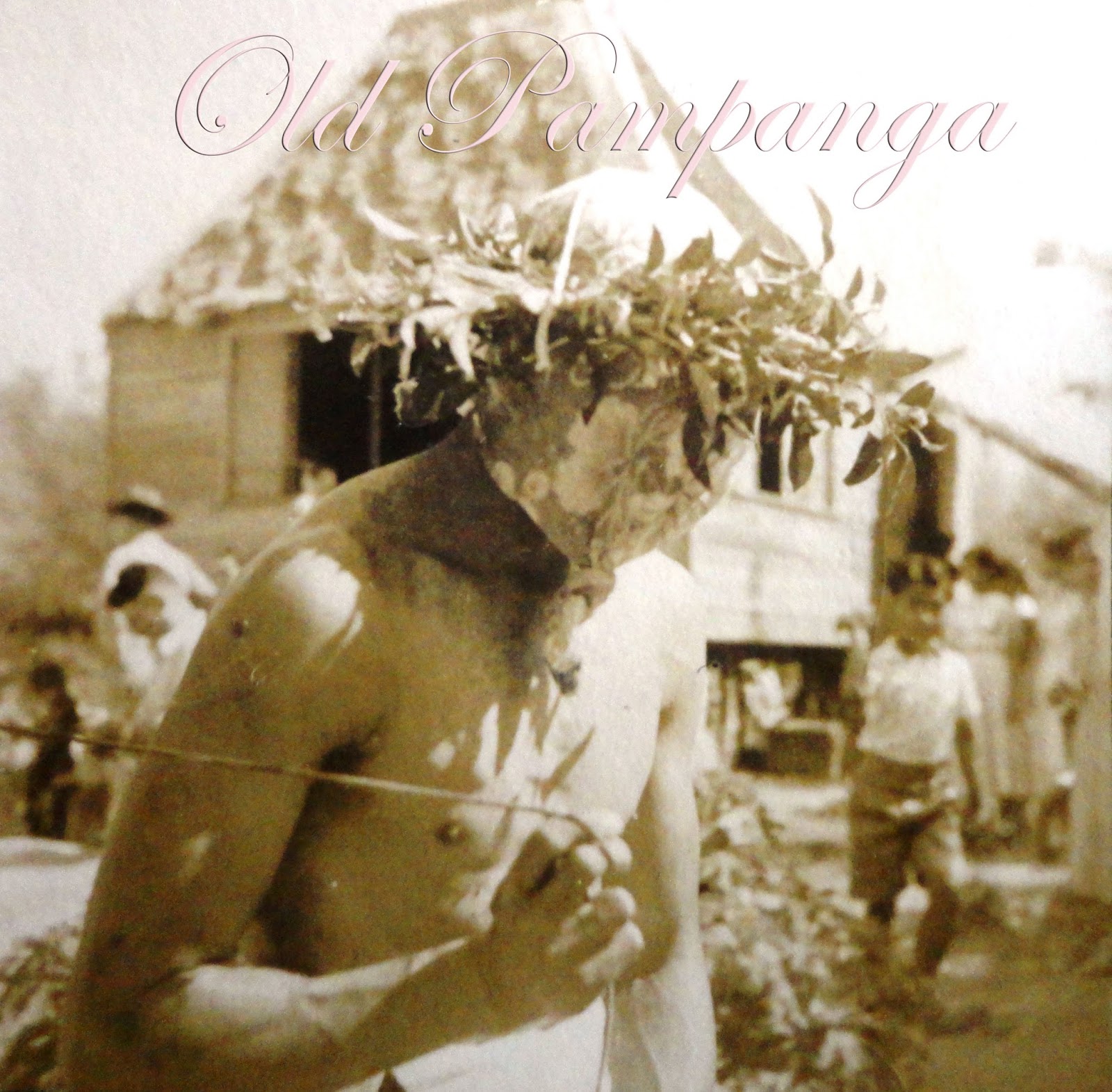
The ways of  flagellants have always inspired awe and curiosity amongst the faithful during the days of Lent. Pampanga flagellants, however, have a different intent. Bloodied, scourged and caked with dust, magdarames live and act out the passion of the Lord—and the term “dámé”, to sympathize and share one’s grief, to take part in someone else’s suffering-- captures this spirit of oneness, in pain and sorrow. Here are, early images of the “magdarame” in Pampanga,  preserved by the camera from the turn of the 20th century to the 1950s.
************

1. MAMALASPAS
Barefooted flagellants from the early 20th century have their backs incised with wounds, drawing blood by whipping their backs with burilyos--bamboo strips tied to a cloth. These magdarame types are called mamalaspas, A distinctive sound is heard when the bamboo strips strike the flesh.

2. MAGDARAMES IN A VISITA
Makeshift chapels of wood, nipa and light materials serve as pitstops for  retinue of magdarames. Here, at these gaily decorated visitas, they pause to say their prayers, before moving on.

 3. MAGDARAME ANONYMOUS.
A magdarame remains anonymous by covering his face with a black hood or a white cloth, called "capariza", held in place by a crown of vines or twisted branches. These days, the face cover is an option as some modern-day flagellants expose their faces to the world. Instead, a piece of cloth is used to covers their heads, Arab-style.

4. BLOOD AND GORE
The back of a magdarame  is incised with a panabad, a paddle with shards of broken glass or directly with a razor or the sharp tip of a knife, such as the one shown in the photo.

5. EYES ON THE MAGDARAME
A group of American ladies from nearby Fort Stotsenburg gawk at a cross-bearing magdarame, followed by his aide, who intones prayers. Then, as now, magdarames were strange sights to see for foreigners. Today, the display of unusual practices such as flagellation and crucifixion are part of a 'religious tourism program' propagated by such places led by the City of San Fernando.

 6. THE CROSS-BEARERS
A popular type of magdarame is the cross-bearer or mamusan kurus. He either carries a cross or is tied to one. This flagellant carries a cross of bamboo, and he carries its full weight as the cross does not touch the ground. Today's crosses are fashioned from commercial lumber from hardware stores, or fashioned from old electric posts. They are also unusually long, so that the end of the cross touches the ground, thus providing support,

 7. THE WAY OF THE CROSS
Flagellants often walked country trails and roads, in small packs of 8 to 12. Others go on solitary walks, the better to reflect on his personal mission to be united in suffering with Christ. An American in a white suit follows this group in their walk of faith.

8. WHIP IT GOOD!
Another kind of magdarame is the sasalibatbat, who fling their bodies to the ground, rolling over sharp rocks and stones in the process. They are followed by a flogger, who whips them when they are on the ground. Their torsos, legs and arms are tied with abaca rope to impair circulation, hence making the experience more torturous.

9. EVERYTHING'S ALRIGHT?
An ayudante checks on the condition of a magdarame, sprawled on the field under the hot, mid-day sun.  The walk around town begins in the morning, ends by early afternoon and is followed by a dash to the nearest river for a quick, recuperative bath.


10. CRUCIFY HIM!
A magdarame is symbolically crucified, by having his arms tied on the crossbar.  The first re-enactment of Christ's crucifixion happened in the 1955 "Via Crucis" in San Fernando, but it was only in 1962 that an actual crucifixion was done, with the nailing of Artemio Anoza to the cross in barrio San Pedro Cutud. Anoza believed he could realize his dream to be a faith healer with his crucifixion.

PHOTO SOURCES:
Photos, courtesy of "Old Pampanga" FB Group.
Others: Alex R.castro, ebay.com 

Wednesday, January 17, 2018

71. 12 EN GRANDE PAMPANGA WEDDINGS HELD IN 1936

One of the most significant milestones in one’s life is the Wedding, in which two people are united in marriage. “Kasal”, is our term for marriage, “kasalan”, the wedding ceremony. The customs and traditions of present-day unions were primarily influenced by a blend of Filipino, Spanish, American and Chinese models. One thing is certain though—when Kapampangans get married, they leave no stone unturned to make sure that theirs is a wedding to remember—the flashier, the better! Here are 12 notable Pampanga weddings in 1936, half of which were held in the “marry” month of June!
**********


LOURDES ALBA & RAFAEL C. HIZON
Married: 30 September 1936, Paco Church, Manila
Sponsors: Dña. Victoria H. vda. De Rodriguez, Don Jaime Hernandez
Notes:
The groom was a successful insurance agent of the National Life Insurance Co. insurance agent at the time of his marriage.

CARMEN DEL ROSARIO & VIRGILIO RODRIGUEZ
Married: 25 January 1936, Sto. Domingo Church, Manila
Sponsors: Dña. Victoria H. vda. De Rodriguez, Dña. Rosa del Rosario Valdezco, Dr. Teofilo Villongco, Hon. Cayetano Rivera
Notes:
Carmeling, a 19-year old Centro Escolar de Señoritas beauty,  and her beau Virgilio Rodriguez ( eldest son of sugar planter  Dña Victoria Hizon Rodriguez and the late Godofredo Rodriguez of San Fernando), had already planned on getting married after college, when the 1935 Manila Carnival intervened. A friend of Carmeling’s father badgered him into allowing her  daughter to run for Miss Philippines.  Thinking that her chances of winning were slim, Carmeling’s father persuaded his reluctant daughter to run. To their utter surprise, Carmeling won the Miss Mindanao title. Her name had already been announced in national newspapers when Carmeling resigned her title to marry the man she loved.

**********


JOSEFINA BUYSON & DR. JESUS EUSEBIO
Married: 12 April 1936, San Guillermo Church, Bacolor
Sponsors: Dña. Bartola S. de Dizon, Hon. Mariano Buyson Lampa
Notes:
Dr. Jesus Eusebio was the eldest son of Don Andres Eusebio,  a prominent sugar planter and businessman, with Asuncion Santos. Jesus was already a practicing ophthalmologist when he proposed to his fiancee, Josefina Buyson. Pitang, as she was called,  was one of the children of Mariano Buyson and Dña. Maria de la Paz Miranda Angeles.  Their well-documented wedding at San Guillermo Church was officiated by Fr. Andres Bituin. The church was decorated with flowers especially brought in a day before by Manila’s foremost florist, Mr. Francisco Hilario. The bride was resplendent in a gown made by Pacita Longos, the most famous couturier of the era. Reception followed at the Buyson residence. Entertainment was provided by Serafin Payawal and Tirso Cruz, Manila’s best big bands.

ESPERANZA PAHATI & ATTY. CARMELINO ALVENDIA
Married: 4 April 1936, Lourdes Church, Manila
Sponsors: Dña. Francisca Pascual de Pahati, Hon. Eusebio Orense
Notes:
Atty. Carmelino Alvendia was the valedictorian of his University of the Philippines law class in 1930. He was the winner of the Callaghan Prize given by the U.P. College of Law. He taught Mercantile Law at  Far Eastern University, and worked with Orense and Belmonte law firm. He hails from Floridablanca, Pampanga.

**********


LUZ HIZON & RAFAEL P. HIZON
Married: 25 April 1936, San Fernando Church, Pampanga
Sponsors: Justice Jose Abad Santos, Dña. Miguela Hizon Teopaco
Notes:
The groom is one of the 8 children of Primo Hizon and Maria Perez of Mexico. Primo was a U.S.T chemistry graduate who carried out researches and scientific studies of diseases and their cures. He would go on to found Hizon Laboratories Inc., the very first pharmaceutical manufacturing company in the Philippines. The pharmaceutical firm still operates today, run and managed by Hizon descendants.

EMILIA P. RORIGUEZ & AMADO R. LUCIANO
Married: 3 June 1936, San Beda Church, Manila
Sponsors: Dña. Josefa Rodriguez, Dr. Andres Luciano
Notes:
Amado is the son of Antonio Luciano, former mayor of Magalang who served for 2 terms, with Nicolas Quiason.
**********


AMPARO Z. DIAZ & DEMETRIO S. SANTOS
Married: 7 June 1936, San Ignacio Church, Manila
Sponsors: Don Mariano J. Santos, Dña. Nieves S. Santos, Justice Anacleto Diaz, Dña. Sotera Z. Diaz
Notes:
Demetrio is the son of Mariano and Nieves Songco Santos. Her bride, Amparo, was two years older. He was 24 when they got married, and he would precede her in death, passing away at just age 43 in California, where they settled with their 6 children. Amparo died in 1985.

MANUELA DE LEON & AUGUSTO HIZON
Married: 20 June 1936, Mexico Church, Pampanga
Sponsors: Dña. Maria Hizon, Don Rafael de Leon
Notes:
Augusto Hizon comes from a very large family—parents Ramon and Maria Hizon had seven daughters and five sons. Coming from a landed class, the Hizons owned haciendas in the province. They also figured in politics, known for being staunch Liberal Party members.”  Augustor’s brother, Rodolfo Hizon, became a post-war mayor of San Fernando mayor. A sister, Corazon, reigned as Miss Pampanga 1933. Meanwhile, Manuela, who hails from Mexico, was the daughter of Don Rafael de Leon, a PASUDECO stockholder,  with Rosario Basa (daughter of patriot Jose Maria Basa).

**********


CORAZON MALIG & BENITO GOLDING
Married: 24 June 1936, San Ignacio Church, Manila
Sponsors: Dña. Remedios Soto de Malig, Don Emilio A. Santos
Notes:
Benito (“Beniting”, “Ben”) Goldman is of Polish-American-Filipino descent. His grandfather, Poland-born Herman Golding, emigrated to the U.S. from Bremen, Germany in January 1856. His father,  Benito “Bennie” Golding Sr. (Herman’s son), married Rosenda Francisco Abriol Santos of Sta. Ana. His bride, Bacolor-born Corazon Malig, was the daughter of Lazaro Malig and Remedios Soto. The couple settled in the U.S. with their children. Benito would pass away first; leaving Corozaon a wido, She died at home in Waldorf, Maryland on 19 April 2003, age 88.

ESTER DE LEON & NORBERTO RODRIGUEZ
Married: 27 June 1936, Sto. Rosario Church, Angeles, Pampanga
Sponsors: Don Jose de Leon y Joven, Dña. Josefa Rodriguez
Notes:
The bride, Ester, was the daughter of Alonzo de Leon and Vicenta Paras of San Fernando. Besides being a sugar planter, Alonzo was a respected leader in finance and agriculture.

**********


CONSUELO CONSING & ARTURO LUMANLAN
Married: 8 August 1936, U.S.T. Chapel
Sponsors: Don Rafael Consing, Dña. Potenciana Cuyugan Lumanlan
Notes:
Arturo Lumanlan is the son of Porac sugar planter Bonifacio Lumanlan, with Potenciana Cuyugan. Consuelo was the eldest child of Rafael Consing with Porfiria Quintana. She would outlive her husband by many years. Arturo’s sister, Juanita Lumanlan-Nepomuceno became Pampanga’a governor and congresswoman.

ANTONIETA PANLILIO & DR. ALFREDO ORTIZ
Married: 27 June 1936, Knox memorial Church, Manila
Sponsors: Dr. Mariano Lamson, Dña. Camila Panlilio

SOURCES:
All photos, Pampanga Social Register, 1936, by Kabigting.
www.viewsfromthepampanga.blogspot.com, various articles
Ninu't Ninu Qng Capampangan, by Kabigting

Saturday, November 18, 2017

66. 20 FUNERAL TRADITIONS & PRACTICES THAT KAPAMPANGANS OBSERVE

All Saints’ Day (Todos Los Santos on Nov. 1) and All Souls Day (Nov. 2) used to be 2 distinct observances until somehow, they merged as one. When campo santos (cemeteries) began being built outside of the town, folks found it convenient to divide their pious duties: Nov. 1 was devoted to grave visits while Nov. 2 was reserved for church rites. Death came early for Filipinos in the 19th century; life expectancy was just about 35 years. Life, was indeed precious, which was why, death was considered major rite of passage, with traditional ceremonies and post-mortem practices created around the inevitable.

**********
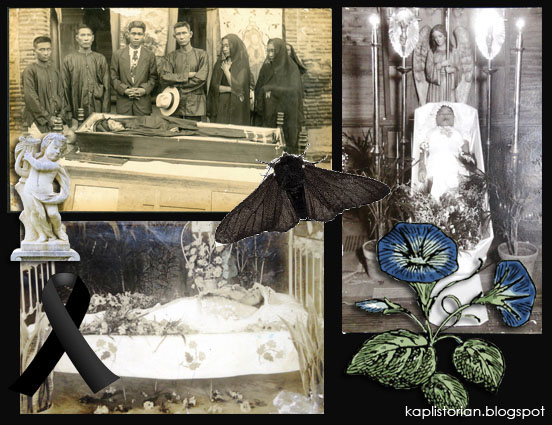
1.There were certain portents of death that old Kapampangan folks believed in: the appearance of a black moth, a dog digging up the ground for no apparent reason, the dreaming of a loss tooth, combing one’s hair at night. To avoid untimely deaths, one should neither position his bed towards the door nor join a picture-taking session if the number of subjects is either 3 or 13. If the toes of the dead curled inwards, beware of another impending death.

2.As soon as someone died in the neighborhood (indicated by loud wailing), neighbors knew exactly what to do next. Members of the grieving family were not allowed to do any work, and so the neighbors took over. There were no funeral services, no embalming, and so everything that needed to be done must be done quickly, before decomposition set in (burial must take place within 24 hours)

3.Early Filipinos believed in the mystical number 7, representing the 7 holes of the head. Our pre-colonial ancestors thus covered their dead’s faces with a death mask cut out with 7 holes. But Kapampangans also believed that an invisible 8th hole exists at the crown of the head of certain special persons, gifting them with the power to liaise between the dead and the living.

4.The deceased was laid on his bed decorated with hangings (black for an adult, white for a child). If the deceased did not own a bed, he was laid out on a mat (dase or banig) on the floor. A black cloth is draped in front of the house to signify a death in the household.

5.The grieving family would have nothing to do but stay beside the dead to weep (they had less than 24 hours to say their final good-byes). If they had to talk to visitors at all, it should be about the life and legacy of the departed.

6.Meanwhile, the teenagers stayed up all night to keep watch and guard against the magcucutud (or manananggal), the airborne supernatural creatures who stole corpses. They entertained themselves by playing card games like entre siete and pierde y gana or playing the traditional Kapampangan games of caragatan (or bugtungan) and talubangan (or bulaclacan), where the boys played butterflies to the girls' flowers.

7.There are certain no-no’s when a death in the family occurred. The family of the deceased were prohibited from bathing, cleaning the house or getting a haircut. The children of the deceased were not supposed to play; if they did, old folks warned, they'd go crazy. A dead should not be perfumed lest he decomposes faster.

8.Children and infants were carried across the coffin to prevent hauntings by the deceased. Taking out the deathbed through the window is another sure way to ward off ghostly encounters.

9.In Macabebe they still do tagulele, an ancient practice that the Bergaño dictionary defined as "the chant of lamentation during a person's wake or burial, relating the bravery of the deceased."

10.Any form of house cleaning is still prohibited during the wake, or another member of the family might also die. When the coffin is already being carried out of the house, however, it should be followed with sweeping of the floor, to drive away illness and bad spirits.

11.Some relatives must also stay behind and peep out of the windows as the coffin is being taken out. The deceased person's bed must be discarded by taking it out of the house through a window, to ensure his happiness in the next life and to prevent another death in the family.

12.The Church dictated the rituals associated with the dead and the dying. Back then, fees were being collected by unscrupulous frailes for walking the dead to his burial ground or for ringing the church bells a certain number of times. During a funeral procession, prayers were intoned at regular intervals called “posas”.

13.During the funeral procession, everyone (not just the family) should be in black and holding lighted candles. The widow and female relatives should wear sucong (long black veils). Rich families spend more to have a punebre (funeral band) and the parish priest accompanying the dead to the cemetery.

14.In those days when there were still no public cemeteries, the dead were buried in private properties, usually the backyard. A child's corpse was always buried neck-deep while a male adult's corpse only knee-deep, in the belief that the soul of older people needed to get out of this world more quickly.

15.When it was time for the dead to be buried, the coffin, as was the custom in old Mabalacat, was placed on a “lankayan”, a stretcher of bamboos, which was then carried on the shoulders of 4 persons. Shortly before burial, relatives younger than the deceased took turns kissing his hand, while the children were held up and passed to waiting arms across the coffin to prevent hauntings. Taking out the deathbed through the window is another sure way to ward off ghostly encounters.

16.Everyone threw in a handful of soil as the casket was lowered, but only the gravediggers were permitted to look at it. There was also the prevalent practice of burying a rosary with the dead, but it had to be cut first lest the dead became restless. (Death is the end of our physical life, but a rosary, in a chain form, is “endless”, so it also needs to be cut).

17.In the first two nights after burial, family and friends gathered around a makeshift altar inside the house to pray for the deceased, have bread, sweets and tea or coffee (nothing more), followed by merriment (more caragatan and talubangan).

18.On the third night, when the soul was believed to come for a brief visit, a seat would be reserved for him at the dining table where ash, instead of food, was put on his plate and covered with cacaricucha leaves. The soul would be pleased to see this and would reward his loved ones with a passing apparition or even clues to some hidden wealth.

19.From fourth to eighth nights, only bread, sweets and tea/coffee would be served again to those who participated in the prayer vigils, but on the ninth night (the uacas of the pasiyam), a big dinner was served. Groups of visitors took turns praying for the deceased before proceeding to the dinner table.

20.The period of mourning ends after a year—lukas paldas—and on this day, the black clothes worn by the bereaved family are finally replaced and kept in the baul. A pa-misa and a grand salu-salo cap this day, with everyone reminiscing about the past year and of the days with their beloved departed. Tears are wiped, laughter returns. Indeed, to everything, there is a season.

SOURCES:
Castro, Alex. Kematen: A Time to Mourn/ Mourning Mortality, www.viewsfromthepampang.blogspot.com

Monday, October 30, 2017

65. 12 STATELY KAPAMPANGAN RESIDENCES, AS THEY LOOKED IN THE 1930s

The 1930s was a period of relative peace and prosperity for many Kapampangans, especially for those who made their fortunes from the province’s burgeoning sugar and rice industry. Old colonial homes were refurbished and expanded, modern residences were built,  designer mansions and multi-storey homes were commissioned to be lived in, and to be seen. Here are some of them as they appeared in the halcyon days of the 1930s.
 **********
The spacious Don Alfonso de Leon residence was designed by Arch. Fernando H. Ocampo, considEred as the “Father of Modern Architecture”. It was constructed with Rizal Cement and furnished with renowned Puyat Furniture pieces.

The residence of Don Luis Wenceslao Dison and Feliza Hizon Dison is located in brgy. San Jose. It is another creation of Arch. Fernando H. Ocampo, built with Rizal Cement, painted by A.B. Villanueva & Sons, and furnished with Puyat Furniture. The 1930s house, whose main features remain intact,  is now being used as the Archdiocesan Chancery.

Don Benigno Fajardo is one of the founding fathers of Lubao Institute which opened in 1929. The most distinctive part of his multi-level house is the double-roofed upper storey terrace, accessible by a grand central staircase.


A prominent sugar planter of Lubao, Don Ambrosio Gonzales (b.1876/d.1957)  is also a socio-civic leader of the town, having founded the Hormiga de Hierro (Ants of Steel) in 1901. His charming 2-storey house, which is enclosed by a metal grill fence, sits on a lush garden and is typical of the modernized homes in 1930s Pampanga.

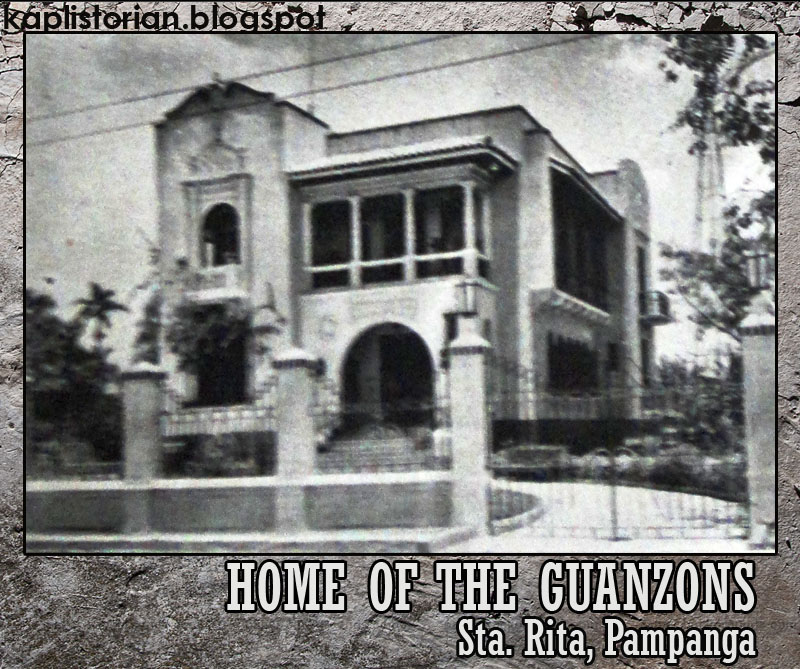
The Guanzon house was built in 1932 by Don Felipe Pineda Guanzon for his wife Dona Epifania Alvendia- Guanzon of Sta. Rita. Known today as Villa Epifania, the concrete house has sleek art deco elements, a style in vogue during the Commonwealth years.

Don Leandro Ibarra, an accomplished lawyer, was named Secretary of Interior of the Philippine Revolutionary Government under Emilio Aguinaldo. His capacious  “bahay na bato” residence was still well-kept and in order in the 1930s,

The Angeles home of Don Jose Lazatin, a  well-known businessman and sugar planter was designed by Menem Tayag. The concrete and wood house is furnished with the latest in Puyat Furniture.

The imposing Lopez Mansion, built in the grand Greek revival style, is reputed to be the first all-concrete house in Pampanga. It is constructed with APO Cement and furnished with Puyat Furniture. Owner Don Alejandro Lopez was a successful planter, owner of the Lopez Rice Mill, Co., and the Vice President of Pampanga Sugar Mills Planters Association. Together with his wife, Jacinta Limson and his family, Lopez resided and also held office here.

The home of Don Jose Luciano in Magalang was a favorite party place of the town’s elite, and the Lucianos would often host dinners and balls for Manila’s high society families like the Madrigals.  The beautiful house with a wide porch. was specially designed by Arch. Fernando H. Ocampo,  built with Rizal Cement and furnished with Puyat Furniture.

The beautiful home of lawyer  Don Pedro Morales (b.1886/d.1945) and Magdalena Hizon, was designed by his wife’s cousin, Arch. Fernando H. Ocampo in Mabalacat. A typical 30s house, it was furnished with Puyat Furniture. When the couple perished in he 1945 liberation of Manila, their lone surviving child inherited the house, and moved it to Magalang. Unfortunately, a fire destroyed the ancestral Morales house.

The house of Don Teodosio Pecson Santos and Josefa Panlilio was another design of the much-in demand architect, Fernando H. Ocampo, and furnished with the usual Puyat Furniture. Located along A. Consunji Street in Barangay San Jose),  it was purchased by the Miranda family, and is now recognized as one of the capital city’s treasured ancestral houses.

Don Emiliano J. Valdes (b. 1876/d.1953), the generous Kapampangan philanthropist who gave his name as well as financial donation to fund Pampanga’s leading TB hospital in Angeles had his grand residence built along Plaridel St. in the mid 30s. The Valdeses had barely enjoyed their new house when his wife died on 20 September 1936.To make matters worse, his house was taken over by the Japanese during the war and turned into a military headquarters. To forget the sad events that transpired in his Angeles home, he sold the house and lot after the war, and the space has since become a commercial area.

SOURCES:
PAMPANGA SOCIAL REGISTER, 1933
Lubao Commemorative Fiesta Program, 1936
www.viewsfromthepampang.blogspot.com, for Emiliano Valdes, Lopez Mansion, Pedro Morales House, 

Friday, August 4, 2017

56. 15 OLD-TIME CIGARETTE WRAPPERS FROM PAMPANGA

LA PAMPANGUENA. CALIXTO SURLA y COMPANIA. Angeles, Pampanga

Cigar and cigarette manufacturing in our islands officially began in 1782, under the tobacco monopoly introduced by Gov. Jose Basco y Vargas. Under the system, the government had complete control of tobacco cultivation  and only only select provinces like Bulacan, Nueva Ecija and Pampanga and Ilocos provinces were authorized to grow the plant. Turn-of-the-century cigarrillos were often packaged in batches of 24s-30s, in wrappers with detailed graphics such as these examples from Pampanga. Local backyard entrepreneurs bought processed cigar leaves from growers in the North and engaged  workers to roll and wrap cigarettes in attractive packages in color, carrying assorted visual themes, often irrelevant to the product, ranging from the patriotic to the mythical and romantic.

 LA ASAMBLEA FILIPINA. (The Philippine Assembly), Betis, Pampanga

 LA FUERZA (The Force), Sto. Nino, Guagua, Pampanga

 DOS AMIGOS, FABRICA DE CIGARILLOS FELICIANO DAVID. Betis, Pampanga

 LA REINA FILIPINA, (Philippine Queen, Purita Villanueva), Betis, Pampanga

 BANDA NANG ANGELES/BETIS. The band from Angeles won first place in the
1909 Manila Carnival Band Contest. Angeles, Pampanga

 DING MUNAG NING ASLAGAN. JOAQUINA, INES, Y ROSARIO BASA.
Angeles, Pampanga

 PLAZA DE BETIS. FABRICA DE TABACOS Y CIGARILLOS, P. CAREON

 EL COSECHERO DE SINUCUAN. (The Harvester of Sinukuan)
PASCUALA FLORES. Arayat, Pampanga

 LA NEGRITA, EUSEBIA BASCO, Angeles, Pampanga

 ATES, FABRICA DE TABACOS, NEMECIO LEONARDO. Betis, Pampanga

 LAS DOS HERMANAS. Bacolor, Pampanga

 VIVA SAN MIGUEL. Sto. Cristo, Guagua, Pampanga

SOCIEDAD BETISENA, SIMON ROQUE. Betis, Pampanga

SINUKUAN. Plaza Sto. Tomas, Pampanga

 KALAYAAN. Plaza Sto. Tomas, Pampanga

PUSA. FABRICA DE CIGARILLOS DE MARIA MARIANO. Betis, Pampanga


SOURCES:
ALL CIGARETTE WRAPPERS, Alex R. Castro Collection
"patriotism in a Puff", www.viewsfromthepampang.blogspot.com