Showing posts with label F. Diego Bergaño. Show all posts

Monday, July 8, 2019

112. 5 REPUTATIONS THAT KAPAMPANGANS WERE WELL KNOWN FOR IN THE 1700s.

By Robby P. Tantingco

Kapampangans today are known for their pride, vanity, culinary skills, loud voice, love for the good life and entrepreneurial skills. But what was their reputation back in the early days? Bergano's Kapampangan dictionary (1729) provides us with clues:
*********
KAPAMPANGAN VANITY
Our female ancestors were magale ("wearing formal dresses outside proper occasion") while our male ancestors were maticas ("good looks, good form in size, waist, figure, shape of legs and calves"), masanting ("handsome"), maticmus ("good figure"), matingquis ("well-dressed"). You can differentiate between a Tagalog and a Kapampangan by putting them on a slippery road: the Tagalog falls while the Kapampangan "very, very rarely falls," according to Bergano.

KAPAMPANGAN PERFECTIONISM
 Our ancestors always insisted on accuracy and excellence, were never satisfied, for example, with grazing a moving target, unlike most Filipinos. "The Pampango," Bergano said, "would say, E me tiran, atambisan mea mu ("You did not hit it, you only grazed it"). Our ancestors had many synonyms for perfection and excellence: sampat ("beauty at its peak;" "the greater perfection"), pauit ("excellence"), liclic ("excellence in writing, debate, running")

KAPAMPANGAN BRAVERY
Bergano wrote, Sagan ya, pablasang indio ya ("He is weak, because he is an indio"), paqui Tagalog ya, nun e talaralit, talaterac ya ("Being a Tagalog, if he is not fond of singing, he is fond of dancing"), paqui Capampangan ya, magmatapang ya ("Being a Kapampangan, he is brave").

KAPAMPANGAN PARIOTISM
Ancient Kapampangans felt a strong attachment to their land and fellow Kapampangans. Bergano observed that our ancestors were proud pablasang daya lang Capampangan ("for they belong to the Pampango nation"). Kapampangans, he wrote, were misangdaya ("you are my countryman," "we have the same blood," "we are all Pampangos") and cadaya ("We are of the same blood even if we are not relatives... we are of one nation").

KAPAMPANGAN ACCENT
Kapampangans were maitad ("They speak with a lilt, with their peculiar accent").

SOURCE:
Reposted from Robby Tantingco's FB Page

Saturday, August 25, 2018

91. 24 SIGNIFICANT BOOKS ABOUT PAMPANGA YOU MUST KNOW, part I

Books written about Pampanga, its people and culture, including its language, literature, history. Some of these books were written by foreigners, others by local writers, in Spanish, in English, and in Kapampangan— great reading essentials to know more about our province. Here are the first 12:
**********

1. VIDA DEL GLORIOSO S. NICOLAS, TRADUCIDA EN YDIOMA PAMPANGO, por el P.R Phelipe Tallada, del orden N.P.S. Agustin, el año de 1614. (Life of the Glorious Saint Nicolas, Translated in the Pampango Language by Rev. Fr. Felipe Tallada, of the order of St. Augustine, in the year 1614).
Significance: This is the first ever book published in Kapampangan, in 1614. It is a biography of the life of St. Nicholas, with prayers and reflections.


2. ARTE Y REGLA DE LA LENGUA PAMPANGA, Compuesto por el Padre Predicador  Fray Francisco Coronel y prior misionero del Convento de Macabebe, 1621. (Kapampangan Grammar and Rules, by Fr. Francisco Coronel, prior of Macabebe, ca, 1621)
Significance: The earliest Kapampangan grammar and rule book in existence.  In 2005, it also became the first Kapampangan grammar book from that period to be transcribed, translated  and annotated in English, by Fr. Edilberto V. Santos. The book still contains the original text with a parallel English translation.


3. VOCABULARIO DE PAMPANGO EN ROMANCE Y DICCIONARIO DE ROMANCE EN PAMPANGO, by Fray Diego Bergaño, first published in 1732, reprinted 1860, 1916.
Significance: This Kapampangan dictionary and glossary book of over 5,177 Kapampangan word entries by the Augustinian priest Bergaño represent not just one of the earliest extant studies of our language, but also probably, the most scholarly and comprehensive. A translated English version was published by the Center for Kapampangan Studies in 2007, along with a Bergaño’s companion grammar book, “Arte de la Lengua Pampanga”, first published in 1729.


4. EJERCISIO COTIDIANO, by Dña. Luisa Gonzaga de Leon, ca. 1844.
(Book of Daily Devotions)
Significance:  Ejercisio Cotidiano (Daily Devotions) is a book of prayers, meditations and reflections, written by Bacolor-born Luisa Gonzaga de Leon (b.1805/d.1843),  printed in Spanish in 1844. This makes her the first Filipino woman to publish a book. In 1910, the book was translated into Kapampangan.


5. ING MACUYAD A PAMAGSALITA DIQUIL QÑG BIE NANG DELANAN AT PANĞATIMAUAN NING METUNG A MEBIJAG. By Fernando Garcia OSA. Published 1900. Imprenta del Colegio de Sto. Tomas. (Translated as “An Epistle of a Friar-Prisoner”, by Lino L. Dizon, 2007).
Significance: A rare account of the captivity of an Augustinian priest, P. Fernando Garcia OSA, written by the Spaniard himself in Kapampangan,  during during the Philippine revolution. It includes accounts of his “sorties from town to town and provinces” as prisoner and missionary at the turn of the century. His observations were critical of the treatment religious received from the revolucionarios. He escaped in Bontoc, reached Manila to write about his trials and tribulations as a POW.


6. GONZALO DE CORDOBA, Comedia Heroica de la Conquista de Granada o sea Vida de Don Gonzalo de Cordova, Llamado el Gran Capitan. By Fr. Anselmo Jorge Fajardo, ca. 1830s. published 1912, by Cornelio Pabalán y Byron. (Heroic Comedy of the Conquest of Granada or The Life of Don Gonzalo de Cordova, Called the Great Captain)
Significance: The longest comedia (also called “moro-moro”) in Philippine literature, the play about the exploits of Capt. Cordoba took seven nights to perform, as the lines alone numbered 31,000. When published, the book was 832 pages long. No wonder, it was only published once, over a century ago.

7. NAPUN, NGENI’T BUKAS, by Aurelio Tolentino. “Ing dramang ‘Napun, Ngeni’t Bukas’ kesukul ne ning ginawa at meatulan king apat a kasalanang sedicion, conspiracion, rebellion at insureccion laban king gobierno Americano”. 1914, Limbagang Noli. (The drama Yesterday, Today and Tomorrow caused the writer to be jailed and charged with 4 crimes: sedition, conspiracy, rebellion and insurrection against the American government).
Significance: This is Tolentino’s play first staged to a jampacked crowd in 1903 at Teatro Libertad. A key scene called for one Tagalog performer to bring down the American flag and then trample it, but the actor froze when he saw Americans in the audience. Tolentino ascended the stage and did the act himself. He was found guilty of “scurrilous libel’ for desecrating the Stars and Stripes,  and was imprisoned.


8. A CHILD OF SORROW. A Novel by Zoilo M. Galang. 1921.
Significance: The first novel in English written by a Filipino. The novel-- was made into a movie in 1930. Zoilo Galang of Bacolor, also was an encyclopedist, who put together the 10-vlume “Encyclopedia of the Philippines” published in 1934-36.


9. HISTORIA NING FILIPINAS. By Santiago Mallari. 1933 (History of the Philippines)
Significance: This slim volume is the first comprehensive Philippine history book in the Kapampangan language. It also has an account of the battle exploits and death of Tarik Soliman, the boy warrior of Macabebe. The book also devotes a section on the  Kalantiao code in Kapampangan, which has since been debunked.


10. PAMPANGA DIRECTORY, Agricultural, Commercial, Industrial, and Professional Guidebook of the Province of Pampanga, The Richest Market Outside Manila. Vol.I, by Manuel David, Managing Editor. 1933.
Significance: This limited edition book, published to commemorate the holding of the 1933 Pampanga Carnival and Exposition, gives us a snapshot of the province in the area of agriculture, commerce, and industries, etc.  during the peacetime era.  All 21 municipalities of the province are represented here, including history, key people, geographical info, products,  among others.


11. NINU’T NINU QNG CAPAMPANGAN, Bilungan Dang Bie ding Anac nang Carangalan Ning Lalawigan Capampangan, by Faustino Gutierrez. 1934 , Catimawan Press.(Who's Who in Pampanga.,  A Compendium of the Lives of the Honorable Children of Pampanga Province).
 Significance: The limited edition book contains photos and brief biographical entries of the leading personalities, families, movers and shakers of Pampanga during the Commonwealth years.


12. A BRIEF HISTORY OF THE TOWN OF ANGELES (From its Foundation in 1796 A.D. to the Present), and his other Writings. By Mariano A.Henson. 1948, Katiwala Press.
Significance: For decades, this was the only widely-referenced published book on the history of Angeles town (reprinted 2002), written by Angeles’ venerable historian and genealogist. His major opus— “The History of Pampanga and its Towns” (rev. 1965)–remains in typewritten and mimeographed form—and continues to be consulted by Kapampangan scholars.

SOURCES:
Singsing Magazine, various issues, Center for Kapampangan Studies, HAU.
Dizon, Lino L. The Epistle of a Friar-Prisoner, as written by F. Fernando Garcia OSA, Center for Kapampangan Studies, HAU.
A Child of Sorrow: http://thessalythea.blogspot.com/2015/07/a-child-of-sorrow-biographical-analysis.html
Historia ning Filipinas, Pampanga Directory, Gonzalo de Cordoba, Napun, Ngeni't Bukas: Alex R. Castro Collection

Wednesday, August 8, 2018

89. 16 FISH NAMES IN KAPAMPANGAN

Fishing is the lifeblood of many Kapampangans especially those living in towns lining the Gran Rio de la Pampanga. As such, the Kapampangan is acquainted with all kinds of fishes that have become so much a part of his life,  his industry and his culture.
**********
BACOCO (Pacific Sea Bream)
There are quite a few species of fish that are called by the name bacoco here in the Philippines of which the Pacific Sea Bream is one.  This particular species is primarily found in estuaries and even in rivers in brackish water.  They are not a particularly large fish however they are a heavy set fish and make a good food fish.

BALULUNGI (Needlebeak)
A folklorist describes balulungi as “a small fish resembling a swordfish”. It could have been coined by combining “balungus” (mouth/beak) with tungi (sharp stick). According to Kapampangan culinary chef Gene Gonzales, these fish were considered “plebeian fare because of their reputation as surface skimmers that feed on floating waste”. A freshwater variety, the balulungi could be the Rynchorhamphus georgii, a long billed, half beak fish., known as baritos, buging and bugiw in other Philippine languages.

BIA (Goby)
Bia are from the very common fish family Gobiidae (goby fish) , one of the largest in the world.  Most of them are relatively small, typically less than 10 cm (3.9 in) in length. The world’s smallest goby fish, Pandaka Pygmaea, is found in the Philippines. This dwarf goby called “bia” or “tabios” has a size that range only from .9 to 1.5 cm. Bia are commercial edible fishes, found in local Kapampangan fare, cooked by the handful in batter and fried.

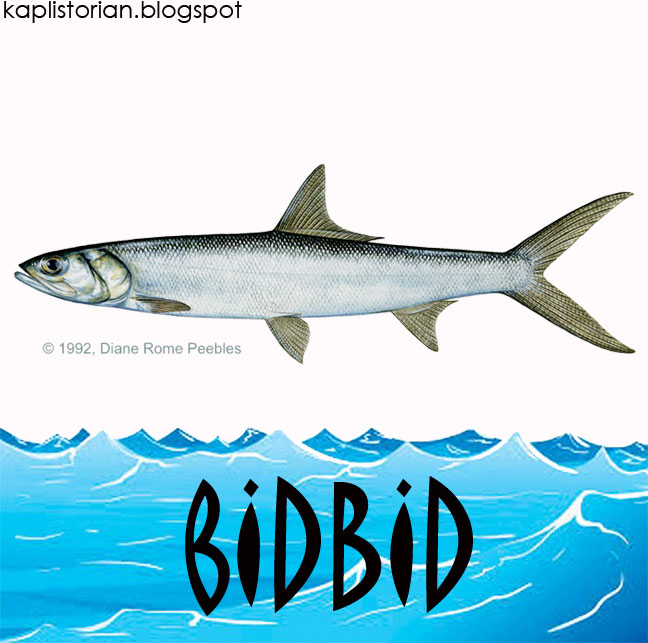
BIDBID (Ladyfish)
These long and slender fish from the Elopidae family are characterized by a small, pointed head, large deeply forked tail, as well as big eyes and mouth, lined with sharp, tiny teeth. Bidid also have small, thin scales  The scales are small and thin. The coastal-dwelling bidbid are foun d throughout the tropical regions where they are known as ladyfish, skip jacks and tenpounders.

BUAN-BUAN (Wolf herring)
This predator fish is quite rare and elusive. It has silvery sides, a long sardine shaped body and large fangs. The riverine barangay of Mabuanbuan in Sasmuan got its name from this fish species, which Bergaño describes as “pescado espinoso”--a spiny fish, with white scales, but delicious. 

BUNDAQUI (Mudfish)
Bundaqui is another old term for “bulig” or mudfish, a big fish that is also known in many Southeast Asian countries. The stages of the bulig’s growth are chronicled by Bergaño—the yellow-striped fingerlings are called “bundalag”,  the grow to their intermediate size called “bundaqui”. The fully grown fish is called “dalag”. French historian Jean Mallat write about this fish during the rainy season: “ It is more or less during this period that they catch in this lake (Candaba Swamp) a great quantity of dalacs, a fish which the Indios are extremely fond of, and which is in fact, delicious. The dalac resembles a very large and very short short eel, and its way of swimming makes it prefer muddy places”.
DULUNGAN (Mullet)
Dulungan or balanak (mullet, banak in Tagalog) is one of the more expensive fishes in the Philippines, common in the Cagayan River, but also in Pampang rivers and estuaries. They are a challenge to catch, and as such, are served during special occasions—as quenelles (creamed fish,  combined with breadcrumbs and egg, then cooked) or served with mayonnaise.

LICAUC (Silver Perch)
This is a small bangus-like fish that teems in ponds after flood or rain, preferred for their small roes (puga). Its Tagalog name is ayungin or silver perch. In the dictionary complied by Fray Bergaño, it is properly termed as lucauc, or pececillos.

LIWALU (Climbing Perch)
This common fish--Liwalu--also gave its name to such places as Maliwalu (in Bacolor and Tarlac City) and Caluluan (Ca-liwalu-wan, in Concepcion). Incidentally, the Historical Data Papers of Concepcion call it archer fish, but American inchthyologist Albert William Herre, who called it “lawalo” classified it as a Climbing Perch, Ananas testudineus (Bloch). This fish is known for prolonged living without water hence the name “liwalu”, meaning “luwal” or outside (the waters).

PACUT (Young river crab)
Pacut is a small-crab like crustacean, which when fully grown, is called talangka, Philippines shore crabs, still smaller than alimasag and ema.

PALAS-SAN (Swordfish)
Bergaño collected a unique Kapampangan term for a swordfish -- “palas-san”. Its Tagalog counterpart, now also rarely used is “tag-gan”. Of course, there is a flat, narrow-bodied fish that we also call “ispada” (beltfish), but this is obviously different from the bigger, predatory swordfish that take its name for its long, flat bill.

PALIMANOC (Ray Fish)
Fray Bergaño was very sparse with his description of “palimanoc”—he just noted that it is “a certain kind of fish, a ray fish”). Rays are a distinctive, cartilaginous marine fishes, noted for their flat, disc-like bodies, broad, wing-like pectoral fins that are fused to the head, and gill slits that are placed on their ventral surfaces. Their tails have venomous spines that can cause injuries.  Their nearest relatives are the sharks.

SAPSAP (Toothpony Fish)
The fish (Gazza mintua, Bloch), also called sapsap in Tagalog, is commonly available in Philippine markets.  It is often used as main ingredient in cooking Filipino favorite fish stews like paksi and pangat.

TABANGOGO (Manila Sea Catfish)
Tabangongo or kanduli (Arius manillensis) is a species of commercial marine catfish endemic to the island of Luzon. First described by the French zoologist Achille Valenciennes in 1840,  the fish inhabits marine, brackish, and freshwater habitats. Compared to the black-skinned “itu”,  the tabangongo has shiny silvery gray skin with a big head, and is delicious as adobo or as sinigang.

TAGAN-BIRHEN (Sole)
The fish with a religious name –tagan birhen (Virgin’s Leftover, solea humilis) is a member of the sole family of fishes (Soleidae). It is sometimes called "tagan ginu" (the Lord's leftover). The flat fish, to imaginative Kapampangans, has the silhouette of the Virgin, with the tail forming the crowned head. It is prized in many restaurants, although some soles are poisonous.

TALANG-TALANG (Goldfish)
There is a talang fish (Queenfish) that is endemic in the Philippines, but this short-headed, skinny, silvery fish does not conform to the description of Bergaño’S Kapampangan talang-talang, which he simply calls a “goldfish”. Its name may have come from “talang”, the round mabolo fruit (velvet apple) which can come in red or golden yellow color. The color, plus the plump shape certainly mimc that of the common aquarium goldfish, which is native to east Asia.

INFO SOURCES:
Dizon, Lino L. , “Fish in the Life of Kapampangan”. Singsing Magazine, Vol. 3, No. 2 issue.
F. Diego Bergano Dictionary, tramslated by Fr. Venancio Samson, CKS, Holy Angel University
Wikimedia

PICTURE SOURCES:
BACOCO (Pacific Sea Bream): https://pam.wikipedia.org/wiki/Bakoko
SAPSAP (Toothpony Fish): https://www.uniprot.org/taxonomy/218819
TAGAN BIRHEN (Sole Fish): https://species.wikimedia.org/wiki/Solea
TABANGOGO (Manila Sea Catfish): http://fishing.ph/fishes/kanduli/

Friday, July 6, 2018

86. 10 KAPAMPANGAN PLACE NAMES AND THEIR ORIGINS, part III


1.      BUCANAN, Magalang
A barangay in Magalang owes its  foreign-sounding name from a modern sugarcane crusher made in England with a “Buchanan” brand, owned by a local haciendero. These imported steel crushers made sugar processing easier, helping modernize the industry.


2.      BUNTUK BABI, Concepcion
The contemporary name of this barangay is Sta. Monica, but its old name, Buntuk Babi (Hog’s Head), is still fondly remembered. The name, as the story goes, was a tribute to a Negrito chief who hanged pigs’ heads as trophies of his achievements. Another version had it that the name came from the locals’ tradition of hanging a “buntuk babi” in their veranda during their fiestas. The barangay was once visited by Felipe “Apo Ipe” Salvador, a religious cult leader of Sta. Iglesia.


3.      CALANTIPE, Apalit
Barangay Calantipe in Apalit was named after a local wetland bulrush or grassweed,  that grew in profusion in the place. Belonging to the genus Scirpus, the calantipe plant has grass-like leaves, and clusters of small spikelets.


4.      CASTULI, Macabebe
The flowering plant (hibiscus abelmoschus) that looked like a gumamela gave its name to an Apalit barrio still known today as Castuli. The perennial herbaceous plants, which can grow up to two meters tall, bears 5-petalled white or yellow flowers, with a red or purple spot at each petal’s base. Castuli has medicinal and culinary uses, Abelmoschus is now recognized as a separate genus from hibiscus plants.


5.      CONSUELO, Macabebe
“Maniup” was the old name of brgy. Consuelo, owing to a story of a ghost that haunted the area that blew (“tiup”) wisps of cool air at people who passed by. But when a wealthy entrepreneur moved in to set up a liquor business there, many locals found gainful employment at his gin factory. As business flourished, the population of the barrio grew as migrant workers streamed in. The barrio prospered even more, and the residents enjoyed lasting “consuelo” (kuswelo, in the vernacular)—contentment and happiness—at last.


6.      MABUANBUAN, Sasmuan
The riverine barangay of Sasmuan—Mabuanbuan---got its name from a specie of fish that thrived in their waters called “buanbuan”, which Bergaño describes as “a delicious fish, spiny and with white scales”.  Thus, “Mabuanbuan” means a place flourishing with buanbuan fish. Surprisingly, Tagalogs call it “bulanbulan”. Buanbuan is a kind of tarpon fish, found  in brackish or freshwater, can measure more than a feet long,  and can be fished all year long.


7.      MALATUMBAGA, Magalang
A sitio of San Vicente, Magalang used to be called “Malatumbaga”,  a hardwood lumber tree similar to molave. The durable malatumbaga is used in house constructions, for making posts, window sills, floors, sculptures, frames, railroad ties and ship-building. In turn, the malatumbaga tree gets its name from a hard, reddish bronze metal called “tumbaga”, used for jewelry.


8.      MAMATITANG, Mabalacat
Mamatitang used to be a vast sugarland with prime sugar haciendas owned by rich Mabalacat people. Mascup River ran through one of its sitios, a popular resort destination.  Mamatitang was named after an early female Baluga settler named “Titang”. “Mama” was an appellation used to address old people and the two words became one.


9.      PAGUIRUAN, Floridablanca
The name “Paguiruan”, sometimes spelled as Pagyuruan, came about due to a local industry that began in the small Apalit barrio. Years ago, people used to go to the place to harvest fruits from buri plants which grew thickly in the area.  They were able to manufacture a certain type of sweet-tasting delicacy  called “yuruan”. It soon grew to a lucrative business for the people, who, in trun, renamed their barrio into “Pagyuruan”, a place where “yuruan” is made.


10.  SUCAD, Apalit
Formerly called Sta Lucia, barrio Sucad derived its name from “sucad”, meaning “to measure, so as to indicate a boundary”. Town lore has it that menfolk from Sucad distrusted male visitors from nearby San Simon who came to their barrio to serenade the local maidens. To prevent possible trouble, the San Simon men were called to inform them that they cannot overstep their bounds. A demarcation line was agreed on to define their barrio’s boundaries, which cannot be trespassed by both sides—“angga mu queni ing ‘sucad’ yu”.


SOURCES:
Historical data papers: Floridablanca, Candaba, Floridablanca, Macabebe, Magalang
Bartolo, Lou Aldrin L., The Magalang Book, NCCA, Center for Tarlaqueño Studies, 2015.
Dizon, Lino L. Amlat, Kapampangan Local History Contours in Tarlac and Pampanga,
Center for Tarlaqueño Studies, Tarlaca State University, 2000.
Sibug, Edgardo C., Porac, A Rancheria at Batiauan 1594-2004, published by the Municipal Government of Porac.
Vocabulario de Pampango en Romance y Diccionario de Romance en Pampango. The English Translation of the Kapampangan Spanish Dictionaryy written by Fray Dego Bergano of the Order of St. Augustine, first published in 1732. Holy Angel University Press.
PHOTOS:
All maps: googlemaps, unless otherwise noted.
Bucanan:  pinterest
Buntuk Babi:
Calantipe:
Consuelo:
HDP, Macabebe
Mabuanbuan,
Malatumbaga:
Mamatitang:
Castro, Alex R. Scenes from a Borderton and other Views, 2006, privately printed.
Paguiruan/ Pagyuruan:
HDP Floridablanca
Sucad: HDP Apalit

Sunday, June 17, 2018

84. 12 MORE BIRDS AND THEIR KAPAMPANGAN NAMES, part II


SOURCES: