Showing posts with label Bacolor. Show all posts

Sunday, May 6, 2018

80. 15 KAPAMPANGAN PLACES, THEIR MONICKERS AND MOTTOS

The use of short descriptive phrases--sobriquets, nicknames, monickers-- to describe places goes a long way back in history. "Pearl of the Orient" (Perla del Oriente) was first used in 1571 for Manila, now used as a sobriquet for the whole country. Central Luzon, which includes Pampanga, was dubbed as the "Rice Granary of the Philippines". Pampanga, of course, lays claim to the title of "Culinary Capital of the Philippines". Not all place nicknames, however, are positive in nature-- some are insulting, some amusing, many hilarious --but this naming tradition lives on today. Recently, town mottos, too, are being appended to rally people to support their municipality's vision/mission. 

**********


ANGELES CITY
Angeles earned its reputation as a center of entertainment with the rise of its barangay, Balibago as a recreation and leisure hub for serving both American and local patrons. The city’s proximity to Clark Air Base jumpstarted the establishments of night clubs, pubs, bars and gambling dens which lined the main avenue of Balibago, as well as the nearby perimeter roads known as Fields and Friendship Avenue. The entertainment strip was lit with neon marquees with Las Vegas inspired names such as Copa Cabana, Nina’s Papagayo, Little brown Jug, and Tropicana. Like Los Angeles, it was dubbed as the “City of Angels”, as it was named for both the founder (Angel Pantaleon de Miranda) and titular patrons  (Los Angeles Custodios).  The Casino Filipino, run by PAGCOR, is also located in Balibago.
“Abe-abe…Saup-saup…Agyu Tamu!” (Together...Helping Each Other...We Can!)


APALIT 
Apalit is the last town of Pampanga as one goes south to Manila, hence its nickname. The town is also famous for its long tradition in blacksmithing, and  the best bolos are said to come from Apalit. Today, th town doe not only produce bladed weapons like machetes and knives, but also domestic steel tools like rakes, hoes, anvils, picks, shovels and garden implements.
“Aplit…Apalit!” (Quicken the Pace...Apalit!)


BACOLOR
Like the ancient capital of Greece—Athens—Bacolor was the undisputed seat of arts and culture of the province, with the highest concentration of poets, artists, zarzuela performers, musicians, singers and writers. Bacolor is the proud home of such literary greats  as Juan Crisostomo Soto, Felix Galura, Luisa Gonzaga de Leon, Jose Gutierrez David, Mariano Proceso Pabalan Byron, Anselmo Fajardo, Zoilo Hilario, among others. Bacolor was also the country’s capital for two years during the Spanish colonial times when Manila was invaded by the British.
“Pluribus Unum, Non Plus Ultra" (Out of Many, No Further and Beyond)”


CAPAS
Capas is one of the richest, most historic towns of Tarlac,  the final site of the infamous Bataan Death March. It is a trekkers’ and mountaineers’ paradise as the challenging Mount Pinatubo treks were first offered by this town, which today continues to  attract thousands of tourists every year, unprecedented in number. This accounts for its latest nicknames as Tarlac’s tourism capital.
"Paspas..Capas!" (Make Haste, Capas!)


DAU
Camp Stotsenburg established its  Post Exchange in Dau, which presaged its rise from a barrio of Mabalacat to  the country's PX capital in the 70s. With the relaxation of Clark rules, PX goods flowed out of the base in abundance, to be resold later in stores  that quickly sprouted like mushrooms along MacArthur Highway of Dau. The completion of the North Expressway that linked Dau to Manila facilitated the great American experience as visitors trooped to Dau to buy Pringles, Oreos, Kellogg’s Corn Flakes, Hershey’s Chocolates, Almond Rocha, Hanes and Fruit of the Loom shirts, imported rubber shoes, branded cosmetics, apples and grapes, among others. The reversal of fortune began with the departure of American servicemen facilitated by the Pinatubo eruption of 1991. Business took a turn for the worse when PX Clubs opened at Clark-which extended PX shopping privileges to Filipinos.  Today, Dau shops continue to flourish, with toilet fixtures, military uniforms, various tools, and used surplus items replacing the once in-demand PX goods.


FLORIDABLANCA
The third largest municipality in the province has so much potential waiting to be untapped that the municipal government came up with a kilometric monicker for the province that reads more like a vision.
“Abe-abe king Panyulung!” (Together in Advancement)


LUBAO
The ancient town of Lubao (old name: Baba) has the sole distinction of producing two presidents: Diosdado Pangan Macapagal (b. Sep. 28, 1910/d. Apr. 21, 1997), who served from 1961-1965 as our ninth President, and daughter Gloria Macapagal Arroyo ( b.Apr. 5, 1947 ), who was our 14th President,  from 2001 until 2010.


MABALACAT
Over 97% of Clark Economic Zone is on Mabalacat land, hence the claim as Clarks economic breadbasket. ‘Makati of the North’ is a monicker coined by the long-running Morales Administration, which came across as too pretentious. The only similarity is, like the Binays of Makati, Morales’ term was a long one, stepping down only 2017, after 22 years in power. The Kamikaze monicker is in reference to the Divine Wind suicide attacks of Japan that was planned in the home of local Mabalacat resident,  Marcos Santos, during the last years of World War II.
“Misanmetung, Mabalacat! (United for once, Mabalacat!)


MACABEBE
In the art of peddling, perhaps no one can compare to the selling skills of the Macabebe cloth vendors. In fact, Macabebe takes pride in being called “Home of the Peddlers”, a reputation built by these native vendors who roamed across the Archipelago, travelling on foot and in groups of two or more, selling the famous ‘Macabebe cloth’—actually, Manila-bought fabrics. These humble, hardworking cloth vendors infused a lot of money into their town and in the 1930s, were largely responsible for pumping up Macabebe’s economy.
"Memalen Macabebe, tapat makiabe!" (Macabebe townfolks are loyal friends)


MAGALANG
Magalang aspires to become the sweet tamarind capital of the Philippines through a locally-propagated tamarind variety known as Aglibut. The late Professor Andres Aglibut, a consultant of Pampanga Agricultural College, successfully developed a  sampaluk type noted for it sour-sweet taste and juicy dark brown flesh. This is in consonance with the town’s “farm tourism” program which aims to revitalize the farm industry of this scenic, agricultural town.
“One Magalang! Metung King Panyulung!” (One Magalang, One in our Stride to Progress)


MINALIN
The town is known as the "Egg Basket of Central Luzon" because of its large scale production of eggs and chickens. According to the municipal government, Minalin earns P30 million per month or P1 million per day from the sales of eggs. There are 22 poultry raisers who own around 280,000 chickens. These chickens produce 479,100 eggs per day. So important is this egg industry that a laying chicken is even included in its town seal.


SAN FERNANDO
The capital city of San Fernando is popularly known as the "Christmas Capital of the Philippines" because of its traditional giant Christmas lantern industry. The establishment of the Paskuhan Village in 1990 served to reinforce its image, but the lantern-shaped complex folded up after the Pinatubo eruption and fell into disarray. Its Giant Lantern Festival held every December remains the city’s biggest attraction, in which the city’s barangays field their biggest and brightest lantern in a friendly competition attended by thousands of local and international tourists.


SAN LUIS
San Luis’ most famous son is the Huk Supremo, Luis Mangalus Taruc, who was born in the barrio of sta. Monica, of peasant parents on June 21, 1913. Following the Japanese invasion, Taruc formed the Hukbalahap (Hukbo ng Bayan Laban sa Hapon), along with Casto Alejandrino and other guerillas, in central Luzon in 1942.  San Luis became one of the hotbeds of Huk activities in the 50s and 60s. in 2017, Taruc was recognizedas a hero by the National Historical Commission of the Philippines (NCHP) for his role the struggle for  agrarian reforms.


SANTA RITA
Sugarcane was the cash crop that made Pampanga so rich, Sta. Rita included. The town is famous for its sweet delicacies-- turrones de casuy (wafer paper-wrapped cashew nougats) and sans rival (rich pastry made with layers of buttercream, meringue, and chopped cashew nuts). Ocampo-Lansang made these treats famous, and which in turn, gave the town’s nickname.
 “Sesen taya ing Santa Rita” (Let's care for Sta. Rita)


SANTO TOMAS
Santo Tomas is the smallest town of Pampanga but it has many unique homegrown industries like red clay pottery and funeral casket-making. The latter products are known for their beauty and fine quality,  made by craftsmen from about 100 registered enterprises, not to mention 200 backyard producers.  Its nickname as the casket capital of the country was given by the Department of Trade and Industry (DTI) in the 1980s, and its reputation shows no sign of waning. It is estimated currently, that 40% of the town depends on the coffin-making industry. It has been the tradition of Sto. Tomas town to donate coffins to affected provinces during times of calamities.

SOURCES:
Dau: Photo by Jun Malig, Inquirer Central Luzon
Floridablanca: www.pampangatalents.com
Photo: by Chris Navarro,
Thursday, April 26, 2018

79. 10 KAPAMPANGAN PORTRAITS PAINTED BY SIMON FLORES


The wish to be remembered after one is gone is only human. People live on, in the stories we conjure as we view portraits. Through their faces, expressions, finery and pose---we see people as the artists saw them. 

In Pampanga, there was no lack of portrait sitters as the numerous members of the landed gentry sought the services of itinerant artists. The most prominent name is Manila –born Simon Flores de la Rosa (1839), who settled in Bacolor and made the rounds of Kapampangan towns, and a handful of his portraits form part of his legacy.

*************
QUIASON FAMILY (San Fernando)
Two Flores portraits of the Quiason Family of San Fernando, headed by Cirilo Cunanan Quiason are still existence today. Cirilo  and his 2 brothers, Lucio and Pablo, were successful landowners and traders, and each one commissioned Flores to create family portraits. The first painting depicts him, at age 33 and his wife Severina David Henson along with  their two children painted in 1875. The artwork costs 50 pesos per head, in gold coins,  for a total of 200 pesos. The seated baby is named Jose.  The older child holding a prayer book is Aureo. The seated baby, Jose, was originally painted naked. He was teased about this when he grew up, so he burned the part that showed his genitals. The painting has been restored since.

The second painting shows the expanded family, painted after 1875. They would have 9 children in all. Ceferina became a widow after Cirilo was accused by the town friar of engaging in seditious acts. The friar, who had romantic designs on his daughter Rosaruo, was rebuffed by Cirilo, who was then captured and tortured.


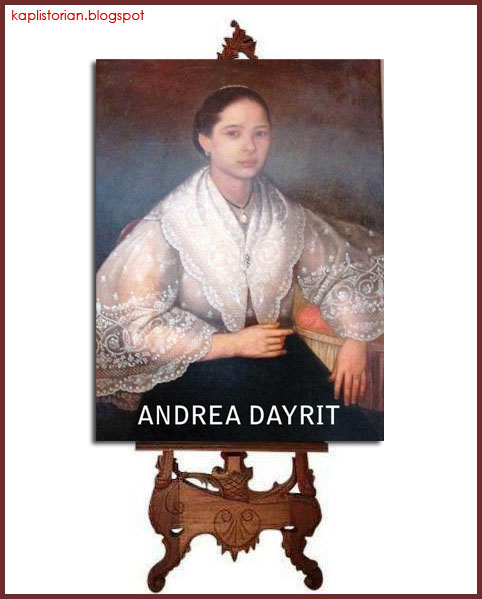
ANDREA DAYRIT (Sta. Ana)
In the town of Sta. Ana, Flores painted the pretty Andrea Dayrit. Her portrait hung in the 1840s Dizon house, famous in its time for its late Neoclassical and English Regency architectural details. Portrait of Andrea Dayrit by Simon Flores, circa 1870s, Oil on canvas, 81 X 58 cm.


MIGUELA HENSON (Mexico)
Mexico has a couple of Flores portraits, and the most well-known is that of long-haired Miguela Henson in front of her Isabelina-style dresser.  It is now in the Bangko Sentral ng Pilipinas collection. Ca. 1880s.


MSGR. IGNACIO TAMBUNGUI (Bacolor)
Flores, who settled in San Vicente in Bacolor, also painted portraits of his wife, Simplicia Tambungui, originally from Guagua, but no work survived.However, in 1890, he painted a portrait of his brother Monsignor Ignacio Pineda Tambungui ,  a canon of the Manila Cathedral and a chaplain at the San Juan de Dios Hospital. In return, Msgr. Tambungui gave his brother-in-law church decorating-commissions in Pampanga towns.


DON JOSE LEON SANTOS (Bacolor)
Bacolor’s most influential couple in the 1850s also sat for Flores.  Don Jose Leon y Santos was one of the sons of gobernadorcillo Francisco Paula de los Santos, Gobernadorcillo and DoƱa Luisa Gonzaga de Leon. Jose Leon Santos became the gobernadorcillo of Bacolor in 1857. The oil portrait of him was done in August 1887 when he was 59 years old.


DOƑA RAMONA JOVEN (Bacolor)
Don Jose Leon y Santos was first married to Arcadia Joven y Suarez. Upon her death, Leon Santos wed her sister, Ramona Joven. Her portrait was completed in August 1882.  Both paintings now hang at the Museo de La Salle.


OLEGARIO RODRIGUEZ (Bacolor)
One of the earliest known works of  Flores, dates from 1862,--when he was just 23. It is that of Don Olegario Rodriguez (1806/1874), patriarch of the still-flourishing Rodriguez clan of Bacolor, when the subject was “56 anos.”  Rodriguez is shown wearing the European black coat with tails, embroidered “nipis” shirt of “pina”, and trousers of a “principalia,” seated on an armchair. Until Pinatubo of 1991, it used to hang in the sala of his ancestral house but has since been secured by Rodriguez descendants in Manila.


SEVERINA OCAMPO DE ARROYO
In Candaba, Flores painted portraits of two matrons, both from the affluent landowning class. The first portrait is that of  Severina Ocampo de Arroyo, noted for her serious, icy stare. A virina-encased ivory santo is shown beside her. ca. 1885.


QUINTINA CASTOR DE SADIE (Candaba)
Another portrait done of a rich lady of the house is that of hefty Quintina Castor de Sadie, nicknamed “Fat Woman from Candaba.” The two Candaba portraits were formerly owned by banker Manuel Martinez Dizon, which he later sold to the Bangko Sentral ng Pilipinas in the 1980s.  


SOURCES:
Msgr. Ignacio Tambungui: Kasaysayan

Thursday, June 15, 2017

50. 18 PAMPANGA LANDMARKS AND MONUMENTS, 2nd of 2 parts

JOSE ABAD SANTOS MONUMENT
Location: Heritage District, Angeles City
Jose Abad Santos was the fifth Chief Justice of the Supreme Court of the Philippines and served as Acting President of the Philippines during World War II. Born in San Fernando (b. 19 Feb. 1886), he and his son Pepito were captured by the Japanese forces in Cebu, then taken to Malabang, Lanao where the jurist was ordered executed. He comforted his son with this noble thought: “"Do not cry, Pepito, show to these people that you are brave. It is an honor to die for one's country. Not everybody has that chance." The monument of Abad Santos stands in the heritage district of Angeles City, in front of the old municipio, now converted into a museum. It was inaugurated on 31 Oct. 1958, during the last term of Angeles Mayor, Manuel Abad Santos, a nephew of Pampanga’s most well-known hero. The plaque, courtesy the Pampanga Masonic Lodge , is inscribed with a re-stated version of his last words given to his son:  “He gave up life to consecrate an idea—that it is a rare opportunity not given to everyone to die for one’s country”.

BENEDICTO T. DAYRIT STATUE
Location: Town Plaza, Magalang
On 28 Dec. 1963, Mayor Benedicto Tapnio Dayrit (b. 21 Aug. 1932) was assassinated by the alleged men of Huk Cmdr. Sumulong during the Magalang centenary celebration at the town plaza. The well-loved mayor was gunned down as the “Mountain Side” evening ball was going on, the highlight of the 3-day festivities to mark the 100th anniversary of the transfer of Magalang town proper.  It was speculated that the Mayor Dayrit was killed because he refused to tax the public school teachers.  In his honor, the Freedom Park and the emergency hospital were renamed after him. A statue in his likeness was also unveiled at the town square in memory of this devoted public servant—the first re-elected chief executive of Magalang,  and who was, as the plaque on the pedestal states, “a champion of the masses, defender of the poor, a devoted public servant beloved by his people.


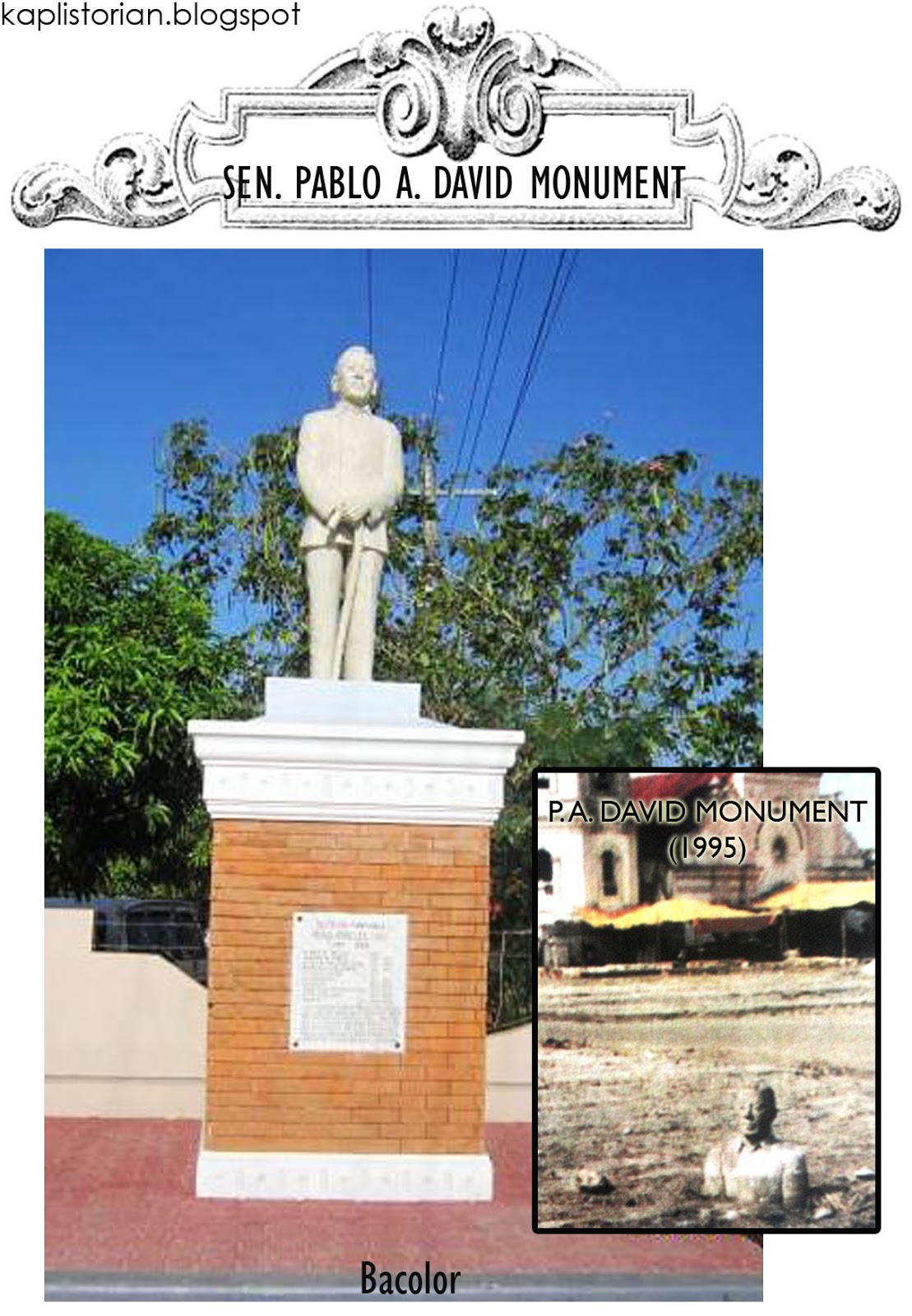
GOV. PABLO ANGELES DAVID MONUMENT
Location: Bacolor, Pampanga
This monument was erected as a token of gratitude to the late Gov. Pablo Angeles David (1889-1965) who served the government in various official capacities. A distinguished son of Bacolor, Pablo Angeles David was born to Carlos de los Angeles  and Ceferina Mesina David on 17 August 1889. He passed the bar in 1910, became a juez de paz for Sta. Rita, Sasmuan and Bacolor  until he became Asst. Provincial Fiscal. Provincial Board Member (1916-1919). He would become the governor of the province from (1931-37), and after his term, served as Judge Court of First Instance (1939-1945). After the war, David was called on to become an acting Governor (1945-1947). He served as Senator of the Philippine Republic from 1948-1953. The monument, as the plaque inscriptions note, is a “symbol of love and affection of the people of Bacolor”, made possible by virtue of Resolution No. 44, Series of 1982 of the Municipal Council of Bacolor.


PRES. MANUEL ROXAS MONUMENT
Location: Clark Air Base
Manuel  AcuƱa Roxas (b. 1 Jan. 1892) was the fifth President of the Philippines who served from 1946 until his death in 1948. He briefly served as the third and last President of the Commonwealth of the Philippines . On the morning of 15 April 1948, at the Kelly Theater in Clark Air Base,  Roxas delivered a speech before the United States Thirteenth Air Force. He suddenly felt dizzy and was immediately brought to the residence of Major General E.L. Eubank. Shortly after, he suffered a fatal heart attack in the evening. Roxas' presidential term is thus the third shortest, lasting only one year, ten months, and 18 days. A plaque originally marked his place of death in Clark. On the occasion of the 56th death anniversary of the soldier-statesman, the Pres. Manuel A.Roxas Foundation (PMARF) and the National Historic Institute, in cooperation with the Clark Development Corp., inaugurated the Pres. Roxas memorial statue  on 15 April 2004.


KAMIKAZE MONUMENT
Location: Japanese War Memorial, Mabalacat
As World War II drew to a close with imminent American victory, Vice Admiral Takajiro Ohnisi arrived in Mabalacat on 19 Oct. 1944 and, meeting in the house of Marcos Santos,  planned organized suicide attack units composed of "Zero aircraft fighters" against the Americans.  Thus, the Kamikaze suicide mission was launched. In all, over 5,000 Japanese pilots died in these missions. In 1975, a Kamikaze Marker was erected in Barangay Cacutud through the initiative of local historian-writer-artist Daniel H. Dizon. Buried in lahar in 1991, it was replaced with a new peace memorial in October 2001. On October 24, 2004, a life-size fiberglass gold statue of an unnamed Kamikaze pilot was unveiled at the Japanese War Memorial, eliciting cries of outrage and disgust that saw print on national dailies. Local tourism official Guy Hilbero, the proponent of the controversial project, maintains that the statue “is not a memorial glorifying the Kamikaze pilots” but its aim is to promote peace “using the lessons of war”. Concerned individuals think otherwise. Dr. Benito Legarda Jr. of the National Historic Institute, calls it a “monument to servility” as “the purpose of the Kamikaze was precisely to prolong the war”.


MONUMENTO FERNANDINO
Location: Dolores, San Fernando
The grand and imposing thirty-foot bronze monument that welcomes everyone to the capital city is a masterpiece of the National Artist Abdulmari Imao, a Tausug who also was one of the Ten Outstanding Young Men of the Philippines in 1968.  “Monumento Fernandino” shows four allegorical figures  aspects of the city’s history—the penitent girl with a lantern, lady with a torch, lady making an offering and a boatman. When seen from a distance, the tableau seems like a plant growing on a barren landscape. San Fernando’s newest landmark was inaugurated in December 2004. 


CAPT. COLIN P. KELLY MEMORIAL SHRINE
Location: cor. Ninoy Aquino Ave. and Foxhound St., Clark Air Base
One of the historic buildings in Clark Air Base was the Kelly Theater, constructed in 1953, the only cinema house in Clark and the venue of many stage plays and cultural shows. There was an earlier Kelly Theater built earlier—in 1947—that was converted from an old gymnasium. Both theaters were names after B-17 pilot Capt. Colin Purdie Kelly Jr. (b. 11 July 1915/10 Dec. 1941)  who died in action against the Japanese forces in 1941. Kelly’s damaged plane, while returning from a bombing run, blew up near Clark Field after being engaged by enemy forces. Capt. Kelly was declared America’s first hero of WWII by US President Franklin D. Roosevelt.  The  memorial statue of the fallen captain was inaugurated on the theater grounds on 10 Dec. 2007—the 66th year of his passing. It was made possible  though the auspices of the Mabalacat Tourism Office and the Air Force Wing of the Philippine Air Force. Lt. Clay Crawford, Chief of the U.S. Air Force Programs of JUSMAG, graced the significant event.


RUFINO CARDINAL SANTOS STATUE
Location: Guagua, Pampanga
Marking his 100th birth anniversary, the Center for Kapampangan Studies of Holy Angel University donated 6-foot statue of the late Rufino Cardinal Santos y Jiao at the Immaculate Parish in Guagua, Pampanga. The country’s first  Cardinal, born in brgy. Santo NiƱo in Guagua in 1908,  served as the Archbishop of Manila from 1953, before receiving the red hat from Pope John Paul XXIII on 31 March 1960. Cardinal Santos was known for founding Caritas Manila, the reconstruction of St. Paul Hospital (now the Cardinal Santos Medical Center) and in rebuilding the war-damaged Manila Cathedral in 1958.  He passed away on 3 Sep. 1973. The statue of the Cardinal Santos was made by Kapampangan artist,  Edillardo Paras. It rests  atop a seven-foot concrete pedestal outside the Rufino J. Cardinal Santos convention hall adjacent to the Parish Church. It was unveiled on 26 Aug. 2008 by Pres. Gloria Macapagal-Arroyo.


LUIS TARUC FREEDOM PARK MONUMENT
Location: Brgy. San Sebastian, San Luis
In July 2013, a public park in San Luis was named after the late Huk supremo,  Luis Taruc ((b. 21 Jun. 1913/4 May 2005), a noted leader of the Hukbalahap guerrilla group, a high-ranking official of the Socialist Party of the Philippines, military leader of the United Front, and an agrarian reform champion. The symbol of his advocacy finds full expression in the monument of a peasant family, celebrating their freedom from the bondage of the soil. The mother holds his baby aloft clutching a laurel crown of victory while the farmer-father holds the implement of his sweat and labors.

BONUS:
PHOTO COURTESY: Jason Paul Laxamana, The Prodigal
Mole Cricket blog
RIZAL "WATERWORLD" MONUMENT
Masantol, Pampanga
A solitary figure of the national hero appears to rise from the floodwaters that have covered the grounds of an elementary school where this solitary monument stands.


SOURCES & REFERENCES:
JOSE ABAD SANTOS. Photo: (old photo) Alex R. Castro, (new photo): Wikimedia commons: https://commons.wikimedia.org/wiki/File:0434fjfJose_Abad_Santos_Monument_Pampangafvf_04.jpg
BENEDICTO T. DAYRIT STATUE. Photo: Magalang Heritage FB Group, c/o Doriz Manlapaz.
Special thanks to Louie Bartolo Lacson for additional info.
(old photo): Singsing Magazine, Center for Kapampangan Studies
KAMIKAZE MONUMENT.
Photo: Kamikaze Pilot Statue, www.pampangatalents.com
KELLY SHRINE
CARDINAL SANTOS:

Thursday, June 8, 2017

49. 18 PAMPANGA LANDMARKS AND MONUMENTS, 1st of 2 parts

Pampanga has but a few monuments that serve as identifying landmarks of our towns and cities. New or old, they commemorate events, mark the achievements of heroes and local icons, and also remind us of the likenesses of figures and personalities they honor. Here are a few of these monuments that stand on the hallowed grounds of our great province.

ANDA MEMORIAL OBELISK
Location: Bacolor, Pampanga
The original 6 meter-high Anda Obelisk was unveiled by town officials in 1853 to honor Gov. Gen. Simon de Anda y Salazar who moved the capital of the Philippines to Bacolor from 1762-64, as the British sacked Manila.  The obelisk stood on a pedestal 1.7 meters high, anchored on a 6 sq. meter base., On the monument’s frontal was a marble plate on which was carved a commander’s cane  and a general’s sword, united by a crown of laurels and palms.  The monument, made of Meycauayan stone, stood in front of the house where Anda lived, across the Bacolor church patio. A similar monument could be found in Intramuros, the centerpiece of the Anda circle, built in 1876. But while the Manila obelisk survived, the memorial in Bacolor was destroyed by revolutionary forces when Spanish forces burned the town in 1899. On 8 October 2012, a replica of the original Anda memorial monument  was inaugurated in front of the town hall, which is across the former site of the Casa Real, the seat of the provincial government.

GEN. MAXIMINO HIZON MONUMENT
Location: Pampanga Capitol Grounds, San Fernando
At the center of the grounds in front of the Capitol Building stands a stately statue of Gen. Maximino Hizon, one of the famous Pampango generals who, during the revolution, distinguished himself in many battles against the Spanish and American armies. Maximino was born on 28 May 1870, of Chinese-Filipino roots, in Mexico. He rose to become the Comandante General of Pampanga and died on 1 Sep. 1901. The monument, which shows the hero wearing a familiar revolucionario hat astride a horse,  was erected on 28 December 1919, by the government and the people of Pampanga.


MACABEBE Ɓ RIZAL MONUMENT
Location: Poblacion, Macabebe
The "Macabebe Ć” Rizal" Monument  manifested the town’s recognition of the making of the Filipino nation during the American period. It was the first act of the Macabebes to honor the icon of the Revolution in 1919 (also the same year the National Flag derived from that of Aguinaldo's was officially instituted as the national colors). The next gesture of Macabebes' participation in the process of nation-building was the erection, in 1934,  of a monument dedicated to their native hero—“To The Brave King of Macabebe",  a symbol of the Macabebes’ bravery and his struggle for freedom from foreign rule. Majority of Macabebes might not have yet developed the concept of a nation in 1898, but they struggled to be Filipinos and underwent the said process.  As Jose Rizal’s 1888 letter to Mariano Ponce declared with longing:   "On the day when all Filipinos should think like us, on that day we shall have fulfilled our arduous mission which is the formation of the Filipino nation”.


JUAN CRISOSTOMO SOTO MEMORIAL BUST
Location: Bacolor
Pampanga’s foremost man of letters--Juan Crisostomo C. Soto (b. 27 Jan. 1867) was known by his pen name Crissot. He was an influential and distinguished poet, playwright, novelist, journalist, publisher and revolutionary who sparked the golden age of Kapampangan literature. His lifeworks works are 49 plays, a novel, a few stories, sketches and a good number of poems and newspaper articles. At the height of his career, Crissot wrote the best-selling novel, Lidia. His zarzuela masterpiece, Alang Dios! (There is no God!) was first performed on 16 November 1902 at Teatro Sabina in Bacolor, Pampanga, and it was reported to have been given a standing ovation once at Teatro Zorilla in Manila. By common consent, Kapampangans immortalized Crissot by naming the popular vernacular poetic jousts Crissotan. The literary giant died on  12 July 1918. On 2 Aug. 1919, the “Aguman 33”, and actor’s club whose members performed in many Crissot zarzuelas, raised funds to build a bust memorial, done by the Quiapo sculptor, Euogio Velarde Garcia. After the town was buried in lahar in 1995, the Crissot Memorial Bust was the first to be unearthed.


AURELIO TOLENTINO MONUMENT
Location: Municipal Hall frontage, Guagua
Pampanga’s most notable revolutionary playwright was born in Sto. Cristo of this town on 13 Oct. 1867. Aurelio Tolentino's law studies in Manila was cut short due to his father’s death, and he returned to Guagua briefly to teach.  He found a job at the Court of the First Instance in Tondo where he met Andres Bonifacio and became a revolucionario. He helped print propaganda materials, was a signatory of the Declaration of Philippine Independence in Kawit on 12 June 1898. But it was his fiery writings that made Tolentino a force to reckon with. He was charged with sedition for his 1903 verse drama “Napun, Ngeni at Bukas” (Kahapon , Ngayon at Bukas) and was imprisoned for 2 years. Other works include the Kapampangan 6-act drama “Buac ng Ester” , “Daclat Kayanakan” and “Kasulatang Guintu”. Aurelio Tolentino died in 1915 and was buried in the North Cemetery. In 1921, his remains were transferred to Guagua, where they were interred in the base of a memorial monument which is now located at the Plaza Burgos, on the right side of Guagua’s municipal hall.


FELIX GALURA MONUMENT
Location: Bacolor, Pampanga
On 24 December 1924, a monument was put up in front of the Bacolor Elementary School by Aguman 33, a band of grateful citizens and friends, dedicated to the memory of a beloved son of Bacolor--“Caluguran Nang Anac Ning Baculud”—Felix Napao Galura. Born on 21 Feb. 1866, Galura became a well-known writer; he assumed the pseudonym “Flauxgalier” (an anagram of his name), and was a regular contributor to the bi-lingual newspaper “E Mangabiran/ El Imparcial” which began publication in 1905. He wrote Kapampangan adaptations of Spanish plays like “O, Kasiran” and “Azucena”. With Juan Crisostomo Soto, he co-wrote “Ing Singsing A Bacal” (The Ring of Steel), a zarzuela based on a Spanish play. ”Ing Cabiguan” (The Misfortune”), a verse narrative published in 1915, is his best-known work. The multi-faceted Galura was not onlya poet, grammarian, revolutionary journalist but also a public servant, serving as  Bacolor’s town head from 1909-18. He passed away on 21 July 1919, at age 53.

KING OF MACABEBE (Nameless Hero)  MONUMENT
Location: Municipal Hall frontage, Macabebe
The young leader of Macabebe led more than 2,000 warriors from Pampanga and Bulacan to expel Spaniards from Luzon on 31 May 1571. He refused the offer of friendship of Gov. Gen. Miguel Lopez de Legazpi and instead, challenged him to a battle in Bangkusay, where the nameless hero perished. For centuries, he has been confused with Rajah Soliman, owing to Pedro Paterno’s assigning him the name “Tarik Soliman”. Spaniards called him “Bambalito”, a pejorative term, that does not really identify him. Nonetheless, in 1934, the brave warrior was honored with a monument showing "The King of Macabebe" seated, armed with a spear and shield. Originally located  in the Poblacion in 1934, it was a donation of then municipal presidente M. Bustos  Zabala and members of the Town Fiesta Committee led by its president, Feliciano Pineda,  In 2010, the monument was inscribed with the name ‘Tarik Soliman”, and 3 years later, with the issue still unresolved, a marble marker used both “Tarik Soliman “ and “Bambalito”. Only in 2016 that the National Historical Commission of the Philippines (NHCP)  corrected the centuries-old error committed by Spanish and Filipino historians, by proclaiming an unnamed leader of Macabebe as the hero and martyr in the Battle of Bangkusay.


GEN. JOSE M. ALEJANDRINO MONUMENT
Location: Municipal Hall Grounds, Arayat
Gen. Jose M. Alejandrino was born to rich parents from Arayat in Tondo on 1 Dec. 1870 and would play many significant roles in our history—as a hero of the Philippine Revolution of 1896 and of the Philippine-American War of 1898. Later in life, he was known as an accomplished political leader-- as a senator for Mindanao and Sulu, and as an elected representative to the 1934 Constitutional Convention.  Even as a student in Spain, he was an active member of the Propaganda movement,  helping edit  Dr. Jose Rizal’s  book, “Noli Me Tangere” and in publishing  “El Filibusterismo”. He served in the 1898 Malolos Congress, and when the Philippine-American War erupted, he rose to the position of brigadier general and became the acting secretary of war. He died on 1 June 1951. To honor his memory his monument was unveiled on 20 October 1963 by the Gov. Jose M. Alejandrino Movement, and sponsored by the Arayat Municipal Scouting Committee. The Gen. Jose M. Alejandrino monument was designed by architects Romeo and Felicisimo Vivencio. The monument, showing the general on his war steed,  was installed on the grounds of the Arayat municipal hall.  It was refurbished after the renovation of the plaza and after the reconstruction of the municipal building.


ING TANDA
Location: Town Plaza, Magalang
“Ing Tanda”, or the Magalang town marker, features a book guarded by an eagle. On the pages of the open book is inscribed the history of the town—from its founding by the Augustinians in 1605 to its turnover to the Philippine Republic  in 1946.  A plaque on its pedestal recounts the same, in English. The marker, designed by the Father of Modern Philippine Architecture, Fernando Ocampo y Hizon of San Fernando, was built through funds raised by town committees. It was installed on 13 December 1954.  

TO BE CONTINUED....


SOURCES & REFERENCES
Photo: Bacolor Anda Monument: Francis Musni
HIZON STATUE. Photos: Ivan Henares, Alex R. Castro
Source: Philippine Social Directory 1934
MACABEBE RIZAL MONUMENT. Photo/Source: Ian Alfonso
CRISSOT BUST. Photo: Sapni ng Crissot FB page
FELIX GALURA MONUMENT.
Photo: (old photo) Alex R. Castro Collection;  
Source: www.viewsfromthepampang.blogspot.com (The Fiery Pen of Felix Galura)
KING OF MACABEBE. Photo: Ruston Banal
Source: Ian Christopher Alfonso, “Nameless Hero” book, 2016.
GEN. ALEJANDRINO. Photo: Religion, Revolution and Rice: Rambling through Bulacan, Nueva Ecija and Pampanga (Part 2, owned by Marco Ph)
ING TANDA. Photos: Magalang Heritage FB page, courtesy of Doris Manlapaz

Monday, April 24, 2017

44. 9 CRIMES INVOLVING KAPAMPANGANS THAT SHOCKED THE NATION

THE MAGALANG SERIAL-KILLER PRIEST (ca. 1813-1826)
Juan Severino Mallari, was a native priest, possibly of Macabebe who completed his religious studies at the University of Sto. Tomas in 1809. Thereafter, he was assigned as a coadjutor in Gapan, Lubao and Bacolor. The artistically-gifted priest  (he was an excellent calligrapher) was plagued by mental problems,  triggered by stressful episodes—first, by  a series of rejections from parishes he applied for—Orani, Mariveles, Lubao, port of Cavite and second, the strange malady that befell his mother. Thankfully, he was appointed as a cura of Magalang.

What happened next was the stuff of horror movies: over a period of 10 years, a series of unexplained murders took place in  Magalang -- a total of 57 murders! When the killer was finally arrested and identified, it was none other than the psychotic parish priest himself, Fr. Juan Severino Mallari! Spanish authorities hauled him off to Manila to be imprisoned , instead of committing him to a mental institution.

In his defense, Fr. Mallari claimed that he had murdered 57 of his parishioners "because he believed that he could by this means save his mother who, he persuaded himself, had been bewitched". The judge was not convinced. In 1840, after languishing in jail for 14 years, Fr. Mallari was executed by hanging --  the first Filipino priest executed by the Spanish colonial government, pre-dating the execution of the Gomburza priests by 32 years!

THE CASE OF THE SCHOOLGIRL MURDERESS (1929)
In 1929, a gruesome murder committed by a Kapampangan made the front pages of national dailies. It was shocking  enough that the offender was a woman, but worse still that she was but a teen-ager! Sixteen year old Avelina Teodoro, of San Fernando, confessed to the killing of  classmate, Constancia Pineda, also 16 years old, who was found dead from knife wounds in the school grounds of Arayat Elementary School.

During the investigation, police found blood stains on Avelina’s clothing and books.  When confronted, Avelina, at first, denied her role, pointing to Hilario Lugtu as the culprit. Two witnesses however, provided damaging testimonies. The first, Crisanto Reyes, testified that Avelina borrowed his single-edge penknife, which matched the size of the wounds on Constancia’s body. The same knife was later found in Avelina’s possession. Second witness Maximo Bundoc, also saw Avelina and Constancia on the day of the murder. Bundoc heard Avelina convinced  Constancia to go inside the toilet, where her lifeless body would be discovered.

It appeared that Avelina had indeed held a grudge against Constancia—she had been spreading shameful rumors about her, and opening her letters without her permission. This, Avelina confided to one Hilario Lugtu. Avelina alleged that Lugtu told her that “he will take care of Constancia”.

The teen killer was sentenced to life imprisonment, plus P1,000 indemnity to the deceased's heirs, a decision upheld and affirmed by the Supreme Court on 12 August 1930. Thus ended the sad, sorry tale of the young Kapampangan murderess, Avelina Teodoro, who tried to get away with murder, but got a life sentence instead.

THE PASUDECO SHOOTING RAMPAGE (1939)
On 12 July 1939, Pampanga was horrified with the news of the  murder of Pasudeco founder and president  Don Jose Leoncio (Pitong) De Leon, his associate Don Augusto Gonzalez and then provincial inspector Capt. Julian Olivas—all committed in the Pasudeco administrative office by the disgruntled Timbols of Mexico and their cohorts.

Brothers Carmelino and Gregorio Timbol, nephew Dalmacio and bodyguard Geronimo Buan had suddenly come to the Pasudeco office, demanding that De Leon and Gonzalez  sign a document that would give the planters 60% participation instead of the 55% they had at that time. When the two refused to sign, the Timbols drew their guns, and a commotion ensued. Pasudeco accountant Ambrosio Razon who heard the threats, immediately called the authorities.

Dispatched to the scene was the unarmed Capt. Olivas,  who tried to pacify the Timbols. He also warned them that the two Pasudeco bosses were under his protection, but as the constabulary officer headed for the door, the Timbols shot him several times and killed him. A melee ensued.  Buan shot Gonzalez in the chest, while Gregorio fatally shot De Leon while he was trying to run to the bathroom for cover. The Timbols made a quick get away through the window, but Pasudeco guards and employees succeeded in wounding Carmelino before they could escape.

The triple killing of Pampanga’s most affluent and influential businessmen and the provincial commander left the nation in shock. De Leon was an outstanding citizen and Pampanga’s first multi-millionaire industrialist,  while  Gonzalez, also a millionaire, was the brother of Bienvenido Gonzalez, UP President. Capt. Olivas had been cited for his bravery by Pres. Quezon.

Dalmacio Timbol and Geronimo Buan were shortly arrested, while the Timbol brothers surrendered to the police the next day.. On 20 April 1940, the Court of First Instance of Pampanga found Gregorio Timbol, Carmelino Timbol, Geronimo Buan and Dalmacio Timbol  guilty of three counts of murder. All, except Dalmacio were sentenced to death.

THE MALIWALU MASSACRE (1950)
The killings of peasants in Bacolor that has come to be known as the Maliwalu Massacre began with Captain Nonong Serrano,  a Captain of the Philippine Military who was also a commander  of the "Serrano Army", a private army that provided protection to  Jose B. Lingad, governor of Pampanga, right after he was elected in 1947. Tragically, Capt. Serrrano would be murdered by Huks, reportedly from Maliwalu.

Retaliation from the Serrano Army was quick. On Good Friday—7 April 1950—Serrano’s relatives and civilian guards descended upon Maliwalu and took nine farmers who were all executed. The rounding up of peasants suspected to be Huks continued and in all, 21 peasants were reportedly seized and summarily killed. It was former governor Pablo Angeles David who brought to light the bloody Maliwalu Massacre to  national consciousness, in rebuttal to the claim of  Pres. Elpidio Quirino that the Hukbalahap force has been decimated. This event would be a major contributing factor to the re-election bid of Lingad, who was blamed for the massacre. He was soundly  defeated by Rafael Lazatin in the 1951 governorship election. The Maliwalu Massacre ranks among the most prominent examples of state-perpetrated armed violence against  Filipino famers, along with the more recent Mendiola and Hacienda Luisita Massacre.

COSETTE’S  83-DAY KIDNAPPING ORDEAL (1964)
For about 3 suspenseful months, the whole nation was riveted to the news of the kidnapping of 15 year-old Cosette Tanjuaquio. The Maryknoll coed was staying in his uncle’s Loyola Heights’ home when, on 16 November 1964, she was snatched by 4 men where she was spirited away and just disappeared. A Php50,000 reward was put up by her distraught parents, Mr. & Mrs. Calixto Tanjuaquio.

The head of the Criminal Investigation Service (CIS) himself, Col. Benjamin Tolentino handled the Cosette case, which had a break only in 25 January 1966 when a counterfeit ring was uncovered. A member of the syndicate accidentally blurted out details of a “kidnapped girl”. This led to the dramatic rescue of Cosette who was found in a World War II air raid shelter next to a pig pen, on 7 February 1965. The dank, dirty pit, only 4 feet high, was accessible only through a narrow 2 ft. x 2 ft. crevice. It was, ironically, just 4 kilometers away from the Tanjuaquio’s Guagua home.

In 1966, the kidnappers—all Kapampangans-- were tried, proven guilty and sentenced by Judge Placido  Ramos. Orador Pingol and Nomer Jingco, the masterminds, were sentenced to death while followers Armando Morales and Angel David were given life sentences.  The judge recommended that the president commute the death penalty to reclusion perpetua for the reason that Pingol and Jingco never took advantage of the victim’s weakness in all the time Cosette was held captive,  hence they still had the “spark of divinity” that boded well for their rehabilitation.

LUCILA LALU’S  JIGSAW MURDER (1967)
28 year-old Lucila Lalu was a probinsyana from Candaba who, in 1957, went to Manila to try her luck in the big city. In a few years, she had became the common-law wife of policeman Aniano de Vera, and established 2 businesses: Lucy’s House of Beauty, and a nightclub, the Pagoda, in Sta. Cruz. On 28 May 1967, Lalu disappeared and two days later, policemen found her dismembered body in two separate areas—her torso along EDSA near the Guadalupe bridge, and her legs at the corner of Rizal Ave., and Malabon St., Her head was nowhere to be found.

The initial suspects were rounded up: Florante Relos, a waiter at the Pagoda and Lalu’s lover,  Aniano de Vera, the 42 year old estranged partner who was the last person ot see Lalu on May 28,  and Jose Luis Santiano, a dental student boarder at Lalu’s parlor.  Relos was released after finding no evidence against him, and de Vera was identified as the one with the strongest motive to kill Lalu-- he had threatened her and Relos after discovering their affair.

Then shockingly, two weeks after Lalu’s death, Santiano confessed to the crime to investigator Sgt. Ildefonso Labao. He alleged that on May 28, Lalu tried to seduced him. In rejecting her advances, Santiano claimed to have accidentally throttled her to death.  Then, he chopped up her body and disposed the parts, including her still-to-be-found head that he threw in a creek near Sct. Albano Q.C. The sloppy investigators had not bothered to check Santiano’s room because Labao said that “they did not consider it important”.

Two days later, Santiano recanted his confession, and the case was even more muddled when “mystery witness” Dr. Nora L. Ebio came forward to testify that Santiano was coerced by Labao into owning up to the crime. When Santiano’s room was finally checked, the door was found to have been forced open, Found inside were bloodstains on the floor, kitchen knife, razor blade and a woman’s stockings—supposed pieces of evidence that the fiscal found so unconvincing, he had the NBI take over. Today, the Lalu chop-chop murder remains an open case.

THE CRIME AGAINST MAGGIE’S VIRTUE (1967)
Maggie de la Riva was already a rising star of  TV and films, when the most despicable crime was committed against her virtue.  On 26 June 1967, while en route back to her New Manila home from  a TV appearance, she was intercepted by a group of young men and taken to the Swanky Hotel in Pasay City where the helpless 25 year old was tortured, punched and then raped. The perpetrators included  by Basilio Pineda, Jr., Eduardo Aquino, Rogelio CaƱal and Jaime Gomez Jose, a combo player and the son of a well-to-do doctor from Pampanga, Dr. Jose Jose.

After the dastardly deed was done, the group dumped de la Riva in front of the Free Press building where a taxi driver took her home. There, the sobbing Maggie told her mother of her rape. It was only a matter of time before the assailants were found.

First to fall was Jose, arrested near his Makati home. All his co-conspirators were captured in succession. Brought to trial, one of the suspects, Pineda said that they “wanted to teach her a lesson” after she allegedly almost hit their car. He then offered  her P1,000 to do a striptease act, to which de la Riva supposedly complied. The court found this story incredulous, and handed out a guilty verdict for the crime of kidnapping with rape. Judge Lourdes San Diego meted out death sentences by electrocution on 2 October 1967.  The accused later appealed, but lost, with the Supreme Court upholding the RTC decision in 1971.

On 17 May 1972, Jose, Pineda Jr. and Aquino were executed in the electric chair in Muntinlupa, despite a last-minute plea for mercy by Jose’s mother in MalacaƱang. The fourth convict, CaƱal, had died of a drug overdose in 1971. Jose, pale and dazed, was the first to die, in the electrocution that was witnessed by his father. His last words were: “Avoid bad companions and obey your parents”. Their deaths provided closure to the tragic De la Riva episode, considered as one of the most sensational cases in post-war Philippines.

MARK DIZON,  SERIAL EXPAT KILLER  (2010)
28-year old computer technician Mark Dizon ranks as one of the most prolific serial killers in the country, with 9 murders attributed to him, three of whom were expats whom he targetted. Dizon befriended  foreign nationals in Angeles City to gain their trust, offering to fix their computers. Once Dizon gained access to their homes, he shot them, stealing their electronic gadgets and equipment, in the process. His victims included Canadian Geoffrey Bennun and girlfriend Abegail Helina (bodies found on July 12), British James Porter and companion Melissa Madarang (found July 16), American Albert Mitchell, his Filipina wife Janet Andrenada, plus their 3 housekeepers. A massive manhunt was launched by the police, and in the afternoon of July 27, Dizon was finally captured in San Fernando, La Union. Found in his possession was a caliber .38 revolver with eight bullets, a laptop, and a cellular phone . A family friend of the Mitchell's recognized the suspect as a Facebook friend of the Mitchells' daughter. Dizon is incarcerated at the Angeles City jail without bail, and is charged for nine counts of murder, filed in three separate cases of five-count murder and two double-murder charges.

THE EDEJER FAMILY MASSACRE (2013)
In the late afternoon of 21 September 2013, in a quiet subdivision in Angeles, seven members of the Edejer household were gunned down by a group of men who forced their way into the residence. Initially, the fatalities numbered 6—Corazon (47, the mother), her 19 year old son Kenneth, housemaid Teresita Camiling, 40, workers Nelson Dominico, 17,  and Benigno Villanueva Jr., 52, and a woman identified only as Kay-kay (20). The 42 year old father, Nicolas Edejer, a fish trader, sustained a gunshot wound in his head, and was taken to a nearby hospital, only to  succumb a day later. Spared was the 9-year old Edejer son who arrived from school, after the incident.

A safe believed to contain cash was brought down by the  killers to the garden. It was subsequently abandoned after they failed to open it. The band of criminals escaped using the Edejer pick-up truck. A “Task Force Edejer” was organized by Sr. Superintendent Oscar Albayalde to track down the killers, but a year after the massacre, investigators remain clueless, and the case still has to be solved to this day.

SOURCES:
MAGALANG SERIAL KILLER PRIEST
Tantingco, Robert P., Peanut Gallery. “Magalang’s Serial-Killer Priest”
 THE SCHOOLGIRL MURDERESS
Graphic Magazine, October 1929 issue
 PASUDECO SHOOTING RAMPAGE:
‘The Life of Jose de Leon y Joven by Jose N. de Leon III’, Performance Printing Center
Criminal Case Nos. 6294, 6295 and 6296, The People of The Philippines, Plaintiff vs. Gregorio P. Timbol, Et Al, Accused
Newspaper excerpts taken from ‘In Memoriam Don Jose Leoncio de Leon y Hizon and Don Augusto Gonzalez y Sioco’, News (Press) Clipping, Philippines Today and Tomorrow, Volume 1, Year 1939, Clipping Bureau
 MALIWALU MASSACRE
Singsing Magazine, Vol. 6, No. 1: “BRavehearts: Kapampangan Rebels, Radicals and Renegades Who Changed Philippine History
 COSETTE’S 83 DAY ORDEAL
Source: “Rescued”, by Jean Pope, The Sunday Times Magazine, 21 February 1965, pp. 18-
 LUCILA LALU JIGSAW  MURDER
“Luckless Lucila and her House of Horrors”, by P. A. Zapanta, Sunday Times Magazine, 2 July 1967. pp. 10-15.
“The Barrio’s Lucia to the City’s Lucila”, by P.A. Zapanta, Sunday Times Magazine, 9 July 1967. pp. 18-19.
 MAGGIE DE LA RIVA
“Maggie, A Rare Kind of Virtue”, Sunday Times Magzine, 16 July 1967, p. 22
“Heroine in a Real-Life Tragedy”, by Benjamin V. Afuang, Sunday Times Magazine, 16 July 1967, pp. 26-31
“My Case Has Started A Revolution,”Maggie de la Riva as told to Jean Pope, Sunday Times Magazine, 13 August 1967, pp. 18-22.
“Life with Mother”, by Jean Pope, Sunday times Magazine, 20 August 1967, pp.”18-2
 Additional Photos: http://www.executedtoday.com/2009/05/17/1972-the-rapists-of-maggie-dela-riva/
 Thanks to: Jason Paul Laxamana for the tip
Photo: Punto! Central Luzon
 EDEJER FAMILY MASSACRE
6 Killed in Massacre at Home of Pampanga Fish Trader, by Tonette Orejas, INQInquirer Central Luzon September 21, 201
Photo source: Justice for Edejer Family FB Page,
FILIPIKNOW.NET, Castro, Alex R., 10 Notorious Crimes That Shocked the Philippines, http://www.filipiknow.net/sensational-crimes-in-the-philippines-1960s/