Fishing is the
lifeblood of many Kapampangans especially those living in towns lining the Gran
Rio de la Pampanga. As such, the Kapampangan is acquainted with all kinds of
fishes that have become so much a part of his life, his industry and his culture.
**********
BACOCO (Pacific Sea Bream)
There are quite a few species of fish that are called by the name
bacoco here in the Philippines of which the Pacific Sea Bream is one.
This particular species is primarily found in estuaries and even in rivers in brackish water.
They are not a particularly large fish however they are a heavy set fish and make a good food fish.
BALULUNGI
(Needlebeak)
A folklorist describes balulungi as “a small fish resembling a
swordfish”. It could have been coined by combining “balungus” (mouth/beak) with
tungi (sharp stick). According to Kapampangan culinary chef Gene Gonzales,
these fish were considered “plebeian fare because of their reputation as surface
skimmers that feed on floating waste”. A freshwater variety, the balulungi
could be the Rynchorhamphus georgii, a long billed, half beak fish., known as
baritos, buging and bugiw in other Philippine languages.
Bia are from the very common fish family Gobiidae (goby
fish) , one of the largest in the world.
Most of them are relatively small, typically less than 10 cm (3.9 in) in
length. The world’s smallest goby fish, Pandaka Pygmaea, is found in the
Philippines. This dwarf goby called “bia” or “tabios” has a size that range
only from .9 to 1.5 cm. Bia are commercial edible fishes, found in local
Kapampangan fare, cooked by the handful in batter and fried.
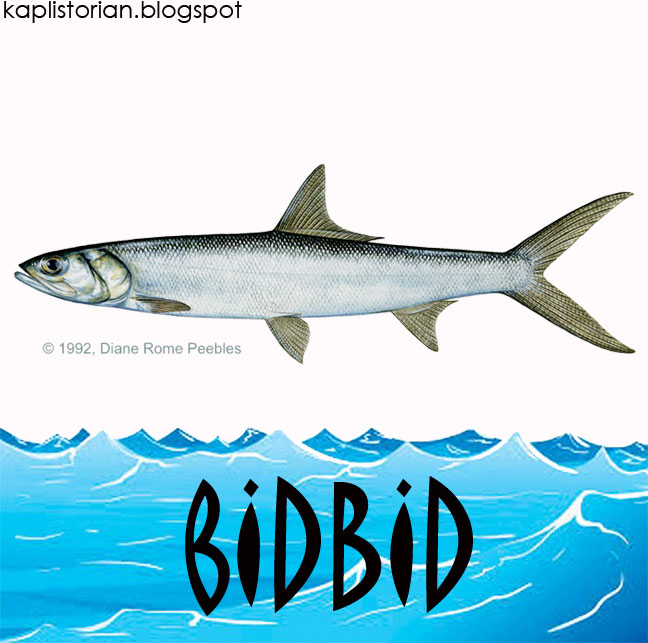
These long and slender fish from the Elopidae family are
characterized by a small, pointed head, large deeply forked tail, as well as
big eyes and mouth, lined with sharp, tiny teeth. Bidid also have small, thin
scales The scales are small and thin.
The coastal-dwelling bidbid are foun d throughout the tropical regions where
they are known as ladyfish, skip jacks and tenpounders.
This predator fish is quite rare and elusive. It has
silvery sides, a long sardine shaped body and large fangs. The riverine
barangay of Mabuanbuan in Sasmuan got its name from this fish species, which
Bergaño describes as “pescado espinoso”--a spiny fish, with white scales, but
delicious.
Bundaqui is another old term for “bulig” or mudfish, a
big fish that is also known in many Southeast Asian countries. The stages of
the bulig’s growth are chronicled by Bergaño—the yellow-striped fingerlings are
called “bundalag”, the grow to their
intermediate size called “bundaqui”. The fully grown fish is called “dalag”.
French historian Jean Mallat write about this fish during the rainy season: “
It is more or less during this period that they catch in this lake (Candaba
Swamp) a great quantity of dalacs, a fish which the Indios are extremely fond
of, and which is in fact, delicious. The dalac resembles a very large and very
short short eel, and its way of swimming makes it prefer muddy places”.
Dulungan or balanak (mullet, banak in Tagalog) is one of
the more expensive fishes in the Philippines, common in the Cagayan River, but
also in Pampang rivers and estuaries. They are a challenge to catch, and as
such, are served during special occasions—as quenelles (creamed fish, combined with breadcrumbs and egg, then
cooked) or served with mayonnaise.
This is a small bangus-like fish that teems in ponds
after flood or rain, preferred for their small roes (puga). Its Tagalog name is
ayungin or silver perch. In the dictionary complied by Fray Bergaño, it is
properly termed as lucauc, or pececillos.
This common fish--Liwalu--also gave its name to such places as
Maliwalu (in Bacolor and Tarlac City) and Caluluan (Ca-liwalu-wan, in
Concepcion). Incidentally, the Historical Data Papers of Concepcion call it
archer fish, but American inchthyologist Albert William Herre, who called it
“lawalo” classified it as a Climbing Perch, Ananas testudineus (Bloch). This
fish is known for prolonged living without water hence the name “liwalu”,
meaning “luwal” or outside (the waters).
Pacut is a small-crab like crustacean, which when fully
grown, is called talangka, Philippines shore crabs, still smaller than alimasag
and ema.
Bergaño collected a unique Kapampangan term for a
swordfish -- “palas-san”. Its Tagalog counterpart, now also rarely used is
“tag-gan”. Of course, there is a flat, narrow-bodied fish that we also call
“ispada” (beltfish), but this is obviously different from the bigger, predatory
swordfish that take its name for its long, flat bill.
Fray Bergaño was very sparse with his description of
“palimanoc”—he just noted that it is “a certain kind of fish, a ray fish”).
Rays are a distinctive, cartilaginous marine fishes, noted for their flat,
disc-like bodies, broad, wing-like pectoral fins that are fused to the head,
and gill slits that are placed on their ventral surfaces. Their tails have
venomous spines that can cause injuries.
Their nearest relatives are the sharks.
The fish (
Gazza mintua, Bloch), also called
sapsap in
Tagalog, is commonly available in Philippine markets.
It is often used as main ingredient in
cooking Filipino favorite fish stews like
paksi and
pangat.
TABANGOGO (Manila Sea Catfish)
Tabangongo or kanduli (Arius manillensis) is a species of commercial marine catfish endemic to the island of Luzon. First described by the French zoologist Achille Valenciennes in 1840, the fish inhabits marine, brackish, and freshwater habitats. Compared to the black-skinned “itu”, the tabangongo has shiny silvery gray skin with a big head, and is delicious as adobo or as sinigang.
The fish with a religious name –
tagan birhen (Virgin’s
Leftover,
solea humilis) is a member of the sole family of fishes (Soleidae). It is sometimes called
"tagan ginu" (the Lord's leftover). The flat fish, to imaginative Kapampangans, has the silhouette of the Virgin, with the tail forming the crowned head. It is prized in many restaurants, although some soles are poisonous.
TALANG-TALANG
(Goldfish)
There is a talang fish (Queenfish) that is endemic in the
Philippines, but this short-headed, skinny, silvery fish does not conform to
the description of Bergaño’S Kapampangan talang-talang, which he simply calls a
“goldfish”. Its name may have come from “talang”, the round mabolo fruit
(velvet apple) which can come in red or golden yellow color. The color, plus
the plump shape certainly mimc that of the common aquarium goldfish, which is native
to east Asia.
INFO SOURCES:
Dizon, Lino L. , “Fish in the Life of Kapampangan”.
Singsing Magazine, Vol. 3, No. 2 issue.
F. Diego Bergano Dictionary, tramslated by Fr. Venancio Samson, CKS, Holy Angel University
Wikimedia
PICTURE
SOURCES:




_(PSF).png)

--Fenale.jpeg)
.jpeg)
.jpg)


.png)


_with_worm.jpg)

.jpg)
-_Immature_feeding_in_Kolkata_I_IMG_1898.jpg)


.jpg)
_in_flight.jpg)

.jpg)

_Wild_duck,_Stockente,_Anas_platyrhynchos_ginsheim-gustavsburg.JPG)
