Showing posts with label 1950s. Show all posts

Saturday, June 15, 2019

110. 10 KAPAMPANGAN MOVIE ACTRESSES AND THEIR ORIGINAL NAMES, part II


1. ROSA DEL ROSARIO
The pre-war Queen of the Philippine Movies was born in Bacolor (b. 15 Dec. 1919) as Rosa Stagner, the daughter of Agustina Del Rosario and American Frank Stagner. Her discovery was purely accidental. Rosa accompanied a foreign film director to Malayan Motion Pictures who was looking to work with a local  movie production  outfit. The wife of the owner of Malayan —Mrs. Jose Nepomuceno—saw her and convinced her husband to cast her in “Ligaw na Bulaklak”. She took her mother’s surname and was billed as Rosa del Rosario. Thus began her long, and successful career.  She starred with the major leading men of her time, but she is best known for her role as “Darna”, a comics super heroine created by Mars Ravelo that was made into a movie in 1951, and directed by Fernando Poe Sr.


2. LILIA DIZON
Born in 1931 as Claire Strauss, the only child of German-Jew Abraham Strauss with Kapampangan  Regina Dizon, Lilia Dizon began her showbiz career at age 15 as a singer at Lotus Theater. She was discovered for the movies by writer-director Susana de Guzman and was cast in her first lead role in  “Kaaway ng Babae,” (1948). At 17, she married director Gil de Leon, sixteen years her senior. She made her mark portraying strong woman roles in movies like “Sandra Wong,” “Kandilerong Pilak” (Asia’s Best Actress award in 1954), and "Bathaluman” with Mario Montenegro. After her 18 year-marriage ended, Lilia left for the U.S. in 1966 to join her father in California. She resurfaced in 1974 as the reel-and-real life mother of Christopher de Leon in the award-winning Brocka film, “Tinimbang Ka, Nguni’t Kulang”.


3. CHERIE GIL
Evangeline Rose Gil Eigenmann (b. 21 Jun. 1963), known in the movie world as  Cherie Gil was born to a showbiz family. Her mother, Rosemarie Gil, comes from the old Spanish family of Gils who settled in Porac. Cherie's father is 60s matinee idol, Eddie Mesa. She started her  career as actress-singer at age 9. As a singer, she scored a hit song with “(I Love You) Boy”, later covered by the Nailclippers. In films, she may be best known as Lavinia Arguelles in “Bituing Walang Ningning” (1985), Sharon Cuneta’s tormentor. She often appears as a movie villainess and still makes appearances in TV soaps, movies and in reality TV programs.


4. HILDA KORONEL
Born in Plaridel, Angeles City (b. 17 Jan. 1957) to Marina Higum and David Reid, Hilda was launched at age 13 in the movie “Haydee” (1970). Her acting skills were honed by renowned director Lino Brocka who transformed the teen sensation into to an actress of international repute. She was the youngest recipient of the FAMAS Best Supporting Actress award when she won for “Santiago” that same year. She took Cannes by storm with her intense portrayal of a daughter scorned in the 1975 movie, "Insiang". Formerly married to actor Jay Ilagan, Koronel now resides in the U.S.with second husband Ralph Moore.


5. LIZA LORENA
The Kapampangan actress who rose to stardom via a beauty pageant was born Elizabeth Ann Jolene Winsett y Luciano (b. 31 Oct. 1949) to American George Winsett and Magaleña, Josefina Luciano. She had been the first runner-up in the 1966 Bb. Pilipinas. This paved the way for movie offers. Nepomuceno Productions gave her a screen test, which she passed. She was cast as Esperanza in a major film headlined by  Charito Solis and Ric Rodrigo.  As Liza Lorena, she appeared in the critically acclaimed ”Dahil sa Isang Bulaklak” (1967),  the first Philippine movie in color by De Luxe. Her career spans 4 decades, with more than 185 movies and television shows to her credit. Her son with Eddie Gutierrez,Ton-Ton Gutierrez, is also an actor.


6. LYDIA MONTAÑEZ
Tatiana Korionoff (b. 1933) was the daughter of Russian Victor Paul Korionoff and Marcelina Simbulan of Arayat, Her father had fled his country at the height of Bolshevik revolution. From China, Korionoff  moved to the Philippines where, in 1926,  he found work as an engineer at the Arayat Sugar Central. He married the 18-year old Simbulan and settled in Arayat permanently. Tatiana was the eldest girl in a brood of 9. She was discovered for the movies by Leopoldo Salcedo. She took the screen name Lydia Montanez from her foster aunt named Lydia, and Montanez--from the mountain town where she was born. Lydia became a contract star for Fernando Poe Sr.'s Royal Productions, doing movies like "Lihim ni Bathala"."Maria Bonita", "Isinanlang Pagibig" and "Mona Lisa".


7. ALMA MORENO
Moreno (b. 25 May 1959) was the child of Frank Laxamana of Macabebe, with Jean Moreno. Named Vanessa (or Venesa) Moreno Laxamana, she shortened her name to Alma Moreno for her first movie, ”Urduja”. Her first starring role was in Ishmael Bernal’s “Ligaw na Bulaklak” Part 2 (1976), which turned her into a star. For portraying sexy, Lolita-type girls on screen, she was dubbed the  "Sex Goddess of Philippine Movies" of the 1970s-80s. Other noteworthy films: ” Eva Fonda, 16” (1976), “ City After Dark”(1980), and “Mga Bilanggong Birhen”. On TV, she was famous for her dance moves in The Other Side of Alma and LoveliNess.  She had relationships and children with Rudy Fernandez and  Dolphy. Moreno was also previously married  to Joey Marquez and Sultan Fahad Salic of Marawi. 


8. ROSITA NOBLE
The bedimpled Rosita Costenoble (b. 1934)  was the  first-born of  German immigrant, Herman von Costenoble, who a married local girl from Floridablanca, Maria Panlaqui. In 1951, at age 17, she was cast in the epic movie “Sta. Cristina”, under Premiere Productions. Before long, she became one of the hottest stars on the silver screen, known for her costumed action movies like “Ibong Adarna”, “Siete Infantes de Lara” and “Prinsipe Amante”.  She had the distinction of being the first leading lady to be paired with an up-and-coming young star—Fernando Poe Jr.—in “Anak ni Palaris” (1955). Rosita married Turkish-Filipino Antonio Basmayor Tani from Albay, with whom she had 5 children.


9. PATSY
The loveable, laughable Patsy Patsotsay was born (b. 12 Apr. 1916) as Pastora Mateo. Her father hails from Lubao. She started as a bodabil song-and-dance girl who performed alongside such veterans as Katy de la Cruz, Tugo, Pugo and Amanding Montes. Patsy was also part of the celebrated group of seven bungling househelps ( with Aruray, Chichay, Menggay, Elizabeth Ramsey, Dely Atay-Atayan, Metring David) in the blockbuster movie “Pitong Atsay” (1962). But she is perhaps most well-known as a co-host (with Lopito) of the greatest talent search in Philippine TV history--Tawag ng Tanghalan.


10. ROSA ROSAL
Florence Danon y Lansang  (b. 16 Oct. 1931) of  Sta. Rita, Pampanga, was discovered by film producer Luis Nolasco and was introduced in “ Fort Santiago” (1946). She became an  LVN Pictures star, most famous for her role as a vamp with the heart of gold in the award-winning “Anak Dalita” (1956) directed by Lamberto Avellana. Other notable movies: "Sonny Boy" (1955) for which she won a FAMAS Best Actress award), "Badjao"(1956) and "Biyaya ng Lupa" (1959) .Rosal is also well-known for her charitable and humanitarian  work with “Kapwa Ko, Mahal Ko”, and the Red Cross. For her selfless efforts, she received the Ramon Magsaysay Award for Public Service. Married to Walter Gayda with whom she has a daughter,  Toni Rose.

Wednesday, May 15, 2019

109. 12 KAPAMPANGAN MOVIE ACTORS AND THEIR ORIGINAL NAMES

As an actor’s name, Ronald Kookooritchkin seems a tad too long, so the artista wannabe shortened it and became Ronald Remy. Meanwhile, Augusto Valdes Pangan wanted to be a comedian, but his name was anything but funny, so he became known  as “Chiquito”.  In more recent times, the career of aspiring actor Richard Faulkerson Jr  was going nowhere until the studio changed his name to Alden Richards.  See what a name change can do!  Let’s take a look at the original names of Kapampangan movie stars, before they became famous!

 ********

1. BENTOT
Born Arturo Vergara Medina (b.1928/d. 1986) in San Simon, Benton began his showbiz career in 'bodabil' shows. At age 19, he made his first movie under Sampaguita Pictures, "Maria Kafra" (1947) billed as Ben Cosca. He was cast in the radio program, “Sebya, Mahal Kita”, along with Sylvia La Torre and Pugo,  where h used his screen name “Bentot” for the first time. In 1961, "Tang-tarang-tang", a spin-off of "Sebya" started on DZRH, which became so popular , it was turned into a TV series. His “Bitoy” character made him a household name. He remained active through the 70s, passing away in 1986 due to heart failure. His son, Bentot Jr.,also became a comedian.


2. MANUEL CONDE
The son of an Italian mestizo, Dionisio Urbano, and Lucia Pabustan of San Fernando,  Manuel Urbano was born in  Daet, Camarines Norte on 9 Oct. 1915. After high school in 1931, Urbano left for Manila to enroll in engineering at Adamson University, but got sidetracked by the movies, where he worked in production.  After his studies, he joined Marsman & Co., got married,  and moonlit with  Borromeo Lou’s repertory group using the screen name “Manuel Conde”.  He passed up an opportunity to work abroad by assisting Carlos Vander Tolosa  in directing the 1939 film,”Giliw Ko”.  Thus began a directing career highlighted by “Genghis Khan”, a historical costume movie that was accepted to the prestigious Venice Film festival in 1952, where it became a sensation. After his return, he did more LVN hit movies and started the popular “Juan Tamad”film series. Manuel Conde passed away at age 69 on 11 August 1985.


3. APENG DALDAL
This Kapampangan motormouth was born as Serafin Gabriel in San Luis, Pampanga on 12 October 1928. After ditching his job as a cargador in Divisoria, he discovered bod-a-bil, formed a comedy group called “Top Three” which performed at the Manila Opera House. His stage success paved the way for a TV and movie career. His non-top gabbing gave him the name “Apeng Daldal”.  He was third-billed in 1964 production “Magic Bilao” after Rosemarie and Dindo Fernando, which became a certified hit. His next flick,”Walis ni Tenteng”, was an even bigger  blockbuster. Now an A-lister, Apeng Daldal worked nonstop on films  like “Tatlong Mabilis” (1965), “Mistiko Meets Mamaw” (1966), “The Pogi Dozen”(1967), and  “Baticobra at Flying Salakot”(1974). The final decades of his life were spent working in different capacities for TV, radio and films. Afflicted for years with emphysema, he passed away on 9 February 1992.


4. BEN DAVID
Deep-voiced Bienvenido Parungao was the son of Enrique Parungao and Raymunda David, both Kapampangans. He had a deep, baritone voice which led to  jobs in the budding radio industry  of the country. He made his mark on air with his overly dramatic signature quips: “O, hindeeee!” and “Hangaaal!”. He joined DZAQ as announcer in 1966, an apt host for the program,”Ginoong Mananakot”. Taking on “Ben David” as a screen name, he was cast in “Da Best Show”, “Tang-Tarang-Tang” and “Buhay Artista”. Most famous character role: playing Hudas Iscariote to the hilt. He was nominated for a FAMAS Best Supporting Actor for “Alamat ng Sandaigdig” (1961), adapted from a DZAQ radio serial. On TV, David had recurring roles in “Rosemarie-Pepito Show” and “Oras ng Ligaya”. In the 80s, David managed a male entertainment club in Manila, until he passed away.


5. EDDIE DEL MAR
The actor best known for portraying Jose Rizal on the silver screen was born in Candaba on 13 Oct. 1923 as Eduardo Magat, the son of Albino Magat and Benigna Sangalang. During the war, he became a guerilla fighter. A classmate of his, Lucas Usero, introduced him to the Veras of Sampaguita Pictures which led to a screen test with director Gerry de Leon. Passing that, he was introduced as “Eduardo del Mar” in "Kapilya sa May Daang Bakal" starring Oscar Moreno and Tita Duran, where he left quite an impression. When director de Leon began his 1951 hit movie, “Sisa”, he remembered del Mar, and cast him as Crisostomo Ibarra. It was his 1956 film, “Ang Buhay at Pag-ibig ni Dr. Jose Rizal” that would change his showbiz career forever. He essayed the role of the national hero so perfectly that he won the 1956  Best Actor Award. He would make another Rizal movie, the film adaptation of “Noli Me Tangere”, which won “FAMAS Best Film” in 1961. To showcase his versatility in portraying roles of opposing characters, he appeared as the revolutionary hero, Bonifacio, in the 1964 epic, “Andres Bonifacio (Ang Supremo)”. Eddie del Mar died on 8 Nov. 1986,


6. TONY FERRER
Antonio Laxa (born June 12, 1934) of Macabebe went by the screen  name “Tony Ferrer”, and earned the reputation as the Philippine James Bond with his Agent X-44 character. The award winning actor-director was the younger brother of Atty. Espiridion Laxa, of Tagalog Ilang-Ilang Productions. Most of Ferrer’s films were action movies including “Kilabot Sa Barilan “(1960),  Suicide Commandos (1962), and “Marcong Bagsik” (1964), and “Sabotage (1966) where he originated his Tony Falcon persona. He also co- starred with Ramon Revilla in Nardong Putik (1972), Lito Lapid in Back To Back (1979), and  Rey Malonzo in Deadly Fighters (1979). Ferrer was married to   Mutya ng Pilipinas Alice Crisostomo , with whom he had two kids, actress Mutya Crisostomo and Falcon. He has a daughter with actress Imelda Ilanan, Maricel Laxa.
.

7. DICK ISRAEL
The movie villain that you love to hate from the ‘70s to the 2000’s,  as  Ricardo Vizcarra Michaca (b. 10 Dec. 1958), the son of a Spanish father and Kapampangan mother from Porac.  As Dick Israel, he found his groove as a kontrabida who made life miserable for many movie heroes and heroines.  He was most active in the 1980s nd 90s where he was either a terrorist, gangster, rapist, sidekick, gunman, mercenary, or a cold-blooded killer in such movies as Misson: Terrorize Panay, Magno Barumbado (1980), Pepeng Shotgum (1981), Sumuko Ka Na, Ronquillo (1983), Dongalo Massacre (1986), Asiong Salonga: Hari ng Tondo , Tapos na ang Lahi Mo, Hadji Djakiri, Anak ni Baby Ama (1990), Alyas Pogi , Shabu Distributor  (1991), The Vizconde Massacre Story (God Help Us!) (1993) and Boy Golden (2013). In later years, he appeared in telenovelas in father and character roles. He was last seen in Channel 2’s “Kung Ako’y Iiwan Mo” in 2012. The multi-awarded Israel passed away unexpectedly on 11 Oct. 2016, months after his house was burned. A week later, wife Marilyn tragically passed away too.


8. COCO MARTIN
Rodel Pacheco Nacianceno (b. 1 Nov. 1981), traces his roots from Lubao, where his father comes from. His screen name, Coco Martin, was borrowed from the surname of ex-Menudo Ricky Martin who was already a famous singer then. While he waited for movie roles, he worked as a waiter. He was planning to work abroad when he was cast in “Masahista”, a gay-themed indie movie that won international acclaim. For his performance, he was given the2006 Young Critics Circle Best Actor Award. Martin became associated with indie films, like “Kinatay”, which gave him a FAMAS nomination for Best Actor. He found wide popularity with his hit TV series “Minsan Lang Kita Iibigin” (2011), and “Walang Hanggan” (2012), for which he was called the "Prince of Philippine TV Series". In  2015, Martin starred in the TV version  of  Fernando Poe Jr.'s film “Ang Probinsyano”. The TV series became a monster hit and continues to this day.


9, 10. PUGAK and TUGAK
Pugak was born in 1924 as Conrado Piring and was the other half of the well-known comedy team “Pugak and Tugak” in the 1950s-1960s. Tugak was played by Perfecto Piñon, from Guagua (b. 10 May 1917) who had to shave his head to match the bald pate of Pugak. Together, they were known for their  60s  slapstick movie spoofs, “Pogi Dozen” (1967), “We Only Live Wa-Is”(1968) and “Crazy 8 at Walong Dyango” (1969).  Theirs was an on-and-off partnership that was many times threated with split-ups, until Tugak called it quits in 1960. Pugak went full-steam ahead as a solo comedian, and dabbled as a director. Pugak is best remembered for his “mukhasim” appearance in the Datu Puti Vinegar,“ 80s commercial. Tugak, on the other hand, became a successfull painter. As Peck Piñon , he had galleries all ver Manila.He moved to the U.S. with his family where he continued painting until his death on 7 Jan. 2006.


11. DANTE RIVERO
The actor formerly known as Luisito Ramos Meyer Jr. was born in 1946, in Floridablanca town. His American mestizo looks were good enough for the movies and in 1966, became an actor. His performance in the 1969 film, “Adriana” gave him a FAMAS Best Actor nomination. LEA Productions signed him up in the film adaptation of  Mars Ravelo’s  popular comic serial ”Wanted: Perfect Mother”. With Boots Anson Roa as his leading lady, and with Lino Brocka directing, Rivero rose to the occasion and bagged another FAMAS nomination for his performance. Another LEA opus, “Villa Miranda” earned him his 3rd FAMAS nomination. Rivera also dabbled in teevison in his later years and appeared in many ABS-CBN telenovelas. He was also  seen in the 1018 indie film, “Kung Paano Hinihintay ang Dapithapon" (2018), where he gave another sterling performance as an aged man in the twilight of his years.


12. ROI VINZON
Roi Vinzon traces his roots to the David family of Mexico. Christened as Mark Angelo Vinzon (b. 20 Sep, 1953), he took the screen name Roi Vinzon and became a film actor kown for his many action and villain roles like Lucas Abelardo, Adan Lazaro, Baby Paterno, Jesus Salonga alyas Boy Indian, Antonio Cuervo - Police: Walang Pinipili Ang Batas, Kapitan Tumba: The Capt. Jose Huevos Story and Sunugin si Antero Castro. He also took on  the role of Retired General Armando Soriano in the controversial drama. “My Husband's Lover”. Still active on TV and indie films, Vizon keeps a homestead in Mexico.

Saturday, March 2, 2019

106. 12 SIGNIFICANT EVENTS THAT HAPPENED IN CLARK

Clark Air Base’s history is intertwined with the history of the Philippines since that fateful day when the United States established its presence at the turn of the 20th century—1902 to be exact--that was to last a hundred years. Here are some significant moments that happened in “Pampanga’s piece of America”.
********


THE BOMBING OF CLARK, 8 December 1941
After the attack of Pearl Harbor by the Japanese forces, airstrikes against the U.S. were planned  on its military bases in the Pacific to prevent intervention of the the Far East Force (FEAF). Also, the capture of the Philippines was necessary to control the shipping routes between Japan and Greater East Asia Co-Prosperity Sphere, which consisted of Japan-occupied countries during World War II. At Takao Naval Air Base, 27 Mitsubishi G4M Type 1 land attack bombers  of the Takao Kokutai took off  on 8 December 1945, at 9:30 a.m. with Clark Field as their target. At 12 noon, Clark Field received warning of the approaching airstrike. Thirty five minutes later, 53 Japanese bombers dropped down bombs on Clark Field, followed by the Zero pilots descending to strafe the field thoroughly. While a few American P-40’s were airborne, they could not provide counter attacks as they were poorly positioned.  Twelve of Clark Field’s seventeen   B-17 planes were destroyed, while 34 P-40s were destroyed on the ground and in aerial combat.
Earlier, 11 B-17s had been flown to safety to Mindanao before the attack, while 2 remained unscathed as they were on reconnaissance missions. The American forces regained Clark Filed on 31 January 1945.


THE FATAL CRASH OF PILOT CAPT. COLIN P. KELLY. 10 December 1941
 Capt. Colin Purdie Kelly Jr. (b. 11 July 1915/10 Dec. 1941) was a B-17 pilot who died in action against the Japanese forces in 1941. The Madiosn, Florida native was a West Point 1937 graduate  how as the first Army officer to fly the Boeing Flying Fortress in the Far East. On 10 Dec. 1941, Kelly took off from Clark Field in his B-17 plane with his bombardier, Sgt. Meyer Levin, to engage the Japanese in a bombing run. He managed to damage the Japanese cruiser Natori. Returning to Clark,  the Tainan Air Group A16Ms that were patrolling Vigan followed Kally’s plane and attacked it. Nearig Clark, his damaged aircract caught fire. Kelly ordered his crew to bail out but the plane blew up, killing him. Capt. Kelly was declared America’s first hero of WWII by US President Franklin D. Roosevelt. He was posthumously awarded the Distinguished Service Cross For "extraordinary heroism" and "selfless bravery". The Kelly Theater in Clark, converted from an old gymnasium in 1947 was named after him. A memorial statue of the hero was inaugurated on the Kelly Theater grounds on 10 Dec. 2007—the 66th year of his passing.


PRES. MANUEL A. ROXAS DIES IN CLARK, 15 April 1948
On 15 April 1948, upon the invitation from Maj. Gen. E. L. Eubank, Pres. Manuel A. Roxas, along with Sen. Pres. Jose Avelino, Speaker Eugenio Perez and Gen. Rafael Jalandoni, visited Clark Air Base. His tour was capped by a speech he delivered at the Kelly Theater. He felt faint after his speech, and so he was talen to the residence of Maj. Gen. Eubank to rest. It turned out that his condition was a prelude to a series of heart attacks that led to his death at 9:23 in the evening. The president’s body was brought to Manila the following day on a special train that reeached Malacañang at 9:20 a.m.


CLARK AS A LOGISTICS HUB DURING THE VIETNAM WAR, 1964-75
During the second phase of the Cold War, Clark grew into a major American air base, serving as an important logistics hub during the 20 year Vietnam War. Clark joined the war effort in March 1964; its  KC-135 tankers refuelled fighters enroute to Laos. Injured American soldiers were evacuated and flown weekly from the Saigon airport to Clark Air Base, to be treated or operated on at the Clark Air Base Hospital. Touted as “Asia’s Military Medical Center” when it opened in 1964, the hospital was the savior of thousands of American military men and their families, recognized for its exceptional medical services and treatment of soldiers. At the height of the War, 70% of the patients at the Clark hospital were soldiers who sustained varying degrees of injuries in the battlefields. The Clark Air Base mortuary also served as the place for the processing of Vietnam War casualties,  headed by a mortuary officer, who help ensured the dignified transfer of the body to a team of military personnel for conveyance to the port mortuary and finally to his family. In 1975, after the end of the ground combat, Clark Air Base was also used for the massive evacuation of Vietnamese orphan children, dubbed as   Operation Babylift. The operation expanded to include evacuation of adult refugees from Saigon, Phnom Penh, and Vientiane, and the humanitarian effort became known as “Operation New Life”.


BOB HOPE’S USO SHOWS IN CLARK AIR BASE, 1966, 1967, 1972, 1987
From 1964 to 1972, the famous stand-up comic Bob Hope entertained U.S. troops in Southeast Asia, in his annual Christmas USO (United Services Organization) shows. The one-man moral booster machine took his shows to Vietnam, Laos, Guam, Thailand. Diego Garcia, Wake Island, and Clark Air Base in the Philippines, which he described as the “Country Club of the Pacific”. In January 1966, Hope arrived in Clark and was welcomed by the base commander Lt. Gen. James Wilson. His show that year featured Phyllis Diller, Chris Noel, Joey Heaherton and regulars Les Brown and his Band of Renown. By Christmas 1967, the number of American military in Vietnam had reached almost 500,000, resulting in massive crowds  and making Hope’s appearances even more important for boosting morale. He was welcomed by gen. Benjamin O. Davis in Clark where his shows featured Raquel Welch , Barbara McNair, Phil Crosby and Miss World, Madeleine Hartog Bell. His last stop in Clark was for his 1987 USO show which was taped for TV entitled “'Bob Hope`s USO Christmas from the Persian Gulf-Around the World in Eight Days”.   Guests included Barbara Eden, Lee Greenwood and Connie Stevens.


POWs HOMECOMING,  12 February  1973
In 1968, RichardM.Nixon was elected as the new U.S. president and he began move to end the conflict in Vietnam. The number of American forces in Southeast Asia was also substantially reduced. His policy was to give continued support to non-communist SEA  countries, while lessening military presence in the areas. One immediate U.S. demand to North Vietnam was for the full release of American POWs and an accurate accounting of  servicemen missing or killed in action. It was in 1972 that an agreement was reached for the repatriation of prisoners, and Clark Air Base as designated as the point of the POWs return from Hanoi.  “Operation Homecoming” thus began on 12 February 1972 when  a C-141A Starlifter transport jet took off from Hanoi and the first flight of 40 U.S. prisoners of wars began their journey home. Arriving at Clark at around 4:15 P.M., the POWs returned to a hero’s welcome, received by Adm. Noel Gayler, Commander-in-Chief of the Pacific Command; Lt.  Gen. William G. Moore, 13th  Air Force Commander; and Air Force Sr. Master Sgt. Homer E. Henderson, Joint Information Bureau Asst. Non-comm. O-I-C. A second group followed on February 18, until all the 591 POWs were returned home by late March 1973. On 6 April 1975, the Clark Air Base Peace Garden was dedicated to the memory of those who died or were declared "missing in action" in Southeast Asia.


THE PHILIPPINE ADMINISTRATION OF CLARK AIR BASE, 7 January 1979
A pivotal period in Clark Air Base history began in the year 1979, when the government of the Philippines began assuming administration of the Asia’s biggest American military base. When the revised 1947 Military Bases Agreement was ratified on January 7, it was put into effect immediately and on February 16,  the command and security command and security of Clark and other American bases was officially turned over to to the Philippine government. The size of the Clark reservation was also trimmed from 156,204 acres to 131,000 acres, while the base size remained the same at 9155 acres. On March 25, Clark's third major labor strike occurred.


PRES. FERDINAND MARCOS FLEES THE COUNTRY VIA CLARK, 25 February 1986
When the People Power street rallies turned into a nationwide revolution, the desperate Marcos called the office of the U.S. president, and managed to talk to Senator Paul Laxalt. He asked the senator if the State Department’s advice for him to step down was valid, further asking if there was a way for him to share power with Mrs. Cory Aquino, whom he beat by rigging the snap elections. When Sen. Laxalt told him it was time “to cut and cut cleanly”, the embattled Marcos agreed to give up the presidency to avert further violence and possible bloodbath. Marcos was given a safe passage with helicopters from Clark Air Base's 31 ARRS picking him up at his Presidential palace, and flying him to the Clark airport. There, he and his retinue transferred to a C-9A and were flown first to Guam’s Hickam Air Force Base enroute to Hawaii


FILIPINO EMPLOYEES’ STRIKES ROCK CLARK, 1971, 1983,  22 March 1986
The first time that Filipino employees went on strike in Clark was when they stage a walk-out on 3 March 1971. This came a time when ant-American sentiments was at its most high. The strike was ended after 3 days, but only 4 months later, on July 25,  a bigger strike followed that lasted for 25 days. Another strike happened in October 1983, when thousands of Filipino workers went on indefinite strike today over demands for wage increases. Pres. Reign was due to visit that year, but the trip was called off. But the most serious civilian employees strike was stage on 22 March 1986. Thousands of Filipino workers  blockaded the gates of both Clark and Subic on 25 March in a


MT. PINATUBO ERUPTION ENDS AMERICA’S PRESENCE IN CLARK
As early as April, pilot in Clark have reported seeing ominous smoke emanating from Mount Pinatubo, a volcano that has not erupted in 500 years. When it was clar that an eruption was imminent, Clark mounted a massive evacuation  of 15,000 U.S. personnel and their dependents on June 10. The major June 12 eruption dumped tons of ash on Clark.  But another eruption in June 15, exacerbated by passing typhoon Yunya, further cause massive damages, and all but buried the military base in a sea of ash, mud, pyroclastic materials and lahar. About 2,500 servicemen and women stayed on to provide security and try to maintain basic services. Meanwhile, the extension of the Military Bases Agreement was rejected by the Philippine Senate, and was due to expire on September 16. Driven by budgetary realities (it would tae $500 million to rehabilitate Pinatubo-damaged Clark)  and nature's explosive whims, the U.S. did not renegotiate anymore and agreed to leave Clark Air Base in 1992 but keep the sprawling Subic Bay Naval Base for 10 more years. The U.S. Air Force formally transferred entire Clark to the Philippines on 26 November 1991, ending its 100 years in the Philippines. On 24 November 1997, the last U.S. forces left the Philippines.


THE CLARK AIRPORT BEGINS COMMERCIAL OPERATIONS, 1995
The airport was rehabilitated from the damaged US Clark Air Base that was  closed in 199. After two years of cleaning up debris and lava, the Clark Special Economic Zone was opened on the site with the airport at the center. In 1995, the Clark International Airport Corporation was established to manage the airfield facilities. In 1996, limited air service from Clark to Hong Kong began, signaling the first international flight. Renamed Disodado Macapagal Airport by Pres. Gloria Macapagal-Arroyo in 2003  to honor her father, it reverted back to Clark International Airport in February 2012. Today, Clark hosts 490 flights per week (332 Domestic flights, 158 International flights), with  19 local and 11 international destinations, as of June 2018.


CLARK HOSTS APEC MEETING 2015
The Philippines hosted the year-long Asia-Pacific Economic Cooperation (APEC) summit in 2015. It was held against the backdrop of Chinese intrusion f islands in the South China Sea, contested by several countries, like Vietnam, Japan, Malaysia, and the Philippines. The First Senior Officials' Meeting and Related Meetings were held at the Fontana Leisure Park, Clark Freeport, Angeles City and Subic Bay, Zambales, from 26 January to 7 February 2015. Kapampangan DFA-Undersecretary Laura Quiambao-del Rosario was chair of the summit.

SOURCES:
CLARK AS LOGISTICS HUB:
THE STARS AND STRIPES ARCHIVES “Vietnam wounded go 1st class on air ambulance (1965), U.S. SOLDIERS IN VIETNAM”: https://www.stripes.com/news/vietnam-wounded-go-1st-class-on-air-ambulance-1.292349
BOB HOPE: Bob Hope, The USO One Man Morale Machine https://www.uso.org/stories/154-bob-hope-the-uso-s-one-man-morale-machine
Bob Hope Special January 19th, 1966: https://www.youtube.com/watch?v=75jUL2E6tEQ&t=4120s
PHILIPPINE ADMIN OF CLARK: : http://www.clarkab.org/history/
CLARK EMPLOYEES’ STRIKE: http://www.clarkab.org/history/
MT. PINATUBO ENDS AMERICA’S PRESENCE: http://www.clarkab.org/history/
CLARK AIRPORT: https://en.wikipedia.org/wiki/Clark_International_Airport
Photo: I Remember Clark Air Base FB page
CLARK HOSTS APEC MEET:
Photo courtesy of Mick Basa/Rappler.

Wednesday, November 21, 2018

100. 10 KAPAMPANGAN MATINEE IDOLS OF THE 1950s-1960s

These midcentury Kapampangan screen stars were the Daniel Padilla, Dingdong Dantes, and Alden Richards of their days--captivating female fans, melting hearts and causing screams and swoons, with their good looks and great acting talents.
**********


1. GREGORIO FERNANDEZ, Lubao
(b. 25 May 1904/ d. 11 March 1973)
Actor-director Gregorio “Yoyong” Fernandez was the son of  Eugenio Aranita Fernandez and Maria Montemayor, and grew up in an artistic milieu. To help finance his dentistry studies, he  became an actor at  Mayon Photoplay Corp.  where he did  “Anak sa Ligaw”. This film started his long career in Philippine moviedom, first as an actor ( “Yesterday, Today and Tomorrow” ,  “Ang Lumang Simbahan”, and the 1921 hit, “Ligaw ni Bulaklak” ). His first directorial debut was  “Asahar at Kabaong” (1937). He would have a directing career at LVN Studios, even winning a FAMAS in 1955 for “Higit sa Lahat”. His children with Pilar Padilla became actors too: Merle Fernandez, and Rudy “Daboy” Fernandez. Fernandez  was active until the early 70s; his last film was “Daing”, shown in 1971. 

2. MANUEL CONDE, San Fernando
(b. 9 Oct.1915/d. 11 Aug.1985)
Manuel Pabustan Urbano Sr., better known as Director Manuel Conde, is recognized as one of the greatest Filipino directors of our time. Born in Daet to Dionisio Urbano and Lucia Pabustan of San Fernando, Manuel enrolled in Geology at Adamson University, hoping to be a mining engineer. But he was lured by the movies, starting as an ‘extra’ in “Mahiwagang Biolin”. It was in LVN that he became a director. When he started his production outfit, he starred in his on pictures starting with the popular “Juan Tamad” series, and costume epics like Prinsipe Paris (1949), Krus Na Kawayan (1956), Siete Infantes de Lara (1950) and its re-make in 1973. But it was for “Genghis Khan” (1950) that introduced Philippine cinema to the world. From among 780 film entries, it was chosen as one of 20 films to vie for awards at the Venice Film Festival. Though it did not win, the film emerged as one of the most acclaimed movies of the prestigious festival. United Artists bought the film for international distribution, where it would later be dubbed in 16 languages and became a bestseller.


3. ROGELIO DELA ROSA, Lubao
(b. 12 Nov. 1916/ 26 Nov. 1986)
Lubao’s native son, born Regidor dela Rosa,  rose to become the brightest male star in the Golden Age of the Philippine Cinema (1940s-50s). Born to Feliciano de la Rosa and Rosario Lim, he was discovered by Gregorio Fernandez. He debuted in “Ligaw na Bulaklak”, with Rosa del Rosario in 1932. Soon, he was being paired with Emma Alegre, and Paraluman, but his team-up with Carmen Rosales was the longest and most successful . By 1948, he was the highest paid movie actor in the Philippines. . His 1955 role in “Higit sa Lahat” earned him a FAMAS 'Best Actor' trophy as well as the Best Actor Award at the 1956 Southeast Asian Film Festival in Hong Kong. After retirement, he entered politics, got elected as a Senator (1957-63), ran for Presidency (retracted upon the pleading of Macapagal, his brother-in-law, who was also running for the same position) and became an ambassador to Sri Lanka, Cambodia and The Hague, Netherlands.

4. JAIME DELA ROSA, Lubao
(b. 18 Sep.1921/d. 2 Dec. 1992)
Rogelio’s younger brother, Tommy, assumed the screen name Jaime de la Rosa, and he too, would earn his place in Philippine showbiz. He was studying Law when he was first featured in the Eastern Pictures movie, “Anak ng Lansangan” in 1939.Making his strong presence felt, he was cast successively in 3 movies: “Cadena de Amor”, “Bawal na Pag-ibig” and “Kahapon Lamang” . Before the war began, he was seen in a musical, “Ibong Sawi”. Two post-war roles would etch Jaime’s image in the hearts and minds of movie fans forever. One, was in the 1st ever “Darna” movie, starring Rosa del Rosario, as the lead’s love interest. And, in 1953, he was Fredo, the human lover of the fabled mermaid , “Dyesebel”, played by Edna Luna. Jaime was married to Betty Santos, also a Kapampangan.


5. EDDIE DEL MAR, Candaba
(b. 13 Oct. 1923/d. 8 Nov. 1986)
Born Eduardo Magat in Candaba, the son of Albino Magat and Benigna Sangalang, he was a medical student at UST when war intervened. After the War,  Sampaguita Pictures gave him a screen test which he passed. As “Eduardo del Mar” he became a featured player in "Kapilya sa May Daang Bakal" starring Oscar Moreno and Tita Duran, and directed by Tor Villano. It was at Premiere Productions where he made his most memorable film "Sisa". As Crisostomo Ibarra, he generated much buzz and an acting nomination. The film itself won the top "Maria Clara Award" in 1951. Thus began his association with "Rizaliana movies". His 1956 film, “Ang Buhay at Pag-ibig ni Dr. Jose Rizal” would changed the course of his showbiz career. The film, which dramatized Rizal’s romances,  won for del Mar the 1956 Best Actor Award trophy. Five years later, he would star in the movie adaptation of “Noli Me Tangere”  that was produced to commemorate Rizal’s birth centenary in 1961. Many actors have essayed the role of Rizal since— Joel Torre, Albert Martinez Cesar Montano, to name a few—but nobody was more famously identified with that role than Eddie del Mar.

6. LUIS GONZALES, San Luis
(b. 8 Aug. 1928/d. 15 Mar. 2012)
Luis Mercado, also known as Luis Gonzales, did over 100 films during his career, mostly by Sampaguita Pictures. He is best remembered for essaying the role of Pres. Ferdinand Marcos in two 1965 biopics: “Iginuhit ng Tadhana”, a Marcos’ propaganda film; and  “Pinagbuklod ng Langit”. He co-starred with Gloria Romero, who had appeared with him in the 1955 romantic comedy, “Despatsador” and which led to other blockbusters like “Artista” , “Hootsy Kootsy” (1955), Pagdating ng Takip Silim, Teresa, Vacationista (1956), Colegiala, (1957), Alaalang Banal, Palaboy, (1958), Sinisinta Kita (1963) and Show of Shows (1964). Together, they did about 30 movies. Luis would continue to be active in the next decades and some of his memorable movies include “Tubog sa Ginto” and “Haydee” in 1970, where he helped launch the career of another Kapampangan, Hilda Koronel. He was married to socialite Vina Concepcion, with whom he had 3 children.


7. EDDIE GARCIA, Macabebe
(b. 2 May 1929)
The bemoustached kontrabida you love to hate—Eduardo “Eddie” García started in showbiz as a swashbuckling hero in Manuel Conde’s 1950 classic, “Siete Infantes de Lara” . It also comes as a pleasant surprise that his grandmother was from Macabebe, married to a Spaniard, which makes him a quarter Kapampangan. Born in Sorsongon to Antonio Garcia and Vicenta Verchez, he joined the Philippine Scouts after the war. Fresh from his assignment in Okinawa, he answered a casting call for a costume film—and the tall, Hispanic-looking scout made it to the Conde film. Soon, he was being called to play villains, owing to his sleek, well-kept moustache, roles he played with such credibility. One of his movies was aptly titled, “Contravida”, which he did in 1955. Another memorable role is that fo a closeted gay husband in the 1970 film “Tubog sa Ginto”, by Lino Brocka. The durable actor is the only artist inducted in three categories in the FAMAS Hall of Fame: Best Actor, Best Supporting Actor and Best Director. The prolific Garcia continues to act in TV shows and movies today, with over 400 appearances to his credit.

8. JESS LAPID SR., Guagua
(b. 5 Oct. 1933/d.13 Jul. 1968)
At the height of his career, ranked among the bigtime action stars of the 60s, led by Fernando Poe Jr. and Joseph Estrada. Born as Jesus Songco Lapid, he had started as an “extra”, then became a stuntman, where he had the good fortune of doubling for Fernando Poe, Jr. They became fast friends, and Poe would eventually give Lapid his break in the  1963 FPJ Productions’ “Sierra Madre”, where he gave a noteworthy performance. His next move, “Kardong Kidlat” (1964) would catapult him to stardom. Lapid had just wrapped up the movie “Simaron Brothers”with Jun Aristorenas, when, on the night of 13 July 1968, he was shot to death at the Lanai Nightclub after a row between two groups of movie personalities, which also involved his reputed girlfriend,  Nancy Roman, an actress. Lapid was just 35. As a belated tribute, nephew Lito Lapid appeared as Jess in the biopic “The Jess Lapid Story”, released in 1978.


9. RAMIL RODRIGUEZ, San Fernando
(b. 22 Aug. 1944/d. 29 Apr. 2014)
Ramil Rodriguez,  (Rene Rodriguez Jr., in real life) the elder son of Rene Hizon Rodriguez and Ma. Rosa Moreno. The Rodriguezes are from a prominent family with roots in Bacolor. They were friends of the Vera-Perezes, who owned Sampaguita Pictures. Ramil, unlike the younger Pepito, was the more reticent one when they were offered to make movies. In the end, family friendship prevailed and began his showbiz career via the 1960 movie, "Palanca". He was officially introduced in 1964's "Leron-Leron Sinta", a musical comedy starring Susan Roces and Eddie Gutierrez. As part of Stars '66, Ramil was  paired with Loretta Marquez, and Liberty Ilagan. He took on everything from comedies,  musicals, action and drama flicks in the '60s and evolved into a fine dramatic actor in the 80s. He starred in classics like "Blusang Itim", "Magdusa Ka", (1986), "Asawa Ko, Huwag Mong Agawin", "Ibulong Mo sa Diyos" (1988). Ramil found a new set of fans with his appearances in telenovelas like 1997's "Mula Sa Puso", "Love to Love" (2004) , "Magpakailanman" (2005) and the highly rated "Bakekang" (2006-07). He died of lung cancer.

10. PEPITO RODRIGUEZ, San Fernando
(b.1944)
Pepito Rodriguez was born Jose Rodriguez in 1944, younger brother of Ramil. The Rodriguezes were from a prominent family with roots in Bacolor. In 1963, Pepito joined the movie bandwagon as the boy-next-door type, in the film “Haliging Bato”. He was noticed in light musical romances like “Dance o’ Rama”, “Jukebox Jamboree” and of course, in the popular “Mga Bata..” series. He dabbled in drama like “Alaala ng Lumipas” (1965) , “Hinango Ka Sa Lusak” (1967), but fans seemed to like him better in lightweight romance films. When actor Ricky Belmonte entered the picture as Rosemarie’s other love interest, an alternative love team was formed. After appearing in “Life Everlasting” in 1971, Pepito  dropped out of circulation, only to come back almost a decade later in the made-for-TV movie, “The Children of An Lac” as the Vietnamese Capt. Nam. He was lured to return in the 1985 drama, “Palimos na Pag-ibig”, and in the 1990 action film “Alias Baby Face”. He would permanently retire from showbiz after that, and settle in the U.S. as a successful businessman.

SOURCES:
Wikipedia.com
http://www.andropampanga.com/history_sanluis.htm
Salumbides, V.icente. Motion Pictures in the Philippines, 1952
Tiongson, Nicanor, The Cinema of Manuel Conde, UST Publishing House, 2008
All others: Alex Castro Collection

Thursday, March 29, 2018

77. 10 RARE AND EARLY PHOTOS OF FLAGELLANTS IN PAMPANGA


The ways of  flagellants have always inspired awe and curiosity amongst the faithful during the days of Lent. Pampanga flagellants, however, have a different intent. Bloodied, scourged and caked with dust, magdarames live and act out the passion of the Lord—and the term “dámé”, to sympathize and share one’s grief, to take part in someone else’s suffering-- captures this spirit of oneness, in pain and sorrow. Here are, early images of the “magdarame” in Pampanga,  preserved by the camera from the turn of the 20th century to the 1950s.
************

1. MAMALASPAS
Barefooted flagellants from the early 20th century have their backs incised with wounds, drawing blood by whipping their backs with burilyos--bamboo strips tied to a cloth. These magdarame types are called mamalaspas, A distinctive sound is heard when the bamboo strips strike the flesh.

2. MAGDARAMES IN A VISITA
Makeshift chapels of wood, nipa and light materials serve as pitstops for  retinue of magdarames. Here, at these gaily decorated visitas, they pause to say their prayers, before moving on.

 3. MAGDARAME ANONYMOUS.
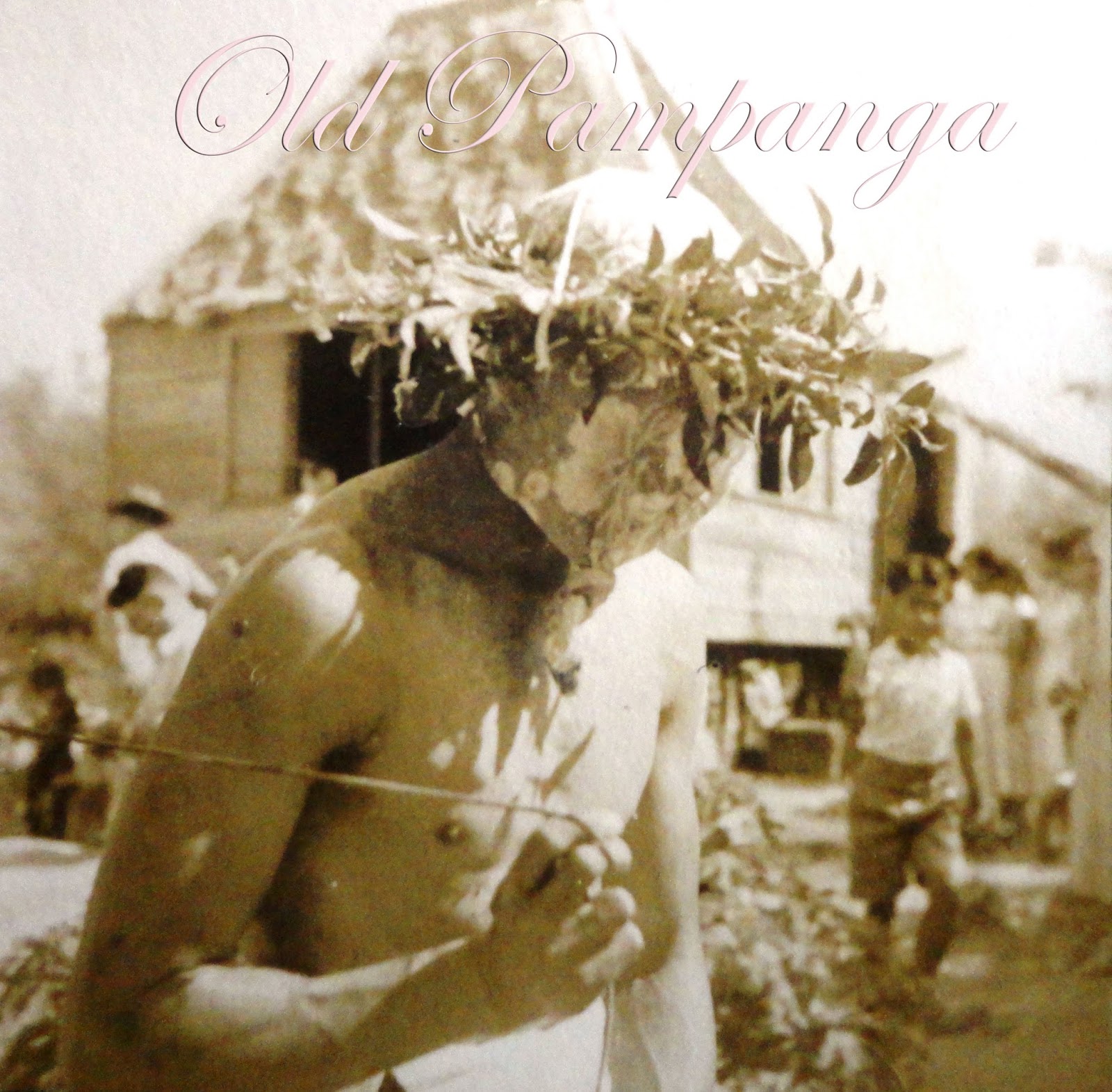
A magdarame remains anonymous by covering his face with a black hood or a white cloth, called "capariza", held in place by a crown of vines or twisted branches. These days, the face cover is an option as some modern-day flagellants expose their faces to the world. Instead, a piece of cloth is used to covers their heads, Arab-style.

4. BLOOD AND GORE
The back of a magdarame  is incised with a panabad, a paddle with shards of broken glass or directly with a razor or the sharp tip of a knife, such as the one shown in the photo.

5. EYES ON THE MAGDARAME
A group of American ladies from nearby Fort Stotsenburg gawk at a cross-bearing magdarame, followed by his aide, who intones prayers. Then, as now, magdarames were strange sights to see for foreigners. Today, the display of unusual practices such as flagellation and crucifixion are part of a 'religious tourism program' propagated by such places led by the City of San Fernando.

 6. THE CROSS-BEARERS
A popular type of magdarame is the cross-bearer or mamusan kurus. He either carries a cross or is tied to one. This flagellant carries a cross of bamboo, and he carries its full weight as the cross does not touch the ground. Today's crosses are fashioned from commercial lumber from hardware stores, or fashioned from old electric posts. They are also unusually long, so that the end of the cross touches the ground, thus providing support,

 7. THE WAY OF THE CROSS
Flagellants often walked country trails and roads, in small packs of 8 to 12. Others go on solitary walks, the better to reflect on his personal mission to be united in suffering with Christ. An American in a white suit follows this group in their walk of faith.

8. WHIP IT GOOD!
Another kind of magdarame is the sasalibatbat, who fling their bodies to the ground, rolling over sharp rocks and stones in the process. They are followed by a flogger, who whips them when they are on the ground. Their torsos, legs and arms are tied with abaca rope to impair circulation, hence making the experience more torturous.

9. EVERYTHING'S ALRIGHT?
An ayudante checks on the condition of a magdarame, sprawled on the field under the hot, mid-day sun.  The walk around town begins in the morning, ends by early afternoon and is followed by a dash to the nearest river for a quick, recuperative bath.


10. CRUCIFY HIM!
A magdarame is symbolically crucified, by having his arms tied on the crossbar.  The first re-enactment of Christ's crucifixion happened in the 1955 "Via Crucis" in San Fernando, but it was only in 1962 that an actual crucifixion was done, with the nailing of Artemio Anoza to the cross in barrio San Pedro Cutud. Anoza believed he could realize his dream to be a faith healer with his crucifixion.

PHOTO SOURCES:
Photos, courtesy of "Old Pampanga" FB Group.
Others: Alex R.castro, ebay.com