Showing posts with label Kapampangan words. Show all posts

Saturday, September 22, 2018

94. 12 GARDEN PLANTS AND FLOWERS AND THEIR KAPAMPANGAN NAMES

1. ALAS DIES
There are at least 3 flowering plants in the Philippines with names derived from the “hours of the day” that refer their peak blooming time. There is an Alas Cuatro (4 o’clock), Alas Dose (12 noon) and the ubiquitous Alas Diyes (10 o’clock, Portulaca grandiflora) that is propagated easily, and can grow to cover a garden patch. The bright pink flowers open before noon, and they wither quickly .

2. BALANTAKAN
The Biblical character who suffered a series of life’s misfortunes  gave his name this tall, grain bearing tropical plant—Job’s Tears (KatikbiCoix lacryma-jobi L.). It is known to both tagalogs and Kapampangans as “Balantakan”. As an ornamental plant, the balantakan has capsule-shaped fruit that enclose fruits are capsules, enclosing the female flowers. 

3. BUAK NANG ESTER
This silver gray, hair-like epiphytic bromeliad is often found hanging in wire pots in rural gardens, or grows on tree limbs with lengths of 2 meters or longer. Known to the estern world as Spanish moss (Tillandsia usneoides Linn.), it is fancifully called “Buak nang Ester” (Ester’s Hair).The plant inspired the great writer Aurelio Tolentino (1858-1915) to write the 1911 novel, “Ing Buac nang Ester”

4. KAMANTIGI
Kamantigi (Impatiens balsamina Linn.) are common Southeast Asian plants with flowers that can come in pink, white, red, lilac, mauve colors. These flowers also have medicinal properties, used as poultice to cool bruises or painful areas. In English, it also goes by the name “Touch Me Not”.

5. KARA-KARIKUCHA
The small, deciduous Karakarikucha tree (Plumeria acuminata W. T. Ait.) is known as kalachuchi in Tagalog, and frangipani or temple flower in English. It is characterized by dark green oblong leaves and large, fragrant white petalled flowers with yellow inner lower portion. Flowers are often strubg through the rib of coconut leaves (tingting) for quick, decorative fixes.

6. MALA-MARINE
The thorny Mala-marine (Mimosa pudica)  get its name from "pudica",Latin word for “shy or bashful”.  Called “makahiya” by Tagalogs, the low-growing, creeping flowering plant has small leaflets arranged in pairs that fold inwards together upon stimulation by touch, shaken, warmed or blown by the wind. In cultivation, the mala-marine plant is often grown as an indoor annual, but is also grown for ground cover.
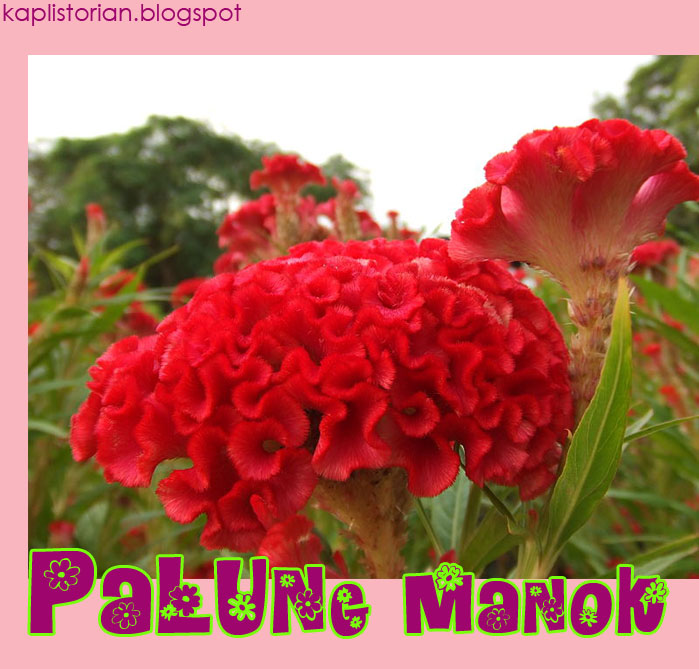
7. PALUNG-MANUK
Palung-manuk is a transliteration of the English name, Red Cockscomb (Celosia argentea L.) as the bright red flowers resemble the head of a rooster cock. Also called “palung-palung”, the attractive blooms are often strewn on top of tombs during All Saints’ Day.

8. PALUNAI
The beach sunflower (Wedelia biflora, Linn.) is known locally as “Palunai”or “palunag”,with numerous yellow or yellow-brown flowers. The roots are often used in the Philippines as diuretic or for the relief of stomach aches.

9. PANDAKAKI
The small, evergreen shrub is appropriately called  “Pandakaki” (Tabernaemontana pandacaqui). The plant has small 5-petalled flowers and is sometimes gathered from the wild, mainly for local medicinal use (e.g. to induce menstruation). The town of Mexico, Pampanga has a barangay named “Pandacaqui”.

10. PUKENDANG
The plant with a salacious name—“Pukendang”—has the same derivation as its Tagalog counterpart, Pukinggan or Pukingan, a variant term for a woman’s private parts. It has a more decent name in English--Blue Pea-- although its scientific name (Clitoria ternatea Linn.) is an explicit reference to its similarity to the female genitalia.

11. SAN FRANCISCO
Another common shrub used as an ornamental is the San Francisco or Croton (Codiaeum variegatum (L.) , that comes in a variety of shapes and colored foliage. The leaves can come twisted, or oblong, linear, pointed, but all are thick and leathery. Young leaves start out as green, yellow or red, later changing to single color or becomes variegated with bright color combinations. In other parts of the country, it is called Sagilala or Buenavista.

12. TUKOD-BANUA
This  herb known as Tukod-Banua (Amorphophallus paeoniifolius (Dennst.)  owes its name to its stem-like structure  that grows to more than a meter or more from its bulbous corm—hence, a tukod (a cane or a prop).  It is also called Pungapung or Apungapung in other regions, and Corpse Flower in English. That is the plant’s cluster of flowers (spadix) exude a bad odor that is often likened to the smell of rotting flesh.

 PHOTO CREDITS:
Balantakan: Wikimedia commons
Karakarikucha: Wikimedia commons
Mala-marine: Wikimedia commons
Palung-palung: Wikimedia commons
Palunai: http://www.stuartxchange.com/Hagonoi.html

Friday, July 6, 2018

86. 10 KAPAMPANGAN PLACE NAMES AND THEIR ORIGINS, part III


1.      BUCANAN, Magalang
A barangay in Magalang owes its  foreign-sounding name from a modern sugarcane crusher made in England with a “Buchanan” brand, owned by a local haciendero. These imported steel crushers made sugar processing easier, helping modernize the industry.


2.      BUNTUK BABI, Concepcion
The contemporary name of this barangay is Sta. Monica, but its old name, Buntuk Babi (Hog’s Head), is still fondly remembered. The name, as the story goes, was a tribute to a Negrito chief who hanged pigs’ heads as trophies of his achievements. Another version had it that the name came from the locals’ tradition of hanging a “buntuk babi” in their veranda during their fiestas. The barangay was once visited by Felipe “Apo Ipe” Salvador, a religious cult leader of Sta. Iglesia.


3.      CALANTIPE, Apalit
Barangay Calantipe in Apalit was named after a local wetland bulrush or grassweed,  that grew in profusion in the place. Belonging to the genus Scirpus, the calantipe plant has grass-like leaves, and clusters of small spikelets.


4.      CASTULI, Macabebe
The flowering plant (hibiscus abelmoschus) that looked like a gumamela gave its name to an Apalit barrio still known today as Castuli. The perennial herbaceous plants, which can grow up to two meters tall, bears 5-petalled white or yellow flowers, with a red or purple spot at each petal’s base. Castuli has medicinal and culinary uses, Abelmoschus is now recognized as a separate genus from hibiscus plants.


5.      CONSUELO, Macabebe
“Maniup” was the old name of brgy. Consuelo, owing to a story of a ghost that haunted the area that blew (“tiup”) wisps of cool air at people who passed by. But when a wealthy entrepreneur moved in to set up a liquor business there, many locals found gainful employment at his gin factory. As business flourished, the population of the barrio grew as migrant workers streamed in. The barrio prospered even more, and the residents enjoyed lasting “consuelo” (kuswelo, in the vernacular)—contentment and happiness—at last.


6.      MABUANBUAN, Sasmuan
The riverine barangay of Sasmuan—Mabuanbuan---got its name from a specie of fish that thrived in their waters called “buanbuan”, which Bergaño describes as “a delicious fish, spiny and with white scales”.  Thus, “Mabuanbuan” means a place flourishing with buanbuan fish. Surprisingly, Tagalogs call it “bulanbulan”. Buanbuan is a kind of tarpon fish, found  in brackish or freshwater, can measure more than a feet long,  and can be fished all year long.


7.      MALATUMBAGA, Magalang
A sitio of San Vicente, Magalang used to be called “Malatumbaga”,  a hardwood lumber tree similar to molave. The durable malatumbaga is used in house constructions, for making posts, window sills, floors, sculptures, frames, railroad ties and ship-building. In turn, the malatumbaga tree gets its name from a hard, reddish bronze metal called “tumbaga”, used for jewelry.


8.      MAMATITANG, Mabalacat
Mamatitang used to be a vast sugarland with prime sugar haciendas owned by rich Mabalacat people. Mascup River ran through one of its sitios, a popular resort destination.  Mamatitang was named after an early female Baluga settler named “Titang”. “Mama” was an appellation used to address old people and the two words became one.


9.      PAGUIRUAN, Floridablanca
The name “Paguiruan”, sometimes spelled as Pagyuruan, came about due to a local industry that began in the small Apalit barrio. Years ago, people used to go to the place to harvest fruits from buri plants which grew thickly in the area.  They were able to manufacture a certain type of sweet-tasting delicacy  called “yuruan”. It soon grew to a lucrative business for the people, who, in trun, renamed their barrio into “Pagyuruan”, a place where “yuruan” is made.


10.  SUCAD, Apalit
Formerly called Sta Lucia, barrio Sucad derived its name from “sucad”, meaning “to measure, so as to indicate a boundary”. Town lore has it that menfolk from Sucad distrusted male visitors from nearby San Simon who came to their barrio to serenade the local maidens. To prevent possible trouble, the San Simon men were called to inform them that they cannot overstep their bounds. A demarcation line was agreed on to define their barrio’s boundaries, which cannot be trespassed by both sides—“angga mu queni ing ‘sucad’ yu”.


SOURCES:
Historical data papers: Floridablanca, Candaba, Floridablanca, Macabebe, Magalang
Bartolo, Lou Aldrin L., The Magalang Book, NCCA, Center for Tarlaqueño Studies, 2015.
Dizon, Lino L. Amlat, Kapampangan Local History Contours in Tarlac and Pampanga,
Center for Tarlaqueño Studies, Tarlaca State University, 2000.
Sibug, Edgardo C., Porac, A Rancheria at Batiauan 1594-2004, published by the Municipal Government of Porac.
Vocabulario de Pampango en Romance y Diccionario de Romance en Pampango. The English Translation of the Kapampangan Spanish Dictionaryy written by Fray Dego Bergano of the Order of St. Augustine, first published in 1732. Holy Angel University Press.
PHOTOS:
All maps: googlemaps, unless otherwise noted.
Bucanan:  pinterest
Buntuk Babi:
Calantipe:
Consuelo:
HDP, Macabebe
Mabuanbuan,
Malatumbaga:
Mamatitang:
Castro, Alex R. Scenes from a Borderton and other Views, 2006, privately printed.
Paguiruan/ Pagyuruan:
HDP Floridablanca
Sucad: HDP Apalit

Sunday, June 17, 2018

84. 12 MORE BIRDS AND THEIR KAPAMPANGAN NAMES, part II


SOURCES:

Saturday, June 9, 2018

83. 13 KAPAMPANGAN WORDS ASSOCIATED WITH EYES AND VISION

“Eyes are our windows to the world”.  Fray Diego’s Bergaño’s compilation of Kapampangan words published as a dictionary in 1732, serves as an eye-opener to the fascinating language of our past. Here are words that our ancestors used to describe their vision,  and how they saw the world through their eyes--whether crossed, squinted or half-closed.
*********

1. DULING
Cross-eyed, squint eyed,  one whose eyes seem to focus on opposite directions.

2. LULA
Of short vision, malula, to have short or impaired vision

 3. MALIKMATA
Juggling or play of the hands with which the eyes are deceived

 4. MURI
Slimy moisture or discharge from the eyes, panamuri is a handkerchief, when the palay grains are growing—the palay grains at their earlier stage. Talamuri, a red-eyed bird.

 5. MULAGAT 
One who has his eyes  wide open in terror, kulagat is one who is permanently wide-eyed.

 6. MULAT
To open the eyes

 7. PIYAK
To close the eyes.

 8. PULING
Mote that falls on the eye, figurative, to muddle the clear rights enjoyed by another.

 9. KINDAT 
To arch the eyebrows, in admiration, ot giving a signal. To wink.

 10. KIRAT
 Odd-eyed, one eye smaller than the other

11. KILIT
 Adjective, one who stares with squint eyes, or with one eye.

 12. KITKIT
One who can hardly open eyes.

13. TAGUIBULAG
A thing that deceives the eye or vision, like a thing made to appear by magic.


SOURCES
Piyak: getty images

Monday, February 12, 2018

73. 12 PLACES OUTSIDE OF PAMPANGA WITH KAPAMPANGAN NAMES

Condensed from an article of Joel Pabustan Mallari

Pampanga  used to occupy large portions of Luzon—including parts of Bulacan, Nueva Ecija, Bataan, Zambales, Tarlac and extending as far north as Nueva Vizcaya. Over the years, new provinces and towns were carved out from this area, and today these places that are no longer part of the province, continue to  retain their Kapampangan names. On the other hand, other places have names with Kapampangan meanings, or that were derived from the Kapampangan language.
**********
1. BINUANGAN, Bulacan
This town must have gotten its name from  ‘binuangin’--a Kapampangan term for an early species of rice, a short variety with red stripes on its hulled seed. A barangay in Bataan shares a similar name.

2. CABIAO, Nueva Ecija
 “Cabiao” comes from the Kapampangan word ‘kabio’, meaning ‘to pound rice’. The time for ‘kabio’ ushers in the season of plenty for frmers, as rice becomes ready for sale and for eating. The capital city of San Fernando has a barangay called ‘Quebiawan’, derived from the same verb.

3. CAPITANGAN, Bataan
Bataan, a Tagalog province has a barangay in the municipality of Abucay called “Capitangan”, which means “midnight” in Kapampangan (“hatinggabi” in Pilipino). Like San Fernando, Capitangan is known for its crucifixions during Holy Week.

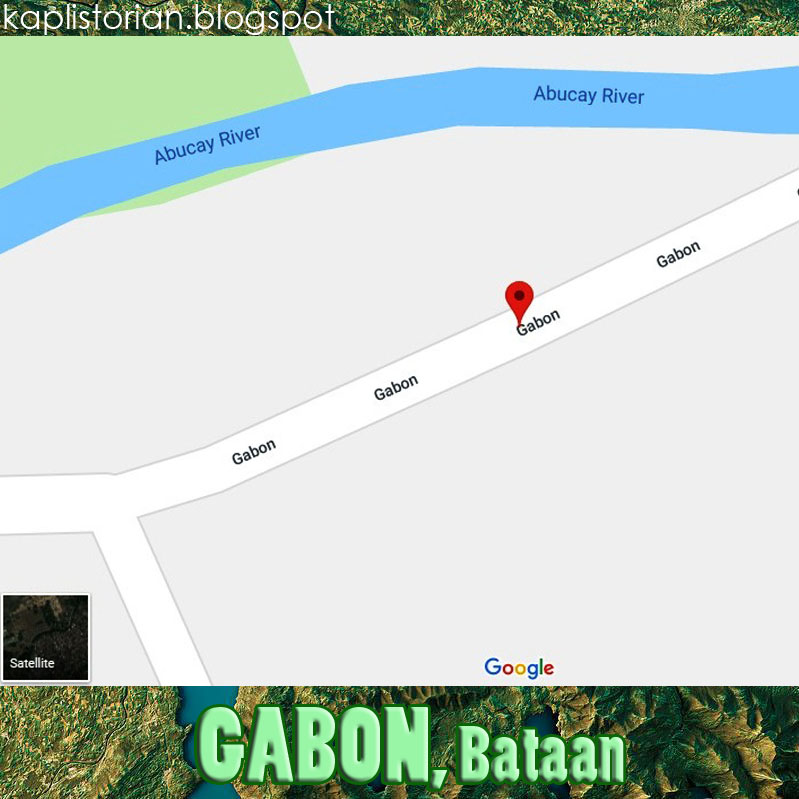
4. GABON, Bataan
In Abucay, there is a barangay that goes by the name, “Gabon”.  No, its  name was not derived from the African country of Gabon, but from the Kapampangan word “gabun”, meaning ‘soil, ground or land’.
5. MADLUM CAVE, Sibul, Bulacan
Sixteen kilometers off San Miguel, Bulacan, in Sibul, can be found the Madlum Cave, so named because of its creepy darkness—“madalumdum”, in Kapampangan, which was contracted to 'Madlum". It is believed that a stone image of the patron saint of the town—San Miguel—was first found in Madlum. The caves are characterized by limestone stalagmites. During World War II, Madlum was occupied by Japanese soldiers.

6. MATULID RIVER, Bulacan
Matulid River is a stream within Bulacan and is nearby to Wawang, Pinaganakan and Banaba. It is one of the 3 major tributaries of the mighty Angat River. The river flows on the boundary between between Pampanga and Bulacan, running on almost a straight course, hence “matulid”, meaning ‘straight’.

7. PAMITINAN MOUNTAIN, Rizal
In Rizal province, one of the peaks in the famous limestone mountain there has a Kapampangan name—“Pamitinan Mountain”. “Pamitinan” means “used for hanging”, as in stalactite patterns, a feature in the limestone caves found there. Pamitinan Mountain, along with the Puting Bato, are the two facing rock mountains that entrapped Bernardo Carpio in Tagalog of folklore.

8. SAN MIGUEL DE MAYUMU, Bulacan
The Bulacan town was once a part of the vast Pampanga realm, and it was famous for its sugar produce and sweets—“mayumu”. It was actually settled by Kapampangans until the early 1900s, until Tagalog started trickling in. When it became a town of Bulacan, it retained this Kapampangan word to describe it s a “town of sweets”—San Miguel de Mayumo.

9. TAYSAN, Batangas
When a Kapampangan goes to Taysan, Batangas, he would immediately recognize that the name of the town means  a “grinding or whetting stone” in his native language--a taisan. It is also the name of a soft, sugar-sprinkled cake, a local delicacy shaped  like a whet stone. Local lore has it that “Taysan” was  corruption of the word “atisan”(or a place atis fruit grew) or “tiisan” (to bear with fortitude). But even historians are not too sure. Could it have been that a transplanted Kapampangan  artisan introduced the ‘taisan’ in Batangas? It is interesting to know that Bamban, too, has a place named after grinding stones—the sitio of Panaisan.

10. TAKLANG ANAK, Calaca, Batangas
Lest you think that this barangay between the town of Lemery and Calaca smells bad because of its name, think again. “Taklang Anak” is a small, round juicy fruit that resembles a child’s droppings. The yellow-orange colored fruit (Garcinia dulcis), was first found either in  Arayat or Candaba, according to the noted botanical scholar, Fray Manuel Blanco. But how this Kapampangan fruit reached Batangas and gave this barangay its name is unknown.

11. TAKLANG DAMULAG, Nueva Ecija
Oh yes, there is a mountainous place in Nueva Ecija named after carabao manure or taklang damulag. It must have had  a large population of carabaos that regularly littered its streets with their dung. Whatever the case, “Taklang Damulag” was probably the most fertile land in Nueva Ecija, in those days, as carabao manure--then, as now--is used to enrich agricultural soil. Today, Taklang Damulag is a training ground inside the army division in Fort Magsaysay, Palayan City, Nueva Ecija. In 2011, it was the site of  a 100 mile ultra-trail racing event, the first endurance run in Southeast Asia.

12. TALAGUIO, Doña Remedios Trinidad, Bulacan
Talaguio is a sitio of barangay Kabayunan, and is located northwest of Mount Tabernaculo and northeast of Mount Maon and Mount Mayapa, where llarge conservation areas can be found,like the Angat Watershed. Talaguio is one of the 3 tributaries of the Angat River through where the Sierra Madre mountain range feeds its waters. ‘Laguio’ means ‘name’ in Kapampangan.

SOURCES:
Singsing Magazine. “The Augustinians in Pampanga”, vol. 3 No. 1.
wikimedia.commons: Cabiao seal, Cabiao town photo
San Miguel de Mayumo: https://allevents.in/san%20miguel/san-miguel-de-mayumo-tara-na-pasyal-na/1618364498486213
Taklang Anak, photo by Antonio Soraiano Guia Jr., via Michael Pangilinan FB page
 Maps (Talaguio,Matulid)) : mapcarta.com