Showing posts with label Kapampangan personalities. Show all posts

Sunday, April 28, 2019

108. 11 INFLUENTIAL KAPAMPANGAN RADIO PERSONALITIES

Radio, as a new communication medium officially came to the Philippines in 1922 when a test broadcast was made by a Mrs. Redgrave from Nichols Air Field using a 5-watt transmitter. Early broadcasting was a strictly an American affair until the 1930s when local songs and program, started to be heard from KZIB, KZRH and KZRG Stations. In this new medium, the Kapampangan voice found its place, and our kabalens who animated the airwaves became welcome presences in every home with a transistor-- disseminating news, dispensing advice, making commentaries or simply spinning music to the avid listener.
**********

MILA BALATBAT (Sta. Ana)
Mila Balatbat, who started her radio career at age 15, found great success by becoming a successful independent producer of programs (a‘blocktimer’) heard on DZRH, DZBB, DZAQ, DZMY,  PBS (Philippine Broadcasting Service) and Eagle Broadcasting Corp.  She was the host of such programs as “Mila Balatbat’s Radio Stars”, “Let’s Go Shopping with Mila” (DZBB, 1960-1962).


ANGELO CASTRO SR. (Tarlac)
One of the earliest peronalities to join the radio bandwagon was Angelo Ruiz Castro of Tarlac. A brother of former chief justice Fred Ruiz Castro, Angelo joined Manila Broadcasting Company at Insular Life Bldg. and was known as the “Good Time King”. In 1946, he became the chief announcer of Station KZOK. Under Pres. Carlos P. Garcia, he headed the Radio Department of the Office of the Press Secretary. Angelo’s sons, Angelo Castro Jr.(husband of June Keithley) and Naldie also became announcers


ANGELO Y. CASTRO JR. (Tarlac)
The checkered career of Angelo Y. Castro Jr. (b.6 Mar. 1945/ d. 5 Apr. 2012) includes being the anchor of ABS-CBN’s “The World Tonight” (with Loren Legarda), broadcast journalist, news manager (1986, ABS-CBN) and TV/ Film actor (Bong in “Baltic & Co,). For ANC, he hosted the travel show Las Islas Filipinas. Retired in 2009 after being diagnosed with lung cancer, he continued his anchoring duties together with Teddy Boy Locsin and Tina Monzon-Palma on ‘The World Tonight”. Married to the late TV and radio personality, June Keithley, with whom he had 2 children, Diego  and Gabriella.


BEN DAVID
The King of Over-Acting, Ben David, was born as Bienvenido Parungao, the 4th of 8 children of Enrique Parungao and Raymunda David, both Kapampangans. Baritone-voiced Ben made his presence felt with his overly dramatic signature quips: “Oh, hindeeee!”and “Hangaaal!”. He became  an announcer for DZAQin 1966, an apt host for the program ,”Ginoong Mananakot”. In 1967, he became an announcer for ABS-CBN. He produced and directed “Dear Kuya Cesar”, and disc-jockeyed for “Patrolman OA”. David also broke into the movies, debuting in “Ismol bat Teribol” , a 1957 comedy from Sampaguita Pictures. He was cast in “Da Best Show”, “Tang-Tarang-Tang”and “Buhay Artista”. His most famous character role is playing Hudas Iscariote to    the hilt.


MINDA FELICIANO (Guagua)
Arminda “Minda” Feliciano (1 June, 1931) was the daughter of Manuel Valdez Feliciano, a district engineer, and Amparo Santana of Batanes. Before she became an international jetsetter, Feliciano had a brief career with radio in 1956, specifically on DZFM. She had auditioned for a single slot with Eddie Mercado and Johnny Wilson. But big boss Koko Trinidad wanted all 3 of them, so he offered all 3 to share the Php120 a month salary. Surprisingly, all three agreed. The arrangement was great for awhile, but eventually the 3 broke up ,and Feliciano moved to DZMB.with a hefty salary of Php150 monthy, plus 30 pesos add-on talent fee. The pretty announcer then moved to the U.S., to pursue an acting career. She snagged a role in the popular TV series,”Hawaiian Eye”, of Warner Brothers. Her world trips led to a chance meeting with actor Michael Caine. The two were soon engaged, but nothing came out of their affair. Feliciano was also linked with singer Tony Bennett, but a more lasting relationship was formed  with Norman John McClintock Lonsdale, an English blue blood, whom she wed in 1997.


REY LANGIT
Reynante "Rey" Magat Langit (b. 30 Sept. 20, 1948) is known for his public service radio programs that served mostly overseas Filipino workers. With his bombastic announcing style, Langit became well-known for remaining on air for 2 straight days during the People Power revolution. The multi-awarded broadcaster was the Station Manager of the AM Radio station DWIZ 882 kHz. and vice president of Aliw Broadcasting Corporation until 2016, disrupted by a foiled senatorial bid in 2016. After over 2 decades at DWIZ, he joined  PTV as anchor of programs "Insider Exclusive Kapihan" "Kasangga Mo ang Langit" and "Balitang Tanghali". He is producer of TV and radio shows under his  Heavenly Images Productions. A son,Reyster, also became a journalist, but died of cerebral malaria while on assignment in Palawan in 2005.


CESAR NUCUM (Candaba)
The eldest of Kapampangan Aurelio and Romaman Nucum, Cesar Nucum  (15 May 1938-d. 17 May 2007) was a balut vendor and bote’t dyaryo dealer before he auditioned in Manila to become an announcer. He got a job at DZRM, only to be pirated by ABS-CBN. For his narrative program “Mga Kasaysayan sa Likod ng Langit”, he evolved thestyle of Eddie Ilarde, developing it into his signature snail-paced, monotonous delivery.Thus, “Kuya Cesar”was born., a personal used in his radio shows “Dear Kuya Cesar” and “Ikaw sa Likod ng mga Awit”. His career lasted for many decades,  halted temporarily in 1972 during Martial Law. In the many programs he hosted, Kuya Cesar gave out advice, played music, spoke in tagalog and Eglish—always in his deep, distinctive slow-paced manner.


PERRY PANGAN (Mabalacat)
The quintessential voice of Pampanga,  Fernando “Perry” Pangan. He is the seasoned voice and station manager of RW 95.1 FM that was put up in the province at the height of the lahar inundation, where he reported the most accurate information of the state of Pampanga towns. Under his helm, RW 95.1 FM rose to become one of the most respected, and most awarded radio stations in the province. In 2011, the radio station  RW 95.1 FM was selected as the country’s Best Provincial FM Radio Station. A skilled commentator and public affairs host, he heads the “Talakayan  Ngayon” with Boy Santiago and Albert Lacanlale, Son Chester Pangan became a broadcaster at the age of 19 for a rival station, GV 99.1 FM and a TV personality on Channel 3 in Angeles City, Philippines. He now hosts a morning show on radio in Winnipeg, Canada.


ORLY PUNZALAN (Minalin)
The 1960s also saw the rise of a former seminarian from Minalin as the quintessential voice of news and current events. Orly Punzalan took the bus to Manila and auditioned for DZFM as a newscaster for the Department of National Defense. He passed the auditions and got a starting salary of 30 pesos a week, working with the likes of Jose Mari Avellana, Joonee Gamboa and Tita Muñoz. Making the transition to TV, he became a booth announcer for Channel 3 where he met and married Helen Vela.


JOE TARUC (Gapan)
Gapan-born  Jose Malgapo Taruc, Jr. (b.18 Sep. 1946/d/ 30 Sep. 2017) ranks as  one of the most popular and most followed news anchor on DZRH, in which he was also the station’s senior vice president. He anchored the longest-running public affairs program “Pangunahing Balita” and  “Damdaming Bayan”, often heard interviewing high-profile politicians, including the president. Best remembered for his trailblazing role in ABS-CBN DZAQ Radyo Patrol before  Martial Law, Taruc also worked in tandem with  Dely Magpayo and Noli de Castro in a KBS morning program. from , then joined DZBB Bisig Bayan 594 (later, Super Radyo) , until his transfer in 1991 to DZRH. Taruc’s son, Jay Taruc is well-known TV documentarist.


RAFAEL YABUT (Candaba)
The most influential radio personality from radio’s golden years is Rafael “Paeng” Yabut of Candaba. Growing up in Tondo, he started as a commercial reader for blocktimer Luz Mat Castro. During the Japanese occupation, he became an announcer at Star Theater along Azcarraga. After Liberation, he became a barker for “Atomic Bomb”, a honky tonk place along Rizal Avenue.In the late 1940s, he was offered by Hal Bowie, General Manager of MBC to do a daily Tagalog program called “Tayo’y Mag-aliw”. But instead of providing entertainment, he made stinging news commentaries against certain characters in the government. His program drew not only high listenership but also friends and foes alike. By 1957, Yabut had accumulated so much pulling power at DZRH that he was urged to run for president in 1957 against Carlos P. Garcia. Instead, he endorsed Manuel Manahan, then shifted to Jose Yulo. Both lost. For his political meddling, Yabut was suspended from his broadcast work, leaving behind his high-rating programs like "Ruleta Musikal", "Tatlo Lamang", "Gumising sa Pagsikat ng Araw". His most serious brush with death was when he was ambushed by a gunman after his tirades against Philippine Charity Sweepstakes. He recuperated, joined DZFM, but by then his credibility was in tatters. After the People Power revolution, he joined DZBB, only to be assigned the graveyard shift. Not long after that, Paeng Yabut died

SOURCES:
Aniceto, Ben. Stay Tuned: The Golden Years of Philippines Radio. A Historical Perspective of Philippine Radio—its Beginnings, its Golden Years and its Suppression in Sepetmeber 1972.Atlas Publishing Co., Inc. Quezon City. © 2007
Rafael Yabut Photo: Castro, Alex R.  viewsfromthepampang.blogspot, “Pilot of the Airwaves”
Angelo Castro Jr. Photo: rappler.com
Minda Feliciano Photo: wikimedia commons
Rey Langit Photo: wikimedia commons
Cesar Numcum Photo: FB page
Perry Pangan photo: https://www.rw951.fm/about.html
 Orly Punzalan Photo:
https://www.gmanetwork.com/news/publicaffairs/tunaynabuhay/507134/primera-kontrabida-ng-90s-na-si-princess-punzalan-ikukuwento-ang-kaniyang-tunay-na-buhay/story/
All others:Aniceto, Ben. Stay Tuned: The Golden Years of Philippines Radio. A Historical Perspective of Philippine Radio

Monday, February 4, 2019

105. 11 DISTINGUISHED, TOP-RANKED MILITARY MEN OF PAMPANGA, part II


Col. PATRICIO C. BUYSON
Bacolor’s distinguished colonel,  Patricio Buyson,  was trained at Fort Sill where he finished a 6-month course at  the U.S. Armv Artillery and Missile School.  He had his baptism of fire in the Korean war where the then-major served as a battery commander in the Battalion Combat Team of the Philippine Army, which was attached the Third Infantry Division Artillery, then commanded by Gen. Verdi B. Barnes. He and the good general would meet again when, in August 1959, Maj. Buyson returned to Fort Sill to take up a 9-month course in advanced officer artillery training, which included the study of missiles. This was in preparation for a new artillery school that was then being planned by the Philippine Army, and which he was tapped to join as an instructor. Post-war, Maj. Buyson was assistant superintendent of ROTC units in .Manila.


Lt. Gen. GREGORIO M. CAMILING JR.
Named as the Commanding General of the Philippine Army in 2002, Lt. Col. Gregorio M. Camiling Jr. (b. 15 Nov. 1947)  has parents whose are both Kapampangans: Gregorio Camiling Sr. (Bacolor) and Apolonia M. Miclat (San Fernando). Two of his brothers were officers of the AFP. After graduating as salutatorian of Cubao High School, he gained admission at the Philippine Military Academy from where he graduated in 1969. He rose quickly up the ranks; from a 2nd lieutenant of the Philippine Army assigned Mindanao in 1969, he was made the commanding officer of Alpha Company of the 26th Infantry Battalion from 1971-74 that saw action against Muslim rebels in the deep south. He was promoted to Captain in 1975, and a Major of the AFP in 1977. Because of his military experience, the Philippine Army named him as instructor and department head of the School for Combat Arms (1977-1980). In the 90s, as a personal choice of Pres. Cory Aquino, he served his 4th Mindanao tour as Chief of Staff of the 4th Infantry Division, and stayed on in the region, providing support to the government panel during the MNLF negotiations. In 1999, he was nominated as commanding general of the UN Peace Keeping Forces in East Timor. Later that year, he was promoted to Major General in October 16. From 2000-01, Maj. Gen. Camiling served as chief of the Southern Command of the AFP, which led to the neutralization of the Abu Sayyaf. He was eventually promoted to Vice Chief of Staff of the Armed Forces of the Philippines, the 2nd highest-ranking military officer in the Philippines. He has been awarded 9 Distinguished Service Star Awards Gold Cross Medal, 4 Military Merit Medals with 4th Bronze Spearhead Device (Combat), 19 Military Merit Medals, Silver Wing Medal, and 6 Military Commendation Medals, to name a few. He is now retired.


Gen. RICARDO A. DAVID JR.
Born in San Fernando, Gen. Ricardo David Jr. finished his early education at Dolores Elementary School, as class valedictorian in 1967. He moved to Victoria, Tarlac to continue his high school, graduating  as salutatorian at Victoria High School. He took up Engineering at St. Louis University, Baguio on a scholarship, which he finished at the Philippine Military Academy, in 1973. He was the Commanding Officer of the 50th Infantry Battalion, Philippine Army (1996-98) and the Commanding General of the 402nd Infantry Brigade, Philippine Army ( 2005- 2006). The general then became the Northern Luzon AFP Command Chief. In 30 June 2010, he was named by Pres. Benigno Aquino III as Chief of Staff of the Armed Forces of the Philippines, a post he assumed in July. His decorations included: Philippine Republic Presidential Unit Citation, Anti-dissidence Campaign Medal, Distinguished Aviation Cross, Distinguished Service Star and Combat Commander's (Kagitingan) Badge, among others. In 2011, Gen. David was appointed by Pres. Benigno Aquino III as the chief of Bureau of Immigration


Maj. PEDRO DEANG
The first Kapampángan valedictorian of the Philippine Constabulary Academy hails from Minalin, and eventually moved to Angeles. Pedro Deang (b. 16 January 1906)  finished at the top of his class in 1932, just the fourth batch of cadets to be graduated from the country’s premiere military school. He joined the Philippine Constabulary as a lieutenant and was assigned to Sulu. There he met his future wife, Emiliana Rodriguez. When WWII broke out, Pedro was deployed to Bataan but not after sending his wife and uncles to Guinobatan, Albay, where they waited for his return. As a Major in Bataan, he was the operations officer of the 31st Infantry Division of the Philippine Army, under Brig Gen Clifford Bluemel. He served alongside the future president, Capt. Ramon Magsaysay, who was the motor transport officer of the 32st Infantry. When Bataan fell, Maj. Deang, along with thousands of American and Filipino surrenderees, joined the infamous Death March. Along the way, he was rescued by civilians, but he opted to remain with his men and rejoined the march to Capas, where he died at Camp O’Donnell on 23 April 1943.


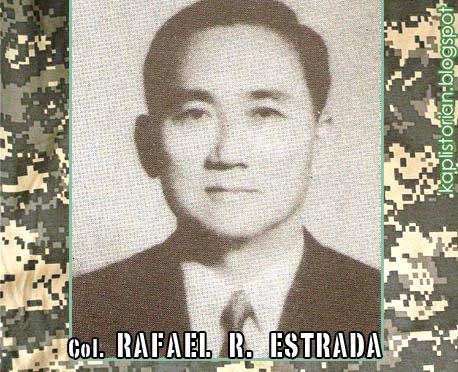
Col. RAFAEL R. ESTRADA
The distinguished Col. Rafael Reynaldo Estrada was born in Concepcion, Tarlac,  (b. October 1918) the son of Dr. Salvador Q. Estrada and Demetria Reynaldo. Highlights of his military service include his membership in the 2nd Regular Division USAFFE, and was also involved in the defense of Luzon and the Battle of Bataan (1941-42). With rations lacking and ammunitions almost gone, their commanding officer, Gen. Edward King surrendered to the Japanese on 9 April 1942. Estrada became a POW (prisoner of war) and joined the notorious 100 km. Death March to Camp O’Donnel in Tarlac. Luckily for him, he survived the march and imprisonment. After the war he was appointed Director of the Philippine Veterans Board by President Magsaysay and became Commissioner of the Veterans Claims Commission. He also became the Founder and National Commander Emeritus of Defenders of Bataan and Corregidor, Inc. (DBC). To show his commitment to help war vets, Col. Estrada developed the Blue Ridge Subdivision in Quezon City exclusively for WWII veterans. Col. Estrada counts poet Nina Estrada-Puyat and  former Sen. Eva Estrada-Kalaw as half-sisters. The respected WWII veteran died at age 98 on Oct. 2016.


 Brig. Gen. RAFAEL D. GOSECO
The late Brig. Gen Rafael D. Goseco (ret.), was a homegrown boy  from Sto. Niño,  Guagua, a graduate of the esteemed Guagua National College, founded in 1918. He would later serve the same school as its President. His wife, Dr. Petronila S. Goseco, was also a dean at the college. In May 1999, the generous general gave a deed of donation to the Court, giving some 5,000 sq. m. of land, that were part of the family’s 20-hectare property in Brgy. San Matias, Guagua,. The land was offered as site for the proposed Hall of Justice and other buildings that the Court may be minded to construct. According to General Goseco, his family will find fulfillment in knowing that it had done something for the government. Gen. Goseco passed away in February 2015. His son Ronald, a graduate of UP and the PMA, assumedthe presidency of Guagua National College.


Cmdre. JOSE G. LANSANGAN JR.
Commodore Jose G.Lansangan, from Sta. Ana, was a multi-facteted military man who was also a businessman, a college head, and author. He finished a degree in Marine Transportation, a Master in Business and Government Administration and in National Security Administration at the Royal Naval Staff College in Greenwich, London. His military career included being serving as Chief of Naval Staff of the Philippine navy (1876-78) and Commander of the Cavite Naval Base (1978-1982). Eventually, he would assume the presidency of the National Defense College of the Philippines (1982 -88). Together with his partners, he put up a government, business and industry consultancy firm (Martillano, Lansangan, Domingo & Associates, Inc.), headed the FRIENDS Foundation, and served as president of the Makati Mabuhay Lions Club as president. In March 2017, Cmdre. Lansangan wrote his memoirs,  “The 21st Century Legacy Letters Volume 1: 17 Legacy Lessons”.


Rear Adm. ARMANDO Q. MADAMBA
From San Juan, San Fernando, Armando Quizon Madamba (b. 3 Nov. 1938) was a product of Pampanga High School, class 1954. From there, he went to the state university (U.P.) to study engineering, but moved to the PMA after qualifying for the exams. At the academy, he gain renown for his brilliance in military planning and strategy. The 1962 graduate joined the Philippine Navy as ensign. He performed so well that his studies were sponsored at the Fletcher School of Law and Diplomacy at Tufts University in Boston, Massachusetts. There, he earned his M.A. in International Affairs (1970) and M.A. in Law and Diplomacy  (1971).  He was assigned to Iran as Attache at the Philippine embassy for 5 years (1975-80). Towards the decade’s end, he attended the Naval Command College course for Senior International Officers at the US Naval War College in Newport, Rhode Island. As Deputy Chief of Staff, he pushed for the complete  modernization of AFP. He retired as a Vice Admiral, but Pres. Fidel V. Ramos named him Ambassador to the Asian Pacific Economic Cooperation  in 1996. He engaged in consultancy work after his diplomatic stint. His impressive career has earned him the Distinguished Conduct Star, the Distinguished Service Star, the Philippine Legion of Honor,  Navy Distinguished Cross, the 1991 Cavalier Award of the Philippine Military Academy and Outstanding Kapampangan Award for Military Service in 1993.


Gen. RAFAEL M. MANIAGO
The future general, Rafael Manarang Maniago (b. 7 Nov. 1936)  comes from Parian, Mexico. He is said to be a descendant of the brave 17th century hero, Francisco Maniago, who led a revolt against Spain. He graduated from the Philippine Military Academy in 1962 and joined the Philippine Army. He served as regional military commander in different military zones and installations in the Philippines. As a colonel, Maniago was named Commanding Officer of the  403rd Infantry Brigade, 4th Infantry Division of the Philippine Army from 1988-89. It is known officially as the Peacemaker Brigade which specializes in anti-guerrilla warfare. From 1990-91, the colonel served as the Commander of the 502nd Infantry (Liberator) Brigade. Gen. Maniago passed away on 1 January 2004.

Col. SAMUEL S. QUIWA
Before his death from pneumonia on 12  February 2011, Col. Samuel Quiwa (b. 3 Feb. 1917) was considered as the last surviving World War II hero of San Fernando, having outlived 16 other comrades. Quiwa , a USAFFE (U.S. Armed Forces in the Far East) soldier, was a participant in the battles of Bataan and Corregidor in 1942.  He was able to escape the 3-day Death March that started in Mariveles, Bataan, but slipped back to war-ravaged Corregidor, only to surrender to the Japanese. For 20 days, he became a POW, along with other American military men, until they were transferred to Manila. After his release, he went underground in Nueva Ecija and Pangasinan as a guerrilla fighter. When the country was liberated, he returned to active service and was assigned to the 103rd Military Police Command, now the Northern Luzon Command of the AFP. He retired in 1969. For his gallantry, he was awarded the Philippine Defense Ribbon, American Defense Ribbon, WWII Victory Medal and Ribbon, Philippine Liberation Medal, among others. Before his death, he managed to receive financial reward from the U.S. government.


1st Lt. RUBEN P. SONGCO

Capt. Ruben Paras Songco (b. 5 Sep. 1921/ d. 5 Dec. 1944), was a native son of Guagua. A graduate of the prestigious U.S. Naval Academy, Annapolis,Maryland, in 1943, he excelled in football, tennis, lacrosse and boxing. He was graduated a year early due to the War. During the War, he was a member of the 1st Reconnaissance Battalion missions that left for Australia in Oct. 1943, with Gen. MacArthur attending their send-off. He was with Maj. Lawrence Phillips, Capt.  Galang, 4 radio operators and 2 reconnaisance men when they landed in Mindoro, only to be tracked and captured by the Japanese with the help of a Filipino informer. 1st Lt. Ruben Songco was one of those killed; only 3 survived. The other sad thing about his shortlived military career  was that, because of his Filipino nationality, he was  denied a commission in the U.S. Navy.

SOURCES:
Patricio Buyson: Pampanga High School, Golden 50th Anniversary Yearbook,
Photo courtesy of the Philippine Army Official Website
Pedro Deang: Picture and information courtesy of First Consul Elmer Cato.
Rafael Goseco: GNC Batch of 2005 FB page
Samuel Quiwa: “ LAST WW II WAR HERO IN SAN FERNANDO DIES”by Charlene Quiwa.


Friday, January 25, 2019

104. 13 DISTINGUISHED, TOP-RANKED MILITARY MEN OF PAMPANGA, part I

Brave warriors, fearless soldiers, and dauntless freedom fighters—all figured prominently in our early provincial history. Here is a more contemporary list of our finest Kapampangans in uniform who have managed to ascend up our country’s military hierarchy—top-ranked and acclaimed for their boldness achievements.

**********


PNP Chief OSCAR D. ALBAYALDE
The current Philippine National Police director who replaced Ronald “Bato” de la Rosa was born in San Fernando (b. 8 Nov. 1963). Oscar David Albayalde went to local city schools : San Fernando Elementary School, Pampanga High School, University of Assumption. He graduated with cum laude honors from the Philippine Military Academy Sinagtala Class of 1986, and also finished his Masters in Public Adminsitration at  MLQ University. He started his service with the Police Constabulary Special Action Force (SAF) from 1986-91. Among his  significant positions in the Police Regional Office-3 were: Acting Provincial Director of Pampanga Police; Chief, Regional Intelligence Division; Chief,Regional Police Coommunity Relations, and Chief, Regional Investigations Division. Albayalde was named Outstanding Kapampangan in Law Enforcement in 2016.


Col. JUAN E. ARROYO
The Philippine National Police - Communications and Electronics Service (PNP-CES) traces its beginnings at the turn of the 20th century, originally known as the “SIGNAL CORPS” which contributed to the development of the communications systems and facilities of the police force. In the critical war years,  beginning in 1941, Col. Juan E. Arroyo  was designated Chief Signal officer of the Philippine Constabulary (PC)  until 1942, when the Japanese took over the islands. In the period leading  to our  liberation, Col. Arroyo resumed his post as PC Signal Officer. After the war, he became the manager of the National Steel Corp., The Arroyos are from Candaba.


Col. EMIGDIO C. CRUZ
Col. Emigdio "Meding" C. Cruz of Arayat went to U.P., finishing a Liberal Arts course in 1923 and Medicine in 1929, at a rather late age of 31. He was Pres. Manuel L. Quezon’s chief physician and trusted aide during the War years. He was the recipient of the Philippine Congressional Medal of Valor and Distinguished Service Cross in 1948, the highest award that the Philippine government can give to its citizens,  for his “daring resourcefulness and long sustained courage” he displayed at the height of the second World War. After Quezon’s death in 1944, Meding lingered in the U.S., doing stints at Walter Reed Hospital, Brunns General Hospital, Ann Arbor University Hospital and the Barnes General Hospital in Missouri. He returned to the Philippines in Feb. 1946. Today, a government hospital stands in Arayat—the Dr. Emigdio C. Cruz Medical Center--named after the decorated physician-patriot who passed away in 1978.


Brig. Gen. RENE R. CRUZ
Arayat son Gen. Rene R. Cruz had an illustrious military career. As a colonel, he was connected with the Philippine National Police Academy. He was also the former RaCom Commander and PC-INP Commander and, like all high-ranking officers, was drawn into the People Power revolution in 1986. After the police general retired, he became a director of the Bataan Shipyard and Engineering Co. Inc. (Baseco). Gen, Cruz also headed the Philippine Olympic Committee (POC) from 1993-96. It was during his term that boxer Manuel Velasco won an Olympic silver in the Atlanta Olympics in 1996. He was honored by his alma mater, University of the East, a Distinguished Alumnus in Military Science award, where he finished in 1957. He passed away of heat attack, 30 Sept. 2015.


Brig. Gen. ROMEO S. DAVID
The unico hijo of a former San Fernando vice mayor and a public school teacher, Romeo Soliman David attended local schools, graduating in 1951 at the Pampanga High School. He pursued an engineering course in Manila but opted for Philippine Military Academy when he passed the admission.  At PMA, he shone in sports and in academics, and graduated among the top of his class in 1956. He became a pilot for the Philippine Air Force and was sent off by the Philippine government for pilot training in the U.S. he also underwent advanced studies at the United States Air War College in Air University, Alabama USA in 1983. David served as military air base commander and commanding general of the Armed Forces of the Philippines Regional Unified Command III. After his retirement, then Pres. Cory Aquino appointed him as president  of Philippine Amusement and Gaming Corporation in 1987-1989. Pres. Fidel Ramos named him as president and CEO of Clark Development Corporation and Clark International Airport in 1995-1998. The retired general heads the Rainbow Rising High Co., Inc., a natural gas producer based in Palawan.


Brig. Gen. VIRGILIO M. DAVID
The general from Bacolor, Virgilio Mañago David, was a PMA graduate, and an alumnus of Pampanga High School,  Class of 1954. He was a former National Police Commissioner, and served as the Anti-Drug Chief of during the term of president Cory Aquino. As head of the Narcotics Command (NARCOM), he had to revamp the agency of over 1,000 men which had been plagued with corruption charges under 2 previous heads.  Upon retirement,  he was appointed administrator of the Philippine Coconut Authority from 1992-98. He then became its director, but his term was marred by an incident when, in late May 2005, during an altercation with a person who parked his car in front of his house, the general fired his gun, injuring a construction worker nearby.


Col. MIGUEL NICDAO
Guagua-born Col. Miguel Nicdao (b. 8 May 1888/d. 1938), was but 15 when he became a pensionado (government scholar)  to the U.S., a batchmate of Jose Abad Santos. With six other Filipinos, Nicdao began his studies at Illinois State Normal University,  became a champion orator, and  graduated with an Education degree—the youngest of the 1907 batch. Once home, he started work as Principal of the San Luis Intermediate School. He was also assigned in Mabalacat, Apalit and in San Fernando where he was with Pampanga High School  for 3 years. The young teacher found it frustrating to advance in his career, so in 1911, Nicdao enrolled in the newly-opened Camp Henry T. Allen (the pre-cursor of the Philippine Military Academy). After undergoing an intensive 3-month boot camp training, he graduated as 3rd Lieutenant.  The 23 year-old embarked on his  new military career, and led campaigns in Lanao and Cotabato, during the Moro War years (1909-1923).  He would eventually become the District Commander for Muslim Mindanao. By 1917, he had attained the rank of a First Lieutenant of the PC, with missions in Cagayan and Misamis.  In the 1930s, he was instrumental in crushing a Sakdalista revolt in Laguna. The bemedalled colonel  passed away at age 50 of peritonitis, during a military exercise in Leyte, and was given full military honors during his burial.


Brig. Gen. RAMSEY L. OCAMPO
Brig. Gen. Ramsey Lapuz Ocampo is a native of Candaba, and a 1963 alumnus of Pampanga High School. As a police superintendent, he was the provincial police director of Pampanga from 1990-1992, and rose to become the Regional Director of police command VII.  Ramsey was responsible for the very good peace and order situation in Cebu City. The general also became Chief of the Central Intelligence Service (CIS) and NARCOM. He later pursued a law course and a doctorate degree and now the multi-facetted general has his own law firm and is the Vice President for Security Services of Clark.


Lt. Col. LEON F. PUNSALAN
The  West Pointer and M.I.T. graduate who saw action with the Philippine Army was born in San Simon, Pampanga on 3 July 1910. Leon Flores Punsalan is a 1928 Pampanga High School alumnus . In 1936, he graduated as a Mechanical Engineer at West Point in the top ten of his class, and he was assigned to serve  in the Philippine Army in 1938. In 1940 he was assigned in an Army base in Boston, Massachusetts and attended nigh class for his his Masters Degree in Mechanical Engineering from MIT. He invented a durable rifle cartridge ejector and obtained a patent for it. After serving for 31 years in the U.S. Army, he retired in Hampton, Virginia, where he taught mathematics and physics at local high school. He was the founder of the Pampanga Language Club of Virginia. Lt. Col. Punsalan was also a writer and a poet. Died 3 October 2001 at the age of 91.


Brig. Gen. MARCOS SOLIMAN
The general best remembered as the anonymous whistleblower who exposed the Marcos plan to place the country under Martial Law to oppositionist Benigno Aquino Jr., was born in Candaba (b. 25 April 1910), the son of the town police chief.  He was a classmate of Pres. Diosdado Macapagal at the Pampanga High School, Class 1929. He graduated in 1933 from the Philippine Constabulary Academy, and then served  the PC company in  Iloilo as a lieutenant for 2 years. Soliman was chosen to study in the Air Corps Flight School at Randolph Field, Texas. After his tour of duty, he was appointed commandant of  various ROTC units like the U.P. FEU and U.S.T. During the War, he refused to surrender to the Japanese, and became a guerilla untilhis captured in January 1944. Though released, he continued doing espionage work. In the post-war years, he served as Superintendent of the Philippine Military Academy and Commanding General of the Philippine Army. Upon leaving the military, he became chief of the National Intelligence Coordinating Agency. Shortly after Martial Law was declared in Sept. 1972, newspaper reported his death due to a heart attack, but his family believed that Marcos was responsible for his death.


Brig. Gen. BASILIO VALDES
Basilio Valdes (b. 10 Jul 1892) with roots in Floridablanca, was a doctor first, but also earned recognition as a military man, and a government executive. He finished medicine at the University of Santo Tomas and graduated with honors in 1916. Driven to serve beyond his country, he joined the French Army as a medical volunteer, then the U.S. Army as a surgeon from 1917-1919. He labored in Europe as part of the American Red Cross mission. Thus began his second career in military service. Returning home, he joined the Philippine Constabulary from 1926-1934 as medical inspector. Pres. Manuel L. Quezon appointed him as Chief of Staff of the Philippine Constabulary and Philippine Army in 1939, elevating his rank to a general (he would rise to become a Brigadier General). Two years later, Basilio was appointed as Secretary of National Defense. To expand his military education, he attended the Command and General Staff School in Fort Leavenworth, Kansas, graduating there in 1943. During the Japanese period, he served under Pres. Jose P. Laurel as Secretary of Public Works. He died in 26 January 1970.


Brig, Gen. LUIS A. VILLA-REAL
The venerable general, Luis “Louie Villa-Real, was a graduate of Culver Military School who joined the Philippine Army and headed its 21st field artillery. He fought in World War II and is acknowledged as one of the valiant Defenders of Bataan and Corregidor, having also walked in the Death March. He was to serve many presidents, including Pres. Cory Aquino who appointed him head of National Intelligence Coordinating Authority (NICA) after the fall of Marcos. Known as a Huk fighter in his time, he also headed the Philippine Anti-Communist League. He was never known to be political; in fact, he was critical of the military hierarchy in Pres. Aquino’s time, proof that he was a true servant of the Filipino people. The Villa-Reals trace their roots in Arayat.


Maj. PORFIRIO ZABLAN
The early years of Philippine aviation count only some 400 military men--all chosen between 1907 to 1935, with Pres. Quezon’s approval.  Among the first 10 Filipinos to undergo actual flight training were 10 Philippine Constabulary (PC) officers, led by topnotcher 1st Lt. Porfirio Zablan; and 23 recruits from the National Guard. Zablan, who rose to the rank of a Major,  became the first fighter pilot of the Philippines, but perished while training in the U.S. in 17 June 1935. In his memory, the Zablan Airfield in Quezon City was named after him.

(OTHER RANKING KAPAMPANGANS IN THE MILITARY: Col. (Ret.) Vicente A. Pascual (Arayat), Commodore Lodovigildo L. Gantioqui, Ph. Navy (Arayat), Col. Sergio Sanchez,  Col. Federico Calma, Col. Auelio Miranda, Col. Gregorio Yambao, Col. David Pelayo, Col. Pacifico Marin, Col. Diosdado Garcia,Col. Migule Pingul, L.t Col. Felix Duenas (Phil Coconut Authority director), Maj. Conrad Flores, Lt. Col. Patricio Buyson, Major Rufino Dizon, Capt. Crescencio Pineda)

SOURCES:
Oscar Albayalde: Most Outstanding Kapampangan Award 2016 souvenir program
Juan Arroyo:
Rene R. Cruz, Luis Villareal: The Pampangos, by Rafaelita Hilario Soriano, 1999, 218 pages
Basilio Valdes, Emigdio Cruz. Miguel Nicdao: www.viewsfromthepampang.blogspot
Marcos Soliman: PHS Golden Jubilee 50th Yearbook, 1962
Romeo David, Virgilio M. David: History of Pampanga Towns, by Andro Camiling, http://www.andropampanga.com/history_phs.htm
Leon Flores Punsalan: The Untold Battle of Leo Punsalan, https://scholar.lib.vt.edu/VA-news/VA-Pilot/issues/1995/vp950910/09070045.htm

Wednesday, November 21, 2018

100. 10 KAPAMPANGAN MATINEE IDOLS OF THE 1950s-1960s

These midcentury Kapampangan screen stars were the Daniel Padilla, Dingdong Dantes, and Alden Richards of their days--captivating female fans, melting hearts and causing screams and swoons, with their good looks and great acting talents.
**********


1. GREGORIO FERNANDEZ, Lubao
(b. 25 May 1904/ d. 11 March 1973)
Actor-director Gregorio “Yoyong” Fernandez was the son of  Eugenio Aranita Fernandez and Maria Montemayor, and grew up in an artistic milieu. To help finance his dentistry studies, he  became an actor at  Mayon Photoplay Corp.  where he did  “Anak sa Ligaw”. This film started his long career in Philippine moviedom, first as an actor ( “Yesterday, Today and Tomorrow” ,  “Ang Lumang Simbahan”, and the 1921 hit, “Ligaw ni Bulaklak” ). His first directorial debut was  “Asahar at Kabaong” (1937). He would have a directing career at LVN Studios, even winning a FAMAS in 1955 for “Higit sa Lahat”. His children with Pilar Padilla became actors too: Merle Fernandez, and Rudy “Daboy” Fernandez. Fernandez  was active until the early 70s; his last film was “Daing”, shown in 1971. 

2. MANUEL CONDE, San Fernando
(b. 9 Oct.1915/d. 11 Aug.1985)
Manuel Pabustan Urbano Sr., better known as Director Manuel Conde, is recognized as one of the greatest Filipino directors of our time. Born in Daet to Dionisio Urbano and Lucia Pabustan of San Fernando, Manuel enrolled in Geology at Adamson University, hoping to be a mining engineer. But he was lured by the movies, starting as an ‘extra’ in “Mahiwagang Biolin”. It was in LVN that he became a director. When he started his production outfit, he starred in his on pictures starting with the popular “Juan Tamad” series, and costume epics like Prinsipe Paris (1949), Krus Na Kawayan (1956), Siete Infantes de Lara (1950) and its re-make in 1973. But it was for “Genghis Khan” (1950) that introduced Philippine cinema to the world. From among 780 film entries, it was chosen as one of 20 films to vie for awards at the Venice Film Festival. Though it did not win, the film emerged as one of the most acclaimed movies of the prestigious festival. United Artists bought the film for international distribution, where it would later be dubbed in 16 languages and became a bestseller.


3. ROGELIO DELA ROSA, Lubao
(b. 12 Nov. 1916/ 26 Nov. 1986)
Lubao’s native son, born Regidor dela Rosa,  rose to become the brightest male star in the Golden Age of the Philippine Cinema (1940s-50s). Born to Feliciano de la Rosa and Rosario Lim, he was discovered by Gregorio Fernandez. He debuted in “Ligaw na Bulaklak”, with Rosa del Rosario in 1932. Soon, he was being paired with Emma Alegre, and Paraluman, but his team-up with Carmen Rosales was the longest and most successful . By 1948, he was the highest paid movie actor in the Philippines. . His 1955 role in “Higit sa Lahat” earned him a FAMAS 'Best Actor' trophy as well as the Best Actor Award at the 1956 Southeast Asian Film Festival in Hong Kong. After retirement, he entered politics, got elected as a Senator (1957-63), ran for Presidency (retracted upon the pleading of Macapagal, his brother-in-law, who was also running for the same position) and became an ambassador to Sri Lanka, Cambodia and The Hague, Netherlands.

4. JAIME DELA ROSA, Lubao
(b. 18 Sep.1921/d. 2 Dec. 1992)
Rogelio’s younger brother, Tommy, assumed the screen name Jaime de la Rosa, and he too, would earn his place in Philippine showbiz. He was studying Law when he was first featured in the Eastern Pictures movie, “Anak ng Lansangan” in 1939.Making his strong presence felt, he was cast successively in 3 movies: “Cadena de Amor”, “Bawal na Pag-ibig” and “Kahapon Lamang” . Before the war began, he was seen in a musical, “Ibong Sawi”. Two post-war roles would etch Jaime’s image in the hearts and minds of movie fans forever. One, was in the 1st ever “Darna” movie, starring Rosa del Rosario, as the lead’s love interest. And, in 1953, he was Fredo, the human lover of the fabled mermaid , “Dyesebel”, played by Edna Luna. Jaime was married to Betty Santos, also a Kapampangan.


5. EDDIE DEL MAR, Candaba
(b. 13 Oct. 1923/d. 8 Nov. 1986)
Born Eduardo Magat in Candaba, the son of Albino Magat and Benigna Sangalang, he was a medical student at UST when war intervened. After the War,  Sampaguita Pictures gave him a screen test which he passed. As “Eduardo del Mar” he became a featured player in "Kapilya sa May Daang Bakal" starring Oscar Moreno and Tita Duran, and directed by Tor Villano. It was at Premiere Productions where he made his most memorable film "Sisa". As Crisostomo Ibarra, he generated much buzz and an acting nomination. The film itself won the top "Maria Clara Award" in 1951. Thus began his association with "Rizaliana movies". His 1956 film, “Ang Buhay at Pag-ibig ni Dr. Jose Rizal” would changed the course of his showbiz career. The film, which dramatized Rizal’s romances,  won for del Mar the 1956 Best Actor Award trophy. Five years later, he would star in the movie adaptation of “Noli Me Tangere”  that was produced to commemorate Rizal’s birth centenary in 1961. Many actors have essayed the role of Rizal since— Joel Torre, Albert Martinez Cesar Montano, to name a few—but nobody was more famously identified with that role than Eddie del Mar.

6. LUIS GONZALES, San Luis
(b. 8 Aug. 1928/d. 15 Mar. 2012)
Luis Mercado, also known as Luis Gonzales, did over 100 films during his career, mostly by Sampaguita Pictures. He is best remembered for essaying the role of Pres. Ferdinand Marcos in two 1965 biopics: “Iginuhit ng Tadhana”, a Marcos’ propaganda film; and  “Pinagbuklod ng Langit”. He co-starred with Gloria Romero, who had appeared with him in the 1955 romantic comedy, “Despatsador” and which led to other blockbusters like “Artista” , “Hootsy Kootsy” (1955), Pagdating ng Takip Silim, Teresa, Vacationista (1956), Colegiala, (1957), Alaalang Banal, Palaboy, (1958), Sinisinta Kita (1963) and Show of Shows (1964). Together, they did about 30 movies. Luis would continue to be active in the next decades and some of his memorable movies include “Tubog sa Ginto” and “Haydee” in 1970, where he helped launch the career of another Kapampangan, Hilda Koronel. He was married to socialite Vina Concepcion, with whom he had 3 children.


7. EDDIE GARCIA, Macabebe
(b. 2 May 1929)
The bemoustached kontrabida you love to hate—Eduardo “Eddie” García started in showbiz as a swashbuckling hero in Manuel Conde’s 1950 classic, “Siete Infantes de Lara” . It also comes as a pleasant surprise that his grandmother was from Macabebe, married to a Spaniard, which makes him a quarter Kapampangan. Born in Sorsongon to Antonio Garcia and Vicenta Verchez, he joined the Philippine Scouts after the war. Fresh from his assignment in Okinawa, he answered a casting call for a costume film—and the tall, Hispanic-looking scout made it to the Conde film. Soon, he was being called to play villains, owing to his sleek, well-kept moustache, roles he played with such credibility. One of his movies was aptly titled, “Contravida”, which he did in 1955. Another memorable role is that fo a closeted gay husband in the 1970 film “Tubog sa Ginto”, by Lino Brocka. The durable actor is the only artist inducted in three categories in the FAMAS Hall of Fame: Best Actor, Best Supporting Actor and Best Director. The prolific Garcia continues to act in TV shows and movies today, with over 400 appearances to his credit.

8. JESS LAPID SR., Guagua
(b. 5 Oct. 1933/d.13 Jul. 1968)
At the height of his career, ranked among the bigtime action stars of the 60s, led by Fernando Poe Jr. and Joseph Estrada. Born as Jesus Songco Lapid, he had started as an “extra”, then became a stuntman, where he had the good fortune of doubling for Fernando Poe, Jr. They became fast friends, and Poe would eventually give Lapid his break in the  1963 FPJ Productions’ “Sierra Madre”, where he gave a noteworthy performance. His next move, “Kardong Kidlat” (1964) would catapult him to stardom. Lapid had just wrapped up the movie “Simaron Brothers”with Jun Aristorenas, when, on the night of 13 July 1968, he was shot to death at the Lanai Nightclub after a row between two groups of movie personalities, which also involved his reputed girlfriend,  Nancy Roman, an actress. Lapid was just 35. As a belated tribute, nephew Lito Lapid appeared as Jess in the biopic “The Jess Lapid Story”, released in 1978.


9. RAMIL RODRIGUEZ, San Fernando
(b. 22 Aug. 1944/d. 29 Apr. 2014)
Ramil Rodriguez,  (Rene Rodriguez Jr., in real life) the elder son of Rene Hizon Rodriguez and Ma. Rosa Moreno. The Rodriguezes are from a prominent family with roots in Bacolor. They were friends of the Vera-Perezes, who owned Sampaguita Pictures. Ramil, unlike the younger Pepito, was the more reticent one when they were offered to make movies. In the end, family friendship prevailed and began his showbiz career via the 1960 movie, "Palanca". He was officially introduced in 1964's "Leron-Leron Sinta", a musical comedy starring Susan Roces and Eddie Gutierrez. As part of Stars '66, Ramil was  paired with Loretta Marquez, and Liberty Ilagan. He took on everything from comedies,  musicals, action and drama flicks in the '60s and evolved into a fine dramatic actor in the 80s. He starred in classics like "Blusang Itim", "Magdusa Ka", (1986), "Asawa Ko, Huwag Mong Agawin", "Ibulong Mo sa Diyos" (1988). Ramil found a new set of fans with his appearances in telenovelas like 1997's "Mula Sa Puso", "Love to Love" (2004) , "Magpakailanman" (2005) and the highly rated "Bakekang" (2006-07). He died of lung cancer.

10. PEPITO RODRIGUEZ, San Fernando
(b.1944)
Pepito Rodriguez was born Jose Rodriguez in 1944, younger brother of Ramil. The Rodriguezes were from a prominent family with roots in Bacolor. In 1963, Pepito joined the movie bandwagon as the boy-next-door type, in the film “Haliging Bato”. He was noticed in light musical romances like “Dance o’ Rama”, “Jukebox Jamboree” and of course, in the popular “Mga Bata..” series. He dabbled in drama like “Alaala ng Lumipas” (1965) , “Hinango Ka Sa Lusak” (1967), but fans seemed to like him better in lightweight romance films. When actor Ricky Belmonte entered the picture as Rosemarie’s other love interest, an alternative love team was formed. After appearing in “Life Everlasting” in 1971, Pepito  dropped out of circulation, only to come back almost a decade later in the made-for-TV movie, “The Children of An Lac” as the Vietnamese Capt. Nam. He was lured to return in the 1985 drama, “Palimos na Pag-ibig”, and in the 1990 action film “Alias Baby Face”. He would permanently retire from showbiz after that, and settle in the U.S. as a successful businessman.

SOURCES:
Wikipedia.com
http://www.andropampanga.com/history_sanluis.htm
Salumbides, V.icente. Motion Pictures in the Philippines, 1952
Tiongson, Nicanor, The Cinema of Manuel Conde, UST Publishing House, 2008
All others: Alex Castro Collection

Wednesday, October 24, 2018

98. 10 TOMBS AND MEMORIALS OF REMARKABLE KAPAMPANGAN PERSONALITIES

DON ANGEL PANTALEON DE MIRANDA
(ca. 1765/ d. 21 Jun. 1835)
Place of Memorial: Sto. Rosario Church
Founder of Angeles. Together with wife, Doña Rosalía de Jesús and some followers, the group headed north to clear a forested area there for rice and sugar farming in 1796. The settled area became known as Culiat, named after the vines that proliferated in the place. Culiat would become the future city of Angeles, named after him and his patron, the Guardian Angel.

FELINO GIL
(b.1803/d.1884)
Place of Interment: Pio Chapel, Porac, Pampanga
Spanish civic leader. For helping secure lands in Porac for the friar missions, he was awarded tracts of land that he successfully turned into sugar plantations. Recognized as one of the founders—along with Juan P.  Zita-- of the “Escuela de Artes y Oficios de Bacolor”, which aimed to train artisans, on 14 Nov. 1861. Later renamed to Bacolor Trade School in 1915, which offerd courses in Woodworking Domestic Science, Ironworking and Building Construction.

 HONORIO T. VENTURA
(b. 30 Jul. 1887/ d. 3 Sep. 1940)
Place of Interment: Cementerio del Norte (Manila North Cemetery)
Son of Balbino Ventura and Juana Tizon of Bacolor. Graduated with a law degree from Universty of Santo Tomas , and went to Spain for advance studies in Jurisprudence. Appointed as acting governor of Pampanga in 1916. Served as Chief of the Executive Bureau of the Department of Interior and later as Secretary of the Interior in place of Atty. Felipe Agoncillo. The former Pampanga School of Arts and Trades in Bacolor, Pampanga which he supported as a philantrophist, was re-named as Don Honorio T. Ventura College of Arts and Trades in his honor. One of his scholars was the future president, Diosdado P. Macapagal.

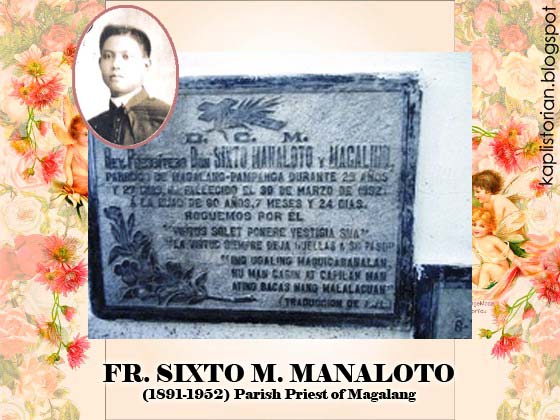
FR. SIXTO M. MANALOTO
(b. 6 Jul. 1891/d. 30 Mar. 1952)
Place of Interment: Magalang Memorial Park
Though Tarlac-born, Fr. Manaloto would make a lasting impression on Magaleños, serving their parish for an unprecedented period of nearly 30 years. On 8 December 1915, feast of the Immaculate Conception, Fr. Manaloto, a product of San Carlos Seminary, was ordained into priesthood by Archbishop Harty in 1915. Assigned in Magalng in 1923, he is known for his major restoration works of San Bartolome Church., for opening a parochial school in the town and for sending poor, but deserving students to Manila, many of whom eventually returned as professionals and became leaders of the community.

 JOSE CORAZON DE JESUS
(b. 22 Nov. 1896/ 26 May 1932)
Place of Interment: Cementerio del Norte (Manila North Cemetery)
Son of Vicente de Jesús  of Sta. Maria, Bulacan and Susana Pangilinan of Pampanga. As Huseng Batute,  he wrote nationalistic articles for Ang Democracia, Liwayway, Taliba, under the pseudonym Huseng Batute. He supported Philippine independence and wrote critical articles about Philippine society under the Americans. Known as the King of Balagtasan, for his mastery of Tagalog poetry.Wrote the lyrics  of the popular Filipino song “Bayan Ko”,which has become an alternative anthem.

KUDIARO LAXAMANA
(b.1906/d.1970)
Place of Interment: Clark Cemetery, Angeles City, Pampanga
Born in the Mt. Pinatubo area. Aeta World War II Guerrilla Hero. Head of the 55-155th Squadron of the Northwest Pampanga Mountain District. Reputedly killed 50 Japanese soldiers, chopping off at least 17 enemy heads with  his bolo. Given a post-humous recognition in Mabalacat in 1995 for his wartime bravery. Killed in 1970 for his advocacies. Given a 21-gun salute at his burial at the Clark Cemetery. A major road in Clark—Kudiaro Laxamana Ave.—is named after him.

RUFINO J. CARDINAL SANTOS
(26 Aug. 1908-d. 3 Sep. 1973)
Place of Interment: Manila Metropolitan Cathedral crypt
The 1st Filipino Prince of the Church. Born in Sto. Niño, Guagua to Gaudencio Santos and Rosalia Jiao. Accepted as seminarian at San Carlos Seminary in 1921.  At 19, became a scholar of the Pontifical Gregorian University in Rome in 1927. Ordained on 25 Oct. 1931 in Rome. Assigned to Imus, Cavite and Marilao, Bulacan as assistant priest; then to Manila. After his war imprisonment, was named by Arch.  Michael O’Doherty as Vicar General of Manila, then elected as the Titular Bishop of Barca and Auxiliary Bishop to the archbishop. Succeeded Arch. Gabriel M. Reyes as the new archbishop of Manila in 1953, following his appointment by Pope Pius XII. Elevated to the rank of the cardinal at the Basilica of St. Peter in Rome at 9:30 a.m. on 31 Mar. 1960.

CLEOFE J. BALINGIT
(b. 9 Apr. 1910/ d. 5 Jun. 1981)
Place of Interment: Apalit Municipal Cemetery
Daughter of  Macabebe Scout Felix Balingit and Juliana Jaime of Macabebe. Chosen to represent Pampanga in the search for the 1936 Queen of the Manila Carnival, touted as “the biggest annual event of the Orient”. Her candidacy was supported by the newspaper “Ing Catimauan”. Placed 4th after the winner, Mercedes Montilla, of Negros Occidental,  crowned Miss Mindanao 1936. Married to Dr. Mariano Bayani of Apalit.  Spent the rest of her life involved in socio-civic causes,  especially the Pampanga Chapter of the Girl Scouts and the local Red Cross.

DIOSDADO P. MACAPAGAL
(b. 28 Sep. 1910/ d. 21 Apr. 1997)
Place of Interment: Libingan ng mga Bayani
Born in Lubao to Urbano and Romana Pangan. “The poor boy from Lubao” became the 9th President of the Philippines, serving from 1961 to 1965, and the sixth Vice-President, serving from 1957 to 1961. Was a member of the House of Representatives, and headed the Constitutional Convention of 1970. Father of Gloria Macapagal Arroyo, the 14th President of the Philippines from 2001 to 2010. Succeeded by Ferdinand Marcos.

THE AQUINOS OF TARLAC
Place of Interment: Manila Memorial Park, Parañaque, Manila
Corazon Cojuangco Aquino ((b. 25 Jan. 1933/d. 1 Aug. 2009)
The first woman president and the 11th chief executive of the Philippines.  The most prominent figure of the 1986 People Power Revolution that ended the 21 years of dictatorial rule by Pres. Marcos. People rallied around her after her husband’s assassination and swept the plain housewife to power. Hailed as the “Mother of Asian Democracy”.
Benigno Aquino Jr. (b. 27 Nov. 1932 /d. 21 Aug.1983)
A leading oppositionist of the Pres. Ferdinand Marcos and his dictatorial regime. Arrested and jailed for 7 years during the Martial Law of 1972.Founder of the lakas ng Bayan (Laban) party. Allowed to travel by Marcos in 1980 for medical reasons, byt was assassinated upon his return to Manila in 1983. His death was the catalyst for te People Power Revolution that ended the arcos regime and started his wife Corazon’s ascent to power.

FERNANDO POE JR
(b. 20 Aug. 1939/d. 14 Dec. 2004)
Place of Interment: Cementerio del Norte (Manila North Cemetery)
Actor, director, film producer and presidential of the Philippines. Considered King of Philippine Movies. Began showbiz career in the 1953 with the movie “Anak ni Palaris”. Has over 200 films to his credit. Most portrayals show him as a champion of the poor. 5-time winner of FAMAS Award. Married to showbiz royalty, Susan Roces; daughter Grace Poe is a senator. Ran for the 2004 presidential race, but lost by the slimmest of margin against Gloria Macapagal-Arroyo.

ALEXIS TIOSECO
(b. 11 Feb. 1981/d. 1 Sep. 2009)
Place of Interment: Family mausoleum, Angeles City Cemetery
The young film critic is the great-grandchild of Leonardo Lilles, a successful agricultural engineer, businessman and town leader of Macabebe.  Noted film critic and film professor at the University of Asia and the Pacific. Known advocate of Southeast Asian cinema. Named  in 2005 as “one of the most important young people in the Philippines today”, by Philippine Star, for championing Philippine cinema. On 1 Sep. 2009, Tioseco and Slovenian girlfriend Nika Bohinc, were murdered in their Quezon City apartment by 3 burglars. Their househelp was convicted in May 2018 for her participation in the crime,

BONUS!
COLIN P. KELLY JR.
(b. 11 July 1915/10 Dec. 1941) 
Place of Memorial: Madison, Florida
B-17 pilot Capt. Colin Purdie Kelly Jr. died in action against the Japanese forces in 1941. Kelly’s damaged plane, while returning from a bombing run, blew up near Clark Field after being engaged by enemy forces. Declared as America’s first hero of WWII by US President Franklin D. Roosevelt.  The Kelly Theater of Clark as named after him. There is a  memorial statue of the fallen captain in front of the theater ruins inaugurated on 10 Dec. 2007—the 66th year of his passing.

CONRADO Y, GUINTO, KING OF POETS
(b. 21 Jan. 1946/d. 5 May 2015)
Place of Interment: Porac, Pampanga
Conrado Guinto is the fictional character in the award-winning advocacy film,”ARI: My Life with a King”, produced by Holy Angel University. The aging Kapampangan poet royalty befriends a Pampanga-born high school lad, JP, who can’t speak the language. Their contentious relationship ends with the death of Conrado, but only after passing the poet’s torch, and the laurel crown to the young boy. Portrayed by real-life poeta laureado,  Francisco "Frank" Guinto, who won Best Actor honors in the Metro-Manila Film Festival 2016, New Wave edition. The FAMAS-award winning sory was penned by Robby Tantingco and directed by Carlo Catu.

SOURCES:
(tomb)
FELINO GIL: Jerry Punzalan Sagmit (tomb); Luther Parker Collection (photo)
SIXTO MANALOTO,:Old Cemetery: https://magalang-heritage.weebly.com/old-cemetery.html
JOSE CORAZON DE JESUS: http://malacanang.gov.ph/undas-2012-a-cemeteries-tour/(tomb); flickr.com, posted by NCCA Official (photo)
CLEOFE BALINGIT: Alex R. Castro Collection
COLIN KELLY: www.findagrave.com
CARDINAL SANTOS: findagrave.com (tomb); Alex R. Castro (photo)
KUDIARO LAXAMANA: www.finadagrave.com (tomb);
 www.art.com (photo)
DISODADO MACAPAGAL: Twitter photo, by Maria Cepeda (tomb); wikipedia.com  (photo)
CORY AQUINO, NINOY AQUINO: wikimedia commons
FERNANDO POE JR: Wikimedia commons (grave); Alex R. Castro (photo)
ALEXIS TIOSECO: Robby Tantingco (tomb), Association for Southeast Asian Cinemas Conference - WordPress.com (photo)