Showing posts with label religion. Show all posts

Thursday, March 29, 2018

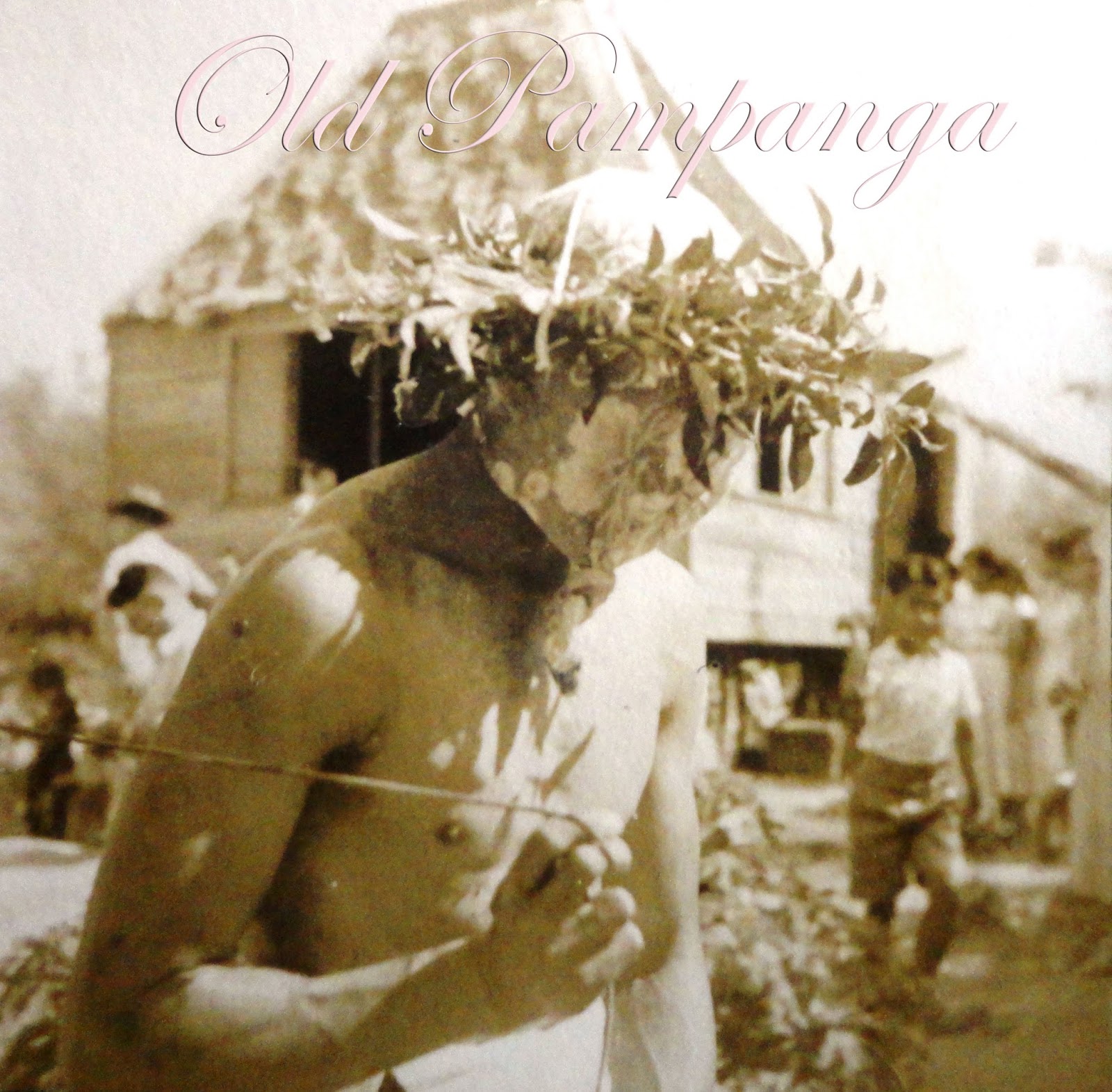
77. 10 RARE AND EARLY PHOTOS OF FLAGELLANTS IN PAMPANGA


The ways of  flagellants have always inspired awe and curiosity amongst the faithful during the days of Lent. Pampanga flagellants, however, have a different intent. Bloodied, scourged and caked with dust, magdarames live and act out the passion of the Lord—and the term “dámé”, to sympathize and share one’s grief, to take part in someone else’s suffering-- captures this spirit of oneness, in pain and sorrow. Here are, early images of the “magdarame” in Pampanga,  preserved by the camera from the turn of the 20th century to the 1950s.
************

1. MAMALASPAS
Barefooted flagellants from the early 20th century have their backs incised with wounds, drawing blood by whipping their backs with burilyos--bamboo strips tied to a cloth. These magdarame types are called mamalaspas, A distinctive sound is heard when the bamboo strips strike the flesh.

2. MAGDARAMES IN A VISITA
Makeshift chapels of wood, nipa and light materials serve as pitstops for  retinue of magdarames. Here, at these gaily decorated visitas, they pause to say their prayers, before moving on.

 3. MAGDARAME ANONYMOUS.
A magdarame remains anonymous by covering his face with a black hood or a white cloth, called "capariza", held in place by a crown of vines or twisted branches. These days, the face cover is an option as some modern-day flagellants expose their faces to the world. Instead, a piece of cloth is used to covers their heads, Arab-style.

4. BLOOD AND GORE
The back of a magdarame  is incised with a panabad, a paddle with shards of broken glass or directly with a razor or the sharp tip of a knife, such as the one shown in the photo.

5. EYES ON THE MAGDARAME
A group of American ladies from nearby Fort Stotsenburg gawk at a cross-bearing magdarame, followed by his aide, who intones prayers. Then, as now, magdarames were strange sights to see for foreigners. Today, the display of unusual practices such as flagellation and crucifixion are part of a 'religious tourism program' propagated by such places led by the City of San Fernando.

 6. THE CROSS-BEARERS
A popular type of magdarame is the cross-bearer or mamusan kurus. He either carries a cross or is tied to one. This flagellant carries a cross of bamboo, and he carries its full weight as the cross does not touch the ground. Today's crosses are fashioned from commercial lumber from hardware stores, or fashioned from old electric posts. They are also unusually long, so that the end of the cross touches the ground, thus providing support,

 7. THE WAY OF THE CROSS
Flagellants often walked country trails and roads, in small packs of 8 to 12. Others go on solitary walks, the better to reflect on his personal mission to be united in suffering with Christ. An American in a white suit follows this group in their walk of faith.

8. WHIP IT GOOD!
Another kind of magdarame is the sasalibatbat, who fling their bodies to the ground, rolling over sharp rocks and stones in the process. They are followed by a flogger, who whips them when they are on the ground. Their torsos, legs and arms are tied with abaca rope to impair circulation, hence making the experience more torturous.

9. EVERYTHING'S ALRIGHT?
An ayudante checks on the condition of a magdarame, sprawled on the field under the hot, mid-day sun.  The walk around town begins in the morning, ends by early afternoon and is followed by a dash to the nearest river for a quick, recuperative bath.


10. CRUCIFY HIM!
A magdarame is symbolically crucified, by having his arms tied on the crossbar.  The first re-enactment of Christ's crucifixion happened in the 1955 "Via Crucis" in San Fernando, but it was only in 1962 that an actual crucifixion was done, with the nailing of Artemio Anoza to the cross in barrio San Pedro Cutud. Anoza believed he could realize his dream to be a faith healer with his crucifixion.

PHOTO SOURCES:
Photos, courtesy of "Old Pampanga" FB Group.
Others: Alex R.castro, ebay.com 

Wednesday, February 15, 2017

36. 7 SPANISH FRIARS FROM KAPAMPANGAN TOWNS WHO MET VIOLENT DEATHS

There are documents to prove that Spanish friars were treated better in Pampanga than in other regions in the Philippines. Eighteenth-century chronicler Fray Gaspar de San Agustin wrote that Kapampangans were "very good Christians, most respectful of their ministers." But still some frailes met unspeakable deaths—occupational hazards of their mission work. Also, because “ya ing pari, ya ing ari ("he is priest as well as king"), some curas parroco tended to abuse their authority and exploit the parishioners' subservience—leading to their doom. Still others became collateral casualties of the bloody Revolution, victims of strong anti-Spanish sentiments in those tempestuous times.
* * * * * * * * *

BLESSED  FRAY PEDRO DE ZUÑIGA OSA
Assignments: Sasmuan, Porac
Manner of Death: Tortured and burned.

The future saint was born and educated in Sevilla, Spain, where he completed his priestly studies. The newy professed Agustino was shipped off to the Philippines in 1609 and became the first prior of Sasmuan. His arrival resulted in the separation of Sasmuan from the parish of Lubao, reverting back in 1642 due to the scarcity of priests. He ministered in Sasmuan from 1615 to 1618, until he was transferred to Porac. In 1620, Fray de Zuñiga sailed for  Japan with a stop in Taiwan in June. He, along with other missionaries of different orders, were tasked with propagating the Catholic faith among the natives. The ship captain was Catholic  Japanese, Joaquin Hirayama Diaz, and the crew all were members of the Confraternity of the Holy Rosary. En route, the ship was intercepted by Dutch pirates who surrendered the passengers and crew to pagan Japanese officials in the port of Hirando. They were kept in prison for two years, until Fray de Zuñiga,  his Dominican companion, Fray Luis Flores and the captain,  were tortured and burned to death in Nagsaki on 19 August 1622. Fray De Zuñiga and his companions were elevated as “beatos” (Blessed) on 7 May 1867 by Pope Pius IX, just one step away from sainthood. His ashes were brought back by Augustinian fathers to the Philippines where they are interred at the San Agustin Church.

FRAY BALDOMERO ABADIA, OAR
Assignment: O’Donnell, Capas
Manner of Death: Killed in an attack by Revolucionarios

The saintly Fray Baldomero Abadia was another tragic victim of circumstance, who died a valiant, albeit, violent death. From Jarque del Moncayo, Baldomero entered the Recoletos community of Monteagudo, Navarre province, where, on 4 October 1887,  he professed his vows.  During his stay at the rectory, he became acquainted with two future holy men—St. Ezekiel Moreno, who had just returned from the Philippines,  and Blessed Vicente Pinilla, one of the martyrs of Motril, who became his fast friend. In fact, the two would make a trip to Philippines together, arriving in Manila on 18 September 1892. Sometime in January 1896, Fr. Abadia was made parish priest of a newly created O’Donnell town in Tarlac (named after the Spanish Gen. Leopoldo O’Donnell, who coincidentally had given his name to the priest’s brother, Leopoldo Abadia). Fr. Abadia  fulfilled the functions of his sacred ministry with great apostolic zeal.  But at the end of August 1896, the Philippine revolution had exploded, spreading  quickly from Manila to the border provinces. Several Recoletos were murdered, and Fray Baldomero found himself in the danger zone. In his last letter to his family dated Oct. 27, he calmly reassured them that, for his safety, he was sleeping in the soldiers' barracks. But he was not safe at all—he could not trust even his own parishioners. On October 31, Filipino insurgent troops entered O'Donnell and, as historiologist Francisco Sadaba put it-- "inhumanly sacrificed him in hatred of Religion and Spain." Fray Baldomero Abadia was not even 27 years old.

FRAY  GREGORIO BUENO DE LA VIRGEN DEL ROSARIO, OAR
Assignment: Mabalacat
Manner of Death: Executed by firing squad,  Boloed to death

The Spanish fraile  known for putting a curse on Mabalacat, saying that the town will never prosper, was Fray Gregorio Bueno de la Virgen del Rosario. Born in Taragona in Aragon, Spain, he was first assigned to Iba and Masinloc in Zambales, then moved to the Recoletos convent in Manila. On 30 November 1885, the Padre Garigu was named cura of Mabalacat. He was the last Recollect priest to serve and his was also the longest term, staying on for 23 years until his untimely death. The popular belief was that he incurred the wrath of town head Don Marcelo Tiglao, for harassing a female member of his family. The truth was, by 1897, the fervor of the Philippine revolution had reached Pampanga and Tarlac, which resulted in the closing of some Recollect missions. When Filipino revolutionaries succeeded in taking Tarlac from the Spaniards, word reached Mabalacat about Spain’s surrender at the Makabulos headquarters in San Miguel. A horde of angry, impassioned locals, incited by the Tiglao, stormed the parish and dragged Fr. Bueno outside.  The 66 year old priest was paraded on the streets in a bullcart, publicly humiliated and charged with espionage. On 10 July 1898, he was shot dead by a firing squad, although one other version had him boloed to death while in a pit that was to be his grave. Before Padre Bueno died, however, it was said that he managed to utter his famous legendary curse  on Mabalacat: the town will only be freed from the spell if it can produced fourteen native priests—a number that has since been exceeded.

FRAY JUAN HERRERO, OAR
Assignment:  Mabalacat
Manner of Death: Cornered and shot to death

The Recoletos were already firmly established in Pampanga and Tarlac when Fray Juan Herrero OAR, assigned in Dagami, Leyte,  was called on to help the thriving mission center in Mabalacat from where Recoletos fanned out to neighboring places to evangelize. In 1885, he was named as a compañero or assistant priest to long-serving Fr. Gregorio Bueno de la Virgen del Rosario.. Fr. Herrero stayed for just 5 months—from July 11 to December 10, but long enough to be facile with the Kapampangan language, a talent which earned him an amount of respect among the natives. On 30 April 1891, a new assignment took him to Imus where he was named as the Prior-Administrator of the order’s hacienda. But the looming revolution would change the course of the padre’s fate. By 1896, violent attacks against Spaniards were waged in many towns, Imus included. In the last days of September 1896, the Recoletos’ hacienda became the scene of a bloody siege. Advancing revolucionarios managed to corner Spanish soldiers and Recoleto priests--led by Fr. Juan Herrero--who bravely rallied around their country’s flag. Holed up in the hacienda without any hope of escape, Fr. Juan Herrero and 9 other Recoletos were killed in the crossfire by impassioned Filipinos. In an eerie twist of fate, a similar drama would unfold two years later in the same Pampanga town that he once served and involving the parish priest that he once assisted-- Fr. Gregorio Bueno.

FRAY JUAN TARRERO, OSA
Assignments: Arayat
Manner of Death: Executed by Gen. Maximino Hizon

Fray Juan Tarrero was assigned as a cura of Arayat, succeeding Fr. Jose Torres in 1858. Fr. Torres had started rebuilding the church, a project which Fr. Tarrero continued from 1858 to 1892. The work remained unfinished for two reasons—the stirrings of the Revolution had begun, and the poor padre found himself in trouble with the Alejandrino family of Arayat. The Spanish friar had ordered the patriarch, Mariano Alejandrino, exiled to Kiangan in the distant Ifugao province for allegedly being a Freemason. The last straw was when he supposedly abused a girl belonging to the Alejandrino family. By the time of the Revolution, the sons of Mariano—Jose, Joaquin, Manuel, Anselmo and Pastor-- had ascended into power as military leaders. Fearing for his dear life, the priest fled to the neighboring town of Mexico, only to be intercepted and apprehended by the troops of the gallant Kapampangan Gen. Maximino Hizon. He was dragged in front of the church where he was promptly executed. Curiously, Fr, Tarrero’s sorry tale has striking parallels with that of Fr. Bueno in Mabalacat, which is why old folks in Mabalacat and Mexico still believe that their towns have been cursed by executed friars.

FRAY ANTONIO REDONDO
Assignments: Bacolor, Sasmuan, Sta. Ana, Apalit, Minalin, San Fernando, Tarlac
Manner of Death: Illness while in captivity

Born in 1835 in Ceceda (Oviedo), Fr. Redondo took his solemn profession in Valladolid in 1854 and sailed to the Philippines in May 26, 1858. Initially assigned as presbitero in Manila, he was later appointed as cura interino of  Bacolor. He served in parishes in Tarlac (1861) and Pampanga:  Sexmoan (1862), Sta. Ana (1866), Minalin (1871), Apalit (1873) and San Fernando (1886-1898). He served in various capacities: prior vocal (1871 and 1889), Definidor de Provincia (1881) Vicario Provincial and Examinador de Idioma (1893 and 1897). The convents of Sta. Ana and San Fernando (including the church’s painted ceilings and dome) , and Apalit church are some of his accomplishments. During the Revolution, he escaped via Macabebe together with 13 Augustinians and one Recollect through the help of Gen. Ricardo Monet. He was captured by the revolutionaries in Hagonoy on 30 June 1898, as he was en route to Manila to board a ship for Spain. He was held captive in San Fernando where he contracted a disease; and was transferred to Mt. Arayat in 1899.  He was moved back to San Fernando, then to Angeles and finally forced to walk to Magalang. Fr. Redondo was supposed to have been brought to Magalang church, but his conditioned worsened and died on 30 March 1899, after receiving his viaticum from his fellow Franciscan captive, Fr. Francisco Sta. Olalla. 
   
FRAY VICTOR BALTANAS, OAR
Assignment: Mabalacat
Manner of Death: Hacked to death on the head

There has been so much focus on the gruesome murder of Fr. Gregorio Bueno, that it all but overshadowed the cases of his two other Mabalacat compañeros,  who died in the same terrible and controversial manner. The first, was the aforementioned F. Juan Herrero who was killed in Imus, and the second, the good padre, Fray Victor Baltanas de laVirgen del Rosario. Born on on 17 November 1869 in Berceo, La Rioja,  Spain, he became a Recoleto on 24 October 1886. Five years after, he was given a Philippine assignment, and just a few days after his arrival on 21 October 1891, the young deacon was sent to Mabalacat to assist Fr. Bueno and to learn, strangely enough, Tagalog basics. His stay was temporary, for  he was shuffled  from  Mabalacat to Manila, then Palawan (1894-1895) to Intramuros (1899-1902), and then finally to Valencia, Negros Oriental where he served as coadjutor. In October 1907, he became the cura of the Catholic Church of Escalante town. It was here that he was hacked to death in the head by an Aglipayan assassin, Mauricio Gamao, on the night of 15 May 1909, succumbing to his wounds the next day. The murder, motivated by the schism between Aglipayans and the Roman Catholic Church involving church property, was planned in connivance with the town head, Gil Gamao—Mauricio’s relative, who was subsequently convicted and sentenced to life imprisonment. The martyr of Escalante was interred in San Carlos, but his bones were exhumed in 1995 due to acts of vandalism and robbery in the cemetery. These were then kept at the Colegio de Santo Tomas-Recoletos

BONUS: The Prisoner of War Who Survived.
FRAY FERNANDO GARCIA, OSA
Assignment: Macabebe, Betis

One Spanish priest who went through a harrowing experience and lived to tell his tale was the Augustinian Fray Fernando Garcia. He came to the Philippines in 1875, and was assigned in Ilocos, until 1889, until he was recalled to Spain to serve at the Augustinian College at La Vid at  El Escorial. In 1896, he returned to the Philippines, and was assigned in Macabebe, only to be overtaken by the events of the Philippine Revolution. As  Gen. Antonio Luna  and his forces advanced towards Pampanga, he took Spanish officials and friars prisoners—including the poor Fr. Garcia. He and other friars were hauled off from town to town across Central Luzon, forced to walk barefoot, tortured, beaten, starved and publicly displayed like animals as war booty. When Aguinaldo's troops fled to Cordillera mountains to elude pursuing Americans, they took with them the hapless friars hoping to use them later as bargaining chips. A gunfight that killed Gen. Gregorio del Pilar gave the friars a chance to escape via a boat in Ilocos to Manila, where they got safe passage back to Spain. Fr. Garcia recovered to write an account of his 18-month ordeal, Ing Pangatimaua ning Metung a Mebijag, published in 1901. In it, he wrote: “The townspeople secretly gave us coffee to drink as well as bread, cigarettes and clothes. And others sent us money and all forms of sustenance. There were the more daring ones and truly kind who washed our miserable clothes for free." In 1913, he was named prior of the Augustinian Monastery in Manila in 1913. After two years, he returned to Pampanga as párroco of Betis. He died in 1924 and is buried in the side chapel of San Nicolas in San Agustin.


CREDITS:
Singsing Magazine, AUGUSTINIANS IN PAMPANGA


Entry of Fr. Antonio Redondo, by: Louie Aldrin L. Bartolo
Perez, Elviro Jorde, Catalogo Bio-Bibliografico de los Religiosos Agustinos Provincia del Santissimo Nombre de Jesus de las Islas Filipinas (1901), Establecimento tipográfico del Colegio de Sto. Tomas pages 509-510.
Alcubierre, Casimiro España el Filipinas Los Ultimos Años Su de Dominacion en el Archipelago (1910) Establecimiento tipográfico de El Imparcial, 25 de Mayo 1910 pages 54-57

Orejas Tonette. "Showing the Human Side of Heroes", Fr.Juan Tarrero
Tantingco, Robby P.,  "The Friars' Fate in Pampanga"

Photo Credits: 
Photos of Frs. Bueno, Herrero: Order of the Augustinian Recollects Archives, c/o Fr. Rommel Rubia OAR
Singsing Magazine
http://catholicsaints.info/blessed-pedro-de-zuniga/Bl. Pedro de Zuniga

Sunday, December 4, 2016

27. 10 REASONS WHY CHRISTMAS IN PAMPANGA IS UNIQUE

There’s no Christmas like a Pampanga Christmas! It’s the the time of the year when Kapampangans put on their best shows—through their unique religious festivals, quaint customs, unusual traditions—some vanishing, some flourishing—all sublime expressions of a people’s devotion to their faith, and for visitors--all sure to please and awe. Here are reasons why Christmas in Pampanga is unique.
 1. THE SERENATA OF BETIS. On the eve of the barrio fiesta on December 30, three of the best brass bands in Pampanga, including Sasmuan’s Banda 31 and Betis’ own Banda 48, come together in front of the famous Betis Church and perform all the musical pieces they have in their respective repertoires to the delight of the crowd, often lasting until the wee hours. The objective is to outplay, outclass and outlast each other. The band that can play the most number of pieces without repeating is declared winner. Their repertoires consist of arias, fantasies, classical opera pieces from Verdi, Gounod, Rossini, Auber, and Bellini, local folk songs, Christmas songs, Broadway songs, and standards from John Sousa and US military bands, apparently brought here by the Thomasites. Other towns hold their own serenatas, including Angeles City during its fiesta and Sta. Rita during Holy Week ('pasyon serenata'), but it is only in Betis that it is held during the holiday season, making Christmas in Pampanga truly unique.

2. THE KURALDAL OF SASMUAN. Kapampangans dance the kuraldal in Betis, in Apalit, in Macabebe, in Masantol, in Lubao and almost everywhere else, but the biggest, longest and most fervent kuraldal happens in this small fishing town, starting on the feast day of its patron saint, St. Lucy, on Dec. 13, and reaching its climax on Jan. 6 (traditional feast day of the Three Kings) and Jan. 10, when the Christmas season officially ends in Sasmuan. "Kuraldal" is a generic term for devotional dances performed during feast days of saints but the mad dancing and gyrating done by devotees in Sasmuan would make Obando and Sinulog seem like innocent grade-school folk dances. Dancers shout "Viva Apu Lucia! Puera sakit (Away with illness)!" Barren mothers are often said to conceive after dancing the kuraldal. Apparently the tradition dates back to pre-Hispanic times, probably around a prehistoric pagan god now lost and replaced by a Catholic saint, because Spanish chronicler Gaspar de Sa Agustin wrote that the image of St. Lucy had been venerated in Sasmuan “since long ago”--and he wrote that in 1698!

3. THE PASTORELA OF MABALACAT. During the nine-day simbang bengi, the parish choir of this town performs the Kyrie, Gloria, Credo, Agnus Dei and other parts of the Mass like no other choir does—with operatic flourish and high drama complete with violins. The songs are collectively called ‘pastorela’ (from Misa de Pastorela, Mass of the Shepherds) supposedly brought from Spain during colonial times but adopted by local musicians who made them more spectacular and melodramatic, I suspect to keep drowsy Mass-goers entertained. The Spanish friars collaborated with our ancestors to come up with all sorts of gimmicks to make church services worthy alternatives to their folk practices. Thus, they created lubenas, sabat santacruzan, salubong, tanggal, kuraldal, libad, and of course, pastorela. The Misa de Pastorela is still done in Spain, Portugal and Mexico, where it is sometimes called Misa de los Pastores (Mass of the Shepherds) and Misa de Gallo (Rooster's Mass), but here in the Philippines, there's only one parish left where they still sing the pastorela: the Our Lady of Grace Parish in Mabalacat City. Catch the pastorela before they vanish!

4. MAJIGANGGAS OF STA. ANA. The more well-known Higante Festival in Angono has a counterpart in Sta. Ana town of Pampanga known as Majigangga. Giant human puppets representing dark, evil-looking people take to the streets and revel with the residents in the church patio, from Dec. 16 to Christmas Day, when they are supposedly banished by Christ’s birth. The unique tradition was derived from Mexico, which had a form of street pageant called “mojigangga” , which, in turn was adapted from medieval Spain. Kapampangans however, used the puppets as symbols of evil, unlike in Mexico where they represented saints and royal figures. The tradition has been kept alive mostly by the family and friends of the late Jacinto Quiambao, as well as by the town's cultural advocates who see the majiganggas as a valuable tradition that expresses the townspeople's folk religiosity. The giants trail the lubenas (lantern procession) and perform in the church patio, drawing children and adults alike closer to the church where the simbang bengi is held.

5. THE GIANT LANTERNS OF SAN FERNANDO. The term deserves to be in capital letters because these humongous wheels of rotating lights, like UFO mother ships descending from the night sky, are truly world-class. Their sheer size (average 20 feet) , design, and the precision with which the kaleidoscope of colors dances (lit by 5,000 bulbs)-- you'd think they were assembled by a well-financed army of engineers, electricians, artists, computer technicians and programmers, but in reality, the lanterns are only put together in a backyard in some barrio in San Fernando, by a ragtag team of local craftsmen and artisans, using hairpins, masking tape, and a spaghetti tangle of wires connected to tin drums mounted on a six-by-six truck. Someone rotates these drums with a wheel to the tune of Christmas carols. Every December, these Giant Lanterns turn San Fernando into a dazzling city of lights, as they vie for several titles at the Giant Lantern festival. The “ligligan parul’ was said to have started in San Fernando in 1904 or 1908, following the transfer of the provincial capital from Bacolor to the town, and grew to spectacular proportions with the introduction of electricity in 1931.

6. MAYTINIS. Traditional 9-day processions in Pampanga are called “lubenas” (corrupted from “novena”) , held from Dec. 16 to Dec. 24. “Lubenas” happens in Angeles, San Fernando, Mexico and Magalang, but the Christmas Eve event held in Mabalacat is most elaborate. Called “Maytinis”, (derived from “matins”, early evening prayers), it is marked with the spectacular procession of holy images—patrons of every barangay, accompanied by colorfully lit lanterns or parul of the most amazing variety. Village choirs singing “Dios te Salve” accompany the faithful as they wend their way through the main streets of the town and back to the courtyard of the church. Barangays try to outdo each other in decorating the carrozas and in designing the electrified lanterns that are borne on bamboo poles. After the midnight mass, citations are given to the barangay with the most representation, best lantern, best choir, and most prayerful.

7. THE ANIMATED FISH LANTERNS OF ANGELES. Everyone is familiar with the star-shaped lantern that symbolized the bright star that guided the Magis and shepherds to the stable where Jesus was born. But there existed other lanterns shapes that were processioned in Angeles during Christmas time. Local historian Mariano Angeles recorded such event in 1830 when a procession featured “quaint, illuminated lanterns made of the same material (bamboo and paper), depicting aquatic animals, in skillful and artistic imitation of the real ones. The big paper fishes and lobsters, by means of ingenious contrivances, are made to move their dorsal andcaudal fins, their mouths, and their eyes”. The Fish, is of course, a symbol of Christ, and the lanternsserved as added attractions to the religious processions. Only a few barangays in Angeles still have the fish lantern in prusisyons, as the last maker of such lanterns, Eulogio Catahan (Apung Eloy) have since passed away in late 2012.

8. THE HANDMADE CHRISTMAS TOYS OF GUAGUA. In old Guagua, children received Christmas toys not from fancy shops but handcrafted for the occasion by loving fathers, uncles and brothers. This folk art was still thriving in the early 1950s. A 1953 magazine account describes the toys thus: “These are the animal pull toys that were fashioned from bamboo and wire. The skeleton frame was then covered with thin, white “papel de japon”. They were mounted on 4-wheeled wooden platforms, and were so constructed that at every turn of the wheels, parts of their bodies moved and simulated an action peculiar to the animal they represented”. The animals chosen were often culled from the figures present at the birth of Jesus—lambs, cows, doves—as well as domesticated ones like dogs, cats, carabaos. Ingeniously made, the chickens flapped their wings, the cats played with their balls of thread, and dogs crouched and leaped as they were pulled on the town streets at night, lit with candles. The children with their glowing toys head for the church with their parents for the traditional mass. “It seemed”, waxed one Guagua resident recalling the scene, “as if all mankind and all the creatures of the earth were going again to the manger to worship at the feet of the Prince of Peace”. 


9. PANUNULUYAN. Biblical dramatizations were often enacted to teach catechism and caton during the Spanish times. Thus, the Panunuluyan, adapted from  “las posadas” of Mexico, a novenario performed on the 9 days before Christmas. It is known in the Tagalog region, but Pampanga has its versions too. The Panunuluyan dramatizes the search for lodging of the Holy Couple, Jose and the very pregnant Maria. Originally, the images of the two, atop decorated carrozas, are processioned on Christmas eve and taken from house to house, in re-enactment of that event in Bethlehem.  Eventually, real people, instead of santos, were cast to assume the roles of Jose and Maria, almost always respectable citizens of the town. The cast expanded to include the 3 Magis, Melchor, Gaspar and Baltazar and even a Narrator and a Koro, a Chorus of singers who sang and delivered verses for the Holy Couple. Only a few towns like Sta. Rita and Arayat now stage this playlet every year, but sometimes done in the church  grounds—no longer on the streets.

10. PAMANGAN PASKU! From the 'duman' whose harvest in early November coincides with the countdown to Christmas, to the 'tsokolati king batirul' and the 'panara' which mass goers coming home from the 'simbang bengi' take for breakfast. It is during Christmas when the dining table is most heavily laden with a cornucopia of the best that the Kapampangan culinary tradition can offer--galantina, bringhe, asado, escabeche, estofado, afritada, mechado, menudo, azucena, pochero, relleno, morcon, lengua, etc.--and the delicacies that only Kapampangans can make—turrones, sans rival, pastillas de leche, tibuk tibuk, pepalto, yemas, sanikulas, empanada, ensaimada, bobotu, pulburun, leche flan, silvana, espasol, araru, putu seco, ale ubi, bibingkang nasi, calame ubi, calame biko, sampelut, inangit, galang galang, putu lazon, kutsinta, suman tili, suman bulagta, suman ebus, patupat, alualu (Kabigting style, Corazon style, Razon style, you name it), pionono, tocino del cielo, samani, bangka bangka, batya batya, bucarillo, putung babi, taisan, plantadilla, rosquetes, mayumung kamias, mayumung kamatis, brazo de la reina, etc. There's even a street food called 'patcu' which is a corruption of 'pascu' and 'lagang pasku' which your mother cooks only this time of year when the Chinese ham is available.

BONUS:
AGUMAN SANDUK OF MINALIN Technically, the Aguman Sanduk is not part of the Christmas festivities. But its celebration takes place within the holiday period-- on January 1 afternoon, while the country takes a rest after welcoming the New Year. Since its conception in 1934, the menfolk of Minalin have participated in the most flamboyantly freakish parade ever seen—the Aguman Sanduk (Fellowship of the Ladle) . On this day, they dab rouge and lipstick on their faces, put on their wives’ or sisters’ dresses and join others dressed similarly in a riotous street parade. The tradition started as a dare among men 80 years ago while on a drinking binge—to prove their machismo and as a liberation from repression. The only difference is that the particpants are all straight males and boys. The culmination of Pampanga’s zaniest festival is the selection and coronation of the ugliest cross-dresser, the Reyna ning Aguman Sanduk, where, she is given a ladle as a scepter.

 SOURCES: 
Adapted from“Why Christmas in Pampanga is Unique?” by Robby P. Tantingco, originally posted on his facebook page. 6 Dec. 2013. With additional notes by Alex Castro 
 “Folk Festivals”, Singsing Magazine, Vol. 1, No. 4, p. 5 
 Singsing Magazine, “Pampanga’s Folk Arts” Vol. 5. Nol. 1. Center for Kapampangan Studies, Holy Angel University. 
Henson, Mariano A., “A Brief History of the Town of Angeles”, ©1948, revised edition, 2003. 

Photo Sources: 
Serenata: Punto Central Luzon/ Kuraldal, Aguman Sanduk: Headline Gitnang Luzon/ 
Pastorela/Christmas Toys: Alex Castro/ Majinganggas, Pamangan Pasku: RPT / 
Giant Lanterns: Ivan Henares/ Maytinis: Jude Belnas photo
Fish Lanterns: Singsing Magazine/ Panunuluyan: Sta. Rita de Cascia Parish FB page.

Tuesday, September 20, 2016

17. 10 KAPAMPANGANS THE NATION FORGOT

How sad indeed that aside from Jose Abad Santos, most Filipinos cannot name another Kapampangan who deserves to be in the nation’s pantheon of heroes and patriots.The reason for this ignorance is Manila’s control over national history—the same control it has on national language and, unfortunately, pretty much everything else. Nothing in this country ever gets national attention or national recognition unless Manila says so.

Because Manila is a Tagalog city dictating its Tagalog identity on the rest of the nation, we are made, for example, to read all 377 stanzas of 'Florante at Laura' and not even one stanza from the equally great 'Gonzalo de Cordoba,' the country’s longest literary work written by a Kapampangan.
We are also required to know the name of practically every Caviteño, Bulakenyo and Batangueño who ever fought in the Revolution, while all the equally heroic Kapampangans, Ilocanos, Cebuanos, etc. are completely ignored.

If there’s any justice in this country, these 10 Kapampangans must have their statues erected in parks all over the country and their names written in history books:

1. PEDRO ABAD SANTOS, the Socialist Party founder who inspired an entire generation of peasants and laborers to claim the land they tilled and the just wages they earned. He influenced his younger brother Jose to become a more pro-poor Justice Secretary and Chief Justice, and pressured his brother’s boss, President Manuel Quezon, to initiate land reform. Because Jose later died a glorious martyr’s death and Pedro only died from a bleeding ulcer, we have streets, schools and hospitals across the country named after Jose, while all that Pedro got is a small statue in his hometown.

2. BAMBALITO (a.k.a. Tarik Soliman), the Macabebe chieftain who rallied thousands of Macabebe warriors to Tondo to resist Miguel Lopez de Legazpi in 1571. Abandoned by Tagalog leaders Lacandula, Rajah Matanda and Rajah Soliman, he faced the Spanish conquistadores alone at the critical Battle of Bangkusay. His death sealed the fate of the country, and yet who remembers him except us Kapampangans? Worse, Manila credits the Tagalog Rajah Soliman as the hero of Bangkusay (he wasn’t even there). It was only in June 2016 that the National Historic Commission (NHCP) officially corrected the longtime claim that Rajah Soliman was the first native to die for freedom--but this this young warrior--now honored with a commemorative marker in Macabebe.

3. MARTIN SANCHO, the 10-year-old Kapampangan prodigy who was shipped to Spain in 1587 to recite the entire Catholic Catechism (in Latin!) before King Philip II. His performance convinced the King that the natives he imagined to be savages were actually as erudite as Europeans, and that the colony he was ready to quit was after all worth keeping. After creating a sensation in Madrid, Martin next went to Rome where he studied and eventually became the first Filipino Jesuit. Yet he only merited a tiny footnote in Jesuit annals and no mention at all in history books.

4. REMEDIOS GOMEZ, the Huk soldier known as Kumander Liwayway who polished her nails and wore makeup before going to battle. Her feminine ways amused and sometimes irritated her comrades, but she proved that a woman didn’t have to act like a man to fight like a man. Her courage made Huk Supremo Luis Taruc declare that “the role of women was one of the proudest features of the Hukbalahap.” When President Manuel Roxas scolded her after her capture, she told him “You are wrong, Mr. President” to his face. Filipinos romanticize to death the stories of Nelia Sancho, Maita Gomez and other beauty queens-turned-dissidents, yet don’t even know or care that Kumander Liwayway is still alive and living in Metro-Manila.*

5. FELIPE SONSONG, the Macabebe soldier-turned-missionary whose reputation for holiness eclipsed that of mission leader Fr. Diego Sanvitores, SJ and mission companion Pedro Calungsod, and prompted a contemporary, Fr. Lorenzo Bustillo, SJ, to write a detailed account of Sonsong’s life—so detailed that historian Fr. John Schumacher, SJ called Sonsong the most documented Filipino before the time of Jose Rizal. When he died (in 1685), the top civilian and military officials of the Ladrones islands (Guam) carried his casket to the cemetery. Sanvitores has since been beatified and Calungsod canonized, but Sonsong’s own cause for beatification is still neither here nor there.

6. ZOILO GALANG, who holds not one, not two, but three Philippine records: he wrote the country’s first English novel (in 1921), the country’s first book of English poems (in 1925) and the country’s first encyclopedia (in 1934). Galang wrote the novel 'A Child of Sorrow' three years before Paz Marquez Benitez wrote the short story 'Dead Stars,' and yet all textbooks in Philippine Literature in English begin with Benitez and 'Dead Stars.'

7. LUISA GONZAGA DE LEON, the first Filipino woman to author a book (in 1844). This country has honored every woman who pioneered something, including first Filipina admitted to Harvard, first Filipina Ph.D., first Filipina scientist, etc. Gonzaga de Leon wrote a book at a time when most women didn’t even read books, so it’s puzzling why the nation shows no appreciation for this Kapampangan woman’s extraordinary accomplishment.

8. THE MALAYA LOLAS of Mapaniqui, Candaba, all 100 of them, raped all night by Japanese soldiers when they were still young girls and forced to witness the massacre of their husbands and fathers—a story more horrific than anything to ever come out of World War II. And yet the nation has paid more attention to other comfort women with far less compelling stories to tell.

9. PEDRO DANGANAN, the miracle worker from Sapangbato who became such a national celebrity in the 1930s that pilgrims from as far as Ilocos and Bicol flocked to his house by the thousands, sometimes hiding under the 'batalan' to catch his bath water which they believed to be miraculous. Estampitas bearing his image were sold outside churches, while newspapers carried news stories proclaiming that he was “gumagamot nang walang gamot at walang bayad.” It’s amazing how a country obsessed with faith healers and visionaries, from Felipe Salvador to Jun Labo to Judiel Nieva, would have absolutely no memory of this enigmatic Kapampangan.

10. VOLUNTARIOS DE MACABEBE, not the better-known Macabebe Scouts of the American Period, but their earlier version in the Spanish Period, who helped the Spaniards stretch their colonial rule to 300 years, for better or for worse. Even Gen. William Draper of the invading British Navy in 1762 was in awe of their ferocity and military skills. Their do-or-die defense of the fleeing Spaniards so angered Gen. Aguinaldo that he had the whole town burned to the ground. By the time the Americans took over, the Voluntarios were ready to morph into the Scouts to avenge their fate. Today the Scouts are the stuff of debates and movies, while the Voluntarios, whom the Spaniards fondly described as “the loyal companions of our disgraces and glories,” only had a street named after them—and it’s not even here in the Philippines.

*Remedios Gomez died after the article was first published, in May 2014, at age 95.

SOURCE:
ROBBY TANTINGCO, originally published 2014, posted on his FB Notes, 11 November 2015

Monday, August 29, 2016

14. 10 KAPAMPANGAN TERMS WITH RELIGIOUS ORIGINS

Contributed by Papa Osmubal


ABOUT THE CONTRIBUTOR:
PAPA OSMUBAL(aka Oscar Balajadia) of Magalang, is a poet-artist residing in Macau-SAR, China. A graduate of Holy Angel University,  he has an MA in English Studies from the University of Macau (Highest Honor),and  a post-graduate diploma in education from Universidade de Sao Jose (Highest Honor) As an artist, he has an interest in occidental calligraphy, and has done many solo art exhibits. His writings have appeared in various anthologies and publications, online and hard copy, most recently in Subtle Tea, The Houston Literary Review, Poor Mojo's Almanac, Bulatlat and The Cortland Review. Author of the book series on the roots of Kapampangan language, O Jo Nu'Ca Menibat. A forthcoming book , "Capampangan Roots: Primitive Words and Syllables from Polynesian-Austronesian, Sanskrit, Chinese and Bahasa Languages as Roots of the Capampangan Language" will be published by the Center for Kapampangan Studies.