Showing posts with label Kapampangan politicians. Show all posts

Wednesday, October 24, 2018

98. 10 TOMBS AND MEMORIALS OF REMARKABLE KAPAMPANGAN PERSONALITIES

DON ANGEL PANTALEON DE MIRANDA
(ca. 1765/ d. 21 Jun. 1835)
Place of Memorial: Sto. Rosario Church
Founder of Angeles. Together with wife, Doña Rosalía de Jesús and some followers, the group headed north to clear a forested area there for rice and sugar farming in 1796. The settled area became known as Culiat, named after the vines that proliferated in the place. Culiat would become the future city of Angeles, named after him and his patron, the Guardian Angel.

FELINO GIL
(b.1803/d.1884)
Place of Interment: Pio Chapel, Porac, Pampanga
Spanish civic leader. For helping secure lands in Porac for the friar missions, he was awarded tracts of land that he successfully turned into sugar plantations. Recognized as one of the founders—along with Juan P.  Zita-- of the “Escuela de Artes y Oficios de Bacolor”, which aimed to train artisans, on 14 Nov. 1861. Later renamed to Bacolor Trade School in 1915, which offerd courses in Woodworking Domestic Science, Ironworking and Building Construction.

 HONORIO T. VENTURA
(b. 30 Jul. 1887/ d. 3 Sep. 1940)
Place of Interment: Cementerio del Norte (Manila North Cemetery)
Son of Balbino Ventura and Juana Tizon of Bacolor. Graduated with a law degree from Universty of Santo Tomas , and went to Spain for advance studies in Jurisprudence. Appointed as acting governor of Pampanga in 1916. Served as Chief of the Executive Bureau of the Department of Interior and later as Secretary of the Interior in place of Atty. Felipe Agoncillo. The former Pampanga School of Arts and Trades in Bacolor, Pampanga which he supported as a philantrophist, was re-named as Don Honorio T. Ventura College of Arts and Trades in his honor. One of his scholars was the future president, Diosdado P. Macapagal.
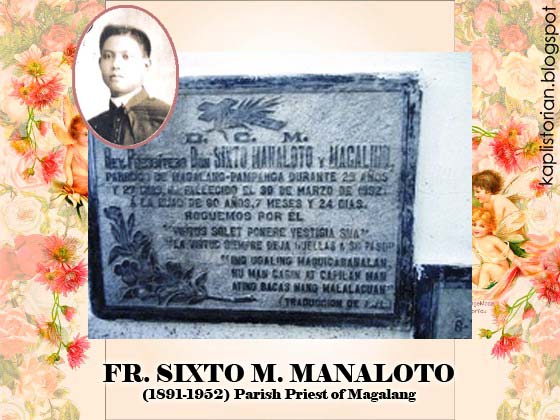
FR. SIXTO M. MANALOTO
(b. 6 Jul. 1891/d. 30 Mar. 1952)
Place of Interment: Magalang Memorial Park
Though Tarlac-born, Fr. Manaloto would make a lasting impression on Magaleños, serving their parish for an unprecedented period of nearly 30 years. On 8 December 1915, feast of the Immaculate Conception, Fr. Manaloto, a product of San Carlos Seminary, was ordained into priesthood by Archbishop Harty in 1915. Assigned in Magalng in 1923, he is known for his major restoration works of San Bartolome Church., for opening a parochial school in the town and for sending poor, but deserving students to Manila, many of whom eventually returned as professionals and became leaders of the community.

 JOSE CORAZON DE JESUS
(b. 22 Nov. 1896/ 26 May 1932)
Place of Interment: Cementerio del Norte (Manila North Cemetery)
Son of Vicente de Jesús  of Sta. Maria, Bulacan and Susana Pangilinan of Pampanga. As Huseng Batute,  he wrote nationalistic articles for Ang Democracia, Liwayway, Taliba, under the pseudonym Huseng Batute. He supported Philippine independence and wrote critical articles about Philippine society under the Americans. Known as the King of Balagtasan, for his mastery of Tagalog poetry.Wrote the lyrics  of the popular Filipino song “Bayan Ko”,which has become an alternative anthem.

KUDIARO LAXAMANA
(b.1906/d.1970)
Place of Interment: Clark Cemetery, Angeles City, Pampanga
Born in the Mt. Pinatubo area. Aeta World War II Guerrilla Hero. Head of the 55-155th Squadron of the Northwest Pampanga Mountain District. Reputedly killed 50 Japanese soldiers, chopping off at least 17 enemy heads with  his bolo. Given a post-humous recognition in Mabalacat in 1995 for his wartime bravery. Killed in 1970 for his advocacies. Given a 21-gun salute at his burial at the Clark Cemetery. A major road in Clark—Kudiaro Laxamana Ave.—is named after him.

RUFINO J. CARDINAL SANTOS
(26 Aug. 1908-d. 3 Sep. 1973)
Place of Interment: Manila Metropolitan Cathedral crypt
The 1st Filipino Prince of the Church. Born in Sto. Niño, Guagua to Gaudencio Santos and Rosalia Jiao. Accepted as seminarian at San Carlos Seminary in 1921.  At 19, became a scholar of the Pontifical Gregorian University in Rome in 1927. Ordained on 25 Oct. 1931 in Rome. Assigned to Imus, Cavite and Marilao, Bulacan as assistant priest; then to Manila. After his war imprisonment, was named by Arch.  Michael O’Doherty as Vicar General of Manila, then elected as the Titular Bishop of Barca and Auxiliary Bishop to the archbishop. Succeeded Arch. Gabriel M. Reyes as the new archbishop of Manila in 1953, following his appointment by Pope Pius XII. Elevated to the rank of the cardinal at the Basilica of St. Peter in Rome at 9:30 a.m. on 31 Mar. 1960.

CLEOFE J. BALINGIT
(b. 9 Apr. 1910/ d. 5 Jun. 1981)
Place of Interment: Apalit Municipal Cemetery
Daughter of  Macabebe Scout Felix Balingit and Juliana Jaime of Macabebe. Chosen to represent Pampanga in the search for the 1936 Queen of the Manila Carnival, touted as “the biggest annual event of the Orient”. Her candidacy was supported by the newspaper “Ing Catimauan”. Placed 4th after the winner, Mercedes Montilla, of Negros Occidental,  crowned Miss Mindanao 1936. Married to Dr. Mariano Bayani of Apalit.  Spent the rest of her life involved in socio-civic causes,  especially the Pampanga Chapter of the Girl Scouts and the local Red Cross.

DIOSDADO P. MACAPAGAL
(b. 28 Sep. 1910/ d. 21 Apr. 1997)
Place of Interment: Libingan ng mga Bayani
Born in Lubao to Urbano and Romana Pangan. “The poor boy from Lubao” became the 9th President of the Philippines, serving from 1961 to 1965, and the sixth Vice-President, serving from 1957 to 1961. Was a member of the House of Representatives, and headed the Constitutional Convention of 1970. Father of Gloria Macapagal Arroyo, the 14th President of the Philippines from 2001 to 2010. Succeeded by Ferdinand Marcos.

THE AQUINOS OF TARLAC
Place of Interment: Manila Memorial Park, Parañaque, Manila
Corazon Cojuangco Aquino ((b. 25 Jan. 1933/d. 1 Aug. 2009)
The first woman president and the 11th chief executive of the Philippines.  The most prominent figure of the 1986 People Power Revolution that ended the 21 years of dictatorial rule by Pres. Marcos. People rallied around her after her husband’s assassination and swept the plain housewife to power. Hailed as the “Mother of Asian Democracy”.
Benigno Aquino Jr. (b. 27 Nov. 1932 /d. 21 Aug.1983)
A leading oppositionist of the Pres. Ferdinand Marcos and his dictatorial regime. Arrested and jailed for 7 years during the Martial Law of 1972.Founder of the lakas ng Bayan (Laban) party. Allowed to travel by Marcos in 1980 for medical reasons, byt was assassinated upon his return to Manila in 1983. His death was the catalyst for te People Power Revolution that ended the arcos regime and started his wife Corazon’s ascent to power.

FERNANDO POE JR
(b. 20 Aug. 1939/d. 14 Dec. 2004)
Place of Interment: Cementerio del Norte (Manila North Cemetery)
Actor, director, film producer and presidential of the Philippines. Considered King of Philippine Movies. Began showbiz career in the 1953 with the movie “Anak ni Palaris”. Has over 200 films to his credit. Most portrayals show him as a champion of the poor. 5-time winner of FAMAS Award. Married to showbiz royalty, Susan Roces; daughter Grace Poe is a senator. Ran for the 2004 presidential race, but lost by the slimmest of margin against Gloria Macapagal-Arroyo.

ALEXIS TIOSECO
(b. 11 Feb. 1981/d. 1 Sep. 2009)
Place of Interment: Family mausoleum, Angeles City Cemetery
The young film critic is the great-grandchild of Leonardo Lilles, a successful agricultural engineer, businessman and town leader of Macabebe.  Noted film critic and film professor at the University of Asia and the Pacific. Known advocate of Southeast Asian cinema. Named  in 2005 as “one of the most important young people in the Philippines today”, by Philippine Star, for championing Philippine cinema. On 1 Sep. 2009, Tioseco and Slovenian girlfriend Nika Bohinc, were murdered in their Quezon City apartment by 3 burglars. Their househelp was convicted in May 2018 for her participation in the crime,

BONUS!
COLIN P. KELLY JR.
(b. 11 July 1915/10 Dec. 1941) 
Place of Memorial: Madison, Florida
B-17 pilot Capt. Colin Purdie Kelly Jr. died in action against the Japanese forces in 1941. Kelly’s damaged plane, while returning from a bombing run, blew up near Clark Field after being engaged by enemy forces. Declared as America’s first hero of WWII by US President Franklin D. Roosevelt.  The Kelly Theater of Clark as named after him. There is a  memorial statue of the fallen captain in front of the theater ruins inaugurated on 10 Dec. 2007—the 66th year of his passing.

CONRADO Y, GUINTO, KING OF POETS
(b. 21 Jan. 1946/d. 5 May 2015)
Place of Interment: Porac, Pampanga
Conrado Guinto is the fictional character in the award-winning advocacy film,”ARI: My Life with a King”, produced by Holy Angel University. The aging Kapampangan poet royalty befriends a Pampanga-born high school lad, JP, who can’t speak the language. Their contentious relationship ends with the death of Conrado, but only after passing the poet’s torch, and the laurel crown to the young boy. Portrayed by real-life poeta laureado,  Francisco "Frank" Guinto, who won Best Actor honors in the Metro-Manila Film Festival 2016, New Wave edition. The FAMAS-award winning sory was penned by Robby Tantingco and directed by Carlo Catu.

SOURCES:
(tomb)
FELINO GIL: Jerry Punzalan Sagmit (tomb); Luther Parker Collection (photo)
SIXTO MANALOTO,:Old Cemetery: https://magalang-heritage.weebly.com/old-cemetery.html
JOSE CORAZON DE JESUS: http://malacanang.gov.ph/undas-2012-a-cemeteries-tour/(tomb); flickr.com, posted by NCCA Official (photo)
CLEOFE BALINGIT: Alex R. Castro Collection
COLIN KELLY: www.findagrave.com
CARDINAL SANTOS: findagrave.com (tomb); Alex R. Castro (photo)
KUDIARO LAXAMANA: www.finadagrave.com (tomb);
 www.art.com (photo)
DISODADO MACAPAGAL: Twitter photo, by Maria Cepeda (tomb); wikipedia.com  (photo)
CORY AQUINO, NINOY AQUINO: wikimedia commons
FERNANDO POE JR: Wikimedia commons (grave); Alex R. Castro (photo)
ALEXIS TIOSECO: Robby Tantingco (tomb), Association for Southeast Asian Cinemas Conference - WordPress.com (photo)

Sunday, September 9, 2018

93. 12 MEMORABLE LINES FROM FAMOUS KAPAMPANGANS

From known Kapampangan personalities--quotable quotes that not only speak a lot about their character, but also serve to inspire, motivate, encourage, and sometimes, amuse and entertain, without really trying!
**********

A famous, oft-quoted Kapampangan boast uttered by an unknown Pampanga native, in reference to his unparalleled courage and bravery.

 Attributed to Ninoy’s widow who restored democracy to the Philippines and who would be swept  to power as the country’s first female president, in one of her interviews.

 In 2003, former Miss International Melanie Marquez delivered one of her infamous lines, when she defiantly defended her brother Joey Marquez against detractors who blamed and bashed him for his part in his failed marriage with media darling Kris Aquino. Her penchant for making these hilarious grammatical lapses have resulted in a book appropriately entitled “Melanisms”.

 Said by the Huk Supremo after Pres. Elpidio Quirino asked him if he was now ready to swear loyalty to the Philippine government, following his acceptance of an offer of amnesty.

 These words are attributed to the nameless “brave youth  from Macabebe”.  Miguel Lopez de Legazpi had sent feelers that he wanted to meet with the Macabebes who arrived in Tondo, with Lakandula as mediator. The young leader spurned him, as “ahe did not come to befriend the adelantado, but rather to fight him”. This led to the warrior’s valiant death in the battle of Bangkusay, as chronicled in Conquistas de las Islas de Filipinas 1565-1615.

 Dubbed as Gloriagate, the Hello Garci political scandal created an electoral crisis in the Philippines when, in June 2005, telephone conversations between GMA and Comelec commissioner Virgilio Garci were leaked to the public. Allegedly, Arroyo tried to sway the election results in her favor. An attempt to impeach her in the lower house was thwarted by GMA’s group, and she escaped trial. With a sad, contrite face, she eventually apologized to the country on TV. “I want to close this chapter.”, she ended.

 Last words of the convicted criminal before his death by electric chair on May 17, 1972. Jose, whose father is Dr.  and 3 others (Basilio Pineda, Jr., Eduardo Aquino, Rogelio Cañal) were found guilty of the kidnapping and rape of actess Maggie dela Riva on June 26, 1967.  His mother’s plea for mercy in Malacañang was not heeded. Jose was the son of a well-to-do doctor from Pampanga, Dr. Jose Jose.

 At the end of her popular 1980s weekly musical-variety show V.I.P.(Vilma in Person), the bubbly star would throw a flying a kiss and wave her hand as she shouts “I love you, Lucky!”.  Lucky happens to be the nickname of her son with Edu Manzano, Luis Philippe. “I love you,Lucky!” would become her trademark goodbye.

 Words of wisdom from the “poor boy from Lubao”, who would become the ninth President of the Philippines, serving from 1961 to 1965..

Pampanga’s most well-known hero addressed these words to his son after learning of his father’s impending execution by the Japanese, in May 2, 1942..


 Action star Mark Lapid, unleashed these words to Dick Israel in the Northeast Films’ “Apoy sa Dibdib ng Samar”. The cpmlete lines are: “ Oo, inaamin ko. Saging lang kami. Pero maghanap ka ng puso sa buong Pilipinas---sagin lang ang may puso! Buti pa ang saging, may puso!”

This powerful—and popular-- line has been quoted in countless speeches, inspirational talks and used in book titles and political collectibles, but Ninoy Aquino did not exactly state the line verbatim. It was actually a condensed version of a section in his 1980 speech in New York before the Asia Society where he said:  “I have carefully weighed the virtues and the faults of the Filipino and I have come to the conclusion that he is worth dying for because he is the nation’s greatest untapped resource.”

Wednesday, August 15, 2018

90. 17 KAPAMPANGAN AMBASSADORS WHO HEADED EMBASSIES

An ambassador is, technically, is a career diplomat or political appointee who holds rank of Chief of Mission I or II, nominated and confirmed as Ambassador Extraordinary and Plenipotentiary who heads diplomatic missions in Philippine embassies worldwide. (Diplomats of same rank or lower rank who serve as consuls general in embassies or consulates or Chargé d’Affaires in embassies are not included here).
*****


1. H.E. JOSE M. ALEJANDRINO (Arayat). Ambassador to Spain and Italy.
Jose Medina Alejandrino comes from the prominent Alejandrinos of Arayat town that includes his namesake, revolutionist and senator, Gen. Jose Magdangal Alejandrino. A U.P. Law graduate, he placed 10th in the 1934 bar. Alejandrino organized the workers of Pambusco and Pasudeco into labor unions. He was sent as a scholar to the U.S. Department of State and went home to top the foreign service exams in the U.S. Rising through the ranks, he became an ambassador to Spain and Italy. The lawyer-diplomat counts Gen. Charles de Gaulle of France as a close friend.


2. H.E. LIBRADO CAYCO (Sta. Rita).  Ambassador to the Netherlands.
Ambassador Cayco(b.1912/d.2009), from Sta. Rita, was a Political Advisor with the Philippine Mission to the UN. He later served as Consul of the Philippines at New York and served as the Philippine ambassador to the Netherlands from 1962-1963,  He was the leader of the Philippines delegation to the Ministerial Meeting of the Southeast Asian Treaty Organization in 1965.


3. H.E. VICENTE I. SINGIAN (San Fernando). Ambassador to Belgium and Luxembourg.
In 1964, the Philippine established formal ties with the European community on 12 May 1964. Amb. Vicente Singian, of San Fernando was first assigned as First Secretary and Consul in Great Britain in 1954. Subsequently, he was named as the Head of Mission of Belgium and Luxembourg from 1964 to 1971.


4. H.E. AMELITO R. MUTUC (Arayat). Ambassador to the United States.
Amelito Ramirez Mutuc attended Arayat Institute, then topped his high school in Guagua. He earned his Associate in Arts (valedictorian) and completed his law degree in 1942 at Ateneo de Manila (salutatorian). In 1957, Mutuc caught the eye of then congressman, Diosdado P. Macapagal, who hired him as consultant for his candidacy as VP of the Philippines. Mutuc launched “Macapagal for Vice President Movement”, and from thereon, became the future president’s right hand man. When Macapagal was elected as President in  1962, he named Mutuc as his Executive Secretary.That same year, he was appointed as Ambassador to the United States, serving in Washington D.C. from 1962-1964. He died in 1994.


5. H.E. ROGELIO L. DE LA ROSA (Lubao). Ambassador to Sri Lanka, Cambodia, The Hague.
The golden boy of Philippine cinema, Regidor La Rosa began his political career when as elected Senator in 1955. He could have been our first movie star president had he continued his run for Presidency in 1961. Dela Rosa withdrew his candidacy to give way to his brother-in-law, Diosdado Macapagal  who eventually was elected Philippine president. De la Rosa was rewarded with an ambassadorial position in Cambodia in 1965. During the Marcos years, de la Rosa was  named ambassador to the The Hague, Netherlands, and to the Soviet bloc countries of Poland, Bulgaria and Czechoslovakia. His last  post was Sri Lanka. He died on 10 Nov. 1986.


6. H.E. CARLOS J. VALDES (Bacolor). Ambassador to Japan
The distinguished son of Bacolor, Carlos J. Valdes (b. 1919/d. )  finished commerce from La Salle College, and Law from the Far Eastern University in 1949, on scholarships. He also taught at Holy University, in Angeles. Valdes then opened a successful  Law and Accountancy firms with many high profile clients in the business world. Valdes became a member of the Constitutional Assembly in 1971,he served as  ambassador to Japan from 1978-1986.


7. H.E. RAFAELITA HILARIO-SORIANO (Bacolor). Ambassador to Israel.
Dr. Rafaelita Hilario-Soriano’s (b.2 Jul. 1915/d. 1 Jan2007) was the child of  eminent jurist and politician Zoilo J. Hilario of Bacolor  with Trinidad Vasquez. After finishing a political science degree from the Philippine Women’s University in 1936, Soriano won a Barbour Scholarship at the University of Michigan. Returning in 1948, she forayed into another career path—Foreign Affairs. She was named as a Chairman of the Information, Culture, Education and Labor Activities Committee of the SEATO and as Sec.-General of the SEATO Council of Minister’s Meeting in 1970. This led to her being named as an Ambassador Extraordinary and Plenipotentiary to Israel.


8. H.E. BIENVENIDO L. TAN JR. (Bacolor). Ambassador to Germany,1989
Amb. Tan has roots in Bacolor, being the grandson of Don Gonzalo Arceo Tan, a financier of the Revolution. His parents were Judge Bienvenido Tan, Sr. and Salome Limgenco. Tan became an outstanding public servant and headed the BIR during Pres. Corazon Aquino’s term. In 1989, he was named Ambassador to Germany. The late Sister Mary Christine Tan is his sibling.


9. H.E. RUPERTO M. DIZON (Magalang). Ambassador to Jordan
When the Philippines reopened ties with Jordan in 1998, Ruperto Dizon became the  Philippine Ambassador Extraordinary and Plenipotentiary to the Hashemite Kingdom.The Philippines also decided to re-open its Embassy in Amman in recognition of the critical role that Jordan continues to play in regional and international affairs, especially in the Middle East Peace Process. Dizon was also tasked with the care and concerns of the growing number of Overseas Filipino Workers in Jordan. Amb. Dizon served as Consul general at the Philippine Consul General in New York. Upon retirement, he was  given the Distinguished Service Award in New York on 27 Sep. 2012.


10. H. E. LEONCIO R. PARUNGAO JR. (Arayat). Ambassador to Palau
Prior to becoming an ambassador, Leoncio Parungao held a corporate job in public relations at the Central Bank. The accomplished Parungao finished Journalism from Far Eastern University in 1952, and was a Ten Outstanding Young Men Awardee for Public Service in 1964. He served as Press Secretary of the first President Macapagal at the very young age of 31. From 1998- 2004, he was the Philippine ambassador to the Republic of Palau. In 2012, he  was conferred the Distinguished Service Award by DFA.


11. H.E. LAURA QUIAMBAO-DEL ROSARIO (Angeles City).  Ambassador to India and Vietnam.
Amb.Laura Del Rosario holds an A.B Litt. Degree from Maryknoll (1968) and her M.A. in Education from the University of the Philippines (1975). She was commissioned as a career Foreign Service Officer in 1979, and was assigned to Singapore.  She was the country’s senior official at the Asia Pacific Economic Cooperation (APEC) forum.  She was appointed the Alternate Philippine Permanent Representative to the UN in Vienna, and served as Ambassador to India, Nepal (non-resident) and Vietnam.She retired as Undersecretary for International Economic Relations, one of the highest positions in the Foreign Service.


12. H.E. VESTA R. CUYUGAN (San Fernando). Ambassador to New Zealand
Amb. Vesta Roque Cuyugan was the 4th  Philippine ambassador to New Zealand, serving there from 1993-1996. She was coaxed out of her retirement by the Ramos government to head Philippine foreign affairs office in Taiwan (since the Philippines does not have diplomatic relations with Taiwan ) towards the end of the president’s term.


13. H.E. LEONIDA L. VERA (Sasmuan). Ambassador to the Holy See (Vatican)
Leonida Laki Vera served as Ambassador of the Philippines to the Holy See (Vatican), replacing Amb. Francisco Alba who retired in 2003. She had previously worked for the United Nations Development Fund for Women and religious organizations, such as Caritas Manila, Council of Laity of Manila, Children Rosary Movement, and Paraclete Foundation. An accounting graduate of UST, Amb.Vera is a recipient of the Dame of the Pontifical Order of St. Sylvester and St. Gregory in 1994 and 1998, respectively. She quit her post in 2008.  She was a Most Outstanding Kapampangan Awardee for Government Service in 2014.


14. H.E.  JERRILL G. SANTOS (San Fernando). Ambassador to Vietnam
Jerril G. Santos of San Fernando is the current Chief of Mission of the Philippine Embassy in Vietnam which he assumed in 2009. With the Department of Foreign Affairs since the 1980s, Amb. Santos has served several presidents as chief of Presidential Protocol and is now Consul general of the newly opened Philippine Consulate General in Houston. His awards include:  Gawad Mabini, with a rank of Dakilang Kasugo (2007),  the Order of Sikatuna, with a rank of Datu (2009) and honored as among the Outstanding Fernandinos in 2012


15. H.E. MA. CONSUELO PUYAT-REYES (Guagua). Ambassador to Chile.
Consuelo Puyat is the daughter of Deogracias Puyat, a son of industrialist Gonzalo Puyat from Guagua. Her mother is Patria Gil. She served as the Ambassador Extraordinary and Plenipotentiary to Chile, based in Santiago. Lito Puyat, a name associated with Philippine basketball, is her brother.


16. H.E. MERCEDES REINARES –ARRASTIA TUASON (Lubao).  Ambassador to the Holy See (Vatican)
Maria Mercedes Reinares y Arrastia-Tuason (b. Sep. 27, 1930) is an alumnus of St. Scholastica in Manila. She is known for her work in the Red Cross and her pro-life activism. She was appointed ambassador plenipotentiary to the Holy See in 2009. In May 23, 2012, Pope Benedict XVI awarded Tuason the Grand Cross of Merit for the title Order of Pius IX due to her charitable and diplomatic services to the Catholic Church, a coveted title that was not granted to women until November 1993. She is a 2016 Outstanding Kapampangan Awardee in Government Service.


17. H.E. ELIZABETH P. BUENSUCESO (San Fernando). Norway, Denmark, Iceland , ASEAN
H.E. Elizabeth P. Buensuceso is a  Permanent Representative (PR) of the Philippines to ASEAN, based in Jakarta. Prior to her appointment, Amb. Buensuceso was the Assistant Secretary of the Office of European Affairs-DFA (2011-2013), the Ambassador  to Norway, Denmark, and Iceland (2008-2011), and Lao PDR (2004-2008). She is the third  Philippines’ Permanent Representative to ASEAN. Her mother, a Pineda, is from San Fernando. The ambassador speaks the Kapampangan language.
.
SOURCES:
MANY THANKS TO Acting Asst. for Public Diplomacy-DFA MR. ELMER G. CATO for providing the updates.
Bienvenido l. Tan Jr.: Leo Suryadinata, editor. Southeast Asian Personalities of Chinese Descent: A Biographical Dictionary . Institute of Southeast Asian Studies, Singapore, 2012.
Philippine Government Directory, Diplomatic Post Publishing Corporation, 2000      
Rogelio dela Rosa, Rafaelita Hilario, Amelito Mutuc: www.viewsfromthepampang.blogspot.com
Vesta Cuyugan: The Pampangans, by R. Hilario. Info c/o: Mr. Roberto Magat

Monday, November 14, 2016

24. 24 LITTLE-KNOWN FACTS ABOUT ROGELIO DE LA ROSA

November 12, 2016 marks the birthday centenary of Rogelio de la Rosa (b. 1916/d. 1986)—matinee idol, politician, ambassador. This feature pays homage to Lubao’s famous son who rose to become the first King of Philippine Movies during the golden age of Philippine cinema, and the first showbiz personality to become a successful politician, and later, a much-admired diplomat.  

1. Rogelio de la Rosa’s grandfather, Francisco, was a pure Spaniard and and surveyor.  His grandmother—Francisco’s wife—was an Ilocano belle, Marciana Dariano, of Naguilian, La Union.

2. Feliciano, Rogelio’s father, is credited with donating an artesian well to the people of barrio San Jose Gumi, pre-dating Magsaysay’s practice of giving out water pumps to barrios. Feliciano was a painter, while mother Rosario, was famed as a singer.

3. The de la Rosas were the first family in Lubao to own the town’s first car.


4. The young de la Rosa was a zarzuelista, and along with his friend, Diosdado P. Macapagal, appeared in staged plays like “Sumpang Metupad”, “Atul ning Banua” and “Bayung Jerusalem”, written by playwright, Urbano Macapagal, Diosdado’s father.

5. After high school at the Lubao Institute, de la Rosa went to Far Eastern College where he earned a Liberal Arts degree. There, he became a superb athlete (intercollegiate welterweight boxing champ, member of the undefeated basketball Central Luzon basketball team) and a champion orator (Claro M. Recto Gold medallist  in Oratory).

6. Rogelio’s favorite books:  The Political Upheaval) (Schlesinger), Caesar and Christ (Will Durant), The Importance of Living (Lin Yutang) and Soviet Russia in China ( Gen. Chiang Kai-Shek). Favorite food: Pinakbet.


7. His baptismal name was “Regidor”; Rogelio de la Rosa was a screen name given to him by Jose Nepomuceno (“Father of Philippine Movies”), who directed him in  his first movie. She was paired with Bacolor-born Rosa del Rosario (Rosa Stagner, in real life) and their love team was alliteratively billed as—Rogelio de la Rosa and Rosa del Rosario.

8. At age 16, Rogelio made his first movie, “Ligaw na Bulaklak”, directed by Jose Nepomuceno. As it was a silent film, his lead actress mouthed lines in English,  while Rogelio spewed out sentences in Kapampangan. Fearing that the audience could lip-read, director Nepomuceno enrolled them in a Tagalog language course.

9. At his prime, de la Rosa stood 6 feet tall, weighed 184 pounds and had a 45 in. chest. In 1948, he had a fixed monthly salary of Php 2,000, and had  25% to. 33.3% share of net proceeds from his pictures, giving him a guaranteed annual income in the range of Php 150,000- Php 200,000, a substantial amount in those days.

  
10. The popular Rogelio de la Rosa-Carmen Rosales love tandem began with the 1939 musical, “Takipsilim”. They would appear together in 12 more films:  Lambingan, Señorita, Diwang Awit, Colegiala (1940), Panambitan, Tampuhan (1941), Camelia, Kampanang Ginto (1949), Maalaala Mo Kaya (1954), Ang Tangi Kong Pag-ibig, Iyong-iyo (1955), and their last movie together, Lydia (1956).

11. The actor put up his own RDR productions  with J. Amado Araneta and Placido Mapa in 1941, and produced box-office hits including: Ang Maestra, Anong Ganda Mo (1941) and Caballero (1942).

12. De la Rosa was the first Filipino actor to in a film slated for international release in 1949:  ‘Sword of the Avenger’, where he was top-billed as Ramon Delgado along with Sigrid Gurie. Produced by Eagle Films and the United Philippine Artists, it also had a Tagalog version—‘Ang Vengador’, this time, with Pacita Francisco. Shot  in Hollywood, the film was directed by Sidney Salkow,and featured the exploits of “ the swashbuckling leader of the Filipino resistance to Spanish opposition during the 19th century”.


13. Many of the films of Rogelio de la Rosa spawned a few theme songs that became very popular:”Maalaala Mo Kaya?”, “Sarung Banggi”, “Tayo Na Sa Antipolo” and “ Ang Tangi Kong Pag-ibig”.

14. De la Rosa won two Best Actor awards for his movie “Higit sa Lahat”, earning the FAMAS Best Actor nod in 1955, and the Asia Film Festival Best Actor trophy in 1956, held in Hong Kong.

15. The very private Rogelio was already married when he was at the peak of his career. He was married during the Japanese Occupation to  Dolores “Lolita”  Z. Bayot of Masbate. Rogelio was  married a second time to a fellow Kapampangan actress, Carlota “Lota” Concepcion Delgado”, who was born in Camp Stotsenburg.
   

16. The de la Rosa children’s names all begin with the letter “R”:  Ramon, Rudolf,  Reynaldo, Roberto, Regidor (Rocky) and only girl, Ruby. His son with Bayot was also named Rogelio Jr.

17. In 1951, de La Rosa bought a 300 hectare property in Irisan, Baguio which  he developed into the RDR Dairy Farm. He supplied his city friends with eggs, pork, beef  and 225 quarts of milk daily, from his 150 cows imported from the U.S. Bureau of Animal Industry officials once tested their dairy milk and found it to have superior butterfat content.

18. During the Japanese Occupation, de la Rosa joined the underground resistance movement. He also volunteered to go to the war during the height of the hostilities in Korea, to help boost the morale of the U.N. forces.


19. De la Rosa’s first fling with politics was in 1957, when he ran for the Senate and won—largely on the support of his legions of fans, mostly from the masses. His most vital piece of legislation was his sponsorship of a bill that condemned the illegal appropriation of public streams and rivers by big fishpond owners. As a senator, he met with Pres. John F. Kennedy at the Oval office when the U.S. president signed the War Bill in 1962.

20. Pres. Ramon Magsaysay designated de la Rosa as his adviser on labor, agriculture and rural development. He impressed the president so much that Magsaysay even encouraged him to run for governor of Pampanga in 1955.

21. When de la Rosa ran for the Presidency as an Independent in 1961, he chose the salakot and a pair of bakya (wooden shoes) as elements of his campaign seal.His slogan was : “We shall return to Malacañang!”, in reference to his pro-“masa” (common people) approach to governance.


22. Ten days before the election, de la Rosa withdrew his presidential bid as he realized that he would split the opposition votes against the ruling re-electionist  Carlos P. Garcia. This move generated many ugly rumors: that he was paid Php 500,000 by the Macapagal camp to withdraw, plus a key cabinet position and control of the Central Bank, and that his decision had driven his wife, Lota, to drink poison and attempt suicide.  Another rumor had it that Malacañang paid de la Rosa to run to split the Luzon votes, but when he looked headed for victory in the South, the Nacionalistas were alarmed that he could actually win the presidency. De la Rosa gave way to his brother-in-law, thus paving the way for Macapagal’s victory.

23. De La Rosa served in the diplomatic corps for 18 years, starting as ambassador to  Cambodia in 1965, where he was admired even by Prince Norodom Sihanouk, He was also assigned to the Hague, Poland, and Bulgaria and Sri Lanka. During his term, he became the dean of the diplomatic corps. He retired from the Foreign Service in 1983.

24. He ran for a position in the Batasang Pambansa under the banner of KBL in 1984, but lost, amidst mounting protests against President Ferdinand Marcos. 

SOURCES:
 The Case for Rogelio de la Rosa,  Sunday Times Magazine, 23 November 1961.
 The “Untimely Withdrawal” of Roger de la Rosa, by Quijano de Manila, November 1961
 Garcia, Jessie B., A Movie Album Quizbook, Erehwon Books and Magazine, Iloilo City. December 2004. P. 107-111.
 Rogelio de la Rosa: Matinee Idol, Icon, Patriot, Gentleman. By Tonette Orejas, Philippine Daily Inquirer.p, A2-3.  13 Nov. 2016.
Doña Sisang and Filipino Movies. Philippines: Vera-Reyes, Inc. Published by A.R. Mercado Management, Inc.

Photo sources: Video 48, The Chronicle, Sunday Times Magazine,Constantino, Ronaldo, K., ed., "Memorable Tagalog Movie Ads 1946-56" Manila: Danny Dolor Publications, 1994,  Alex R. Castro Photo Collection. SPECIAL THANKS to; Michael de Leon, for photos of RDR and Lota Delado, and children.