Showing posts with label Lubao. Show all posts

Tuesday, January 28, 2025

114. 9 TAMBAY SPOTS IN PAMPANGA

Pampanga has been on the tourist map staple for a long, long time. Known for the majestic cooking of its people and its astonishing mix of country and cityscapes, the province also offers casual hangout spots perfect for the chill days, may it be for tourists or even locals.
                                                                     ********

1. PORAC BAYWALK PARK, Porac
The serene Porac river view plus the fresh breeze of air is the perfect equation of a “tambay” spot. Porac Baywalk Park, also known as Porac Babo Robot, turns into a lively night market by sunset that offers the local flavors of Pampanga. With both tourists and locals enjoying the delicate Porac riverscape, various activities by the local government of Porac are held in this place throughout the year.

Photo from: Porac Government Page

2. MINALIN SUNSET PARK, Minalin
Situated between Minalin’s proud vast fish ponds, Sunset Park is an up and coming destination in the north of Pampanga. If you’re looking to spend the afternoon lazing around, watching the sunset and mingling with people, Sunset Park is a must visit. With expansion plans from the government, Minalin is looking to expand this beautiful stretch into an entertainment hub for the locals and tourists to enjoy in the future.

                                  Photo from: Sunstar 

3. CAPITAL TOWN, City of San Fernando
Capital Town is the best hang out spot if you want to experience both tradition and modernity at once. Situated along Capitol Boulevard in the heart of San Fernando, Pampanga. One of the most famous places to visit in Capital Town is the largest McDonald's branch in the Philippines; more importantly, this branch accommodates parks with traditional carriage, food carts selling low-cost street foods, and more. This hangout spot is undoubtedly among the best options for those on a tight budget. All you need to do is bring your picnic blanket and enjoy the fun experience at Capital Town.

                                 Photo from: Mega World

4. THE ORCHID GARDEN RESORT, City of San Fernando
The Jewel of San Fernando is only a short drive away from Capital Town and is one of the must-visit destinations when the ber-months approach. The Christmas Village Pampanga, which is part of The Orchid Resort, brings holiday fantasies to life with displays including nativity scenes, Santa's workshop, lights illuminating every corner, and special activities that can create cherished memories with your family. During the regular days, The Christmas Village turns into a resort and a recreational park that offers scenic dining experiences with its wide range of restaurants and establishments inside.

                                  Photos from: The Orchids Gardens

5. CLARK PARADE GROUNDS, Mabalacat
A place full of historical upbringing and a symbolic reminder of Philippines-United States friendship over the years, now serves as a park with natural scenery for families to enjoy. Clark Parade Grounds has made significant strides and now provides ideal leisure activities like jogging, biking, strolling, and picnics. The greenery and abundance of open spaces at Clark Parade Grounds made it one of the greatest places to unwind and chill out with your loved ones.

                                 Photo from: Feliix Inc.

6. BAMBOO HUB ECO PARK, Lubao
The Bamboo Hub Eco Park in Lubao, Pampanga serves as a hub for bamboo cultivation with its unique and environmentally-focused design to promote sustainable practices. Visitors can learn about the different species of bamboo, its ecological benefits, and how it can be used for various purposes. The park plays a part in reforestation efforts, encouraging the use of bamboo as a sustainable alternative to deforestation practices. Bamboo's ability to quickly grow and stabilize the soil makes it ideal for preventing erosion and improving biodiversity.

                                 Photo from: Pelago


7. CLARK GLOBAL CITY / WEST AERO PARK, Clark Freeport Zone
This area looks like a normal gasoline station full of car dealerships, but at night, this is where the car enthusiasts or “tambay” near Clark hang out. Clark Global City was a go-to place for Gen z’s, millennials, and even boomers when they wanted to chill out with their Barkadas, flexing their cars while drinking beer on their open trunks and camp chairs.

                                 Photo from: Skyscraper City Forum

8. NORTHWALK CLARK / SF2, Clark Freeport Zone
If you want to witness planes take off and land while drinking beer with your friends this tambay spot is for you. Due to its spacious parking lots, it’s been a go-to chill spot for different generations. The illuminating lights at night give a serene and comforting place for barkadas to sit, drink, and have deep conversations.

                                  Photo from: Foursquare


9. TABNUAN CULTURAL CENTER, Mabalacat, Xevera
Just February of last year, another hangout or chill spot in the outskirts of Pampanga emerged. Tabnuan Cultural Center is not only a heritage spot to visit but also a tambay must-see as it houses a magnificent view of Mabalacat City and offers a breather from the hustle and bustle of the city scene. Tabnuan is quite literally tambay-material with wide space and the fact that the name literally means “meeting place.” Various food stalls, local merchandise and affordable coffee hosted by Cafe Municipio will surely make your tambay more worthwhile. While you’re there, Balacat Tea is a must try!

                                            Photo from: Mabalacat City News Facebook

They introduce a new concept of these places may not be your usual tourist spots but they introduce a new concept of relaxation, not only for the locals but tourists as well.


P.S: This was made by Center for Kapampangan Studies interns who love to tambay.


Wednesday, November 21, 2018

100. 10 KAPAMPANGAN MATINEE IDOLS OF THE 1950s-1960s

These midcentury Kapampangan screen stars were the Daniel Padilla, Dingdong Dantes, and Alden Richards of their days--captivating female fans, melting hearts and causing screams and swoons, with their good looks and great acting talents.
**********


1. GREGORIO FERNANDEZ, Lubao
(b. 25 May 1904/ d. 11 March 1973)
Actor-director Gregorio “Yoyong” Fernandez was the son of  Eugenio Aranita Fernandez and Maria Montemayor, and grew up in an artistic milieu. To help finance his dentistry studies, he  became an actor at  Mayon Photoplay Corp.  where he did  “Anak sa Ligaw”. This film started his long career in Philippine moviedom, first as an actor ( “Yesterday, Today and Tomorrow” ,  “Ang Lumang Simbahan”, and the 1921 hit, “Ligaw ni Bulaklak” ). His first directorial debut was  “Asahar at Kabaong” (1937). He would have a directing career at LVN Studios, even winning a FAMAS in 1955 for “Higit sa Lahat”. His children with Pilar Padilla became actors too: Merle Fernandez, and Rudy “Daboy” Fernandez. Fernandez  was active until the early 70s; his last film was “Daing”, shown in 1971. 

2. MANUEL CONDE, San Fernando
(b. 9 Oct.1915/d. 11 Aug.1985)
Manuel Pabustan Urbano Sr., better known as Director Manuel Conde, is recognized as one of the greatest Filipino directors of our time. Born in Daet to Dionisio Urbano and Lucia Pabustan of San Fernando, Manuel enrolled in Geology at Adamson University, hoping to be a mining engineer. But he was lured by the movies, starting as an ‘extra’ in “Mahiwagang Biolin”. It was in LVN that he became a director. When he started his production outfit, he starred in his on pictures starting with the popular “Juan Tamad” series, and costume epics like Prinsipe Paris (1949), Krus Na Kawayan (1956), Siete Infantes de Lara (1950) and its re-make in 1973. But it was for “Genghis Khan” (1950) that introduced Philippine cinema to the world. From among 780 film entries, it was chosen as one of 20 films to vie for awards at the Venice Film Festival. Though it did not win, the film emerged as one of the most acclaimed movies of the prestigious festival. United Artists bought the film for international distribution, where it would later be dubbed in 16 languages and became a bestseller.


3. ROGELIO DELA ROSA, Lubao
(b. 12 Nov. 1916/ 26 Nov. 1986)
Lubao’s native son, born Regidor dela Rosa,  rose to become the brightest male star in the Golden Age of the Philippine Cinema (1940s-50s). Born to Feliciano de la Rosa and Rosario Lim, he was discovered by Gregorio Fernandez. He debuted in “Ligaw na Bulaklak”, with Rosa del Rosario in 1932. Soon, he was being paired with Emma Alegre, and Paraluman, but his team-up with Carmen Rosales was the longest and most successful . By 1948, he was the highest paid movie actor in the Philippines. . His 1955 role in “Higit sa Lahat” earned him a FAMAS 'Best Actor' trophy as well as the Best Actor Award at the 1956 Southeast Asian Film Festival in Hong Kong. After retirement, he entered politics, got elected as a Senator (1957-63), ran for Presidency (retracted upon the pleading of Macapagal, his brother-in-law, who was also running for the same position) and became an ambassador to Sri Lanka, Cambodia and The Hague, Netherlands.

4. JAIME DELA ROSA, Lubao
(b. 18 Sep.1921/d. 2 Dec. 1992)
Rogelio’s younger brother, Tommy, assumed the screen name Jaime de la Rosa, and he too, would earn his place in Philippine showbiz. He was studying Law when he was first featured in the Eastern Pictures movie, “Anak ng Lansangan” in 1939.Making his strong presence felt, he was cast successively in 3 movies: “Cadena de Amor”, “Bawal na Pag-ibig” and “Kahapon Lamang” . Before the war began, he was seen in a musical, “Ibong Sawi”. Two post-war roles would etch Jaime’s image in the hearts and minds of movie fans forever. One, was in the 1st ever “Darna” movie, starring Rosa del Rosario, as the lead’s love interest. And, in 1953, he was Fredo, the human lover of the fabled mermaid , “Dyesebel”, played by Edna Luna. Jaime was married to Betty Santos, also a Kapampangan.


5. EDDIE DEL MAR, Candaba
(b. 13 Oct. 1923/d. 8 Nov. 1986)
Born Eduardo Magat in Candaba, the son of Albino Magat and Benigna Sangalang, he was a medical student at UST when war intervened. After the War,  Sampaguita Pictures gave him a screen test which he passed. As “Eduardo del Mar” he became a featured player in "Kapilya sa May Daang Bakal" starring Oscar Moreno and Tita Duran, and directed by Tor Villano. It was at Premiere Productions where he made his most memorable film "Sisa". As Crisostomo Ibarra, he generated much buzz and an acting nomination. The film itself won the top "Maria Clara Award" in 1951. Thus began his association with "Rizaliana movies". His 1956 film, “Ang Buhay at Pag-ibig ni Dr. Jose Rizal” would changed the course of his showbiz career. The film, which dramatized Rizal’s romances,  won for del Mar the 1956 Best Actor Award trophy. Five years later, he would star in the movie adaptation of “Noli Me Tangere”  that was produced to commemorate Rizal’s birth centenary in 1961. Many actors have essayed the role of Rizal since— Joel Torre, Albert Martinez Cesar Montano, to name a few—but nobody was more famously identified with that role than Eddie del Mar.

6. LUIS GONZALES, San Luis
(b. 8 Aug. 1928/d. 15 Mar. 2012)
Luis Mercado, also known as Luis Gonzales, did over 100 films during his career, mostly by Sampaguita Pictures. He is best remembered for essaying the role of Pres. Ferdinand Marcos in two 1965 biopics: “Iginuhit ng Tadhana”, a Marcos’ propaganda film; and  “Pinagbuklod ng Langit”. He co-starred with Gloria Romero, who had appeared with him in the 1955 romantic comedy, “Despatsador” and which led to other blockbusters like “Artista” , “Hootsy Kootsy” (1955), Pagdating ng Takip Silim, Teresa, Vacationista (1956), Colegiala, (1957), Alaalang Banal, Palaboy, (1958), Sinisinta Kita (1963) and Show of Shows (1964). Together, they did about 30 movies. Luis would continue to be active in the next decades and some of his memorable movies include “Tubog sa Ginto” and “Haydee” in 1970, where he helped launch the career of another Kapampangan, Hilda Koronel. He was married to socialite Vina Concepcion, with whom he had 3 children.


7. EDDIE GARCIA, Macabebe
(b. 2 May 1929)
The bemoustached kontrabida you love to hate—Eduardo “Eddie” García started in showbiz as a swashbuckling hero in Manuel Conde’s 1950 classic, “Siete Infantes de Lara” . It also comes as a pleasant surprise that his grandmother was from Macabebe, married to a Spaniard, which makes him a quarter Kapampangan. Born in Sorsongon to Antonio Garcia and Vicenta Verchez, he joined the Philippine Scouts after the war. Fresh from his assignment in Okinawa, he answered a casting call for a costume film—and the tall, Hispanic-looking scout made it to the Conde film. Soon, he was being called to play villains, owing to his sleek, well-kept moustache, roles he played with such credibility. One of his movies was aptly titled, “Contravida”, which he did in 1955. Another memorable role is that fo a closeted gay husband in the 1970 film “Tubog sa Ginto”, by Lino Brocka. The durable actor is the only artist inducted in three categories in the FAMAS Hall of Fame: Best Actor, Best Supporting Actor and Best Director. The prolific Garcia continues to act in TV shows and movies today, with over 400 appearances to his credit.

8. JESS LAPID SR., Guagua
(b. 5 Oct. 1933/d.13 Jul. 1968)
At the height of his career, ranked among the bigtime action stars of the 60s, led by Fernando Poe Jr. and Joseph Estrada. Born as Jesus Songco Lapid, he had started as an “extra”, then became a stuntman, where he had the good fortune of doubling for Fernando Poe, Jr. They became fast friends, and Poe would eventually give Lapid his break in the  1963 FPJ Productions’ “Sierra Madre”, where he gave a noteworthy performance. His next move, “Kardong Kidlat” (1964) would catapult him to stardom. Lapid had just wrapped up the movie “Simaron Brothers”with Jun Aristorenas, when, on the night of 13 July 1968, he was shot to death at the Lanai Nightclub after a row between two groups of movie personalities, which also involved his reputed girlfriend,  Nancy Roman, an actress. Lapid was just 35. As a belated tribute, nephew Lito Lapid appeared as Jess in the biopic “The Jess Lapid Story”, released in 1978.


9. RAMIL RODRIGUEZ, San Fernando
(b. 22 Aug. 1944/d. 29 Apr. 2014)
Ramil Rodriguez,  (Rene Rodriguez Jr., in real life) the elder son of Rene Hizon Rodriguez and Ma. Rosa Moreno. The Rodriguezes are from a prominent family with roots in Bacolor. They were friends of the Vera-Perezes, who owned Sampaguita Pictures. Ramil, unlike the younger Pepito, was the more reticent one when they were offered to make movies. In the end, family friendship prevailed and began his showbiz career via the 1960 movie, "Palanca". He was officially introduced in 1964's "Leron-Leron Sinta", a musical comedy starring Susan Roces and Eddie Gutierrez. As part of Stars '66, Ramil was  paired with Loretta Marquez, and Liberty Ilagan. He took on everything from comedies,  musicals, action and drama flicks in the '60s and evolved into a fine dramatic actor in the 80s. He starred in classics like "Blusang Itim", "Magdusa Ka", (1986), "Asawa Ko, Huwag Mong Agawin", "Ibulong Mo sa Diyos" (1988). Ramil found a new set of fans with his appearances in telenovelas like 1997's "Mula Sa Puso", "Love to Love" (2004) , "Magpakailanman" (2005) and the highly rated "Bakekang" (2006-07). He died of lung cancer.

10. PEPITO RODRIGUEZ, San Fernando
(b.1944)
Pepito Rodriguez was born Jose Rodriguez in 1944, younger brother of Ramil. The Rodriguezes were from a prominent family with roots in Bacolor. In 1963, Pepito joined the movie bandwagon as the boy-next-door type, in the film “Haliging Bato”. He was noticed in light musical romances like “Dance o’ Rama”, “Jukebox Jamboree” and of course, in the popular “Mga Bata..” series. He dabbled in drama like “Alaala ng Lumipas” (1965) , “Hinango Ka Sa Lusak” (1967), but fans seemed to like him better in lightweight romance films. When actor Ricky Belmonte entered the picture as Rosemarie’s other love interest, an alternative love team was formed. After appearing in “Life Everlasting” in 1971, Pepito  dropped out of circulation, only to come back almost a decade later in the made-for-TV movie, “The Children of An Lac” as the Vietnamese Capt. Nam. He was lured to return in the 1985 drama, “Palimos na Pag-ibig”, and in the 1990 action film “Alias Baby Face”. He would permanently retire from showbiz after that, and settle in the U.S. as a successful businessman.

SOURCES:
Wikipedia.com
http://www.andropampanga.com/history_sanluis.htm
Salumbides, V.icente. Motion Pictures in the Philippines, 1952
Tiongson, Nicanor, The Cinema of Manuel Conde, UST Publishing House, 2008
All others: Alex Castro Collection

Sunday, May 6, 2018

80. 15 KAPAMPANGAN PLACES, THEIR MONICKERS AND MOTTOS

The use of short descriptive phrases--sobriquets, nicknames, monickers-- to describe places goes a long way back in history. "Pearl of the Orient" (Perla del Oriente) was first used in 1571 for Manila, now used as a sobriquet for the whole country. Central Luzon, which includes Pampanga, was dubbed as the "Rice Granary of the Philippines". Pampanga, of course, lays claim to the title of "Culinary Capital of the Philippines". Not all place nicknames, however, are positive in nature-- some are insulting, some amusing, many hilarious --but this naming tradition lives on today. Recently, town mottos, too, are being appended to rally people to support their municipality's vision/mission. 
**********


ANGELES CITY
Angeles earned its reputation as a center of entertainment with the rise of its barangay, Balibago as a recreation and leisure hub for serving both American and local patrons. The city’s proximity to Clark Air Base jumpstarted the establishments of night clubs, pubs, bars and gambling dens which lined the main avenue of Balibago, as well as the nearby perimeter roads known as Fields and Friendship Avenue. The entertainment strip was lit with neon marquees with Las Vegas inspired names such as Copa Cabana, Nina’s Papagayo, Little brown Jug, and Tropicana. Like Los Angeles, it was dubbed as the “City of Angels”, as it was named for both the founder (Angel Pantaleon de Miranda) and titular patrons  (Los Angeles Custodios).  The Casino Filipino, run by PAGCOR, is also located in Balibago.
“Abe-abe…Saup-saup…Agyu Tamu!” (Together...Helping Each Other...We Can!)


APALIT 
Apalit is the last town of Pampanga as one goes south to Manila, hence its nickname. The town is also famous for its long tradition in blacksmithing, and  the best bolos are said to come from Apalit. Today, th town doe not only produce bladed weapons like machetes and knives, but also domestic steel tools like rakes, hoes, anvils, picks, shovels and garden implements.
“Aplit…Apalit!” (Quicken the Pace...Apalit!)


BACOLOR
Like the ancient capital of Greece—Athens—Bacolor was the undisputed seat of arts and culture of the province, with the highest concentration of poets, artists, zarzuela performers, musicians, singers and writers. Bacolor is the proud home of such literary greats  as Juan Crisostomo Soto, Felix Galura, Luisa Gonzaga de Leon, Jose Gutierrez David, Mariano Proceso Pabalan Byron, Anselmo Fajardo, Zoilo Hilario, among others. Bacolor was also the country’s capital for two years during the Spanish colonial times when Manila was invaded by the British.
“Pluribus Unum, Non Plus Ultra" (Out of Many, No Further and Beyond)”


CAPAS
Capas is one of the richest, most historic towns of Tarlac,  the final site of the infamous Bataan Death March. It is a trekkers’ and mountaineers’ paradise as the challenging Mount Pinatubo treks were first offered by this town, which today continues to  attract thousands of tourists every year, unprecedented in number. This accounts for its latest nicknames as Tarlac’s tourism capital.
"Paspas..Capas!" (Make Haste, Capas!)


DAU
Camp Stotsenburg established its  Post Exchange in Dau, which presaged its rise from a barrio of Mabalacat to  the country's PX capital in the 70s. With the relaxation of Clark rules, PX goods flowed out of the base in abundance, to be resold later in stores  that quickly sprouted like mushrooms along MacArthur Highway of Dau. The completion of the North Expressway that linked Dau to Manila facilitated the great American experience as visitors trooped to Dau to buy Pringles, Oreos, Kellogg’s Corn Flakes, Hershey’s Chocolates, Almond Rocha, Hanes and Fruit of the Loom shirts, imported rubber shoes, branded cosmetics, apples and grapes, among others. The reversal of fortune began with the departure of American servicemen facilitated by the Pinatubo eruption of 1991. Business took a turn for the worse when PX Clubs opened at Clark-which extended PX shopping privileges to Filipinos.  Today, Dau shops continue to flourish, with toilet fixtures, military uniforms, various tools, and used surplus items replacing the once in-demand PX goods.


FLORIDABLANCA
The third largest municipality in the province has so much potential waiting to be untapped that the municipal government came up with a kilometric monicker for the province that reads more like a vision.
“Abe-abe king Panyulung!” (Together in Advancement)


LUBAO
The ancient town of Lubao (old name: Baba) has the sole distinction of producing two presidents: Diosdado Pangan Macapagal (b. Sep. 28, 1910/d. Apr. 21, 1997), who served from 1961-1965 as our ninth President, and daughter Gloria Macapagal Arroyo ( b.Apr. 5, 1947 ), who was our 14th President,  from 2001 until 2010.


MABALACAT
Over 97% of Clark Economic Zone is on Mabalacat land, hence the claim as Clarks economic breadbasket. ‘Makati of the North’ is a monicker coined by the long-running Morales Administration, which came across as too pretentious. The only similarity is, like the Binays of Makati, Morales’ term was a long one, stepping down only 2017, after 22 years in power. The Kamikaze monicker is in reference to the Divine Wind suicide attacks of Japan that was planned in the home of local Mabalacat resident,  Marcos Santos, during the last years of World War II.
“Misanmetung, Mabalacat! (United for once, Mabalacat!)


MACABEBE
In the art of peddling, perhaps no one can compare to the selling skills of the Macabebe cloth vendors. In fact, Macabebe takes pride in being called “Home of the Peddlers”, a reputation built by these native vendors who roamed across the Archipelago, travelling on foot and in groups of two or more, selling the famous ‘Macabebe cloth’—actually, Manila-bought fabrics. These humble, hardworking cloth vendors infused a lot of money into their town and in the 1930s, were largely responsible for pumping up Macabebe’s economy.
"Memalen Macabebe, tapat makiabe!" (Macabebe townfolks are loyal friends)


MAGALANG
Magalang aspires to become the sweet tamarind capital of the Philippines through a locally-propagated tamarind variety known as Aglibut. The late Professor Andres Aglibut, a consultant of Pampanga Agricultural College, successfully developed a  sampaluk type noted for it sour-sweet taste and juicy dark brown flesh. This is in consonance with the town’s “farm tourism” program which aims to revitalize the farm industry of this scenic, agricultural town.
“One Magalang! Metung King Panyulung!” (One Magalang, One in our Stride to Progress)


MINALIN
The town is known as the "Egg Basket of Central Luzon" because of its large scale production of eggs and chickens. According to the municipal government, Minalin earns P30 million per month or P1 million per day from the sales of eggs. There are 22 poultry raisers who own around 280,000 chickens. These chickens produce 479,100 eggs per day. So important is this egg industry that a laying chicken is even included in its town seal.


SAN FERNANDO
The capital city of San Fernando is popularly known as the "Christmas Capital of the Philippines" because of its traditional giant Christmas lantern industry. The establishment of the Paskuhan Village in 1990 served to reinforce its image, but the lantern-shaped complex folded up after the Pinatubo eruption and fell into disarray. Its Giant Lantern Festival held every December remains the city’s biggest attraction, in which the city’s barangays field their biggest and brightest lantern in a friendly competition attended by thousands of local and international tourists.


SAN LUIS
San Luis’ most famous son is the Huk Supremo, Luis Mangalus Taruc, who was born in the barrio of sta. Monica, of peasant parents on June 21, 1913. Following the Japanese invasion, Taruc formed the Hukbalahap (Hukbo ng Bayan Laban sa Hapon), along with Casto Alejandrino and other guerillas, in central Luzon in 1942.  San Luis became one of the hotbeds of Huk activities in the 50s and 60s. in 2017, Taruc was recognizedas a hero by the National Historical Commission of the Philippines (NCHP) for his role the struggle for  agrarian reforms.


SANTA RITA
Sugarcane was the cash crop that made Pampanga so rich, Sta. Rita included. The town is famous for its sweet delicacies-- turrones de casuy (wafer paper-wrapped cashew nougats) and sans rival (rich pastry made with layers of buttercream, meringue, and chopped cashew nuts). Ocampo-Lansang made these treats famous, and which in turn, gave the town’s nickname.
 “Sesen taya ing Santa Rita” (Let's care for Sta. Rita)


SANTO TOMAS
Santo Tomas is the smallest town of Pampanga but it has many unique homegrown industries like red clay pottery and funeral casket-making. The latter products are known for their beauty and fine quality,  made by craftsmen from about 100 registered enterprises, not to mention 200 backyard producers.  Its nickname as the casket capital of the country was given by the Department of Trade and Industry (DTI) in the 1980s, and its reputation shows no sign of waning. It is estimated currently, that 40% of the town depends on the coffin-making industry. It has been the tradition of Sto. Tomas town to donate coffins to affected provinces during times of calamities.

SOURCES:
Dau: Photo by Jun Malig, Inquirer Central Luzon
Floridablanca: www.pampangatalents.com
Photo: by Chris Navarro,

Wednesday, November 29, 2017

67. 12 RIVER MYTHS AND MYSTERIES OF PAMPANGA

1. THE ONCE-MIGHTY PORAC RIVER
Ancient Porac was in the vicinity of a seashore.

Three pre-historic settlements in Porac, one unearthed by anthropologist H. Otley Beyer’s team in 1939 (Hacienda Ramona site), another by archaeologist Robert Fox in 1959 (Balukbuk site), and the third by the National Museum in 1999 (Upper Balukbuk site) raise the question of why the settlers built relatively large communities high up on the foothills of the Zambales Mountain Range. A  theory says that the ancient Porac River, which today is nothing but a shallow brook, was navigable enough for large water vessels from Manila Bay, and that the subsequent eruptions of Mount Pinatubo, years (not centuries) before the Spaniards arrived in 1571, silted the river and either destroyed the communities or forced the inhabitants to abandon them. Old folks in Lubao town, claim that in the 1960s, they saw what looked like large wooden boards floating in the Porac-Gumain river. The boards, between 12 and 16 feet long, were roughly cut and had holes in them, which made the folks speculate that they must have been parts of a large ancient boat washed down from upstream Porac River, which they believe to be navigable in the distant past. (Joel Pabustan Mallari)

2. WERE BETIS AND LUBAO AS BIG AS CEBU?
The conquistadores found thriving Muslim communities here.

The earliest  Spanish chronicles show that the first settlements in Pampanga were situated along the major waterways. Miguel Loarca listed these ancient settlements with their corresponding population figures, thus revealing a comparison between Pampanga settlements and those in other parts of the archipelago. In the list, Betis (Vitis) and Lubao had a population of 3,500 people, the same number as that of Cebu. Calumpit (Calonpite) outnumbered Macabebe by 400 people, but the latter Pampanga town had a bigger population than Vigan (1,600 people), Malolos (800), Negros (700) and Ylocos (500). Most if not all of these Pampanga communities thrived along or close to riverine areas for two basic reasons: abundant resources and accessibility of transportation. This is true for all the great cities and civilizations of the world (J. Mallari)

3. LUBAO’S ANCIENT BURIAL BOATS
Skeletons turn up during a flood.

Old civilizations all over the world—like Vikings, Austronesians, and Ebypt--observed a variety of elaborate burial rituals, one of which involved boats. Researchers of the Center for Kapampangan Studies, together with Dr. Rodrigo Sicat, author of The Kapampangans, recently interviewed old folks in Dr. Sicat’s hometown, Lubao, living near the now-heavily silted Gumain River. According to them, during the great flood of 1972, an eroded section of the protective dike near the property of a Pablo de la Peña in Brgy. Gumi turned up several boat-shaped coffins. They described the finds as canoe-shaped kabaung, inside of which were the skeletal remains of what appeared to be at least six-footers. Beside the skeletons, the interviewees claimed, were indigenous and tradeware ceramics: blue-and-whites and local earthen pots like kuran and banga. Each coffin measured between 12 and 18 feet long, carved out of the trunk of a bulaon tree (Vitex parviflora Juss.).  (J. Mallari)

4. FACTORIA AND THE SHIP THAT SANK IN NUEVA ECIJA
Did Spanish galleons sail as far as the headwaters of the Pampanga River?

Pedro Arcilla wrote that as recently as the early 1900s, large boats could still navigate the Pampanga River from Manila Bay all the way to Cabanatuan City and other Nueva Ecija towns. In fact, a parish document in a Nueva Ecija town mentions a casco (old folks there say it was a Chinese junk, others say it was a Spanish galleon) that sank during a storm in the early 1800s in that upstream section of the Pampanga River that flowed through the town of Factoria. An old resident of San Isidro town (present name of Factoria) allegedly recovered a part of this sunken ship’s rudder which is now displayed in his private museum, awaiting scientific verification. In times past, Factoria once controlled the tobacco industry in the North and was once the capital of Nueva Ecija. Indeed, this once-thriving town, formerly within the boundaries of the Kapampangan Region, owed all of this to its proximity to the Pampanga River. (J. P. Mallari)

5. THE SASMUAN-CABIAO CONNECTION
This upstream town served as haven to Kapampangan refugees.

In the Sasmuan Papers of the Luther Parker Collections (c.1900), there is a claim that Factoria became the capital of Pampanga in 1762, when the British invaded Manila and the country’s capital was moved to Bacolor. The territory of Pampanga extended all the way to Nueva Vizcaya, and Nueva Ecija as a province, was still non-existent. The provincial governor of Pampanga, a Señor Biron, was residing in Factoria, when British soldiers invaded Sasmuan through the town’s Manglares River.  Biron ordered all the residents in eastern Sasmuan  to evacuate to Cabiao (then still part of Pampanga). A group of women, led by Doña Magdalena Pineda protested against the order, citing the inconvenience of moving to Cabiao. After the British left the country in 1765, the Philippine capital was returned to Manila and apparently, Pampanga’s capital was returned to Bacolor and thus ended Factoria’s brief shining moment in history.

6. MEXICO: PAMPANGA’S CAPITAL BEFORE BACOLOR?
Bacolor was the provincial capital only from 1755 to 1903
Bacolor  started functioning as capital of Pampanga in 1746 and officially became capital only in 1755.  The town served as the provincial seat of government until 1903, when the capital was moved to San Fernando. In Conquistas de las Islas Filipinas, Gaspar de San Agustin, OSA wrote that the provincial capital  prior to Bacolor was Mexico town, one of the oldest and most prosperous communities in Pampanga. The province’s oldest surviving church structure is found in San Jose Matulid; the town has a barangay named Parian which indicates the presence of a community of Chinese merchants before; and a tributary to the Pampanga River links Mexico directly to Manila Bay passing through the important towns of San Fernando, Bacolor, Guagua, Sasmuan and Macabebe.

7. SAPANG BALEN AND ITS VIOLENT PAST
Angeles City lies in the path of an old, forgotten river

When the city’s founder Don Angel Pantaleon de Miranda  and wife Doña Rosalia de Jesus, came to Kuliat  to establish a new town, they chose the area around the Sapang Balen creek. The creek may seem harmless but its present tranquility belies a violent past. Historian Mariano Henson notes that on July 20, 1881, “A typhoon and a heavy downpour of rain caused the treacherous Taug salient, which used to originate at the southwesternmost tip of barrio Pampang, to swell up to a murky, clay-ey tone into the Sapang Balen Creek, causing the destruction of the three bridges of 1850 and carrying away three houses from barrio San Jose. It is said that before 1796, the Taug sometimes went a few hundred yards behind the present church during protracted heavy rainfall.” A similar devastation occurred in 1972 when Sapang Balen washed away dozens of houses in San Jose, and again when Mount Pinatubo erupted on June 15, 1991, when the creek overflowed into downtown Angeles. Sapang Balen is actually the ancient path of Taug River; at some point in the distant past.
(C. Manese)

8. THE MYSTERY OF THE SACOBIA RIVER
The mighty river probably did not exist before the 1850s

Sacobia River, which became a byword during the lahar season in the 1990s, is one of four major rivers emanating from the eastern slope of Mount Pinatubo itself.  Strangely, however, Sacobia River does not appear in maps made during the entire colonial period until mid-1800s. Cartographers could not have missed such a major river, considering that even creeks in the vicinity of the Sacobia River are depicted. Is it possible that Sacobia River did not exist before mid-1800s? There is a theory that it may have been formed, probably due to a lake breakout on the slopes of Mount Pinatubo, in the 1850s. Sometime in 1856, the town of San Bartolome in southern Tarlac was completely swamped with floodwaters from Parua, the river’s old name. Parua may have been the downstream name of Bamban River (Sapang Mabanglu). 1856 may have been the year Sacobia River was formed; it elbowed away from Mabalacat (in a spot called Maskup in sitio Bana) to merge with the Bamban River before proceeding to Concepcion and draining into Rio Chico. Another puzzle is the name “Sacobia.” Nobody knows what it means or to whom it refers. It is not a Kapampangan term and there was no Spaniard or Filipino who went by that name. (J.P.Mallari)

9. RUSSIA’S GRAND DUKE CAME BY BOAT
The world’s rich and famous traveled all the way to Apalit

DURING colonial times, elegant mansions of rich Kapampangan families lined the Rio Grande, the most famous of which was that of Don Joaquin Arnedo Cruz and Doña Maria Sioco Arnedo, in Sulipan, Apalit. “(Their) combined fortunes…created a lifestyle of leisure and luxury unmatched elsewhere in the archipelago,” writes Gene Gonzales in his book Cocina Sulipeña. The couple frequently threw lavish parties for their guests who came from Manila via the bay and Pampanga River .Among the guests  Jose Rizal, Gen. Arthur McArthur, Gen. William Howard Taft, and Prince Norodom I of Cambodia, who reportedly fell in love with a local maiden, Pepita Roxas of the next town Calumpit, Bulacan. But the best-cherished visit to Sulipan was that of Alexis Alexandrovich, Grand Duke of Russia and son of the Czar himself. While in Pampanga, the Russian Duke hunted birds in the surrounding marshes, and boar and deer in the mountains. In gratitude, he gifted his gracious hosts with a whole set of monogrammed porcelain dinner set.

10. THE LOST CANNERY OF GUAGUA
Why a small tributary in an interior town is called Dalan Bapor

Guagua has always been a commercial hub, even as early as pre-Hispanic times when it was a thriving community of Moros who traded with Chinese merchants. The Pasak-Guagua River which connected with the Rio Grande, served as the highway of cargo ships doing business in the town; a tributary to this river is known as Dalan Bapor (literally, ship’s way), which today has been reduced to just a shallow canal. Until World War II, however, it bustled with economic activity because it led to the Guagua  Cannery located in what is now a Brgy. Sta. Filomena  subdivision beside the Guagua National College. Old folks living in the area recall that the cannery occupied the entire land area of the subdivision; that “huge ships” transported tons of canned goods like sardines and even local specialties like tabang talangka and burung asan; that it offered retail canning services for affluent families who wanted to send canned products abroad; that it was bombed by Japanese planes in World War II; and that it finally closed in the 1960s following a series of labor disputes. (J. Mallari)

11. THE GREAT FLOOD OF 1972
Pampanga’s worst calamity before Pinatubo

Next to the eruption of Pinatubo, the worst calamity to ever hit the Kapampangan Region in recent memory was the flood of 1972, when the entire Central Plain of Luzon was submerged under water. Heavy monsoon rains lasting 40 days nonstop had been triggered by four tropical cyclones that made a direct hit in the area during that year’s rainy season: Asiang, Konsing, Toyang and Undang.The flood, which claimed 298 lives, was worst in the Central Plain because this area is the natural catch basin of two major waterways, the Pampanga River and the Agno River; moreover, the presence of the Candaba Swamp (pinac), alugin (waterlogged) areas and baná (marshes), as well as the phenomenon of subsidence, further makes the area susceptible to flooding. (C. Manese)

SOURCES:
Singsing Magazine, Center for Kapampangan Studies, "River Myths and Mysteries". by Joel Pabustan-Mallari, Robby Tantingco, C. Manese.

Monday, October 30, 2017

65. 12 STATELY KAPAMPANGAN RESIDENCES, AS THEY LOOKED IN THE 1930s

The 1930s was a period of relative peace and prosperity for many Kapampangans, especially for those who made their fortunes from the province’s burgeoning sugar and rice industry. Old colonial homes were refurbished and expanded, modern residences were built,  designer mansions and multi-storey homes were commissioned to be lived in, and to be seen. Here are some of them as they appeared in the halcyon days of the 1930s.
 **********
The spacious Don Alfonso de Leon residence was designed by Arch. Fernando H. Ocampo, considEred as the “Father of Modern Architecture”. It was constructed with Rizal Cement and furnished with renowned Puyat Furniture pieces.

The residence of Don Luis Wenceslao Dison and Feliza Hizon Dison is located in brgy. San Jose. It is another creation of Arch. Fernando H. Ocampo, built with Rizal Cement, painted by A.B. Villanueva & Sons, and furnished with Puyat Furniture. The 1930s house, whose main features remain intact,  is now being used as the Archdiocesan Chancery.

Don Benigno Fajardo is one of the founding fathers of Lubao Institute which opened in 1929. The most distinctive part of his multi-level house is the double-roofed upper storey terrace, accessible by a grand central staircase.


A prominent sugar planter of Lubao, Don Ambrosio Gonzales (b.1876/d.1957)  is also a socio-civic leader of the town, having founded the Hormiga de Hierro (Ants of Steel) in 1901. His charming 2-storey house, which is enclosed by a metal grill fence, sits on a lush garden and is typical of the modernized homes in 1930s Pampanga.

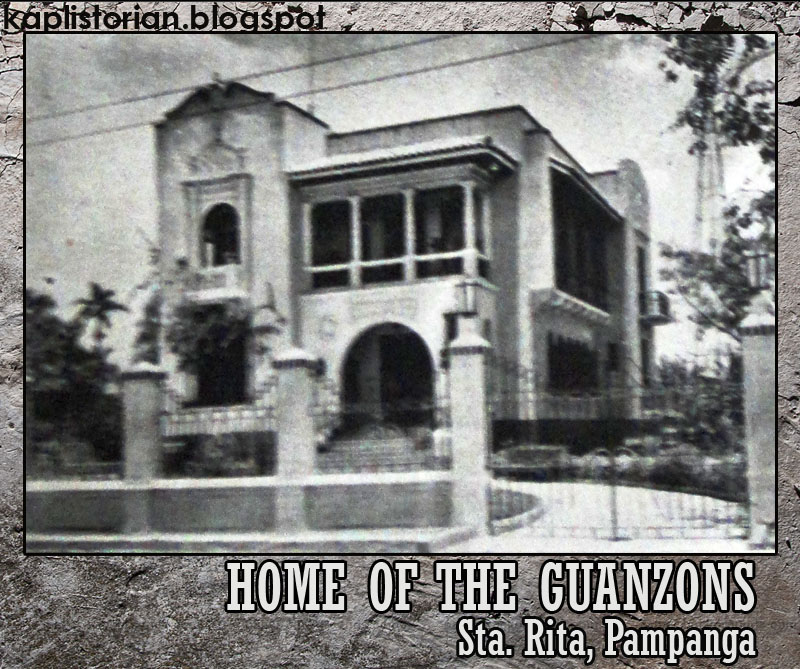
The Guanzon house was built in 1932 by Don Felipe Pineda Guanzon for his wife Dona Epifania Alvendia- Guanzon of Sta. Rita. Known today as Villa Epifania, the concrete house has sleek art deco elements, a style in vogue during the Commonwealth years.

Don Leandro Ibarra, an accomplished lawyer, was named Secretary of Interior of the Philippine Revolutionary Government under Emilio Aguinaldo. His capacious  “bahay na bato” residence was still well-kept and in order in the 1930s,

The Angeles home of Don Jose Lazatin, a  well-known businessman and sugar planter was designed by Menem Tayag. The concrete and wood house is furnished with the latest in Puyat Furniture.

The imposing Lopez Mansion, built in the grand Greek revival style, is reputed to be the first all-concrete house in Pampanga. It is constructed with APO Cement and furnished with Puyat Furniture. Owner Don Alejandro Lopez was a successful planter, owner of the Lopez Rice Mill, Co., and the Vice President of Pampanga Sugar Mills Planters Association. Together with his wife, Jacinta Limson and his family, Lopez resided and also held office here.

The home of Don Jose Luciano in Magalang was a favorite party place of the town’s elite, and the Lucianos would often host dinners and balls for Manila’s high society families like the Madrigals.  The beautiful house with a wide porch. was specially designed by Arch. Fernando H. Ocampo,  built with Rizal Cement and furnished with Puyat Furniture.

The beautiful home of lawyer  Don Pedro Morales (b.1886/d.1945) and Magdalena Hizon, was designed by his wife’s cousin, Arch. Fernando H. Ocampo in Mabalacat. A typical 30s house, it was furnished with Puyat Furniture. When the couple perished in he 1945 liberation of Manila, their lone surviving child inherited the house, and moved it to Magalang. Unfortunately, a fire destroyed the ancestral Morales house.

The house of Don Teodosio Pecson Santos and Josefa Panlilio was another design of the much-in demand architect, Fernando H. Ocampo, and furnished with the usual Puyat Furniture. Located along A. Consunji Street in Barangay San Jose),  it was purchased by the Miranda family, and is now recognized as one of the capital city’s treasured ancestral houses.

Don Emiliano J. Valdes (b. 1876/d.1953), the generous Kapampangan philanthropist who gave his name as well as financial donation to fund Pampanga’s leading TB hospital in Angeles had his grand residence built along Plaridel St. in the mid 30s. The Valdeses had barely enjoyed their new house when his wife died on 20 September 1936.To make matters worse, his house was taken over by the Japanese during the war and turned into a military headquarters. To forget the sad events that transpired in his Angeles home, he sold the house and lot after the war, and the space has since become a commercial area.

SOURCES:
PAMPANGA SOCIAL REGISTER, 1933
Lubao Commemorative Fiesta Program, 1936
www.viewsfromthepampang.blogspot.com, for Emiliano Valdes, Lopez Mansion, Pedro Morales House,