Showing posts with label Semana Santa. Show all posts

Thursday, March 29, 2018

77. 10 RARE AND EARLY PHOTOS OF FLAGELLANTS IN PAMPANGA


The ways of  flagellants have always inspired awe and curiosity amongst the faithful during the days of Lent. Pampanga flagellants, however, have a different intent. Bloodied, scourged and caked with dust, magdarames live and act out the passion of the Lord—and the term “dámé”, to sympathize and share one’s grief, to take part in someone else’s suffering-- captures this spirit of oneness, in pain and sorrow. Here are, early images of the “magdarame” in Pampanga,  preserved by the camera from the turn of the 20th century to the 1950s.
************

1. MAMALASPAS
Barefooted flagellants from the early 20th century have their backs incised with wounds, drawing blood by whipping their backs with burilyos--bamboo strips tied to a cloth. These magdarame types are called mamalaspas, A distinctive sound is heard when the bamboo strips strike the flesh.

2. MAGDARAMES IN A VISITA
Makeshift chapels of wood, nipa and light materials serve as pitstops for  retinue of magdarames. Here, at these gaily decorated visitas, they pause to say their prayers, before moving on.
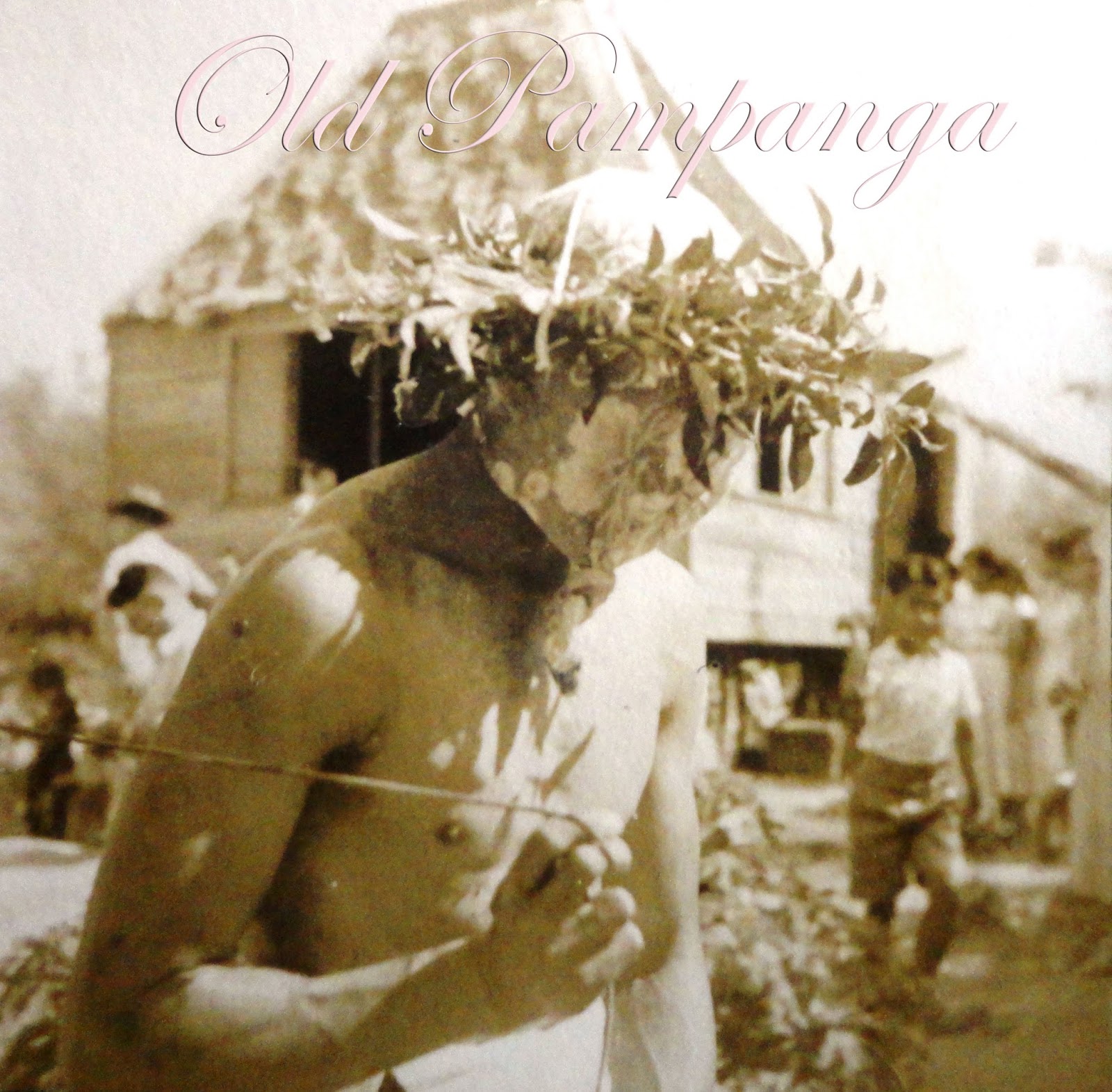
 3. MAGDARAME ANONYMOUS.
A magdarame remains anonymous by covering his face with a black hood or a white cloth, called "capariza", held in place by a crown of vines or twisted branches. These days, the face cover is an option as some modern-day flagellants expose their faces to the world. Instead, a piece of cloth is used to covers their heads, Arab-style.

4. BLOOD AND GORE
The back of a magdarame  is incised with a panabad, a paddle with shards of broken glass or directly with a razor or the sharp tip of a knife, such as the one shown in the photo.

5. EYES ON THE MAGDARAME
A group of American ladies from nearby Fort Stotsenburg gawk at a cross-bearing magdarame, followed by his aide, who intones prayers. Then, as now, magdarames were strange sights to see for foreigners. Today, the display of unusual practices such as flagellation and crucifixion are part of a 'religious tourism program' propagated by such places led by the City of San Fernando.

 6. THE CROSS-BEARERS
A popular type of magdarame is the cross-bearer or mamusan kurus. He either carries a cross or is tied to one. This flagellant carries a cross of bamboo, and he carries its full weight as the cross does not touch the ground. Today's crosses are fashioned from commercial lumber from hardware stores, or fashioned from old electric posts. They are also unusually long, so that the end of the cross touches the ground, thus providing support,

 7. THE WAY OF THE CROSS
Flagellants often walked country trails and roads, in small packs of 8 to 12. Others go on solitary walks, the better to reflect on his personal mission to be united in suffering with Christ. An American in a white suit follows this group in their walk of faith.

8. WHIP IT GOOD!
Another kind of magdarame is the sasalibatbat, who fling their bodies to the ground, rolling over sharp rocks and stones in the process. They are followed by a flogger, who whips them when they are on the ground. Their torsos, legs and arms are tied with abaca rope to impair circulation, hence making the experience more torturous.

9. EVERYTHING'S ALRIGHT?
An ayudante checks on the condition of a magdarame, sprawled on the field under the hot, mid-day sun.  The walk around town begins in the morning, ends by early afternoon and is followed by a dash to the nearest river for a quick, recuperative bath.


10. CRUCIFY HIM!
A magdarame is symbolically crucified, by having his arms tied on the crossbar.  The first re-enactment of Christ's crucifixion happened in the 1955 "Via Crucis" in San Fernando, but it was only in 1962 that an actual crucifixion was done, with the nailing of Artemio Anoza to the cross in barrio San Pedro Cutud. Anoza believed he could realize his dream to be a faith healer with his crucifixion.

PHOTO SOURCES:
Photos, courtesy of "Old Pampanga" FB Group.
Others: Alex R.castro, ebay.com 

Tuesday, April 4, 2017

41. DR. R. FELICIANO'S 14 FAVORITE LENTEN IMAGES IN PAMPANGA

DR. RAYMUND FELICIANO is a clinical pathologist who currently teaches pathology subjects at St. Luke’s Hospital in Quezon City. A resident of Angeles, his roots are in Mabalacat. He, however, is a doctor  with a unique passion. For over three decades now, he has been taking pictures of our Holy Week traditions--santos, religious processions, churches, Lenten exhibits--all over the Islands, from back in the days of analog photography to the age of digital cameras. 

A photography buff since his high school days at Chevalier School, Dr. Feliciano was inspired to travel  by watching Susan Calo-Medina’s TV show “Travel Time”.  He started in 1987, and began toting his instamatic cameras to interesting places where he took pictures of provincial scenes. But when he got hold of Ricky Jose’s book, “Simbahan”, he decided to focuse on religious subjects—and has not stopped since. The results of this lifetime undertaking are hundreds of santo photos compiled in over 50 albums and donated to the Center for Kapampangan Studies of Holy Angel University in Angeles City. 

After having seen thousands of processional santos, he has come up with a list of his 14 favorite, best-looking Semana Santa images that he shares with us, in this blog.
********

The San Pedro statue of Lubao rides a spectacular carroza of the chariot-type. 

Arayat's antique "Manalangin" features a chalice-bearing angel dressed in short pants.

Angeles' "Macagapus" was carved in 1834 with Valentin Tuason as the original owner. It was passed on to his Nepomuceno heirs.

The Senor Desmayado  of Guagua was commissioned by one of the town’s leading citizens, Don Tiburcio Dyco. It was carved in 1882 by the accomplished sculptor, Sotero Dionisio Garcia of Quiapo, Manila.

The small Paciencia image of Guagua is owned by the Familia Cabrera and is a certified antique. 

Porac's Tercera Caida (Third Fall of Christ) comes from the Santa Catalina Parish of this old Kapampangan town, and is known for its complete, well-proportioned character images.

The antique image of Sta. Rita's La Veronica is owned by the Familia Pineda, a prominent family of the town, which also owns a Third fall of Christ paso.

"Macapacu Qng Cruz" or the Crucifixion is also known as Santa Misericordia. It was commissioned in 1907 by Dna. Francisca Evangelista. It was inherited by Leonora Panlilio, and passed on to her present descendants.

Angeleños take pride in their own “Apung Mamacalulu”, or the Lord of Mercy, depicting the image of the dead Christ. It was commissioned by Fr. Macario Paras between 1828-1838, carved by an artisan named Buenaventura.

The spectacular calandra of Sasmuan that contains the body of the dead Christ is owned by the Mercado family. 

Mabalacat's Sta. Maria Jacobe is an antique image that was transported to Pampanga from the Visayas, by a family member when he came to work here, where it was known as Sta. Salome.

The Sta. Salome of Angeles is a transformed image of La Veronica--which is equipped with two heads-- made in 1835 for Vicente Dison. It is still with the Dison descendants.

The antique image of Sta. Maria Magdalena of Arayat is from the prominent Santos-Medina-Samia family.\,who own a host of other processional images like San Juan and Santo Entierro.

The century-old San Juan of San Simon in Pampanga is a short, stocky image that is a fixture in the Good Friday procession of the town.

Hailed as one of the most beautiful Dolorosas in the country, the antique ivory Dolorosa of the Limson Family of Guagua.  Its earliest could be traced to Diego Limson (ca. late 1850s-early 1860s) who married Severina Jingco.

PHOTO SOURCES: 
Tercera Caida: Reichardt Dino, (flickr name: asky)
Paciencia: courtesy of Jerry Punsalan Sagmit
Magdalena: courtesy of Arwin Lingat, (flickr name: pampanga)
Dolorosa: courtesy of Dr. Dindo Limson Juco
Crucifixion, Sta. Jacobe: Alex R. Castro
All others: courtesy of Dr. Raymund Feliciano (flickr name: emongfeliciano)