Wednesday, January 17, 2018

71. 12 EN GRANDE PAMPANGA WEDDINGS HELD IN 1936

One of the most significant milestones in one’s life is the Wedding, in which two people are united in marriage. “Kasal”, is our term for marriage, “kasalan”, the wedding ceremony. The customs and traditions of present-day unions were primarily influenced by a blend of Filipino, Spanish, American and Chinese models. One thing is certain though—when Kapampangans get married, they leave no stone unturned to make sure that theirs is a wedding to remember—the flashier, the better! Here are 12 notable Pampanga weddings in 1936, half of which were held in the “marry” month of June!
**********


LOURDES ALBA & RAFAEL C. HIZON
Married: 30 September 1936, Paco Church, Manila
Sponsors: Dña. Victoria H. vda. De Rodriguez, Don Jaime Hernandez
Notes:
The groom was a successful insurance agent of the National Life Insurance Co. insurance agent at the time of his marriage.

CARMEN DEL ROSARIO & VIRGILIO RODRIGUEZ
Married: 25 January 1936, Sto. Domingo Church, Manila
Sponsors: Dña. Victoria H. vda. De Rodriguez, Dña. Rosa del Rosario Valdezco, Dr. Teofilo Villongco, Hon. Cayetano Rivera
Notes:
Carmeling, a 19-year old Centro Escolar de Señoritas beauty,  and her beau Virgilio Rodriguez ( eldest son of sugar planter  Dña Victoria Hizon Rodriguez and the late Godofredo Rodriguez of San Fernando), had already planned on getting married after college, when the 1935 Manila Carnival intervened. A friend of Carmeling’s father badgered him into allowing her  daughter to run for Miss Philippines.  Thinking that her chances of winning were slim, Carmeling’s father persuaded his reluctant daughter to run. To their utter surprise, Carmeling won the Miss Mindanao title. Her name had already been announced in national newspapers when Carmeling resigned her title to marry the man she loved.

**********


JOSEFINA BUYSON & DR. JESUS EUSEBIO
Married: 12 April 1936, San Guillermo Church, Bacolor
Sponsors: Dña. Bartola S. de Dizon, Hon. Mariano Buyson Lampa
Notes:
Dr. Jesus Eusebio was the eldest son of Don Andres Eusebio,  a prominent sugar planter and businessman, with Asuncion Santos. Jesus was already a practicing ophthalmologist when he proposed to his fiancee, Josefina Buyson. Pitang, as she was called,  was one of the children of Mariano Buyson and Dña. Maria de la Paz Miranda Angeles.  Their well-documented wedding at San Guillermo Church was officiated by Fr. Andres Bituin. The church was decorated with flowers especially brought in a day before by Manila’s foremost florist, Mr. Francisco Hilario. The bride was resplendent in a gown made by Pacita Longos, the most famous couturier of the era. Reception followed at the Buyson residence. Entertainment was provided by Serafin Payawal and Tirso Cruz, Manila’s best big bands.

ESPERANZA PAHATI & ATTY. CARMELINO ALVENDIA
Married: 4 April 1936, Lourdes Church, Manila
Sponsors: Dña. Francisca Pascual de Pahati, Hon. Eusebio Orense
Notes:
Atty. Carmelino Alvendia was the valedictorian of his University of the Philippines law class in 1930. He was the winner of the Callaghan Prize given by the U.P. College of Law. He taught Mercantile Law at  Far Eastern University, and worked with Orense and Belmonte law firm. He hails from Floridablanca, Pampanga.

**********


LUZ HIZON & RAFAEL P. HIZON
Married: 25 April 1936, San Fernando Church, Pampanga
Sponsors: Justice Jose Abad Santos, Dña. Miguela Hizon Teopaco
Notes:
The groom is one of the 8 children of Primo Hizon and Maria Perez of Mexico. Primo was a U.S.T chemistry graduate who carried out researches and scientific studies of diseases and their cures. He would go on to found Hizon Laboratories Inc., the very first pharmaceutical manufacturing company in the Philippines. The pharmaceutical firm still operates today, run and managed by Hizon descendants.

EMILIA P. RORIGUEZ & AMADO R. LUCIANO
Married: 3 June 1936, San Beda Church, Manila
Sponsors: Dña. Josefa Rodriguez, Dr. Andres Luciano
Notes:
Amado is the son of Antonio Luciano, former mayor of Magalang who served for 2 terms, with Nicolas Quiason.
**********


AMPARO Z. DIAZ & DEMETRIO S. SANTOS
Married: 7 June 1936, San Ignacio Church, Manila
Sponsors: Don Mariano J. Santos, Dña. Nieves S. Santos, Justice Anacleto Diaz, Dña. Sotera Z. Diaz
Notes:
Demetrio is the son of Mariano and Nieves Songco Santos. Her bride, Amparo, was two years older. He was 24 when they got married, and he would precede her in death, passing away at just age 43 in California, where they settled with their 6 children. Amparo died in 1985.

MANUELA DE LEON & AUGUSTO HIZON
Married: 20 June 1936, Mexico Church, Pampanga
Sponsors: Dña. Maria Hizon, Don Rafael de Leon
Notes:
Augusto Hizon comes from a very large family—parents Ramon and Maria Hizon had seven daughters and five sons. Coming from a landed class, the Hizons owned haciendas in the province. They also figured in politics, known for being staunch Liberal Party members.”  Augustor’s brother, Rodolfo Hizon, became a post-war mayor of San Fernando mayor. A sister, Corazon, reigned as Miss Pampanga 1933. Meanwhile, Manuela, who hails from Mexico, was the daughter of Don Rafael de Leon, a PASUDECO stockholder,  with Rosario Basa (daughter of patriot Jose Maria Basa).

**********


CORAZON MALIG & BENITO GOLDING
Married: 24 June 1936, San Ignacio Church, Manila
Sponsors: Dña. Remedios Soto de Malig, Don Emilio A. Santos
Notes:
Benito (“Beniting”, “Ben”) Goldman is of Polish-American-Filipino descent. His grandfather, Poland-born Herman Golding, emigrated to the U.S. from Bremen, Germany in January 1856. His father,  Benito “Bennie” Golding Sr. (Herman’s son), married Rosenda Francisco Abriol Santos of Sta. Ana. His bride, Bacolor-born Corazon Malig, was the daughter of Lazaro Malig and Remedios Soto. The couple settled in the U.S. with their children. Benito would pass away first; leaving Corozaon a wido, She died at home in Waldorf, Maryland on 19 April 2003, age 88.

ESTER DE LEON & NORBERTO RODRIGUEZ
Married: 27 June 1936, Sto. Rosario Church, Angeles, Pampanga
Sponsors: Don Jose de Leon y Joven, Dña. Josefa Rodriguez
Notes:
The bride, Ester, was the daughter of Alonzo de Leon and Vicenta Paras of San Fernando. Besides being a sugar planter, Alonzo was a respected leader in finance and agriculture.

**********


CONSUELO CONSING & ARTURO LUMANLAN
Married: 8 August 1936, U.S.T. Chapel
Sponsors: Don Rafael Consing, Dña. Potenciana Cuyugan Lumanlan
Notes:
Arturo Lumanlan is the son of Porac sugar planter Bonifacio Lumanlan, with Potenciana Cuyugan. Consuelo was the eldest child of Rafael Consing with Porfiria Quintana. She would outlive her husband by many years. Arturo’s sister, Juanita Lumanlan-Nepomuceno became Pampanga’a governor and congresswoman.

ANTONIETA PANLILIO & DR. ALFREDO ORTIZ
Married: 27 June 1936, Knox memorial Church, Manila
Sponsors: Dr. Mariano Lamson, Dña. Camila Panlilio

SOURCES:
All photos, Pampanga Social Register, 1936, by Kabigting.
www.viewsfromthepampanga.blogspot.com, various articles
Ninu't Ninu Qng Capampangan, by Kabigting

Friday, January 5, 2018

70. 12 KAPAMPANGANS IN HOLLYWOOD

In the 1920s, Hollywood beckoned with promises of fame and fortune to aspiring actors, ingénues and starving artists. The first wave of Filipinos to arrive in Los Angeles coincided with the rise of Hollywood. They, too, were lured with the prospects of employment that the blossoming film industry offered. In 1929, MGM Pictures sounded out a casting call for extras for the movie “The Pagan”. Hordes of Filipinos went to audition, and many passed the 5 foot height limit set for these extras. Generally, these uncredited and underpaid Filipinos  portrayed  savage natives and service-type roles. Through the years, a few Kapampangan artists have made headway in the American film and TV industry. Let’smeet some of them.
**********
ROSA DEL ROSARIO
U.S. Film Credits: Anna and the King of Siam (1946), The Border Bandits (1946), An American Guerrilla in the Philippines (1950)
Filipino star-wannabes would wait for the postwar 1940s before they could see one of their own claim a legitimate acting role in a Hollywood film. Kapampangan Rosa del Rosario (aka Rosa Stagner, b. Dec. 15, 1916), an American-Filipina mestiza from Bacolor, was already an established star in pre-war Philippine movies when she, on a visit to the U.S., caught the eye of an American director who was casting Asians for his  movie. She won the role as one of the king’s 14 wives in the film classic, “Anna and the King of Siam” in 1946 (to be redone as the musical “The King and I” in 1954). As wife number 7, del Rosario  was unbilled  in this Rex Harrison starrer.  That same year, she  appeared as Celia in the “The Border Bandits”, opposite Johnny Mack Brown and in 20th century Fox ‘s, “An American Guerrilla in the Philippines” with Tyrone Power. Del Rosario is well known for being the first flying female superhero of Philippine films--Darna. She died on Feb. 4, 2005 in Modesto, California.

ROGELIO DELA ROSA
U.S. Film Credit: Sword of the Avenger (1949)
Rogelio Dela Rosa (b. Nov. 12, 1916/d. Nov. 26, 1986) from Lubao was the first true Filipino male superstar, with a career that spanned over 3 decades. He had his first Hollywood break in 1949 when he was cast as the lead for a movie that was  shot with both Tagalog and English version. Thus, two separate casts-one American, one Filipino, supported him.

Entitled “Sword of the Avenger” (Tagalog: “Ang Vengador”), Dela Rosa was billed  as Ramon Delgado, with Sigrid Gurie as his leading lady (in the local version, dela Rosa played opposite Pacita Francisco). The story was set in Spanish Philippines.  The falsely accused Roberto Balagtas (dela Rosa) was imprisoned, but managed to escape with a treasure map. He finds the treasure by fighting off Chinese smugglers, and becomes a wealthy man. Assuming the name Don Diego Sebastian, her returns to exact revenge. The movie, which was shot  in Hollywood, was directed by Sidney Salkow, who was better known as the director of the popular TV series “Lassie” and “The Addams family”.

NEILE ADAMS
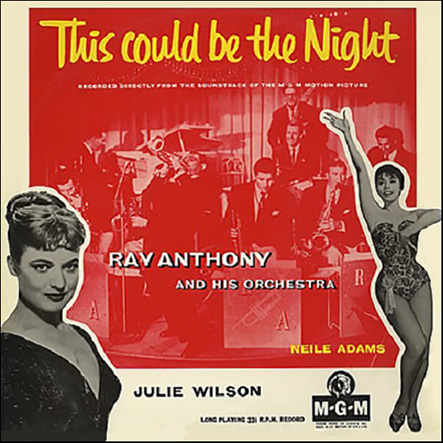
U.S. Film Credits: Grubstake (1952), This Could be the Night (1957),  Women in Chains (1972), Fuzz (1972), Chu Chu and the Philly Flash (1981), and Buddy Buddy (1981)
Ruby Neilam Salvador Arrastia, is known in Hollywood as the actress-singer-dancer Neile Adams—and the first wife of the hottest new male star of 60s Hollywood, Steve McQueen. Born on Jul. 10, 1932, to Jose Arrastia of Lubao with Carmen Salvador (sister of character actor Lou Salvador Sr.), she moved to the U.S. after the war.  Adams became a proficient dancer and found herself being cast in musicals. One of her early appearances was in “Pajama Game”, staged at the Carnegie Hall. She moved on to TV and films,  with credits in the 1952 western “Grubstake” and as Patsy St. Claire in “This Could Be The Night” (1957).

Husband and wife appeared in a memorable episode in “Alfred Hitchcock Presents”. Separately, Neile Adams had a recurring role in the TV series “Five Fingers” as Rita Juan in 1960, and went on to guest star in top TV shows thrugh the 60s,70s and 80s, like “The Man from U.N.C.L.E.”, “Love American Style”, “Bob Hope Show”. “The Bionic Woman”, “ The Rockford Files”, “Fantasy Island”, “Vega$” and “Hotel”. In 1986, Adams wrote “My Husband, My Friend”, a biography of her husband Steve, who had died of cancer in 1980. Coincidentally, Neile’s son (Chad McQueen) and grandson, Steven R. McQueen (Jeremy Gilbert in “The Vampire Diaries”), are both actors. A nephew, Enrique Iglesias, is a singer and an occasional actor.

MINDA FELICIANO
U.S. TV Credits: Hawaiian Eye (1959)
International jetsetter Minda Feliciano was the daughter of Manuel Valdez Feliciano, a district engineer, and Amparo Santana of Batanes. Born as Arminda Feliciano on June 1, 1931, her town of origin is sometimes listed as either Angeles or Guagua. That may be due to the peripatetic career of her father, who was assigned in different provinces like Bataan, Nueva Ecija and Surigao.

When she moved to the U.S., she started modeling and auditioning for acting roles and, in 1959, won a regular slot (she played the hula-dancing receptionist, Evelyn) in the popular TV series,”Hawaiian Eye”, produced by Warner Brothers. Her trips around the world led to a chance meeting with actor Michael Caine. The two were soon engaged, but somehow, things didn’t fall into place and the couple parted ways. Michael would marry the exotic beauty, Shakira Baksh in 1973 , win 2 Oscars and be knighted in 2002.

Linked with singer Tony Bennett, Feliciano would form a more lasting relationship with Norman John McClintock Lonsdale, a true English blue blood. Romance bloomed and they were wed in 1997. In the Lonsdales’ sprawling Oxfordshire estate, the couple entertained film star friends like Joan Collins, Peter Sellers, Britt Ekland and Roger Moore. Minda and Norman would be together for 12 happy years until his death in 2009. Minda Feliciano currently lives in London in her ivy-colored house fronting the scenic Thames River.

GEORGE SUNGA
U.S. TV Credits: Judy Garland Show (1963),  An Evening with Carol Channing TV Special, 1966), The Smothers Brothers Comedy Hour (1967), The Tim Conway Comedy Hour (1970), Three’s Company (1976), Good Times (1976), The Ropers (1978), The Comedy Playhouse (1986)
Behind the camera, Kapampangans have also left their mark in the American entertainment industry. Leading the way is the venerable George Sunga, who first joined CBS as a production supervisor of “The Judy Garland Show” in 1963, and later, “The Smothers Brothers Comedy Hour”. He went on to produce the hit TV shows  "Good Times," (1974)  "The Jeffersons," (1975) , “All in the Family” (1974)  “Three’s Company” (1976) and many other successful serials. In 1989, Sunga was elected  officer of the Academy of Television Arts and Sciences.  For his commitment to diversity in television, an award in his honor was created and given yearly at the Media Access Awards. The Sungas are from Guagua, Pampanga.

LEA SALONGA
U.S. Film Credits: Aladdin (1992), Mulan I & II (1998,2004), Redwood Curtain (1995), ER (2010), Crazy Ex-Girlfriend (2016) 
The toast of West End and Broadway, Angeles-born Lea Salonga (b. Feb. 22, 1971), has also penetrated the U.S. showbiz industry, both as actress and singer. While still with the hit musical ‘Miss Saigon’ . she was tapped to sing key songs for such movies as “Aladdin” (1992) and  “Mulan” I and II ( 1998, 2004). She had a once-in-a lifetime experience of singing “A Whole New World” at the 1993 Oscar Awards, which went on to win Best Song. Salonga was also seen on a 1995 TV film produced by Hallmark Hall of Fame, “Redwood Curtain”. The film chronicles the search of an Amerasian piano prodigy for her biological father, aVietnam veteran. Other credits include guest appearances in hit TV series “ER” , “As The World Turns” and most recently, as Filipina Aunt Myrna in “Crazy Ex-Girlfriend”.

RICO HIZON
U.S. Film Credit: I.T. (2016)
Federico “Rico” Morales Hizon, whose parents come from Mexico and Mabalacat, respectively, made a name for himself as an international journalist, but his credentials now include acting in a Hollywood film. In the 2016 film“I.T.” topbilled by Pierce Brosnan, the Singapore-based BBC correspondent portrayed himself in this nail-biting thriller directed by John Moore.

WINSTON QUITASOL
U.S. Film Credits: Ghost (1990), Honey, I Blew Up the Kid (1992), Mortal Kombat (1995), the Phantom (1996), Spiderman 2 (2004), Iron Man 3 (2013), Frozen (2013), Big Hero 6 (2014), Moana (2017)
The visual effects/lighting genius behind contemporary classic Disney movies is half-Kapampangan (courtesy of his mother) Winston Quitasol. His talents are put to good use in films  that require visual effects, allowing him to push the technical and technological boundaries  of film effects to produce all kinds of fantastic scenes and imageries. As a visual effects technical director, Quitasol is responsible for lighting various elements (like a character or FX) for a specific scene and composing the said elements to a live action background via computer work. The realistic effect is achieved through his mastery of computer tricks. On the other hand, as a senior lighting artist, he determines how a shot should look by observing the environment of the approved scenes or finding an art director’s  color key. By positioning his lights in the computer, he can match the look and then render out all the elements he needs to composite the final scene.

Quitasol has worked on a slew of high profile Hollywood films , and his first unforgettable assignments was the megahit “Ghost” from 1990, starring Patrick Swayze and Demi Moore. His more recent works include “Spiderman 2”, “Surf’s Up”, “Iron Man 3”, “300: Rise of an Empire , “Frozen”, “Big Hero 6”, “Moana” and “Olaf’s Frozen Adventure”. Quitasol works at the Walt Disney Animation Studios, California State University-Long Beach

JESS ESPAÑOLA
U.S. TV Credits: Bill and Yed’s Excellent Adventures (1990), King of the Hill (1993), Futurama (1999), The Simpsons, Season 19: Eternal Moonshine of the Simpson Mind (2007).
Animator Jesus “Jess” Española, from Lubao, is the only full Filipino winner of the
the prestigious primetime Emmy Award for his 2008 work on “The Simpsons ( ‘Eternal Moonshine of the Simpson Mind’ episode). Raised by his single mother, Española struggled to finish high school by taking on odd jobs like baby-sitting and washing dishes. He saved enough money for his  Fine Arts course at the University of the Philippines. Española  found work as an animator for Burbank Animation in Makati, then moved to Fil-Cartoons, which was contracted to create animation for Hanna Barbera cartoons like the popular Flintstones, Scooby Doo and Jonny Quest. So adept did Española become, that he was sent to the head studio in the U.S. where he found employment when the Philippine office closed.

His first assignment was at Film Roman for “King of the Hill,”, one of the primetime shows of Fox, that also includes Matt Groening’s “The Simpsons”. Soon, he was doing character layouts for “The Simpsons”, rising to become its assistant director. Espanola’s win at the Emmys validates the common knowledge that Filipino animators are among the best in Hollywood.”A lot of Filipino artists are in the cutting edge of the animation industry. I guess I am lucky that I worked with "The Simpsons," said Jess, the poor boy from Lubao who made good.

KRISTINE SONGCO
U.S. TV Credits: The Fairly Odd Parents (2014), Sullivan and Son (2014), Sing It (2016), My Little Pony (2016-17), The Great Indoors (2016-17)
In the CBS TV sitcom “The Great Indoors”, Kapampangans were treated to a January 2017 episode in which the characters of actors Joel McHale and Stephen Fry,  spoke  in Kapampangan—albeit, with a thick American accent—so they could disguise their secret plan to leave young campers in the wild without their smartphones. The language got a lot of online attention after Pampanga-born Christ Sundita posted it on facebook. It turned out that the  idea was conceived by story editor/ writer, Kristine Songco (b. Dec. 6, 1985),  a Cal State Fullerton honors graduate in 2007.  She worked on Nickelodeon shows like “The Mighty B!”, “Fanboy” and “Chum Chum”. Her writing gigs have come to include  “The Great Indoors”. Or that much-talked about ‘Kapampangan’ episode, Kristine sought the help of her father in crafting the dialogues. The Songcos are a prominent family from Guagua.

ALLEN EVANGELISTA
U.S. Film & TV Credits: Project Almanac (2015), Ghost Whisperer (2010), The Secret Life of the American teenager (2008-2013), Mozart and the Whale (2005)
From appearing in commercials (American Online, MTV, Time Warner Cable, Domino's),  Allen Evangelista transitioned to TV easily,  beginning with ABC's "Once and Again" , "Alias", and a lead role in "Mozart and the Whale". Evangelista was born in Los Angeles to a Kapampangan mother, Aurora (from Angeles), and Alfredo Evangelista from Manila. He last visited Pampanga when he was 7 years old. After starring in popular teen shows, he snagged his first major film in 2015 with “Project Almanac”, where he essayed the role of Adam, the 16-year old tech-savvy geek who builds a time machine. The youthful-loking Allen was, in fact, already 33 years old at that time.

ETHAN DIZON
U.S. Film & TV Credits: Grey’s Anatomy (2012), The Inevitable Defeat of Mister and Pete (2013), Bad Worlds (2014), Get a Job (2016), Spiderman: Homecoming (2017), Avengers: Infinity War (2018)
Young Ethan Dizon (b. 2002), is the son of  Eric Dizon,  who traces his ancestry to the Dizons of Mabalacat. His mother is actress Corinne Chooey, while two younger brothers are also actors. Ethan made his acting debut as a 3 year-old child actor in the CBS hit series, “How I Met Your Mother”, He then had guest roles in  “Grey's Anatomy”, and “'Til Death”. His film credits include: “Get A Job”, “Bad Words” ( with Jason Bateman), and the “The Inevitable Defeat of Mister and Pete”, where he is best-known for playing Pete.  In 2018, he will be seen in “Avengers: Infinity War”. A gifted artist, he was nominated for Best Actor at the NBCU Short Film Festival 2014 in "Paulie", where he played the title role.

CREDITS:
ROSA DEL ROSARIO PHOTO: www.viewsfromthepampang.blogspot
ROGELIO DELA ROSA PHOTO: Alex R. Castro
Avenger: Constantino, Ronald, editor, The Golden Years: Memorable Tagalog Movie Ads, from the collection of Danilo Dolor.
NEILE ADAMS PHOTO: wikicommons, wikipedia
GEORGE SUNGA PHOTO: youtube, Archive of American Television
Three’s Company: www.amazon.com
Redwood Curtain Poster:
RICO HIZON PHOTO: twitter.com
I.T. Poster: IMP awards
JESS ESPANOLA PHOTO: courtesy of Ruston Banal Photography
The Simpsons: www.amazon.com
WINSTON QUITASOL PHOTO: balita.com
Frozen:http://www.imdb.com/title/tt2294629/mediaviewer/rm3873693440
ALLEN EVANGELIST PHOTO: biphoo.com
Project Almanac:imdb. Project Almanac entry
KRISTINE SONGCO PHOTO: Kristine Songco FB page
Mister & Pete: www.amazon.com

Wednesday, December 27, 2017

69. 10 PLACES IN CLARK AND THE NAMES BEHIND THEM

When one goes to Clark today, he passes avenues like C.M. Recto, G. Puyat, M.A. Roxas, K. Laxamana---all names of Filipino statesmen, heroes and personalities. But in the not-so-distant past, when Clark was still a piece of America in Pampanga, its  major thoroughfares and buildings bore ‘stateside’ names like Dyess, O’Leary, Kelly, Levin, Mitchell, Wagner among others. Not many Kapampangans know the faces behind these names today, so here are a few of them.
**********


CAMP STOTSENBURG, named after Col. John Miller Stotsenburg
The future Clark Air Base started as an unnamed camp established six miles northwest of Angeles town by soldiers of the 5th U.S. Cavalry regiment on Dec. 26, 1902.  It was the tradition to name camps after American soldiers killed in the Philippine-American War, and that was how Col. John M. Stotsenburg, killed in action on April 23, 1899 near Quinga, Bulacan, came to be immortalized when the cavalry post was named after him. A graduate of West Point (1881) and  the Infantry and cavalry School at Fort Leavenworth, Kansas (1897), Col. Stotsenburg was assigned to the Philippines to lead the 1st Nebraska Regiment as their battalion commander. In an unplanned engagement on April 23, Col. Stotsenburg ordered an immediate advance to fight the Filipinos. Moments later, he was shot in the chest and killed; he was only 40 years old.


CLARK FIELD, named after Maj. Harold Melville Clark
The first airplane landing field were just long dirt landings scraped from the ground in 1919. Eventually, a more expansive airfield was built, asphalted and expanded before World War II. The airfield would be named after Maj. Harold M. Clark, a Philippine-educated American (Manila High School, 1910, future president Manuel A. Roxas was a classmate), who received his pilot’s wings in March 1917. One of the first aviators in Hawaii, Clark was flying his seaplane in the Panama Canal Zone when it crashed on May 2, 1919. The young pilot was killed but his name would live on, overshadowing the original camp name, and by the 1960s, the camp complex  together with its airfields, would be known Clark Field or Clark Air Base.


BOBBITT THEATER, named after Col. Aubrey Malcolm Bobbitt
The popular movie house of Clark that was favorite of  American servicemen, their families, as well as Wagner High teens, screened the latest blockbuster films from the 60s thru the 90s--from “The Thing” “Saturday Night Fever” ,”Jaws”, to “American Werewolf in London”. Bobbitt stood next to the BX, across from what used to be the main gas station, in the same parking lot of what was once the American Express Bank. It was named after Col. Aubrey M. Bobbitt (b. Jan. 25, 1940/d. Aug. 29, 1971), base commander and the commander of the 6200th Air Base Wing, in September 1972. Col. Bobbitt had an illustrious 29-year career in the U.S. military, serving in Newfoundland, Europe and the Philippines. He died at the USAF Hospital of heart attack. Bobbitt Theater, post-Pinatubo, it became a hotel, a cocktail lounge (“Forbidden City”), and is  now part of the Widus Hotel and Casino complex.


BONG HIGHWAY, named after Maj. Richard Bong  (now Manuel L. Quezon Avenue)
Bong Highway has such a local ring to it, sounding much like a common Pinoy nickname. But this major Clark road which leads to the Mimosa main gate (now a Filinvest  property),was named after a World War II Medal of Honor recipient, Major Richard Ira "Dick" Bong (b.Sep. 24, 1920/d. Aug. 6, 1945). One of t host decorated fighter pilots, Major Bong is known for downing 40 Japanese aircrafts in his lifetime. Tragically, he died in California while testing a jet aircraft before the war ended.


DYESS AVENUE, named after Ofcr. William Edwin Dyess (now, C.M. Recto Highway)
William Edwin "Ed" Dyess (August 9, 1916 – December 22, 1943) was an officer of the United States Army Air Corps during World War II. He was in command of the 21st Pursuit Squadron tasked to defend Clark. He was captured after the Allied loss at the Battle of Bataan and endured the subsequent Bataan Death March. After a year in captivity, he escaped and spent three months on the run before being evacuated from the Philippines by a U.S. submarine. Once back in the U.S., he recounted the story of his capture and imprisonment, providing the first widely published eye-witness account of the brutality of the Death March. He returned to duty in the Army Air Forces but was killed in a training accident months later.


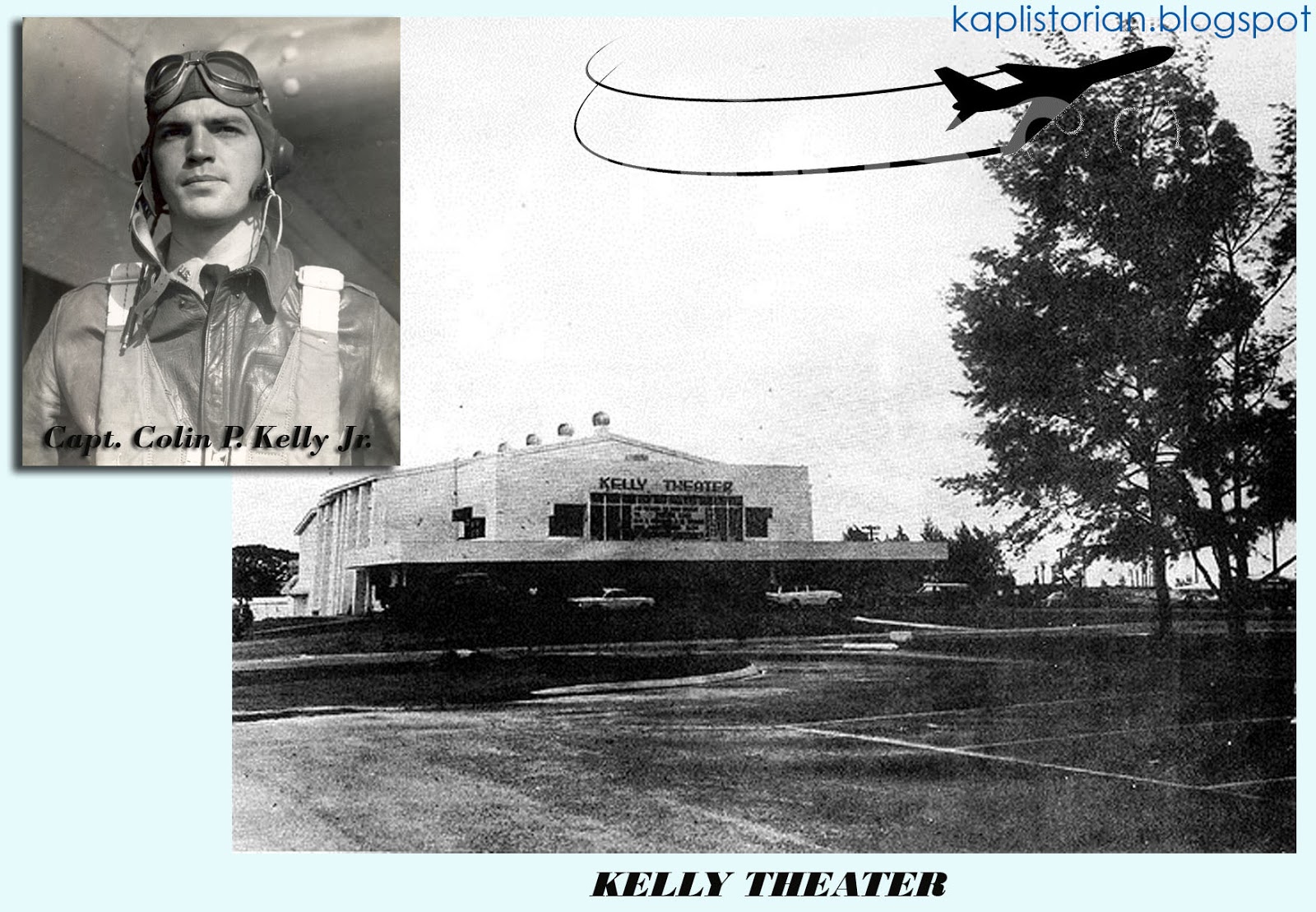
KELLY THEATER, named after Capt. Colin Purdue Kelly Jr.
One of the historic buildings in Clark Air Base was the Kelly Theater, constructed in 1953, the only cinema house in Clark and the venue of many stage plays and cultural shows. There was an earlier Kelly Theater built earlier—in 1947—that was converted from an old gymnasium. Both theatres were names after B-17 pilot Capt. Colin P. Kelly Jr. (b.Jul. 11, 1915/d. Dec. 10, 1941)  who died in action against the Japanese forces in 1941. Kelly’s damaged plane, while returning from a bombing run, blew up near Clark Field after being engaged by enemy forces. Capt. Kelly was declared America’s first hero of WWII by US President Franklin D. Roosevelt.  The memorial statue of the fallen captain was inaugurated on the theater grounds on 10 Dec. 2007—the 66th year of his passing. Kelly Theater, located at the cor. Ninoy Aquino Ave. and Foxhound St., survived Mt. Pinatubo, but eventually everything from the seats to the roof and front walls were stolen.


MEYER LEVIN GYMNASIUM, named after Master Sgt. Meyer Levin
The gymnasium facility on Dau Avenue, east of the Parade Ground was named after Meyer Levin in 1955, a master sergeant of the U.S. Army Air Corps. Raised in Brooklyn, New York, Levin (b.Jun 5, 1916/d.Jan. 7, 1943)—who had wanted to become an aviator—became a bombardier and flew with Capt. Colin Kelly after the Japanese attack of Clark Field. During his last mission on January 7, 1943, Levin volunteered to bomb the Japanese convoy ships that was approaching Australia. The weather worsened, and as the plane used up its fuel, the crew bailed out as the planed ditched the water. Levin remained in the plane to release the rafts that saved his crew. He died in the crash and is listed as one of those missing at Manila National Cemetery. Levin was awarded the  Distinguished Flying Cross (for successfully bombing the Japanese warship “Haruna”) and a Purple Heart for his heroic war feats.


MITCHELL HIGHWAY, named after Brig. Gen. William Lendrum Mitchell,  (now J. Abad Santos Avenue)
One of the most travelled roads in Clark—the Mitchell Highway-- stretches all the way from the Mars Station, then passes close to the Parade Grounds, and leads all the way to the Friendship Gate. It was named Philippine-American war veteran, Gen. William “Billy” Mitchell (b.Dec. 29, 1879/d.Feb. 19, 1936), regarded as the father of the United Sates Air Force. Gen. Mitchell also saw action during World War I in France, and even commanded the American air combat units in that country post-war. In 1924, he returned to Pampanga to revisit  Camp Stotsenburg where he even gave flying lessons to Gen. Emilio Aguinaldo, whom he had helped capture. The North American B-25 Mitchell—an American military aircraft design—was also named in his honor.


WAGNER HIGH SCHOOL, named after 1st Lt. Boyd David Wagner
The beginnings of Wagner High School and Middle School could be traced back in 1957-58 when the Grades 7-12 of Wurtsmith High transferred to individual wooden buildings at the former Chapel Center. That site that will eventually be renamed Wagner High School. The school was named after 1st Lt. Boyd David Wagner, of the U.S. Army Air Corps, who commanded the 17th Pursuit Squadron that was ordered to protect Clark. On Dec. 14, 1941 shot down four Japanese airplanes, and 2 days later, downed another enemy aircraft at Vigan. Thus, he became the first American World War II Ace, and for which he earned him a Distinguished Service Cross. Wagner was nearly blinded in the Lingayen Gulf battle, but survived and evacuated to Australia where he recovered.Later, he was sent back to the U.S. to train new fighter pilots. On  Nov. 29, 1942, Col. Wagner disappeared while on a flight from Florida to Alabama. His plane wreckage was found six weeks later, some 4 miles north of Freeport, Florida. His remains are buried at Grandview Cemetery, Johnstown, Pennsylvania.


WURTSMITH MEMORIAL SCHOOL, named after Maj. Gen. Paul Bernard Wurstmith
 The Clark Dependents’ School opened in 1947 to accommodate school-age children. In 1950, it was moved to another used office building that would be renamed in 1954 as Wurtsmith Memorial  High School. It was name in memory of Maj. Gen. Paul Bernard Wurtsmith (b. Aug. 9,1906/Sept. 13, 1946), who became a flying cadet in 1927. Over the next 13 years, he served in command positions and his fighters’ feats include downing 78 enemy aircraft in the defense of Darwin in Australia, against the Japanese. In 1945, he commanded the 13th Air Force in the Southern Philippines campaign. Wurtsmith was killed when his plane crashed in the mountain area near Asheville, North Carolina. The Clark school that bears his name would have a new air-conditioned building on the former site of the Stotsenburg base picnic grounds in 1961. Construction of an expanded campus complex began in 1989, and the newly-renovated Wurtsmith High opened for schoolyear 1990-1991. The Pinatubo eruption (which occurred just a week before the end of the school year) forced the transfer of the graduation rites to Subic. The school was later demolished and replaced with Fontana Casino.

BONUS!
A hill in Clark bears a peculiar name, because it was not named after a person, or even after a flower, as its name suggests.


LILY HILL
Lilly Hill first appeared on an 1898 map, and is thought to have been derived from the Kapampangan  word “lili”, which means “lost”. The Americanized name was apt because it was easy to get lost on that hill which stood separately from other hills in the area. Used as an observation point by Americans from 1903--42, it was also used by the Japanese for the same purpose. It would become the stronghold of the Kembu Group which defended Clark from late 1944-45. Post-war, a USAF aircraft warning and control unit was put up in the summit until 1962. A Buddhits shrine was built on the hilltop by the Japanese in 1998 on  the 54th commemoration of the Kamikaze. It features a large 5-ton granite statue of Kannon, the "Goddess of Peace ".

SOURCES:
Camp Stotsenburg:
Pix of Camp Stotsenburg: Alex Castro Collection
Pix of Col. John Stotsenburg:
Clark Air Base:
Pix,:Harold Clark: An Annotated Pictorial History of Clark Air Base,  by David Rosmer
Bobbitt Theater:
Pix of Bobbitt Theater: www.margaritastation.com
Bong Avenue:
Pix: Welcome to Clark Air Base, Guardian of Philippine Defense booklet
Dyess Highway:
Pix: Welcome to Clark Air Base, Guardian of Philippine Defense booklet
Kelly Theater:
Pix: An Annotated Pictorial History of Clark Air Base,  by David Rosmer
Pix of Colin P. Kelly: Aces of WW2, http://acesofww2.com/bombers/41/
Meyer Levin Gym:
Pix: An Annotated Pictorial History of Clark Air Base,  by David Rosmer
Mitchell Highway:
Pix: Welcome to Clark Air Base, Guardian of Philippine Defense booklet
Wagner High School:
Pix of Boyd Wagner: Photograph by Carl Mydans for TIME & LIFE Pictures),  (Colourised by Doug)
Pix: Wagner High School, 1971, collection of K. Morgan
Wurtsmith Elem. School:
Pix of Wurtsmith School: http://www.clarkab.org/history/
Lily Hill:
Pix: An Annotated Pictorial History of Clark Air Base,  by David Rosmer
Images: 
Pix; clarksubic.com

Sunday, December 10, 2017

68. 12 GIANT SAN FERNANDO LANTERN TRIVIA

COLORFUL 'SAMPERNANDU' LANTERN, Magazine Cover, Esso Silangan, 1965

The famed San Fernando giant lantern is a product of Kapampangan innovation, creativity and tireless effort. So the next time you witness their spectacular display of lights, color and dazzle, do appreciate the hard work put into each of these works of art that can be considered truly Kapampangan. Here are vintage photos and trivia about this Christmas parul that put Pampanga in the world map.
**********
EARLY LANTERN PHOTO, SAN FERNANDO.  Taken 26 Dec..1909.
Luther Parker Collection.
1.This predecessor of the modern day Giant Lantern Festival was actually a religious activity which we know today as “lubenas.” The lanterns measured just two feet in diameter, created in each barrio from bamboo and other locally available materials. During the nine-day simbang gabi novena before Christmas, these paruls were brought around each barrio in procession to their visita. Before the midnight Mass on Christmas Eve, the lanterns were brought to the town church together with the barrio patrons. This tradition gradually evolved as the lanterns became bigger and the designs more intricate. Later, one big lantern was made for each barrio, which was created through a cooperative effort.
 
TYPICAL SAN FERNANDO PROCESSIONAL LANTERN,1960,
2. The first documented lantern maker was Francisco Estanislao, active ca. 1908, from Barrio Sta. Lucia, San Fernando. “Apung Isku”, aided by his wife, crafted paruls in the 1900s using bamboo sticks, cotton, string, satin and coco fabric panels, which were glued to the framework using gelatinous rice paste. The back is left uncovered to accommodate the ‘kalburo’ (carbide) lights.

 
DEL PILAR GIANT LANTERN, 1940s
3. The San Fernando Giant Lantern Festival, which is held every December, finds its roots in Bacolor where a much simpler activity was held. Following the transfer of the provincial capital from Bacolor to San Fernando in August of 1904, this parul event followed as well.

STO.NINO GIANT LANTERN, in 1956
4. The earliest mention of a lantern procession that culminated in a lantern contest, was reported in the religious publication  in a 1930 issue of,“Ing Misyonero”, (year 4, no. 11) that was won by brgy. Del Pilar, followed by Sto. Niño. The next year,  it was reported in the same magazine that eight  barrios participated in the Christmas pageant  that was highlighted by lively band music and a colorful lantern competition with Del Pilar achieving a back-to-back win.

LANTERN PARADE IN SAN FERNANDO, 1960
5. It is believed that electricity was introduced to the San Fernando lantern in 1931. At this time, the lights were controlled by individual switches that were turned on and off following the beat of the music. Pioneer participants included the barangays of Del Pilar, Sta. Lucia and San Jose.

GIANT LANTERNS, from 1960
6. According to another version claimed by old folks, the Giant Lantern Festival started during the time of Pres. Manuel L. Quezon. At that time, Quezon was trying to make Pampanga a model province. In fact, he made Arayat his vacation place and converted the legendary mountain into a tourist resort. As a show of gratitude to Quezon, the people of San Fernando held a Christmas lantern contest to honor the first family. Quezon himself donated the prize for this lantern contest, which was personally awarded to the winner by First Lady Aurora Aragon Quezon.

SAN FERNANDO LANTERN EXHIBIT, Luneta. 1961
7. Severino David, married to Fortunata Estanislao (daughter of Francisco) is credited with introducing the battery-operated giant lanterns in the 1940s. Great strides in the 1950s made the San Fernando Giant Lantern more visually impactful. Steel wire was introduced in 1950 by Mario Datu and Susing Manalang for use in making the framework of the lantern, thus making it stronger.

INTRICATE LANTERN DESIGN, 1965
8. In 1957, Rodolfo David  invented the rotor system that used ordinary hairpins, attached to the end of the wires leading to each individual bulb. Masking tape strips are placed on the rotor to serve as light switches. As the rotor is turned, the hairpins brushes the tape strips, thus cutting off the current flow that lit the bulbs. When that particular hairpin regains contact with the steel rotor, the bulbs are again lit. Thus, the placement of the tape on the rotors determines the interplay of lights on the lanterns and can spell success or disaster for each entry.

SAN FERNANDO LANTERNS used in a San Miguel Beer Ad.1969
9. The lanterns gained national prominence in 1960, when, the Board of Travel and Tourism Industry and the Philippine Tourist and Travel Association sponsored the San Fernando lantern parade in front of the Luneta Grandstand. Beginning in 1964,  San Fernando lanterns became available for sale to the public, giving birth to the commercial lantern industry.

SAN FERNANDO LANTERNS, 1969

10. The Giant Lantern Festival, which was already an established San Fernando institution was cancelled for two years (1978-1979) by Mayor Armando Biliwang  because of Martial Law. It was revived in 1980. In 1987, Former San Fernando Mayor Virgilio “Baby” Sanchez started producing Capiz lanterns for the export markets, with MAKVEL Enterprises. These lanterns followed the traditional San Fernando design and were developed with the assistance of the Design Center of the Philippines. The next year, the first fiberglass lanterns were installed at the Pampanga Convention.

SAN FERNANDO LANTERN, 1979
11. The new 90s decade saw the transfer of the annual Giant Lantern Festival to the Paskuhan Village. The lanterns made international appearances at the World Expo in Seville (1992), and at the Hollywood Christmas Parade (1993). The festival venue was relocated to the open parking grounds of the SM City Pampanga at the turn of the new millennium.

LANTERN MAKER, Jesus Maglalang. 1979
12. The best-performing barangays in the Giant Lantern Festival Competition include Del Pilar, which had an incredible 9-year winning streak in the 1980s. before that, Sta. Lucia was a perennial champion. Brgys. San Felipe and Telabastagan almost became Hall of Famers (3 championships in a row) in the first decade of the 2000. In recent times, Brgy. Dolores has bagged the championship 4 times in a span of 10 years.

BONUS!
Double Take: LANTERN LOOK-ALIKES
TRADITIONAL MEXICAN WREATHS, have designs that mimic that of the famed San Fernando lanterns. Could these have been design inspirations as we also have a history of Mexican-Philippine relations? Or just plain coincidence?

VERY ENGLISH, VERY SAMPERNANDU. A giant lantern of English make has a striking similarity with the giant San Fernando lantern of San Jose. Taken at the Covent Garden, London, 1965.

SOURCES:
Henares, Ivan Anthony S. (2001). HOW TO MAKE A GIANT LANTERN: The story Behind the Giant Lanterns of San Fernando. School Project. University of the Philippines.
HISTORY OF GIANT LANTERN-MAKING IN SAN FERNANDO, PAMPANGA (Estanisla-Davido-Quiwa Clan), by Landlee Quiwa
HISTORY OF THE LANTERN INDUSTRY : Its Contribution to the Local Economy and Tourism, Oct. 4, 2016, Makati City
Thanks to: Ching Pangilinan, CSF Tourism, Ken Gardiner

Wednesday, November 29, 2017

67. 12 RIVER MYTHS AND MYSTERIES OF PAMPANGA

1. THE ONCE-MIGHTY PORAC RIVER
Ancient Porac was in the vicinity of a seashore.

Three pre-historic settlements in Porac, one unearthed by anthropologist H. Otley Beyer’s team in 1939 (Hacienda Ramona site), another by archaeologist Robert Fox in 1959 (Balukbuk site), and the third by the National Museum in 1999 (Upper Balukbuk site) raise the question of why the settlers built relatively large communities high up on the foothills of the Zambales Mountain Range. A  theory says that the ancient Porac River, which today is nothing but a shallow brook, was navigable enough for large water vessels from Manila Bay, and that the subsequent eruptions of Mount Pinatubo, years (not centuries) before the Spaniards arrived in 1571, silted the river and either destroyed the communities or forced the inhabitants to abandon them. Old folks in Lubao town, claim that in the 1960s, they saw what looked like large wooden boards floating in the Porac-Gumain river. The boards, between 12 and 16 feet long, were roughly cut and had holes in them, which made the folks speculate that they must have been parts of a large ancient boat washed down from upstream Porac River, which they believe to be navigable in the distant past. (Joel Pabustan Mallari)

2. WERE BETIS AND LUBAO AS BIG AS CEBU?
The conquistadores found thriving Muslim communities here.

The earliest  Spanish chronicles show that the first settlements in Pampanga were situated along the major waterways. Miguel Loarca listed these ancient settlements with their corresponding population figures, thus revealing a comparison between Pampanga settlements and those in other parts of the archipelago. In the list, Betis (Vitis) and Lubao had a population of 3,500 people, the same number as that of Cebu. Calumpit (Calonpite) outnumbered Macabebe by 400 people, but the latter Pampanga town had a bigger population than Vigan (1,600 people), Malolos (800), Negros (700) and Ylocos (500). Most if not all of these Pampanga communities thrived along or close to riverine areas for two basic reasons: abundant resources and accessibility of transportation. This is true for all the great cities and civilizations of the world (J. Mallari)

3. LUBAO’S ANCIENT BURIAL BOATS
Skeletons turn up during a flood.

Old civilizations all over the world—like Vikings, Austronesians, and Ebypt--observed a variety of elaborate burial rituals, one of which involved boats. Researchers of the Center for Kapampangan Studies, together with Dr. Rodrigo Sicat, author of The Kapampangans, recently interviewed old folks in Dr. Sicat’s hometown, Lubao, living near the now-heavily silted Gumain River. According to them, during the great flood of 1972, an eroded section of the protective dike near the property of a Pablo de la Peña in Brgy. Gumi turned up several boat-shaped coffins. They described the finds as canoe-shaped kabaung, inside of which were the skeletal remains of what appeared to be at least six-footers. Beside the skeletons, the interviewees claimed, were indigenous and tradeware ceramics: blue-and-whites and local earthen pots like kuran and banga. Each coffin measured between 12 and 18 feet long, carved out of the trunk of a bulaon tree (Vitex parviflora Juss.).  (J. Mallari)

4. FACTORIA AND THE SHIP THAT SANK IN NUEVA ECIJA
Did Spanish galleons sail as far as the headwaters of the Pampanga River?

Pedro Arcilla wrote that as recently as the early 1900s, large boats could still navigate the Pampanga River from Manila Bay all the way to Cabanatuan City and other Nueva Ecija towns. In fact, a parish document in a Nueva Ecija town mentions a casco (old folks there say it was a Chinese junk, others say it was a Spanish galleon) that sank during a storm in the early 1800s in that upstream section of the Pampanga River that flowed through the town of Factoria. An old resident of San Isidro town (present name of Factoria) allegedly recovered a part of this sunken ship’s rudder which is now displayed in his private museum, awaiting scientific verification. In times past, Factoria once controlled the tobacco industry in the North and was once the capital of Nueva Ecija. Indeed, this once-thriving town, formerly within the boundaries of the Kapampangan Region, owed all of this to its proximity to the Pampanga River. (J. P. Mallari)

5. THE SASMUAN-CABIAO CONNECTION
This upstream town served as haven to Kapampangan refugees.

In the Sasmuan Papers of the Luther Parker Collections (c.1900), there is a claim that Factoria became the capital of Pampanga in 1762, when the British invaded Manila and the country’s capital was moved to Bacolor. The territory of Pampanga extended all the way to Nueva Vizcaya, and Nueva Ecija as a province, was still non-existent. The provincial governor of Pampanga, a Señor Biron, was residing in Factoria, when British soldiers invaded Sasmuan through the town’s Manglares River.  Biron ordered all the residents in eastern Sasmuan  to evacuate to Cabiao (then still part of Pampanga). A group of women, led by Doña Magdalena Pineda protested against the order, citing the inconvenience of moving to Cabiao. After the British left the country in 1765, the Philippine capital was returned to Manila and apparently, Pampanga’s capital was returned to Bacolor and thus ended Factoria’s brief shining moment in history.

6. MEXICO: PAMPANGA’S CAPITAL BEFORE BACOLOR?
Bacolor was the provincial capital only from 1755 to 1903
Bacolor  started functioning as capital of Pampanga in 1746 and officially became capital only in 1755.  The town served as the provincial seat of government until 1903, when the capital was moved to San Fernando. In Conquistas de las Islas Filipinas, Gaspar de San Agustin, OSA wrote that the provincial capital  prior to Bacolor was Mexico town, one of the oldest and most prosperous communities in Pampanga. The province’s oldest surviving church structure is found in San Jose Matulid; the town has a barangay named Parian which indicates the presence of a community of Chinese merchants before; and a tributary to the Pampanga River links Mexico directly to Manila Bay passing through the important towns of San Fernando, Bacolor, Guagua, Sasmuan and Macabebe.

7. SAPANG BALEN AND ITS VIOLENT PAST
Angeles City lies in the path of an old, forgotten river

When the city’s founder Don Angel Pantaleon de Miranda  and wife Doña Rosalia de Jesus, came to Kuliat  to establish a new town, they chose the area around the Sapang Balen creek. The creek may seem harmless but its present tranquility belies a violent past. Historian Mariano Henson notes that on July 20, 1881, “A typhoon and a heavy downpour of rain caused the treacherous Taug salient, which used to originate at the southwesternmost tip of barrio Pampang, to swell up to a murky, clay-ey tone into the Sapang Balen Creek, causing the destruction of the three bridges of 1850 and carrying away three houses from barrio San Jose. It is said that before 1796, the Taug sometimes went a few hundred yards behind the present church during protracted heavy rainfall.” A similar devastation occurred in 1972 when Sapang Balen washed away dozens of houses in San Jose, and again when Mount Pinatubo erupted on June 15, 1991, when the creek overflowed into downtown Angeles. Sapang Balen is actually the ancient path of Taug River; at some point in the distant past.
(C. Manese)

8. THE MYSTERY OF THE SACOBIA RIVER
The mighty river probably did not exist before the 1850s

Sacobia River, which became a byword during the lahar season in the 1990s, is one of four major rivers emanating from the eastern slope of Mount Pinatubo itself.  Strangely, however, Sacobia River does not appear in maps made during the entire colonial period until mid-1800s. Cartographers could not have missed such a major river, considering that even creeks in the vicinity of the Sacobia River are depicted. Is it possible that Sacobia River did not exist before mid-1800s? There is a theory that it may have been formed, probably due to a lake breakout on the slopes of Mount Pinatubo, in the 1850s. Sometime in 1856, the town of San Bartolome in southern Tarlac was completely swamped with floodwaters from Parua, the river’s old name. Parua may have been the downstream name of Bamban River (Sapang Mabanglu). 1856 may have been the year Sacobia River was formed; it elbowed away from Mabalacat (in a spot called Maskup in sitio Bana) to merge with the Bamban River before proceeding to Concepcion and draining into Rio Chico. Another puzzle is the name “Sacobia.” Nobody knows what it means or to whom it refers. It is not a Kapampangan term and there was no Spaniard or Filipino who went by that name. (J.P.Mallari)

9. RUSSIA’S GRAND DUKE CAME BY BOAT
The world’s rich and famous traveled all the way to Apalit

DURING colonial times, elegant mansions of rich Kapampangan families lined the Rio Grande, the most famous of which was that of Don Joaquin Arnedo Cruz and Doña Maria Sioco Arnedo, in Sulipan, Apalit. “(Their) combined fortunes…created a lifestyle of leisure and luxury unmatched elsewhere in the archipelago,” writes Gene Gonzales in his book Cocina Sulipeña. The couple frequently threw lavish parties for their guests who came from Manila via the bay and Pampanga River .Among the guests  Jose Rizal, Gen. Arthur McArthur, Gen. William Howard Taft, and Prince Norodom I of Cambodia, who reportedly fell in love with a local maiden, Pepita Roxas of the next town Calumpit, Bulacan. But the best-cherished visit to Sulipan was that of Alexis Alexandrovich, Grand Duke of Russia and son of the Czar himself. While in Pampanga, the Russian Duke hunted birds in the surrounding marshes, and boar and deer in the mountains. In gratitude, he gifted his gracious hosts with a whole set of monogrammed porcelain dinner set.

10. THE LOST CANNERY OF GUAGUA
Why a small tributary in an interior town is called Dalan Bapor

Guagua has always been a commercial hub, even as early as pre-Hispanic times when it was a thriving community of Moros who traded with Chinese merchants. The Pasak-Guagua River which connected with the Rio Grande, served as the highway of cargo ships doing business in the town; a tributary to this river is known as Dalan Bapor (literally, ship’s way), which today has been reduced to just a shallow canal. Until World War II, however, it bustled with economic activity because it led to the Guagua  Cannery located in what is now a Brgy. Sta. Filomena  subdivision beside the Guagua National College. Old folks living in the area recall that the cannery occupied the entire land area of the subdivision; that “huge ships” transported tons of canned goods like sardines and even local specialties like tabang talangka and burung asan; that it offered retail canning services for affluent families who wanted to send canned products abroad; that it was bombed by Japanese planes in World War II; and that it finally closed in the 1960s following a series of labor disputes. (J. Mallari)

11. THE GREAT FLOOD OF 1972
Pampanga’s worst calamity before Pinatubo

Next to the eruption of Pinatubo, the worst calamity to ever hit the Kapampangan Region in recent memory was the flood of 1972, when the entire Central Plain of Luzon was submerged under water. Heavy monsoon rains lasting 40 days nonstop had been triggered by four tropical cyclones that made a direct hit in the area during that year’s rainy season: Asiang, Konsing, Toyang and Undang.The flood, which claimed 298 lives, was worst in the Central Plain because this area is the natural catch basin of two major waterways, the Pampanga River and the Agno River; moreover, the presence of the Candaba Swamp (pinac), alugin (waterlogged) areas and baná (marshes), as well as the phenomenon of subsidence, further makes the area susceptible to flooding. (C. Manese)

SOURCES:
Singsing Magazine, Center for Kapampangan Studies, "River Myths and Mysteries". by Joel Pabustan-Mallari, Robby Tantingco, C. Manese.