Friday, February 23, 2018

74. 14. NATIONALLY-RENOWNED KAPAMPANGAN ARTISTS

The Philippine art scene is made livelier by the contributions of these gifted Kapampangan artists whose unparalleled skills in painting, has earned not only personal glory, but accolades for the country. Meet 14 of these painters, abstractionists, watercolorists, muralists, printmakers and sculptors who rank them among the country’s finest visual artists.
 **********

1. IRINEO MIRANDA
The Dean of Philippine Illustrators, Irineo Miranda (b. 1896/d.1964), was an early graduate of the University of the Philippines’College of Fine Arts, finishing in 1916. He honed his craft under Fernando Amorsolo, and soon, he was earning illustration commissions from Pacific Commercial Company, doing product labels and advertisements. So good was he, that in 1918, he was appointed to the faculty of U.P. where he taught his forte—cartooning--along with decorative painting and commercial design. He would stay on for over 40 years in the academe. He continued to get project, illustrating covers for Graphic, Liwayway and El Debate magazines. In his time, he was also a top-notch water-colorist and a political caricaturist.


2. JUAN C. FLORES
Pampanga’s legendary sculptor and carver, Juan C. Flores (b. 24 Jun. 1900/d. 14 Sep. 1992) of  Sta. Ursula, Betis, grew up in a fishing community. Not wanting to be a fisherman, he went to Manila to seek his fortune and found work in the santo shops of Quiapo. He became an apprentice of Maximo Vicente, worked with the Tampingcos,  and honed his carving skills to perfection. But just as he was making a name in the city, he returned to Betis in 1922 to start his own ‘taller’. He  made religious statuaries, furniture, decorative wooden items, church fixtures famed for their details and high quality. On the side, he mentored young artists like painters Vicente Manansala, Antonio Dumlao and Allan Cosio.  First Lady Imelda Marcos gave him commissions to do the decorative woodworks in Malacañang. He was rewarded in 1971 with a  Washington D.C. trip as the country’s representative in an art competition which he topped. Flores’ winning piece was a bust of the U.S.  Pres. Richard Nixon. At the ripe age of 77, he was given the Panday Pira Award. His most cherished award was being awarded as one of the “Most Distinguished Sons of Pampanga” in 1982. His work is continued today by his son Daniel Flores.


3. ELIAS LAXA
Guagua’s master painter of Philippine vignettes (b.1904/d.1990), was born in Banka, a  fishing village. At 16, he left for Manila, but it was only at the advance age of 25 that he enrolled at the U.P. College of Fine Arts, graduating in 1933. Laxa took on odd jobs, including sign painting in Escolta. He went into serious painting only after the War, supporting himself by giving art lessons.  His signature works are his color-splashed seascapes, inspired by his humble background. But he could also paint other subjects—calesas on narrow alleys, market women, old colonial churches, --done in colorful, swift-strokes. In 1952, Laxa held his first one man show at the Miguel Galvez gallery. It was through his art that he managed to support his 9 children, who earned degrees in engineering, architecture and education. In 1964, he flew to Hawaii where he found artistic success. Laxa’s family would join him there, in the island state that embraced him and his art. He passed away  in 1990.


4. JOSE BUMANLAG DAVID
 In the field of portraiture—where technical accuracy, mastery of light, tone and mood are required of the artist, one Kapampangan painter stands out—Jose Bumanlag David (b. 26 Jul. 1909/d.199?) of Mexico. Though he painted a variety of subjects throughout his long, prolific career, it is in portraiture that he found recognition, thanks largely to his American clientele. A  product of Pampanga High School and the U.P. Fine Arts (1934), his paintings often appeared on the national magazine, Philippine Free Press. His works could be found in pre-war classrooms as he painted many historical scenes. David took a break to finish a management course in 1964 at the Air Force Institute at Gunter Air Base University, Alabama. From 1971 till 1982, he gave private art classes to bored American wives of U.S. military personnel and their other family members in Clark Field.  One of his last one-man show was held in 1990 at Galerie Andrea in 1990. Many of his portraits of American military officers used to hang in various Clark Air Base buildings and those of Filipino heroes at the Scottish Rite Temple.

5. VICENTE S. MANANSALA
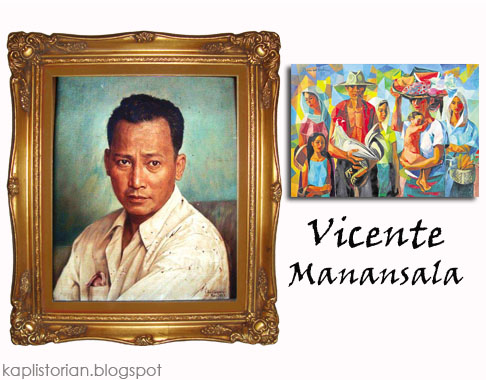
National Artist Vicente “ Enteng” Manansala (b. 22 Jan. 1910/d. 22 Aug. 1981) was  born in Macabebe, and already had artistic inclinations as a boy growing up in Intramuros where his family relocated. At age 15, he painted his first oil—a head of a cow coped fom a milk can. He entered U.P. Fine Arts in 1926, and left home after graduation. He worked as a billboard painter, art director and finally won his first national award in 1941, for his work “Pounding Rice”. He would be included as a member of the “13 Moderns” and the “Neo-Realist Group”. Manansala earned scholarships in Canada (Ecole de Beaux Arts in Banff)  and France (Ecole de Beaux Arts of the University of Paris). He devised his own technique called “transparent cubism”. His prized paintings are in various private and corporate collections here and abroad. Holy Angel University has a section of its museum called The Vicente Manansala Collection, holding most of the sketches, studies and drawings from the artist’s estate.  Mananala was named National Artist for painting in 1981.


6. PATRICIO SALVADOR (b. 17 Mar. 1911/d.?). A 1931 graduate of Pampanga High, he pursued an art course at the U.P. School of Fine Arts, taking only a year to learn and master painting basics. Soon, this Fernandino was dividing his time between commercial art and landscape painting. He was still painting in the mid 1990s at his humble home on Teopaco St. His small work, “Ricefields”, painted in oil in 1943 now hangs at the Jorge B. Vargas Filipiniana Museum at the U.P.


7. GALO B. OCAMPO, Sta. Rita
Galo B. Ocampo, (b. 16 Oct. 1913/d. 12 Sep. 1985 ), who hails from Sta. Rita, studied at the Univeristy of the Philippines. He is the only Flipino to study heraldry abroad and to hold membership in the International Institute of Genealogy and Heraldry in Madrid. He later became a Director of the National Museum in 1961. The multi-talented artist was also  painter, sculptor, scenographer, writer, teacher, and a cultural-activist.  On 22 July 2015, the order of Lakandula was conferred posthumously to  Galo B. Ocampo with the order of Maringal na Pinuno (grand officer) from the National Museum director, Jeremy Barnes.


8. LIBORIO T. GATBONTON
Liborio “Gat” Gatbonton (b. 23 Jun. 1914/.5 May 1976) was a Filipino cartoonist and caricaturist during the 1940s and 1950s who created the popular series "Jappy Days," a comic book that satirized the Japanese rule in the Philippines. He was also the chief cartoonist of the comics section of the now-defunct Evening Chronicle. The Candaba native went to Pampanga High School and took a correspondence course in cartooning. He took formal art lessons at the University of the Philippines, and, in 1935, joined T.V.T. Publications as a staff artist. He became a cartoonist for the Manila Chronicle and was the first Filipino artist to have his work published on The New York Times.


9. SALVADOR CABRERA
Salvador Cabrera (b.1930/d.1986) was BenCab’s big brother, older by some 12 years. He was often referred to as a ’quick-draw’ artist who could finish as many as 10 paintings in a day. His trademark works showed youngsters  with large, gazing, soulful eyes, inspired by artist Margaret Keane. Salvador, who maintained an Ermita studio,  had a successful career as an editorial cartoonist of Daily Mirror, where his comic strip featuring a character named Bindoy, ran for 10 years. In his heyday, he built a large clientele, who paid Php500 for his portraits, a hefty sum at that time—and he could finish 5 a day. He managed to provide a luxurious life for his family, but in the troubled ‘80s, when patrons ceased coming, he had to rely on BenCab’s help as his health began to fail.  Salvador Cabrera was also a skilled watercolorist, illustrator and a lay-out artist, and his works were once carried by Angeles galleries, He died of heart attack in 1986.


10. ALLAN COSIO
The versatile artist, Allan Cosio (b. 1941) traces his roots in Bacolor. This painter (op art and abstract) , printmaker, sculptor and tapestry maker  has represented the Philippines at the Valparaiso Biennale in Chile. The Indian Triennale, and the International Sculptue Event in Victoria, Australia. He has also exhibited in Geneva (Switzerland), California, Munic, Beijing, Marsala (Italy) and Hong Kong. For 5 consecutuve years, he was a prize winner at the annual Art Association of the Philippines (AAP) competitions. He won a Britsih grant as his award for winning the grand prize in the 1980 AAP awards. Cosio is married to the Ivi Avellana, daughter of director Lamberto Avellana and theater actress, Daisy Avellana.


11. BENEDICTO CABRERA (BenCab)
Benedicto Cabrera (BenCab, b. 10 Apr. 1942) is a full-blooded Kapampangan whose parents are from Sasmuan. He studied at the University of the Philippines, graduating in 1963, and had his first one-man show at the Gallery Indio in 1966. After BenCab married British Caroline Kennedy in London in 1969, the couple decided to stay there, where he slowly, but surely established his name in the international art scene, holding exhibits (London, New York ,Macau)  and winning several art awards. Returing to the Philippines in 1972, he was hailed as a Filipino pioneer of the arts, but the restrictive Martial Law years forced him back to London. This episode marked the beginning of his involvement with social commentary and the topics of freedom from repression. Later in the 1990s, BenCab founded the Tamawan Village, an artists’ sanctuary-cum-gallery that has become a popular cultural destination in Baguio. He was named a National Artist for Visual Arts in 2006, and in 2009, U.P., his alma mater, conferred upon him an honorary Doctor of Humanities degree.


12. JOSE  W. HERNANDEZ
Manila-born Jose W. Hernandez (b. 22 Sept. 1944/ d.19? ) practically grew up in San Fernando, when his father was assigned as a law teacher at Harvardian College. Jose spent his grade school years at the Assumption Academy. His artistic inclinations showed early; he would fill his notebooks with drawings rather than schoolwork. In his senior year at Pampanga High, he was offered a scholarship by Pres. Diosdado P. Macapagal. However, he abandoned his schooling to learn from established artists like Fernando C. Amorsolo, Botong Francisco, Vicente Manansala, Simon Saulog and Ben Alano. Painting in the realist tradition, he had his first group exhibit with Mabini masters in 1965. From 1974-77, Hernandez operated his own gallery in Angeles City. His works have been exhibited in the U.S., and reproduced on Unicef greeting cards.


13. MARCELINO  C. GALANG
“Mars” Galang (b. 1 Jan. 1945/d.2001).was born in Cabusao, Camarines Sur. His father, Zoilo M. Galang of Bacolor, was pioneering  encyclopedist who singlehandedly produced the 10-volume “Philippine Encylopedia” published in 1934.  This makes Mars, a half-Kapampangan. He went to public schools in the Sta. Cruz district of Manila, then took up Fine Arts at the University of the Philippines on a scholarship. He became not only a painter, but also a printmaker, colorist and draftsman. Mars dabbled in minimalism, where he excelled. He represented the Philippines at the 1st India Triennial in New Delhi (1968) and the 7th Paris Biennial. His last one-man show ws in 1985, an thereafter remained inactive.


14. CESAR VICTOR “CID” P. REYES
The prodigious artist, advertising executive, book author, art scholar and art critic Cid Reyes (b. 28 Jul. 1946) is a Kapamangan Pangilinan, courtesy of his mother Humilde, from Apalit. After his Lasalle studies, he became an Italian government scholar at the Academia de belle Arti in Rome, and tool courses in Art History at the City Lit Institute in London. Twice named Art Critic of the Year, Reyes is also a mutli-awarded advertising creative. In 1989, he authored “Conversations in Philippine Art”, which featured his interviews with 8 National Artists.  His published books have won 2 national Book Awards. As a painter, Reyes has exhibited his works in major art galleries featuring his robust abstract works using automotive paint. Reyes travels around the country lecturing on various aspects of art and art history. He was named Most Outstanding Kapampangan in Arts in 2015.


15. CLAUDE S. TAYAG
The renaissance man from Angeles City, Claudio “Claude” Moises Tayag (b. 1956) is the son of writer-lawyer Renato ‘Katoks’ Tayag. Although an AB Economics U.P. graduate, he forayed into art by observing artists E. Aguilar Cruz (his menor), Romula Galicano and  Sofornio Y. Mendoza. He won praises for his paintings of  folk festival imageries and folk santo watercolors. He also ventured into creating functional and decorative sculptural wooden pieces. Also known as an award-winning chef, Tayag and wife Mary Ann Quioc, offer unique dining experiences at his residence known as Bale Dutung (Wooden House), and at his 1856 Downtown Café, pop culture restaurant.

16. NORMAN TIOTUICO
The foremost exponent of Kapampangan contemporary indigenous art, Norman Tiotiuico (b.1966) of Angeles City is a Fine Arts graduate of the University of the Philippines. In 2004, he was named a Rockefeller and Ford Foundation grantee at the 4th International Sculpture Symposium in Vietnam His works are mostly sculptures, inspired by spiritual and environmental issues. Tiotuico, subscribes to the belief that he, as an artist, is just a medium used by the Creator as an executor of His ideas. His work is represented at Saatchi Art, the world’s leading online art gallery. This Most Outstanding Kapampangan Awardee for the Arts in 2008 exhibits regularly;  his latest, ”Kalalangan Kapampángan Experiment” (Feb. 2018), features his latest native art installation works.

SOURCES;
Salvador Cabrera: lex Castro Collection
BenCab: photo: wikipedia
Allan Cosio: http://www.philstar.com/arts-and-culture/2014/11/24/1394631/allan-cosio-cid-reyes-ricco-renzo
Juan Flores:Singsig,Magazine
Mars Galang: Portrait by BenCab, Art Manila Newspaper, Vol. 2 Series 7, 2001
Liboro Gatbonton: Mobilways
Elias Laxa: Sunday Times Magazine 1963.
Vicente Manansala: Vicente Manansala Collection, Holy Angel University
Irineo Miranda: Leon Gallery
Galo Ocampo: Positively Filipino
Cid Reyes: Cuadro Filipino, photo by Joey Ibay.
Claude Tayag: Scred Heart Seminary Annual 
Norman Tiotuico: Saatchi-Art, iorbitnews
All others: Kayumanggi, Biographes of Philippine Visual Artists, Peso Book Foundation 2000.

Monday, February 12, 2018

73. 12 PLACES OUTSIDE OF PAMPANGA WITH KAPAMPANGAN NAMES

Condensed from an article of Joel Pabustan Mallari

Pampanga  used to occupy large portions of Luzon—including parts of Bulacan, Nueva Ecija, Bataan, Zambales, Tarlac and extending as far north as Nueva Vizcaya. Over the years, new provinces and towns were carved out from this area, and today these places that are no longer part of the province, continue to  retain their Kapampangan names. On the other hand, other places have names with Kapampangan meanings, or that were derived from the Kapampangan language.
**********
1. BINUANGAN, Bulacan
This town must have gotten its name from  ‘binuangin’--a Kapampangan term for an early species of rice, a short variety with red stripes on its hulled seed. A barangay in Bataan shares a similar name.

2. CABIAO, Nueva Ecija
 “Cabiao” comes from the Kapampangan word ‘kabio’, meaning ‘to pound rice’. The time for ‘kabio’ ushers in the season of plenty for frmers, as rice becomes ready for sale and for eating. The capital city of San Fernando has a barangay called ‘Quebiawan’, derived from the same verb.

3. CAPITANGAN, Bataan
Bataan, a Tagalog province has a barangay in the municipality of Abucay called “Capitangan”, which means “midnight” in Kapampangan (“hatinggabi” in Pilipino). Like San Fernando, Capitangan is known for its crucifixions during Holy Week.

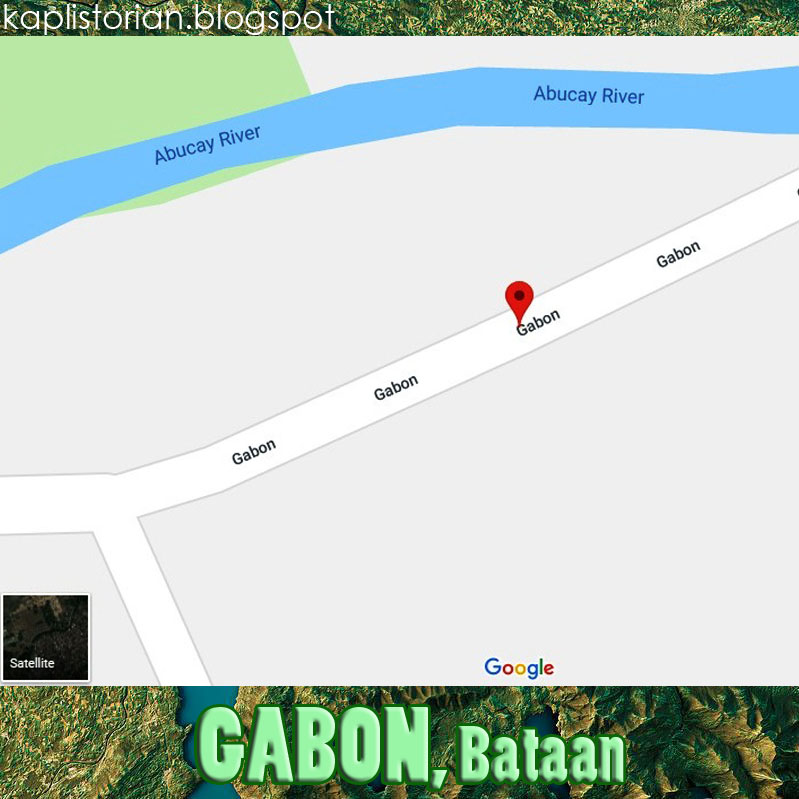
4. GABON, Bataan
In Abucay, there is a barangay that goes by the name, “Gabon”.  No, its  name was not derived from the African country of Gabon, but from the Kapampangan word “gabun”, meaning ‘soil, ground or land’.
5. MADLUM CAVE, Sibul, Bulacan
Sixteen kilometers off San Miguel, Bulacan, in Sibul, can be found the Madlum Cave, so named because of its creepy darkness—“madalumdum”, in Kapampangan, which was contracted to 'Madlum". It is believed that a stone image of the patron saint of the town—San Miguel—was first found in Madlum. The caves are characterized by limestone stalagmites. During World War II, Madlum was occupied by Japanese soldiers.

6. MATULID RIVER, Bulacan
Matulid River is a stream within Bulacan and is nearby to Wawang, Pinaganakan and Banaba. It is one of the 3 major tributaries of the mighty Angat River. The river flows on the boundary between between Pampanga and Bulacan, running on almost a straight course, hence “matulid”, meaning ‘straight’.

7. PAMITINAN MOUNTAIN, Rizal
In Rizal province, one of the peaks in the famous limestone mountain there has a Kapampangan name—“Pamitinan Mountain”. “Pamitinan” means “used for hanging”, as in stalactite patterns, a feature in the limestone caves found there. Pamitinan Mountain, along with the Puting Bato, are the two facing rock mountains that entrapped Bernardo Carpio in Tagalog of folklore.

8. SAN MIGUEL DE MAYUMU, Bulacan
The Bulacan town was once a part of the vast Pampanga realm, and it was famous for its sugar produce and sweets—“mayumu”. It was actually settled by Kapampangans until the early 1900s, until Tagalog started trickling in. When it became a town of Bulacan, it retained this Kapampangan word to describe it s a “town of sweets”—San Miguel de Mayumo.

9. TAYSAN, Batangas
When a Kapampangan goes to Taysan, Batangas, he would immediately recognize that the name of the town means  a “grinding or whetting stone” in his native language--a taisan. It is also the name of a soft, sugar-sprinkled cake, a local delicacy shaped  like a whet stone. Local lore has it that “Taysan” was  corruption of the word “atisan”(or a place atis fruit grew) or “tiisan” (to bear with fortitude). But even historians are not too sure. Could it have been that a transplanted Kapampangan  artisan introduced the ‘taisan’ in Batangas? It is interesting to know that Bamban, too, has a place named after grinding stones—the sitio of Panaisan.

10. TAKLANG ANAK, Calaca, Batangas
Lest you think that this barangay between the town of Lemery and Calaca smells bad because of its name, think again. “Taklang Anak” is a small, round juicy fruit that resembles a child’s droppings. The yellow-orange colored fruit (Garcinia dulcis), was first found either in  Arayat or Candaba, according to the noted botanical scholar, Fray Manuel Blanco. But how this Kapampangan fruit reached Batangas and gave this barangay its name is unknown.

11. TAKLANG DAMULAG, Nueva Ecija
Oh yes, there is a mountainous place in Nueva Ecija named after carabao manure or taklang damulag. It must have had  a large population of carabaos that regularly littered its streets with their dung. Whatever the case, “Taklang Damulag” was probably the most fertile land in Nueva Ecija, in those days, as carabao manure--then, as now--is used to enrich agricultural soil. Today, Taklang Damulag is a training ground inside the army division in Fort Magsaysay, Palayan City, Nueva Ecija. In 2011, it was the site of  a 100 mile ultra-trail racing event, the first endurance run in Southeast Asia.

12. TALAGUIO, Doña Remedios Trinidad, Bulacan
Talaguio is a sitio of barangay Kabayunan, and is located northwest of Mount Tabernaculo and northeast of Mount Maon and Mount Mayapa, where llarge conservation areas can be found,like the Angat Watershed. Talaguio is one of the 3 tributaries of the Angat River through where the Sierra Madre mountain range feeds its waters. ‘Laguio’ means ‘name’ in Kapampangan.

SOURCES:
Singsing Magazine. “The Augustinians in Pampanga”, vol. 3 No. 1.
wikimedia.commons: Cabiao seal, Cabiao town photo
San Miguel de Mayumo: https://allevents.in/san%20miguel/san-miguel-de-mayumo-tara-na-pasyal-na/1618364498486213
Taklang Anak, photo by Antonio Soraiano Guia Jr., via Michael Pangilinan FB page
 Maps (Talaguio,Matulid)) : mapcarta.com

Friday, February 2, 2018

72. 12 KAPAMPANGAN FOLK SONGS

Song genres like the basultu, kuraldal, harana, kundiman,  juvenile songs and many others written and composed by anonymous, often unlettered folks all bear witness to the immense richness of Kapampangn culture. Here is a comprehensive list of popular, as well as less-known folk tunes from the Kapampangan region:
**********

1. ATIN KU PUNG SINGSING
This may very well be the national hymn of Pampanga, as this plaintive folk song—about  the promise of a girl to give her heart to the man who finds her lost ring—is known all over the country. It is an example of a ‘basultu’, a people’s song that often has an allegorical theme. “Atin Ku Pung Singsing” has been recorded by many artists including Nora Aunor and Freddie Aguilar, and a Tagalog version exists.
LISTEN TO "ATIN KU PUNG SINGSING" HERE:
by Mabuhay Singers

 **********

2. ARO, KATIMYAS NA NITANG DALAGA
It has been a tradition in old Pampanga for a swain to sing a serenade song to the object of his affection during the period of courtship. This dramatic kundiman, is sung from the point of view of a young man as he espies his true love from a distance—Isyang, daughter of Apung, charmed by her beauty and graceful movements as she carries a basket-full of rice cakes on her head.

LISTEN TO "ARO KATIMYAS NA" HERE:
sung by Earl Policarpio

********** 

3. ATSING ROSING
Another harana song, in which the singer exalts ‘Atsing Rosing’ by offering her a fantastic assortment of gifts:  a necklace of stars,  a half-moon crown, a hammock made of clouds held by a blue rainbow rope. The singer summons heroes Rizal and Bonifacio to guard the lovely Rosing.
LISTEN TO 'ATSING ROSING' HERE:
sung by Andy Alviz

 **********

4. DALUMDUM NING BENGI
This harana song is different in that the singer does not refer to his heart’s desire, but instead, describes in poetic terms the intense moment of their evening encounter—the falling of rain, cloudy, star-less skies—the only light being the brief flash of lightning.
LISTEN TO 'DALUMDUM NING BENGI' HERE:
sung by Totoy Bato

**********

5. EKA MAMAKO
There are many songs in Spanish called “No Te Vayas” (Don’t Go), and these were eventually introduced to Filipino. The most well-known is  the popular “No Te Vayas de Zamboanga” by Juan Cuadrado, Sr., which even merited an English version (“Don’t you go, don’t you go to far Zamboanga!”). This Pampango version was provided by Imang Fely Tinio.
LISTEN TO "EKA MAMAKO" HERE:
sung by Mr. Ernie Turla

**********

6. INYANG MALATI KU
This very popular ‘basultu’ has so many versions, lyrics-wise—from romantic to the comic (“Inyang malati ku, linub kung kutseru, sira ya'ing kalesa, pile ya'ing kabayu”) . Even the beat is sung in varied ways—from slow and wistful, to bouncy and upbeat. This version has a more nostalgic feel to it.
LISTEN TO "INYANG MALATI KU" HERE
sung by Jonas David & April de los Santos

**********

7. O KAKA, O KAKA
Another “basultu” which is perfect for dancing. Many grandmothers also sang this as a lullabye to put their ‘apos’  to sleep. The singer calls a friend’s (“kaka”)  attention and then proceeds to sing his observations of him and of things around him, in a light, playful and teasing manner.
LISTEN TO "O KAKA, O KAKA" HERE:
sung by Juan Miguel Louise B. Soto

**********

8. O YAN NA ING PAPEL
The lilting “Oyan na ing Papel” has  a repetitive tune and short lyrics that give a directive for Maring to catch a piece of paper being blown by the wind. The windblown paper that contains Pepings’s wedding details, including riding an unrepaired cart to the ceremony
LISTEN TO "OYAN NA ING PAPEL"HERE:
Sung by ArtiSta.Rita

**********

9. O PATAG A BUNDUK
A playful song of many contradictions that talk about a flat mountain, a tree that grows like a vine, a banana tree that grows in a flower pot, monggo that needs a trellis, a santol-bearing mango tree, a hen that’s also a chick, and a rooster that lays eggs. Indeed, this is something for Ripley’s!
LISTEN TO "O PATAG A BUNDUK" HERE:
sung by Je Manansala

**********

10. ONE DAY, MISAN A ALDO
Our love affair with things American began immediately—language was not a barrier. This narrative song begins in fractured English, which is immediately translated literally in Kapampangan—to hilarious effects. This popular song is known to tagalogs as “One Day, Isang Araw”.
LISTEN TO "ONE DAY, ISANG ARAW'
Tagalog Version

**********

11. PIESTA DA RENG ASAN
This old non-sensical song bout n imaginary election among river fishes surprisingly provides a glimpse into folk lifestles, beliefs and attitudes. This ‘basultu’ was contributed by Magdalena Dayrit of San Fernando which Dr. Alejandro Perez included in his 1968 book ‘Pampanga Folklore’.

**********

12. SISINGLE, SISINGLE
This is a play song that is sung in consonance with a game of the same title,  variationof ‘talanan dutung’. It starts with a line of  children holding hands, with the lead child holding fast to a wooden wall, gate, tree trunk, or nay wooden object. With held hands swaying, as they sing. At the last note of the song, the players break the line and scamper to look for a wooden object to touch. A player who fails to do so becomes the next “taya” or ‘it’.

**********
SOURCES:
 SERENATA, A Tresury of Kapampangan Songs, musical notations by Edwin Lumanug, Holy Angel University Press, 2009.
Atin Ku Pung Singsing:https://www.youtube.com/watch?v=v-_pLp1LbE8, uploaded by alpc 2008, Jan. 26, 2012.
Aro, Katimyas Na:https://www.youtube.com/watch?v=sP2r66Q28Cs, uploaded by Earl Policarpio, Jan. 12, 2014
Atsing Rosing:https://www.youtube.com/watch?v=WOHelCZj08Q, uploded by Kapampangan Mekeni, Mar. 9, 2015
Dalumdum ning Bengi:https://www.youtube.com/watch?v=xDViVI-KcSc, uploaded by Kapampangan Mekeni, Mar. 9, 2015
Eka Mamako:https://www.youtube.com/watch?v=ptW62miPZS8, posted by Ernie Turla, May 1, 2007
Inyang Malati Ku:https://www.youtube.com/watch?v=wjpB4-PnewY, uploaded by Benny Guinto, Nov. 23, 2011
O Kaka, o Kaka:https://www.youtube.com/watch?v=an1DEiaE7C0, uploaded by Juan Miguel Louise B. Soto, Aug. 30, 2017
Oyan na ing Papel:https://www.youtube.com/watch?v=zA4DYBkyw88, uploaded by sisigman,  Oct. 9, 2007
O Patag a Bunduk:https://www.youtube.com/watch?v=UE4urAc8Kcc, uploaded by Je Manansala, Nov. 12, 2012
One Day, Misan a Aldo:https://www.youtube.com/watch?v=qBFpGOedBz4, uploaded by robie317, Feb. 10, 2017
Piesta da reng Asan:
Sisingle, Sisingle:

Wednesday, January 17, 2018

71. 12 EN GRANDE PAMPANGA WEDDINGS HELD IN 1936

One of the most significant milestones in one’s life is the Wedding, in which two people are united in marriage. “Kasal”, is our term for marriage, “kasalan”, the wedding ceremony. The customs and traditions of present-day unions were primarily influenced by a blend of Filipino, Spanish, American and Chinese models. One thing is certain though—when Kapampangans get married, they leave no stone unturned to make sure that theirs is a wedding to remember—the flashier, the better! Here are 12 notable Pampanga weddings in 1936, half of which were held in the “marry” month of June!
**********


LOURDES ALBA & RAFAEL C. HIZON
Married: 30 September 1936, Paco Church, Manila
Sponsors: Dña. Victoria H. vda. De Rodriguez, Don Jaime Hernandez
Notes:
The groom was a successful insurance agent of the National Life Insurance Co. insurance agent at the time of his marriage.

CARMEN DEL ROSARIO & VIRGILIO RODRIGUEZ
Married: 25 January 1936, Sto. Domingo Church, Manila
Sponsors: Dña. Victoria H. vda. De Rodriguez, Dña. Rosa del Rosario Valdezco, Dr. Teofilo Villongco, Hon. Cayetano Rivera
Notes:
Carmeling, a 19-year old Centro Escolar de Señoritas beauty,  and her beau Virgilio Rodriguez ( eldest son of sugar planter  Dña Victoria Hizon Rodriguez and the late Godofredo Rodriguez of San Fernando), had already planned on getting married after college, when the 1935 Manila Carnival intervened. A friend of Carmeling’s father badgered him into allowing her  daughter to run for Miss Philippines.  Thinking that her chances of winning were slim, Carmeling’s father persuaded his reluctant daughter to run. To their utter surprise, Carmeling won the Miss Mindanao title. Her name had already been announced in national newspapers when Carmeling resigned her title to marry the man she loved.

**********


JOSEFINA BUYSON & DR. JESUS EUSEBIO
Married: 12 April 1936, San Guillermo Church, Bacolor
Sponsors: Dña. Bartola S. de Dizon, Hon. Mariano Buyson Lampa
Notes:
Dr. Jesus Eusebio was the eldest son of Don Andres Eusebio,  a prominent sugar planter and businessman, with Asuncion Santos. Jesus was already a practicing ophthalmologist when he proposed to his fiancee, Josefina Buyson. Pitang, as she was called,  was one of the children of Mariano Buyson and Dña. Maria de la Paz Miranda Angeles.  Their well-documented wedding at San Guillermo Church was officiated by Fr. Andres Bituin. The church was decorated with flowers especially brought in a day before by Manila’s foremost florist, Mr. Francisco Hilario. The bride was resplendent in a gown made by Pacita Longos, the most famous couturier of the era. Reception followed at the Buyson residence. Entertainment was provided by Serafin Payawal and Tirso Cruz, Manila’s best big bands.

ESPERANZA PAHATI & ATTY. CARMELINO ALVENDIA
Married: 4 April 1936, Lourdes Church, Manila
Sponsors: Dña. Francisca Pascual de Pahati, Hon. Eusebio Orense
Notes:
Atty. Carmelino Alvendia was the valedictorian of his University of the Philippines law class in 1930. He was the winner of the Callaghan Prize given by the U.P. College of Law. He taught Mercantile Law at  Far Eastern University, and worked with Orense and Belmonte law firm. He hails from Floridablanca, Pampanga.

**********


LUZ HIZON & RAFAEL P. HIZON
Married: 25 April 1936, San Fernando Church, Pampanga
Sponsors: Justice Jose Abad Santos, Dña. Miguela Hizon Teopaco
Notes:
The groom is one of the 8 children of Primo Hizon and Maria Perez of Mexico. Primo was a U.S.T chemistry graduate who carried out researches and scientific studies of diseases and their cures. He would go on to found Hizon Laboratories Inc., the very first pharmaceutical manufacturing company in the Philippines. The pharmaceutical firm still operates today, run and managed by Hizon descendants.

EMILIA P. RORIGUEZ & AMADO R. LUCIANO
Married: 3 June 1936, San Beda Church, Manila
Sponsors: Dña. Josefa Rodriguez, Dr. Andres Luciano
Notes:
Amado is the son of Antonio Luciano, former mayor of Magalang who served for 2 terms, with Nicolas Quiason.
**********


AMPARO Z. DIAZ & DEMETRIO S. SANTOS
Married: 7 June 1936, San Ignacio Church, Manila
Sponsors: Don Mariano J. Santos, Dña. Nieves S. Santos, Justice Anacleto Diaz, Dña. Sotera Z. Diaz
Notes:
Demetrio is the son of Mariano and Nieves Songco Santos. Her bride, Amparo, was two years older. He was 24 when they got married, and he would precede her in death, passing away at just age 43 in California, where they settled with their 6 children. Amparo died in 1985.

MANUELA DE LEON & AUGUSTO HIZON
Married: 20 June 1936, Mexico Church, Pampanga
Sponsors: Dña. Maria Hizon, Don Rafael de Leon
Notes:
Augusto Hizon comes from a very large family—parents Ramon and Maria Hizon had seven daughters and five sons. Coming from a landed class, the Hizons owned haciendas in the province. They also figured in politics, known for being staunch Liberal Party members.”  Augustor’s brother, Rodolfo Hizon, became a post-war mayor of San Fernando mayor. A sister, Corazon, reigned as Miss Pampanga 1933. Meanwhile, Manuela, who hails from Mexico, was the daughter of Don Rafael de Leon, a PASUDECO stockholder,  with Rosario Basa (daughter of patriot Jose Maria Basa).

**********


CORAZON MALIG & BENITO GOLDING
Married: 24 June 1936, San Ignacio Church, Manila
Sponsors: Dña. Remedios Soto de Malig, Don Emilio A. Santos
Notes:
Benito (“Beniting”, “Ben”) Goldman is of Polish-American-Filipino descent. His grandfather, Poland-born Herman Golding, emigrated to the U.S. from Bremen, Germany in January 1856. His father,  Benito “Bennie” Golding Sr. (Herman’s son), married Rosenda Francisco Abriol Santos of Sta. Ana. His bride, Bacolor-born Corazon Malig, was the daughter of Lazaro Malig and Remedios Soto. The couple settled in the U.S. with their children. Benito would pass away first; leaving Corozaon a wido, She died at home in Waldorf, Maryland on 19 April 2003, age 88.

ESTER DE LEON & NORBERTO RODRIGUEZ
Married: 27 June 1936, Sto. Rosario Church, Angeles, Pampanga
Sponsors: Don Jose de Leon y Joven, Dña. Josefa Rodriguez
Notes:
The bride, Ester, was the daughter of Alonzo de Leon and Vicenta Paras of San Fernando. Besides being a sugar planter, Alonzo was a respected leader in finance and agriculture.

**********


CONSUELO CONSING & ARTURO LUMANLAN
Married: 8 August 1936, U.S.T. Chapel
Sponsors: Don Rafael Consing, Dña. Potenciana Cuyugan Lumanlan
Notes:
Arturo Lumanlan is the son of Porac sugar planter Bonifacio Lumanlan, with Potenciana Cuyugan. Consuelo was the eldest child of Rafael Consing with Porfiria Quintana. She would outlive her husband by many years. Arturo’s sister, Juanita Lumanlan-Nepomuceno became Pampanga’a governor and congresswoman.

ANTONIETA PANLILIO & DR. ALFREDO ORTIZ
Married: 27 June 1936, Knox memorial Church, Manila
Sponsors: Dr. Mariano Lamson, Dña. Camila Panlilio

SOURCES:
All photos, Pampanga Social Register, 1936, by Kabigting.
www.viewsfromthepampanga.blogspot.com, various articles
Ninu't Ninu Qng Capampangan, by Kabigting

Friday, January 5, 2018

70. 12 KAPAMPANGANS IN HOLLYWOOD

In the 1920s, Hollywood beckoned with promises of fame and fortune to aspiring actors, ingénues and starving artists. The first wave of Filipinos to arrive in Los Angeles coincided with the rise of Hollywood. They, too, were lured with the prospects of employment that the blossoming film industry offered. In 1929, MGM Pictures sounded out a casting call for extras for the movie “The Pagan”. Hordes of Filipinos went to audition, and many passed the 5 foot height limit set for these extras. Generally, these uncredited and underpaid Filipinos  portrayed  savage natives and service-type roles. Through the years, a few Kapampangan artists have made headway in the American film and TV industry. Let’smeet some of them.
**********
ROSA DEL ROSARIO
U.S. Film Credits: Anna and the King of Siam (1946), The Border Bandits (1946), An American Guerrilla in the Philippines (1950)
Filipino star-wannabes would wait for the postwar 1940s before they could see one of their own claim a legitimate acting role in a Hollywood film. Kapampangan Rosa del Rosario (aka Rosa Stagner, b. Dec. 15, 1916), an American-Filipina mestiza from Bacolor, was already an established star in pre-war Philippine movies when she, on a visit to the U.S., caught the eye of an American director who was casting Asians for his  movie. She won the role as one of the king’s 14 wives in the film classic, “Anna and the King of Siam” in 1946 (to be redone as the musical “The King and I” in 1954). As wife number 7, del Rosario  was unbilled  in this Rex Harrison starrer.  That same year, she  appeared as Celia in the “The Border Bandits”, opposite Johnny Mack Brown and in 20th century Fox ‘s, “An American Guerrilla in the Philippines” with Tyrone Power. Del Rosario is well known for being the first flying female superhero of Philippine films--Darna. She died on Feb. 4, 2005 in Modesto, California.

ROGELIO DELA ROSA
U.S. Film Credit: Sword of the Avenger (1949)
Rogelio Dela Rosa (b. Nov. 12, 1916/d. Nov. 26, 1986) from Lubao was the first true Filipino male superstar, with a career that spanned over 3 decades. He had his first Hollywood break in 1949 when he was cast as the lead for a movie that was  shot with both Tagalog and English version. Thus, two separate casts-one American, one Filipino, supported him.

Entitled “Sword of the Avenger” (Tagalog: “Ang Vengador”), Dela Rosa was billed  as Ramon Delgado, with Sigrid Gurie as his leading lady (in the local version, dela Rosa played opposite Pacita Francisco). The story was set in Spanish Philippines.  The falsely accused Roberto Balagtas (dela Rosa) was imprisoned, but managed to escape with a treasure map. He finds the treasure by fighting off Chinese smugglers, and becomes a wealthy man. Assuming the name Don Diego Sebastian, her returns to exact revenge. The movie, which was shot  in Hollywood, was directed by Sidney Salkow, who was better known as the director of the popular TV series “Lassie” and “The Addams family”.

NEILE ADAMS
U.S. Film Credits: Grubstake (1952), This Could be the Night (1957),  Women in Chains (1972), Fuzz (1972), Chu Chu and the Philly Flash (1981), and Buddy Buddy (1981)
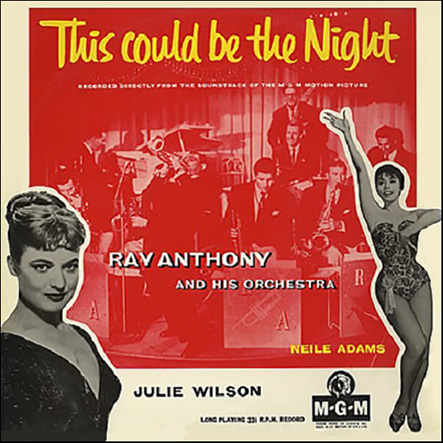
Ruby Neilam Salvador Arrastia, is known in Hollywood as the actress-singer-dancer Neile Adams—and the first wife of the hottest new male star of 60s Hollywood, Steve McQueen. Born on Jul. 10, 1932, to Jose Arrastia of Lubao with Carmen Salvador (sister of character actor Lou Salvador Sr.), she moved to the U.S. after the war.  Adams became a proficient dancer and found herself being cast in musicals. One of her early appearances was in “Pajama Game”, staged at the Carnegie Hall. She moved on to TV and films,  with credits in the 1952 western “Grubstake” and as Patsy St. Claire in “This Could Be The Night” (1957).

Husband and wife appeared in a memorable episode in “Alfred Hitchcock Presents”. Separately, Neile Adams had a recurring role in the TV series “Five Fingers” as Rita Juan in 1960, and went on to guest star in top TV shows thrugh the 60s,70s and 80s, like “The Man from U.N.C.L.E.”, “Love American Style”, “Bob Hope Show”. “The Bionic Woman”, “ The Rockford Files”, “Fantasy Island”, “Vega$” and “Hotel”. In 1986, Adams wrote “My Husband, My Friend”, a biography of her husband Steve, who had died of cancer in 1980. Coincidentally, Neile’s son (Chad McQueen) and grandson, Steven R. McQueen (Jeremy Gilbert in “The Vampire Diaries”), are both actors. A nephew, Enrique Iglesias, is a singer and an occasional actor.

MINDA FELICIANO
U.S. TV Credits: Hawaiian Eye (1959)
International jetsetter Minda Feliciano was the daughter of Manuel Valdez Feliciano, a district engineer, and Amparo Santana of Batanes. Born as Arminda Feliciano on June 1, 1931, her town of origin is sometimes listed as either Angeles or Guagua. That may be due to the peripatetic career of her father, who was assigned in different provinces like Bataan, Nueva Ecija and Surigao.

When she moved to the U.S., she started modeling and auditioning for acting roles and, in 1959, won a regular slot (she played the hula-dancing receptionist, Evelyn) in the popular TV series,”Hawaiian Eye”, produced by Warner Brothers. Her trips around the world led to a chance meeting with actor Michael Caine. The two were soon engaged, but somehow, things didn’t fall into place and the couple parted ways. Michael would marry the exotic beauty, Shakira Baksh in 1973 , win 2 Oscars and be knighted in 2002.

Linked with singer Tony Bennett, Feliciano would form a more lasting relationship with Norman John McClintock Lonsdale, a true English blue blood. Romance bloomed and they were wed in 1997. In the Lonsdales’ sprawling Oxfordshire estate, the couple entertained film star friends like Joan Collins, Peter Sellers, Britt Ekland and Roger Moore. Minda and Norman would be together for 12 happy years until his death in 2009. Minda Feliciano currently lives in London in her ivy-colored house fronting the scenic Thames River.

GEORGE SUNGA
U.S. TV Credits: Judy Garland Show (1963),  An Evening with Carol Channing TV Special, 1966), The Smothers Brothers Comedy Hour (1967), The Tim Conway Comedy Hour (1970), Three’s Company (1976), Good Times (1976), The Ropers (1978), The Comedy Playhouse (1986)
Behind the camera, Kapampangans have also left their mark in the American entertainment industry. Leading the way is the venerable George Sunga, who first joined CBS as a production supervisor of “The Judy Garland Show” in 1963, and later, “The Smothers Brothers Comedy Hour”. He went on to produce the hit TV shows  "Good Times," (1974)  "The Jeffersons," (1975) , “All in the Family” (1974)  “Three’s Company” (1976) and many other successful serials. In 1989, Sunga was elected  officer of the Academy of Television Arts and Sciences.  For his commitment to diversity in television, an award in his honor was created and given yearly at the Media Access Awards. The Sungas are from Guagua, Pampanga.

LEA SALONGA
U.S. Film Credits: Aladdin (1992), Mulan I & II (1998,2004), Redwood Curtain (1995), ER (2010), Crazy Ex-Girlfriend (2016) 
The toast of West End and Broadway, Angeles-born Lea Salonga (b. Feb. 22, 1971), has also penetrated the U.S. showbiz industry, both as actress and singer. While still with the hit musical ‘Miss Saigon’ . she was tapped to sing key songs for such movies as “Aladdin” (1992) and  “Mulan” I and II ( 1998, 2004). She had a once-in-a lifetime experience of singing “A Whole New World” at the 1993 Oscar Awards, which went on to win Best Song. Salonga was also seen on a 1995 TV film produced by Hallmark Hall of Fame, “Redwood Curtain”. The film chronicles the search of an Amerasian piano prodigy for her biological father, aVietnam veteran. Other credits include guest appearances in hit TV series “ER” , “As The World Turns” and most recently, as Filipina Aunt Myrna in “Crazy Ex-Girlfriend”.

RICO HIZON
U.S. Film Credit: I.T. (2016)
Federico “Rico” Morales Hizon, whose parents come from Mexico and Mabalacat, respectively, made a name for himself as an international journalist, but his credentials now include acting in a Hollywood film. In the 2016 film“I.T.” topbilled by Pierce Brosnan, the Singapore-based BBC correspondent portrayed himself in this nail-biting thriller directed by John Moore.

WINSTON QUITASOL
U.S. Film Credits: Ghost (1990), Honey, I Blew Up the Kid (1992), Mortal Kombat (1995), the Phantom (1996), Spiderman 2 (2004), Iron Man 3 (2013), Frozen (2013), Big Hero 6 (2014), Moana (2017)
The visual effects/lighting genius behind contemporary classic Disney movies is half-Kapampangan (courtesy of his mother) Winston Quitasol. His talents are put to good use in films  that require visual effects, allowing him to push the technical and technological boundaries  of film effects to produce all kinds of fantastic scenes and imageries. As a visual effects technical director, Quitasol is responsible for lighting various elements (like a character or FX) for a specific scene and composing the said elements to a live action background via computer work. The realistic effect is achieved through his mastery of computer tricks. On the other hand, as a senior lighting artist, he determines how a shot should look by observing the environment of the approved scenes or finding an art director’s  color key. By positioning his lights in the computer, he can match the look and then render out all the elements he needs to composite the final scene.

Quitasol has worked on a slew of high profile Hollywood films , and his first unforgettable assignments was the megahit “Ghost” from 1990, starring Patrick Swayze and Demi Moore. His more recent works include “Spiderman 2”, “Surf’s Up”, “Iron Man 3”, “300: Rise of an Empire , “Frozen”, “Big Hero 6”, “Moana” and “Olaf’s Frozen Adventure”. Quitasol works at the Walt Disney Animation Studios, California State University-Long Beach

JESS ESPAÑOLA
U.S. TV Credits: Bill and Yed’s Excellent Adventures (1990), King of the Hill (1993), Futurama (1999), The Simpsons, Season 19: Eternal Moonshine of the Simpson Mind (2007).
Animator Jesus “Jess” Española, from Lubao, is the only full Filipino winner of the
the prestigious primetime Emmy Award for his 2008 work on “The Simpsons ( ‘Eternal Moonshine of the Simpson Mind’ episode). Raised by his single mother, Española struggled to finish high school by taking on odd jobs like baby-sitting and washing dishes. He saved enough money for his  Fine Arts course at the University of the Philippines. Española  found work as an animator for Burbank Animation in Makati, then moved to Fil-Cartoons, which was contracted to create animation for Hanna Barbera cartoons like the popular Flintstones, Scooby Doo and Jonny Quest. So adept did Española become, that he was sent to the head studio in the U.S. where he found employment when the Philippine office closed.

His first assignment was at Film Roman for “King of the Hill,”, one of the primetime shows of Fox, that also includes Matt Groening’s “The Simpsons”. Soon, he was doing character layouts for “The Simpsons”, rising to become its assistant director. Espanola’s win at the Emmys validates the common knowledge that Filipino animators are among the best in Hollywood.”A lot of Filipino artists are in the cutting edge of the animation industry. I guess I am lucky that I worked with "The Simpsons," said Jess, the poor boy from Lubao who made good.

KRISTINE SONGCO
U.S. TV Credits: The Fairly Odd Parents (2014), Sullivan and Son (2014), Sing It (2016), My Little Pony (2016-17), The Great Indoors (2016-17)
In the CBS TV sitcom “The Great Indoors”, Kapampangans were treated to a January 2017 episode in which the characters of actors Joel McHale and Stephen Fry,  spoke  in Kapampangan—albeit, with a thick American accent—so they could disguise their secret plan to leave young campers in the wild without their smartphones. The language got a lot of online attention after Pampanga-born Christ Sundita posted it on facebook. It turned out that the  idea was conceived by story editor/ writer, Kristine Songco (b. Dec. 6, 1985),  a Cal State Fullerton honors graduate in 2007.  She worked on Nickelodeon shows like “The Mighty B!”, “Fanboy” and “Chum Chum”. Her writing gigs have come to include  “The Great Indoors”. Or that much-talked about ‘Kapampangan’ episode, Kristine sought the help of her father in crafting the dialogues. The Songcos are a prominent family from Guagua.

ALLEN EVANGELISTA
U.S. Film & TV Credits: Project Almanac (2015), Ghost Whisperer (2010), The Secret Life of the American teenager (2008-2013), Mozart and the Whale (2005)
From appearing in commercials (American Online, MTV, Time Warner Cable, Domino's),  Allen Evangelista transitioned to TV easily,  beginning with ABC's "Once and Again" , "Alias", and a lead role in "Mozart and the Whale". Evangelista was born in Los Angeles to a Kapampangan mother, Aurora (from Angeles), and Alfredo Evangelista from Manila. He last visited Pampanga when he was 7 years old. After starring in popular teen shows, he snagged his first major film in 2015 with “Project Almanac”, where he essayed the role of Adam, the 16-year old tech-savvy geek who builds a time machine. The youthful-loking Allen was, in fact, already 33 years old at that time.

ETHAN DIZON
U.S. Film & TV Credits: Grey’s Anatomy (2012), The Inevitable Defeat of Mister and Pete (2013), Bad Worlds (2014), Get a Job (2016), Spiderman: Homecoming (2017), Avengers: Infinity War (2018)
Young Ethan Dizon (b. 2002), is the son of  Eric Dizon,  who traces his ancestry to the Dizons of Mabalacat. His mother is actress Corinne Chooey, while two younger brothers are also actors. Ethan made his acting debut as a 3 year-old child actor in the CBS hit series, “How I Met Your Mother”, He then had guest roles in  “Grey's Anatomy”, and “'Til Death”. His film credits include: “Get A Job”, “Bad Words” ( with Jason Bateman), and the “The Inevitable Defeat of Mister and Pete”, where he is best-known for playing Pete.  In 2018, he will be seen in “Avengers: Infinity War”. A gifted artist, he was nominated for Best Actor at the NBCU Short Film Festival 2014 in "Paulie", where he played the title role.

CREDITS:
ROSA DEL ROSARIO PHOTO: www.viewsfromthepampang.blogspot
ROGELIO DELA ROSA PHOTO: Alex R. Castro
Avenger: Constantino, Ronald, editor, The Golden Years: Memorable Tagalog Movie Ads, from the collection of Danilo Dolor.
NEILE ADAMS PHOTO: wikicommons, wikipedia
GEORGE SUNGA PHOTO: youtube, Archive of American Television
Three’s Company: www.amazon.com
Redwood Curtain Poster:
RICO HIZON PHOTO: twitter.com
I.T. Poster: IMP awards
JESS ESPANOLA PHOTO: courtesy of Ruston Banal Photography
The Simpsons: www.amazon.com
WINSTON QUITASOL PHOTO: balita.com
Frozen:http://www.imdb.com/title/tt2294629/mediaviewer/rm3873693440
ALLEN EVANGELIST PHOTO: biphoo.com
Project Almanac:imdb. Project Almanac entry
KRISTINE SONGCO PHOTO: Kristine Songco FB page
Mister & Pete: www.amazon.com