Thursday, March 29, 2018

77. 10 RARE AND EARLY PHOTOS OF FLAGELLANTS IN PAMPANGA


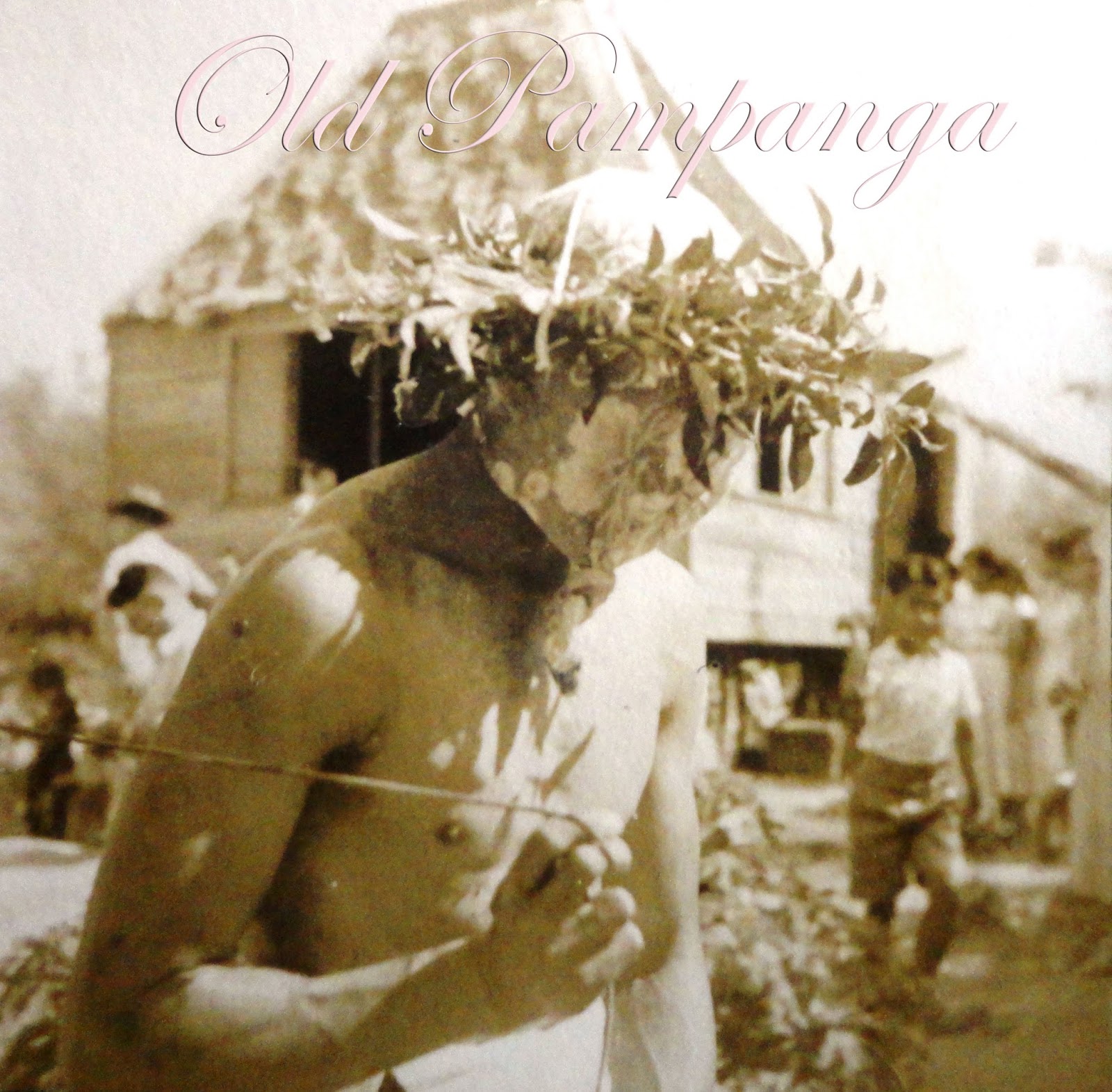
The ways of  flagellants have always inspired awe and curiosity amongst the faithful during the days of Lent. Pampanga flagellants, however, have a different intent. Bloodied, scourged and caked with dust, magdarames live and act out the passion of the Lord—and the term “dámé”, to sympathize and share one’s grief, to take part in someone else’s suffering-- captures this spirit of oneness, in pain and sorrow. Here are, early images of the “magdarame” in Pampanga,  preserved by the camera from the turn of the 20th century to the 1950s.
************

1. MAMALASPAS
Barefooted flagellants from the early 20th century have their backs incised with wounds, drawing blood by whipping their backs with burilyos--bamboo strips tied to a cloth. These magdarame types are called mamalaspas, A distinctive sound is heard when the bamboo strips strike the flesh.

2. MAGDARAMES IN A VISITA
Makeshift chapels of wood, nipa and light materials serve as pitstops for  retinue of magdarames. Here, at these gaily decorated visitas, they pause to say their prayers, before moving on.

 3. MAGDARAME ANONYMOUS.
A magdarame remains anonymous by covering his face with a black hood or a white cloth, called "capariza", held in place by a crown of vines or twisted branches. These days, the face cover is an option as some modern-day flagellants expose their faces to the world. Instead, a piece of cloth is used to covers their heads, Arab-style.

4. BLOOD AND GORE
The back of a magdarame  is incised with a panabad, a paddle with shards of broken glass or directly with a razor or the sharp tip of a knife, such as the one shown in the photo.

5. EYES ON THE MAGDARAME
A group of American ladies from nearby Fort Stotsenburg gawk at a cross-bearing magdarame, followed by his aide, who intones prayers. Then, as now, magdarames were strange sights to see for foreigners. Today, the display of unusual practices such as flagellation and crucifixion are part of a 'religious tourism program' propagated by such places led by the City of San Fernando.

 6. THE CROSS-BEARERS
A popular type of magdarame is the cross-bearer or mamusan kurus. He either carries a cross or is tied to one. This flagellant carries a cross of bamboo, and he carries its full weight as the cross does not touch the ground. Today's crosses are fashioned from commercial lumber from hardware stores, or fashioned from old electric posts. They are also unusually long, so that the end of the cross touches the ground, thus providing support,

 7. THE WAY OF THE CROSS
Flagellants often walked country trails and roads, in small packs of 8 to 12. Others go on solitary walks, the better to reflect on his personal mission to be united in suffering with Christ. An American in a white suit follows this group in their walk of faith.

8. WHIP IT GOOD!
Another kind of magdarame is the sasalibatbat, who fling their bodies to the ground, rolling over sharp rocks and stones in the process. They are followed by a flogger, who whips them when they are on the ground. Their torsos, legs and arms are tied with abaca rope to impair circulation, hence making the experience more torturous.

9. EVERYTHING'S ALRIGHT?
An ayudante checks on the condition of a magdarame, sprawled on the field under the hot, mid-day sun.  The walk around town begins in the morning, ends by early afternoon and is followed by a dash to the nearest river for a quick, recuperative bath.


10. CRUCIFY HIM!
A magdarame is symbolically crucified, by having his arms tied on the crossbar.  The first re-enactment of Christ's crucifixion happened in the 1955 "Via Crucis" in San Fernando, but it was only in 1962 that an actual crucifixion was done, with the nailing of Artemio Anoza to the cross in barrio San Pedro Cutud. Anoza believed he could realize his dream to be a faith healer with his crucifixion.

PHOTO SOURCES:
Photos, courtesy of "Old Pampanga" FB Group.
Others: Alex R.castro, ebay.com 

Wednesday, March 14, 2018

76. 22 MUNICIPAL AND CITY HALLS OF THE PROVINCE OF PAMPANGA

ANGELES CITY HALL
The Angeles City Hall is located in barangay Pulung Maragul, the Angeles City Hall of Justice, and other government buildings. The original municipio however, was constructed during the American regime, in 1922, under mayor Juan D. Nepomuceno, and was built from the original 1840 Casa Tribunal. It is now a museum.

APALIT MUNICIPAL HALL
The municipal hall of Pampanga's Gateway to Manila and The Blacksmith Capital of Pampanga.

ARAYAT MUNICIPAL HALL
The renovated Arayat Municipal Hall is fronted by a monument of its most illustrious son, Gen. Jose Alejandrino, astride his steed.

BACOLOR MUNICIPAL HALL
The municipal building is the former site of the Venturas house, one of Bacolor's most prominent families. On July 8, 1953, the new town hall was completed during the term of Mayor Manuel de Jesus. Its construction was a project of Senator Pablo Angeles David, a native of Bacolor.

CANDABA MUNICIPAL HALL
Candaba, the ancient town noted for its swamplands, and bird sanctuaries, has a neoclassic-style municipal hall centrally located in the poblacion, Brgy. Paralaya.

FLORIDABLANCA MUNICIPAL HALL
The Municipal Hall Building of Floridablanca is on Macabulos St., Brgy. Poblacion, next to the church of Floridablanca.

GUAGUA MUNICIPAL HALL
The heritage town hall of Guagua was built in 1937. The 80 year old Commonwealth-era edifice, which stands on the ground fronting Plaza Burgos,  has  kept most of its original features. The old statue of the patriotic writer, Aurelio Tolentino has been moved to the front of the municipal hall. It  has been declared an Important Cultural Property by the National Historic Commission of the Philippines.

LUBAO MUNICIPAL HALL
The Lubao Municipal Hall, ca. 1937 is one of the early concrete structures erected during the Commonwealth years. It was originally a 2-storey building with stairs at the sides, eventually acquiring a neo-classic look. Much of its original features are intact. In March 2016, a new municipal hall costing Php14.7 million is envisioned to rise  in Brgy. Santa Catalina in an area where the town traces its beginnings.

MABALACAT CITY HALL
The Mabalacat City Hall relocated  to the Xevera Complex of Brgy. Tabun in 2009, from its original site in Poblacion, where the old town hall building still stands next to the elementary school. The old municipio  dates from the American regime, and was improved and expanded in 1951.

MACABEBE MUNICIPAL HALL
The massive Macabebe Municipal Hall is noted for its statue of boy-hero Tarik Soliman, the first native to give up his life for independence at the Battle of Bangkusay, and recognized by the government.

MAGALANG MUNICIPAL HALL
The Magalang Municipal Hall is a town landmark located across the Plaza de la Libertad. Its predecessor was the old Spanish era Casa Tribunal (ca. 1866). The new edifice was built in 1922 , during the presidency of Antonio Y. Luciano, and was inaugurated 2 years later. The municipal building, which survived the war and other natural calamities, was declared an Important Cultural property in 2015.

MASANTOL MUNICIPAL HALL
In Oct. 2017, groundbreaking activities were held for the renovation of the old flood-prone municipal building that houses different government offices. The improvement calls for the construction of a 3-storey building, to be connected with the executive and legislative building for faster delivery of public service.

MEXICO MUNICIPAL HALL
Mexico’s 2-storey town hall is right in the town center, across the public market, adjacent to the police station and close to the Sta. Monica parish.

MINALIN MUNICIPAL HALL
The municipal hall of Minalin is a modernized period building , that includes the Police Station on its grounds.

PORAC MUNICIPAL HALL
The Porac Municipal Hall is a large, modern edifice along Gen. Luna St., in the town poblacion.

CITY OF SAN FERNANDO HALL
The City Hall is located in the heritage district of San Fernando, across the street from the Cathedral of San Fernando. It began as a casa municipal in 1755, made out of stone and thatch. It was burned by the Philippine Revolutionary Army on orders of Gen. Antonio Luna, on May 4, 1899. The building was again reconstructed in 1917. Burned down during WWII, the municipio was reconstructed post-war using its original adobe stonework. The municipio, considered a heritage building, was last restored in 2003 by Mayor Rey B. Aquino.

SAN LUIS MUNICIPAL HALL
The municipal hall of San Luis is an elongated, fenced-in 2 storey building in the heart of the town.

SAN SIMON MUNICIPAL HALL
The municipal hall of this town of over 55,000 people is a contemporary 2-floor building that is in a well-secured location on Punzalan St., Brgy. Tualoc, San Agustin.


SANTA ANA MUNICIPAL HALL
The Sta. Ana Municipal Hall is located in the poblacion, next to the church. As the building is small and situated in a traffic area, a plan  to transfer the town hall on a 1.5 hectare lang in brgy. Sto. Domingo was conceived in 2015, by then-outgoing mayor, Rommel Concepcion. It has been built since then, but is not functional.

SANTA RITA MUNICIPAL HALL
Sta. Rita Town Hall is a larger, new building built on the site of the old  municipio (built in 1951) that is just a stone’s throw away across the ancient Sta. Rita Church. The town hall is located in brgy. San Jose.

SANTO TOMAS MUNICIPAL HALL
When the municipality of Sto. Tomas was re-inaugurated in 1952, the first town hall was temporarily located at the house of its first mayor, Patricio Gomez. The current modern hall is compact in size, and in 2011, the Donato B. Pangilinan, Sr., an annex, was erected.

SASMUAN MUNICIPAL HALL
The municipal hall of Sasmuan, a contemporary 2-storey concrete building, of Sasmuan is located in brgy. Sta. Lucia.
SOURCES:
www.pampangatalents.com,
wikimedia commons
i-orbit news

Sunday, March 4, 2018

75. 11 POINTS OF INTEREST IN AND AROUND PINATUBO IN 1925

In January 17, 1925, Capt. H.A. Myers of the 26th Cavalry, by order of Col. Cavanaugh, prepared and circulated a guide to provide persons interested in riding, with information concerning the best trails an roads to take when riding out of the Post proper. The Stotsenburg Reservation and nearby country, in general, offers much that is worth exploring, for there is a lot of beautiful scenery and many interesting landmarks to be found there. A list of these trails and scenic spots, in and around Pinatubo, as well as  Bamban, are contained in the memo. Some of the names and locations of these trails have been lost to memory.
**********

1. FERN CANYON
This canyon probably offers the finest scenery of its kind around Camp Stotsenburg and should be visited at least once by every person of the garrison. Here, one can see beautiful array of typical shrubbery, particularly ferns, the abundance and variety of which gives the canyon its name.

Wild fowl abound, especially the smaller birds many of which are bedecked with the brightest of plumage. After entering the canyon proper, it narrows down into a gorge only a few feet wide with walls of slid rock on either side varying from 75 to more than 150 feet in height. Huge trees jut out from the walls many feet overhead. Only at midday does the sun ever reach the depths of the canyon and the air is always cool and laden with the fragrance of wild flowers.

2. THREE-CRATER TRAIL
This trail, which forms part of the first part of the 24th Field Artillery China Sea Trail, is very much worthwhile. The trail follows along a canyon which opens out frequently into circular clearings similar to and probably are, very old craters. There is a heavy growth of plant life on all sides and birds and animal life abound. Interesting and unusual geological formations are frequently encountered. The stream which flows through this canyon furnishes a portion of Stotsenburg’s water supply and the water line and settling basin are passed shortly after entering the canyon. Here and there are short trails leading up into the surrounding hills. Persons talking this ride should try and follow the trail as far as the Bamban River which is encountered at the end of the canyon about 4 miles from the Post. Due to its being used throughout the year and forming part of the 24th Field Artillery China Sea Trail, this trail is generally in good shape. Take your camera.

3. LOST CANYON
Lying just south of the the larger and more imposing canyon of the Three Crater Trail, Lost Canyon is very frequently overlooked by equestrians but this oversight is the distinct loss of the latter because Lost Canyon, with its misleading off-shoots and dense growth offers a haven for the seeker of the unusual and uncertain. Entering the canyon, one passes through the gardens of several enlisted men, after which the narrow trail follows along a small stream. The canyon is narrow and overgrown with dense tropical shrubbery, vines and trees. Here, one can find everything in its natural state, there being few evidences of changes made by man. Vari-colored birds flit among the trees and shrubbery, unconscious if intruders, Air plants such as epiphytic orchids grace the front porches of most quarters in the Post and many varieties can be seen as they grow in their natural state. Lost Canyon extends for a considerable distance but for the mounted visitor, only about 1 mile. There are numerous off-shoots from the main trail easily mistaken for the latter, but all finally coming to an end in some inaccessible spot. No doubt, some early pioneer, after struggling to find his way through the canyon, found inspiration for giving it its name. This is a fine place to cool off on hot, tropical days.

4. SOUTH BOUNDARY TRAIL
Following along the Southern Boundary of the reservation from Camp Stotsenburg to Dau, this trail—which in reality is a second class road—offers an excellent route for person desiring to take a ride of several miles over level country. The dirt road is soft and makes a good footing for horses, particularly if gaits faster than a walk are desired. The trail, after being taken to the outskirts of Tacondo, leads almost directly east to Dau. From this point, persons can either return over the same route or take the main Stotsenburg-Dau road. The country along the entire route is level and if desired, one can ride cross-country or; make us of the numerous small trails which run in every direction.

5. SPANISH CUT-SECOND AND THIRD RIVER TRAILS
This is one of the most interesting rides that can be taken around Stotsenburg. Leaving the Post proper, the route leads past the Forage Farm, across Pistil Gulch to the Bamban River. In making the descent to the river, the trail leads down to a long steep bank, somewhat thrilling to ride down, but not at all dangerous if taken slowly. Crossing the river—which is never deep nor dangerous except in the rainy season—the trail leads into a deep cut covered overhead with trees and shrubbery. Following up the cut which is quite steep but accessible, the trail emerges at the top and leads on generally North between, over and around hills, across small streams and through thickets. The scenery here is beautiful. Second River is reached about 1 mile North of the Bamban, and the Third River is a large pool of cool, clear, sparkling water. This is an excellent place for swimming and in years gone by, it was quite the thing to arrange swimming parties here, tents being taken out  of pack mules for dressing rooms. There are any number of excellent sites along the route for staging picnics.

6. DRY RIVER BED TRAIL
This trail offers an excellent route for beginners as it runs through the sandy river bed, has an easy footing for horses and is about the best place one can find to fall off. This trail is also an excellent place to work frisky, nervous horses as the deep sand tends to quiet them down. Except during rainy weather, this stream bed can be followed to a point south east of Dolores and in very dry weather, even further. Trees line the stream bed forming natural barriers on either side. Beginners who are reluctant to try a trot or gallop should do their first work at increased gaits in this sandy stretch. In going over the trail, one can either ride down as far as a point south of Dolores and then return over the same ground or take the Banyan Trail leading through the Banana Grove and back to the Post via Air Service, Murrayville, etc.

7.BANYAN TRAIL
This is an excellent route to take for a short ride. One can leave the Post, cover this trail to where it joins the Dolores Road and return in about three quarters of an hour. The trail is taken near the Air Service then runs through the Banana Grove where the famous Banyan Tree is passed. There is a very dense growth in the Banana Grove and as the sun seldom filters through the thick foliage, it is always cool here. Leaving the Banana Grove, one can either return via the Dry River Bed or take the Dolores Road back to the Post.

8. THE ARTILLERY TRAIL TO THE CHINA SEA
The Artillery Trail to the China Sea constructed by the 24th Artillery is open from about the first of November to the first of July for individually-mounted parties and pack animals. A 2 ½ hour ride, without one hill, brings one to Camp 3 located on the Bamban River. An excellent place for a picnic or to camp (plenty of tent poles, benches and firewood always on hand). A good swimming hole about 200 yards from the camp. During this ride, you will pass through th  4 craters and are struck by the scenic beauty and marvelous rock formation, reminders of the Pre-Glacial  Age.

About a half hour’s ride from the fourth crater, the typical forest begins and continues to the base of Mount Pinatubo. The beauty and wonders of this forest cannot be appreciated unless seen. There is practically no animal life but abundant flora; ferns, air plants, orchids, giant fern trees and other tress 250 feet tall and 25 to 30 feet in diameter. Other beautiful flora peculiar to this forest only, and never named.

From Camp 3 to Camp 4 is about a 1 hour ride following the Bamban River over a practically level trail. Camp 4 is a good halfway camp if going to Pinatubo. Animals should be rested and packs removed before going up out of Bamban as at this point, the only difficult climb begins. The trail follows a gorge out of the Canyon of the Bamban and reaches the divide between the Bamban and Dry Pasig valleys. After following the divide for about four miles, you make a slight descent coming out of the forestand by a slight climb into Zambales Pass and Camp 6. The altitude of Camp 6 is about 4,000 feet The cool climate and invigorating atmosphere rivals Baguio. It is an excellent place to camp with plenty of good spring water available.

The view from Zambales Pass is incomparable with anything in the Philippine Islands. Looking back to the east, the plains of Pampanga are visible for scores of miles and to the West, the mountains of the coast and over them,the China Sea and the Capones islands. From Camp 6, you should ride about a mile further to the north and view Pnatubo Crater. It is beyond description with its walls rising from 500 to 2,000 feet. Parties should not attempt to go beyond this pint unless prepared to stay out sometime. Also, parties going beynd Camp 3 should consist of at least 5 persons, and should be armed.

9. TRAIL TO DRY PASIG
This trail requires about 4 hours to cover but is very worthwhile, and should be taken at least once by everyone. It runs from the Post proper to Sapang Bato Ridge, and then southwest through numerous cultivated areas, a hacienda, a large coconut grove, the latter the only one near the Stotsenburg reservation. Several pretty canyons are crossed and the country in general, offers much in scenic beauty. The trail terminates at what is known as Dry Pasig, a stream bed usually having little, if any, water but deriving its name from the fact that the head waters of the Pasig River originate in this area. The trail, of course, continues on further from this point, but persons coming from Camp Stotsenburg will hardly care to ride beyond.

10. GRIFFITH’S PEAK
The ride to the summit of Griffiths Peak is one of the nicest that can be taken in or around Stotsenburg. The climb up the Peak is steep but not difficult, and once at the top, one can get a very excellent vew of the country for miles around. On clear days, the Central Luzon Valley stretches out to the east and is plainly visible as far as the mountain ranges that run North and South along the Pacific coast of Luzon. Angeles, San Fernando, San Pedro Magalang, and in fact, all of the towns and barrios to the east and South can be seen on clear days. If one cares to take the ride, there is a rail running down the northwestern slope of Griffiths Peak that leads to a point on the Bamban River just above the Intake Station, the latter being where Stotsenburg secures its water supply. The trail from the high South bank of Bamban, down to the stream bed where the Station is located is too steep to be attempted by a horse. However, persons can go down dismounted with no difficulty and should do so as the spot where the Station is located is picturesque. At one point near is a long tunnel where the water line runs under a high hill. This tunnel is large enough for a person to walk through and offers an interesting diversion for persons desiring to explore . This trip should best be taken after the grass has been pruned off and only in dry weather.

11. TOP ‘O THE WORLD
This hill is reached by so many trails that any attempt to describe them all is difficult and unnecessary. It is possible to approach the hill from most any direction and encounter a trail or several of them. However, there are a few general routes over and around the hill which offer the best footing and are therefore the most advisable ones to follow. First, there is a trail which runs West along the crest of a ridge that begins back of the T line. This trail goes over the Reservoir Hill and on along the ridge, turns North and then  goes to a point on the South side of Top ‘O the World. From here, one can go up to the uppermost point on the Top ‘O the World or else proceed on West along the south side of the hill, and then northwest along the ridge that runs along the Top ‘O the World to Griffiths Peak. From the highest point of Top ‘O the World, there is a trail that running dwn the crest of the ridge in a northeasterly direction. This is called the “Knife’s Edge” . The trail is very narrow with steep slopes on either side. None but the very experienced rider who has confidence in his horse should ride over this portion of the trail. The view from Top ‘O the World is excellent. Persons desiring to cover a formidable but safe hill trail should take one of the several trails leading up and around Top ‘O the World, as they are all in good condition, well-travelled and offer no onstacle which the average rider on the average horse should not be able to negotiate.

CREDITS, PINATUBO TRAILS:
NOTE: While most of these photos are Stotsenburg photos, some are representational.
Banyan Forest picture (representation only): https://www.flickr.com/photos/nitinmnair/3968634739, posted by Alel, 30 Sep. 2009

Friday, February 23, 2018

74. 14. NATIONALLY-RENOWNED KAPAMPANGAN ARTISTS

The Philippine art scene is made livelier by the contributions of these gifted Kapampangan artists whose unparalleled skills in painting, has earned not only personal glory, but accolades for the country. Meet 14 of these painters, abstractionists, watercolorists, muralists, printmakers and sculptors who rank them among the country’s finest visual artists.
 **********

1. IRINEO MIRANDA
The Dean of Philippine Illustrators, Irineo Miranda (b. 1896/d.1964), was an early graduate of the University of the Philippines’College of Fine Arts, finishing in 1916. He honed his craft under Fernando Amorsolo, and soon, he was earning illustration commissions from Pacific Commercial Company, doing product labels and advertisements. So good was he, that in 1918, he was appointed to the faculty of U.P. where he taught his forte—cartooning--along with decorative painting and commercial design. He would stay on for over 40 years in the academe. He continued to get project, illustrating covers for Graphic, Liwayway and El Debate magazines. In his time, he was also a top-notch water-colorist and a political caricaturist.


2. JUAN C. FLORES
Pampanga’s legendary sculptor and carver, Juan C. Flores (b. 24 Jun. 1900/d. 14 Sep. 1992) of  Sta. Ursula, Betis, grew up in a fishing community. Not wanting to be a fisherman, he went to Manila to seek his fortune and found work in the santo shops of Quiapo. He became an apprentice of Maximo Vicente, worked with the Tampingcos,  and honed his carving skills to perfection. But just as he was making a name in the city, he returned to Betis in 1922 to start his own ‘taller’. He  made religious statuaries, furniture, decorative wooden items, church fixtures famed for their details and high quality. On the side, he mentored young artists like painters Vicente Manansala, Antonio Dumlao and Allan Cosio.  First Lady Imelda Marcos gave him commissions to do the decorative woodworks in Malacañang. He was rewarded in 1971 with a  Washington D.C. trip as the country’s representative in an art competition which he topped. Flores’ winning piece was a bust of the U.S.  Pres. Richard Nixon. At the ripe age of 77, he was given the Panday Pira Award. His most cherished award was being awarded as one of the “Most Distinguished Sons of Pampanga” in 1982. His work is continued today by his son Daniel Flores.


3. ELIAS LAXA
Guagua’s master painter of Philippine vignettes (b.1904/d.1990), was born in Banka, a  fishing village. At 16, he left for Manila, but it was only at the advance age of 25 that he enrolled at the U.P. College of Fine Arts, graduating in 1933. Laxa took on odd jobs, including sign painting in Escolta. He went into serious painting only after the War, supporting himself by giving art lessons.  His signature works are his color-splashed seascapes, inspired by his humble background. But he could also paint other subjects—calesas on narrow alleys, market women, old colonial churches, --done in colorful, swift-strokes. In 1952, Laxa held his first one man show at the Miguel Galvez gallery. It was through his art that he managed to support his 9 children, who earned degrees in engineering, architecture and education. In 1964, he flew to Hawaii where he found artistic success. Laxa’s family would join him there, in the island state that embraced him and his art. He passed away  in 1990.


4. JOSE BUMANLAG DAVID
 In the field of portraiture—where technical accuracy, mastery of light, tone and mood are required of the artist, one Kapampangan painter stands out—Jose Bumanlag David (b. 26 Jul. 1909/d.199?) of Mexico. Though he painted a variety of subjects throughout his long, prolific career, it is in portraiture that he found recognition, thanks largely to his American clientele. A  product of Pampanga High School and the U.P. Fine Arts (1934), his paintings often appeared on the national magazine, Philippine Free Press. His works could be found in pre-war classrooms as he painted many historical scenes. David took a break to finish a management course in 1964 at the Air Force Institute at Gunter Air Base University, Alabama. From 1971 till 1982, he gave private art classes to bored American wives of U.S. military personnel and their other family members in Clark Field.  One of his last one-man show was held in 1990 at Galerie Andrea in 1990. Many of his portraits of American military officers used to hang in various Clark Air Base buildings and those of Filipino heroes at the Scottish Rite Temple.

5. VICENTE S. MANANSALA
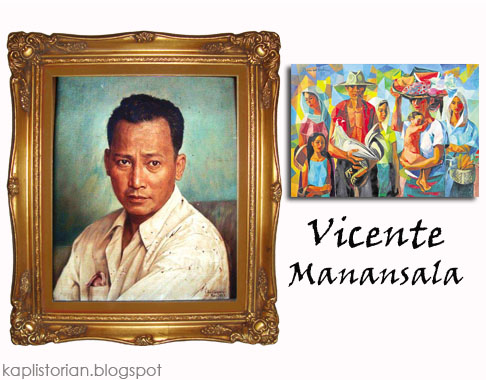
National Artist Vicente “ Enteng” Manansala (b. 22 Jan. 1910/d. 22 Aug. 1981) was  born in Macabebe, and already had artistic inclinations as a boy growing up in Intramuros where his family relocated. At age 15, he painted his first oil—a head of a cow coped fom a milk can. He entered U.P. Fine Arts in 1926, and left home after graduation. He worked as a billboard painter, art director and finally won his first national award in 1941, for his work “Pounding Rice”. He would be included as a member of the “13 Moderns” and the “Neo-Realist Group”. Manansala earned scholarships in Canada (Ecole de Beaux Arts in Banff)  and France (Ecole de Beaux Arts of the University of Paris). He devised his own technique called “transparent cubism”. His prized paintings are in various private and corporate collections here and abroad. Holy Angel University has a section of its museum called The Vicente Manansala Collection, holding most of the sketches, studies and drawings from the artist’s estate.  Mananala was named National Artist for painting in 1981.


6. PATRICIO SALVADOR (b. 17 Mar. 1911/d.?). A 1931 graduate of Pampanga High, he pursued an art course at the U.P. School of Fine Arts, taking only a year to learn and master painting basics. Soon, this Fernandino was dividing his time between commercial art and landscape painting. He was still painting in the mid 1990s at his humble home on Teopaco St. His small work, “Ricefields”, painted in oil in 1943 now hangs at the Jorge B. Vargas Filipiniana Museum at the U.P.


7. GALO B. OCAMPO, Sta. Rita
Galo B. Ocampo, (b. 16 Oct. 1913/d. 12 Sep. 1985 ), who hails from Sta. Rita, studied at the Univeristy of the Philippines. He is the only Flipino to study heraldry abroad and to hold membership in the International Institute of Genealogy and Heraldry in Madrid. He later became a Director of the National Museum in 1961. The multi-talented artist was also  painter, sculptor, scenographer, writer, teacher, and a cultural-activist.  On 22 July 2015, the order of Lakandula was conferred posthumously to  Galo B. Ocampo with the order of Maringal na Pinuno (grand officer) from the National Museum director, Jeremy Barnes.


8. LIBORIO T. GATBONTON
Liborio “Gat” Gatbonton (b. 23 Jun. 1914/.5 May 1976) was a Filipino cartoonist and caricaturist during the 1940s and 1950s who created the popular series "Jappy Days," a comic book that satirized the Japanese rule in the Philippines. He was also the chief cartoonist of the comics section of the now-defunct Evening Chronicle. The Candaba native went to Pampanga High School and took a correspondence course in cartooning. He took formal art lessons at the University of the Philippines, and, in 1935, joined T.V.T. Publications as a staff artist. He became a cartoonist for the Manila Chronicle and was the first Filipino artist to have his work published on The New York Times.


9. SALVADOR CABRERA
Salvador Cabrera (b.1930/d.1986) was BenCab’s big brother, older by some 12 years. He was often referred to as a ’quick-draw’ artist who could finish as many as 10 paintings in a day. His trademark works showed youngsters  with large, gazing, soulful eyes, inspired by artist Margaret Keane. Salvador, who maintained an Ermita studio,  had a successful career as an editorial cartoonist of Daily Mirror, where his comic strip featuring a character named Bindoy, ran for 10 years. In his heyday, he built a large clientele, who paid Php500 for his portraits, a hefty sum at that time—and he could finish 5 a day. He managed to provide a luxurious life for his family, but in the troubled ‘80s, when patrons ceased coming, he had to rely on BenCab’s help as his health began to fail.  Salvador Cabrera was also a skilled watercolorist, illustrator and a lay-out artist, and his works were once carried by Angeles galleries, He died of heart attack in 1986.


10. ALLAN COSIO
The versatile artist, Allan Cosio (b. 1941) traces his roots in Bacolor. This painter (op art and abstract) , printmaker, sculptor and tapestry maker  has represented the Philippines at the Valparaiso Biennale in Chile. The Indian Triennale, and the International Sculptue Event in Victoria, Australia. He has also exhibited in Geneva (Switzerland), California, Munic, Beijing, Marsala (Italy) and Hong Kong. For 5 consecutuve years, he was a prize winner at the annual Art Association of the Philippines (AAP) competitions. He won a Britsih grant as his award for winning the grand prize in the 1980 AAP awards. Cosio is married to the Ivi Avellana, daughter of director Lamberto Avellana and theater actress, Daisy Avellana.


11. BENEDICTO CABRERA (BenCab)
Benedicto Cabrera (BenCab, b. 10 Apr. 1942) is a full-blooded Kapampangan whose parents are from Sasmuan. He studied at the University of the Philippines, graduating in 1963, and had his first one-man show at the Gallery Indio in 1966. After BenCab married British Caroline Kennedy in London in 1969, the couple decided to stay there, where he slowly, but surely established his name in the international art scene, holding exhibits (London, New York ,Macau)  and winning several art awards. Returing to the Philippines in 1972, he was hailed as a Filipino pioneer of the arts, but the restrictive Martial Law years forced him back to London. This episode marked the beginning of his involvement with social commentary and the topics of freedom from repression. Later in the 1990s, BenCab founded the Tamawan Village, an artists’ sanctuary-cum-gallery that has become a popular cultural destination in Baguio. He was named a National Artist for Visual Arts in 2006, and in 2009, U.P., his alma mater, conferred upon him an honorary Doctor of Humanities degree.


12. JOSE  W. HERNANDEZ
Manila-born Jose W. Hernandez (b. 22 Sept. 1944/ d.19? ) practically grew up in San Fernando, when his father was assigned as a law teacher at Harvardian College. Jose spent his grade school years at the Assumption Academy. His artistic inclinations showed early; he would fill his notebooks with drawings rather than schoolwork. In his senior year at Pampanga High, he was offered a scholarship by Pres. Diosdado P. Macapagal. However, he abandoned his schooling to learn from established artists like Fernando C. Amorsolo, Botong Francisco, Vicente Manansala, Simon Saulog and Ben Alano. Painting in the realist tradition, he had his first group exhibit with Mabini masters in 1965. From 1974-77, Hernandez operated his own gallery in Angeles City. His works have been exhibited in the U.S., and reproduced on Unicef greeting cards.


13. MARCELINO  C. GALANG
“Mars” Galang (b. 1 Jan. 1945/d.2001).was born in Cabusao, Camarines Sur. His father, Zoilo M. Galang of Bacolor, was pioneering  encyclopedist who singlehandedly produced the 10-volume “Philippine Encylopedia” published in 1934.  This makes Mars, a half-Kapampangan. He went to public schools in the Sta. Cruz district of Manila, then took up Fine Arts at the University of the Philippines on a scholarship. He became not only a painter, but also a printmaker, colorist and draftsman. Mars dabbled in minimalism, where he excelled. He represented the Philippines at the 1st India Triennial in New Delhi (1968) and the 7th Paris Biennial. His last one-man show ws in 1985, an thereafter remained inactive.


14. CESAR VICTOR “CID” P. REYES
The prodigious artist, advertising executive, book author, art scholar and art critic Cid Reyes (b. 28 Jul. 1946) is a Kapamangan Pangilinan, courtesy of his mother Humilde, from Apalit. After his Lasalle studies, he became an Italian government scholar at the Academia de belle Arti in Rome, and tool courses in Art History at the City Lit Institute in London. Twice named Art Critic of the Year, Reyes is also a mutli-awarded advertising creative. In 1989, he authored “Conversations in Philippine Art”, which featured his interviews with 8 National Artists.  His published books have won 2 national Book Awards. As a painter, Reyes has exhibited his works in major art galleries featuring his robust abstract works using automotive paint. Reyes travels around the country lecturing on various aspects of art and art history. He was named Most Outstanding Kapampangan in Arts in 2015.


15. CLAUDE S. TAYAG
The renaissance man from Angeles City, Claudio “Claude” Moises Tayag (b. 1956) is the son of writer-lawyer Renato ‘Katoks’ Tayag. Although an AB Economics U.P. graduate, he forayed into art by observing artists E. Aguilar Cruz (his menor), Romula Galicano and  Sofornio Y. Mendoza. He won praises for his paintings of  folk festival imageries and folk santo watercolors. He also ventured into creating functional and decorative sculptural wooden pieces. Also known as an award-winning chef, Tayag and wife Mary Ann Quioc, offer unique dining experiences at his residence known as Bale Dutung (Wooden House), and at his 1856 Downtown Café, pop culture restaurant.

16. NORMAN TIOTUICO
The foremost exponent of Kapampangan contemporary indigenous art, Norman Tiotiuico (b.1966) of Angeles City is a Fine Arts graduate of the University of the Philippines. In 2004, he was named a Rockefeller and Ford Foundation grantee at the 4th International Sculpture Symposium in Vietnam His works are mostly sculptures, inspired by spiritual and environmental issues. Tiotuico, subscribes to the belief that he, as an artist, is just a medium used by the Creator as an executor of His ideas. His work is represented at Saatchi Art, the world’s leading online art gallery. This Most Outstanding Kapampangan Awardee for the Arts in 2008 exhibits regularly;  his latest, ”Kalalangan Kapampángan Experiment” (Feb. 2018), features his latest native art installation works.

SOURCES;
Salvador Cabrera: lex Castro Collection
BenCab: photo: wikipedia
Allan Cosio: http://www.philstar.com/arts-and-culture/2014/11/24/1394631/allan-cosio-cid-reyes-ricco-renzo
Juan Flores:Singsig,Magazine
Mars Galang: Portrait by BenCab, Art Manila Newspaper, Vol. 2 Series 7, 2001
Liboro Gatbonton: Mobilways
Elias Laxa: Sunday Times Magazine 1963.
Vicente Manansala: Vicente Manansala Collection, Holy Angel University
Irineo Miranda: Leon Gallery
Galo Ocampo: Positively Filipino
Cid Reyes: Cuadro Filipino, photo by Joey Ibay.
Claude Tayag: Scred Heart Seminary Annual 
Norman Tiotuico: Saatchi-Art, iorbitnews
All others: Kayumanggi, Biographes of Philippine Visual Artists, Peso Book Foundation 2000.