Thursday, April 26, 2018

79. 10 KAPAMPANGAN PORTRAITS PAINTED BY SIMON FLORES


The wish to be remembered after one is gone is only human. People live on, in the stories we conjure as we view portraits. Through their faces, expressions, finery and pose---we see people as the artists saw them. 

In Pampanga, there was no lack of portrait sitters as the numerous members of the landed gentry sought the services of itinerant artists. The most prominent name is Manila –born Simon Flores de la Rosa (1839), who settled in Bacolor and made the rounds of Kapampangan towns, and a handful of his portraits form part of his legacy.

*************
QUIASON FAMILY (San Fernando)
Two Flores portraits of the Quiason Family of San Fernando, headed by Cirilo Cunanan Quiason are still existence today. Cirilo  and his 2 brothers, Lucio and Pablo, were successful landowners and traders, and each one commissioned Flores to create family portraits. The first painting depicts him, at age 33 and his wife Severina David Henson along with  their two children painted in 1875. The artwork costs 50 pesos per head, in gold coins,  for a total of 200 pesos. The seated baby is named Jose.  The older child holding a prayer book is Aureo. The seated baby, Jose, was originally painted naked. He was teased about this when he grew up, so he burned the part that showed his genitals. The painting has been restored since.

The second painting shows the expanded family, painted after 1875. They would have 9 children in all. Ceferina became a widow after Cirilo was accused by the town friar of engaging in seditious acts. The friar, who had romantic designs on his daughter Rosaruo, was rebuffed by Cirilo, who was then captured and tortured.


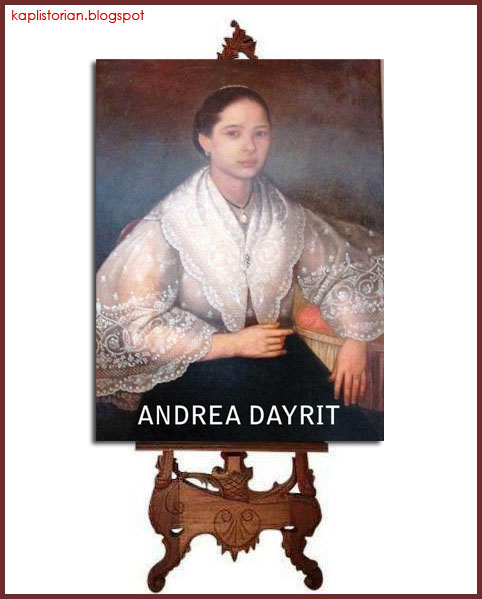
ANDREA DAYRIT (Sta. Ana)
In the town of Sta. Ana, Flores painted the pretty Andrea Dayrit. Her portrait hung in the 1840s Dizon house, famous in its time for its late Neoclassical and English Regency architectural details. Portrait of Andrea Dayrit by Simon Flores, circa 1870s, Oil on canvas, 81 X 58 cm.


MIGUELA HENSON (Mexico)
Mexico has a couple of Flores portraits, and the most well-known is that of long-haired Miguela Henson in front of her Isabelina-style dresser.  It is now in the Bangko Sentral ng Pilipinas collection. Ca. 1880s.


MSGR. IGNACIO TAMBUNGUI (Bacolor)
Flores, who settled in San Vicente in Bacolor, also painted portraits of his wife, Simplicia Tambungui, originally from Guagua, but no work survived.However, in 1890, he painted a portrait of his brother Monsignor Ignacio Pineda Tambungui ,  a canon of the Manila Cathedral and a chaplain at the San Juan de Dios Hospital. In return, Msgr. Tambungui gave his brother-in-law church decorating-commissions in Pampanga towns.


DON JOSE LEON SANTOS (Bacolor)
Bacolor’s most influential couple in the 1850s also sat for Flores.  Don Jose Leon y Santos was one of the sons of gobernadorcillo Francisco Paula de los Santos, Gobernadorcillo and Doña Luisa Gonzaga de Leon. Jose Leon Santos became the gobernadorcillo of Bacolor in 1857. The oil portrait of him was done in August 1887 when he was 59 years old.


DOÑA RAMONA JOVEN (Bacolor)
Don Jose Leon y Santos was first married to Arcadia Joven y Suarez. Upon her death, Leon Santos wed her sister, Ramona Joven. Her portrait was completed in August 1882.  Both paintings now hang at the Museo de La Salle.


OLEGARIO RODRIGUEZ (Bacolor)
One of the earliest known works of  Flores, dates from 1862,--when he was just 23. It is that of Don Olegario Rodriguez (1806/1874), patriarch of the still-flourishing Rodriguez clan of Bacolor, when the subject was “56 anos.”  Rodriguez is shown wearing the European black coat with tails, embroidered “nipis” shirt of “pina”, and trousers of a “principalia,” seated on an armchair. Until Pinatubo of 1991, it used to hang in the sala of his ancestral house but has since been secured by Rodriguez descendants in Manila.


SEVERINA OCAMPO DE ARROYO
In Candaba, Flores painted portraits of two matrons, both from the affluent landowning class. The first portrait is that of  Severina Ocampo de Arroyo, noted for her serious, icy stare. A virina-encased ivory santo is shown beside her. ca. 1885.


QUINTINA CASTOR DE SADIE (Candaba)
Another portrait done of a rich lady of the house is that of hefty Quintina Castor de Sadie, nicknamed “Fat Woman from Candaba.” The two Candaba portraits were formerly owned by banker Manuel Martinez Dizon, which he later sold to the Bangko Sentral ng Pilipinas in the 1980s.  


SOURCES:
Msgr. Ignacio Tambungui: Kasaysayan

Wednesday, April 11, 2018

78. 12 LONGTIME PAMPANGA BUSINESSES THAT ARE STILL IN EXISTENCE TODAY

Businesses come and go. But not for these Kapampangan enterprises founded by visionaries who poured in blood, sweat and tears to build these commercial establishments that have--with a dash of luck--become icons of economic success in the province's business landscape. Let's see some of these businesses that are still in existence and continue to endure to this very day.
**********
APUNG DIUNG BAKERY (1880)
The oldest-known bakery in Pampanga-- “Apung Diung”-- is still in existence in Plaza Burgos, Guagua, after over 120 years of operation. Founded by Aurelio Diyco , the panaderia still uses oldtime recipes and traditional baking methods to come up with special pastries and treats. Apung Diung is credited with popularizing ‘masa podrida” (Nancy Balls brand), the local  version of shortbread biscuits , perfect with coffee or tea. The circular cookie literally means “rotten dough”, but the taste is anything but that. Rich-tasting with a crisp, crumbly texture, masa podrida cookies are made from butter, flour and sugar. Known today as “Apung Diung Pan Plaza Bakery”, the business is now owned and operated by Diyco descendants, and continues to bring to treats like cheese rolls, sampaguitas, egg pies, pan de salitos and other breads to sweet-toothed Kapampangans.

LA MODERNA BAKERY (late 1800s)
La Moderna had its roots  in the late 1800’s when couple Ignacio and Maria Lansang Narciso opend a sweets shop in Sta. Rita. In 1947, son Pablo Narciso and his wife Narcisa Carlos relocated the candy company to  Guagua, which soon evolved into a bakery, La Moderna.   Its wood-fired ovens or pugon  churned out baked treats that were sold  as far north as Dagupan, and in Divisoria, Manila. All 10 Narciso kids all helped in managing La Moderna, which employed over 150 employees working in shifts daily, to meet the growing demands. The second and third children, Toto Narciso and Butchie N. Lagman took over La Moderna  in the early 80’s, and the bakery came to be known for both its traditional and new product innovations: gorgoryas, mamon tostado, sampaguitas, masa podrida and turrones. Not even the eruption of Pinatubo could bring the business down as La Moderna found a loyal Manila market via the Salcedo weekend market. After over 70 years,  La Moderna Bakery continues to operate in Guagua today, right in Plaza Burgos, proof that once a favorite, always a favorite!

R.T. PARAS HAUTE COUTURE (1902)
R. T. Paras Haute Couture is perhaps the most notable fashion house established by a Kapampangan--Roberta Tablante Paras, a woman of extraordinary talent and character. Roberta was one of the daughters of Modesto Paras, a former juez de paz (justice of the peace) of Angeles. Her dressmaking skills were recognized early. But a liaison with a married doctor caused her to be disowned; she fled to Manila and open a small dressmaking shop in Binondo in 1902 and in Quiapo in 1912. She single-handedly operated her  business, building a client list that would include the First Lady Aurora Aragon Quezon. Roberta’s daughter, Josefina, acquired her mother’s skills and business acumen, and turned R. T. Paras as one of the country’s most popular couture shops in the 40s and 50s. Her son, former design head of Jean Patou,  Froilan “Roy” Gonzales would eventually return home to head R.T.Paras Haute Couture which has become a name synonymous with excellence in the domain of high quality wedding gowns, corporate attire, suits and formal wear.

PAMPANGA HOTEL & PANCITERIA (after 1912)
Along A. Consunji Street, on the side of the San Fernando Cathedral still stands the Pampanga Hotel and Panciteria, now operating under the name Pampanga Lodge and Restaurant. The famed hotel cum restaurant was put up in  the spacious Buison Building, which in 1908, started housing Pampanga High School. The building then came into the possession of the Eusebio family, and became the residence of Andres Eusebio, who married Asuncion Santos, daughter of Don Teodoro Santos, Sr. (Dorong Tola). The school vacated the premises when the new Pampanga High School was erected in 1912. Harvardian Colleges, founded in 1955, also used the building for its classes. Pampanga Hotel and Panciteria took over its use, providing affordable lodgings and meals to San Fernando visitors  through the 50s- 60s. The establishment still operates in the same town plaza location.

ANGELES ELECTRIC CORPORATION, (1923)
Angeles City’s main power provider, the Angeles Electric Corp., began as Angeles Electric Light and Power Plant on July 10, 1923, a project of Don Juan Nepomuceno and wife, Nena Gomez. The couple—who already had an ice plant, and would go on to found other ventures like Holy Angel Academy, a softdrinks factory, a subdivicion and a commercial shopping complex---thought that bringing  power to a community, including light to the church—was a great idea. With a 2,000 pesos down payment on a Php 72,000 power plant machines—the Nepomucenos set forth to establish the electric company that would serve Angeles continuously, except during the dark days of the war. It was incorporated in 1959 as Angeles Electric Corp. and the institution continues to provide power service, efficiently and competently-- not only to the city but also to nearby areas, today.

FUNERARIA PUNZALAN, (1930)
One of Pampanga’s leading funeral services was founded way back in 1930 by Pedro Manalili Punzalan who first started Funeraria Punzalan in Arayat town. In the eary 1950s, he bought an old house in San Fernando along Tiomico St., and converted it into another funeral parlor that soon gained patronage in the capital and in nearby towns. In 1959, Funeraria Punzalan opened its Guagua branch, and soon, Punzalan descendants rode on the popularity of the successful memorial and mortuary business by putting up their own branches bearing the same name.  At its peak, Funeraria Punzalan had branches in Candaba, Calumpit and in Nueva Ecija (Jaen and Cabiao). Another Punzalan relative put up parlors in Bataan (Orani, Hermosa, Dinalupihan, Balanga, Limay, Samal, Abucay) which are still currently in operation, along with the San Fernando, Arayat and Porac branches.

ONG SIN SIU GROCERY (1939)
Ong Sin Siu or simply “Sencio” is the name of the oldest supermarket in Mabalacat. It was founded in 1939 by Chinese couple Ong Sin Siu and wife Apung Achi Ong. The small grocery store was put up along MacArthur Highway, Calumpang, and sold everything from canned goods, softdrinks, cosmetics, toys, school supplies, hardware and other day-to-day essentials. Apung Sencio, who was known for being generous to his patrons (he lent money freely), ran the grocery along with his children.  Through the years, the grocery expanded and continues to enjoy a loyal following from the city, this, despite the rise of hypermarts and similar superstores in the area.

HIZON’S BAKESHOP (1946)
Hizon’s Cakes & Pastries on Bocobo St. in Ermita, Manila was founded by Inocencia Hizon, a widowed single mother working as a department store clerk at Aguinaldo’s, Escolta. The Hizon roots are in Mexico. Family lore has it that the now-famous ensaymada recipe was given to her by an anonymous woman. Inocencia baked dozens of ensaymadas using the recipe, and engaged the help of her sister to peddle the pastries in offices, which, to her surprise, were all sold-out. This encouraged her to put up a bakeshop in 1946 on Raon St, which she named simply as “Hizon’s”. It transferred to its present location in Bocobo in 1963. Today, Hizon’s has branches in Pasay, Greenhills and Makati, run by daughter Milagros Ramos Roasa. The shop, regarded as an institution, (it was the late Dolphy's favorite hang-out place),  is also famous for its taisans, apple pies and ube cakes, but the ensaymada remains a sentimental favorite.

APUNG GARI BAKERY & KIOSK, (1955)
San Fernando’s favorite bakeshop at the Assumpta Building, along the busy Abad Santos St., barrio St. Rosario, was put up by an enterprising couple, Jesusa “Susing” Quiambao and husband Jose “Pitong” Valencia, in 1955. It was named after Susing’s mother, Margarita Quiambao.  As a manager of the post-war “La Satisfacion Bakery, “Apung Gari” earned a reputation as a good cook. Her daughter and son-in-law soon took over the business, renaming it as “Apung Gari Bakery and Kiosk”. For fifty centavos, one can enjoy Pancit Luglug (a best-seller), Arroz Caldo, Chicken Mami, Magnolia Ice Cream and Ice Cream Sundae. Halo-halo, Lumpiang Prito, Magnolia Milk. Assorted cakes and pies could be had for forty centavos. Students from Assumption and other schools, government employees frequented “Apung Gari” for over six decades. Descendants continued the business long after the death of the Valencias, until it was sold to the Santiago family around 2007.  The new owners retained the name owing to its pulling power which evokes simple, but tasty food and good times. Recently, the name was changed to LBS (for Leonila B. Santiago) Bakeshop and Kiosk, and time will tell if the same affinity for the one and only “Apung Gari” will rub off on the newly-rechristened bakeshop.

JOHNNY’S GROCERY STORE, (early 1950s)
The founder of Angeles’ early grocery/supermarket  was Amoy-born Johnny Uy whose family migrated to the Philippines and settled in Pampanga. He married Lilia So, who belongs to the well-known clan of Angeles. After their marriage, they put up a mall shop, Johnny’s Grocery Store along Miranda St, which would become the go-to place of Angeles families for their daily, domestic needs, including liquors. The Uys would put up a multi-storey building in Balibago in the early 1970s, which also proved to be very successful, carrying imported goods from American comic books, cigarettes, premiere liquor brands to the latest music records. The Miranda branch was lost in a blaze, but Johnny’s Supermarket in Balibago and at Sto. Rosario Street—housed in a newly-refurbished building, are still going strong. In 2014, “Papa Johnny”as known  by locals, was recognized by the province for his significant contributions to the community and its economy.

MAKABALI CLINIC (1957)
The modern V.L. Makabali Memorial Hospital, Inc along Mendoza St., in San Fernando, began as a modest 6-bedroom maternity clinic that Dr. Venancia L. Makabali opened in a house, on Aug. 11, 1957. Dra. Makabali was a 1946 graduate of medicine at the University of Santo Tomas, where she specialized in Obstetrics and Gynecology. She later went to the U.S. to undergo advanced OB-GYNE training. Her reputation as a women’s health doctor soon spread and the single doctor’s career took off. Just a few months after the clinic opened, she added 4 more beds, one operating room, one delivery room, ten nursery bassinets, a laboratory, and an X-ray room. For years, Dra. Makabali ran her famed clinic, which continued to operate long after her death in 1972. The clinic was then made into a family corporation with all the surviving brothers and sisters as incorporators. This led to the construction of a modern hospital complex now known as  V.L. Makabali Memorial Hospital, Inc.

RURAL BANK OF MABALACAT (1964)
The little bank that could—that’s the Rural Bank of Mabalacat Inc, which after half a century, still operates in the city, an important partner in community progress. The rural bank, established by founding members Concepcion de Leon, Jaime Gomez, Lourdes Dycaico, Benedicto Tiglao  and Angelo Hizon opened  its doors in the Poblacion office on November 4, 1964 . An extension office was put up in Dau on December 8, 1972. However, lahar threats in 1991-1992 from Mount Pinatubo’s eruption prompted the bank to transfer its main office from Mabalacat to Dau, but this did not hamper the bank from expanding its network, opening branches in Magalang (1993), Sindalan, San Fernando (November 1997),  Bamban,Tarlac (November 2002) and another full service branch in Angeles City in 2009. The Rural Bank of Mabalacat Inc, has withstood many challenges like the Asian Economic Crisis, the political upheavals that affected our econmy and financial system in the 1980s, and enjoys continued grwth and stability today.

SOURCES: 
ANGELES ELECTRIC CORP.:  Center for Kapampangan Studies, Holy Angel University
APUNG DIUNG: Photos, from Mr. Jorge Hizon FB page, https://www.facebook.com/search/top/?q=APUNG%20DIUNG%2C%20HIZON
LA MODERNA BAKERY:  Photos and info from La Modern bakery blog:  http://lamoderna1947.blogspot.com/
PAMPANGA HOTEL: 1960 yearbook, Pampanga High School
FUNERARIA PUZALAN, all photos by Jerry Punzalan Sagmit
ONG SIN SIU: Photo from “Ing Mabalaqueño 2017 Year End issue.
HIZON’S BAKESHOP: Photo of Hizon’s Raon branch, Philippine History & Architecture FB page,
APUNG GARI: Alex Castro Collection
JOHNNY’S GROCERY STORE: Vintage Photo by J. Scott,
Photo of Johnny’s Supermaket-Balibago: https://www.facebook.com/JohnnysSupermarket/
MAKABALI CLINIC: 1959 Pampanga Medical Society Souvenir Program
V. L. Makabali Memorial Hospital FB page
RURAL BANK OF MABT.: http://rbmabalacat.com/about-us/

Thursday, March 29, 2018

77. 10 RARE AND EARLY PHOTOS OF FLAGELLANTS IN PAMPANGA


The ways of  flagellants have always inspired awe and curiosity amongst the faithful during the days of Lent. Pampanga flagellants, however, have a different intent. Bloodied, scourged and caked with dust, magdarames live and act out the passion of the Lord—and the term “dámé”, to sympathize and share one’s grief, to take part in someone else’s suffering-- captures this spirit of oneness, in pain and sorrow. Here are, early images of the “magdarame” in Pampanga,  preserved by the camera from the turn of the 20th century to the 1950s.
************

1. MAMALASPAS
Barefooted flagellants from the early 20th century have their backs incised with wounds, drawing blood by whipping their backs with burilyos--bamboo strips tied to a cloth. These magdarame types are called mamalaspas, A distinctive sound is heard when the bamboo strips strike the flesh.

2. MAGDARAMES IN A VISITA
Makeshift chapels of wood, nipa and light materials serve as pitstops for  retinue of magdarames. Here, at these gaily decorated visitas, they pause to say their prayers, before moving on.

 3. MAGDARAME ANONYMOUS.
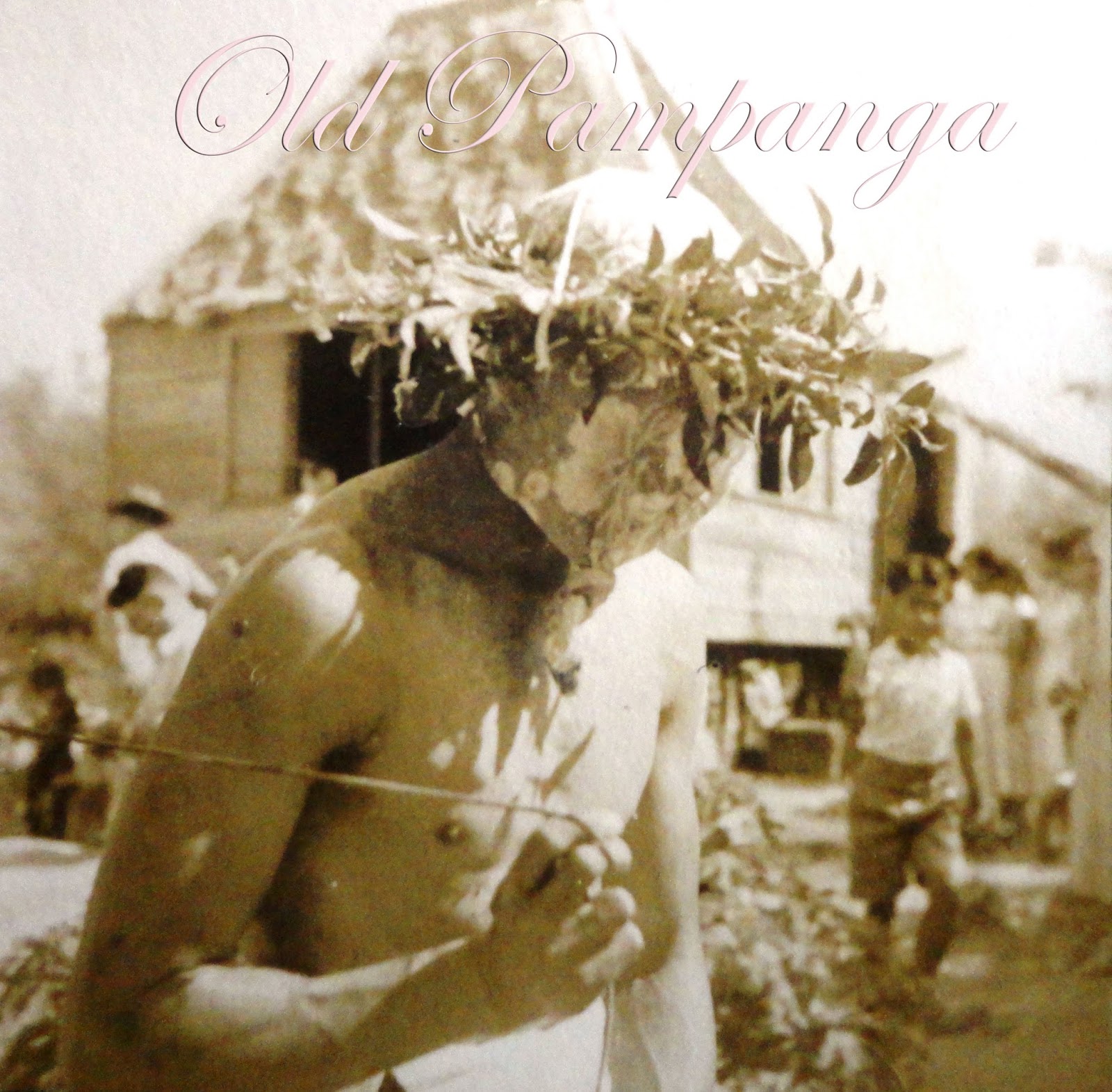
A magdarame remains anonymous by covering his face with a black hood or a white cloth, called "capariza", held in place by a crown of vines or twisted branches. These days, the face cover is an option as some modern-day flagellants expose their faces to the world. Instead, a piece of cloth is used to covers their heads, Arab-style.

4. BLOOD AND GORE
The back of a magdarame  is incised with a panabad, a paddle with shards of broken glass or directly with a razor or the sharp tip of a knife, such as the one shown in the photo.

5. EYES ON THE MAGDARAME
A group of American ladies from nearby Fort Stotsenburg gawk at a cross-bearing magdarame, followed by his aide, who intones prayers. Then, as now, magdarames were strange sights to see for foreigners. Today, the display of unusual practices such as flagellation and crucifixion are part of a 'religious tourism program' propagated by such places led by the City of San Fernando.

 6. THE CROSS-BEARERS
A popular type of magdarame is the cross-bearer or mamusan kurus. He either carries a cross or is tied to one. This flagellant carries a cross of bamboo, and he carries its full weight as the cross does not touch the ground. Today's crosses are fashioned from commercial lumber from hardware stores, or fashioned from old electric posts. They are also unusually long, so that the end of the cross touches the ground, thus providing support,

 7. THE WAY OF THE CROSS
Flagellants often walked country trails and roads, in small packs of 8 to 12. Others go on solitary walks, the better to reflect on his personal mission to be united in suffering with Christ. An American in a white suit follows this group in their walk of faith.

8. WHIP IT GOOD!
Another kind of magdarame is the sasalibatbat, who fling their bodies to the ground, rolling over sharp rocks and stones in the process. They are followed by a flogger, who whips them when they are on the ground. Their torsos, legs and arms are tied with abaca rope to impair circulation, hence making the experience more torturous.

9. EVERYTHING'S ALRIGHT?
An ayudante checks on the condition of a magdarame, sprawled on the field under the hot, mid-day sun.  The walk around town begins in the morning, ends by early afternoon and is followed by a dash to the nearest river for a quick, recuperative bath.


10. CRUCIFY HIM!
A magdarame is symbolically crucified, by having his arms tied on the crossbar.  The first re-enactment of Christ's crucifixion happened in the 1955 "Via Crucis" in San Fernando, but it was only in 1962 that an actual crucifixion was done, with the nailing of Artemio Anoza to the cross in barrio San Pedro Cutud. Anoza believed he could realize his dream to be a faith healer with his crucifixion.

PHOTO SOURCES:
Photos, courtesy of "Old Pampanga" FB Group.
Others: Alex R.castro, ebay.com 

Wednesday, March 14, 2018

76. 22 MUNICIPAL AND CITY HALLS OF THE PROVINCE OF PAMPANGA

ANGELES CITY HALL
The Angeles City Hall is located in barangay Pulung Maragul, the Angeles City Hall of Justice, and other government buildings. The original municipio however, was constructed during the American regime, in 1922, under mayor Juan D. Nepomuceno, and was built from the original 1840 Casa Tribunal. It is now a museum.

APALIT MUNICIPAL HALL
The municipal hall of Pampanga's Gateway to Manila and The Blacksmith Capital of Pampanga.

ARAYAT MUNICIPAL HALL
The renovated Arayat Municipal Hall is fronted by a monument of its most illustrious son, Gen. Jose Alejandrino, astride his steed.

BACOLOR MUNICIPAL HALL
The municipal building is the former site of the Venturas house, one of Bacolor's most prominent families. On July 8, 1953, the new town hall was completed during the term of Mayor Manuel de Jesus. Its construction was a project of Senator Pablo Angeles David, a native of Bacolor.

CANDABA MUNICIPAL HALL
Candaba, the ancient town noted for its swamplands, and bird sanctuaries, has a neoclassic-style municipal hall centrally located in the poblacion, Brgy. Paralaya.

FLORIDABLANCA MUNICIPAL HALL
The Municipal Hall Building of Floridablanca is on Macabulos St., Brgy. Poblacion, next to the church of Floridablanca.

GUAGUA MUNICIPAL HALL
The heritage town hall of Guagua was built in 1937. The 80 year old Commonwealth-era edifice, which stands on the ground fronting Plaza Burgos,  has  kept most of its original features. The old statue of the patriotic writer, Aurelio Tolentino has been moved to the front of the municipal hall. It  has been declared an Important Cultural Property by the National Historic Commission of the Philippines.

LUBAO MUNICIPAL HALL
The Lubao Municipal Hall, ca. 1937 is one of the early concrete structures erected during the Commonwealth years. It was originally a 2-storey building with stairs at the sides, eventually acquiring a neo-classic look. Much of its original features are intact. In March 2016, a new municipal hall costing Php14.7 million is envisioned to rise  in Brgy. Santa Catalina in an area where the town traces its beginnings.

MABALACAT CITY HALL
The Mabalacat City Hall relocated  to the Xevera Complex of Brgy. Tabun in 2009, from its original site in Poblacion, where the old town hall building still stands next to the elementary school. The old municipio  dates from the American regime, and was improved and expanded in 1951.

MACABEBE MUNICIPAL HALL
The massive Macabebe Municipal Hall is noted for its statue of boy-hero Tarik Soliman, the first native to give up his life for independence at the Battle of Bangkusay, and recognized by the government.

MAGALANG MUNICIPAL HALL
The Magalang Municipal Hall is a town landmark located across the Plaza de la Libertad. Its predecessor was the old Spanish era Casa Tribunal (ca. 1866). The new edifice was built in 1922 , during the presidency of Antonio Y. Luciano, and was inaugurated 2 years later. The municipal building, which survived the war and other natural calamities, was declared an Important Cultural property in 2015.

MASANTOL MUNICIPAL HALL
In Oct. 2017, groundbreaking activities were held for the renovation of the old flood-prone municipal building that houses different government offices. The improvement calls for the construction of a 3-storey building, to be connected with the executive and legislative building for faster delivery of public service.

MEXICO MUNICIPAL HALL
Mexico’s 2-storey town hall is right in the town center, across the public market, adjacent to the police station and close to the Sta. Monica parish.

MINALIN MUNICIPAL HALL
The municipal hall of Minalin is a modernized period building , that includes the Police Station on its grounds.

PORAC MUNICIPAL HALL
The Porac Municipal Hall is a large, modern edifice along Gen. Luna St., in the town poblacion.

CITY OF SAN FERNANDO HALL
The City Hall is located in the heritage district of San Fernando, across the street from the Cathedral of San Fernando. It began as a casa municipal in 1755, made out of stone and thatch. It was burned by the Philippine Revolutionary Army on orders of Gen. Antonio Luna, on May 4, 1899. The building was again reconstructed in 1917. Burned down during WWII, the municipio was reconstructed post-war using its original adobe stonework. The municipio, considered a heritage building, was last restored in 2003 by Mayor Rey B. Aquino.

SAN LUIS MUNICIPAL HALL
The municipal hall of San Luis is an elongated, fenced-in 2 storey building in the heart of the town.

SAN SIMON MUNICIPAL HALL
The municipal hall of this town of over 55,000 people is a contemporary 2-floor building that is in a well-secured location on Punzalan St., Brgy. Tualoc, San Agustin.


SANTA ANA MUNICIPAL HALL
The Sta. Ana Municipal Hall is located in the poblacion, next to the church. As the building is small and situated in a traffic area, a plan  to transfer the town hall on a 1.5 hectare lang in brgy. Sto. Domingo was conceived in 2015, by then-outgoing mayor, Rommel Concepcion. It has been built since then, but is not functional.

SANTA RITA MUNICIPAL HALL
Sta. Rita Town Hall is a larger, new building built on the site of the old  municipio (built in 1951) that is just a stone’s throw away across the ancient Sta. Rita Church. The town hall is located in brgy. San Jose.

SANTO TOMAS MUNICIPAL HALL
When the municipality of Sto. Tomas was re-inaugurated in 1952, the first town hall was temporarily located at the house of its first mayor, Patricio Gomez. The current modern hall is compact in size, and in 2011, the Donato B. Pangilinan, Sr., an annex, was erected.

SASMUAN MUNICIPAL HALL
The municipal hall of Sasmuan, a contemporary 2-storey concrete building, of Sasmuan is located in brgy. Sta. Lucia.
SOURCES:
www.pampangatalents.com,
wikimedia commons
i-orbit news