Saturday, September 22, 2018

94. 12 GARDEN PLANTS AND FLOWERS AND THEIR KAPAMPANGAN NAMES

1. ALAS DIES
There are at least 3 flowering plants in the Philippines with names derived from the “hours of the day” that refer their peak blooming time. There is an Alas Cuatro (4 o’clock), Alas Dose (12 noon) and the ubiquitous Alas Diyes (10 o’clock, Portulaca grandiflora) that is propagated easily, and can grow to cover a garden patch. The bright pink flowers open before noon, and they wither quickly .

2. BALANTAKAN
The Biblical character who suffered a series of life’s misfortunes  gave his name this tall, grain bearing tropical plant—Job’s Tears (KatikbiCoix lacryma-jobi L.). It is known to both tagalogs and Kapampangans as “Balantakan”. As an ornamental plant, the balantakan has capsule-shaped fruit that enclose fruits are capsules, enclosing the female flowers. 

3. BUAK NANG ESTER
This silver gray, hair-like epiphytic bromeliad is often found hanging in wire pots in rural gardens, or grows on tree limbs with lengths of 2 meters or longer. Known to the estern world as Spanish moss (Tillandsia usneoides Linn.), it is fancifully called “Buak nang Ester” (Ester’s Hair).The plant inspired the great writer Aurelio Tolentino (1858-1915) to write the 1911 novel, “Ing Buac nang Ester”

4. KAMANTIGI
Kamantigi (Impatiens balsamina Linn.) are common Southeast Asian plants with flowers that can come in pink, white, red, lilac, mauve colors. These flowers also have medicinal properties, used as poultice to cool bruises or painful areas. In English, it also goes by the name “Touch Me Not”.

5. KARA-KARIKUCHA
The small, deciduous Karakarikucha tree (Plumeria acuminata W. T. Ait.) is known as kalachuchi in Tagalog, and frangipani or temple flower in English. It is characterized by dark green oblong leaves and large, fragrant white petalled flowers with yellow inner lower portion. Flowers are often strubg through the rib of coconut leaves (tingting) for quick, decorative fixes.

6. MALA-MARINE
The thorny Mala-marine (Mimosa pudica)  get its name from "pudica",Latin word for “shy or bashful”.  Called “makahiya” by Tagalogs, the low-growing, creeping flowering plant has small leaflets arranged in pairs that fold inwards together upon stimulation by touch, shaken, warmed or blown by the wind. In cultivation, the mala-marine plant is often grown as an indoor annual, but is also grown for ground cover.
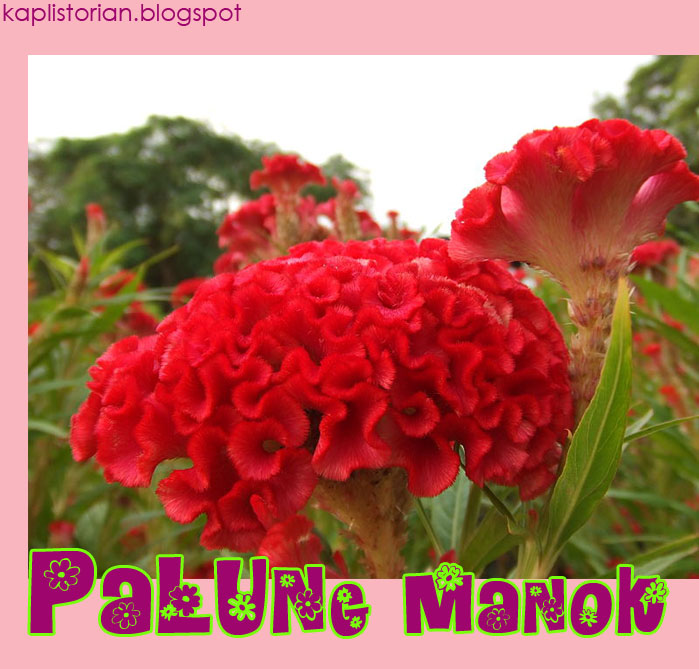
7. PALUNG-MANUK
Palung-manuk is a transliteration of the English name, Red Cockscomb (Celosia argentea L.) as the bright red flowers resemble the head of a rooster cock. Also called “palung-palung”, the attractive blooms are often strewn on top of tombs during All Saints’ Day.

8. PALUNAI
The beach sunflower (Wedelia biflora, Linn.) is known locally as “Palunai”or “palunag”,with numerous yellow or yellow-brown flowers. The roots are often used in the Philippines as diuretic or for the relief of stomach aches.

9. PANDAKAKI
The small, evergreen shrub is appropriately called  “Pandakaki” (Tabernaemontana pandacaqui). The plant has small 5-petalled flowers and is sometimes gathered from the wild, mainly for local medicinal use (e.g. to induce menstruation). The town of Mexico, Pampanga has a barangay named “Pandacaqui”.

10. PUKENDANG
The plant with a salacious name—“Pukendang”—has the same derivation as its Tagalog counterpart, Pukinggan or Pukingan, a variant term for a woman’s private parts. It has a more decent name in English--Blue Pea-- although its scientific name (Clitoria ternatea Linn.) is an explicit reference to its similarity to the female genitalia.

11. SAN FRANCISCO
Another common shrub used as an ornamental is the San Francisco or Croton (Codiaeum variegatum (L.) , that comes in a variety of shapes and colored foliage. The leaves can come twisted, or oblong, linear, pointed, but all are thick and leathery. Young leaves start out as green, yellow or red, later changing to single color or becomes variegated with bright color combinations. In other parts of the country, it is called Sagilala or Buenavista.

12. TUKOD-BANUA
This  herb known as Tukod-Banua (Amorphophallus paeoniifolius (Dennst.)  owes its name to its stem-like structure  that grows to more than a meter or more from its bulbous corm—hence, a tukod (a cane or a prop).  It is also called Pungapung or Apungapung in other regions, and Corpse Flower in English. That is the plant’s cluster of flowers (spadix) exude a bad odor that is often likened to the smell of rotting flesh.

 PHOTO CREDITS:
Balantakan: Wikimedia commons
Karakarikucha: Wikimedia commons
Mala-marine: Wikimedia commons
Palung-palung: Wikimedia commons
Palunai: http://www.stuartxchange.com/Hagonoi.html

Sunday, September 9, 2018

93. 12 MEMORABLE LINES FROM FAMOUS KAPAMPANGANS

From known Kapampangan personalities--quotable quotes that not only speak a lot about their character, but also serve to inspire, motivate, encourage, and sometimes, amuse and entertain, without really trying!
**********

A famous, oft-quoted Kapampangan boast uttered by an unknown Pampanga native, in reference to his unparalleled courage and bravery.

 Attributed to Ninoy’s widow who restored democracy to the Philippines and who would be swept  to power as the country’s first female president, in one of her interviews.

 In 2003, former Miss International Melanie Marquez delivered one of her infamous lines, when she defiantly defended her brother Joey Marquez against detractors who blamed and bashed him for his part in his failed marriage with media darling Kris Aquino. Her penchant for making these hilarious grammatical lapses have resulted in a book appropriately entitled “Melanisms”.

 Said by the Huk Supremo after Pres. Elpidio Quirino asked him if he was now ready to swear loyalty to the Philippine government, following his acceptance of an offer of amnesty.

 These words are attributed to the nameless “brave youth  from Macabebe”.  Miguel Lopez de Legazpi had sent feelers that he wanted to meet with the Macabebes who arrived in Tondo, with Lakandula as mediator. The young leader spurned him, as “ahe did not come to befriend the adelantado, but rather to fight him”. This led to the warrior’s valiant death in the battle of Bangkusay, as chronicled in Conquistas de las Islas de Filipinas 1565-1615.

 Dubbed as Gloriagate, the Hello Garci political scandal created an electoral crisis in the Philippines when, in June 2005, telephone conversations between GMA and Comelec commissioner Virgilio Garci were leaked to the public. Allegedly, Arroyo tried to sway the election results in her favor. An attempt to impeach her in the lower house was thwarted by GMA’s group, and she escaped trial. With a sad, contrite face, she eventually apologized to the country on TV. “I want to close this chapter.”, she ended.

 Last words of the convicted criminal before his death by electric chair on May 17, 1972. Jose, whose father is Dr.  and 3 others (Basilio Pineda, Jr., Eduardo Aquino, Rogelio Cañal) were found guilty of the kidnapping and rape of actess Maggie dela Riva on June 26, 1967.  His mother’s plea for mercy in Malacañang was not heeded. Jose was the son of a well-to-do doctor from Pampanga, Dr. Jose Jose.

 At the end of her popular 1980s weekly musical-variety show V.I.P.(Vilma in Person), the bubbly star would throw a flying a kiss and wave her hand as she shouts “I love you, Lucky!”.  Lucky happens to be the nickname of her son with Edu Manzano, Luis Philippe. “I love you,Lucky!” would become her trademark goodbye.

 Words of wisdom from the “poor boy from Lubao”, who would become the ninth President of the Philippines, serving from 1961 to 1965..

Pampanga’s most well-known hero addressed these words to his son after learning of his father’s impending execution by the Japanese, in May 2, 1942..


 Action star Mark Lapid, unleashed these words to Dick Israel in the Northeast Films’ “Apoy sa Dibdib ng Samar”. The cpmlete lines are: “ Oo, inaamin ko. Saging lang kami. Pero maghanap ka ng puso sa buong Pilipinas---sagin lang ang may puso! Buti pa ang saging, may puso!”

This powerful—and popular-- line has been quoted in countless speeches, inspirational talks and used in book titles and political collectibles, but Ninoy Aquino did not exactly state the line verbatim. It was actually a condensed version of a section in his 1980 speech in New York before the Asia Society where he said:  “I have carefully weighed the virtues and the faults of the Filipino and I have come to the conclusion that he is worth dying for because he is the nation’s greatest untapped resource.”

Monday, September 3, 2018

92. 24 SIGNIFICANT BOOKS ABOUT PAMPANGA YOU MUST KNOW, part II

Part II of the list of 24  Kapampangan books (no.s 13-24), essential reads for every Kapampangan who wants to know about aspects of our history, language, literatature geography, literature, and the lives of Pampanga's leading movers and shakers.
**********

13. BORN OF THE PEOPLE, by Luis Taruc. 1953. Published by International Publishers. Reprinted 1973.
Sugnificance: A must-read autobiography of the supremo of the Hukbalahap or Hukbong Bayan Laban sa Hapon group between 1942 and 1954. Luis Taruc became involved in the agrarian reform problems in the 1930s. He led his Huk guerrilla operations against the Japanese during World War II. of the Philippines. After the war, the Huks continued to clamor for agrarian reform, but which were unmet by th Roxas government. Though he and some colleagues were elected as congressmen, they were not allowed to take their seats. The  went back to the  hills to resume their armed struggle.


14. JUAN CRISOSTOMO SOTO AND THE PAMPANGAN DRAMA, by Juan S. Aguas. 1963. University of the Philippines, Q.C., reprinted, 2016.
Significance: This is a study on the life and works of the greatest Kapampangan writer Soto (1867-1918), with special reference to his masterpiece, “Alang Dios”. Adapted from the author's thesis from 1955. Soto’s literary output is unparalleled in volume and quantity: 50 plays, over 100 poems, scores of short stories, essays and novels. The verbal joust “Crissotan”, the counterpart of the Tagalog’s Balagtasan was named in his honor.


15. THE PAMPANGANS: Colonial Society in a Philippine Province. By John A. Larkin. 1972, University of California Press-Berkely.
Significance: The first book on Kapampangan colonial and social history that does not only treat the usual fare of historians, but also discusses the socio-economic aspects of Pampanga’s existence, including its problems—cash-crop economy driven by sugar, peasants’ unrest, politics, Chinese migration and inter-marriage with indigenous people. More surprising is that this well-researched book was written by an American, John Larkin from the State University of New York at Buffalo, who made his first trip to Pampanga in 1964. He was made an Honorary Kapampangan in 2017.


16. KAPAMPANGAN LITERATURE: A Historical Survey and Anthology, by Edna Zapanta-Manlapaz. 1981, Ateneo de Manila.
Significance: This is a pioneering study of the secular written literature of one of the country’s major language groups—Kapampangan. This volume, and  Rosalina Icban-Castro’s “Literature of the Pampangos” were the major references for kapmapngan literary works—in drama, poetry, and prose.


17. KAPAMPANGAN WRITING: A Selected Compendium and Critique, by Evangelina Hilario-Lacson. 1984, National Historic Commission.
Significance: A useful collection of selected Kapampangan writings, with much information on Pampanga writers and samplings of their works.


18. RECOLLECTIONS AND DIGRESSIONS, Renato Tayag. 1985. Philnabank Club, Manila.
Significance: A personal memoir and a local history book, rolled into one, written by the esteemed lawyer-journalist-writer  Katoks Tayag, an Angeleño. It includes a section on Pampanga and one article-- “The Vanishing Pampanga Nation” is a classic read. Of this book, Jose Luna Castro notes—“this is a meaty book the reader can bite with relish,,and to go with it is a sparkling wine of humor and wit”.


19. AN ANNOTATED PICTORIAL HISTORY OF CLARK AIR BASE, 1899-1986. David Rosmer. 1984. 13th Air Force Office of History, reprinted 1986. Fort Stotsenburg Historical Foundation.
Significance: A definitive reference book about the history of Clark Air Base—from its early beginnings as Camp Stotsenburg, to its modern-day version. The updated 1986 version encompases the ‘cataclysmic events of 1986” (Marcos’ ouster by the People Power Revolution). The book includes many rare photos of the base facilities from the extensive 13th Air Force history photograph collection, which were left and destroyed during the 1991 Pinatubo eruption.


20. THE NEPOMUCENOS OF ANGELES CITY AND THEIR RELATIVES, by Marco D. Nepomuceno. 1987. Published by the author.
Significance: A major work about Pampanga family history and genealogy, gathered from all recorded data and traditional sources, including the work of Mariano A. Henson—The Descendants of the Founders of Angeles (1966) which the author began updating in 1972. Vintage photos accompany the presentation of the Nepomuceno genealogy, organized in simple, easy-to-follow tables.


21. A SHAFT OF LIFE, by Rafaelita Hilario-Soriano. Printon Press. Q.C. 1996.
Significance: This is one of the few books that deal with the contributions of two Central Luzon revolutionary figures—Nueva Ecija’s Gen. Mariano Llanera and Pampanga’s Tiburcio Hilario, during the first and second phases of the Philippine Revolution, retold by the author who is a Hilario descendant.


22. COMFORT WOMAN, Slave of Destiny. By Maria Rosa Henson. 1996. Philippine Center for Investigative Journalism.
Significance: The first book about the ordeals of a comfort woman, personally written and illustrated by Maria Rosa Luna Henson, a Kapampangan . She burst into the national consciousness in 1992, when she broke half-a-century's silence to talk about her experience as ‘comfort woman’ in a World War II rape camp. Her story The book encouraged other women to come out with their own stories, belying earlier claims that the Japanese did not set up ‘comfort stations’ in the Philippines as they did in Korea, Taiwan and Indonesia.


23. PINATUBO: A VOLCANO IN OUR BACKYARD, by Robert P. Tantingco. 2011. Center for Kapampangan Studies, Holy Angel University.
Significance: The 20th anniversary of the Pinatubo eruption spurred the writing of this book which won a National Book Award from the Manila Critics Circle. The book  traces the terrible eruption in 1991, to aid us in appreciating not just any volcano, but this particular volcano, our Pinatubo. It equips us with the scientific basis for all that happened in 1991, but also rewards us with the unique experience of Kapampangans and the monster mountain in our midst.


24. AN INTRODUCTION TO KULITAN, The Indigenous Kapampangan Script. By Michael Raymon M. Pangilinan. 2012,  Center for Kapampangan Studies, Angeles City.
Significance: Kulitan or Súlat Kapampángan, the indigenous Kapampangan script, has found new followers among young people. This book is the perfect reference to understand the indigenous writing system and learn how to write it. It is a product of a life-long research of the writer, a known Kapampangan language expert. 

SOURCES:
Pinatubo, Kulitan: CKS Publications
Comfort Woman, R. Henson: www.mekeniland.blogspot.com
All other Book Covers: from the CKS Library

Saturday, August 25, 2018

91. 24 SIGNIFICANT BOOKS ABOUT PAMPANGA YOU MUST KNOW, part I

Books written about Pampanga, its people and culture, including its language, literature, history. Some of these books were written by foreigners, others by local writers, in Spanish, in English, and in Kapampangan— great reading essentials to know more about our province. Here are the first 12:
**********

1. VIDA DEL GLORIOSO S. NICOLAS, TRADUCIDA EN YDIOMA PAMPANGO, por el P.R Phelipe Tallada, del orden N.P.S. Agustin, el año de 1614. (Life of the Glorious Saint Nicolas, Translated in the Pampango Language by Rev. Fr. Felipe Tallada, of the order of St. Augustine, in the year 1614).
Significance: This is the first ever book published in Kapampangan, in 1614. It is a biography of the life of St. Nicholas, with prayers and reflections.


2. ARTE Y REGLA DE LA LENGUA PAMPANGA, Compuesto por el Padre Predicador  Fray Francisco Coronel y prior misionero del Convento de Macabebe, 1621. (Kapampangan Grammar and Rules, by Fr. Francisco Coronel, prior of Macabebe, ca, 1621)
Significance: The earliest Kapampangan grammar and rule book in existence.  In 2005, it also became the first Kapampangan grammar book from that period to be transcribed, translated  and annotated in English, by Fr. Edilberto V. Santos. The book still contains the original text with a parallel English translation.


3. VOCABULARIO DE PAMPANGO EN ROMANCE Y DICCIONARIO DE ROMANCE EN PAMPANGO, by Fray Diego Bergaño, first published in 1732, reprinted 1860, 1916.
Significance: This Kapampangan dictionary and glossary book of over 5,177 Kapampangan word entries by the Augustinian priest Bergaño represent not just one of the earliest extant studies of our language, but also probably, the most scholarly and comprehensive. A translated English version was published by the Center for Kapampangan Studies in 2007, along with a Bergaño’s companion grammar book, “Arte de la Lengua Pampanga”, first published in 1729.


4. EJERCISIO COTIDIANO, by Dña. Luisa Gonzaga de Leon, ca. 1844.
(Book of Daily Devotions)
Significance:  Ejercisio Cotidiano (Daily Devotions) is a book of prayers, meditations and reflections, written by Bacolor-born Luisa Gonzaga de Leon (b.1805/d.1843),  printed in Spanish in 1844. This makes her the first Filipino woman to publish a book. In 1910, the book was translated into Kapampangan.


5. ING MACUYAD A PAMAGSALITA DIQUIL QÑG BIE NANG DELANAN AT PANĞATIMAUAN NING METUNG A MEBIJAG. By Fernando Garcia OSA. Published 1900. Imprenta del Colegio de Sto. Tomas. (Translated as “An Epistle of a Friar-Prisoner”, by Lino L. Dizon, 2007).
Significance: A rare account of the captivity of an Augustinian priest, P. Fernando Garcia OSA, written by the Spaniard himself in Kapampangan,  during during the Philippine revolution. It includes accounts of his “sorties from town to town and provinces” as prisoner and missionary at the turn of the century. His observations were critical of the treatment religious received from the revolucionarios. He escaped in Bontoc, reached Manila to write about his trials and tribulations as a POW.


6. GONZALO DE CORDOBA, Comedia Heroica de la Conquista de Granada o sea Vida de Don Gonzalo de Cordova, Llamado el Gran Capitan. By Fr. Anselmo Jorge Fajardo, ca. 1830s. published 1912, by Cornelio Pabalán y Byron. (Heroic Comedy of the Conquest of Granada or The Life of Don Gonzalo de Cordova, Called the Great Captain)
Significance: The longest comedia (also called “moro-moro”) in Philippine literature, the play about the exploits of Capt. Cordoba took seven nights to perform, as the lines alone numbered 31,000. When published, the book was 832 pages long. No wonder, it was only published once, over a century ago.

7. NAPUN, NGENI’T BUKAS, by Aurelio Tolentino. “Ing dramang ‘Napun, Ngeni’t Bukas’ kesukul ne ning ginawa at meatulan king apat a kasalanang sedicion, conspiracion, rebellion at insureccion laban king gobierno Americano”. 1914, Limbagang Noli. (The drama Yesterday, Today and Tomorrow caused the writer to be jailed and charged with 4 crimes: sedition, conspiracy, rebellion and insurrection against the American government).
Significance: This is Tolentino’s play first staged to a jampacked crowd in 1903 at Teatro Libertad. A key scene called for one Tagalog performer to bring down the American flag and then trample it, but the actor froze when he saw Americans in the audience. Tolentino ascended the stage and did the act himself. He was found guilty of “scurrilous libel’ for desecrating the Stars and Stripes,  and was imprisoned.


8. A CHILD OF SORROW. A Novel by Zoilo M. Galang. 1921.
Significance: The first novel in English written by a Filipino. The novel-- was made into a movie in 1930. Zoilo Galang of Bacolor, also was an encyclopedist, who put together the 10-vlume “Encyclopedia of the Philippines” published in 1934-36.


9. HISTORIA NING FILIPINAS. By Santiago Mallari. 1933 (History of the Philippines)
Significance: This slim volume is the first comprehensive Philippine history book in the Kapampangan language. It also has an account of the battle exploits and death of Tarik Soliman, the boy warrior of Macabebe. The book also devotes a section on the  Kalantiao code in Kapampangan, which has since been debunked.


10. PAMPANGA DIRECTORY, Agricultural, Commercial, Industrial, and Professional Guidebook of the Province of Pampanga, The Richest Market Outside Manila. Vol.I, by Manuel David, Managing Editor. 1933.
Significance: This limited edition book, published to commemorate the holding of the 1933 Pampanga Carnival and Exposition, gives us a snapshot of the province in the area of agriculture, commerce, and industries, etc.  during the peacetime era.  All 21 municipalities of the province are represented here, including history, key people, geographical info, products,  among others.


11. NINU’T NINU QNG CAPAMPANGAN, Bilungan Dang Bie ding Anac nang Carangalan Ning Lalawigan Capampangan, by Faustino Gutierrez. 1934 , Catimawan Press.(Who's Who in Pampanga.,  A Compendium of the Lives of the Honorable Children of Pampanga Province).
 Significance: The limited edition book contains photos and brief biographical entries of the leading personalities, families, movers and shakers of Pampanga during the Commonwealth years.


12. A BRIEF HISTORY OF THE TOWN OF ANGELES (From its Foundation in 1796 A.D. to the Present), and his other Writings. By Mariano A.Henson. 1948, Katiwala Press.
Significance: For decades, this was the only widely-referenced published book on the history of Angeles town (reprinted 2002), written by Angeles’ venerable historian and genealogist. His major opus— “The History of Pampanga and its Towns” (rev. 1965)–remains in typewritten and mimeographed form—and continues to be consulted by Kapampangan scholars.

SOURCES:
Singsing Magazine, various issues, Center for Kapampangan Studies, HAU.
Dizon, Lino L. The Epistle of a Friar-Prisoner, as written by F. Fernando Garcia OSA, Center for Kapampangan Studies, HAU.
A Child of Sorrow: http://thessalythea.blogspot.com/2015/07/a-child-of-sorrow-biographical-analysis.html
Historia ning Filipinas, Pampanga Directory, Gonzalo de Cordoba, Napun, Ngeni't Bukas: Alex R. Castro Collection

Wednesday, August 15, 2018

90. 17 KAPAMPANGAN AMBASSADORS WHO HEADED EMBASSIES

An ambassador is, technically, is a career diplomat or political appointee who holds rank of Chief of Mission I or II, nominated and confirmed as Ambassador Extraordinary and Plenipotentiary who heads diplomatic missions in Philippine embassies worldwide. (Diplomats of same rank or lower rank who serve as consuls general in embassies or consulates or Chargé d’Affaires in embassies are not included here).
*****


1. H.E. JOSE M. ALEJANDRINO (Arayat). Ambassador to Spain and Italy.
Jose Medina Alejandrino comes from the prominent Alejandrinos of Arayat town that includes his namesake, revolutionist and senator, Gen. Jose Magdangal Alejandrino. A U.P. Law graduate, he placed 10th in the 1934 bar. Alejandrino organized the workers of Pambusco and Pasudeco into labor unions. He was sent as a scholar to the U.S. Department of State and went home to top the foreign service exams in the U.S. Rising through the ranks, he became an ambassador to Spain and Italy. The lawyer-diplomat counts Gen. Charles de Gaulle of France as a close friend.


2. H.E. LIBRADO CAYCO (Sta. Rita).  Ambassador to the Netherlands.
Ambassador Cayco(b.1912/d.2009), from Sta. Rita, was a Political Advisor with the Philippine Mission to the UN. He later served as Consul of the Philippines at New York and served as the Philippine ambassador to the Netherlands from 1962-1963,  He was the leader of the Philippines delegation to the Ministerial Meeting of the Southeast Asian Treaty Organization in 1965.


3. H.E. VICENTE I. SINGIAN (San Fernando). Ambassador to Belgium and Luxembourg.
In 1964, the Philippine established formal ties with the European community on 12 May 1964. Amb. Vicente Singian, of San Fernando was first assigned as First Secretary and Consul in Great Britain in 1954. Subsequently, he was named as the Head of Mission of Belgium and Luxembourg from 1964 to 1971.


4. H.E. AMELITO R. MUTUC (Arayat). Ambassador to the United States.
Amelito Ramirez Mutuc attended Arayat Institute, then topped his high school in Guagua. He earned his Associate in Arts (valedictorian) and completed his law degree in 1942 at Ateneo de Manila (salutatorian). In 1957, Mutuc caught the eye of then congressman, Diosdado P. Macapagal, who hired him as consultant for his candidacy as VP of the Philippines. Mutuc launched “Macapagal for Vice President Movement”, and from thereon, became the future president’s right hand man. When Macapagal was elected as President in  1962, he named Mutuc as his Executive Secretary.That same year, he was appointed as Ambassador to the United States, serving in Washington D.C. from 1962-1964. He died in 1994.


5. H.E. ROGELIO L. DE LA ROSA (Lubao). Ambassador to Sri Lanka, Cambodia, The Hague.
The golden boy of Philippine cinema, Regidor La Rosa began his political career when as elected Senator in 1955. He could have been our first movie star president had he continued his run for Presidency in 1961. Dela Rosa withdrew his candidacy to give way to his brother-in-law, Diosdado Macapagal  who eventually was elected Philippine president. De la Rosa was rewarded with an ambassadorial position in Cambodia in 1965. During the Marcos years, de la Rosa was  named ambassador to the The Hague, Netherlands, and to the Soviet bloc countries of Poland, Bulgaria and Czechoslovakia. His last  post was Sri Lanka. He died on 10 Nov. 1986.


6. H.E. CARLOS J. VALDES (Bacolor). Ambassador to Japan
The distinguished son of Bacolor, Carlos J. Valdes (b. 1919/d. )  finished commerce from La Salle College, and Law from the Far Eastern University in 1949, on scholarships. He also taught at Holy University, in Angeles. Valdes then opened a successful  Law and Accountancy firms with many high profile clients in the business world. Valdes became a member of the Constitutional Assembly in 1971,he served as  ambassador to Japan from 1978-1986.


7. H.E. RAFAELITA HILARIO-SORIANO (Bacolor). Ambassador to Israel.
Dr. Rafaelita Hilario-Soriano’s (b.2 Jul. 1915/d. 1 Jan2007) was the child of  eminent jurist and politician Zoilo J. Hilario of Bacolor  with Trinidad Vasquez. After finishing a political science degree from the Philippine Women’s University in 1936, Soriano won a Barbour Scholarship at the University of Michigan. Returning in 1948, she forayed into another career path—Foreign Affairs. She was named as a Chairman of the Information, Culture, Education and Labor Activities Committee of the SEATO and as Sec.-General of the SEATO Council of Minister’s Meeting in 1970. This led to her being named as an Ambassador Extraordinary and Plenipotentiary to Israel.


8. H.E. BIENVENIDO L. TAN JR. (Bacolor). Ambassador to Germany,1989
Amb. Tan has roots in Bacolor, being the grandson of Don Gonzalo Arceo Tan, a financier of the Revolution. His parents were Judge Bienvenido Tan, Sr. and Salome Limgenco. Tan became an outstanding public servant and headed the BIR during Pres. Corazon Aquino’s term. In 1989, he was named Ambassador to Germany. The late Sister Mary Christine Tan is his sibling.


9. H.E. RUPERTO M. DIZON (Magalang). Ambassador to Jordan
When the Philippines reopened ties with Jordan in 1998, Ruperto Dizon became the  Philippine Ambassador Extraordinary and Plenipotentiary to the Hashemite Kingdom.The Philippines also decided to re-open its Embassy in Amman in recognition of the critical role that Jordan continues to play in regional and international affairs, especially in the Middle East Peace Process. Dizon was also tasked with the care and concerns of the growing number of Overseas Filipino Workers in Jordan. Amb. Dizon served as Consul general at the Philippine Consul General in New York. Upon retirement, he was  given the Distinguished Service Award in New York on 27 Sep. 2012.


10. H. E. LEONCIO R. PARUNGAO JR. (Arayat). Ambassador to Palau
Prior to becoming an ambassador, Leoncio Parungao held a corporate job in public relations at the Central Bank. The accomplished Parungao finished Journalism from Far Eastern University in 1952, and was a Ten Outstanding Young Men Awardee for Public Service in 1964. He served as Press Secretary of the first President Macapagal at the very young age of 31. From 1998- 2004, he was the Philippine ambassador to the Republic of Palau. In 2012, he  was conferred the Distinguished Service Award by DFA.


11. H.E. LAURA QUIAMBAO-DEL ROSARIO (Angeles City).  Ambassador to India and Vietnam.
Amb.Laura Del Rosario holds an A.B Litt. Degree from Maryknoll (1968) and her M.A. in Education from the University of the Philippines (1975). She was commissioned as a career Foreign Service Officer in 1979, and was assigned to Singapore.  She was the country’s senior official at the Asia Pacific Economic Cooperation (APEC) forum.  She was appointed the Alternate Philippine Permanent Representative to the UN in Vienna, and served as Ambassador to India, Nepal (non-resident) and Vietnam.She retired as Undersecretary for International Economic Relations, one of the highest positions in the Foreign Service.


12. H.E. VESTA R. CUYUGAN (San Fernando). Ambassador to New Zealand
Amb. Vesta Roque Cuyugan was the 4th  Philippine ambassador to New Zealand, serving there from 1993-1996. She was coaxed out of her retirement by the Ramos government to head Philippine foreign affairs office in Taiwan (since the Philippines does not have diplomatic relations with Taiwan ) towards the end of the president’s term.


13. H.E. LEONIDA L. VERA (Sasmuan). Ambassador to the Holy See (Vatican)
Leonida Laki Vera served as Ambassador of the Philippines to the Holy See (Vatican), replacing Amb. Francisco Alba who retired in 2003. She had previously worked for the United Nations Development Fund for Women and religious organizations, such as Caritas Manila, Council of Laity of Manila, Children Rosary Movement, and Paraclete Foundation. An accounting graduate of UST, Amb.Vera is a recipient of the Dame of the Pontifical Order of St. Sylvester and St. Gregory in 1994 and 1998, respectively. She quit her post in 2008.  She was a Most Outstanding Kapampangan Awardee for Government Service in 2014.


14. H.E.  JERRILL G. SANTOS (San Fernando). Ambassador to Vietnam
Jerril G. Santos of San Fernando is the current Chief of Mission of the Philippine Embassy in Vietnam which he assumed in 2009. With the Department of Foreign Affairs since the 1980s, Amb. Santos has served several presidents as chief of Presidential Protocol and is now Consul general of the newly opened Philippine Consulate General in Houston. His awards include:  Gawad Mabini, with a rank of Dakilang Kasugo (2007),  the Order of Sikatuna, with a rank of Datu (2009) and honored as among the Outstanding Fernandinos in 2012


15. H.E. MA. CONSUELO PUYAT-REYES (Guagua). Ambassador to Chile.
Consuelo Puyat is the daughter of Deogracias Puyat, a son of industrialist Gonzalo Puyat from Guagua. Her mother is Patria Gil. She served as the Ambassador Extraordinary and Plenipotentiary to Chile, based in Santiago. Lito Puyat, a name associated with Philippine basketball, is her brother.


16. H.E. MERCEDES REINARES –ARRASTIA TUASON (Lubao).  Ambassador to the Holy See (Vatican)
Maria Mercedes Reinares y Arrastia-Tuason (b. Sep. 27, 1930) is an alumnus of St. Scholastica in Manila. She is known for her work in the Red Cross and her pro-life activism. She was appointed ambassador plenipotentiary to the Holy See in 2009. In May 23, 2012, Pope Benedict XVI awarded Tuason the Grand Cross of Merit for the title Order of Pius IX due to her charitable and diplomatic services to the Catholic Church, a coveted title that was not granted to women until November 1993. She is a 2016 Outstanding Kapampangan Awardee in Government Service.


17. H.E. ELIZABETH P. BUENSUCESO (San Fernando). Norway, Denmark, Iceland , ASEAN
H.E. Elizabeth P. Buensuceso is a  Permanent Representative (PR) of the Philippines to ASEAN, based in Jakarta. Prior to her appointment, Amb. Buensuceso was the Assistant Secretary of the Office of European Affairs-DFA (2011-2013), the Ambassador  to Norway, Denmark, and Iceland (2008-2011), and Lao PDR (2004-2008). She is the third  Philippines’ Permanent Representative to ASEAN. Her mother, a Pineda, is from San Fernando. The ambassador speaks the Kapampangan language.
.
SOURCES:
MANY THANKS TO Acting Asst. for Public Diplomacy-DFA MR. ELMER G. CATO for providing the updates.
Bienvenido l. Tan Jr.: Leo Suryadinata, editor. Southeast Asian Personalities of Chinese Descent: A Biographical Dictionary . Institute of Southeast Asian Studies, Singapore, 2012.
Philippine Government Directory, Diplomatic Post Publishing Corporation, 2000      
Rogelio dela Rosa, Rafaelita Hilario, Amelito Mutuc: www.viewsfromthepampang.blogspot.com
Vesta Cuyugan: The Pampangans, by R. Hilario. Info c/o: Mr. Roberto Magat