Monday, October 15, 2018

97. 10 LAMAN LABUAD (EARTH CREATURES) OF PAMPANGA

by Robby P. Tantingco
Here's a catalog of ghouls and goblins (laman labuad, "earth creatures," the opposite of heavenly spirits) that terrorized our Kapampangan ancestors:
********
 PATIANAK, small dark creatures that lived underground, in remote spots marked by termite mounds. Passers-by had to say "Makilabas ku pu!" or "Itábi po, puera nunu!" (“May I pass?" or "Please go away, I hope there is no old dwarf here!”) The word patianak did not come from the Tagalog tiyanak, but from the Bahasa pontianak, the ghost of a stillborn baby. Thus, Kapampangans thought them to be the souls of unbaptized children, who tormented women during childbirth and harassed immoral people (like unchaste priests and unfaithful husbands).


MANGKUKUTUD, the Kapampangan version of the manananggal, whose torso detached from the rest of the body to fly in the night in search of cadavers to eat. This is the reason we never leave our dead unattended, or the mangkukutud would steal the corpse, slice the flesh and cook it. This creature laid eggs like hens do, and people who took these eggs by mistake and cracked them open would be shocked to find a nose, fingers, eyeballs and other body parts inside. The magkukutud got its name from the ancient Kapampangan word kutud, "to cut."


MANGKUKUSINU, the Kapampangan version of the mangkukulam, only much more evil. He could inflict pain on a person even from a great distance, magically able to put poison, a metal object or even a live chicken inside his victim's body, causing extreme suffering.


KULARIUT, a dark, elusive creature with a long white beard who lived in bamboo groves and forests, perched on branches or rooftops quietly watching people while they slept in their rooms. Not too long ago a theater group depicted kulariut as the restless ghost of an American soldier, Col. Elliott.


MANGLILILI, an invisible entity who caused disorientation in solitary travelers, making them lose their way in deep forests and mountains. Poor travelers would spend hours, even days, trying to find their way back. People living at the foot of Mount Arayat have experienced being led astray by a beautiful lady for what seemed to be only hours but turn out to be actually months and years.


MAGLALAGE was the generic term for ghosts, or spirits of the dead stranded on earth because of an unfinished business.


ASWANG was a mean, dark creature who rubbed a special ointment on his armpits to fly in search of the dying instead of the already dead.


MANGUANG ANAK, fast-running agents of an unseen evil person or spirit who kidnapped children off the streets and took them to a faraway place where they were bled to death and their blood sold and used in minting coins (old folks thought dipping coins in blood was part of the minting process and coins did taste like blood). When I was a kid we called them Ilonggot, and I remember seeing one apprehended by the police and tortured before a big crowd in front of the municipio.


BINANGUNAN, vampirish beings that could suck the blood of children even from a distance. Thin, anemic children were thought to be victimized by a binangunan. Research must be made if this word is related to the name of the town Binangonan, Rizal.


KAPRI, "10 to 15 feet tall, very black and wearing a long black coat, had long arms, long beard, a long cane which he used to knock the heads of people, and always had a long cigar in his mouth." He appeared at night during a slight drizzle, staying under a large tree or squatting on its branches or sometimes dangling his legs.” The kapri imagery probably originated from black Africans who worked as slaves for Spaniards; Bergaño referred to these tall, dark-skilled slaves as "cafre" in his 1732 dictionary (from the Muslim derogatory term kafir, or heathen).

(An elaborate description of these Kapampangan beliefs circa 1900 can be found in accounts compiled by ethnographer H. Otley Beyer, in an unpublished volume at the HAU Center for Kapampangan Studies courtesy of Beyer’s family.)

PHOTO SOURCES:
PATIANAK: Illustration by Mike Fernando
MANGKUKUTUD: Filipino Heritage, V
MAGLALAGE, ASWANG: Haunted Times, Issue 2, Fall 2009
KAPRI: Jbl Tayag FB page

Tuesday, October 9, 2018

96. 18 NOTABLE KAPAMPANGAN DOCTORS BORN BEFORE 1900, part II


DR. LIBORIO P. GOMEZ, Sto. Tomas
(b. 23 Jul. 1887/ d.1958 )
Born to Magdaleno and Catalina Pineda, the future pathologist, medical educator, and scientist has an impressive background. As a pensionado in 1903, he was sent to the U.S. to study at Pomona College, University of Missouri,  From there, he earned a doctorate degree of Philosophy in  Pathology and Physiology at the University of Chicago, and a medical degree from the Rush Medical College. At the Bureau of Science, he studied Bacteriology for 7 years, and his expertise enabled him to become the Head of the Department of Pathology and Bacteriology of the said bureau. In 1953,  he was coaced from retirement to help establish the Dept. of Pathology and Microbiology of the newly-organized medical school,  FEU-Dr. Nicanor Reyes Medical Foundation.  Dr. Gomez headed this department as its chairman and professor until his death.


DR. JULIAN D. DYCAICO, Angeles
(b. 17 Oct. 1888/ d. 11 Mar. 1965 )
The noted physician-surgeon of Angeles was the son of Jose and Rufina Dayrit. He studied at the Philippine Normal School (1906-09), and at the UP College of Liberal Arts ( 1909-11). He went on to earn his Doctor of Medicine degree at the U.P. College of Medicine and Surgery in 1914. After his internship at the Philippine general Hospital, he went into private practice in 1915. Dr. Dycaico was elected councilor of Angeles, and was  connected with the beginnings of Holy Angel Academy in 1933,as its first school physician and comptroller.


DR. RUFINO ABRIOL, Arayat
(b. 7 Apr. 1890/ d. 19? )
Dr. Abriol holds the distinction of being elected President of the Philippine Islands Medical Association (1935-36) and Chairman of the Board of Examiners, in his time. The U.P.-educated doctor also became a Fellow of the American Medical Society, as well as a member of both Manila and Pampanga Medical Association. Dr. Abriol garnered the highest rating for the Medical Board Examination in 19 13. He went to Johns Hopkins University for further studies in Public Health. Dr. Abriol, married to Rosa Reyes, was also a member of the faculty of Medicine, University of the Philippines.


DR. BASILIO J.VALDES, Floridablanca
(b. 10 July 1892/d. 26 Jan. 1970)
Though he resided mostly in Manila, Basilio José Segundo Pica Valdés was born in the Floridablanca hacienda of his father, Dr. Benito Salvador Valdes, who was married to Filomena Pica. Influenced by his father, he took up Medicine at the University of Santo Tomas and graduated with honors in 1916. Immediately, he plunged headlong into medical service, treating all his patients with respect and fairness, and adapting a personal motto—“Audaces Fortuna Juvat”—Fortune helps the brave. He joined the French Army as a medical volunteer, followed by a stint at the U.S. Army as a surgeon from 1917-1919. When he returned to the Philippines, he became a medical inspector for the Philippine Constabulary for 8 years (1926-1934). Pres. Manuel L. Quezon appointed him as Chief of Staff of the Philippine Constabulary and Philippine Army in 1939, elevating his rank to a general (he would rise to become a Brigadier General). Two years later, Basilio was appointed as Secretary of National Defense. During the Japanese period, he served under Pres. Jose P. Laurel as Secretary of Public Works. In the 1950s, he headed the family’s Hacienda del Carmen in Floridablanca, Pampanga, which is now known as barrio Valdes.


DR. WENCESLAO B. VITUG, Lubao
(b. 28 Sep. 1892/d. 7 Jan. 1986)
The son of Esteban and Juana Beltran, thefutur doctor went to local schools in Lubao and San Fernando, and finished at Pampanga High School. He earned his medical degree from the University of the Philippines in 1918, where he also taught after. He became a visiting physician of the Philippine General Hospital, where his expertise and skill became very much known. This was how the doctor met his future wife, Juanita Arrastia, Miss Pampanga of 1926, who accompanied her mother to PGH for her check-up, and who happened to be Dr. Vitug’s patient. The couple settled in Lubao, had 5 children, and became hacenderos. The Vitugs eventually moved to Manila.


DR. DALMACIO SONGCO, Guagua
(B.24 Sep. 1895/ d.19 ?)
Dr. Songco spent 4 years at the Escuela de Bellas Artes, then moved to the University of Santo Tomas for his medical degree which he finished in 1926. His education was paid for by Bulaqueño philanthropist, Dr. Felix de Leon. The artist-doctor made news when his exhibits at the Pampanga pavilion during the 1920 Manila Carnival were seized by the police. His framed artworks—which showed paintings of Philippine paper currency from one pesos to 500 pesos—were deemed as counterfeit.  Through the intercession of Gov. Honorio Ventura and Don Pablo Angeles David, all charges were dropped against Dr. Songco. During the great Philippine cholera epidemic of 1926, he volunteered to help at the San Lazaro Hospital. He also had a stint at the San Juan de Dios Hospital., eventually serving as president of the Sanitary Divisions of Cebu and Bataan. Dr. Songco married Julia Sanchez of Porac in 1917.


DR. RAFAEL L.  TEOPACO, San Fernando
(b. 24 Oct. 1896/d. ?)
The son of Jose and Albina Limjuco, the distinguished doctor began his early studies at the San Fernando Elementary School, then enrolled at the National University and the University of the Philippines. He took his internship at the Loyola University, training at the St. Mar Hospital, Chicago. From there, he visited the leading clinics of Europe. He placed 3rd at the medical board exams ( 86% ) in 1928, and also placed 3rd in the exams for Senior Surgeons (83%). Dr. Teopaco served at the Bontoc Provincial Hospital (1928), Baguio Hospital (1929), and as Director of the Pampanga Provincial Hospital in 1931. He is married to Demetria Genuino.


DR. CASTOR T. SURLA, Angeles
(b. 26 Mar. 1897/ d. ?)
Betis-born Surla, whose parents were Castor Sr. and Paula Tizon, relocated to Angeles for his schooling and stayed there permanently. He finished medicine at the University of Sto. Tomas in 1918, and took his residency at the San Juan de Dios Hospital. He likewise taught at the Escuela de Enfermeras in 1919 and headed the Ntra. Sra. Del Pilar Hospital in Zamboanga until 1920. In 1921, he became a longtime instructor at his alma mater, UST, teaching abdominal surgery and genito-urinary diseases.


DR. EMIGDIO C. CRUZ, Arayat
(b. 5 Aug. 1898-d. 1978)
Emigdio was born from the union of Jacinto Cruz, a Malabon rice trader and Andrea Castor, a Portuguese-Filipina from Candaba. His father, an ‘herbolario’ in Arayat, encouraged his children to take up science courses.  Indeed, 3 sons (Emigdio, Vicente and Cecilio) would become doctors. Emigdio himself, went to U.P., finishing Medicine only in 1929, at a rather late age of 31. After becoming one of the board topnotchers, he practiced in Arayat where he would meet his wife, Restituta Roque. Dr. Cruz is credited as the founder of Arayat General Hospital which he would serve as its medical director from 1935-38. He joined the Army and became a Captain of the Medical Corps in 1939.  As a result, he became Pres. Quezon's personal physician, whom he joined in exile in the U.S., until the president’s death. In 1946, he returned to the country with the Quezon family. Dr. Cruz is the recipient of the Philippine Congressional Medal of Valor and Distinguished Service Cross for his valiant WWII underground work.


Wednesday, October 3, 2018

95. 18 NOTABLE KAPAMPANGAN DOCTORS BORN BEFORE 1900, part I

The list of Kapampangan doctors of distinction is long, so we cover first those born at the turn of the 19th century. Their legacies of service to humankind through their medical expertise,  skills,  involvement in community and national affairs plus their personal qualities, are still remembered by a grateful province today. Here are the first 9: 

**********

DR. FRANCISCO T. LIONGSON, Bacolor
(b. 3 Dec. 1869/d. 20 Feb. 1919)
The doctor who would go on to become a Pampanga governor and the first Kapampangan senator was born to Emigdio Liongson and Eulalia Tongio. After earning his Bachelor of Arts from Letran, he sailed to Spain in 1889 to study medicine at the Universidad Central de Madrid,. There, he obtained his degree in Medicine and Surgery 1894, and his doctorate the next year. He further trained in different Paris hospitals like the renowned Pasteur Institute. Exposed to Filipino propagandists in Spain, he began to take interest in the country’s current state and future. He returned to the Philippines with his Spanish wife, Ma. Doloroes Alonso in late 1895.  When the Revolution broke, Dr. Liongson  joined the Katipunan as a doctor with the rank of a captain. With the coming of Americans, he continued his fight for the country, becoming one of the founding fathers of the Nacionalista Party. In 1912, he ran for the governorship of Pampanga and won. His term was marked with peace and prosperity. The highlight of his political career was his election as the first Kapampangan senator in 1916.


DR. GREGORIO T.  SIÑGIAN, San Fernando
(b. 9 May 1872/d. 29 Jan. 1937 )
Born to Cristino and Angela Torres, the young Gregorio went to a private school in San Fernando, then finished high school at Colegio de San Juan de Letran. He took up Medicine at the University of Sto. Tomas in March 1896. In 1907, Dr. Singian was appointed as the first Filipino associate professor of surgery in the Philippine Medical School, which later became the U.P. College of Medicine. He gained renown as a surgeon, so much so that he was known as “mago de bisturi” (wizard of the scalpel), earning him the title of “Father of Philippine Surgery”.  He became the Director of the San Juan de Dios Hospital in 1920 and founded the Philippine College of Surgeons in 1936.


DR. VICENTE H. PANLILIO, Mexico
(b. 19 Jul. 1872/d.19 ?)
The Letran graduate, son of Antonio and Luisa Hizon, proceeded to the University of Sto. Tomas to pursue Medicine which he finished in 1895. The next year,  he went to Barcelona, Spain for advanced studies. He finished his doctorate in Medicine in 1901. Returning to the Philippines in 1902, he put up a private practice in Mexico where he became the town’s ‘doctor de sanidad’.  Dr. Panlilio moved to San Fernando permanently in 1906, and became a physician for the Manila Railroad Co. until 1925. He also forayed into business and politics, becoming a director of PASUDECO as well as a  2-term councilor of the capital town. He married the patriot Nicolas Dayrit.


DR. JACOBO P. FAJARDO, Bacolor
(b. 25 July 1876/d. 23 July 1941)
This distinguished physician, surgeon and public health pioneer was born to Justino and Andrea Puno of Bacolor. After the Revolution where he served as aide-de-camp to Gen. Emilio Aguinaldo, he went to the University of Santo Tomas where he finished a degree in medicine in 1905.  While still in school, he married Antonio Jacinto in 1900. He served as president of the Municipal Board of Health of Arayat, Pampanga, then assigned to assigned to Negros Oriental, Pangasinan and Mindanao as district health officer. As deputy in the Philippine Assembly (1909-12),  he authored the Fajardo Bill in 1912, that was the basis for the organization and efficient administration of public health services in the country. Dr. Fajardo was appointed Director of Bureau of Health (now DOH) in 1924. He was the first Filipino doctor to receive a Rockefeller grant that allowed him to travel to the USA and Europe, as part of his public health research.


DR. FELINO D. SIMPAO, Guagua
(b. 1 Jun. 1880/ d. 1954)
Born to Serapio and Epifania del Rosario, Dr. Simpao was schooled in Letran in 1896, and proceeded to the U.P., and then to Asilo de Huerfanos in Malabon in 1898. During the Revolution, he served as 1st lieutenant of Gen. Tomas Mascardo.  After the war, he enrolled at UST for his medical licentiate in 1909. As a doctor, he joined the Bureau of Sanitation, and appointed medico provincial of La Union, Pangasinan, Leyte (where he founded its provincial hospital), Cavite and Sorsogon. He also worked as a volunteer doctor at the San Lazaro Hospital during the cholera epidemic in Manila. The multi-facetted physician, who was also a poet-playwright,  wrote for several papers like “E Mangabiran”, “Ing Balen”, “Ing Catimawan”, “El Ideal” and “El Renacimiento”. From 1910-12, Dr. Simpao served as the Mayor of Guagua. During his term, the school central, the market, and the Pampanga Pavilion for the 1909 Manila Carnival were all built under his supervision. He was one of the founders of Pampanga’s Nacionalista Party. Dr. Simpao  ran for the governorship of Pampanga but was beaten by another doctor--Francisco Liongson.


DR. CLEMENTE N. PUNO, Bacolor
(b. 23 Nov. 1881/ d.19? )
The child of Eugenio and Patricia Nuqui, he went to Colegio de Letran for his high school years (1895-98), and then to the University of Sto. Tomas (1901-05) for his medical course. Dr. Puno had his own private practice in Candaba and Guagua, and became the president of the Sanitary Division of Guagua, Bacolor and Sta. Rita. Married to Beatriz Concepcion, Dr. Puno was a member of the Colegio Medico Farmaceutico de Filipinas and the Pampanga Medical Association.


DR. FERNANDO S, GONZALEZ, Apalit
(b. 6 Nov. 1884/d. 19? )
This medico cirujano from Apalit, born to Joaquin and Florencia Sioco, attended Letran before enrolling at the Colegio de Farmacia y Medicina, of the UST from 1901-07. He taught English, Physiology and Hygiene at the Instituto de Burgos in 1907. He then practiced in Candaba until 1914, before joining the government service beginning in 1914 to 1928.  During this period, he became the district health officer of San Luis, Candaba, Arayat, Apalit and San Simon. He was also assigned in La Union, the  Rizal, Cavite and Bataan. Dr. Gonzalez then returned to serve Pampanga from 1919-1927.  He is also an active member of several associations of scientific history in America and the Philippines.


DR. GERVACIO SANTOS CUYUGAN, San Fernando
(b. 19 June 1886/ d. 1 Jun. 1968)
Dr. Gervacio Santos-Cuyugan, born to Florencio and Juana Cuyugan, became a U.S. government scholar after his studies at Liceo de Manila. As a pensionado, he and hs contemporary, Jose Abad Santos, was sent to the University of Illinois to take up Medicine from 1905-1910. Upon his return, he started as a Junior Health Inspector at the Bureau of health in 1911, and worked his way up to become a Senior Surgeon at the Philippine General Hospital. In 1913, he taught Surgery at the University of the Philippines. In 1918, Dr. Santos-Cuyugan became a Major and Adjutant of the Surgeon General of the National Guard. The next year, he went into private practice after his marriage to Jacinta Belza. He was later appointed Director of the Tayabas General Hospital. His daughter is  the opera singer, Fides Cuyugan.


DR. ABELARDO O. LANSANG, Sta. Rita
(b. 9 Jul. 1887/ d. 19? )
The young Abelardo was sent to the Ateneo de Manila by his parents, Arcadio and Manuela Ocampo, where he earned a Bachelor of Arts degree in 1901.  He finished Medicine at the University of Sto. Tomas in 1914, went into private practice, then became a resident physician at SanJuan de Dios Hospital from 1921-25. Dr. Lansang dabbled in politics and was elected as a town councilor. His wife, Efigenia Lansang, bore him 5 children.

SOURCES:
NINU'T NINU QNG CAPAMPANGAN, 1934, Fajardo & Kabigting
www.viewsfromthpampang.blogspot.com

Saturday, September 22, 2018

94. 12 GARDEN PLANTS AND FLOWERS AND THEIR KAPAMPANGAN NAMES

1. ALAS DIES
There are at least 3 flowering plants in the Philippines with names derived from the “hours of the day” that refer their peak blooming time. There is an Alas Cuatro (4 o’clock), Alas Dose (12 noon) and the ubiquitous Alas Diyes (10 o’clock, Portulaca grandiflora) that is propagated easily, and can grow to cover a garden patch. The bright pink flowers open before noon, and they wither quickly .

2. BALANTAKAN
The Biblical character who suffered a series of life’s misfortunes  gave his name this tall, grain bearing tropical plant—Job’s Tears (KatikbiCoix lacryma-jobi L.). It is known to both tagalogs and Kapampangans as “Balantakan”. As an ornamental plant, the balantakan has capsule-shaped fruit that enclose fruits are capsules, enclosing the female flowers. 

3. BUAK NANG ESTER
This silver gray, hair-like epiphytic bromeliad is often found hanging in wire pots in rural gardens, or grows on tree limbs with lengths of 2 meters or longer. Known to the estern world as Spanish moss (Tillandsia usneoides Linn.), it is fancifully called “Buak nang Ester” (Ester’s Hair).The plant inspired the great writer Aurelio Tolentino (1858-1915) to write the 1911 novel, “Ing Buac nang Ester”

4. KAMANTIGI
Kamantigi (Impatiens balsamina Linn.) are common Southeast Asian plants with flowers that can come in pink, white, red, lilac, mauve colors. These flowers also have medicinal properties, used as poultice to cool bruises or painful areas. In English, it also goes by the name “Touch Me Not”.

5. KARA-KARIKUCHA
The small, deciduous Karakarikucha tree (Plumeria acuminata W. T. Ait.) is known as kalachuchi in Tagalog, and frangipani or temple flower in English. It is characterized by dark green oblong leaves and large, fragrant white petalled flowers with yellow inner lower portion. Flowers are often strubg through the rib of coconut leaves (tingting) for quick, decorative fixes.

6. MALA-MARINE
The thorny Mala-marine (Mimosa pudica)  get its name from "pudica",Latin word for “shy or bashful”.  Called “makahiya” by Tagalogs, the low-growing, creeping flowering plant has small leaflets arranged in pairs that fold inwards together upon stimulation by touch, shaken, warmed or blown by the wind. In cultivation, the mala-marine plant is often grown as an indoor annual, but is also grown for ground cover.

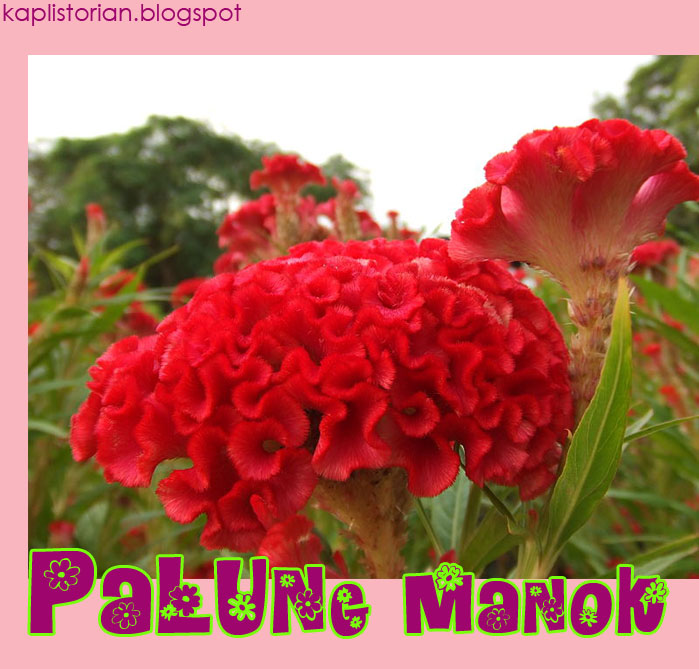
7. PALUNG-MANUK
Palung-manuk is a transliteration of the English name, Red Cockscomb (Celosia argentea L.) as the bright red flowers resemble the head of a rooster cock. Also called “palung-palung”, the attractive blooms are often strewn on top of tombs during All Saints’ Day.

8. PALUNAI
The beach sunflower (Wedelia biflora, Linn.) is known locally as “Palunai”or “palunag”,with numerous yellow or yellow-brown flowers. The roots are often used in the Philippines as diuretic or for the relief of stomach aches.

9. PANDAKAKI
The small, evergreen shrub is appropriately called  “Pandakaki” (Tabernaemontana pandacaqui). The plant has small 5-petalled flowers and is sometimes gathered from the wild, mainly for local medicinal use (e.g. to induce menstruation). The town of Mexico, Pampanga has a barangay named “Pandacaqui”.

10. PUKENDANG
The plant with a salacious name—“Pukendang”—has the same derivation as its Tagalog counterpart, Pukinggan or Pukingan, a variant term for a woman’s private parts. It has a more decent name in English--Blue Pea-- although its scientific name (Clitoria ternatea Linn.) is an explicit reference to its similarity to the female genitalia.

11. SAN FRANCISCO
Another common shrub used as an ornamental is the San Francisco or Croton (Codiaeum variegatum (L.) , that comes in a variety of shapes and colored foliage. The leaves can come twisted, or oblong, linear, pointed, but all are thick and leathery. Young leaves start out as green, yellow or red, later changing to single color or becomes variegated with bright color combinations. In other parts of the country, it is called Sagilala or Buenavista.

12. TUKOD-BANUA
This  herb known as Tukod-Banua (Amorphophallus paeoniifolius (Dennst.)  owes its name to its stem-like structure  that grows to more than a meter or more from its bulbous corm—hence, a tukod (a cane or a prop).  It is also called Pungapung or Apungapung in other regions, and Corpse Flower in English. That is the plant’s cluster of flowers (spadix) exude a bad odor that is often likened to the smell of rotting flesh.

 PHOTO CREDITS:
Balantakan: Wikimedia commons
Karakarikucha: Wikimedia commons
Mala-marine: Wikimedia commons
Palung-palung: Wikimedia commons
Palunai: http://www.stuartxchange.com/Hagonoi.html

Sunday, September 9, 2018

93. 12 MEMORABLE LINES FROM FAMOUS KAPAMPANGANS

From known Kapampangan personalities--quotable quotes that not only speak a lot about their character, but also serve to inspire, motivate, encourage, and sometimes, amuse and entertain, without really trying!
**********

A famous, oft-quoted Kapampangan boast uttered by an unknown Pampanga native, in reference to his unparalleled courage and bravery.

 Attributed to Ninoy’s widow who restored democracy to the Philippines and who would be swept  to power as the country’s first female president, in one of her interviews.

 In 2003, former Miss International Melanie Marquez delivered one of her infamous lines, when she defiantly defended her brother Joey Marquez against detractors who blamed and bashed him for his part in his failed marriage with media darling Kris Aquino. Her penchant for making these hilarious grammatical lapses have resulted in a book appropriately entitled “Melanisms”.

 Said by the Huk Supremo after Pres. Elpidio Quirino asked him if he was now ready to swear loyalty to the Philippine government, following his acceptance of an offer of amnesty.

 These words are attributed to the nameless “brave youth  from Macabebe”.  Miguel Lopez de Legazpi had sent feelers that he wanted to meet with the Macabebes who arrived in Tondo, with Lakandula as mediator. The young leader spurned him, as “ahe did not come to befriend the adelantado, but rather to fight him”. This led to the warrior’s valiant death in the battle of Bangkusay, as chronicled in Conquistas de las Islas de Filipinas 1565-1615.

 Dubbed as Gloriagate, the Hello Garci political scandal created an electoral crisis in the Philippines when, in June 2005, telephone conversations between GMA and Comelec commissioner Virgilio Garci were leaked to the public. Allegedly, Arroyo tried to sway the election results in her favor. An attempt to impeach her in the lower house was thwarted by GMA’s group, and she escaped trial. With a sad, contrite face, she eventually apologized to the country on TV. “I want to close this chapter.”, she ended.

 Last words of the convicted criminal before his death by electric chair on May 17, 1972. Jose, whose father is Dr.  and 3 others (Basilio Pineda, Jr., Eduardo Aquino, Rogelio Cañal) were found guilty of the kidnapping and rape of actess Maggie dela Riva on June 26, 1967.  His mother’s plea for mercy in Malacañang was not heeded. Jose was the son of a well-to-do doctor from Pampanga, Dr. Jose Jose.

 At the end of her popular 1980s weekly musical-variety show V.I.P.(Vilma in Person), the bubbly star would throw a flying a kiss and wave her hand as she shouts “I love you, Lucky!”.  Lucky happens to be the nickname of her son with Edu Manzano, Luis Philippe. “I love you,Lucky!” would become her trademark goodbye.

 Words of wisdom from the “poor boy from Lubao”, who would become the ninth President of the Philippines, serving from 1961 to 1965..

Pampanga’s most well-known hero addressed these words to his son after learning of his father’s impending execution by the Japanese, in May 2, 1942..


 Action star Mark Lapid, unleashed these words to Dick Israel in the Northeast Films’ “Apoy sa Dibdib ng Samar”. The cpmlete lines are: “ Oo, inaamin ko. Saging lang kami. Pero maghanap ka ng puso sa buong Pilipinas---sagin lang ang may puso! Buti pa ang saging, may puso!”

This powerful—and popular-- line has been quoted in countless speeches, inspirational talks and used in book titles and political collectibles, but Ninoy Aquino did not exactly state the line verbatim. It was actually a condensed version of a section in his 1980 speech in New York before the Asia Society where he said:  “I have carefully weighed the virtues and the faults of the Filipino and I have come to the conclusion that he is worth dying for because he is the nation’s greatest untapped resource.”