Sunday, April 28, 2019

108. 11 INFLUENTIAL KAPAMPANGAN RADIO PERSONALITIES

Radio, as a new communication medium officially came to the Philippines in 1922 when a test broadcast was made by a Mrs. Redgrave from Nichols Air Field using a 5-watt transmitter. Early broadcasting was a strictly an American affair until the 1930s when local songs and program, started to be heard from KZIB, KZRH and KZRG Stations. In this new medium, the Kapampangan voice found its place, and our kabalens who animated the airwaves became welcome presences in every home with a transistor-- disseminating news, dispensing advice, making commentaries or simply spinning music to the avid listener.
**********

MILA BALATBAT (Sta. Ana)
Mila Balatbat, who started her radio career at age 15, found great success by becoming a successful independent producer of programs (a‘blocktimer’) heard on DZRH, DZBB, DZAQ, DZMY,  PBS (Philippine Broadcasting Service) and Eagle Broadcasting Corp.  She was the host of such programs as “Mila Balatbat’s Radio Stars”, “Let’s Go Shopping with Mila” (DZBB, 1960-1962).


ANGELO CASTRO SR. (Tarlac)
One of the earliest peronalities to join the radio bandwagon was Angelo Ruiz Castro of Tarlac. A brother of former chief justice Fred Ruiz Castro, Angelo joined Manila Broadcasting Company at Insular Life Bldg. and was known as the “Good Time King”. In 1946, he became the chief announcer of Station KZOK. Under Pres. Carlos P. Garcia, he headed the Radio Department of the Office of the Press Secretary. Angelo’s sons, Angelo Castro Jr.(husband of June Keithley) and Naldie also became announcers


ANGELO Y. CASTRO JR. (Tarlac)
The checkered career of Angelo Y. Castro Jr. (b.6 Mar. 1945/ d. 5 Apr. 2012) includes being the anchor of ABS-CBN’s “The World Tonight” (with Loren Legarda), broadcast journalist, news manager (1986, ABS-CBN) and TV/ Film actor (Bong in “Baltic & Co,). For ANC, he hosted the travel show Las Islas Filipinas. Retired in 2009 after being diagnosed with lung cancer, he continued his anchoring duties together with Teddy Boy Locsin and Tina Monzon-Palma on ‘The World Tonight”. Married to the late TV and radio personality, June Keithley, with whom he had 2 children, Diego  and Gabriella.


BEN DAVID
The King of Over-Acting, Ben David, was born as Bienvenido Parungao, the 4th of 8 children of Enrique Parungao and Raymunda David, both Kapampangans. Baritone-voiced Ben made his presence felt with his overly dramatic signature quips: “Oh, hindeeee!”and “Hangaaal!”. He became  an announcer for DZAQin 1966, an apt host for the program ,”Ginoong Mananakot”. In 1967, he became an announcer for ABS-CBN. He produced and directed “Dear Kuya Cesar”, and disc-jockeyed for “Patrolman OA”. David also broke into the movies, debuting in “Ismol bat Teribol” , a 1957 comedy from Sampaguita Pictures. He was cast in “Da Best Show”, “Tang-Tarang-Tang”and “Buhay Artista”. His most famous character role is playing Hudas Iscariote to    the hilt.


MINDA FELICIANO (Guagua)
Arminda “Minda” Feliciano (1 June, 1931) was the daughter of Manuel Valdez Feliciano, a district engineer, and Amparo Santana of Batanes. Before she became an international jetsetter, Feliciano had a brief career with radio in 1956, specifically on DZFM. She had auditioned for a single slot with Eddie Mercado and Johnny Wilson. But big boss Koko Trinidad wanted all 3 of them, so he offered all 3 to share the Php120 a month salary. Surprisingly, all three agreed. The arrangement was great for awhile, but eventually the 3 broke up ,and Feliciano moved to DZMB.with a hefty salary of Php150 monthy, plus 30 pesos add-on talent fee. The pretty announcer then moved to the U.S., to pursue an acting career. She snagged a role in the popular TV series,”Hawaiian Eye”, of Warner Brothers. Her world trips led to a chance meeting with actor Michael Caine. The two were soon engaged, but nothing came out of their affair. Feliciano was also linked with singer Tony Bennett, but a more lasting relationship was formed  with Norman John McClintock Lonsdale, an English blue blood, whom she wed in 1997.


REY LANGIT
Reynante "Rey" Magat Langit (b. 30 Sept. 20, 1948) is known for his public service radio programs that served mostly overseas Filipino workers. With his bombastic announcing style, Langit became well-known for remaining on air for 2 straight days during the People Power revolution. The multi-awarded broadcaster was the Station Manager of the AM Radio station DWIZ 882 kHz. and vice president of Aliw Broadcasting Corporation until 2016, disrupted by a foiled senatorial bid in 2016. After over 2 decades at DWIZ, he joined  PTV as anchor of programs "Insider Exclusive Kapihan" "Kasangga Mo ang Langit" and "Balitang Tanghali". He is producer of TV and radio shows under his  Heavenly Images Productions. A son,Reyster, also became a journalist, but died of cerebral malaria while on assignment in Palawan in 2005.


CESAR NUCUM (Candaba)
The eldest of Kapampangan Aurelio and Romaman Nucum, Cesar Nucum  (15 May 1938-d. 17 May 2007) was a balut vendor and bote’t dyaryo dealer before he auditioned in Manila to become an announcer. He got a job at DZRM, only to be pirated by ABS-CBN. For his narrative program “Mga Kasaysayan sa Likod ng Langit”, he evolved thestyle of Eddie Ilarde, developing it into his signature snail-paced, monotonous delivery.Thus, “Kuya Cesar”was born., a personal used in his radio shows “Dear Kuya Cesar” and “Ikaw sa Likod ng mga Awit”. His career lasted for many decades,  halted temporarily in 1972 during Martial Law. In the many programs he hosted, Kuya Cesar gave out advice, played music, spoke in tagalog and Eglish—always in his deep, distinctive slow-paced manner.


PERRY PANGAN (Mabalacat)
The quintessential voice of Pampanga,  Fernando “Perry” Pangan. He is the seasoned voice and station manager of RW 95.1 FM that was put up in the province at the height of the lahar inundation, where he reported the most accurate information of the state of Pampanga towns. Under his helm, RW 95.1 FM rose to become one of the most respected, and most awarded radio stations in the province. In 2011, the radio station  RW 95.1 FM was selected as the country’s Best Provincial FM Radio Station. A skilled commentator and public affairs host, he heads the “Talakayan  Ngayon” with Boy Santiago and Albert Lacanlale, Son Chester Pangan became a broadcaster at the age of 19 for a rival station, GV 99.1 FM and a TV personality on Channel 3 in Angeles City, Philippines. He now hosts a morning show on radio in Winnipeg, Canada.


ORLY PUNZALAN (Minalin)
The 1960s also saw the rise of a former seminarian from Minalin as the quintessential voice of news and current events. Orly Punzalan took the bus to Manila and auditioned for DZFM as a newscaster for the Department of National Defense. He passed the auditions and got a starting salary of 30 pesos a week, working with the likes of Jose Mari Avellana, Joonee Gamboa and Tita Muñoz. Making the transition to TV, he became a booth announcer for Channel 3 where he met and married Helen Vela.


JOE TARUC (Gapan)
Gapan-born  Jose Malgapo Taruc, Jr. (b.18 Sep. 1946/d/ 30 Sep. 2017) ranks as  one of the most popular and most followed news anchor on DZRH, in which he was also the station’s senior vice president. He anchored the longest-running public affairs program “Pangunahing Balita” and  “Damdaming Bayan”, often heard interviewing high-profile politicians, including the president. Best remembered for his trailblazing role in ABS-CBN DZAQ Radyo Patrol before  Martial Law, Taruc also worked in tandem with  Dely Magpayo and Noli de Castro in a KBS morning program. from , then joined DZBB Bisig Bayan 594 (later, Super Radyo) , until his transfer in 1991 to DZRH. Taruc’s son, Jay Taruc is well-known TV documentarist.


RAFAEL YABUT (Candaba)
The most influential radio personality from radio’s golden years is Rafael “Paeng” Yabut of Candaba. Growing up in Tondo, he started as a commercial reader for blocktimer Luz Mat Castro. During the Japanese occupation, he became an announcer at Star Theater along Azcarraga. After Liberation, he became a barker for “Atomic Bomb”, a honky tonk place along Rizal Avenue.In the late 1940s, he was offered by Hal Bowie, General Manager of MBC to do a daily Tagalog program called “Tayo’y Mag-aliw”. But instead of providing entertainment, he made stinging news commentaries against certain characters in the government. His program drew not only high listenership but also friends and foes alike. By 1957, Yabut had accumulated so much pulling power at DZRH that he was urged to run for president in 1957 against Carlos P. Garcia. Instead, he endorsed Manuel Manahan, then shifted to Jose Yulo. Both lost. For his political meddling, Yabut was suspended from his broadcast work, leaving behind his high-rating programs like "Ruleta Musikal", "Tatlo Lamang", "Gumising sa Pagsikat ng Araw". His most serious brush with death was when he was ambushed by a gunman after his tirades against Philippine Charity Sweepstakes. He recuperated, joined DZFM, but by then his credibility was in tatters. After the People Power revolution, he joined DZBB, only to be assigned the graveyard shift. Not long after that, Paeng Yabut died

SOURCES:
Aniceto, Ben. Stay Tuned: The Golden Years of Philippines Radio. A Historical Perspective of Philippine Radio—its Beginnings, its Golden Years and its Suppression in Sepetmeber 1972.Atlas Publishing Co., Inc. Quezon City. © 2007
Rafael Yabut Photo: Castro, Alex R.  viewsfromthepampang.blogspot, “Pilot of the Airwaves”
Angelo Castro Jr. Photo: rappler.com
Minda Feliciano Photo: wikimedia commons
Rey Langit Photo: wikimedia commons
Cesar Numcum Photo: FB page
Perry Pangan photo: https://www.rw951.fm/about.html
 Orly Punzalan Photo:
https://www.gmanetwork.com/news/publicaffairs/tunaynabuhay/507134/primera-kontrabida-ng-90s-na-si-princess-punzalan-ikukuwento-ang-kaniyang-tunay-na-buhay/story/
All others:Aniceto, Ben. Stay Tuned: The Golden Years of Philippines Radio. A Historical Perspective of Philippine Radio

Monday, March 18, 2019

107. 16 OLD NAMES OF PAMPANGA TOWNS


The early Kapampangan settlements as found by Spaniards, and the early pueblos that they organized were known by ancient, local names---far different from the names of today’s modern municipalities and cities. Either derived from plants and trees, or from their distinctive natural features and location, many of these names are hardly remembered by young Kapampangans today.
**********

1. CANDAUE (Candaba)
Candaba originally had an older variant name—Candaue, Candawe—which refers to a place where the municipal cemetery is now located. In old maps, the ancient settlement was marked as “Candave”, “Candava”, and eventually localized to “Candaba”. Already a rich settlement in 1571, it also has one of the oldest barrios in the province—Mandasig—founded by Mandic, the wife and first cousin of Malangsic, one of the children of Prince Balagtas, as related in the 1539 will of Pansomun.


2. PÚRAC (Porac)
“Púrac”or “Pórag” was how the name of Porac was pronounced in the 1850s. “Púrac” was a flowering rattan plant (Calamus curag) which must have grown and proliferated in the area, now known as Porac.


3. BACULUD (Bacolor)
The town known for its people of arts, literature and culture was called “Baculud”, from the word “macabaculud”, an upland surrounded by low-lying lands—which refers to Lubao.  Its name has the same etymological origin as the city of Bacolod.  Founded in 1571, “Bacolor” is the Hispanic name of this former capital of Pampanga.


4. BALAYAN NING PAMBUÍT (Arayat)
Before the coming of the Spaniards, the town was called by its ancient name “Balayan ning Pambuit”, then located at barrio Palinlang (or Paglinglang), as the  poblacion was still forested. In vernacular, the place was originally called “dayat”, which means ‘an irrigated riceland or seedbed. Its most visible landmark is Bunduk Alaya (from ‘paralaya”, thus,  eastern mountain).


5. MASICÚ (Mexico)
Before it was christened as Mexico in 1577, the place was called “Masicu”—and pronounced that way-- which may been derived from the “síko fruits” (chicos) that supposedly grew in the area, hence, “ma-sicu”. Another version had it that the town was “elbowing other towns”—hence, “macasicu”. In any case, the name was Romanized to “Mexico”, before the replacement of ‘X” with “J”, after the 19th century.


6. WAWÂ (Guagua)
The ancient prosperous town was originally called in “Wawâ”, which means “the mouth of a river”, based on its location. The spelling was Hispanized into “Guagua”in 1590, in much the same way that the “wa” of Palawan was written in old Spanish maps as “Paragua”.


7. PINPÍN (Santa Ana)
The ancient name of Santa Ana is “Pinpin” (variations: Pimping, Pingping, Pimpin) after an important person who may have lived during the time of Malangsíc. It was then placed under the advocation of Santa Ana when the Spaniards came, a name the town adopted.


8. BABÂ (Lubao)
“Babâ” is Kapampangan for “low”, in contrast to “baculud”. “Lubao” or “tubao”, is an extinct word meaning “to arise, or emerge, or float from water” (its modern form is the dipthong “gatao” or “gato”, to float) . “Babâ Lubao” thus means “to rise from the low depths of the water”. Old residents still refer to themselves as “tau cu Babâ”.


9. SANTA RITA DE LELE (Santa Rita)
As a neighbor of the major town of Bacolor to where residents would go for their daily marketing and commercial transactions, the town was known as “Sta. Rita de Lele”.  It was also called “Sta. Rita Baculud”.


10. SASMOAN (Sexmoan)
Sasmuan was written on maps for over a century as “Sexmoan”, the Spanish transcription of the old town’s name, until 1991, when it reverted back to its vernacular version—Sasmuan. “Sasmoan” means “a place of convergence”, a meeting place where Kapampangans met when they were waging war with the Chinese. The sexual connotation of Sexmoan in English prompted the municipal government to return to the old name.


11. CABAGSÁC (San Luis)
“Cabagsác” was the former name of the town of San Luis, a contraction of “cabág bagsac” , or “bagsácan cabag”, which means “ a drop-off place of  fruit bats”. The name was extended to “San Nicolas Cabagsác”, to honor its Spanish Augustinian priest, Fray Nicolas de Orduño.


12. VIRGEN DEL PILAR (San Simon)
Tradition has it that the former name of an Simon town was “Virgen del Pilar”, its titular patroness whose fiesta is celebrated every October 12. It is also to honor the memory of its founder, Mariano del Pilar.


13. BALIWAG (Santo Tomas)
The traditional name of Santo Tomas is “Baliwag”, a new town in 1773. It is derived from the term “maliwag”,someone prone to habitual tardiness. It was rechristend Santo Tomas in 1792.


14. CULIÁT (Angeles)
The town was inaugurated in 1829, and was given two names by its founder, Don Angel Pantaleon de Miranda: ‘Culiat’, a woody vine (Gnetum indicum Lour.) that grew in abundance in the area cleared by his tenants and future residents of the place. Another name given was “Angeles” in honor of the ‘Los Santos Angeles Custodios” (Holy Guardian Angels), titular patrons of the town, and of the founder himself. Only oldtimers use Culiat nowadays; to modern-day residents, Angeles is preferred, as it has a more cosmopolitan ring for a city.


15. SAN MIGUEL (Masantol)
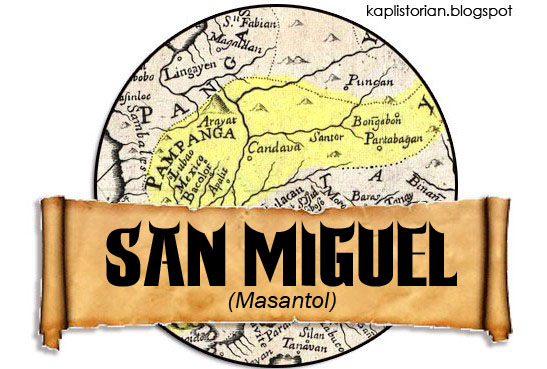
Masantol used to be a barrio of Macabebe, as recorded in the 1853 census. It was known as San Miguel, formed from the Macabebe barrios of Bebe, Bulacus, Caingin and Nigui sometime in 1877 or 1878. It was renamed Masantol, meaning  “a place full of santol (Sandoricum koetjape Merr.) fruit trees” after 1903.


16. CAUMPAUI (Floridablanca)
Before the town was named either after the count of Floridablanca, Jose Moniño (1728-1803) or the white pandacaqui flower, there was a certain place called “Caumpaui” existing in the area in 1847, that was established earlier by Spanish missionaries as a “hacienda” and administered from Lubao. It was transferred to the new town in 1867. Floridablanca is considered as Pampanga’s youngest town,

SOURCE:
Henson, Mariano. The Province of Pampanga and its Towns(A.D.1300-1962)

Saturday, March 2, 2019

106. 12 SIGNIFICANT EVENTS THAT HAPPENED IN CLARK

Clark Air Base’s history is intertwined with the history of the Philippines since that fateful day when the United States established its presence at the turn of the 20th century—1902 to be exact--that was to last a hundred years. Here are some significant moments that happened in “Pampanga’s piece of America”.
********


THE BOMBING OF CLARK, 8 December 1941
After the attack of Pearl Harbor by the Japanese forces, airstrikes against the U.S. were planned  on its military bases in the Pacific to prevent intervention of the the Far East Force (FEAF). Also, the capture of the Philippines was necessary to control the shipping routes between Japan and Greater East Asia Co-Prosperity Sphere, which consisted of Japan-occupied countries during World War II. At Takao Naval Air Base, 27 Mitsubishi G4M Type 1 land attack bombers  of the Takao Kokutai took off  on 8 December 1945, at 9:30 a.m. with Clark Field as their target. At 12 noon, Clark Field received warning of the approaching airstrike. Thirty five minutes later, 53 Japanese bombers dropped down bombs on Clark Field, followed by the Zero pilots descending to strafe the field thoroughly. While a few American P-40’s were airborne, they could not provide counter attacks as they were poorly positioned.  Twelve of Clark Field’s seventeen   B-17 planes were destroyed, while 34 P-40s were destroyed on the ground and in aerial combat.
Earlier, 11 B-17s had been flown to safety to Mindanao before the attack, while 2 remained unscathed as they were on reconnaissance missions. The American forces regained Clark Filed on 31 January 1945.


THE FATAL CRASH OF PILOT CAPT. COLIN P. KELLY. 10 December 1941
 Capt. Colin Purdie Kelly Jr. (b. 11 July 1915/10 Dec. 1941) was a B-17 pilot who died in action against the Japanese forces in 1941. The Madiosn, Florida native was a West Point 1937 graduate  how as the first Army officer to fly the Boeing Flying Fortress in the Far East. On 10 Dec. 1941, Kelly took off from Clark Field in his B-17 plane with his bombardier, Sgt. Meyer Levin, to engage the Japanese in a bombing run. He managed to damage the Japanese cruiser Natori. Returning to Clark,  the Tainan Air Group A16Ms that were patrolling Vigan followed Kally’s plane and attacked it. Nearig Clark, his damaged aircract caught fire. Kelly ordered his crew to bail out but the plane blew up, killing him. Capt. Kelly was declared America’s first hero of WWII by US President Franklin D. Roosevelt. He was posthumously awarded the Distinguished Service Cross For "extraordinary heroism" and "selfless bravery". The Kelly Theater in Clark, converted from an old gymnasium in 1947 was named after him. A memorial statue of the hero was inaugurated on the Kelly Theater grounds on 10 Dec. 2007—the 66th year of his passing.


PRES. MANUEL A. ROXAS DIES IN CLARK, 15 April 1948
On 15 April 1948, upon the invitation from Maj. Gen. E. L. Eubank, Pres. Manuel A. Roxas, along with Sen. Pres. Jose Avelino, Speaker Eugenio Perez and Gen. Rafael Jalandoni, visited Clark Air Base. His tour was capped by a speech he delivered at the Kelly Theater. He felt faint after his speech, and so he was talen to the residence of Maj. Gen. Eubank to rest. It turned out that his condition was a prelude to a series of heart attacks that led to his death at 9:23 in the evening. The president’s body was brought to Manila the following day on a special train that reeached Malacañang at 9:20 a.m.


CLARK AS A LOGISTICS HUB DURING THE VIETNAM WAR, 1964-75
During the second phase of the Cold War, Clark grew into a major American air base, serving as an important logistics hub during the 20 year Vietnam War. Clark joined the war effort in March 1964; its  KC-135 tankers refuelled fighters enroute to Laos. Injured American soldiers were evacuated and flown weekly from the Saigon airport to Clark Air Base, to be treated or operated on at the Clark Air Base Hospital. Touted as “Asia’s Military Medical Center” when it opened in 1964, the hospital was the savior of thousands of American military men and their families, recognized for its exceptional medical services and treatment of soldiers. At the height of the War, 70% of the patients at the Clark hospital were soldiers who sustained varying degrees of injuries in the battlefields. The Clark Air Base mortuary also served as the place for the processing of Vietnam War casualties,  headed by a mortuary officer, who help ensured the dignified transfer of the body to a team of military personnel for conveyance to the port mortuary and finally to his family. In 1975, after the end of the ground combat, Clark Air Base was also used for the massive evacuation of Vietnamese orphan children, dubbed as   Operation Babylift. The operation expanded to include evacuation of adult refugees from Saigon, Phnom Penh, and Vientiane, and the humanitarian effort became known as “Operation New Life”.


BOB HOPE’S USO SHOWS IN CLARK AIR BASE, 1966, 1967, 1972, 1987
From 1964 to 1972, the famous stand-up comic Bob Hope entertained U.S. troops in Southeast Asia, in his annual Christmas USO (United Services Organization) shows. The one-man moral booster machine took his shows to Vietnam, Laos, Guam, Thailand. Diego Garcia, Wake Island, and Clark Air Base in the Philippines, which he described as the “Country Club of the Pacific”. In January 1966, Hope arrived in Clark and was welcomed by the base commander Lt. Gen. James Wilson. His show that year featured Phyllis Diller, Chris Noel, Joey Heaherton and regulars Les Brown and his Band of Renown. By Christmas 1967, the number of American military in Vietnam had reached almost 500,000, resulting in massive crowds  and making Hope’s appearances even more important for boosting morale. He was welcomed by gen. Benjamin O. Davis in Clark where his shows featured Raquel Welch , Barbara McNair, Phil Crosby and Miss World, Madeleine Hartog Bell. His last stop in Clark was for his 1987 USO show which was taped for TV entitled “'Bob Hope`s USO Christmas from the Persian Gulf-Around the World in Eight Days”.   Guests included Barbara Eden, Lee Greenwood and Connie Stevens.


POWs HOMECOMING,  12 February  1973
In 1968, RichardM.Nixon was elected as the new U.S. president and he began move to end the conflict in Vietnam. The number of American forces in Southeast Asia was also substantially reduced. His policy was to give continued support to non-communist SEA  countries, while lessening military presence in the areas. One immediate U.S. demand to North Vietnam was for the full release of American POWs and an accurate accounting of  servicemen missing or killed in action. It was in 1972 that an agreement was reached for the repatriation of prisoners, and Clark Air Base as designated as the point of the POWs return from Hanoi.  “Operation Homecoming” thus began on 12 February 1972 when  a C-141A Starlifter transport jet took off from Hanoi and the first flight of 40 U.S. prisoners of wars began their journey home. Arriving at Clark at around 4:15 P.M., the POWs returned to a hero’s welcome, received by Adm. Noel Gayler, Commander-in-Chief of the Pacific Command; Lt.  Gen. William G. Moore, 13th  Air Force Commander; and Air Force Sr. Master Sgt. Homer E. Henderson, Joint Information Bureau Asst. Non-comm. O-I-C. A second group followed on February 18, until all the 591 POWs were returned home by late March 1973. On 6 April 1975, the Clark Air Base Peace Garden was dedicated to the memory of those who died or were declared "missing in action" in Southeast Asia.


THE PHILIPPINE ADMINISTRATION OF CLARK AIR BASE, 7 January 1979
A pivotal period in Clark Air Base history began in the year 1979, when the government of the Philippines began assuming administration of the Asia’s biggest American military base. When the revised 1947 Military Bases Agreement was ratified on January 7, it was put into effect immediately and on February 16,  the command and security command and security of Clark and other American bases was officially turned over to to the Philippine government. The size of the Clark reservation was also trimmed from 156,204 acres to 131,000 acres, while the base size remained the same at 9155 acres. On March 25, Clark's third major labor strike occurred.


PRES. FERDINAND MARCOS FLEES THE COUNTRY VIA CLARK, 25 February 1986
When the People Power street rallies turned into a nationwide revolution, the desperate Marcos called the office of the U.S. president, and managed to talk to Senator Paul Laxalt. He asked the senator if the State Department’s advice for him to step down was valid, further asking if there was a way for him to share power with Mrs. Cory Aquino, whom he beat by rigging the snap elections. When Sen. Laxalt told him it was time “to cut and cut cleanly”, the embattled Marcos agreed to give up the presidency to avert further violence and possible bloodbath. Marcos was given a safe passage with helicopters from Clark Air Base's 31 ARRS picking him up at his Presidential palace, and flying him to the Clark airport. There, he and his retinue transferred to a C-9A and were flown first to Guam’s Hickam Air Force Base enroute to Hawaii


FILIPINO EMPLOYEES’ STRIKES ROCK CLARK, 1971, 1983,  22 March 1986
The first time that Filipino employees went on strike in Clark was when they stage a walk-out on 3 March 1971. This came a time when ant-American sentiments was at its most high. The strike was ended after 3 days, but only 4 months later, on July 25,  a bigger strike followed that lasted for 25 days. Another strike happened in October 1983, when thousands of Filipino workers went on indefinite strike today over demands for wage increases. Pres. Reign was due to visit that year, but the trip was called off. But the most serious civilian employees strike was stage on 22 March 1986. Thousands of Filipino workers  blockaded the gates of both Clark and Subic on 25 March in a


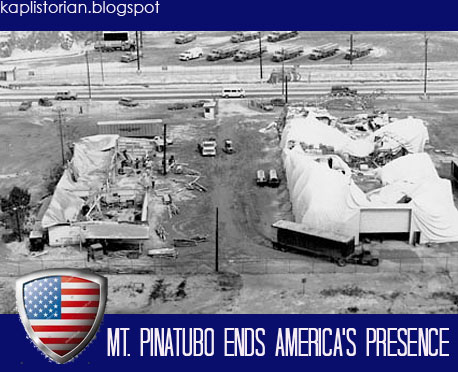
MT. PINATUBO ERUPTION ENDS AMERICA’S PRESENCE IN CLARK
As early as April, pilot in Clark have reported seeing ominous smoke emanating from Mount Pinatubo, a volcano that has not erupted in 500 years. When it was clar that an eruption was imminent, Clark mounted a massive evacuation  of 15,000 U.S. personnel and their dependents on June 10. The major June 12 eruption dumped tons of ash on Clark.  But another eruption in June 15, exacerbated by passing typhoon Yunya, further cause massive damages, and all but buried the military base in a sea of ash, mud, pyroclastic materials and lahar. About 2,500 servicemen and women stayed on to provide security and try to maintain basic services. Meanwhile, the extension of the Military Bases Agreement was rejected by the Philippine Senate, and was due to expire on September 16. Driven by budgetary realities (it would tae $500 million to rehabilitate Pinatubo-damaged Clark)  and nature's explosive whims, the U.S. did not renegotiate anymore and agreed to leave Clark Air Base in 1992 but keep the sprawling Subic Bay Naval Base for 10 more years. The U.S. Air Force formally transferred entire Clark to the Philippines on 26 November 1991, ending its 100 years in the Philippines. On 24 November 1997, the last U.S. forces left the Philippines.


THE CLARK AIRPORT BEGINS COMMERCIAL OPERATIONS, 1995
The airport was rehabilitated from the damaged US Clark Air Base that was  closed in 199. After two years of cleaning up debris and lava, the Clark Special Economic Zone was opened on the site with the airport at the center. In 1995, the Clark International Airport Corporation was established to manage the airfield facilities. In 1996, limited air service from Clark to Hong Kong began, signaling the first international flight. Renamed Disodado Macapagal Airport by Pres. Gloria Macapagal-Arroyo in 2003  to honor her father, it reverted back to Clark International Airport in February 2012. Today, Clark hosts 490 flights per week (332 Domestic flights, 158 International flights), with  19 local and 11 international destinations, as of June 2018.


CLARK HOSTS APEC MEETING 2015
The Philippines hosted the year-long Asia-Pacific Economic Cooperation (APEC) summit in 2015. It was held against the backdrop of Chinese intrusion f islands in the South China Sea, contested by several countries, like Vietnam, Japan, Malaysia, and the Philippines. The First Senior Officials' Meeting and Related Meetings were held at the Fontana Leisure Park, Clark Freeport, Angeles City and Subic Bay, Zambales, from 26 January to 7 February 2015. Kapampangan DFA-Undersecretary Laura Quiambao-del Rosario was chair of the summit.

SOURCES:
CLARK AS LOGISTICS HUB:
THE STARS AND STRIPES ARCHIVES “Vietnam wounded go 1st class on air ambulance (1965), U.S. SOLDIERS IN VIETNAM”: https://www.stripes.com/news/vietnam-wounded-go-1st-class-on-air-ambulance-1.292349
BOB HOPE: Bob Hope, The USO One Man Morale Machine https://www.uso.org/stories/154-bob-hope-the-uso-s-one-man-morale-machine
Bob Hope Special January 19th, 1966: https://www.youtube.com/watch?v=75jUL2E6tEQ&t=4120s
PHILIPPINE ADMIN OF CLARK: : http://www.clarkab.org/history/
CLARK EMPLOYEES’ STRIKE: http://www.clarkab.org/history/
MT. PINATUBO ENDS AMERICA’S PRESENCE: http://www.clarkab.org/history/
CLARK AIRPORT: https://en.wikipedia.org/wiki/Clark_International_Airport
Photo: I Remember Clark Air Base FB page
CLARK HOSTS APEC MEET:
Photo courtesy of Mick Basa/Rappler.

Monday, February 4, 2019

105. 11 DISTINGUISHED, TOP-RANKED MILITARY MEN OF PAMPANGA, part II


Col. PATRICIO C. BUYSON
Bacolor’s distinguished colonel,  Patricio Buyson,  was trained at Fort Sill where he finished a 6-month course at  the U.S. Armv Artillery and Missile School.  He had his baptism of fire in the Korean war where the then-major served as a battery commander in the Battalion Combat Team of the Philippine Army, which was attached the Third Infantry Division Artillery, then commanded by Gen. Verdi B. Barnes. He and the good general would meet again when, in August 1959, Maj. Buyson returned to Fort Sill to take up a 9-month course in advanced officer artillery training, which included the study of missiles. This was in preparation for a new artillery school that was then being planned by the Philippine Army, and which he was tapped to join as an instructor. Post-war, Maj. Buyson was assistant superintendent of ROTC units in .Manila.


Lt. Gen. GREGORIO M. CAMILING JR.
Named as the Commanding General of the Philippine Army in 2002, Lt. Col. Gregorio M. Camiling Jr. (b. 15 Nov. 1947)  has parents whose are both Kapampangans: Gregorio Camiling Sr. (Bacolor) and Apolonia M. Miclat (San Fernando). Two of his brothers were officers of the AFP. After graduating as salutatorian of Cubao High School, he gained admission at the Philippine Military Academy from where he graduated in 1969. He rose quickly up the ranks; from a 2nd lieutenant of the Philippine Army assigned Mindanao in 1969, he was made the commanding officer of Alpha Company of the 26th Infantry Battalion from 1971-74 that saw action against Muslim rebels in the deep south. He was promoted to Captain in 1975, and a Major of the AFP in 1977. Because of his military experience, the Philippine Army named him as instructor and department head of the School for Combat Arms (1977-1980). In the 90s, as a personal choice of Pres. Cory Aquino, he served his 4th Mindanao tour as Chief of Staff of the 4th Infantry Division, and stayed on in the region, providing support to the government panel during the MNLF negotiations. In 1999, he was nominated as commanding general of the UN Peace Keeping Forces in East Timor. Later that year, he was promoted to Major General in October 16. From 2000-01, Maj. Gen. Camiling served as chief of the Southern Command of the AFP, which led to the neutralization of the Abu Sayyaf. He was eventually promoted to Vice Chief of Staff of the Armed Forces of the Philippines, the 2nd highest-ranking military officer in the Philippines. He has been awarded 9 Distinguished Service Star Awards Gold Cross Medal, 4 Military Merit Medals with 4th Bronze Spearhead Device (Combat), 19 Military Merit Medals, Silver Wing Medal, and 6 Military Commendation Medals, to name a few. He is now retired.


Gen. RICARDO A. DAVID JR.
Born in San Fernando, Gen. Ricardo David Jr. finished his early education at Dolores Elementary School, as class valedictorian in 1967. He moved to Victoria, Tarlac to continue his high school, graduating  as salutatorian at Victoria High School. He took up Engineering at St. Louis University, Baguio on a scholarship, which he finished at the Philippine Military Academy, in 1973. He was the Commanding Officer of the 50th Infantry Battalion, Philippine Army (1996-98) and the Commanding General of the 402nd Infantry Brigade, Philippine Army ( 2005- 2006). The general then became the Northern Luzon AFP Command Chief. In 30 June 2010, he was named by Pres. Benigno Aquino III as Chief of Staff of the Armed Forces of the Philippines, a post he assumed in July. His decorations included: Philippine Republic Presidential Unit Citation, Anti-dissidence Campaign Medal, Distinguished Aviation Cross, Distinguished Service Star and Combat Commander's (Kagitingan) Badge, among others. In 2011, Gen. David was appointed by Pres. Benigno Aquino III as the chief of Bureau of Immigration


Maj. PEDRO DEANG
The first Kapampángan valedictorian of the Philippine Constabulary Academy hails from Minalin, and eventually moved to Angeles. Pedro Deang (b. 16 January 1906)  finished at the top of his class in 1932, just the fourth batch of cadets to be graduated from the country’s premiere military school. He joined the Philippine Constabulary as a lieutenant and was assigned to Sulu. There he met his future wife, Emiliana Rodriguez. When WWII broke out, Pedro was deployed to Bataan but not after sending his wife and uncles to Guinobatan, Albay, where they waited for his return. As a Major in Bataan, he was the operations officer of the 31st Infantry Division of the Philippine Army, under Brig Gen Clifford Bluemel. He served alongside the future president, Capt. Ramon Magsaysay, who was the motor transport officer of the 32st Infantry. When Bataan fell, Maj. Deang, along with thousands of American and Filipino surrenderees, joined the infamous Death March. Along the way, he was rescued by civilians, but he opted to remain with his men and rejoined the march to Capas, where he died at Camp O’Donnell on 23 April 1943.


Col. RAFAEL R. ESTRADA
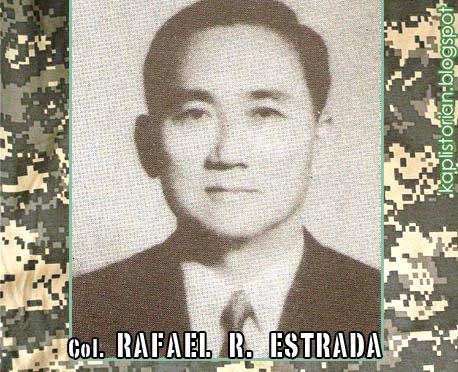
The distinguished Col. Rafael Reynaldo Estrada was born in Concepcion, Tarlac,  (b. October 1918) the son of Dr. Salvador Q. Estrada and Demetria Reynaldo. Highlights of his military service include his membership in the 2nd Regular Division USAFFE, and was also involved in the defense of Luzon and the Battle of Bataan (1941-42). With rations lacking and ammunitions almost gone, their commanding officer, Gen. Edward King surrendered to the Japanese on 9 April 1942. Estrada became a POW (prisoner of war) and joined the notorious 100 km. Death March to Camp O’Donnel in Tarlac. Luckily for him, he survived the march and imprisonment. After the war he was appointed Director of the Philippine Veterans Board by President Magsaysay and became Commissioner of the Veterans Claims Commission. He also became the Founder and National Commander Emeritus of Defenders of Bataan and Corregidor, Inc. (DBC). To show his commitment to help war vets, Col. Estrada developed the Blue Ridge Subdivision in Quezon City exclusively for WWII veterans. Col. Estrada counts poet Nina Estrada-Puyat and  former Sen. Eva Estrada-Kalaw as half-sisters. The respected WWII veteran died at age 98 on Oct. 2016.


 Brig. Gen. RAFAEL D. GOSECO
The late Brig. Gen Rafael D. Goseco (ret.), was a homegrown boy  from Sto. Niño,  Guagua, a graduate of the esteemed Guagua National College, founded in 1918. He would later serve the same school as its President. His wife, Dr. Petronila S. Goseco, was also a dean at the college. In May 1999, the generous general gave a deed of donation to the Court, giving some 5,000 sq. m. of land, that were part of the family’s 20-hectare property in Brgy. San Matias, Guagua,. The land was offered as site for the proposed Hall of Justice and other buildings that the Court may be minded to construct. According to General Goseco, his family will find fulfillment in knowing that it had done something for the government. Gen. Goseco passed away in February 2015. His son Ronald, a graduate of UP and the PMA, assumedthe presidency of Guagua National College.


Cmdre. JOSE G. LANSANGAN JR.
Commodore Jose G.Lansangan, from Sta. Ana, was a multi-facteted military man who was also a businessman, a college head, and author. He finished a degree in Marine Transportation, a Master in Business and Government Administration and in National Security Administration at the Royal Naval Staff College in Greenwich, London. His military career included being serving as Chief of Naval Staff of the Philippine navy (1876-78) and Commander of the Cavite Naval Base (1978-1982). Eventually, he would assume the presidency of the National Defense College of the Philippines (1982 -88). Together with his partners, he put up a government, business and industry consultancy firm (Martillano, Lansangan, Domingo & Associates, Inc.), headed the FRIENDS Foundation, and served as president of the Makati Mabuhay Lions Club as president. In March 2017, Cmdre. Lansangan wrote his memoirs,  “The 21st Century Legacy Letters Volume 1: 17 Legacy Lessons”.


Rear Adm. ARMANDO Q. MADAMBA
From San Juan, San Fernando, Armando Quizon Madamba (b. 3 Nov. 1938) was a product of Pampanga High School, class 1954. From there, he went to the state university (U.P.) to study engineering, but moved to the PMA after qualifying for the exams. At the academy, he gain renown for his brilliance in military planning and strategy. The 1962 graduate joined the Philippine Navy as ensign. He performed so well that his studies were sponsored at the Fletcher School of Law and Diplomacy at Tufts University in Boston, Massachusetts. There, he earned his M.A. in International Affairs (1970) and M.A. in Law and Diplomacy  (1971).  He was assigned to Iran as Attache at the Philippine embassy for 5 years (1975-80). Towards the decade’s end, he attended the Naval Command College course for Senior International Officers at the US Naval War College in Newport, Rhode Island. As Deputy Chief of Staff, he pushed for the complete  modernization of AFP. He retired as a Vice Admiral, but Pres. Fidel V. Ramos named him Ambassador to the Asian Pacific Economic Cooperation  in 1996. He engaged in consultancy work after his diplomatic stint. His impressive career has earned him the Distinguished Conduct Star, the Distinguished Service Star, the Philippine Legion of Honor,  Navy Distinguished Cross, the 1991 Cavalier Award of the Philippine Military Academy and Outstanding Kapampangan Award for Military Service in 1993.


Gen. RAFAEL M. MANIAGO
The future general, Rafael Manarang Maniago (b. 7 Nov. 1936)  comes from Parian, Mexico. He is said to be a descendant of the brave 17th century hero, Francisco Maniago, who led a revolt against Spain. He graduated from the Philippine Military Academy in 1962 and joined the Philippine Army. He served as regional military commander in different military zones and installations in the Philippines. As a colonel, Maniago was named Commanding Officer of the  403rd Infantry Brigade, 4th Infantry Division of the Philippine Army from 1988-89. It is known officially as the Peacemaker Brigade which specializes in anti-guerrilla warfare. From 1990-91, the colonel served as the Commander of the 502nd Infantry (Liberator) Brigade. Gen. Maniago passed away on 1 January 2004.

Col. SAMUEL S. QUIWA
Before his death from pneumonia on 12  February 2011, Col. Samuel Quiwa (b. 3 Feb. 1917) was considered as the last surviving World War II hero of San Fernando, having outlived 16 other comrades. Quiwa , a USAFFE (U.S. Armed Forces in the Far East) soldier, was a participant in the battles of Bataan and Corregidor in 1942.  He was able to escape the 3-day Death March that started in Mariveles, Bataan, but slipped back to war-ravaged Corregidor, only to surrender to the Japanese. For 20 days, he became a POW, along with other American military men, until they were transferred to Manila. After his release, he went underground in Nueva Ecija and Pangasinan as a guerrilla fighter. When the country was liberated, he returned to active service and was assigned to the 103rd Military Police Command, now the Northern Luzon Command of the AFP. He retired in 1969. For his gallantry, he was awarded the Philippine Defense Ribbon, American Defense Ribbon, WWII Victory Medal and Ribbon, Philippine Liberation Medal, among others. Before his death, he managed to receive financial reward from the U.S. government.


1st Lt. RUBEN P. SONGCO

Capt. Ruben Paras Songco (b. 5 Sep. 1921/ d. 5 Dec. 1944), was a native son of Guagua. A graduate of the prestigious U.S. Naval Academy, Annapolis,Maryland, in 1943, he excelled in football, tennis, lacrosse and boxing. He was graduated a year early due to the War. During the War, he was a member of the 1st Reconnaissance Battalion missions that left for Australia in Oct. 1943, with Gen. MacArthur attending their send-off. He was with Maj. Lawrence Phillips, Capt.  Galang, 4 radio operators and 2 reconnaisance men when they landed in Mindoro, only to be tracked and captured by the Japanese with the help of a Filipino informer. 1st Lt. Ruben Songco was one of those killed; only 3 survived. The other sad thing about his shortlived military career  was that, because of his Filipino nationality, he was  denied a commission in the U.S. Navy.

SOURCES:
Patricio Buyson: Pampanga High School, Golden 50th Anniversary Yearbook,
Photo courtesy of the Philippine Army Official Website
Pedro Deang: Picture and information courtesy of First Consul Elmer Cato.
Rafael Goseco: GNC Batch of 2005 FB page
Samuel Quiwa: “ LAST WW II WAR HERO IN SAN FERNANDO DIES”by Charlene Quiwa.